It was a much needed day of (mostly) fresh air after the 24 hours it took to get here to Hanoi. The city is bustling – 10m people, a maze of motor-scooters, mopeds, and cars, tons of store-fronts, a mix of old French-style architecture, more modern high-rises, and some decaying buildings that went up not long after the Vietnam War ended. That conflict here is called the “American War,” similar in naming to the “French War” and “Chinese War” that preceded it and the “Khmer Rouge” war that came after. I’ll write more about the Vietnam War another time, but to paraphrase what I chatted about today with several people, it’s always good to get the other side’s perspective and hear their stories.
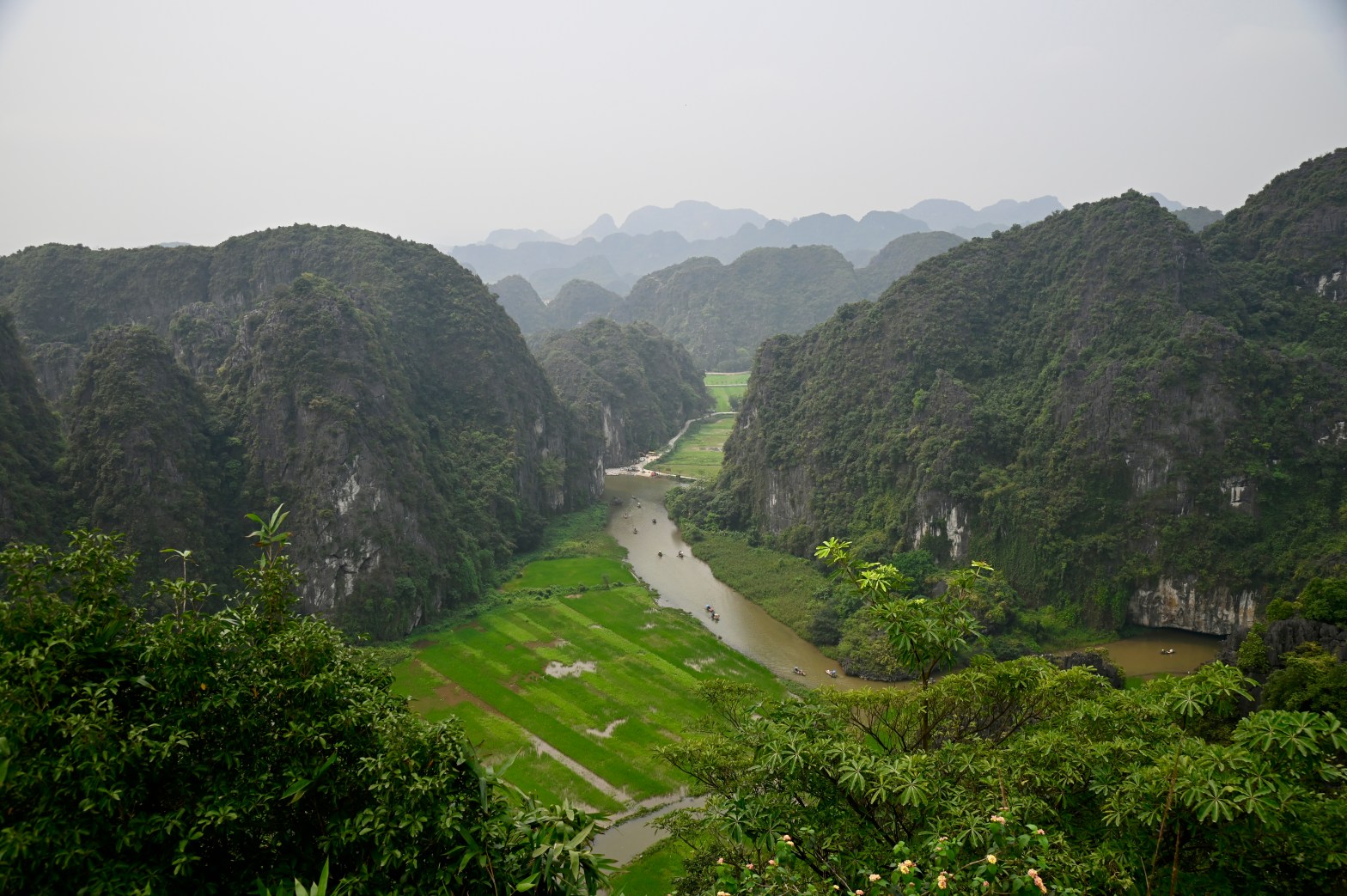
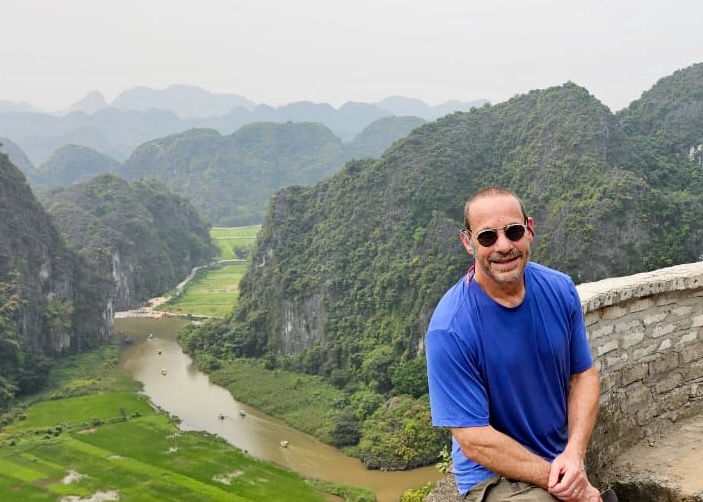
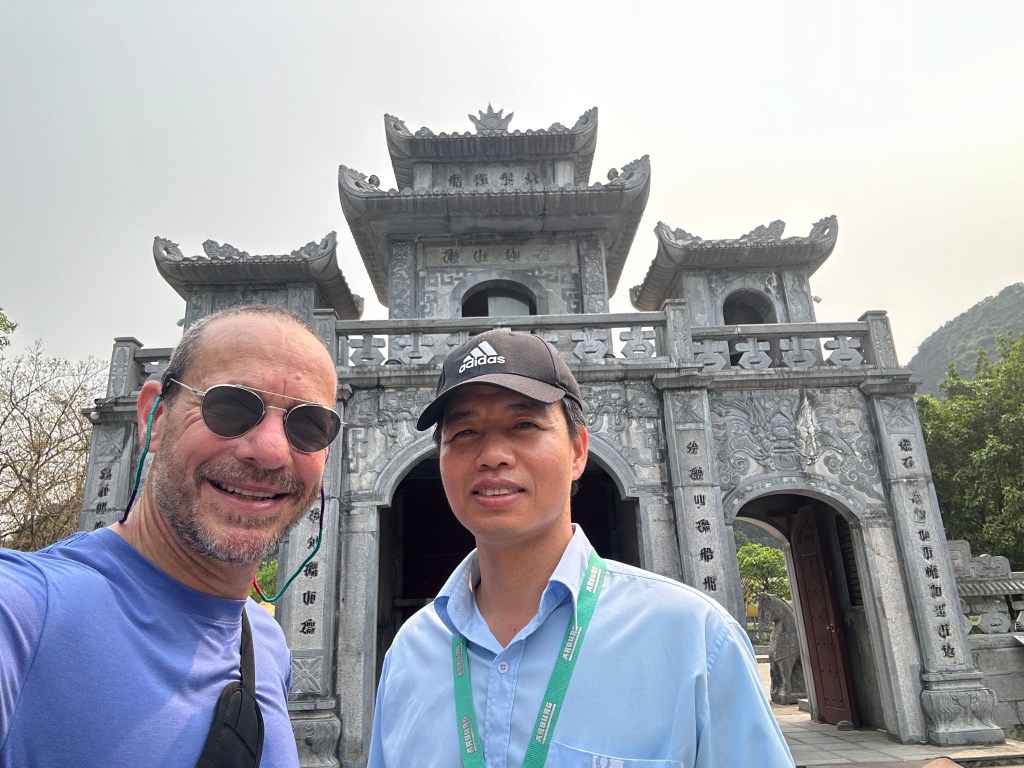
But I digress – I needed to first get out of the city and into the country, so I headed out with a guide to the area known as Ninh Binh (it is both a province and a city), about a 2-hour drive southeast the city, situated in the Red River Delta, and a UNESCO World Heritage Site. It is probably most well known for the huge limestone jungle-covered mountains (called “karsts”) that rise like towers over the rice fields above the (now-enclosed) river that was used as one of the locations where the movie “Kong: Skull Island” was filmed. But more importantly, Ninh Binh was an ancient capital, in the 10th and 11th centuries, offering protection from the Chinese mongols who tried multiple times to invade Vietnam.
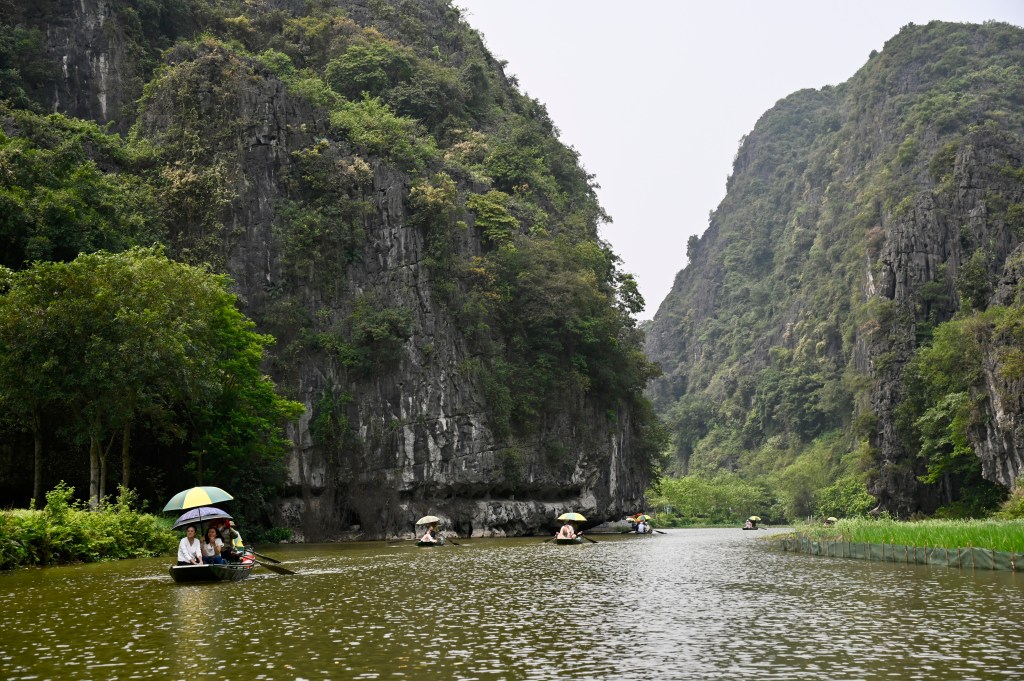
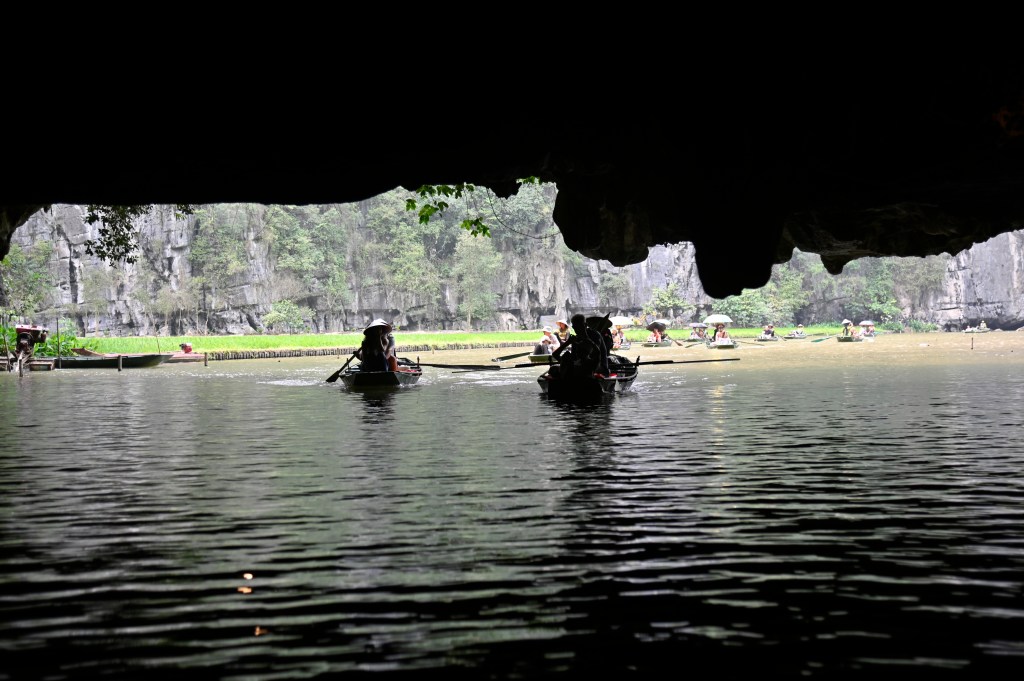
My early afternoon was spent on a riverboat cruise along the river in Tam Coc, where it was just me, my guide, and the boat’s rower – a local woman working two oars, mostly with her feet, as was done by the vast majority of other boat drivers. It was a quiet, tranquil ride past the rice fields, looking at the mountains, and keeping an eye out for mountain goats (which are used for many of the traditional local dishes), storks, and snails who lay their eggs along the edge of the rice fields.
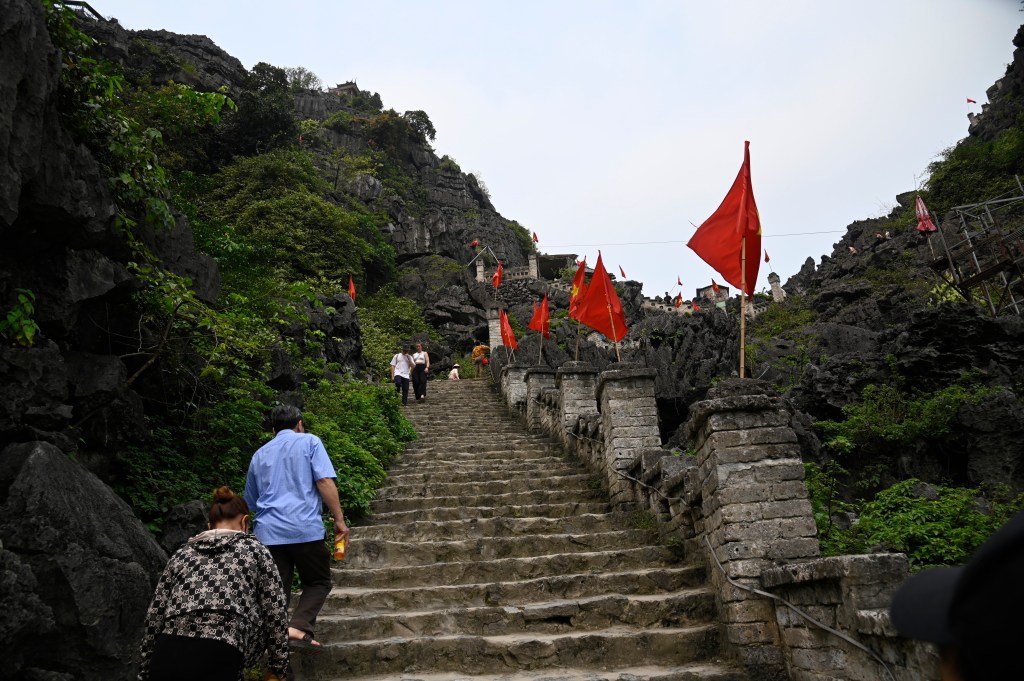
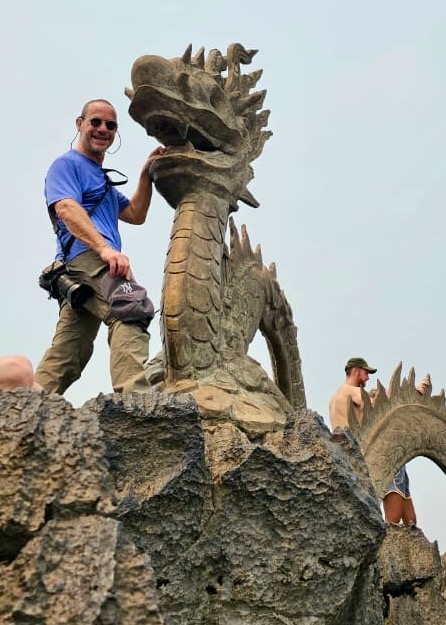
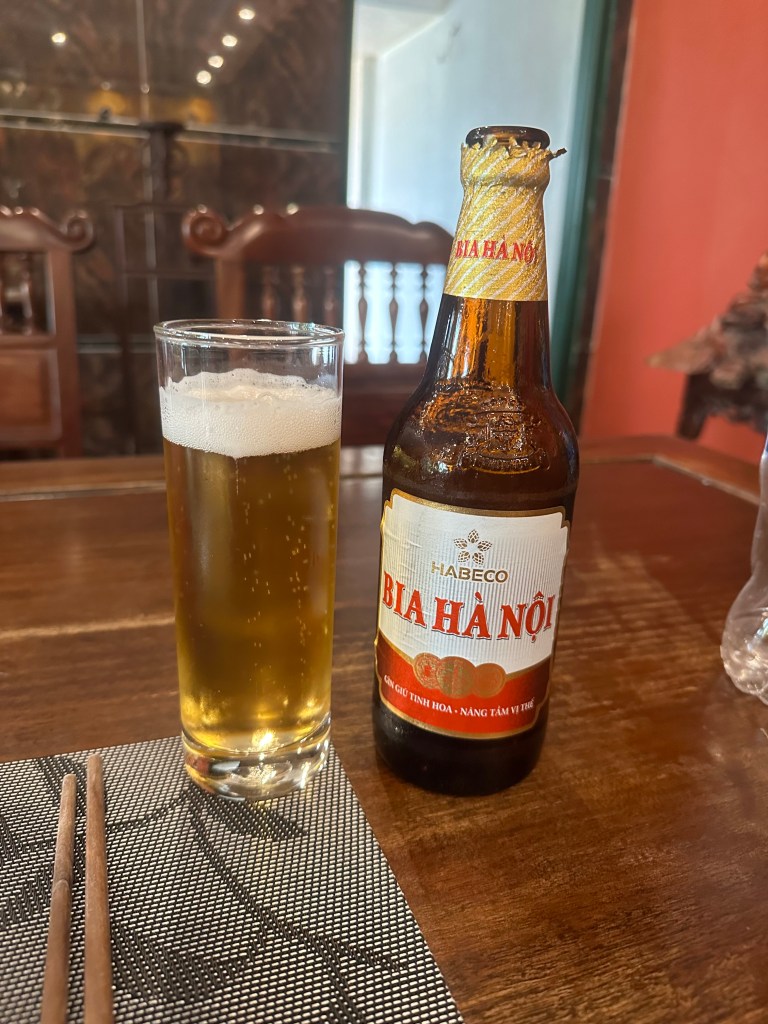
That was much needed after a morning spent climbing the 500 (!) uneven steps – in 90 degree heat with high humidity – to the top of Hang Mua, giving a spectacular view of the valleys below. I was a sweaty mess by the time I got to the top – which was worth it – and even moreso when I made it back down. That meant I got to reward myself with my first local beer of the trip along with a seven-course meal of local specialties (but with insufficient chili heat to my taste).
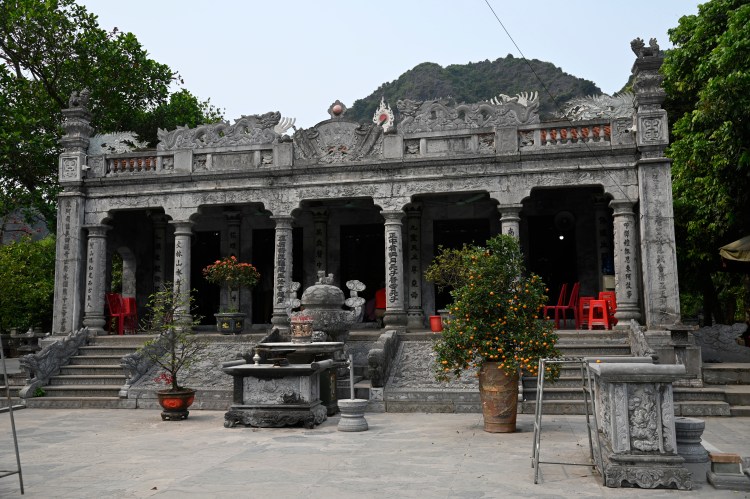
And, for a bit of local religion and history, we stopped by the Thai Vi Temple, dedicated to King Tran Thai Tong, his wife, and son; he was first the general that defeated the Chinese invaders, then left everything to his son so he could become a monk. While it is not the most beautiful of the temples in the area, it was explained to me that it was the most historical and religiously significant.
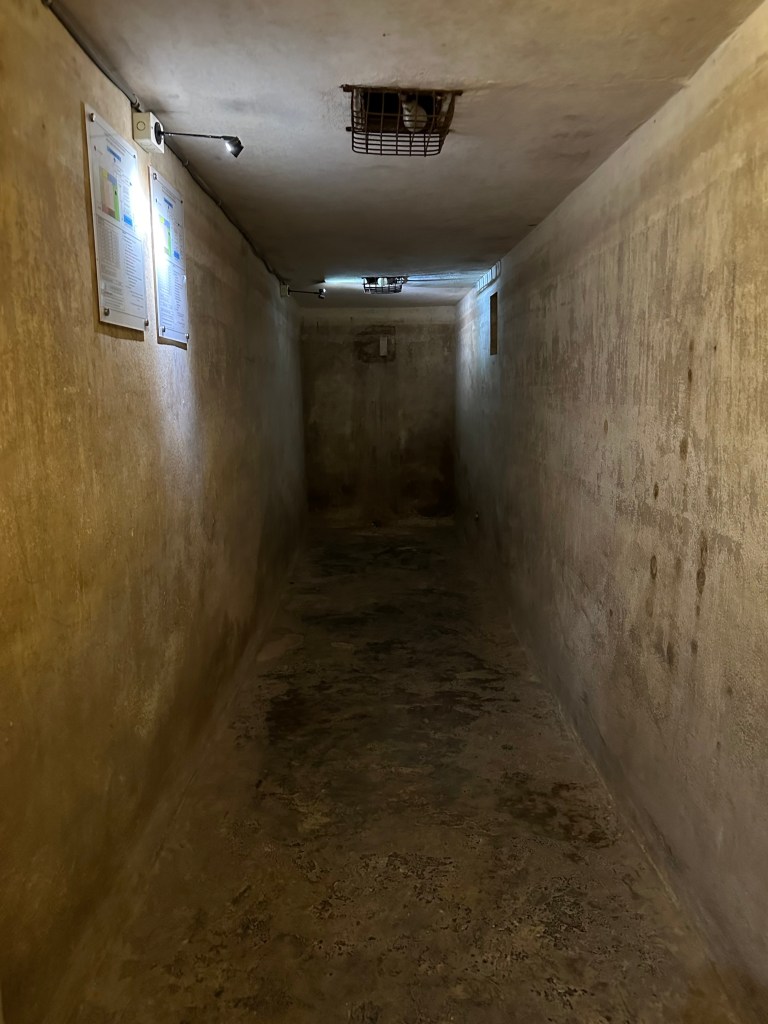
All that outdoor activity was a great relief, and it was followed by a brief lecture and tour at our hotel, giving its history – built in 1901-02, and a hotel ever since, though impacted by the bombing of the city toward the end of the war, and the site of visits by Jane Fonda, Joan Baez, Graham Greene, and many others. And – in 2011 – it was discovered that a bomb shelter lay underneath the hotel’s (now) swimming pool, having been built during the war for hotel guests, staff, local embassy staff (though not the Chinese or Russian embassies, as they had their own bunkers), and other important locals.
Dinner at a local restaurant with two folks I traveled with in Israel and Jordan was a good way to catch-up and share tales of our days as we anticipate our Hanoi city tour and a bit more Vietnam War history.
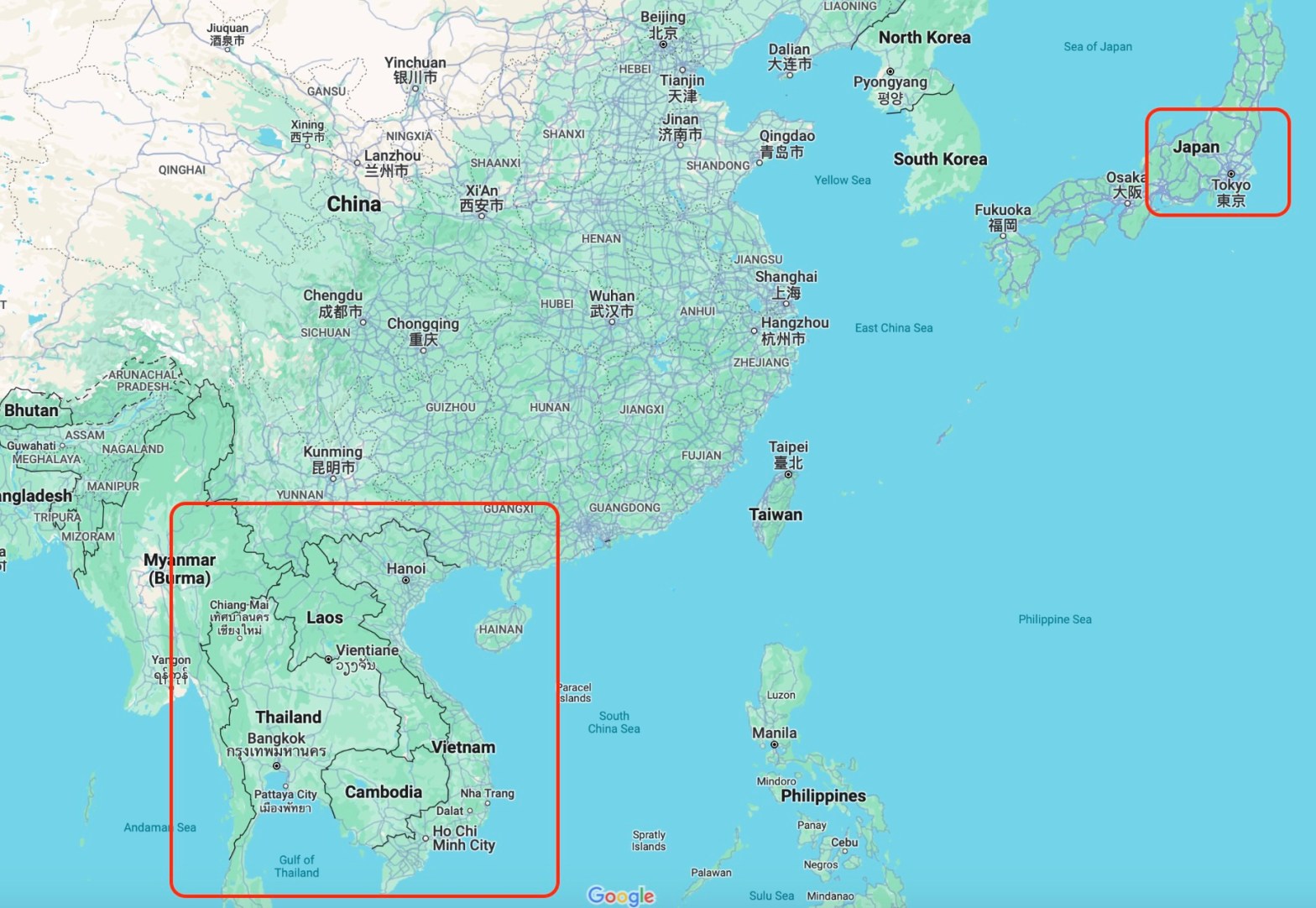
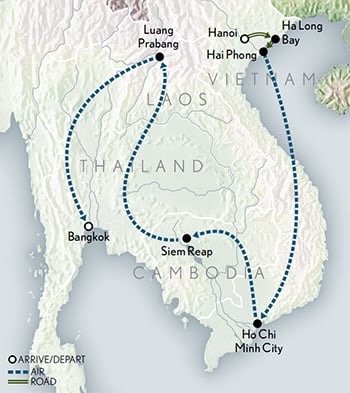
It’s been since last August since I traveled to a far-flung spot, so I couldn’t be more excited about where I’m headed – Vietnam, Cambodia, Laos, and Tokyo.
My original gameplan was to only head to the first three countries (collectively named Indochina during the French colonial period) with a last 2 days in Bangkok, Thailand, where I’d been last year, but I realized, when investigating air-routes that I’d likely have to go through Tokyo. Japan’s always intrigued me (my dad was stationed there during the US Occupation following World War II), and not knowing when or if I’d get there for an extended visit, considering everything that’s on my list, I decided to cut my Bangkok visit to one day and spend a few full days in Tokyo before returning home.
In preparation for the trip, I took quite a bit of time to learn about the history of Vietnam, Cambodia, Laos, and the rest of Southeast Asia, and also did a bunch of research on how best to spend my time in Tokyo. My familiarity with Indochina was probably limited in a way that is similar to a lot of folks around my age – we know about the Vietnam War and not much more. I of course knew this wasn’t the whole story and finally had a good reason to catch-up. I found a pretty detailed podcast on “A history of the lands between India, China and Australia” – the History of Southeast Asia. It’s over 130 episodes (and counting), and there’s absolutely no way I’ve retained a lot of detail from what I’ve listened to, but more than anything it has given me a deep appreciation for the rich history of the lands, the peoples, and the culture.
Armed with a bit more knowledge than previously, I’m ready to visit.
Emotionally recovering from the remarkable experience at the Mount Hagen Cultural Festival, the last evening, after we flew back to Port Moresby, was spent having a delicious group dinner – though with horrendously slow service – at a local restaurant named “Bacchus.” Yup – kind of a weird name, given our locale, made even weirder by the painting of a bacchanalian scene on the wall and the piped-in music that sounded like we were all waiting for massages at a spa.
That, though, was countered by how great it was to finally have a hot shower and catch a shave before dinner, and then the company, the conversation, the memories, the laughs, and a small birthday celebration for one of our co-travelers. To top it all off, her husband figured out how we could stream the FIFA Women’s World Cup final into our private dining room, which was super for the birthday girl since she’d be rooting for Spain over England.
On the morning of August 20th, it was one last breakfast in Papua New Guinea before the 3-hour flight back to Brisbane. On-board, the woman who had celebrated her birthday the day prior graciously shared some of her raspberry fondant birthday cake with me, her husband, and another co-traveler. Not to be too cute, but it was a sweet way to end the time in PNG. Upon arrival in Australia, two folks immediately caught flights back to the States, and the rest of us headed to our local hotel for a final dinner, as most everyone was leaving the next day.
That next day – my last day away – I had a full day to spend in or around Brisbane before catching my flight back home. Someone had mentioned that there was great whale-watching not far from where we were, so I tracked down the company and made it happen. It was about a 45-minute drive to the town of Redcliffe – where The Bee Gees grew-up after they moved from the UK to Australia.
It was a gorgeous sunny day, temps in the high 70’s with very scattered clouds. The cruise out of Moreton Bay was about 90 minutes to just past Moreton Island, which apparently has the tallest sand dunes in the world. The ocean side of the Island is the Coral Sea.
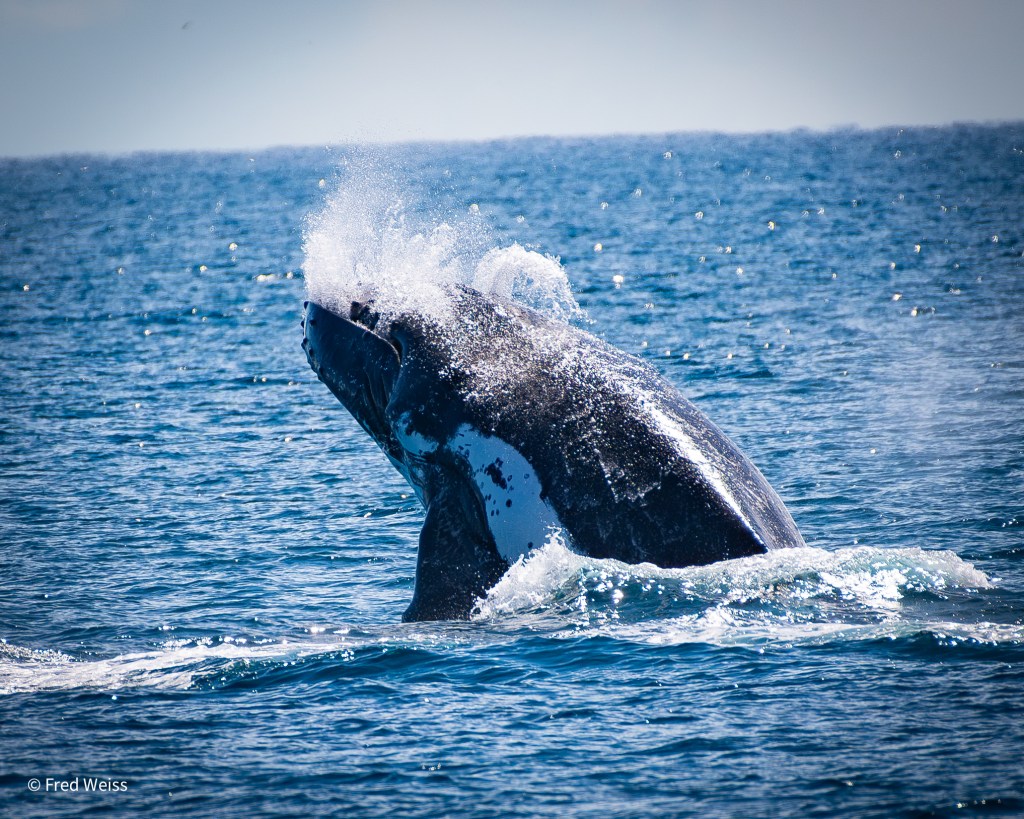
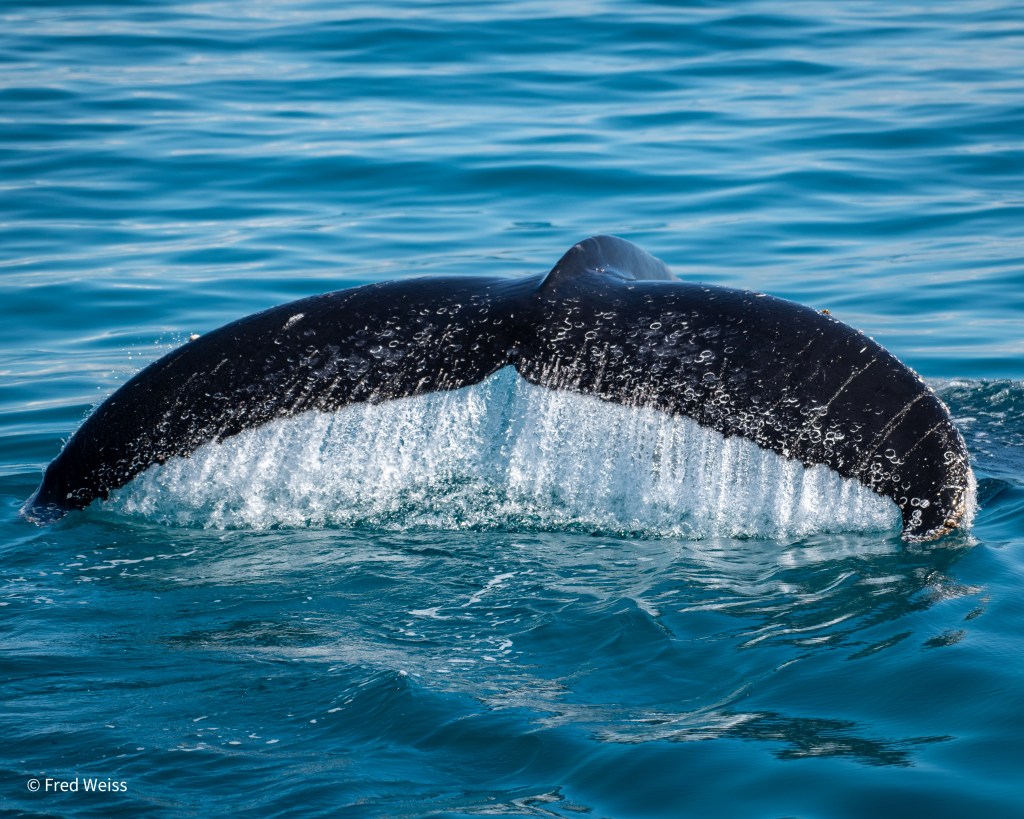
And apparently that is prime whale-watching territory. Once we arrived there, we had a spectacular two hours of humpback whales, with three or four pods appearing off all sides of our boat, one or two whales sometimes swimming right in front of the bow of the boat or swimming off the side of the boat. There was breaching in the distance, tail and fin slapping, and we also were treated to a group of eagle rays and two pods of dolphins as we cruised back into Redcliffe.
It was a helluva way to spend my last day before the 26 1/2 hour trip home that began that evening.
Papua New Guinea is an amazing place. The chance to get so close to cultures that are so ancient and so close to what they have been since white men first interacted with the local tribes is a remarkable experience, unlike all the experiences I’ve had before. If you choose to go, do it because you seek that cultural interaction – not for the hotels or for the service or for the food. Be off the grid for a few days. See the clothing and the dancing and the face-painting and the singing and learn the ways they spend their daily lives.
I continue to be amazed as to how lucky I am to do trips like these and incredibly grateful for being able to do so. We’ll see when and where I head off to next.
[Clicking on an image below will open a larger and full version in a new tab]
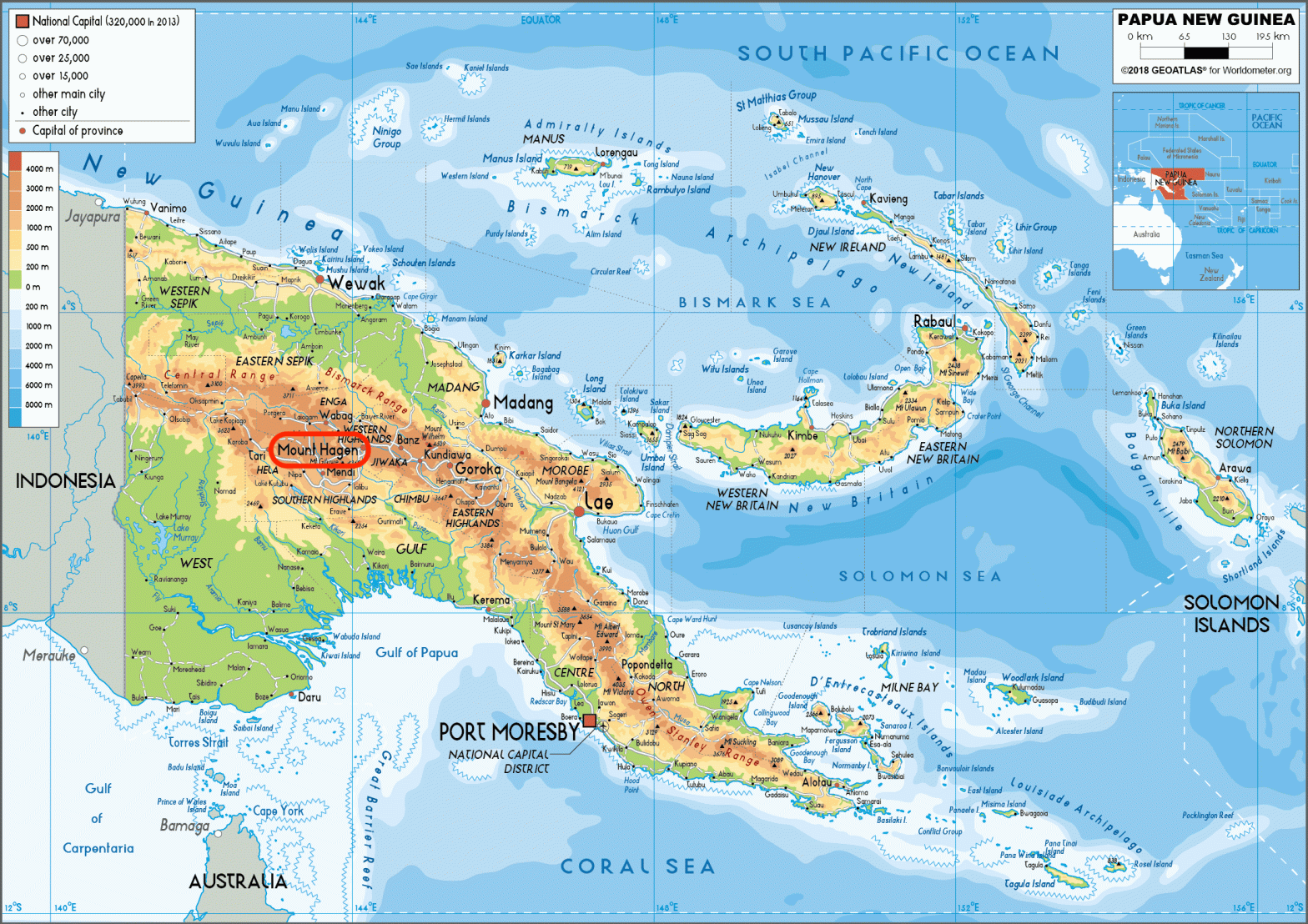
Back in the early 1960’s, a group of tribes from around the Western Highlands Province met in Mount Hagen. While it appears to be difficult to uncover the true history of this meeting, it seems that, originally, it was designed to help calm the animosities between and among various tribes.
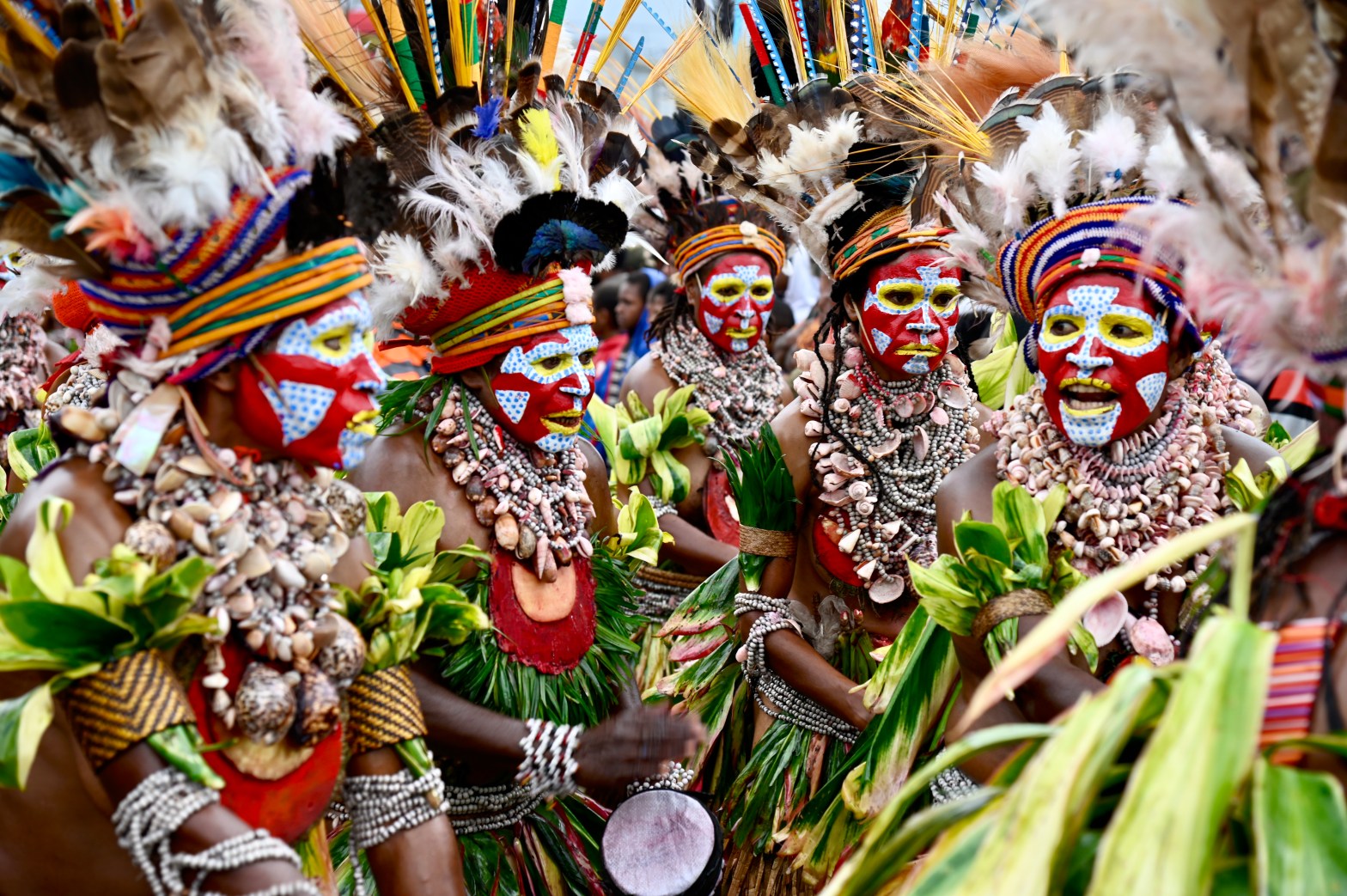
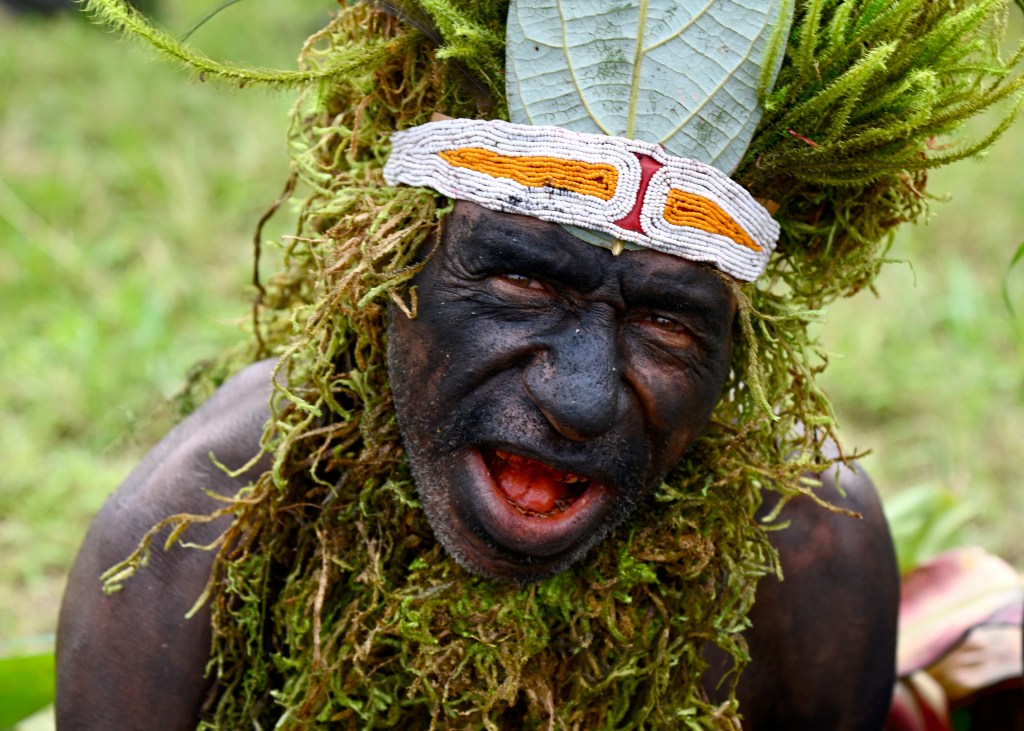
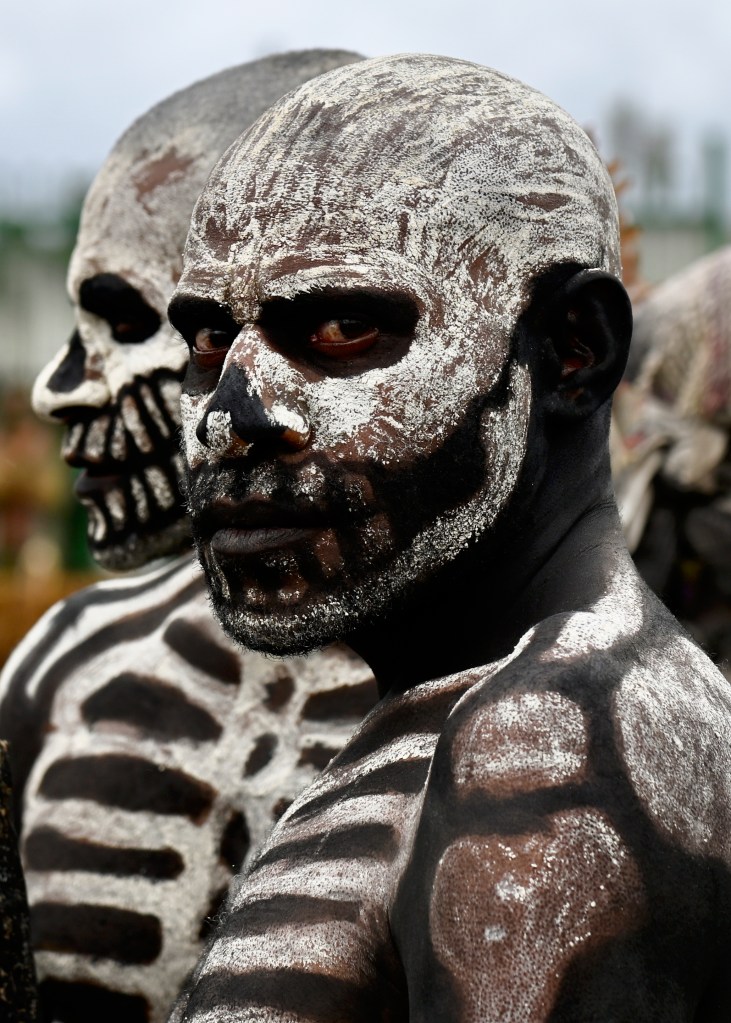
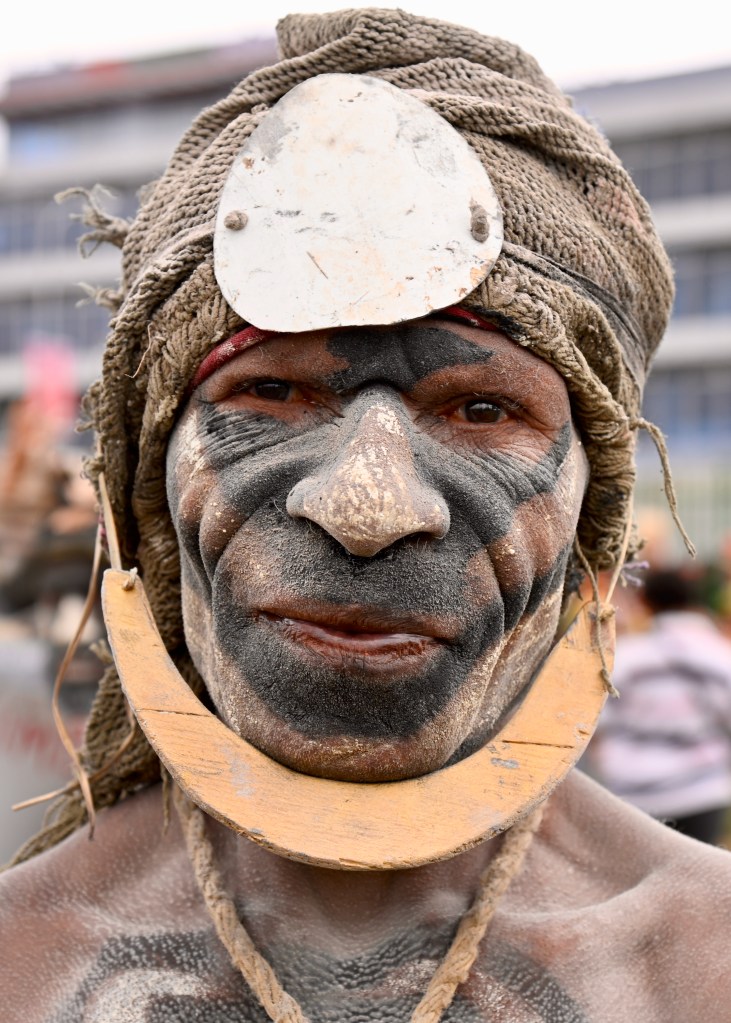
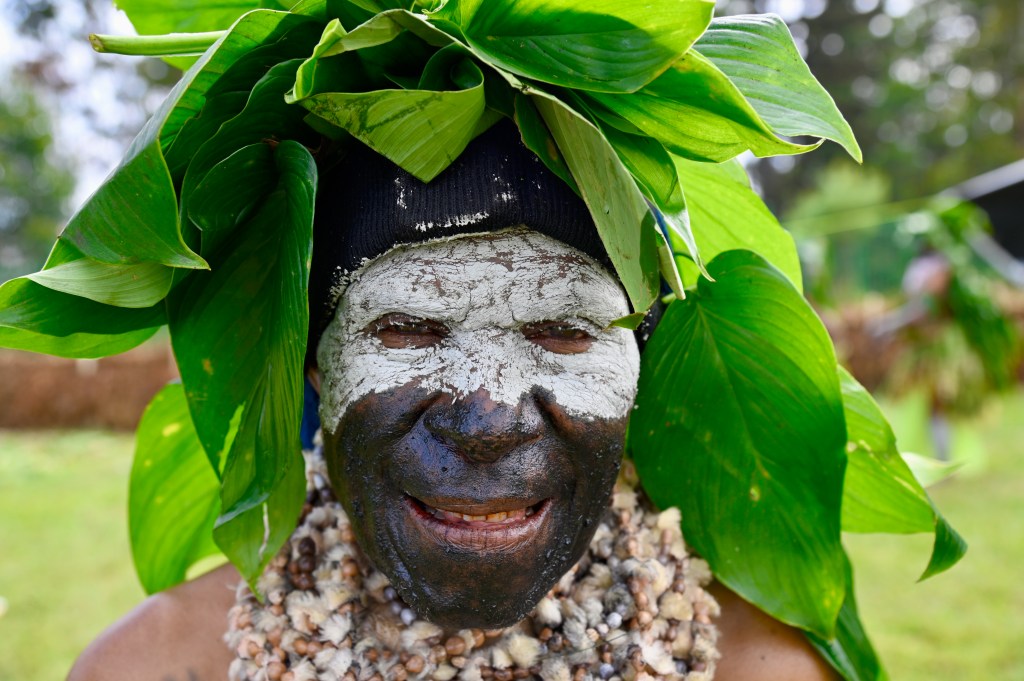
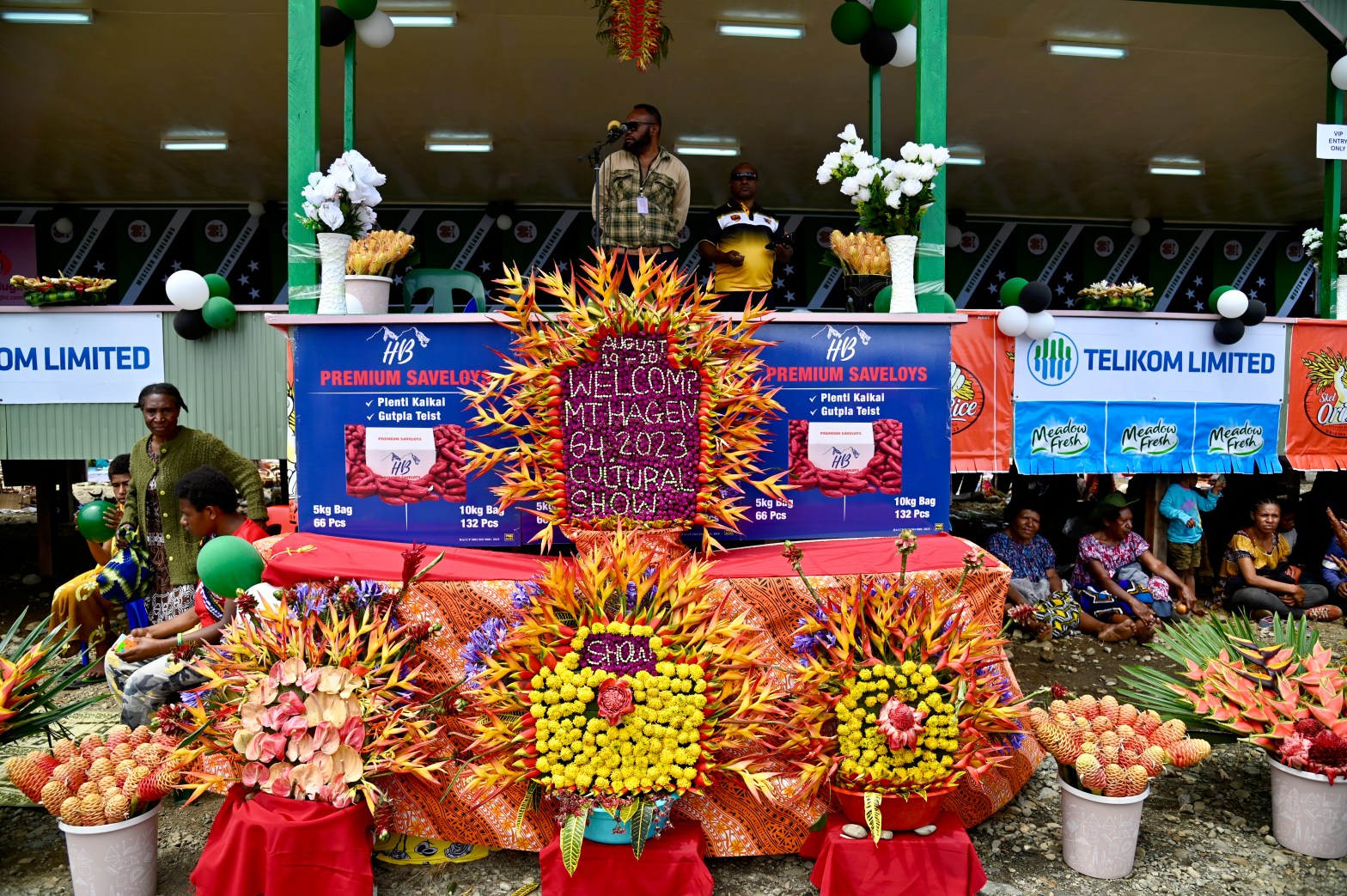
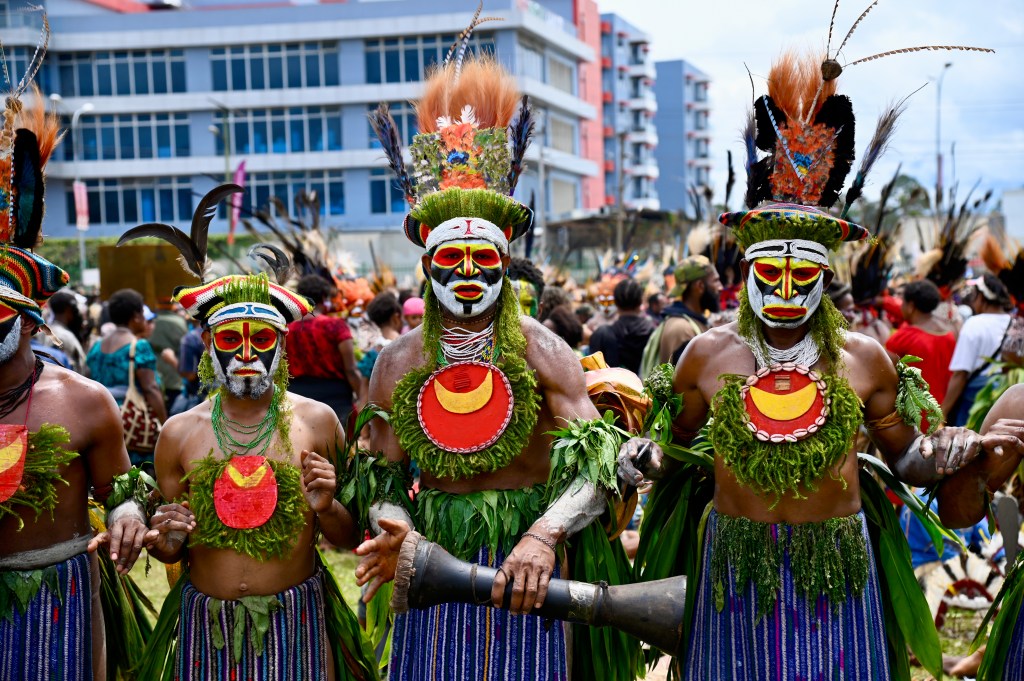
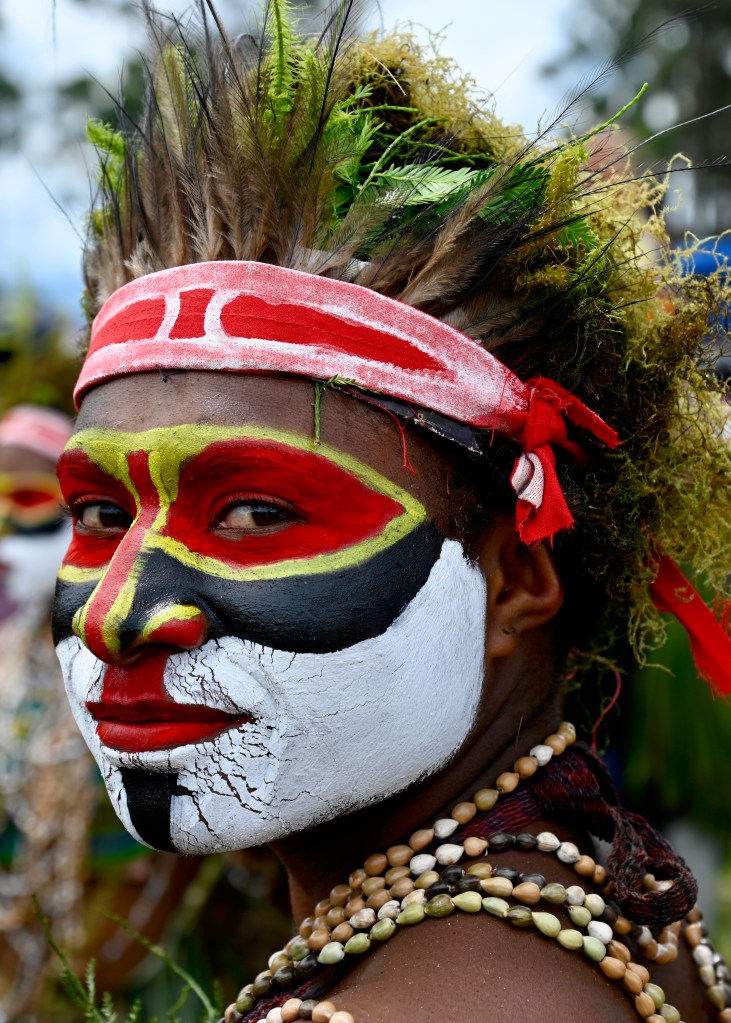
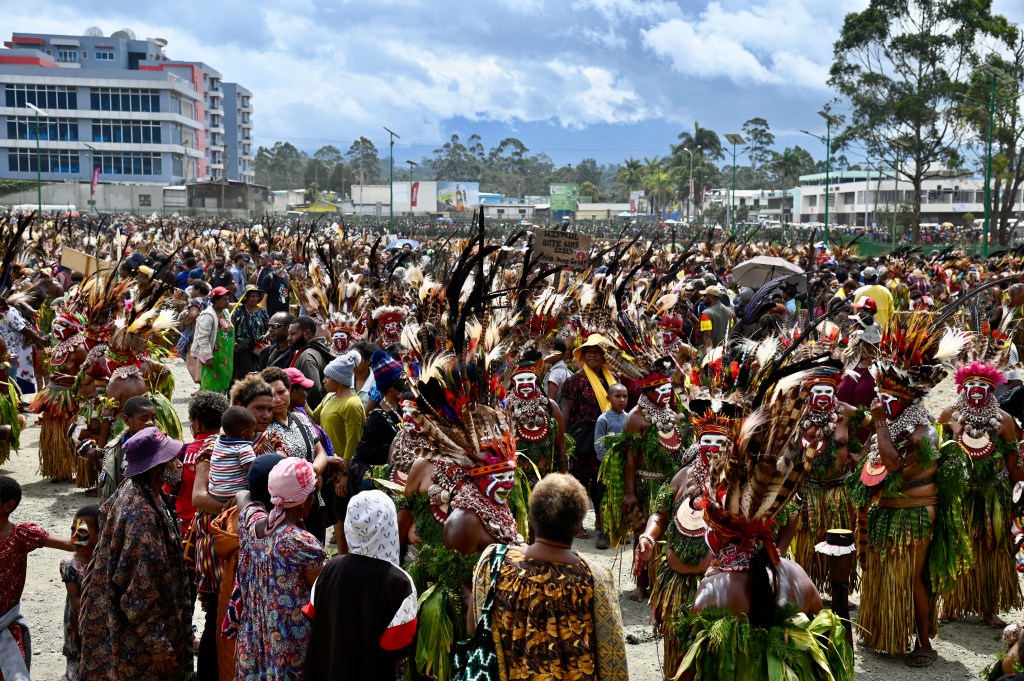
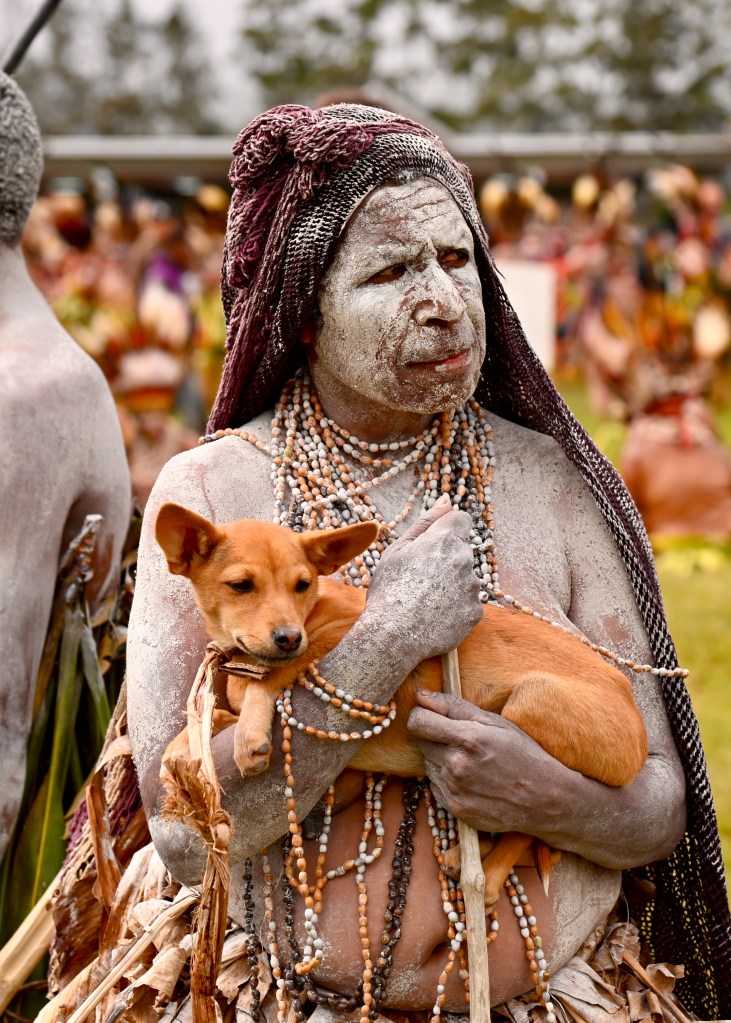
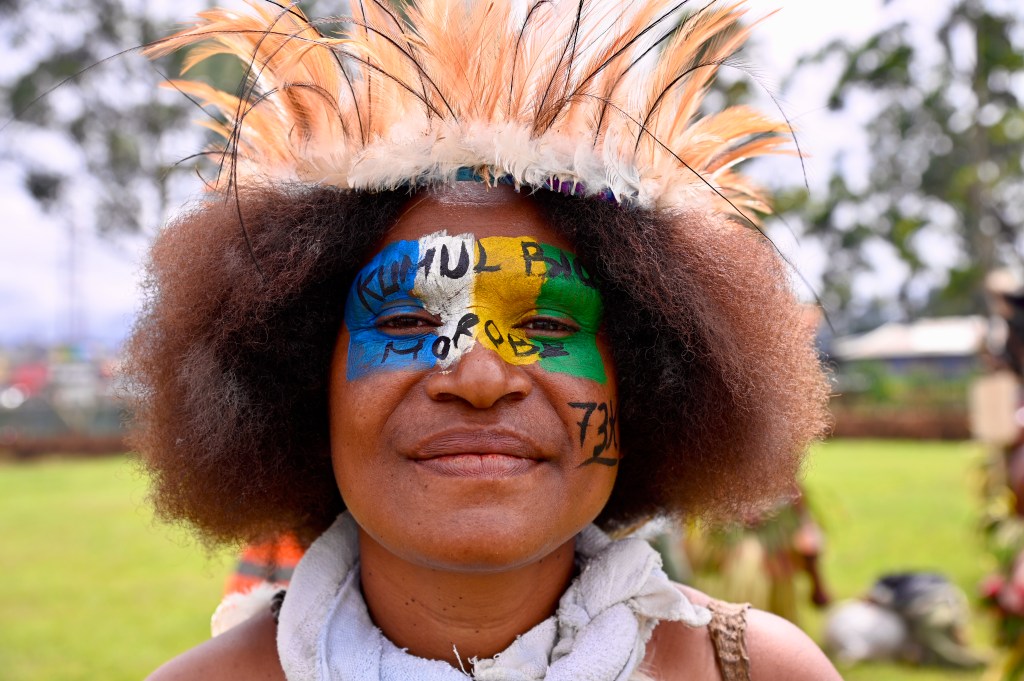
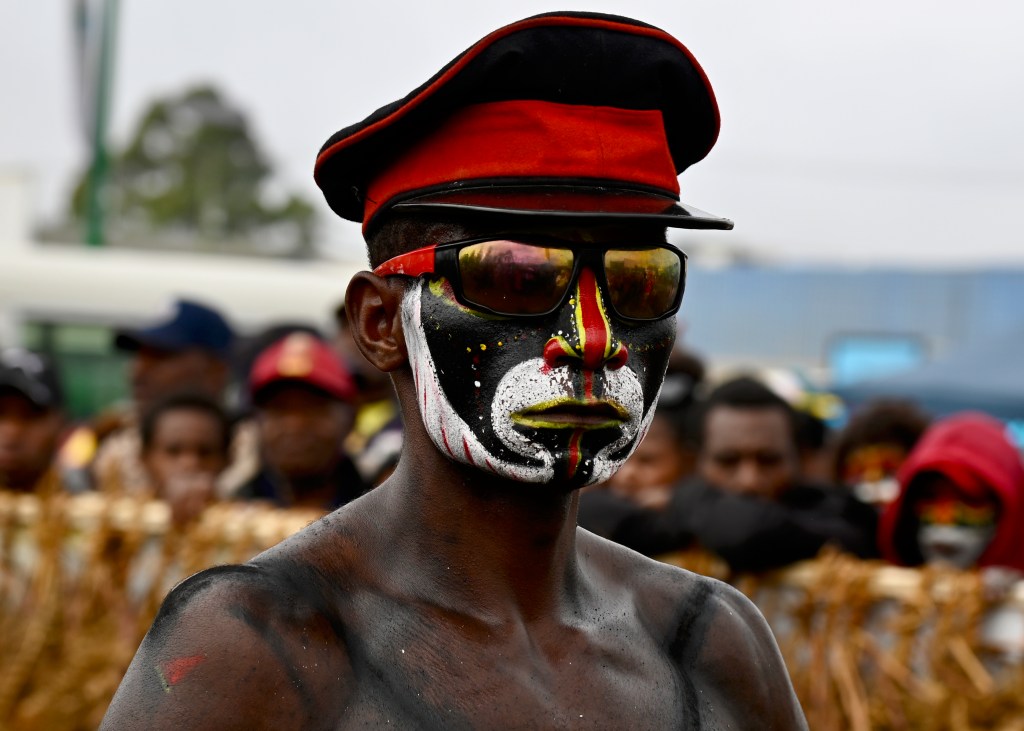
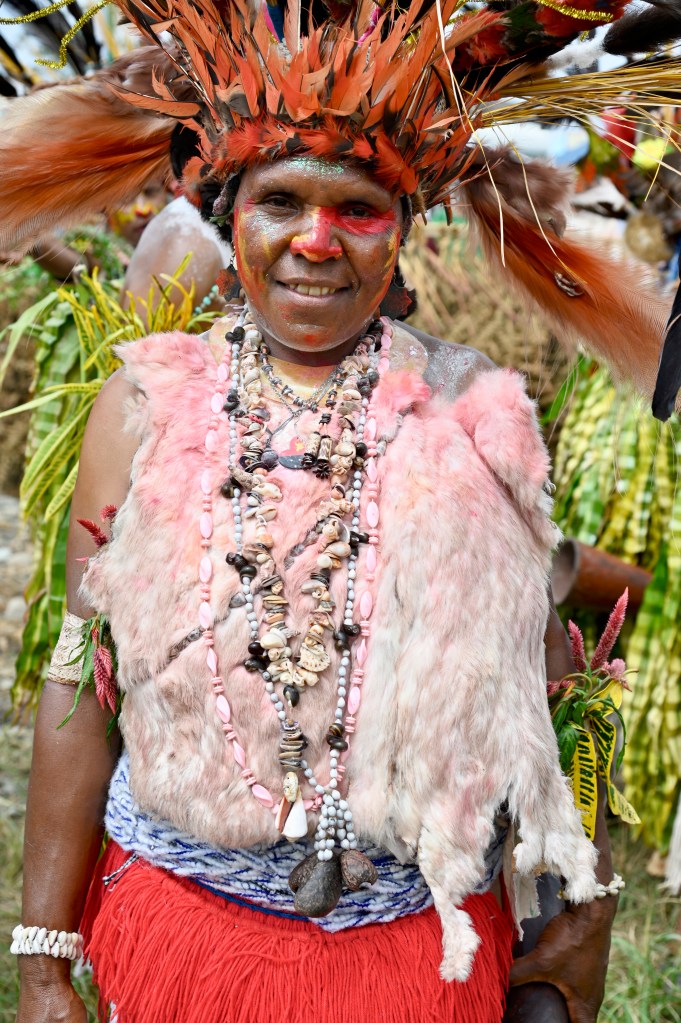
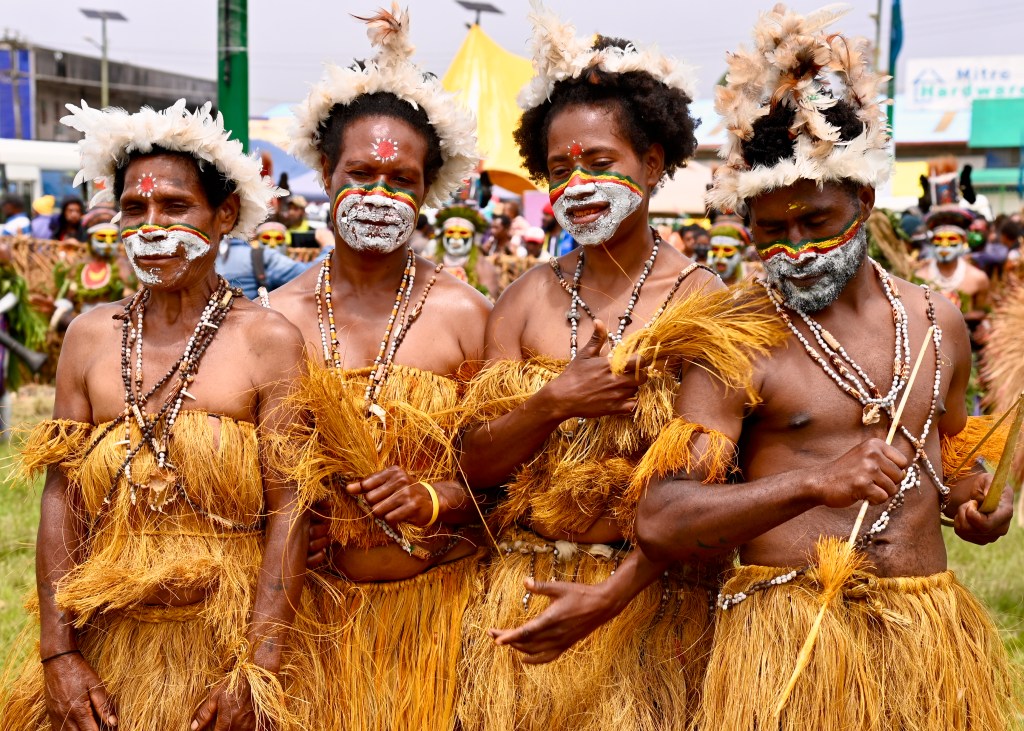
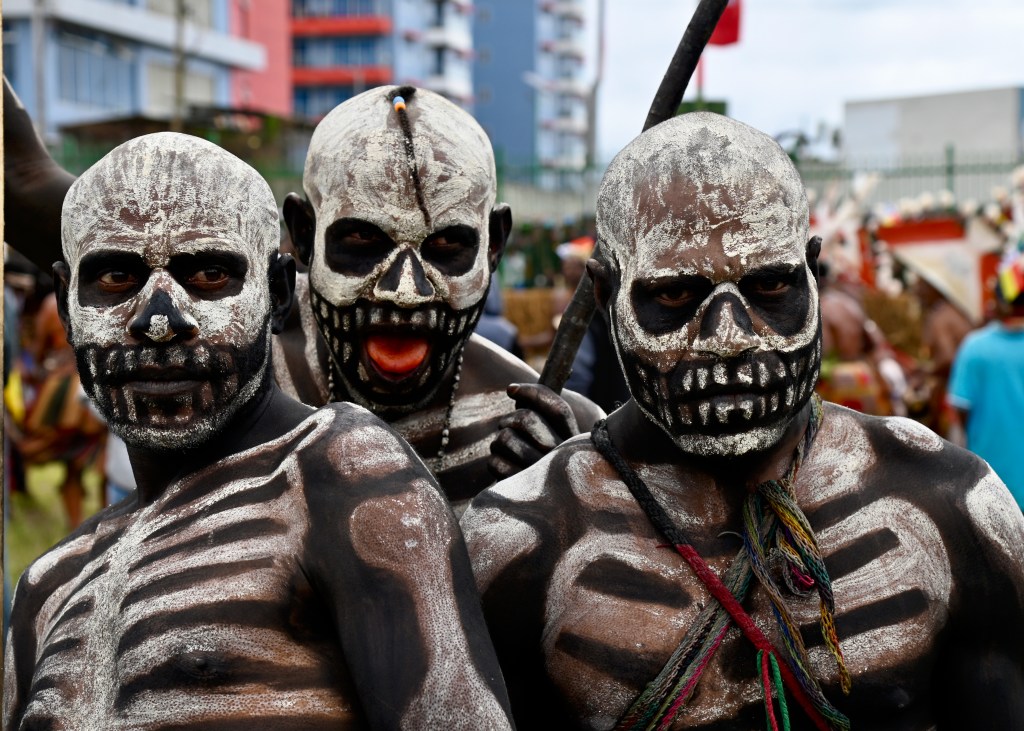
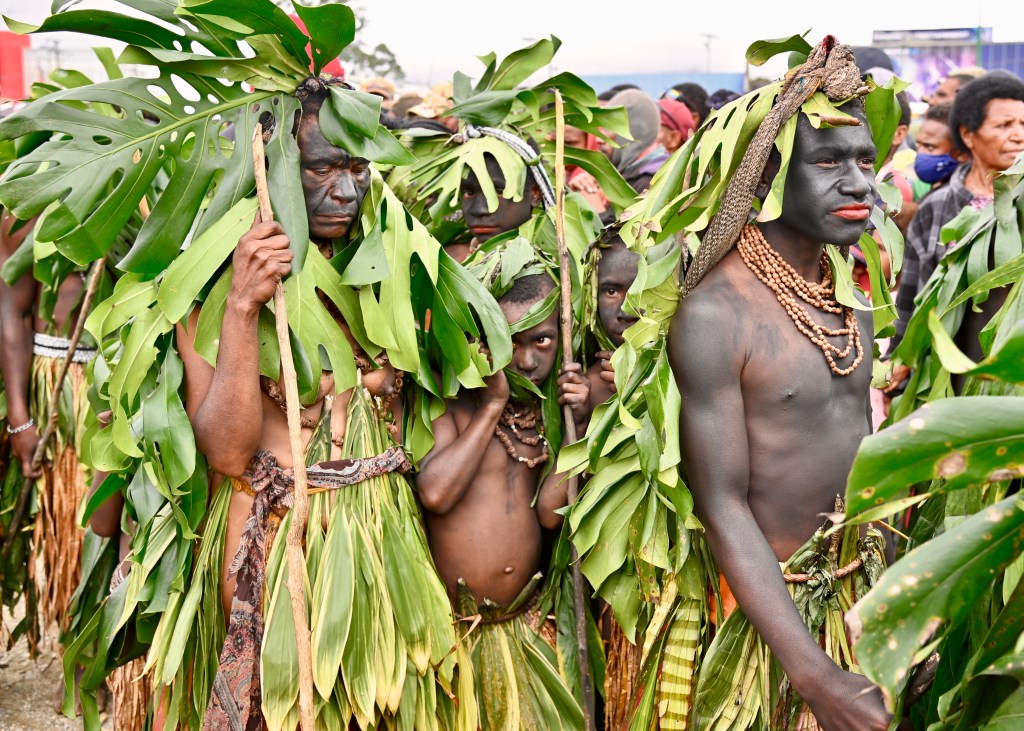
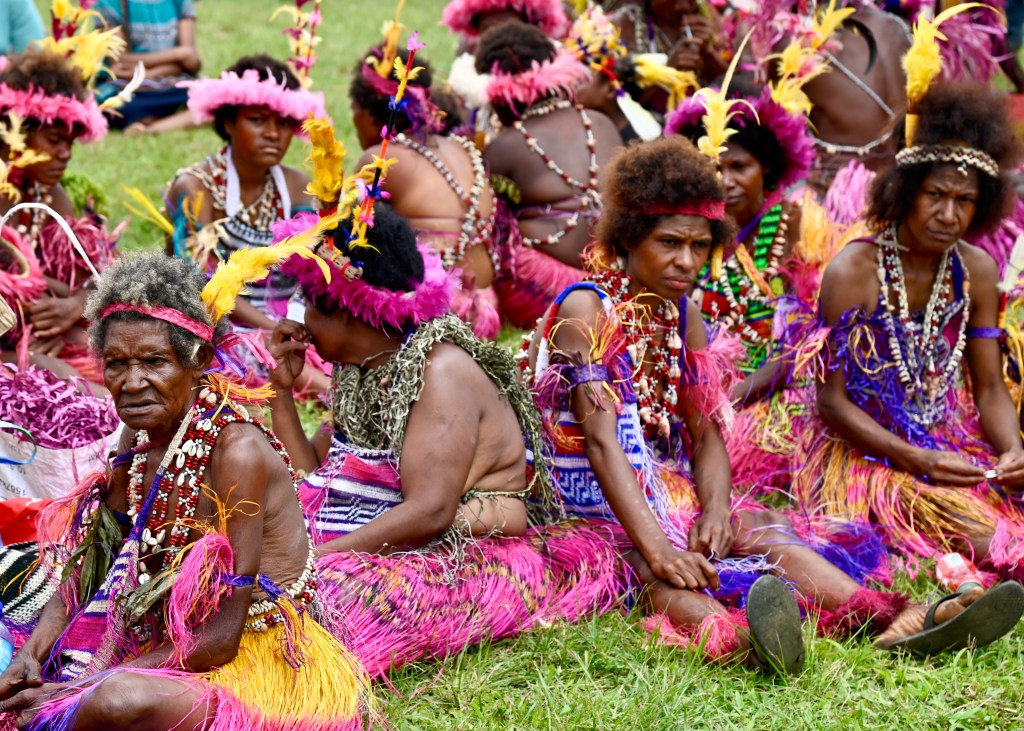
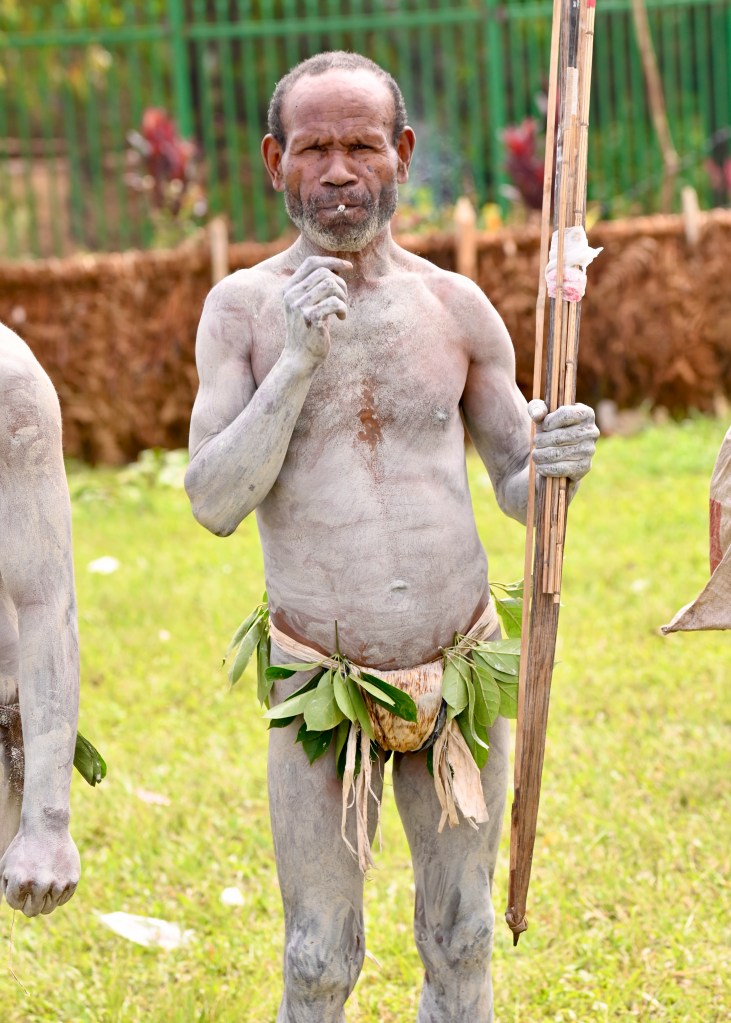
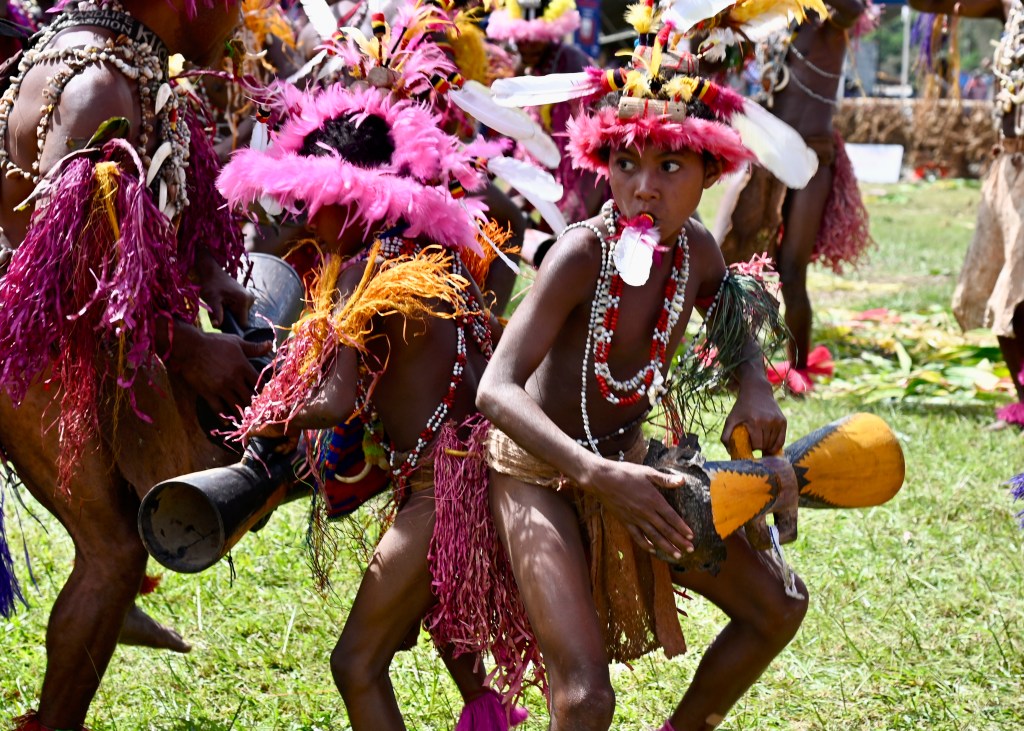
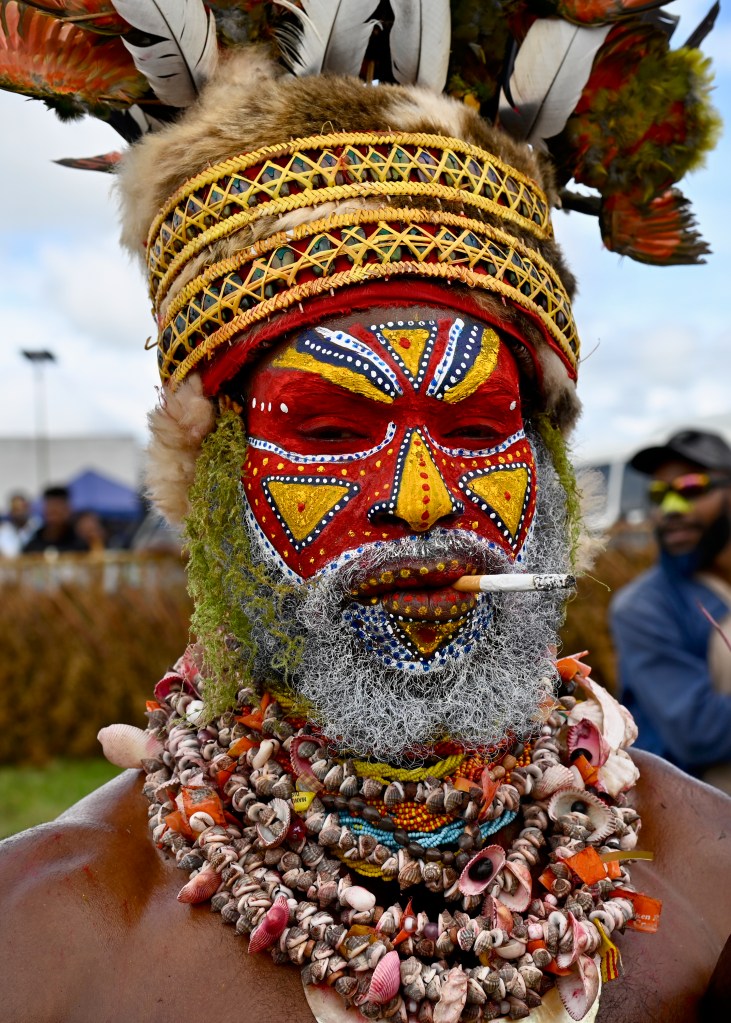
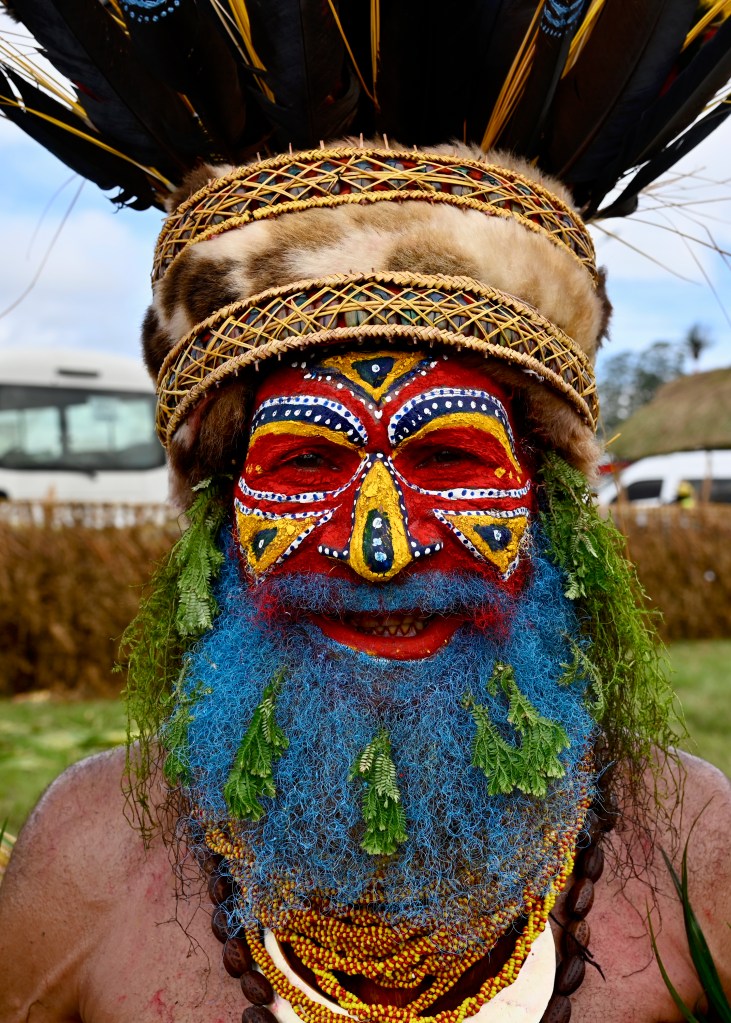
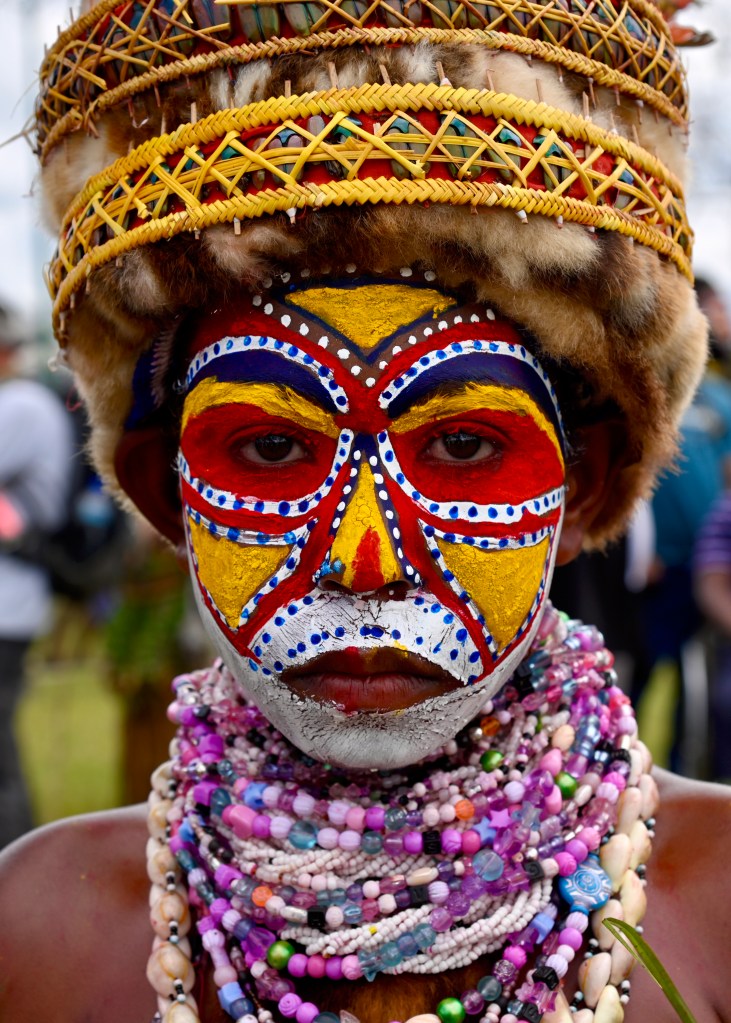
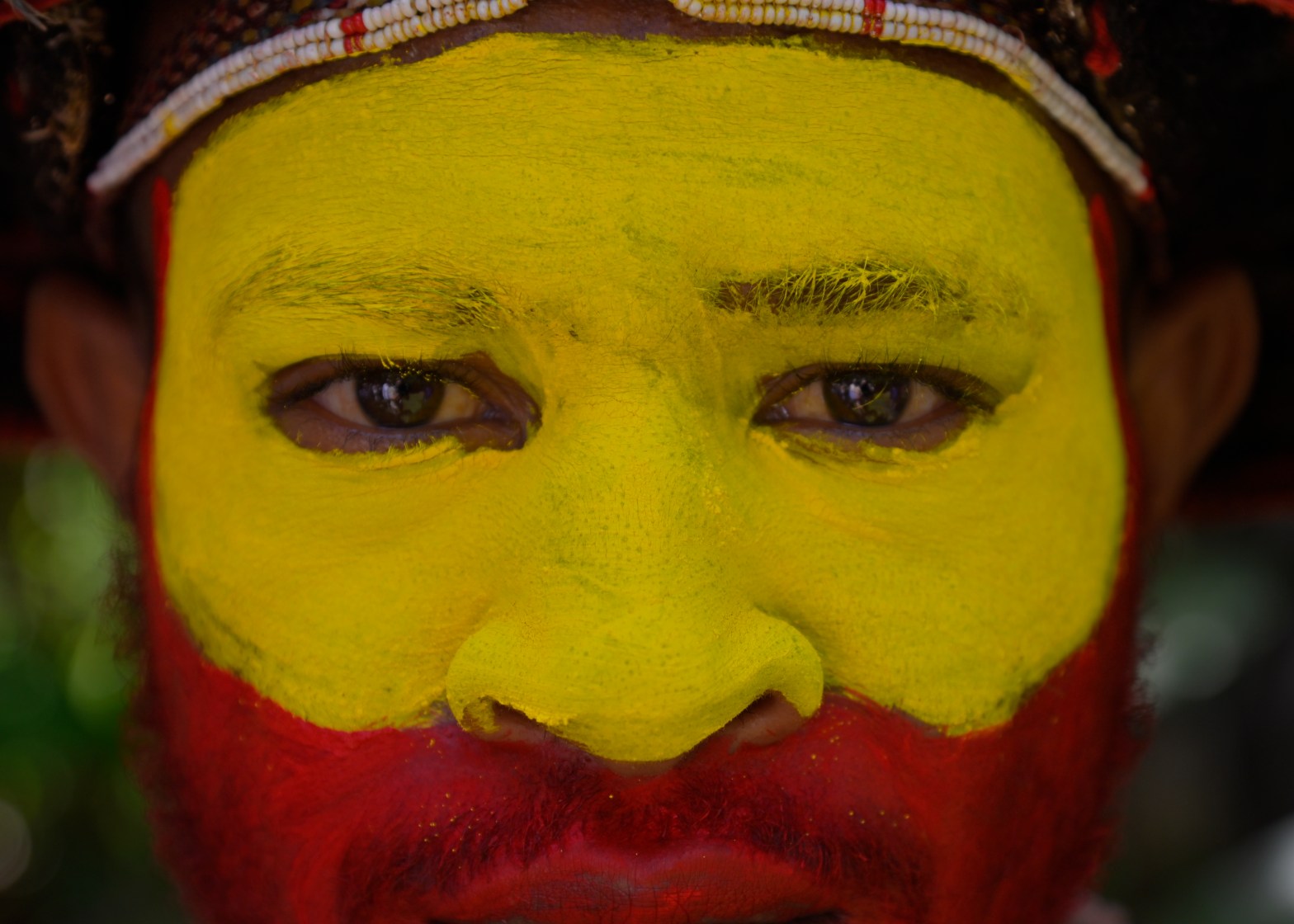
The Mount Hagen Cultural Festival has now become one of – if not “the” – largest and most popular annual gathering of tribes from around the entire country of Papua New Guinea. Some web-sites say it started in 1961, but – according to signage at the event – this was the 64th Festival, which implies the first meeting – if it has always been an annual event – was in 1959. Regardless, the original meeting took place prior to the country’s independence from Australia in 1975. Today, more than 80 different tribes – from all over the country, not just the Western Highlands Province – come together for two days in August each year to show-off and share their cultures – traditional face-paintings, costumes, dances, and songs – in some cases, traditions that go back thousands of years. It is a “sing-sing” in local parlance, and it attracts thousands of locals and international travelers. These days, it is a celebration of all these cultures, a showcase for all the attendees, and a competition, as awards are handed-out for various tribes in attendance.
In December of 2019, I took a cruise to Antarctica, and one of the women I met on-board had told me about the Mount Hagen Cultural Festival. She made a point of saying how amazing it was and that it really should be on my bucket list. This is one of the ways I choose where to travel – by following the recommendations of other experienced travelers. And, so, attending the Festival made it on to my list.
When the first wave of COVID had pretty much ended, I’d tried to get to the Festival in 2022, but was told I could only be on the waitlist. I asked about 2023, but was waitlisted for that year as well. My only confirmed reservation was for 2024, so I thought I’d be waiting a while. In the early Summer of 2022, a spot opened-up for me for that year’s festival, but I had to decline due to other commitments. And again, this year, a spot opened-up, so off I went to Papua New Guinea.
While the rest of the trip had been really remarkable, nothing really prepared me for attending the Festival, which would be on my last two full days in the country.
After we landed at the Mount Hagen airport around 9 a.m. on the morning of day eleven, we immediately headed to the Festival, which was being held, for the first time, in the Queen’s Park which is 9.6 acres in the middle of town.
International tourists pay for the privilege of special treatment at the Festival – we were able to enter the grounds early (while we could get in as soon as we arrived, it seems like the grounds didn’t open up for locals until about 11 or 11:30 a.m.), and we had our own designated entrance and rest area, where our tour guides would keep an eye on our gear and have water and lunch available to us. So – when we first entered the grounds, at about 9:45 on both days, it was already busy with tribes and attendees, but it was nothing like what it would become later in both days.
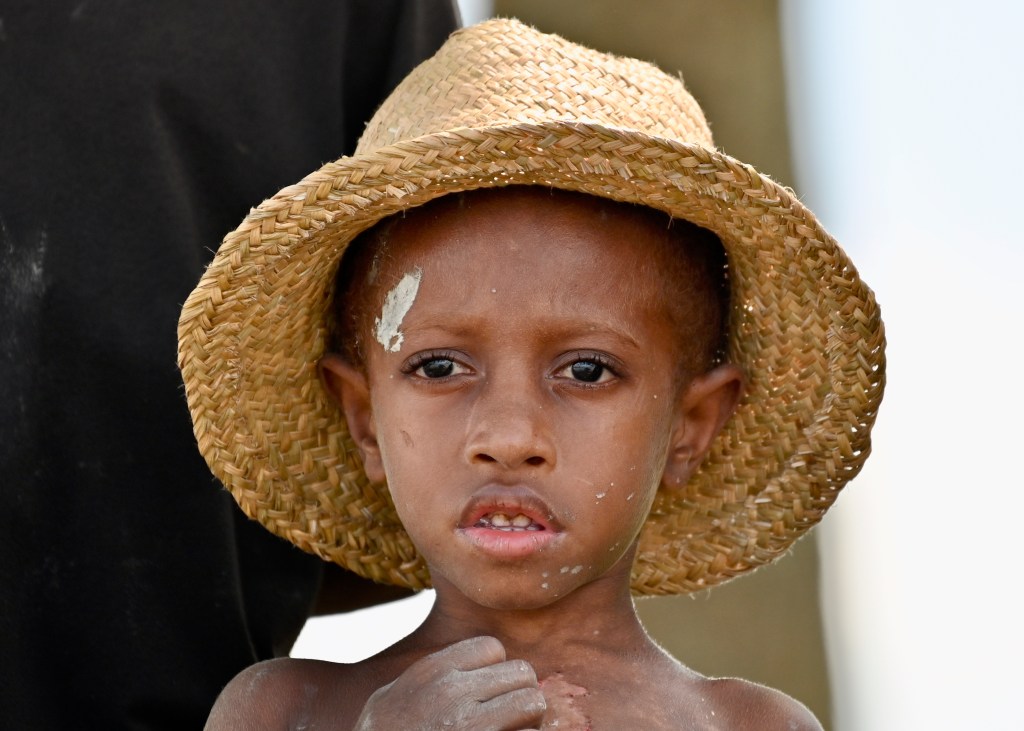
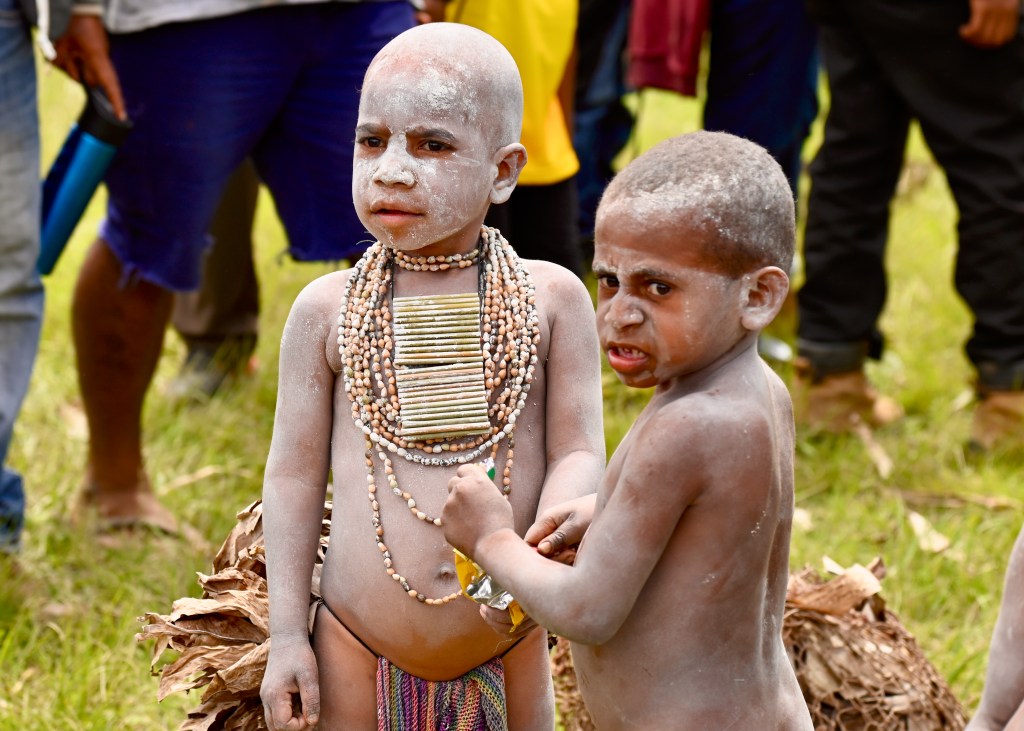
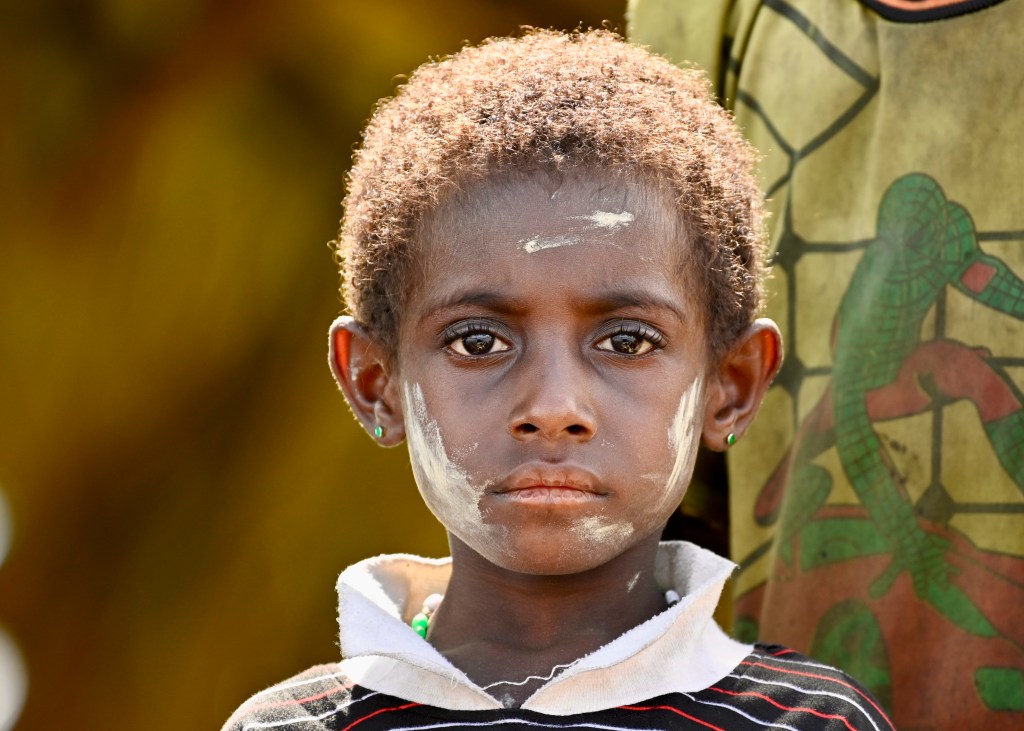
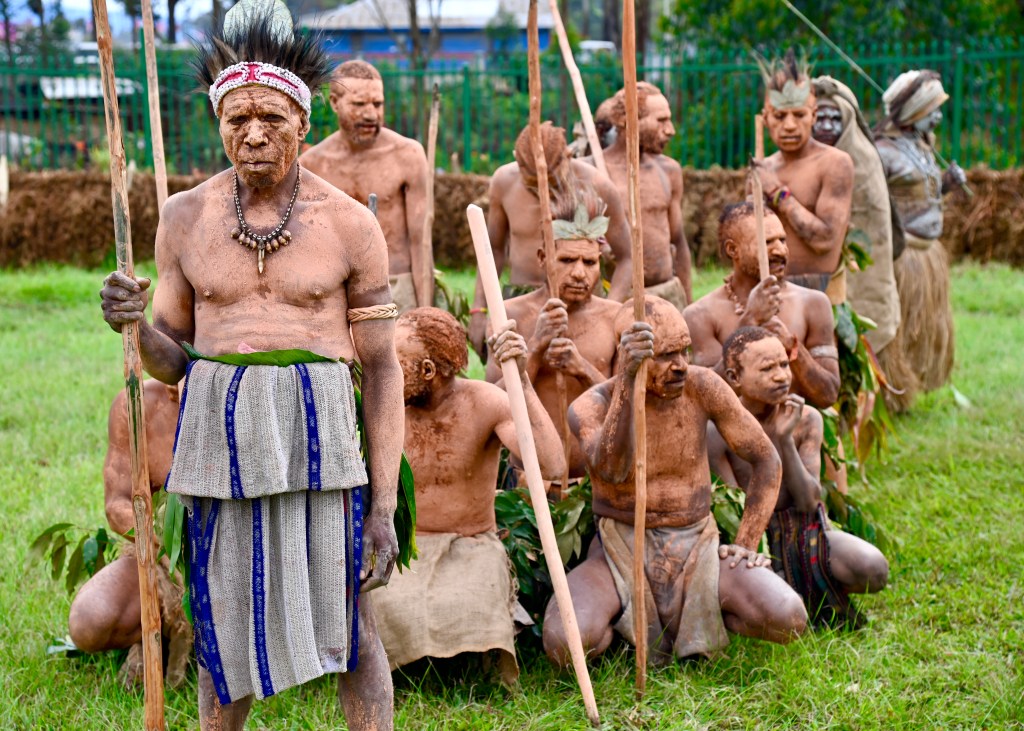
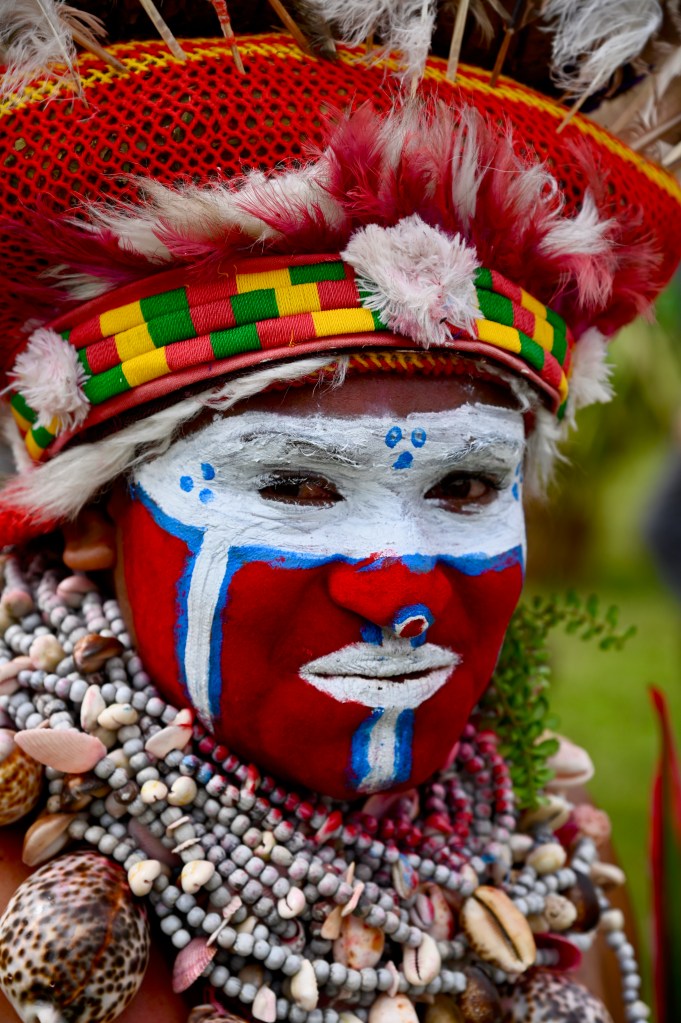
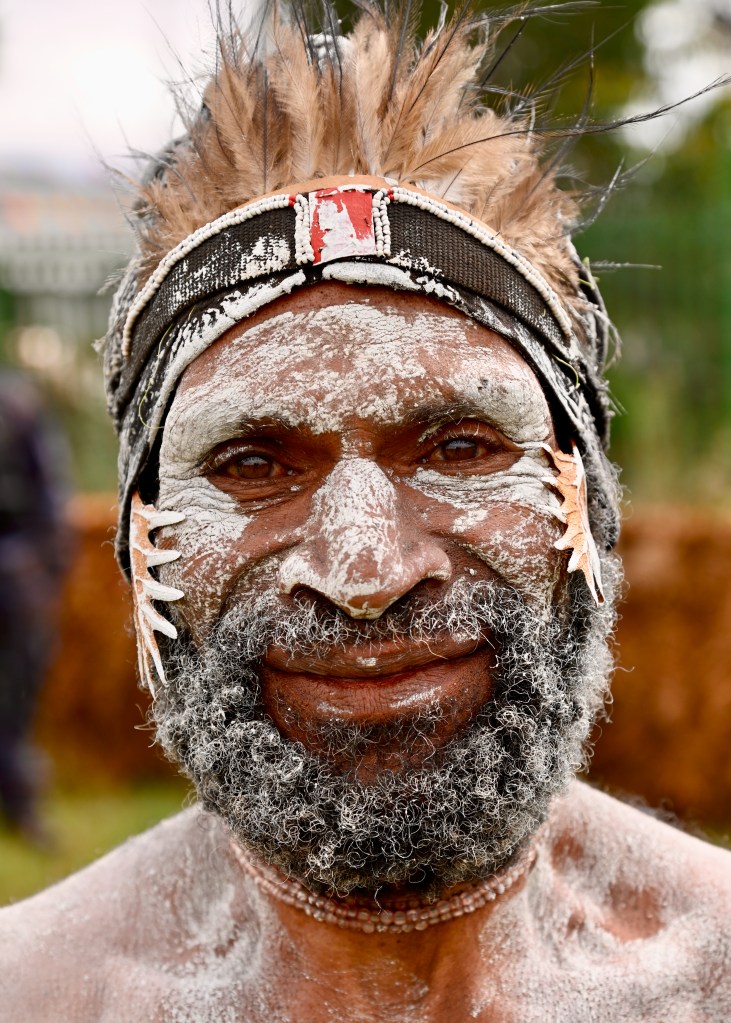
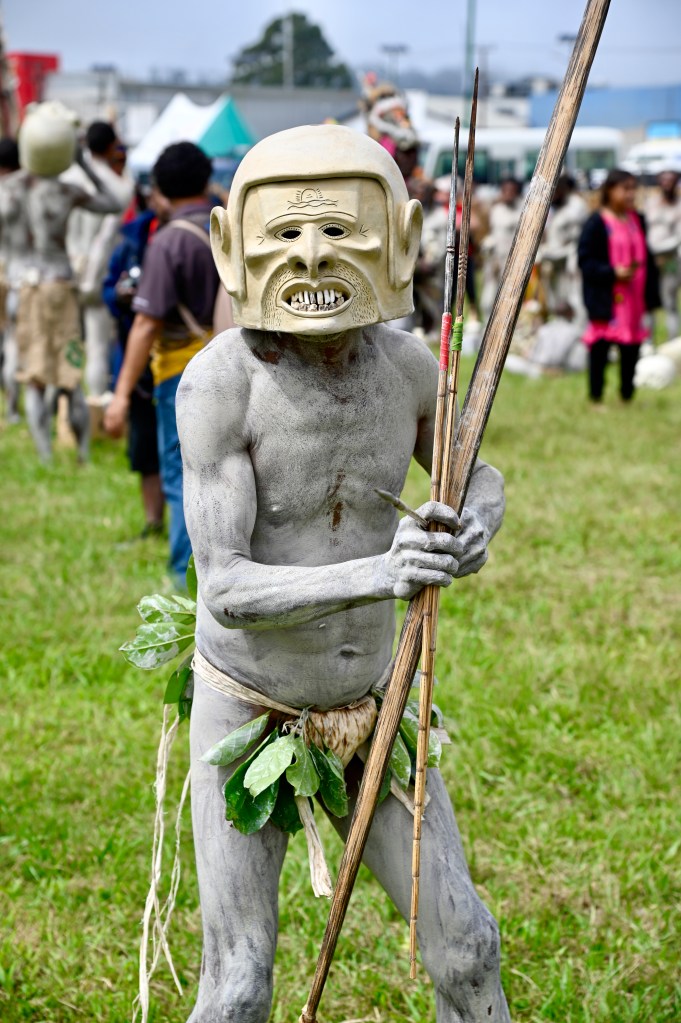
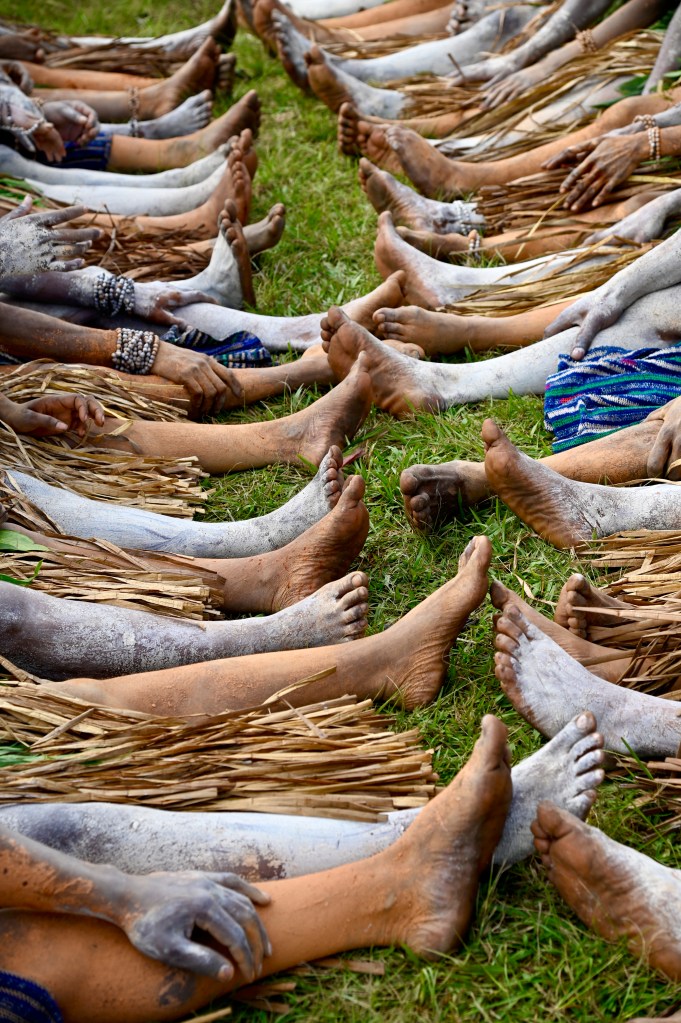
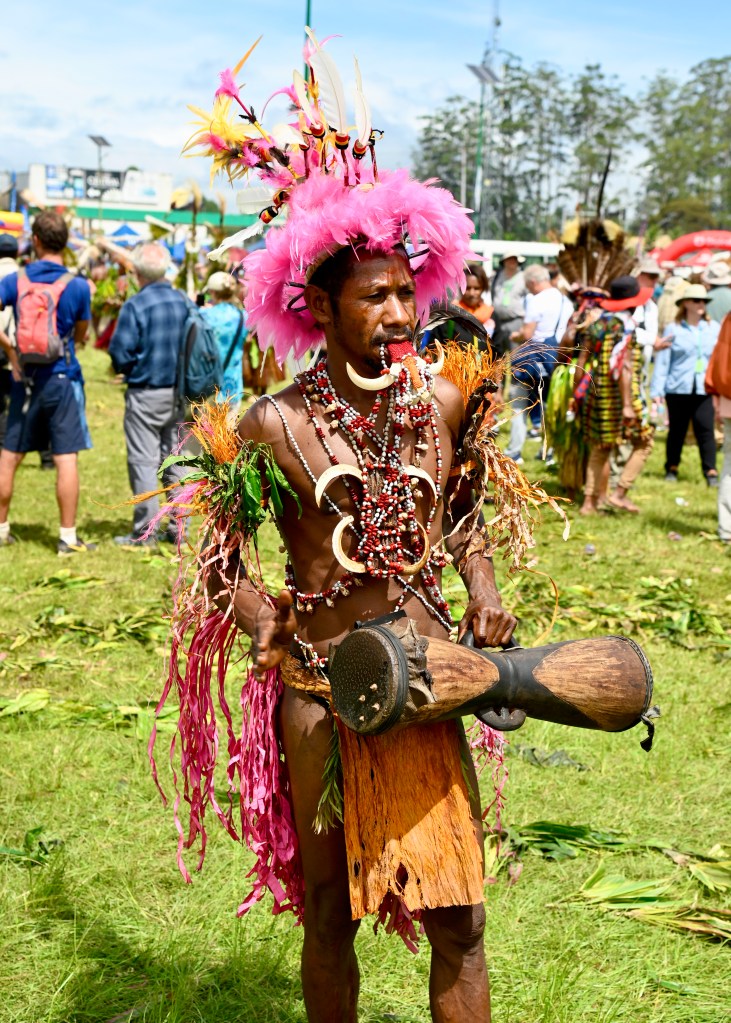
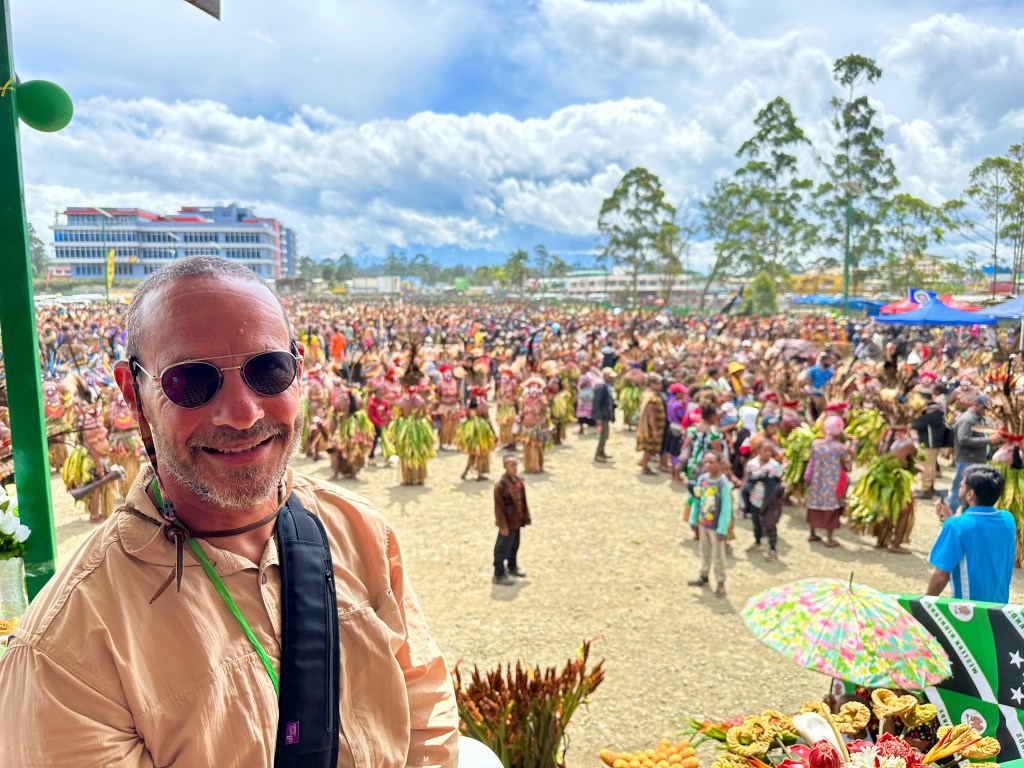
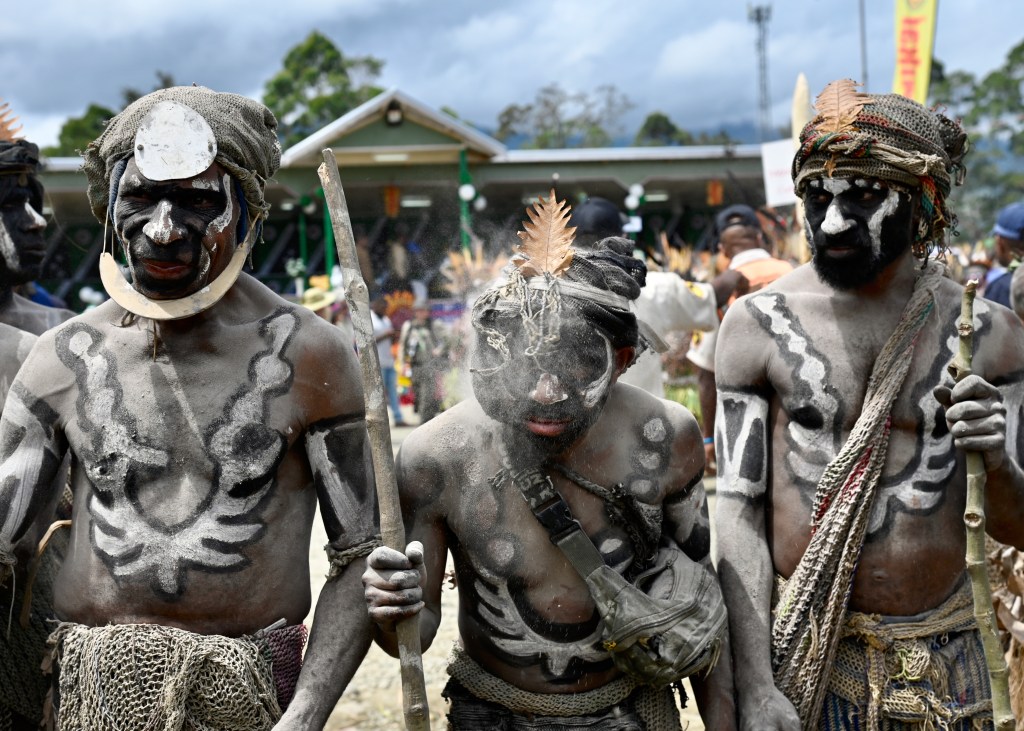
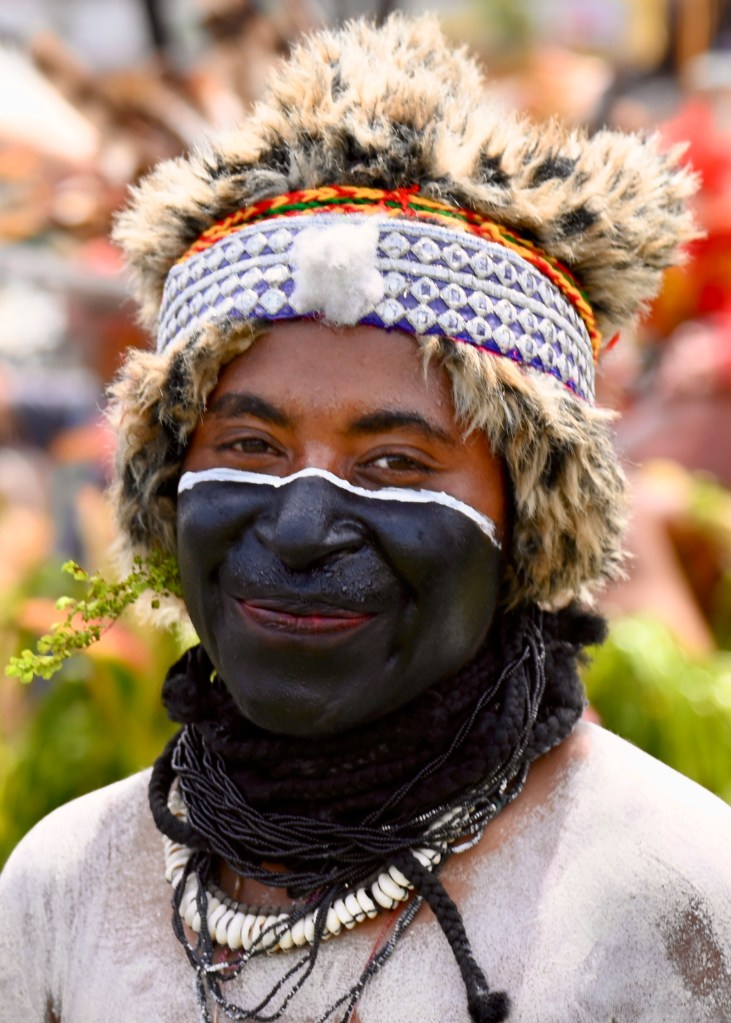
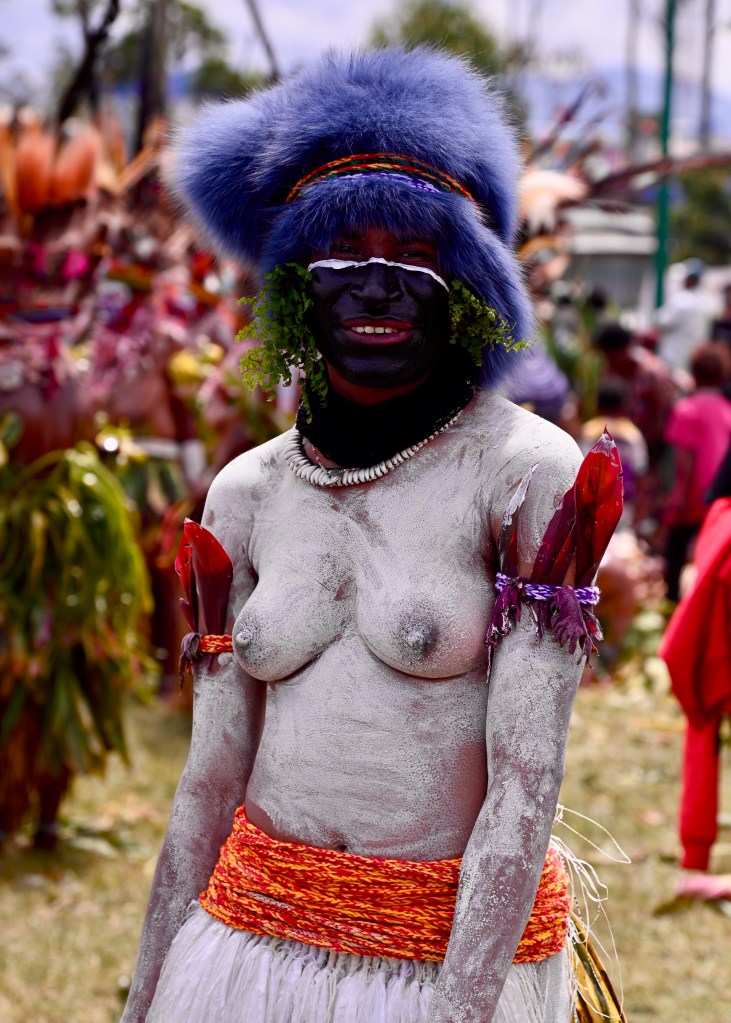
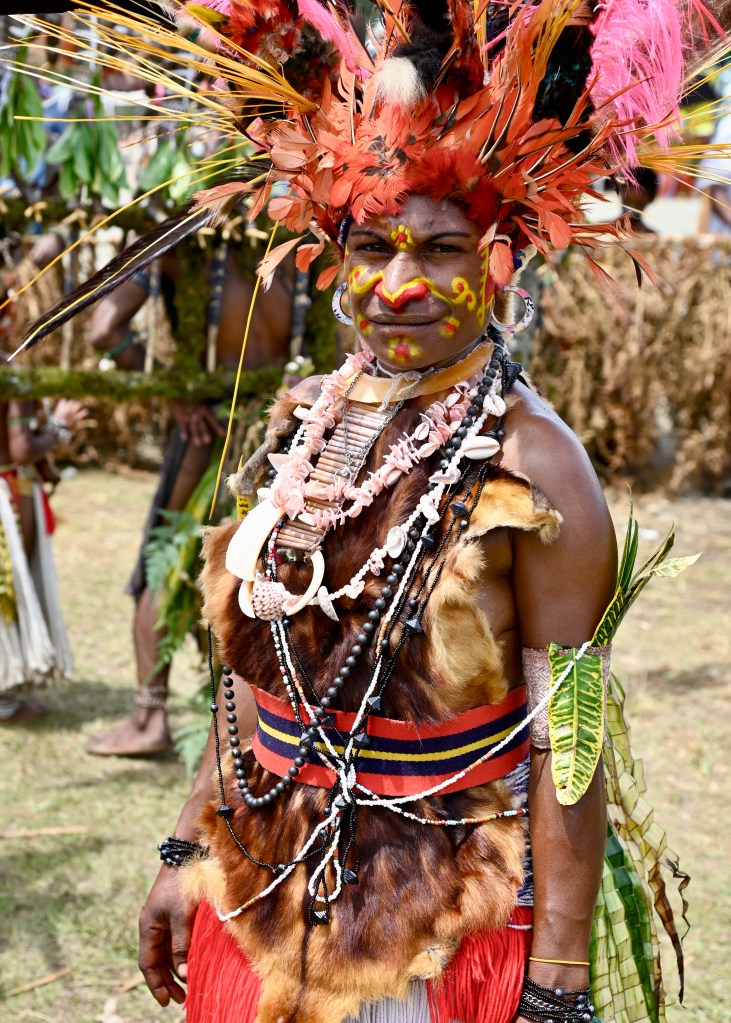
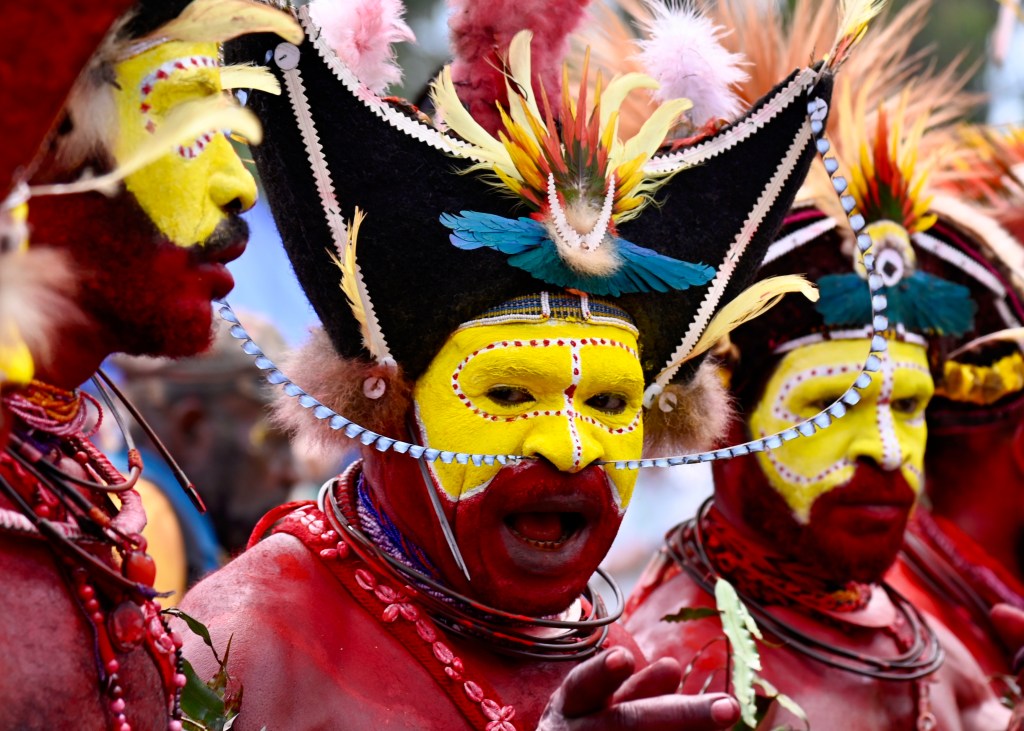
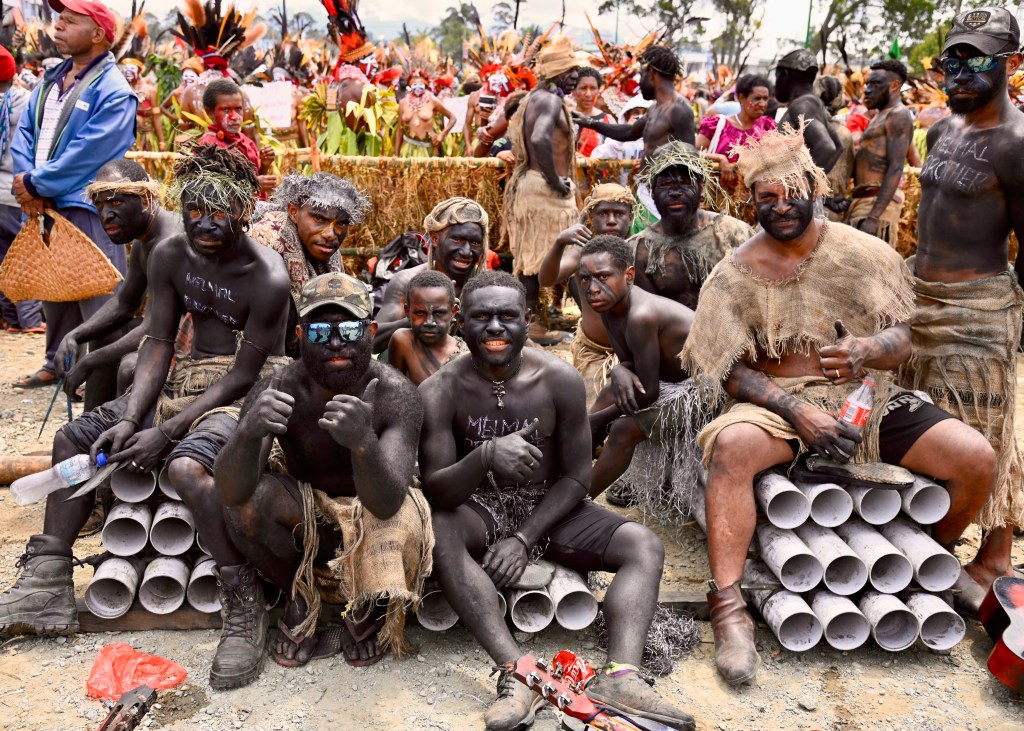
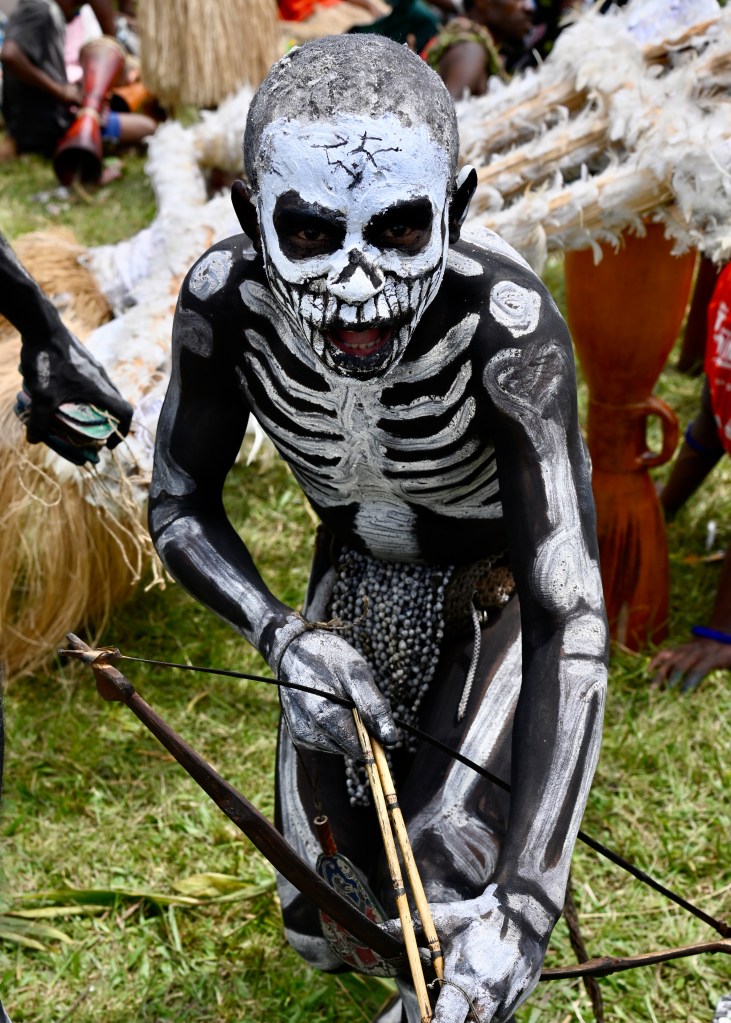
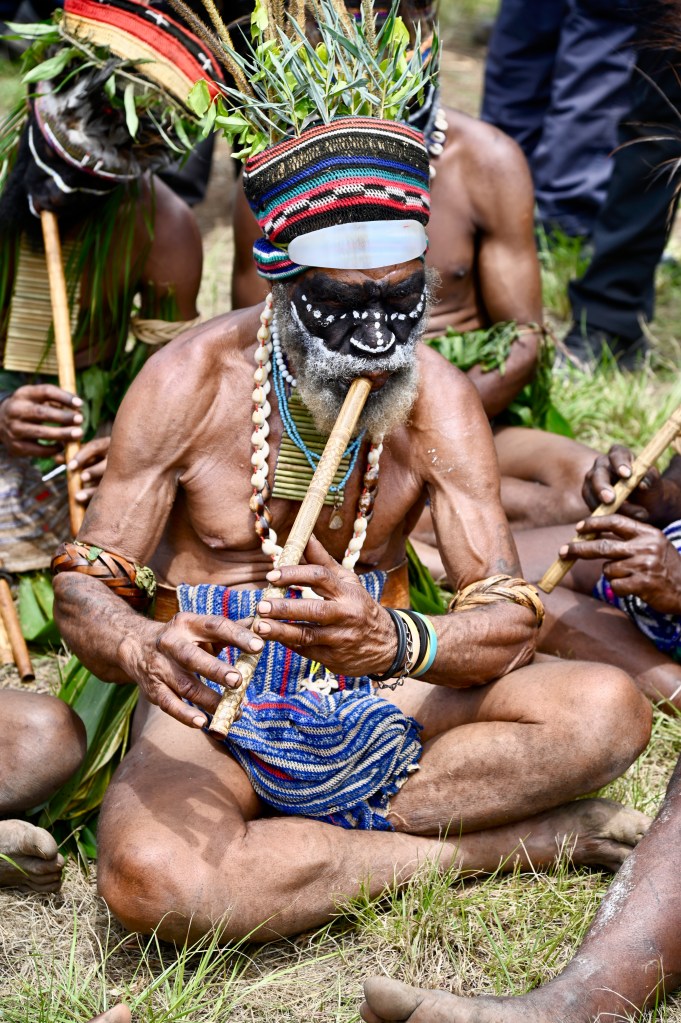
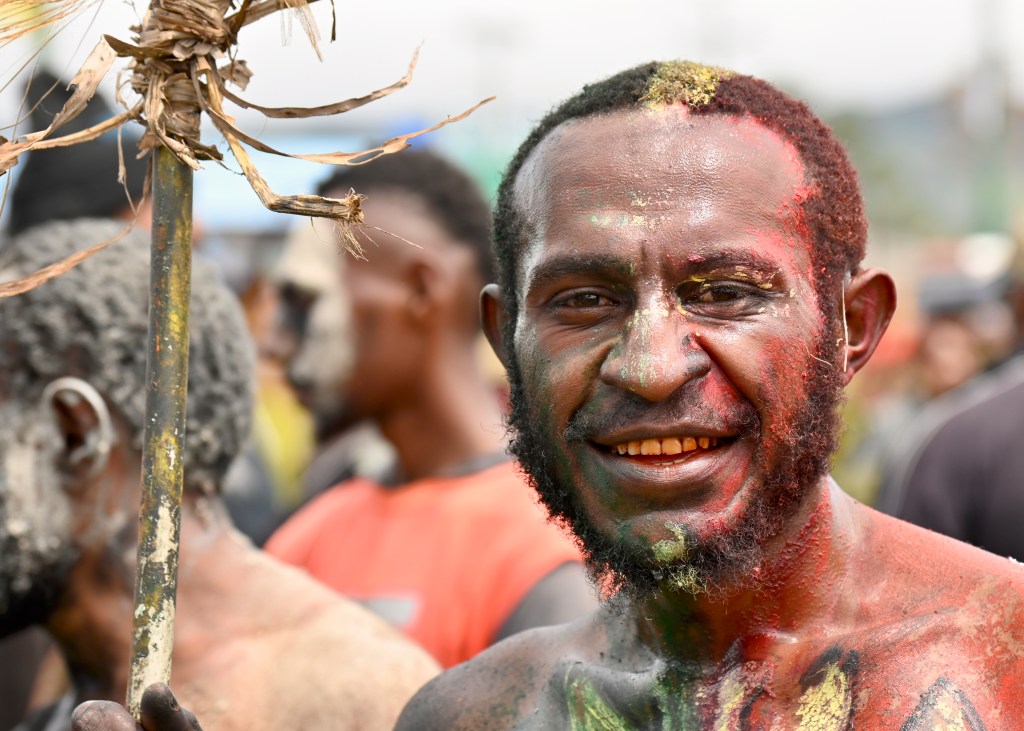
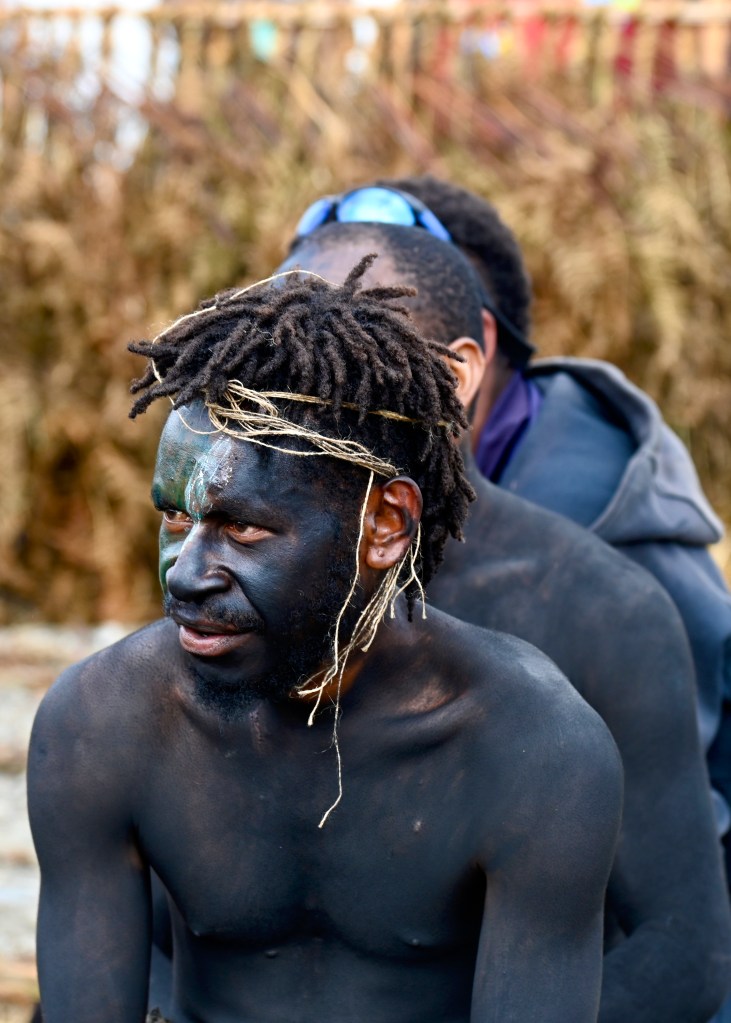
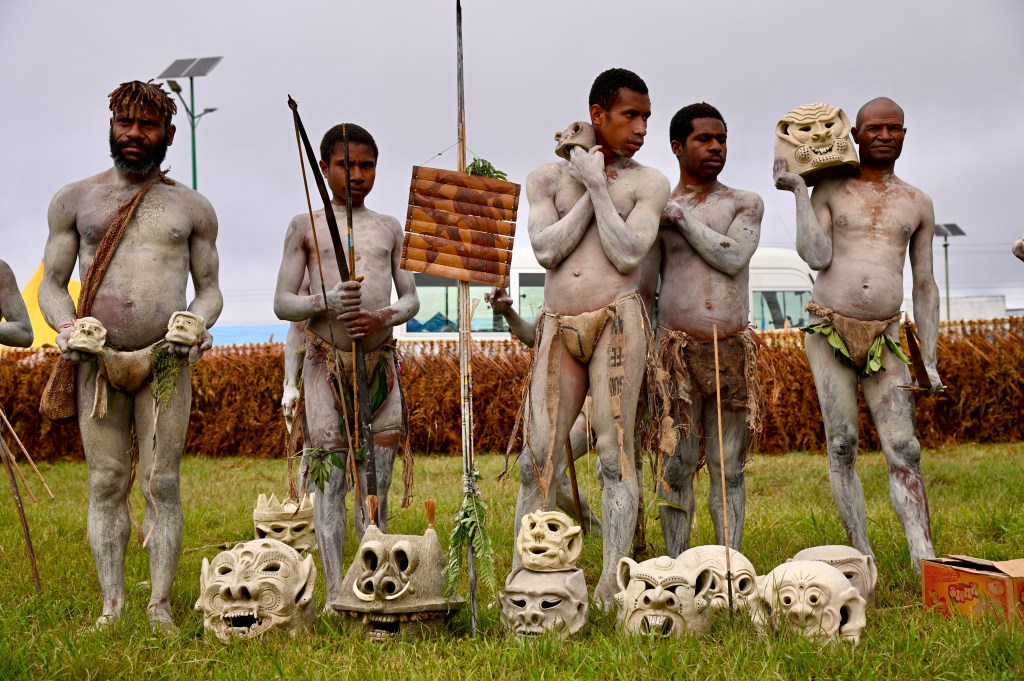
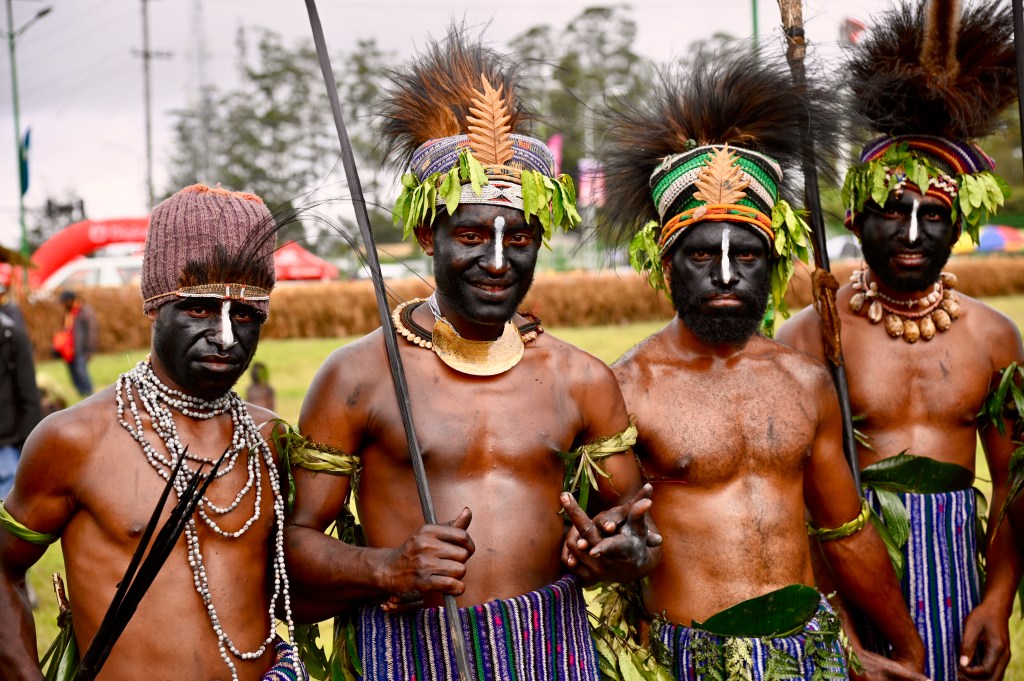
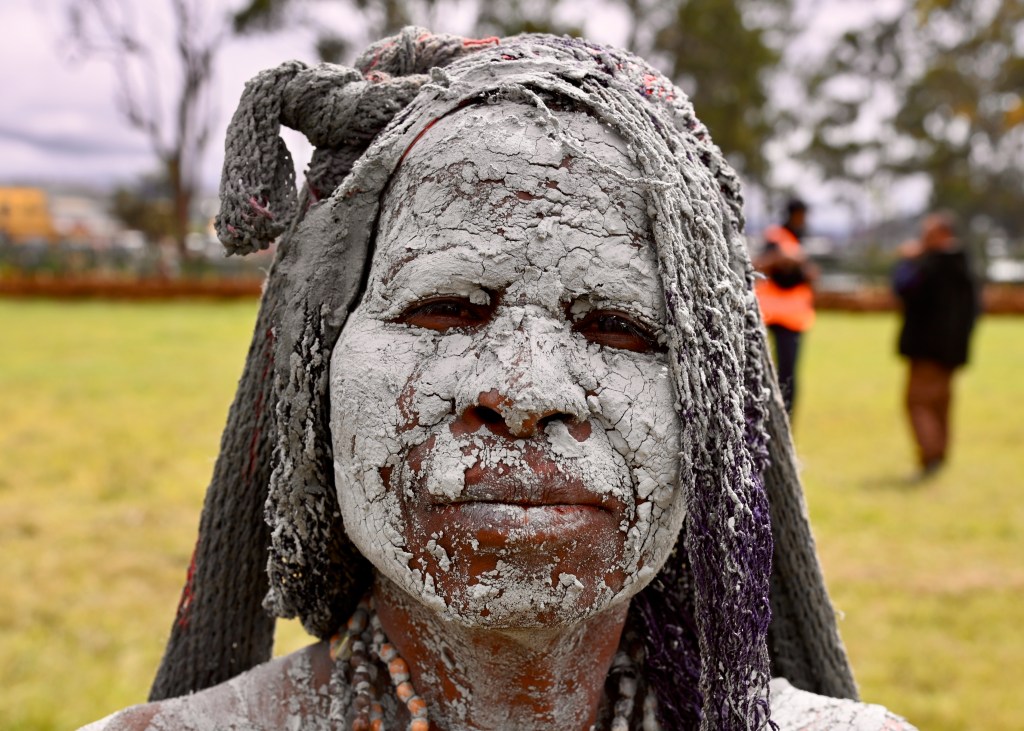
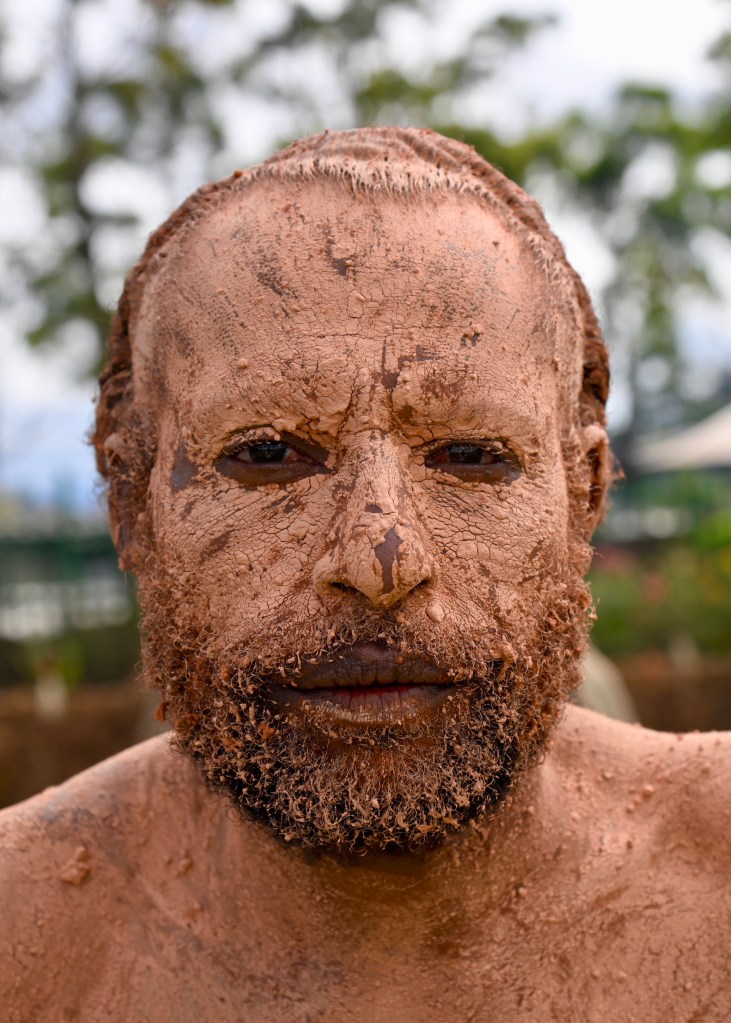
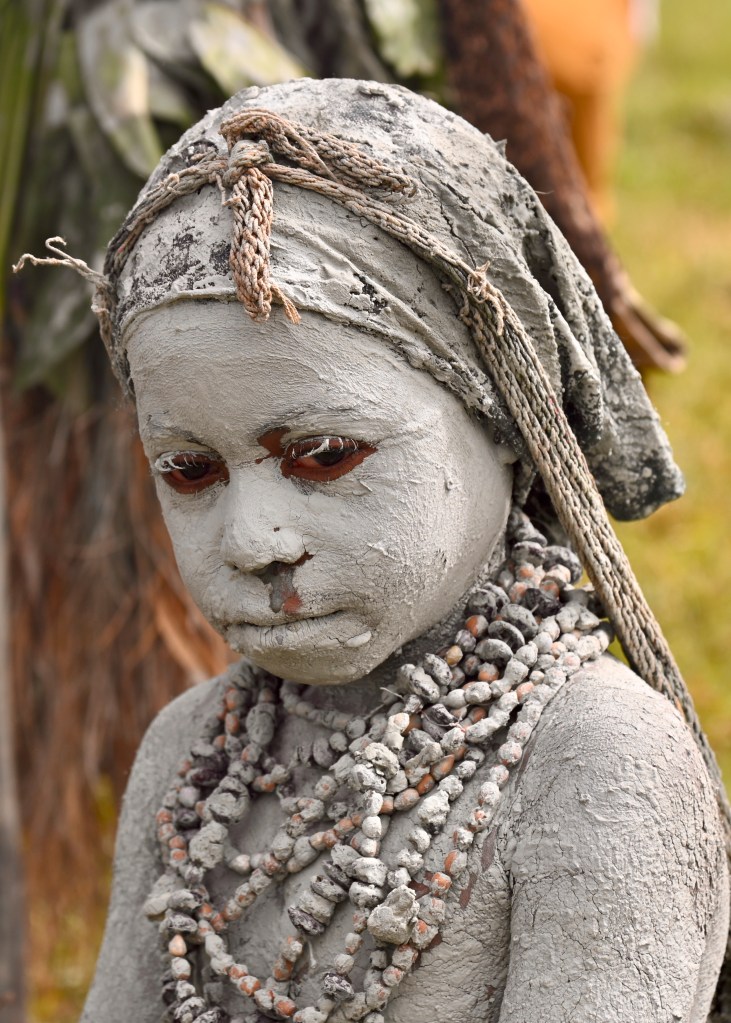
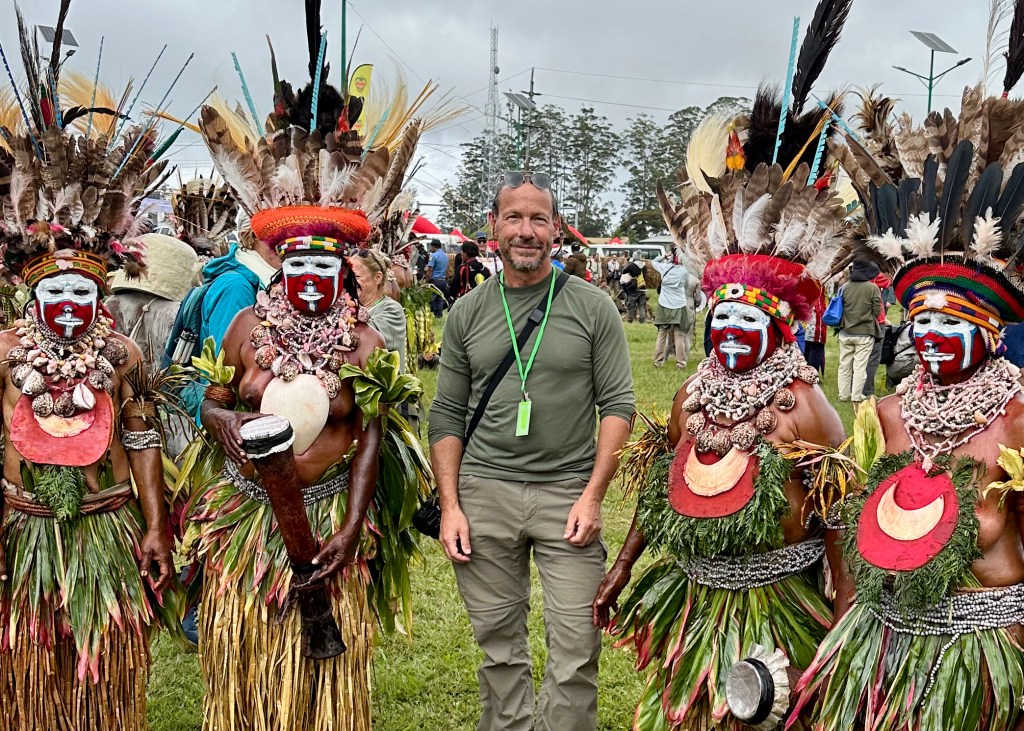
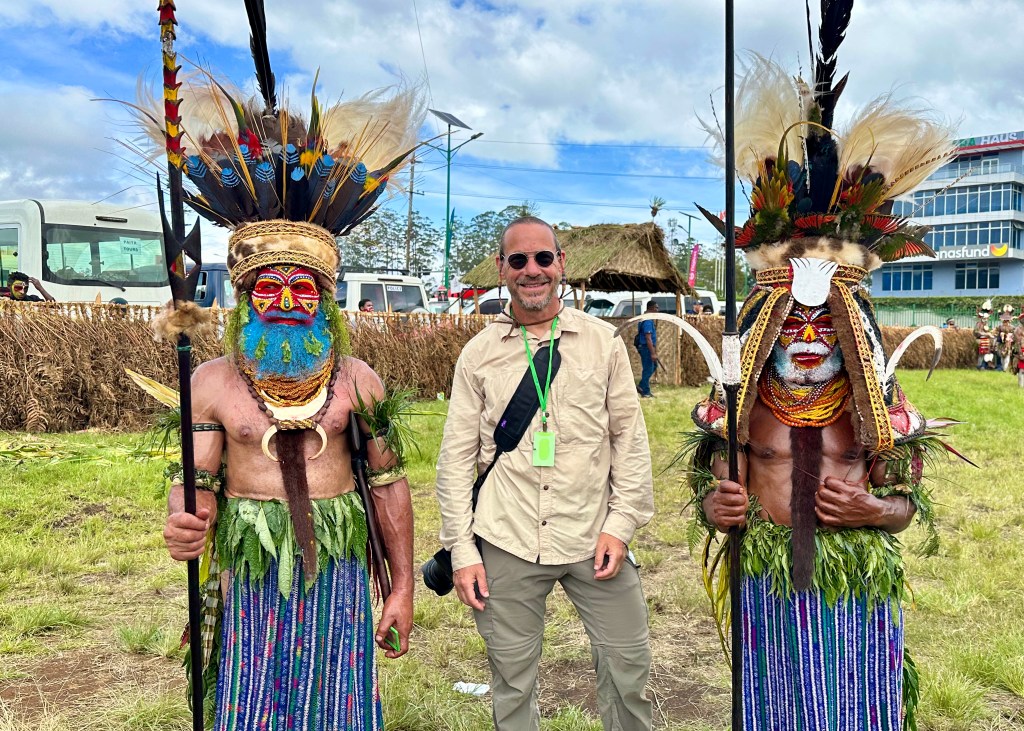
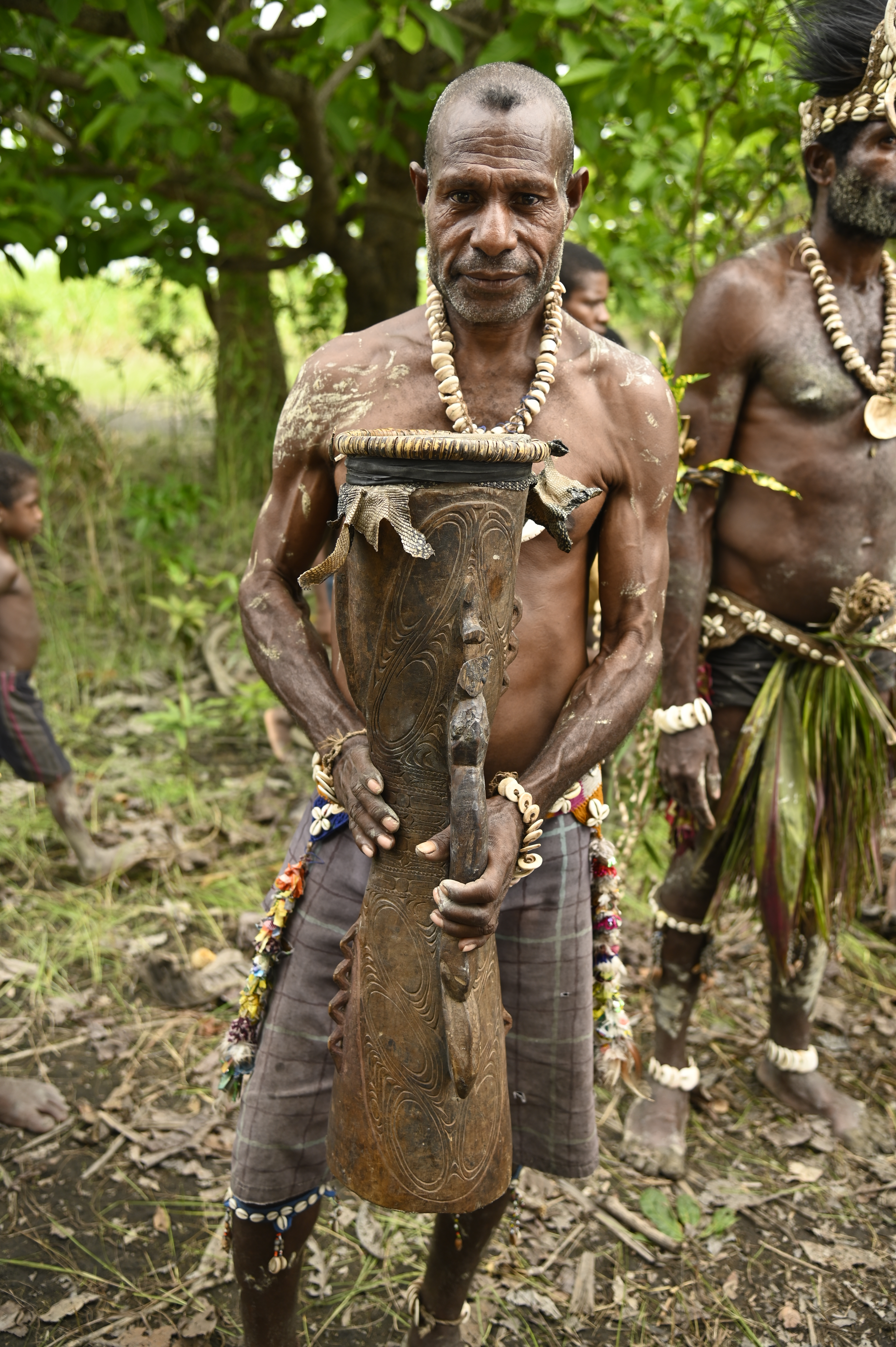
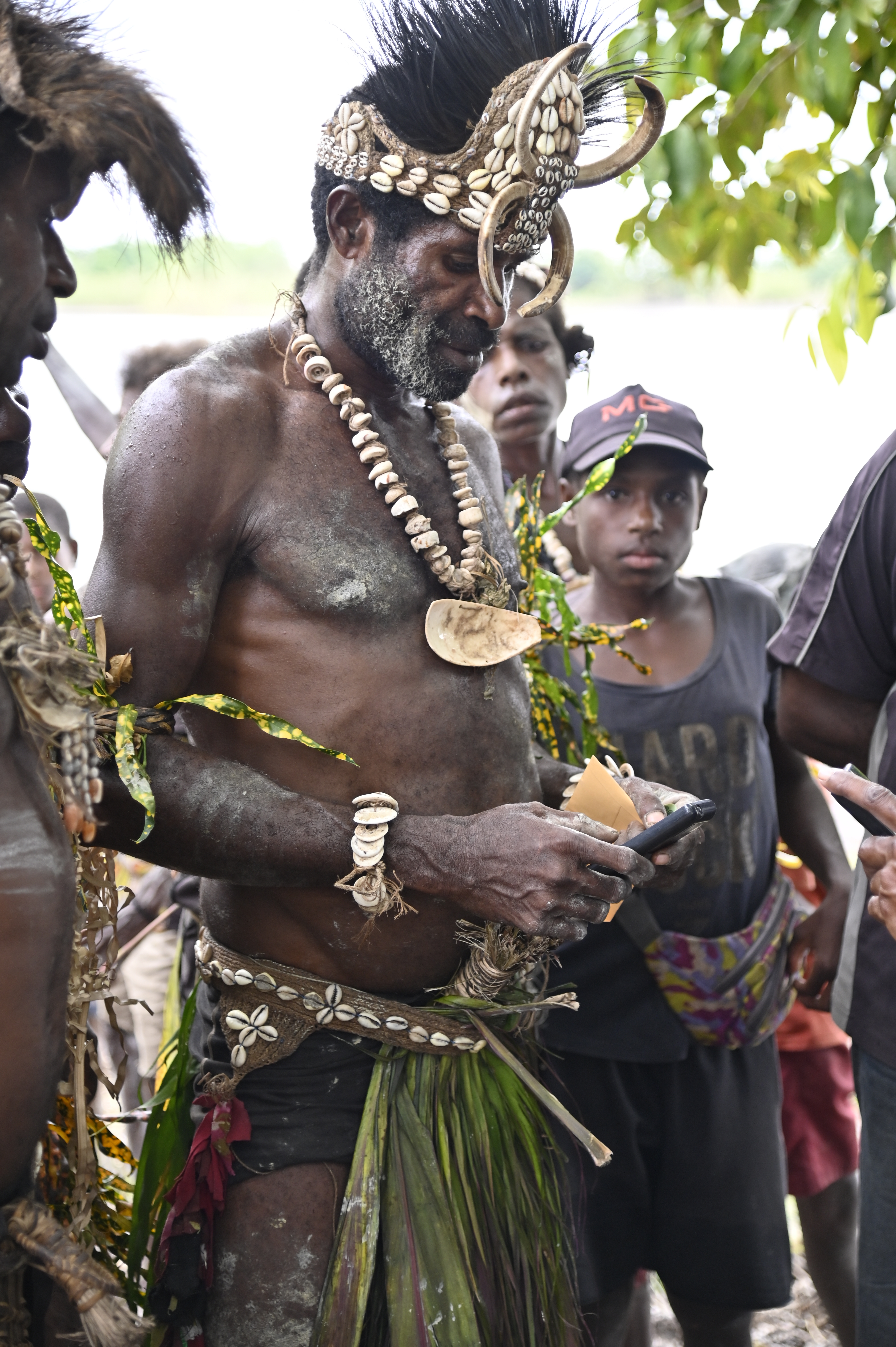
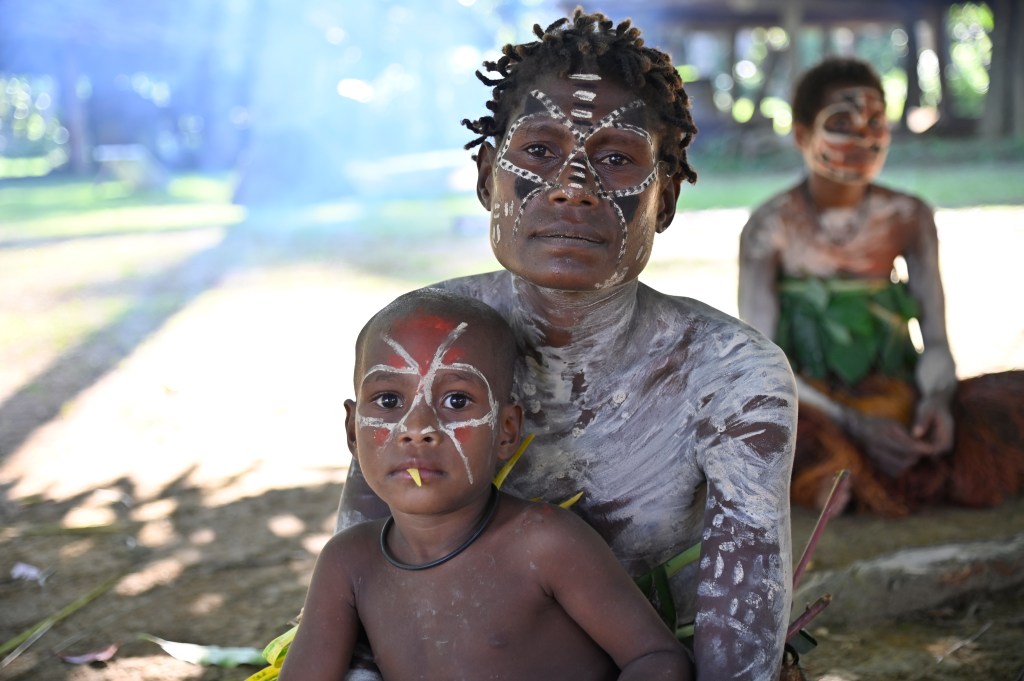
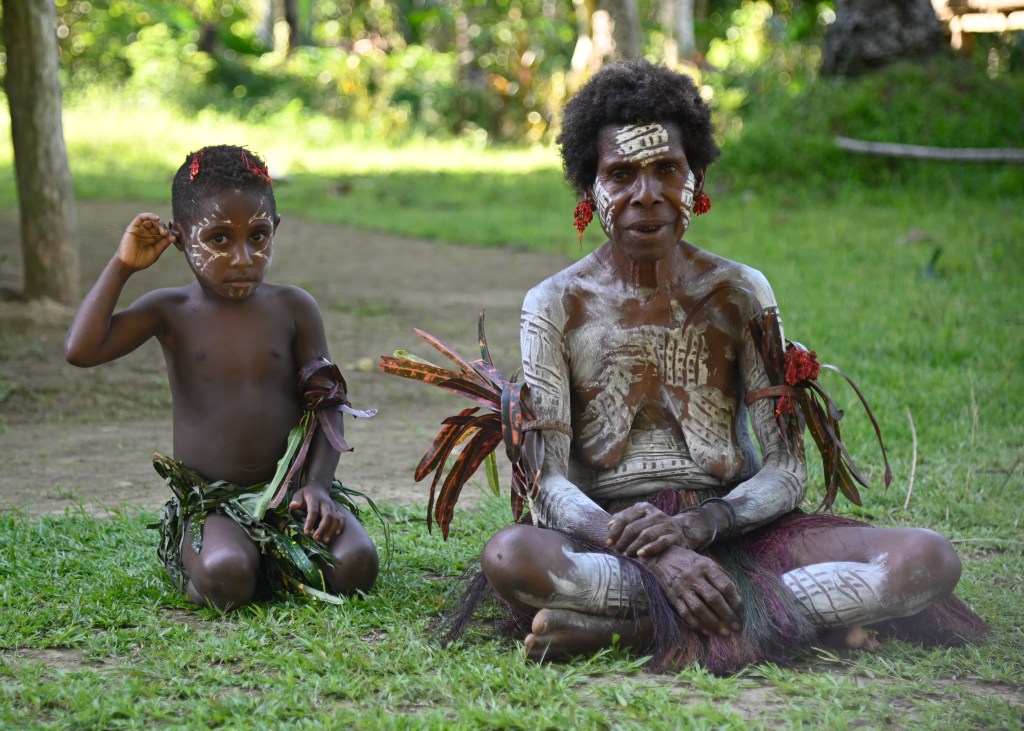
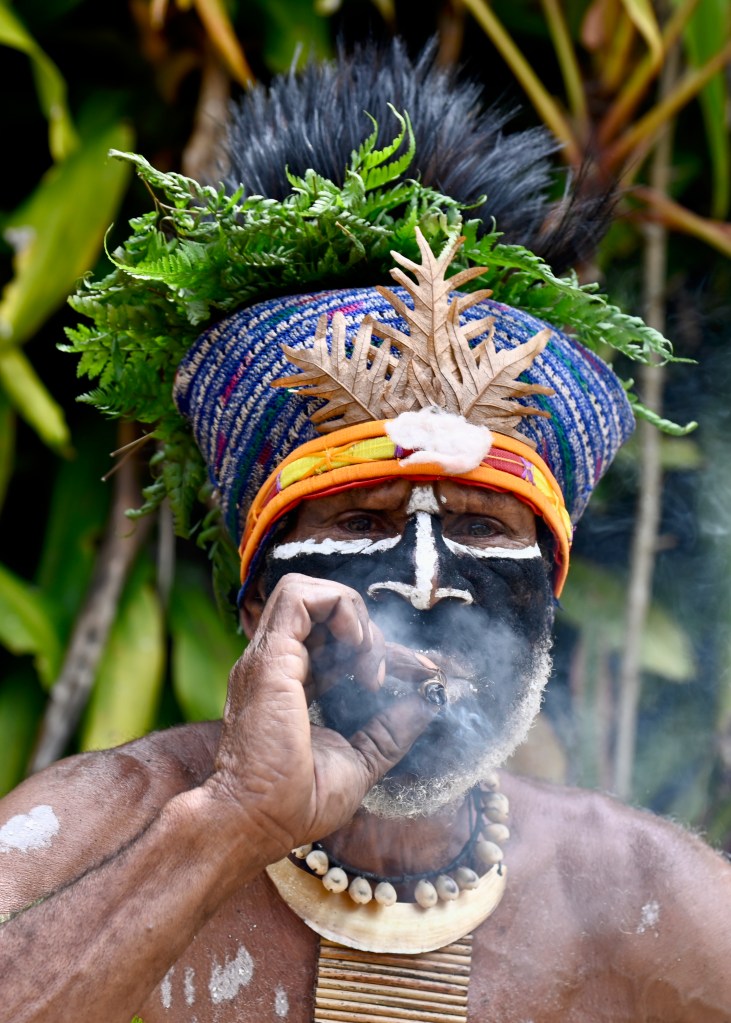
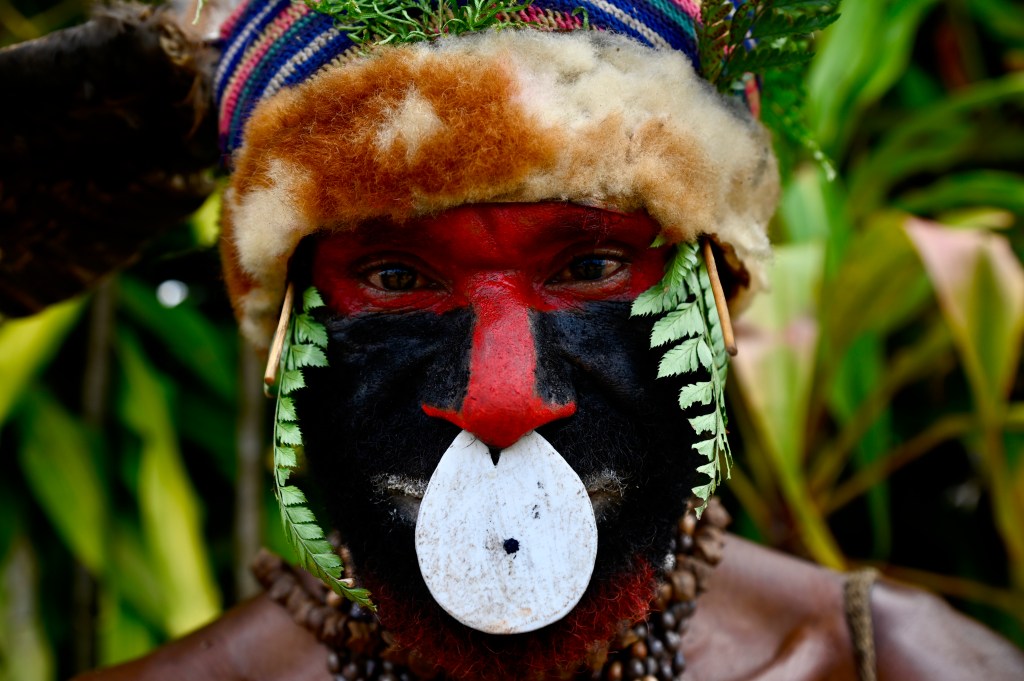
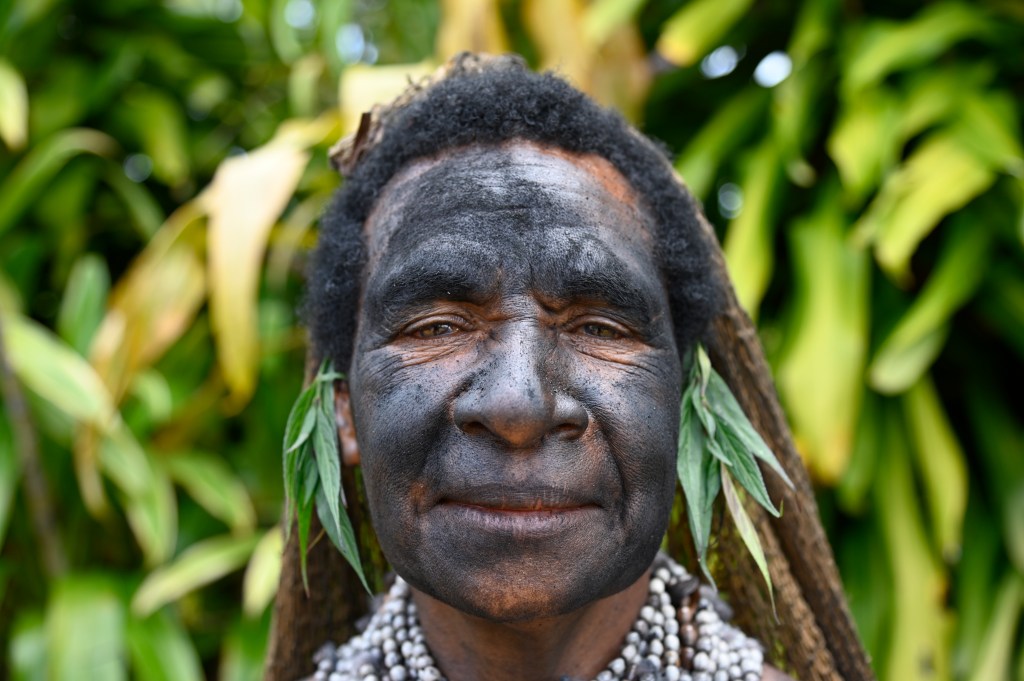
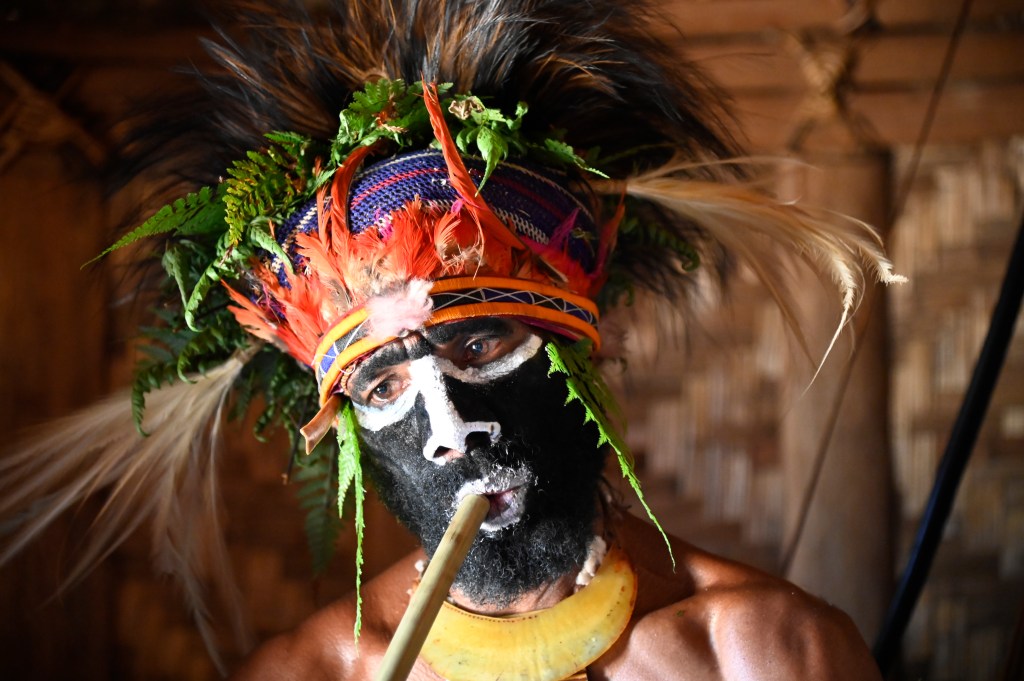
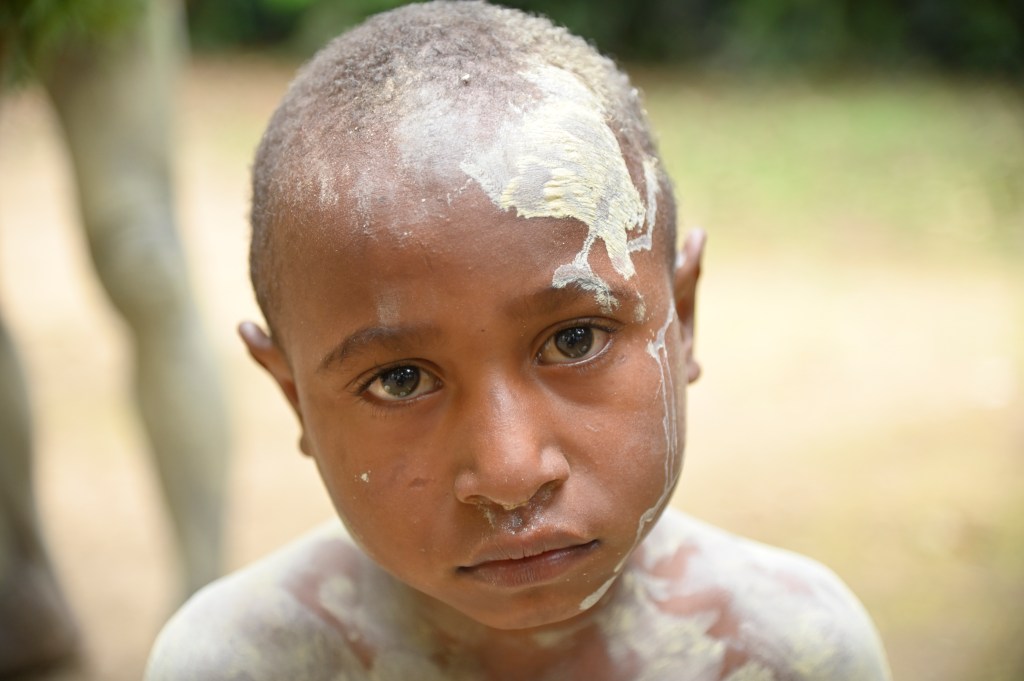
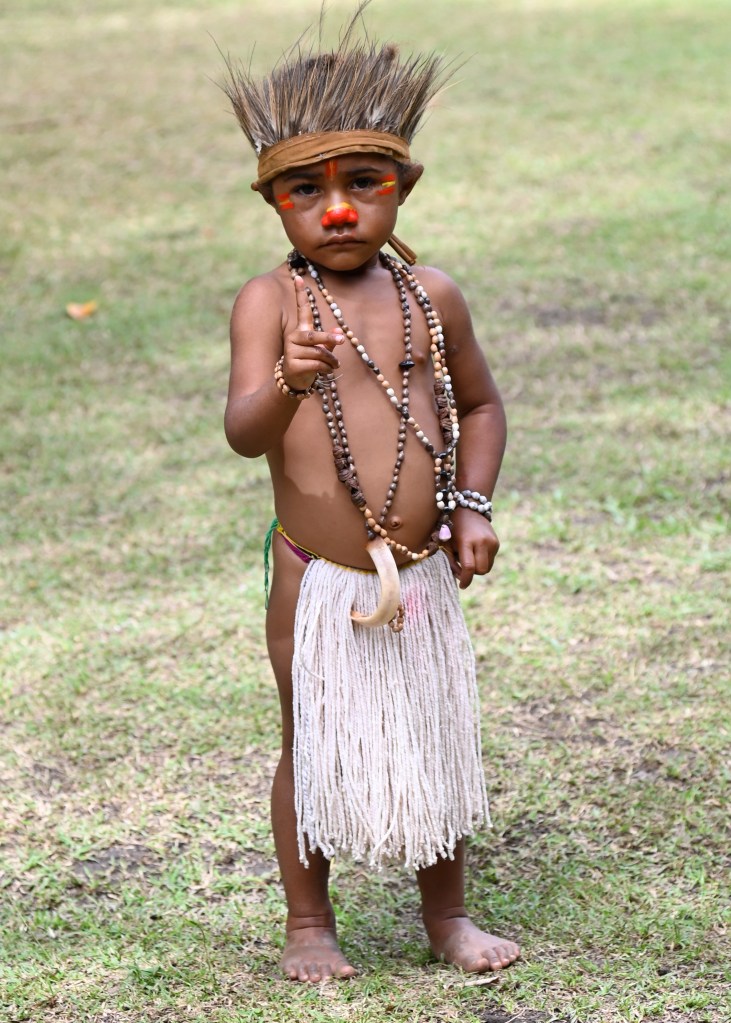
In this large park, there already were around 20-30 tribes gathered – groups of of 10, 15, 20, 30 people each. And, as the day continued, more tribes arrived – with faces painted in fantastic colors and bodies decorated with palms and feathers and beads and bones, or bodies covered with black or gray ash and images of skeletons painted on them, or headdresses of grass and mud, or the Huli Wigmen showing off their headdresses that were expertly woven of human hair, or the Mudmen with their 20-lb clay masks. Men with spears, or bows and arrows. Men and women playing traditional drums that they carried with them as they danced, or drums that sat on the ground while being beaten with small pads or sandals. Tribal members making fires and smoking home-rolled cigarettes. People dancing in circles, or bodies swaying as they sat on the ground and sang and/or rhythmically pounded out a beat, or marching along as they sang and danced, or demonstrating small battles between tribes.
It. Was. Amazing. It was wild. Eye candy. Stunning to the eyes and the ears and the whole body. Just remarkable sights and sounds. The type of experience where the back of your head hurts from smiling so much.
Or, as one of my fellow travelers simply put it, “Wow.”
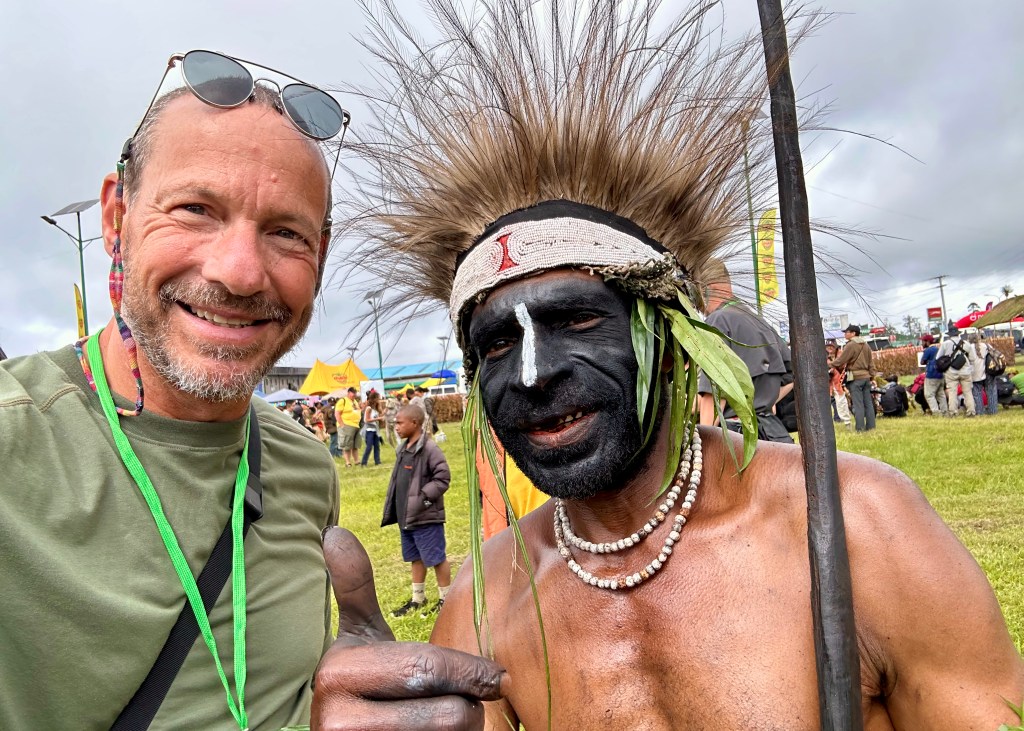
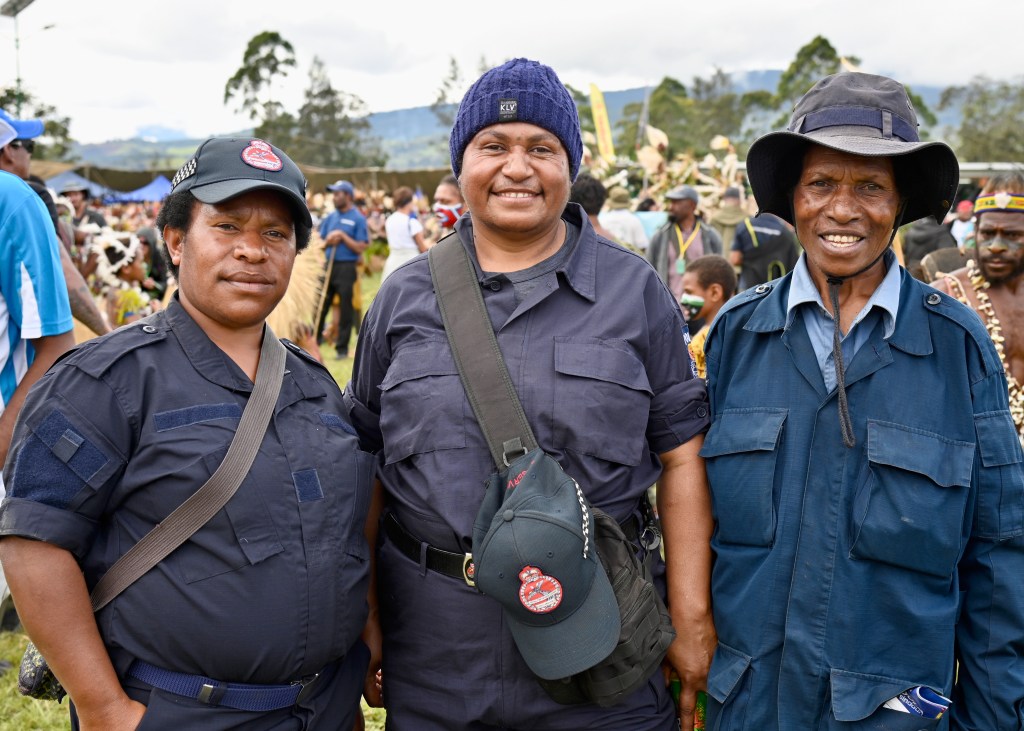
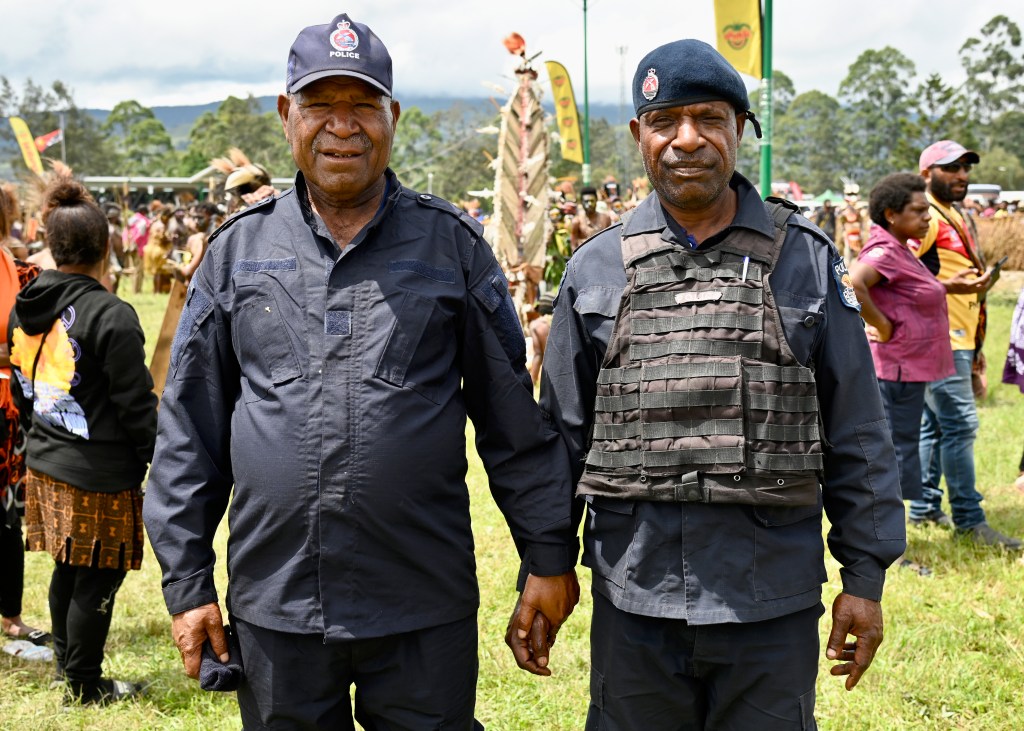
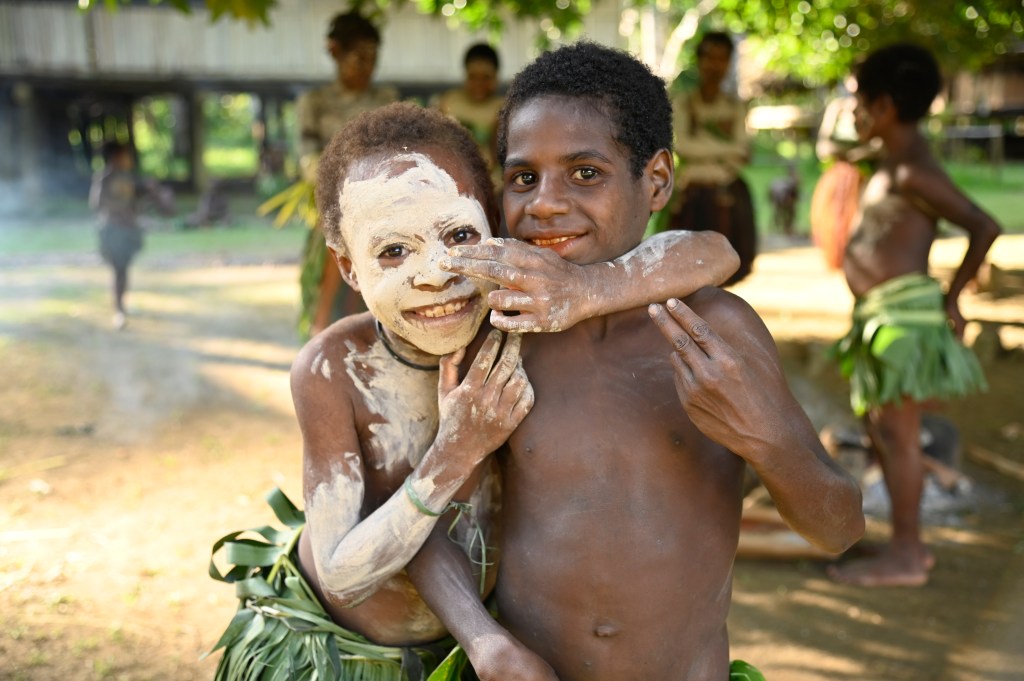
And, as the grounds opened up to the locals, and more tribes also arrived, it became just a sea of merriment and wonder and awe. At dinner that evening, several of us debated how many people were on the grounds, and our estimates went from 5,000 to as many as 12,000. And everyone was in good cheer, and warm and polite with each other (though a local policewoman did warn me to keep my iPhone in my shirt pocket rather than my cargo pants pocket). The tribal members who were performing were very happy to have their pictures taken – posing and prideful in doing so – even some of them asking to have them taken. And, conversely, several tribe members and locals asked me and other international tourists to have our pictures taken by them (“Snap?” someone asked me at one point).
We were able to simply wander the grounds at our leisure, moving from tribe to tribe and working our way through the crowd, waiting at the entrance as new tribes arrived, roaming while we took photos and videos. A stage was set-up at one end of the grounds where speakers stayed at the microphone almost the entire time (frequently to our annoyance) welcoming the tribes, and listing the countries that were represented by the international visitors. Many many of the locals thanked me and my fellow travelers for visiting their country.
And just outside the dancing area there was a display and sale of arts and crafts, like much of which we’d seen in the prior week we’d been in and around the country.
By about 3 p.m. on the first day and 1:30 on the second day, we were exhausted, and departed the Festival. The evening of the first day we headed back to our local hotel – the same place we’d stayed at during our prior stay in Mount Hagen; I met some of my fellow travelers at the bar for a drink before our group dinner. On the second day, we headed right to the airport, and we headed back to Port Moresby for our final evening in Papua New Guinea.
This trip to Papua New Guinea had been based around attending the Mount Hagen Cultural Festival. It was the last thing we really did while in country. And it was incredible.
I took over 1,000 photos and videos in just these two days. I’ve tried to keep the selection relatively small but representative as well. Some browsers will allow you to right-click on each of the images below so they show up larger in a new tab.
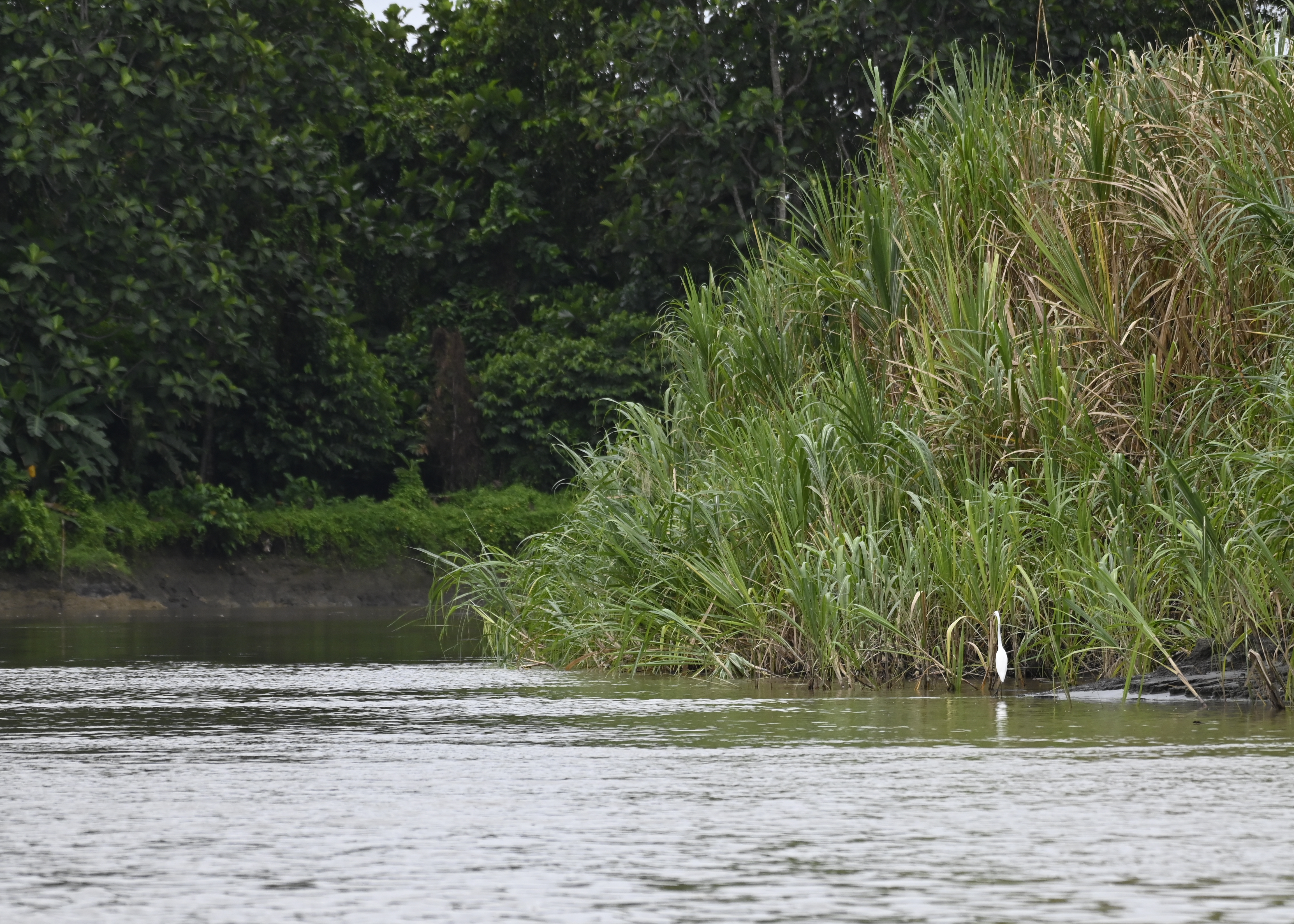
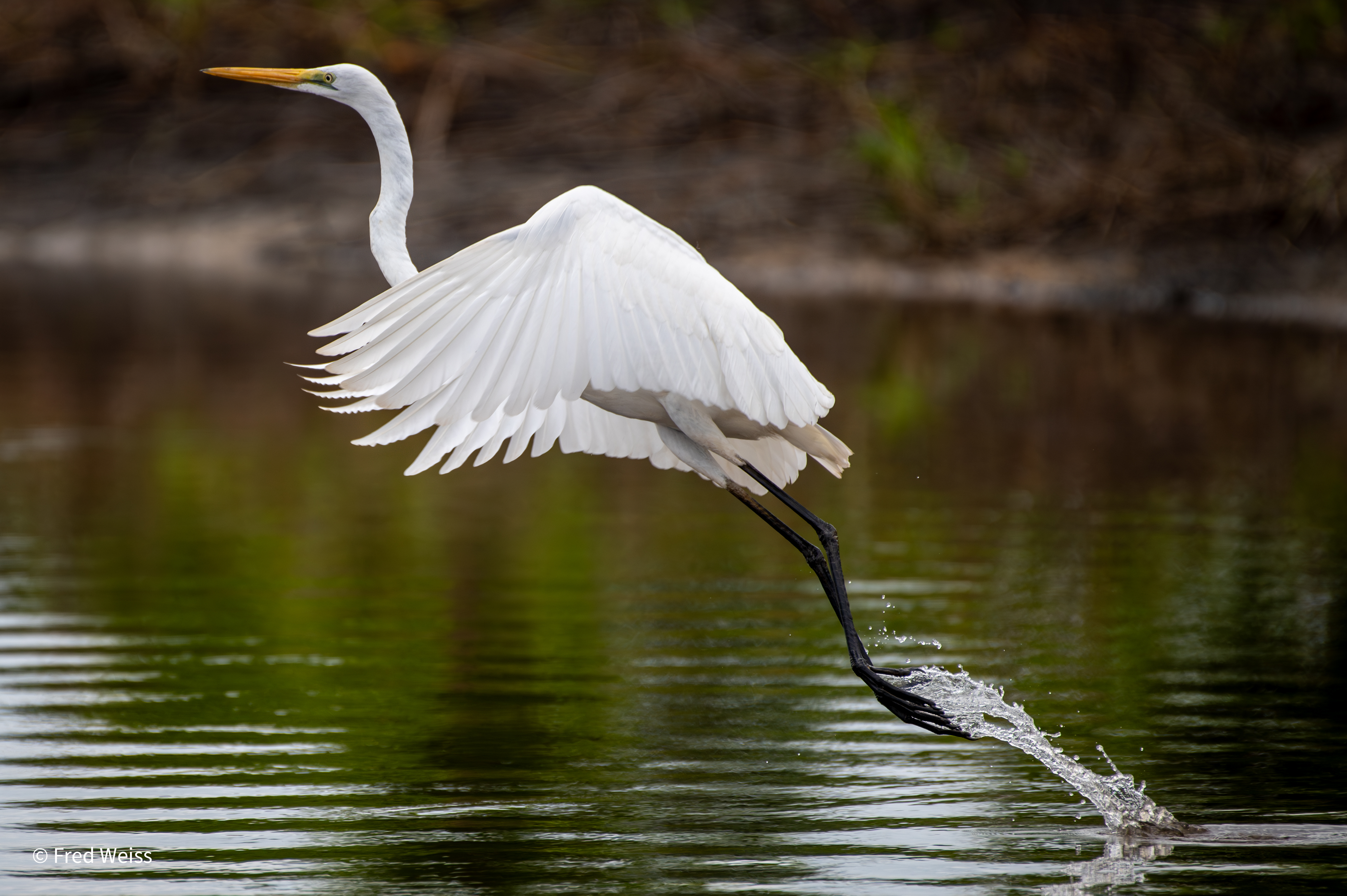
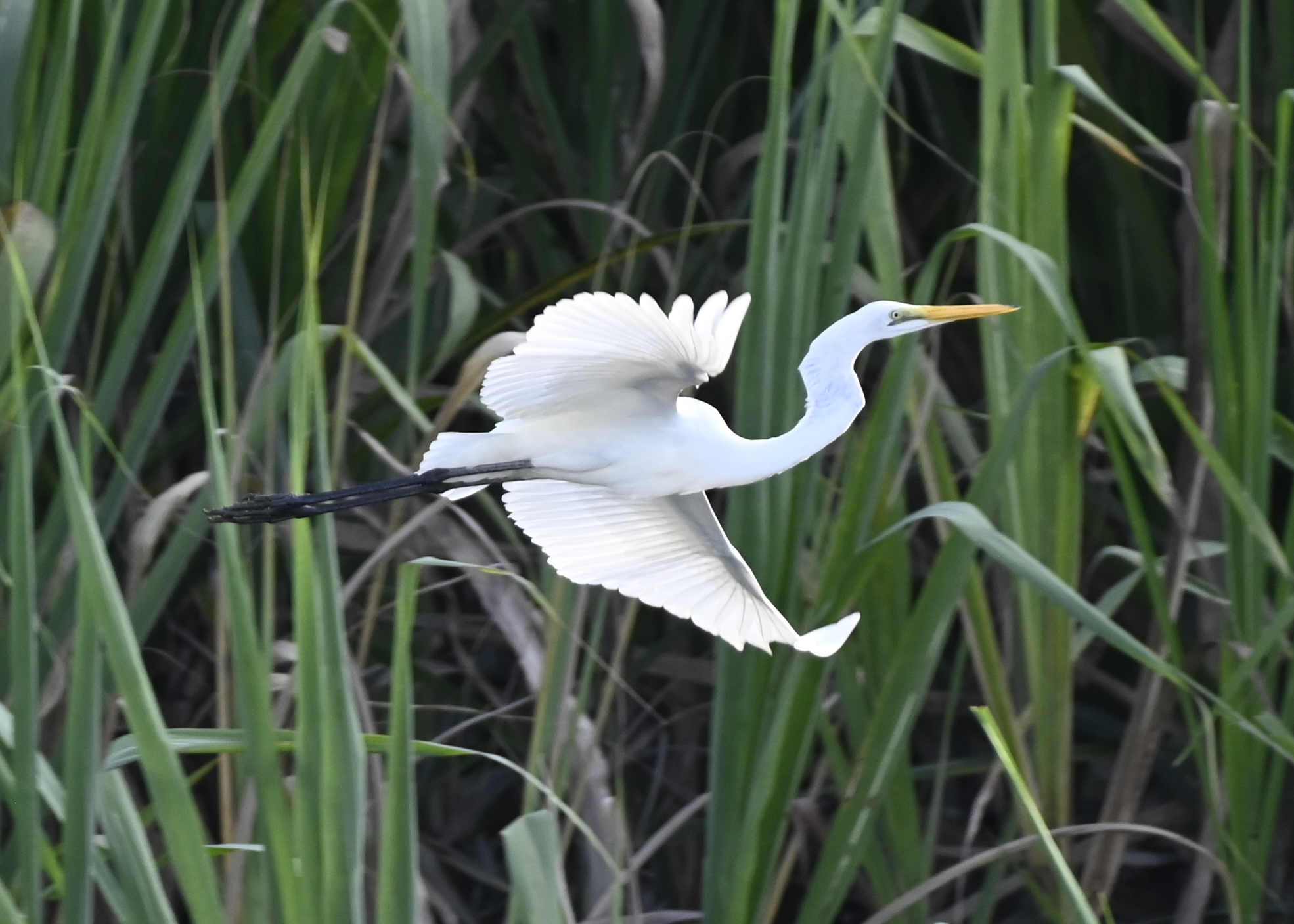
On the morning of day ten, we cruised a bit north on the Karawari; the river opened up a bit, stretching to perhaps 100 yards wide. The grassy shoreline continued to be dotted with tall trees. Egrets sat in the grass until they heard our boat begin to get close, at which point they’d take off – usually going in the same direction as the boat – so that we almost always only got photos of them flying away. There were some fish eagles and cockatoos (too far away for my camera to capture them well), and other birds. It was cloudy and overcast this day, maybe in the 70’s and not too humid.
It would be our last full day out on the river system here in the East Sepik Province, as we’d be flying back to Mount Hagen early tomorrow.
Our first stop was the Mindimbit village, apparently populated by the Iatmul (or “Yatmul”) tribe, of which there are two clans and, for us then, two stops. Combined, the two locations included about 500-600 people.
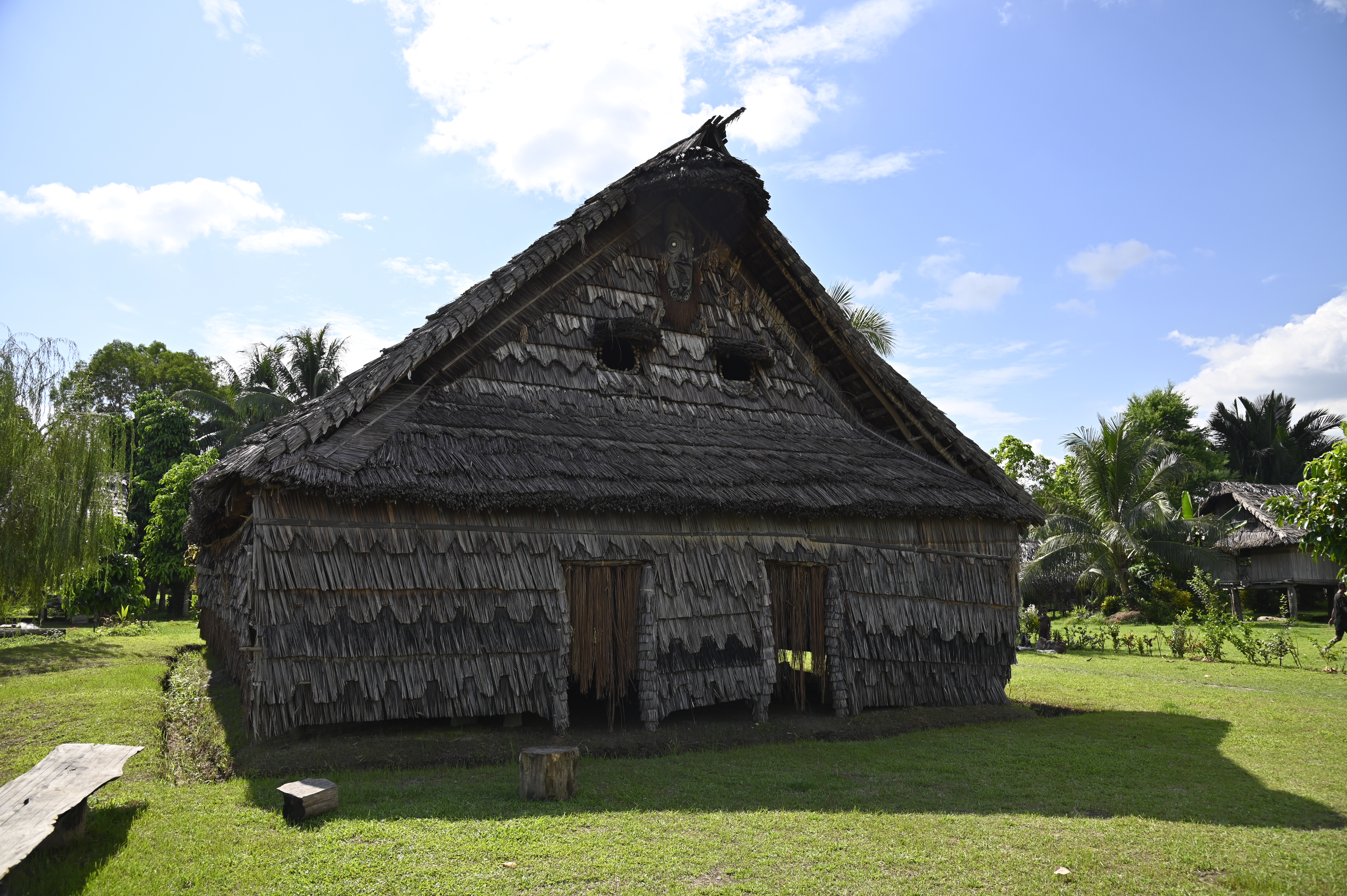
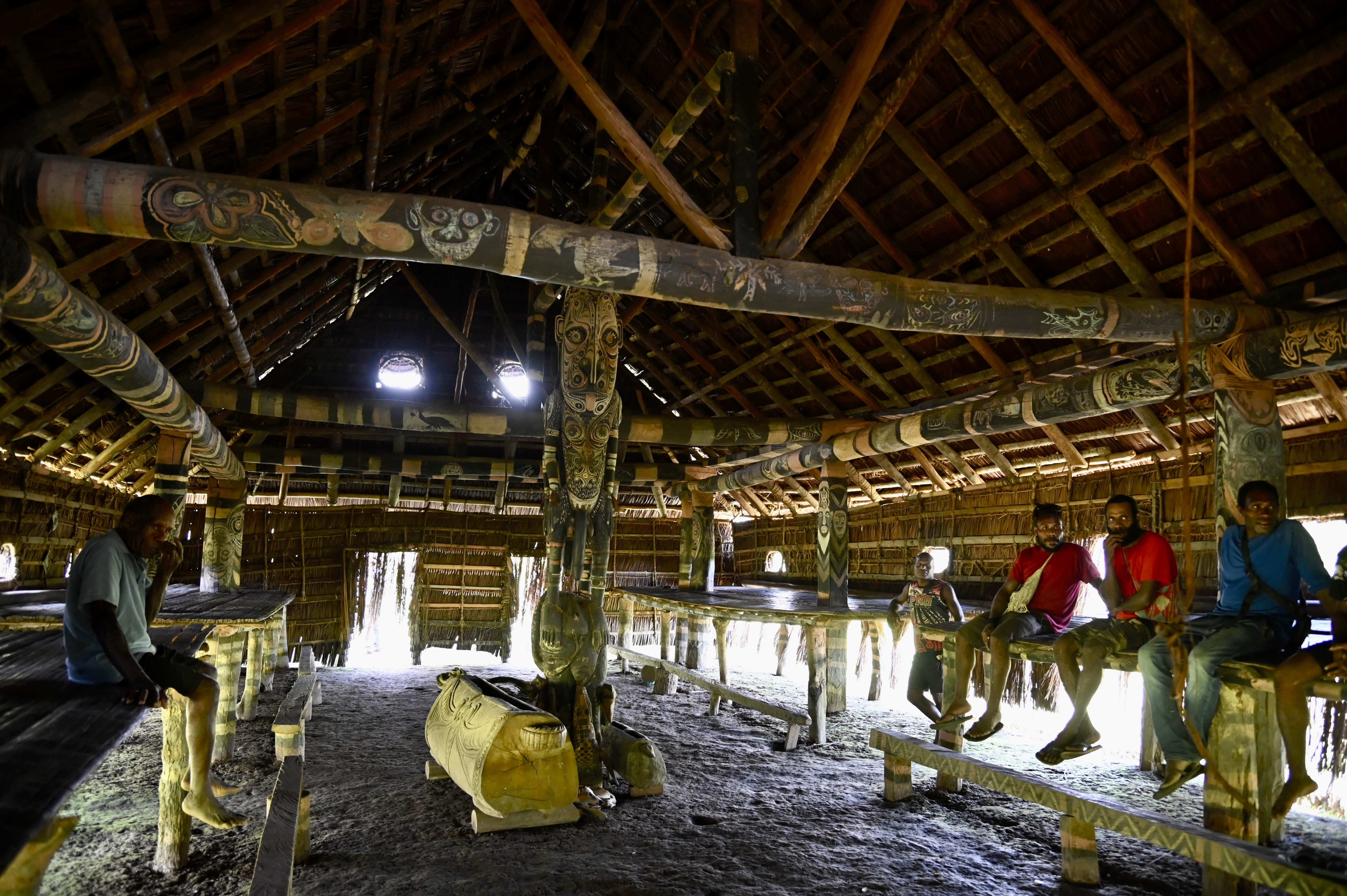
The first stop was so that we could see a demonstration of how disputes are resolved among tribal members. One of my travel mates is a very successful attorney, who had served multiple times as a first chair trial lawyer, so for him this was absolutely fascinating. We entered a men’s spirit house. The two sides of the dispute – a handful of men (it would never be woman, as we asked and were answered) – stood on either side of an intricately carved stool. The stool was not for sitting; instead, it was a protecting and presiding spirit on which sat a bundle of leaves. Each side would take turns explaining their side of the story – in our case, a man was accused of cutting down a tree on another man’s land. As emphasis in making a point, the speaker would strike the stool with the leaves, sometimes leaving a few of the leaves on the stool as his argument progressed. The other side of the dispute would then take-up the leaves and make a counter argument. This could go on for hours or even days, as was explained to us, until – finally – agreement was reached or a chief made a final ruling.
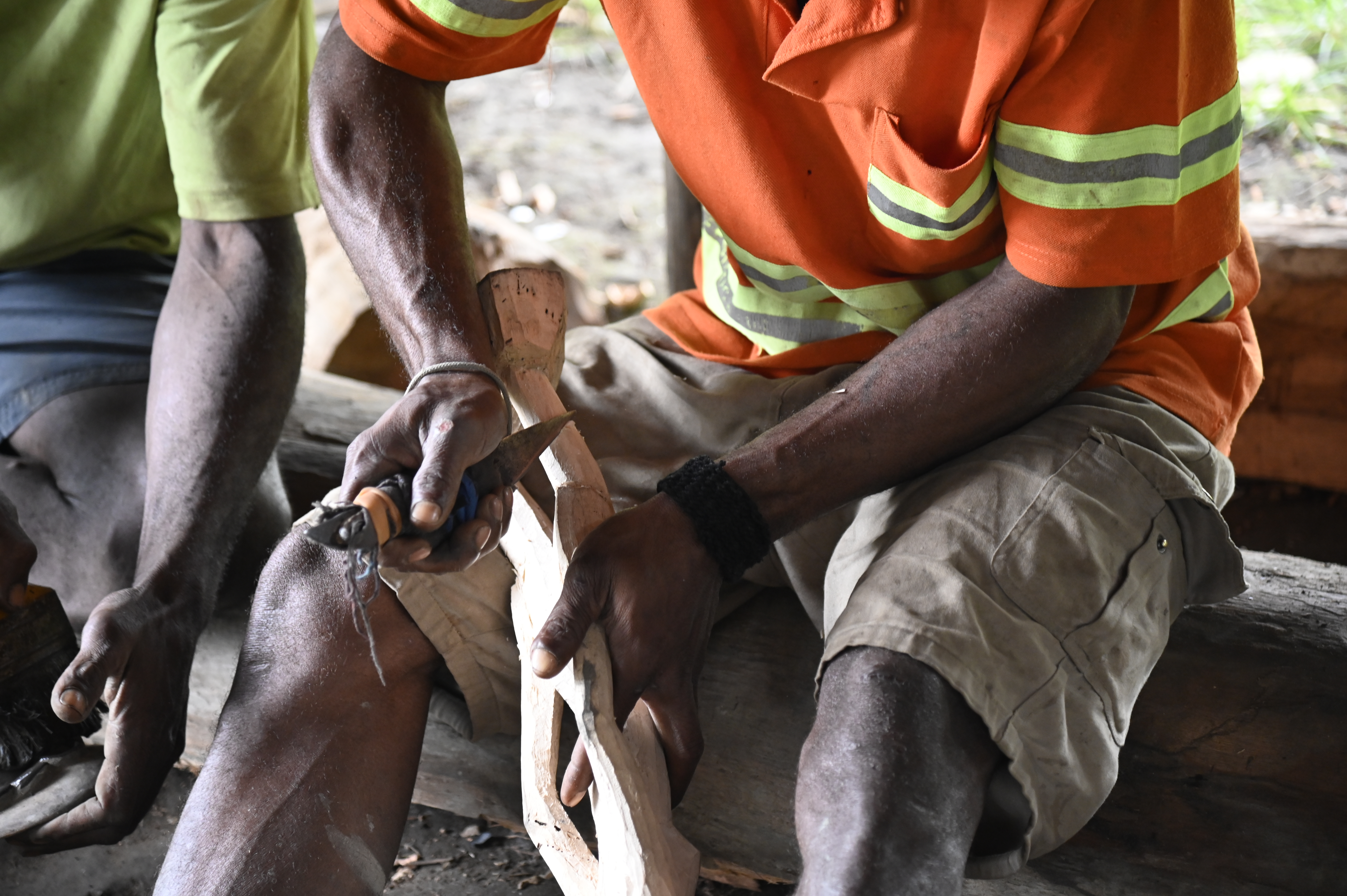
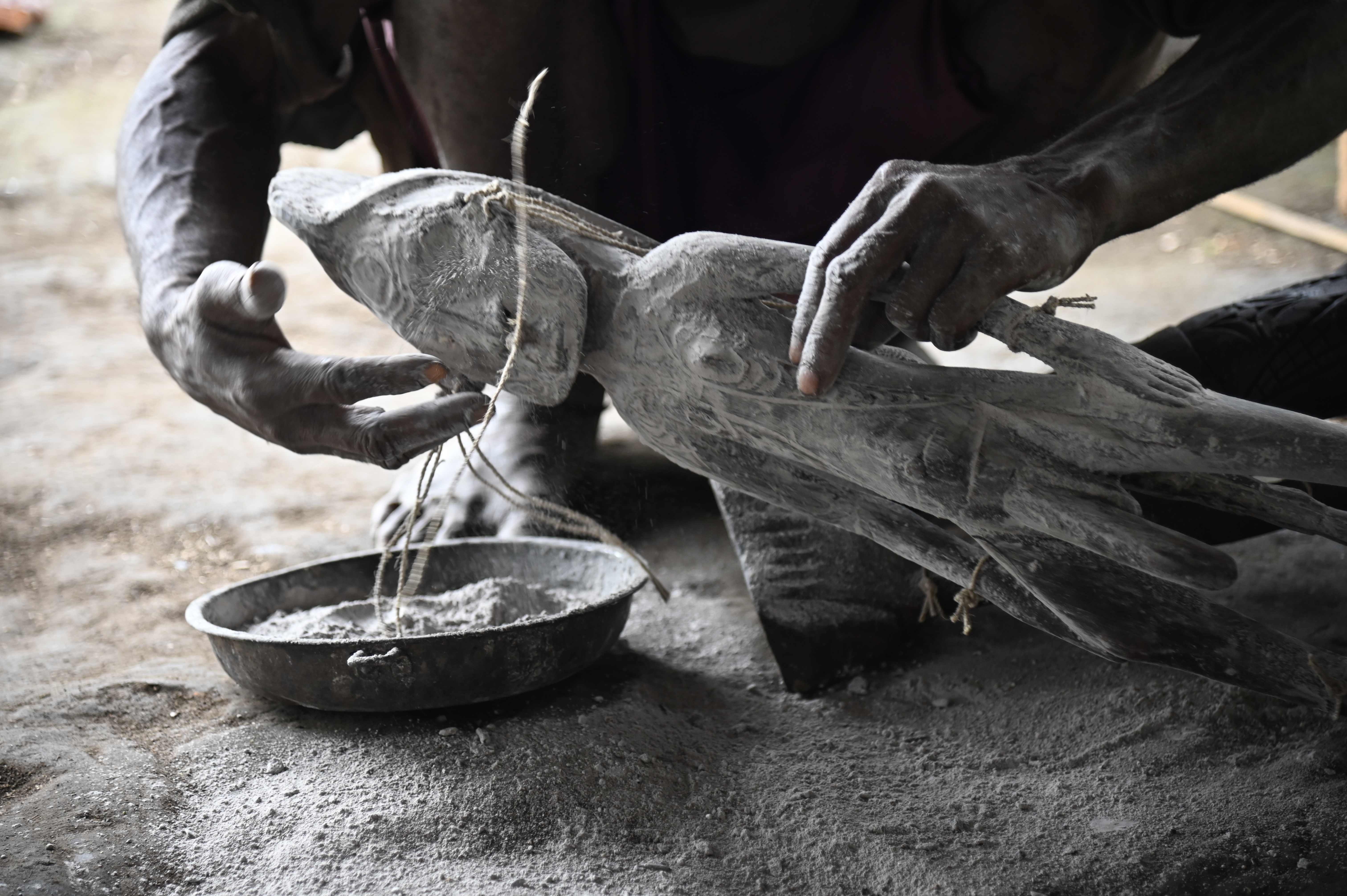
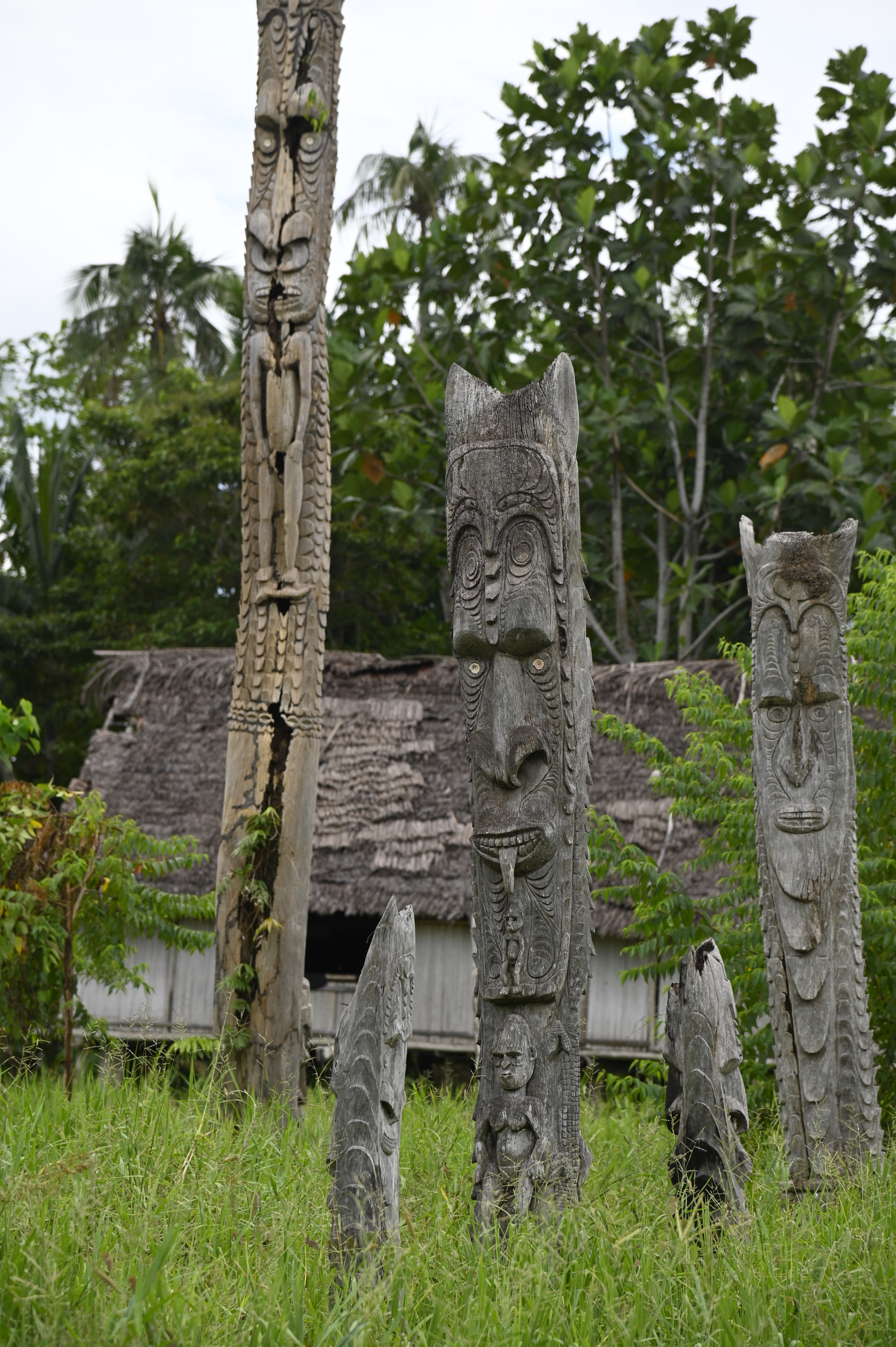
At the second stop, we saw and watched how a set of intricate carving was done – with an axe for rough-cutting, and finer blades for more detail, to painting with a type of oil as a finish, to – finally – a covering in ash to age the piece. This village is well-known for its carving, and we saw incredibly intricate and large examples – include a pair of 8 ft long serpents and a totem representing the village, both of which were being carved to fulfill an order placed by someone from Thailand. The cost of the carving would thus have to include shipping – from the village where we were (Mindimbit) by river to the closest city – Wewak, the capital of the East Sepik Province – and from there to wherever.
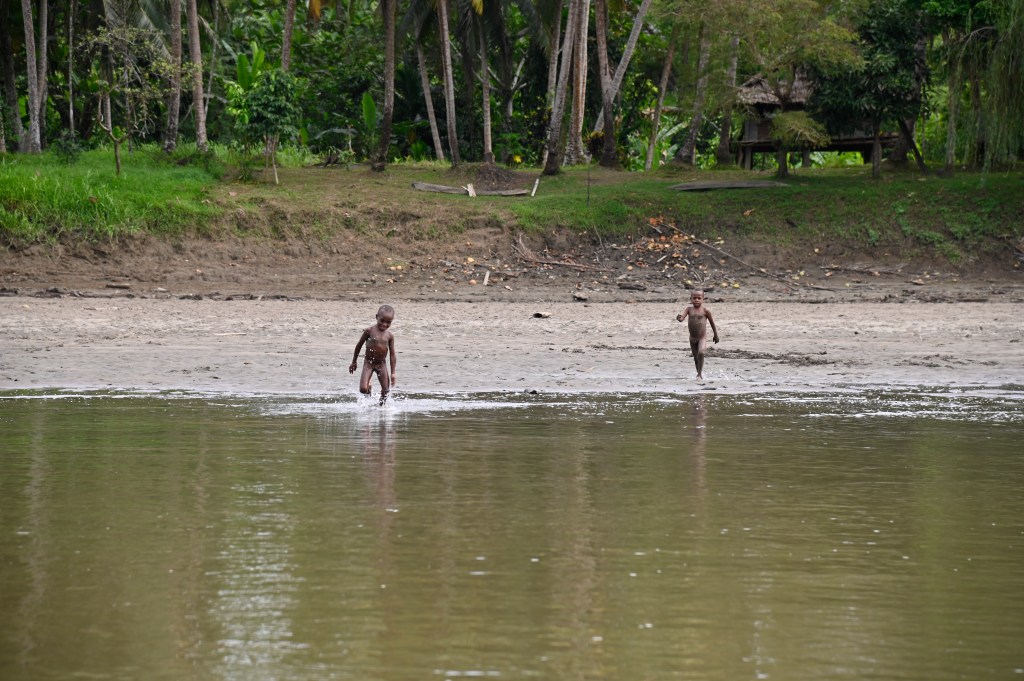
After the second visit, we stepped back onto our boat to return to the Sepik Spirit. Our driver – Brian – continued as he always had – going along the shoreline to flush-out birds, slowing down for photos as he saw us pull-out our cameras, and always careful when he saw locals nearby in their canoes so as not to rock them with our wake; the one exception to that rule was when there were children swimming on the edge of the river near the bank – they loved the wake Brian created and directed, when he could, toward them. He worked hard for our experience, and I came to think of him as the safari driver of the river.
We had lunch on board and then proceeded on the Sepik Spirit so that we would be positioned further south on the Karawari for our morning return to the airstrip. Along the way, we hopped back into the flat-bottom boat for one last stop: a small village where we’d get a chance to see a crocodile farm.
Our imaginations went wild. We envisioned what you might experience in the Florida everglades: multiple large crocs in a gated set of cages built into the river, with raw chicken carcasses nearby so that they could be tossed to the crocs so we could watch their ability in catching them and strength and voraciousness in eating them.
That’s not what we saw.
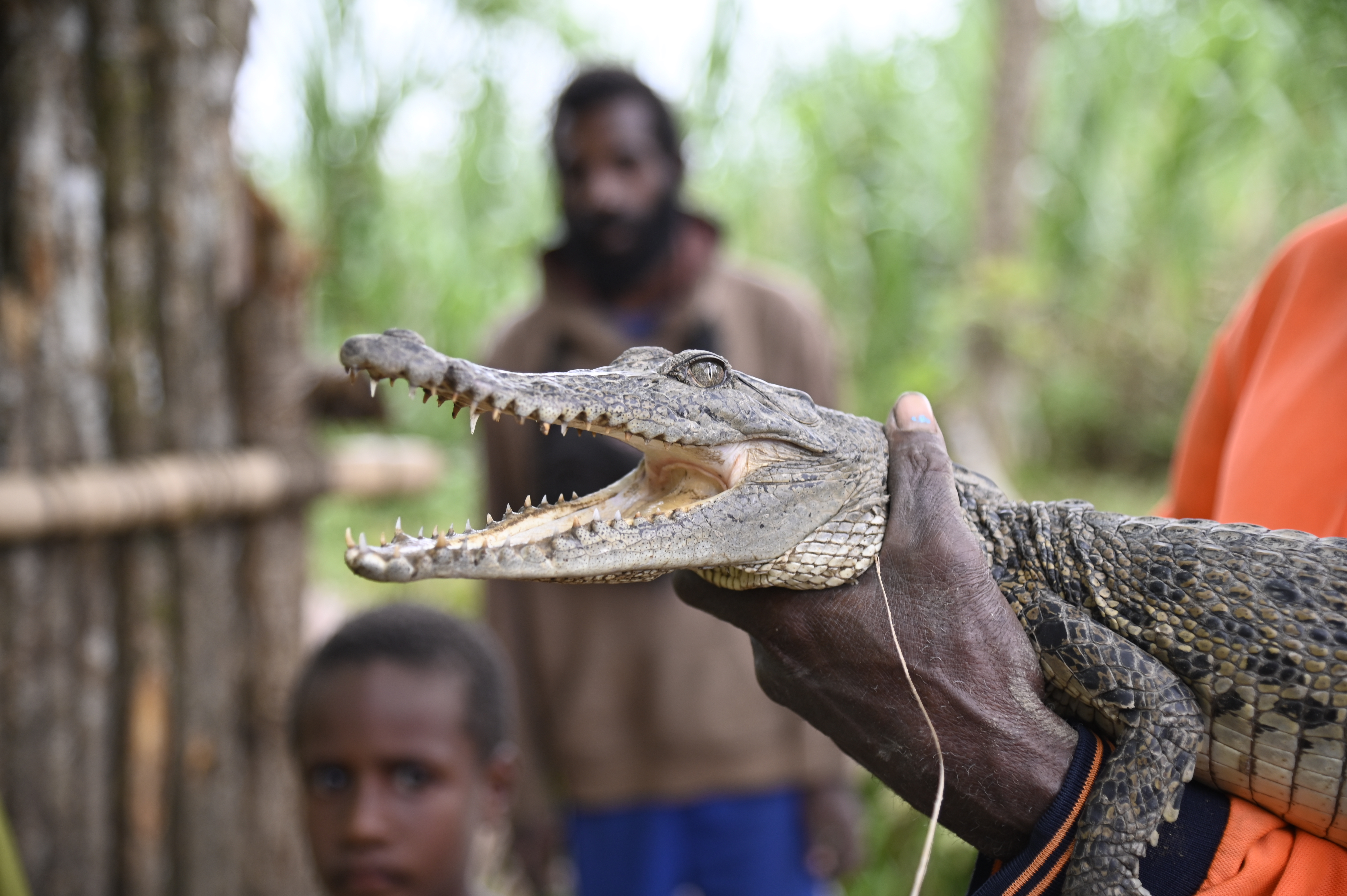
There was a 3-ft square enclosure, with the fencing – about 3-ft tall – likely made of sago palm wood. Inside were three freshwater crocodiles. A small one, a slightly smaller one, and a much smaller one. Gratefully, the keeper of the beasts pulled the two larger ones out for us to see. He offered the medium-sized one to hold to those of us who so dared. So – done! But I wanted to hold the larger one. The keepers thought for a bit. They then grabbed some reeds from a nearby plant and slowly wrapped them tightly around the end of the croc’s snout so that it couldn’t open its mouth.
They carefully handed me the big guy (for whatever reason, I thought the croc was male). All four feet of him. He was hefty but completely docile, and I posed for some pics. Then another of my travel mates – the same woman who had led our touching of the large dead croc on the boat’s deck the prior morning – also wanted to hold the croc, and she did with the obligatory pics. Then her husband – the attorney who had been fascinated by the dispute resolution – wanted in on the action. His wife carefully handed him the croc, which immediately began to urinate, getting some on the poor guy’s shoes and shorts and camera. I’m sure there’s a joke to be made about a lawyer and crocodile pee, but I’m not smart enough to come up with it.
We once again boarded The Sepik Spirit, continuing our journey back south to a spot from which we’d take the flat-bottom boat back to the airstrip in the morning. For the rest of the afternoon we relaxed in the boat’s lounge, reading, editing photos, chatting. After dinner, I stayed in the lounge talking to the crew, who were interested in seeing photos and hearing stories from some of my prior trips, so I shared with them tales of Antarctica, my chimpanzee and gorilla treks in Uganda, and my most recent trip to Bhutan and Nepal.
Day eleven started with breakfast at 4:45 a.m. so that we could leave for the airstrip by 5:30 or so. That departure was delayed until about 5:50, and we left on three flat-bottomed boats: two to handle our split group of 14 people, plus the third to handle our luggage. This was done so that each of the three boats could move a bit faster than usual.
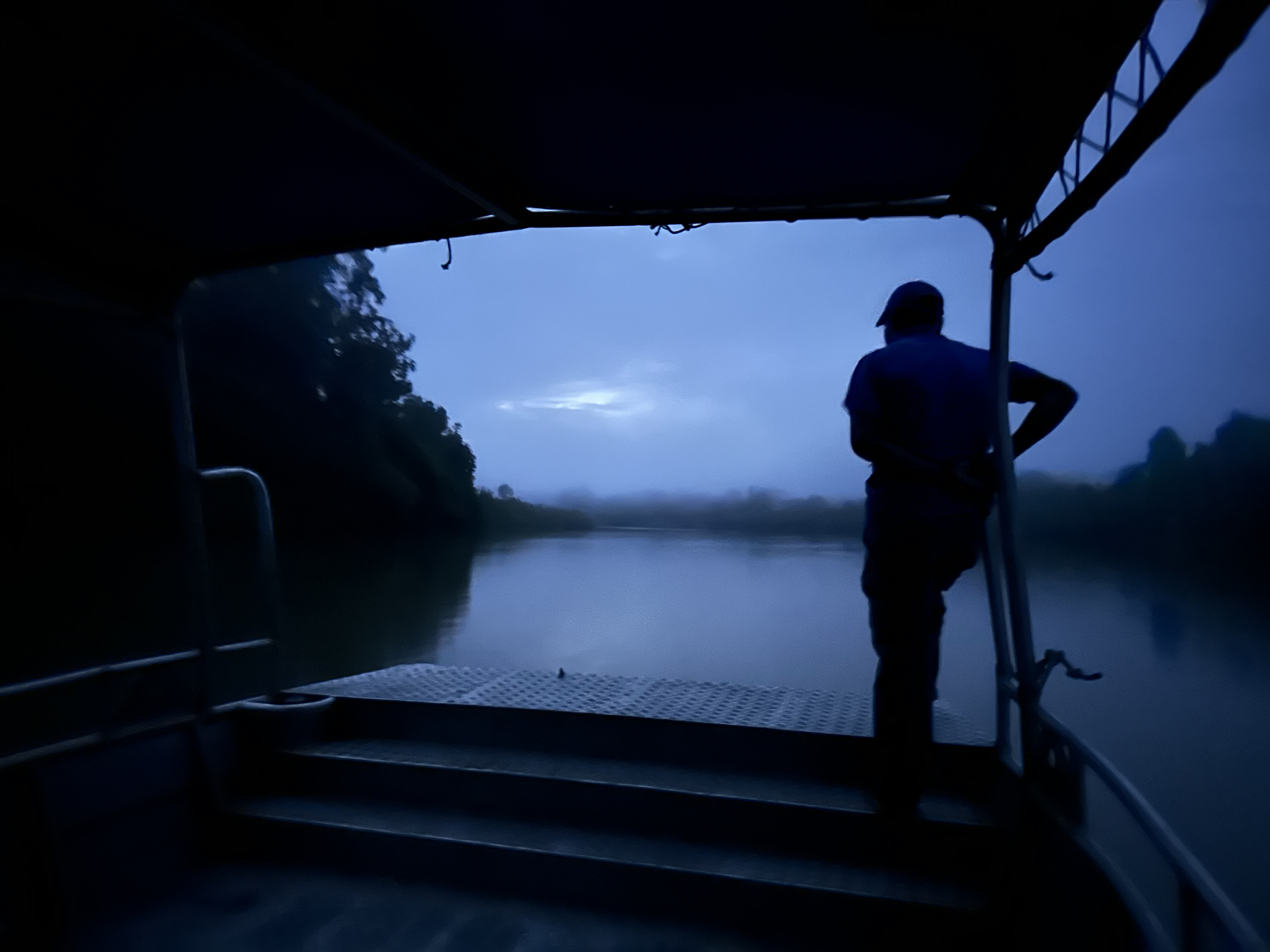
It was pre-dawn when we left, almost completely dark as there only was star and moon-light on the river (I have one video of about 30 seconds that is nothing but blackness). The drivers, though, could see well enough, and the light gradually came as we continued south. For the Vietnam vet who was with us, he later told me this was another time for him of quiet contemplation: a 150 ft-wide river, edged by jungle, in the morning mist. One of my fellow travelers commented that it looked like a Monet painting. As the sun rose, we began to see life along the river’s edge – birds, people, and fish snapping at bugs on the river’s surface.
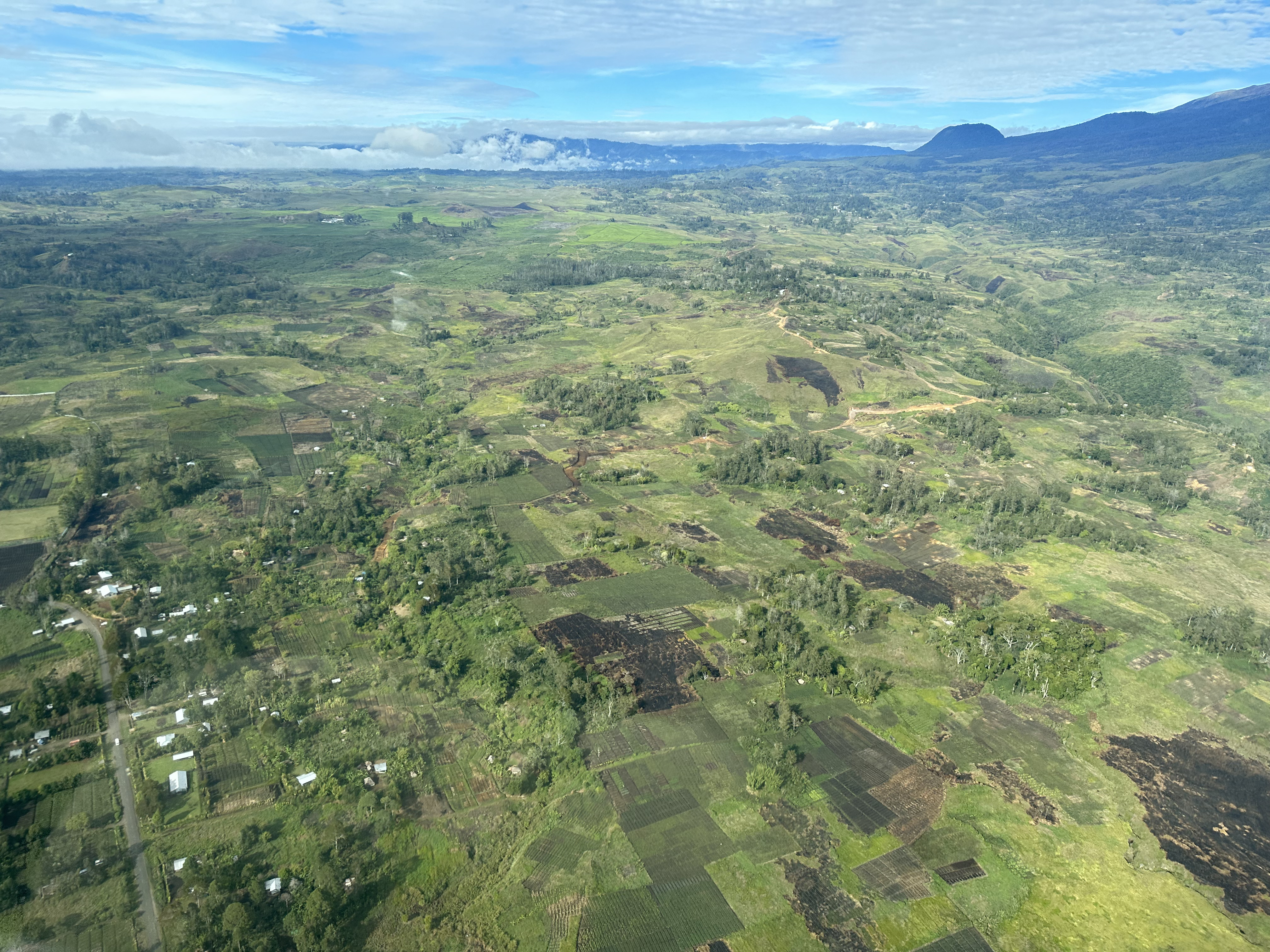
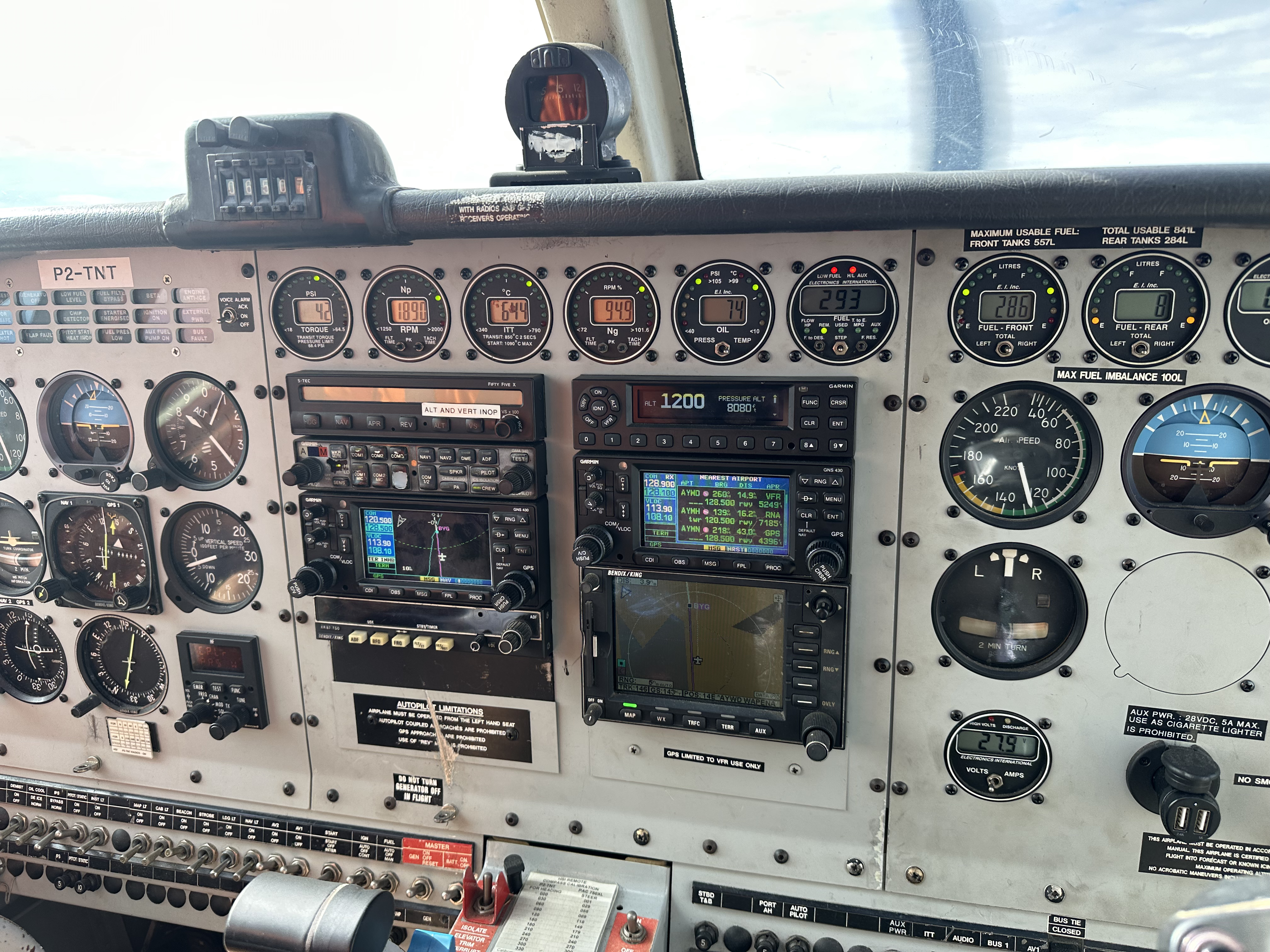
We arrived at the airport in time for a scheduled 7:30 a.m. departure, with our group of fourteen split between two flights along with two other passengers. I got to sit in the co-pilot’s seat alongside Sam, the same New Zealander who had piloted our inbound flight just a few days prior. I rode with the headphones on, careful not to touch any of the controls or pedals, and Sam explained how the measure of altitude worked as we flew (the plane gathers information on air-pressure – which has a constant as altitude increases, and the instrument displays that calculated altitude). As the green hills and mountains of the Western Highlands Province began to rise-up in front of us, Sam also explained had the Highlands – where we were headed – had the best agriculture in the country, with fruits and vegetables from there shipped throughout PNG, and we could see the large number of small family farms from the air.
We had some concern that the Mount Hagen airport – where we were headed – might be too cloudy to land at, but Sam had told us there was another strip nearby we could use if that happened. As we flew, though, Sam pointed out how the wispiness of the tops of the clouds in the distance was an indication to him that the clouds were lifting; he spotted a hole in the clouds where the Mt Hagen airport was, and we headed directly there. The gap broadened as we got closer, and we landed at about 9 a.m.
What we did over the rest of this day and the next I’ll save for my next post.
[Clicking on an image below will enlarge it in a new window]
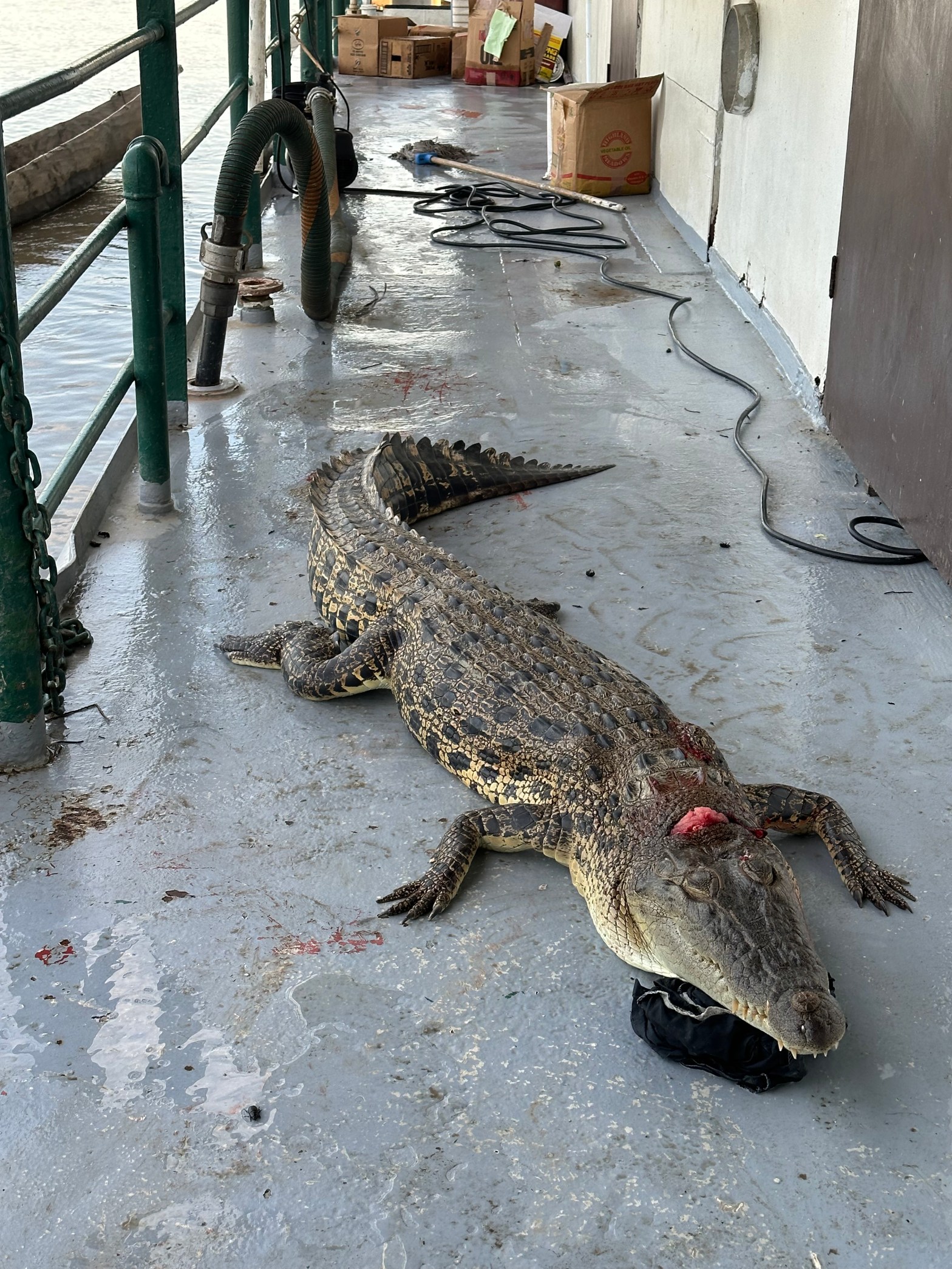
When I left my room at seven a.m. on the morning of day nine, our tour director, Deb, stopped to tell me that there was a crocodile on the deck outside.
It was a dead one.
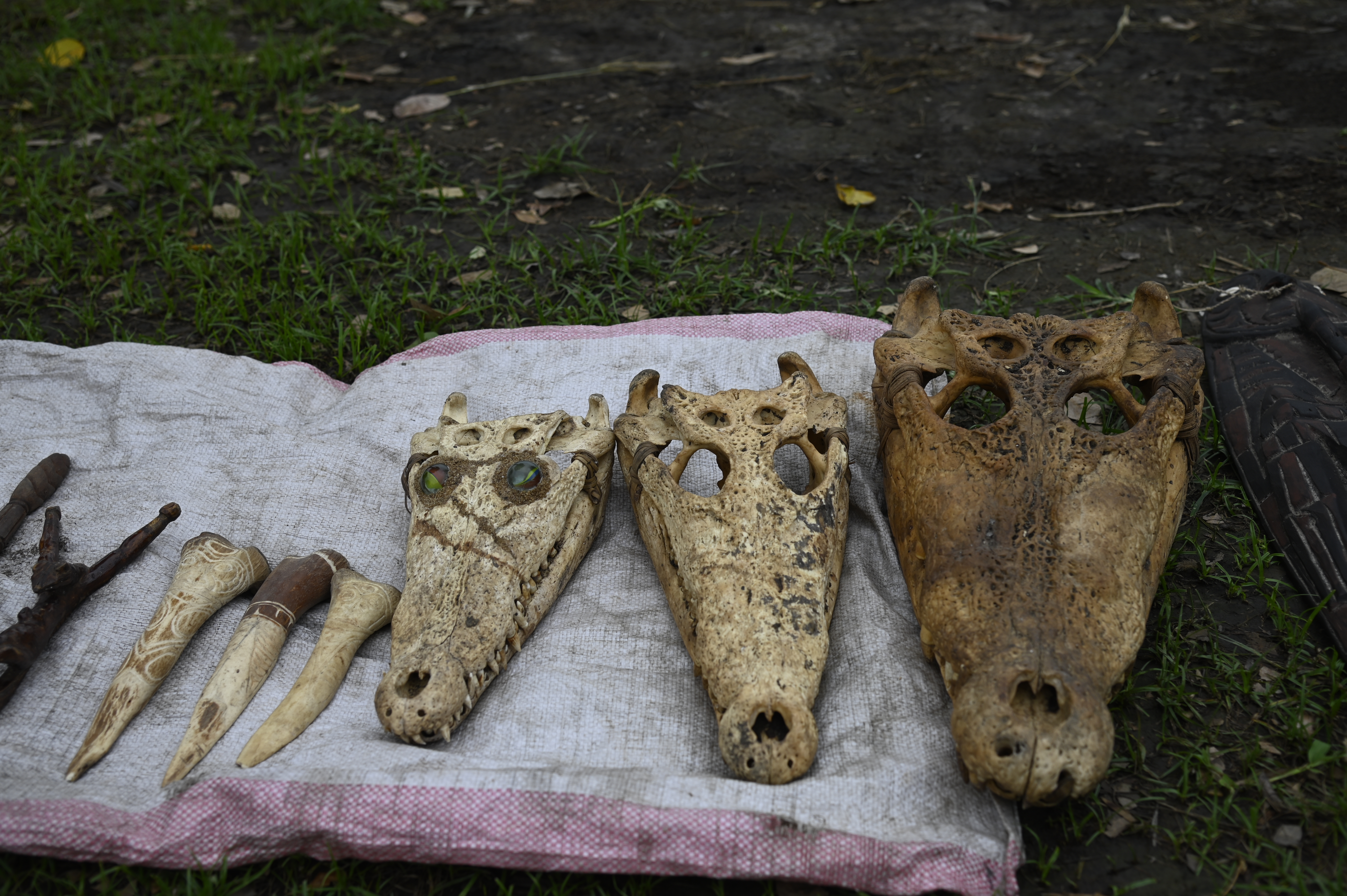
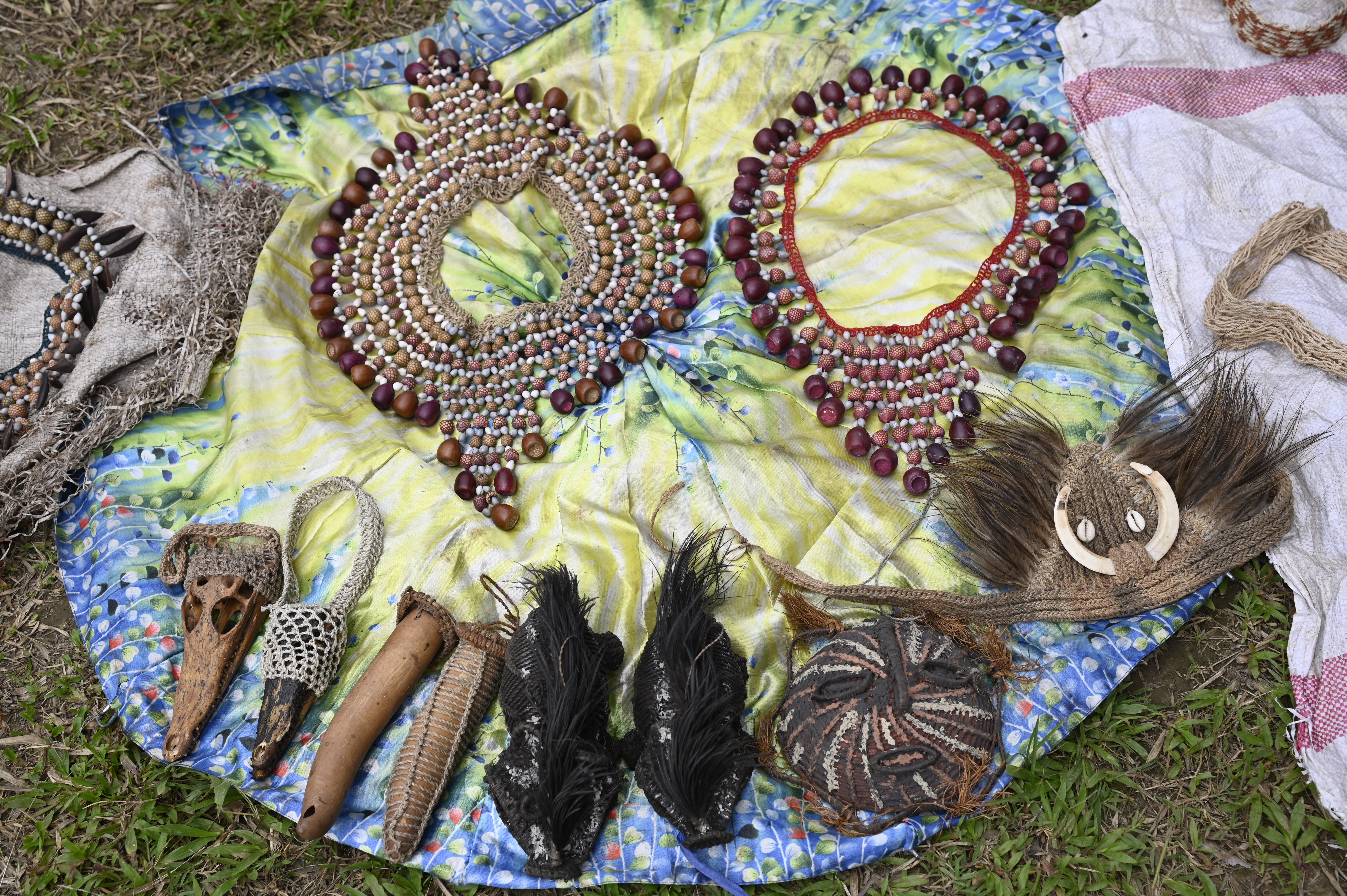
As it turned out, a local merchant – Ronny – had planned on stopping by the Sepik Spirit early to try and sell us a variety of locally-made crafts – masks, spoons and letter openers carved from boar bone, necklaces and bracelets made from nuts and seeds and beads, wood carvings, etc. The prior evening, he and his crew had come across, captured, and killed the saltwater crocodile that was now on deck.
How’d they do that? As Ronny told the story, they first speared and wounded it. They then got a piece of rope around it so that they could hold onto it while it struggled and tired. Eventually, they were able to club it, and then slay it with an axe or knife by severing its spinal cord. That death-blow was still visible on the croc as it lay on the deck for us to see. One of my travel mates and I were curious enough that we poked and probed at it, feeling its heft, its scales, and – yes – its soft underbelly.
Deb purchased the croc, with the idea that our chefs might cook some of it for dinner, then the crew would keep the rest for whatever purpose they wanted. And Ronny still had his crafts on display as well.
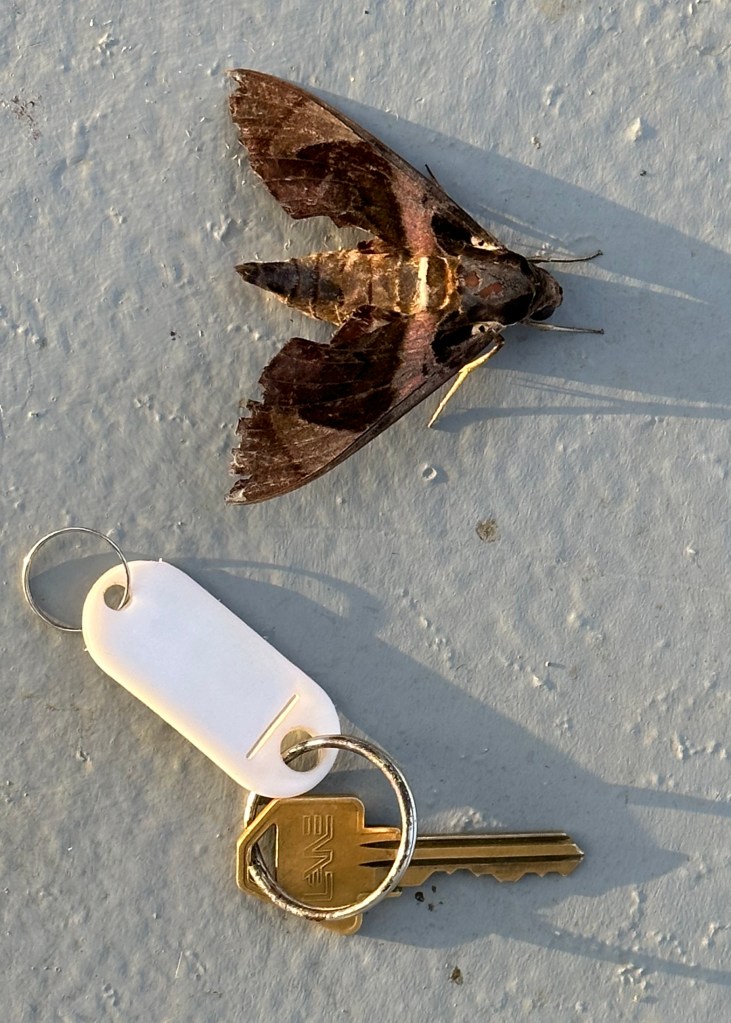
In addition to the dead croc, we also had a number of large moths – like the one I’d wrestled with in my room – just sticking around the front deck of the boat. They were so big that they cast shadows.
We learned that Joseph, who would have been the usual guide for our time on the Sepik Spirit, had passed away unexpectedly a few weeks prior, and that’s why Paul was our lead guide instead. Joseph’s village was nearby and there was to be a mourning ceremony there, which most of our crew hoped to attend.
After breakfast, we all loaded into the flat-bottom boat to head on to the Korosameri River (if you recall, we were then moored at the confluence of this river – also known as the “Cross Mary” and “Angry Woman” – and the Karawari).
We cruised for about an hour past tall reeds, birds, the occasional village (including Joseph’s where we saw mourning shelters going up) until we reached the Blackwater Lakes Region, which we entered via a small tributary. As we entered, the water became more like wetlands – shallower and swampy – we could see the bottom at times – and the growth on the river’s edge became much lower and flatter. There were lots of people out fishing in canoes.
Our first stop would be the village of Sangriman, where we saw a dance demonstration by the Kabriman tribe; the second stop – a village of about 350 people, also the Kambriman tribe – would be to see a woman’s Spirit House and woman’s dance.
For lunch that day, we pulled over under some low trees at the river’s edge. Our crew had taken along a boxed lunch of bean salad, cole slaw, minced meatballs, potatoes salad, cookies, bananas, and water, soda, and beer.
After lunch, we continued to cruise the Blackwater Lakes Region – we saw lots and lots of egrets throughout the day, as well as other birds. At one point, Brian – our captain – abruptly stopped the engine: we had grounded on the shallow waterway, and he and his crew-mate had to hop out and ask us to all move to one side of the boat so that the two of them could push us off the sandy bottom.
Our final stop would be Mumeri, the village of Joseph, the respected guide and local leader who had passed away a few weeks prior. Here we visited a men’s spirit house – a place for men of a group of designated tribes to gather and talk and smoke – and had a chance to walk around. This, too, was the village that Margaret Mead had visited in the early 1930’s.
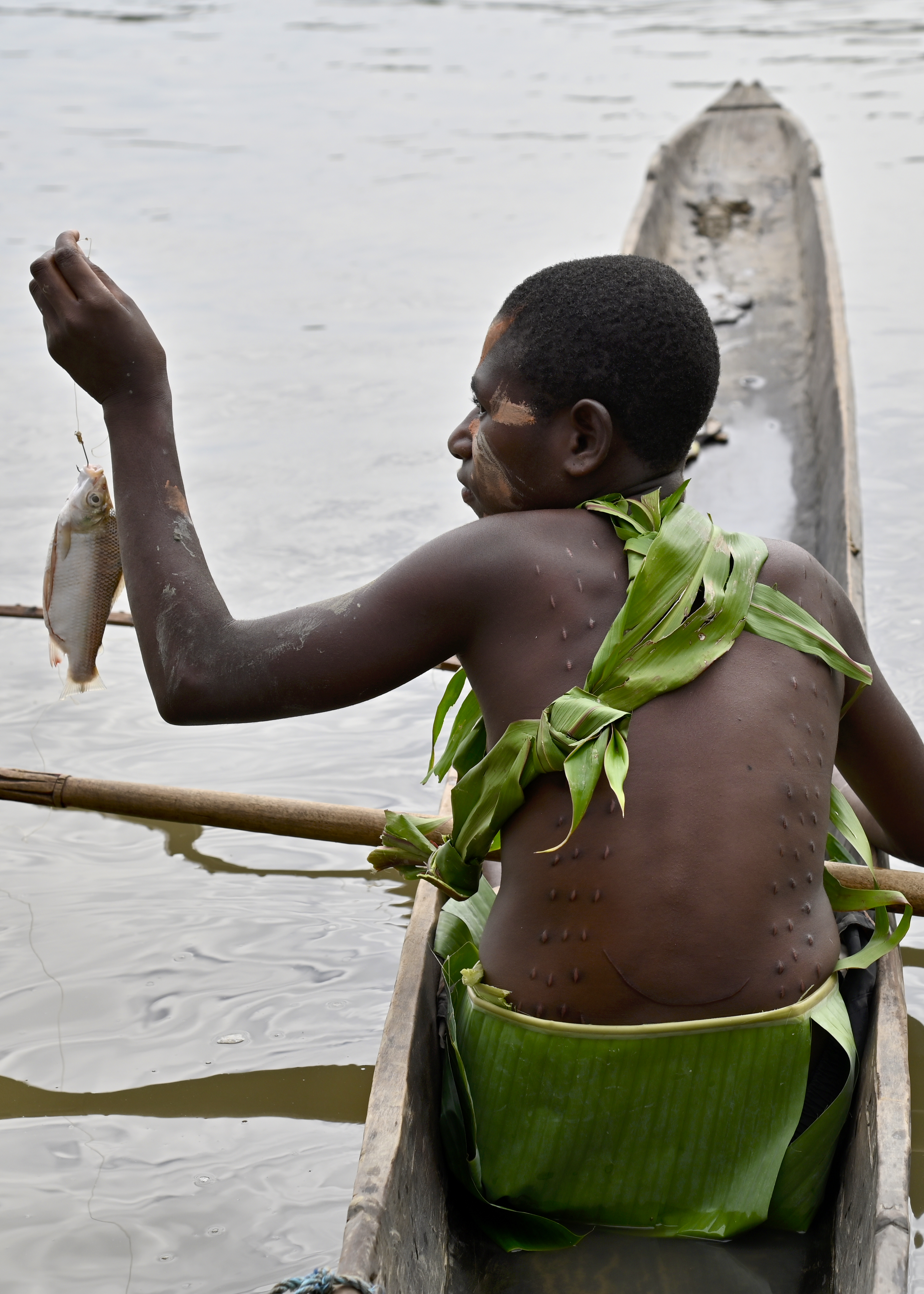
We also had hoped to be able to see men with crocodile scarring – a set of raised scars on their bodies that would be evocative of crocodile scales. Paul, last evening, had told us about the lengthy ritual and care of the scars that would result it what we might see. He explained, as well, that we might have to pay a few Kina – the PNG currency – in order to see and take pictures. But – unfortunately – the water was too shallow this day to get us to the village where we might see the scarring.
All told, we spent from 8:30 until 4:30 on the rivers – long lazy cruising at 30 mph and less, looking for birds and watching people go by as we scanned the river’s edge. We saw no other tourists, as we rode along on flat and still waters, with high clouds, and temps in the 80’s with high humidity when we stopped, but a nice breeze when we cruised.
And our dinner that evening back on the Sepik Spirit included marinated and skewered chunks of crocodile tail, from the beast we’d see on our deck that morning. Some of us were interested in seeing if we could take any of the croc’s teeth back home with us as a souvenir, but the crew wished to keep the remaining parts of the croc for themselves to take back to their villages.
[Clicking on an image below will enlarge it in a new window]
On day eight, the electricity in the Karawari Lodge went back on at six in the morning, starting-up the ceiling fan above my mosquito-net draped bed. There was a beautiful view of the Karawari River from my room, with the sounds of birds and insects and who knows what else. We’d been told, though, that – other than domesticated cats and dogs and the occasional family-farm pig – there weren’t many other mammals around; rats and mice, yes, and wild boars, but no cats, no monkeys, nor predators other than birds of prey and crocodiles. Of these, there are two types – the larger salt water version, which reach 5-6 meters long (they are the largest living reptile), are indigenous, and are caught, sold, and eaten; the fresh water version (which arrived from northern Australia) are smaller – 2-3 meters in length. Regardless, we were unlikely to see either given where we were then located.
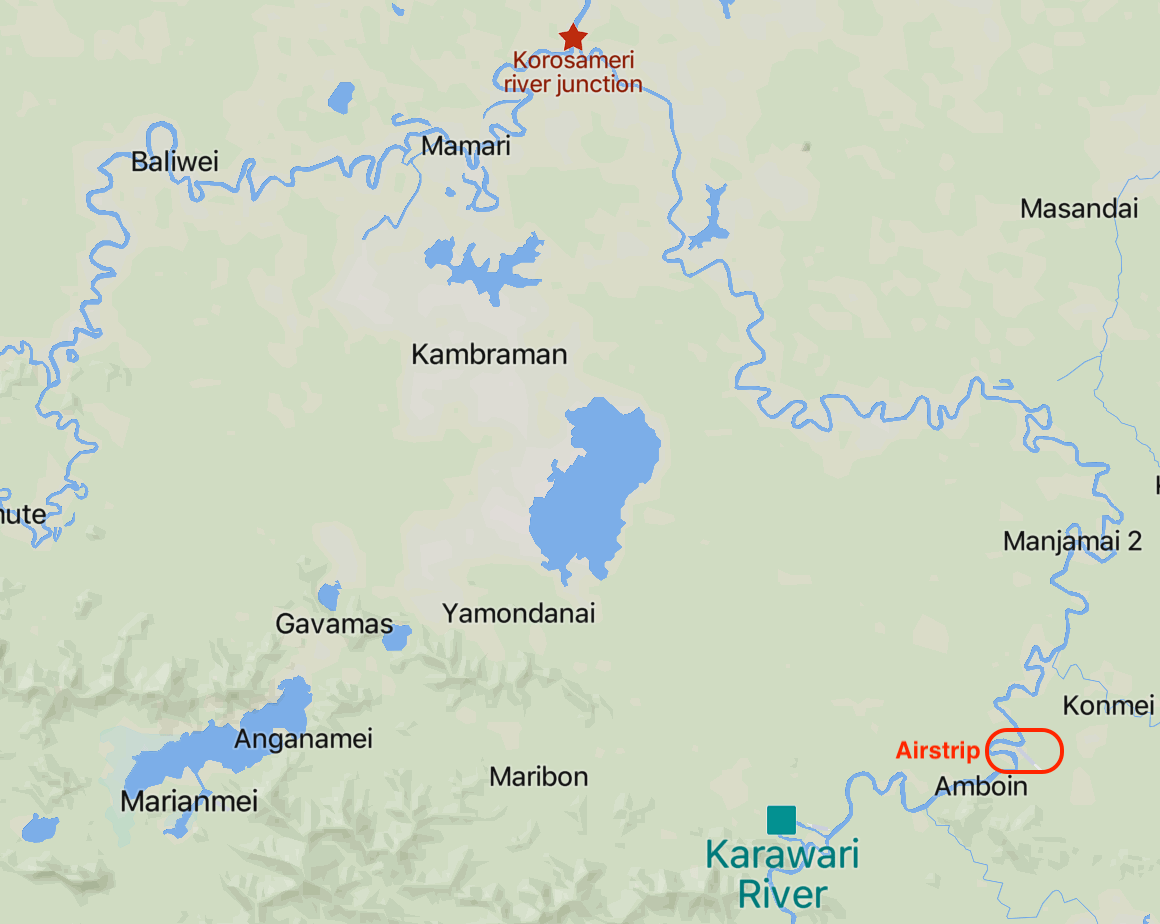
After breakfast, it was time for us to leave the Lodge after only one night. We loaded all of our bags onto the flat-bottomed boat, along with cardboard boxes that contained all of our food for the next three nights/four days. We began our trip headed north on the Karawari, though the river itself twisted and turned as we cruised for three hours. We passed the muddy steps on the river’s edge that led to the airstrip where we’d landed the day before; and, like the day before, Brian – our driver – sped up and slowed down as we moved along the river. Paul, who took over as guide from Chris, pointed out plants along the way – sago palms (which, in addition to food, provide wood for housing and leaves for a wide variety of uses), bananas, tall reeds and grass, tobacco, and more. Apparently the island on which Papua New Guinea sits is the most floristically diverse in the world.
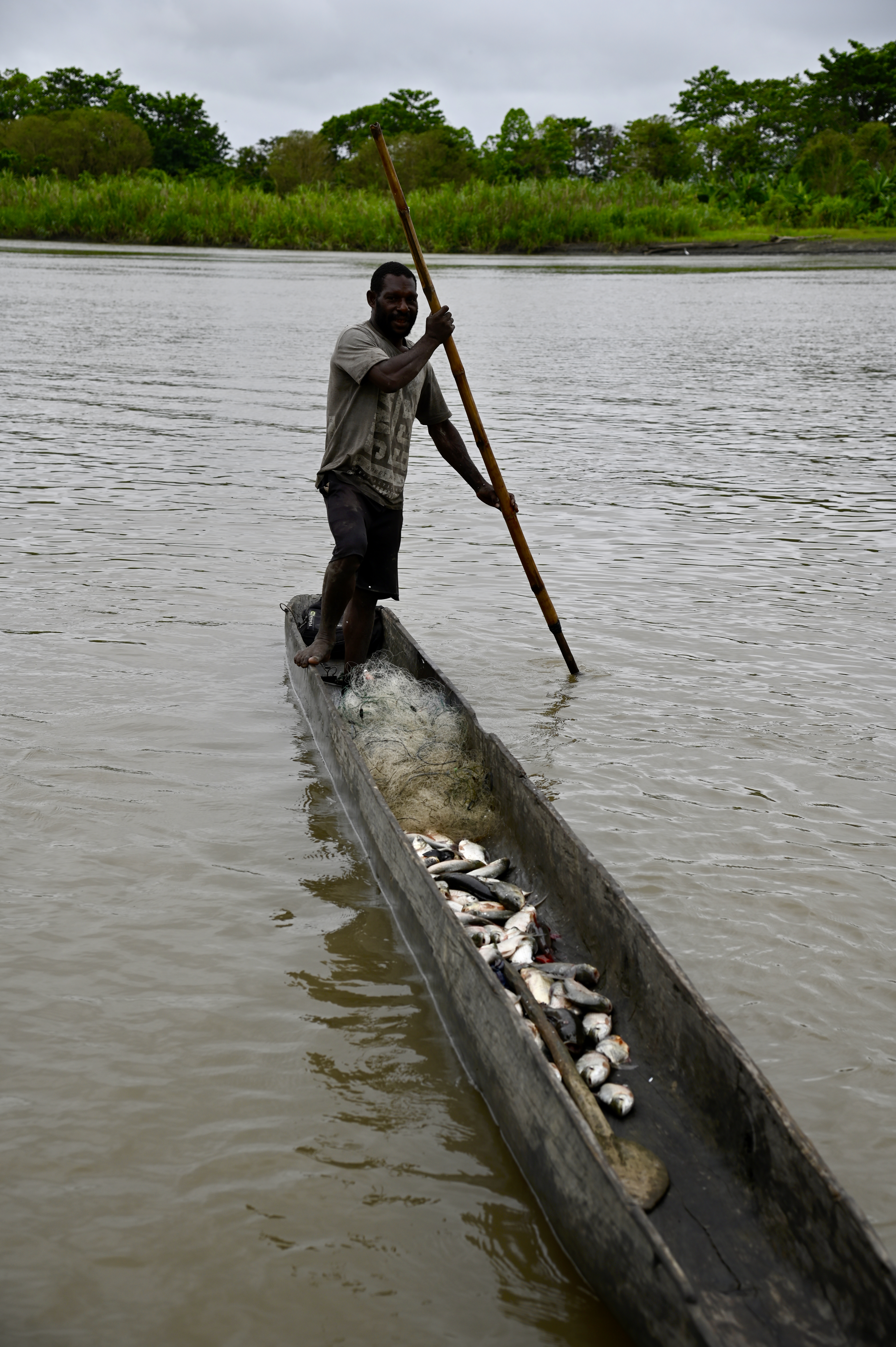
Our first stop along the way was a fishing village named Manjammai, home to about 700 people. They catch a wide-variety of fish – snapper, piranha, perch, catfish, and more – using lines and nets. They eat, cook, and sell the fish, along with other cash crops (the sago palm and betel nuts among them). [Place and tribal names are based upon what our guides told us; I’ve tried to match these up with what info I find on-line, but can’t always – which may have to do with my misunderstandings, spellings, very micro-communities, or local names].
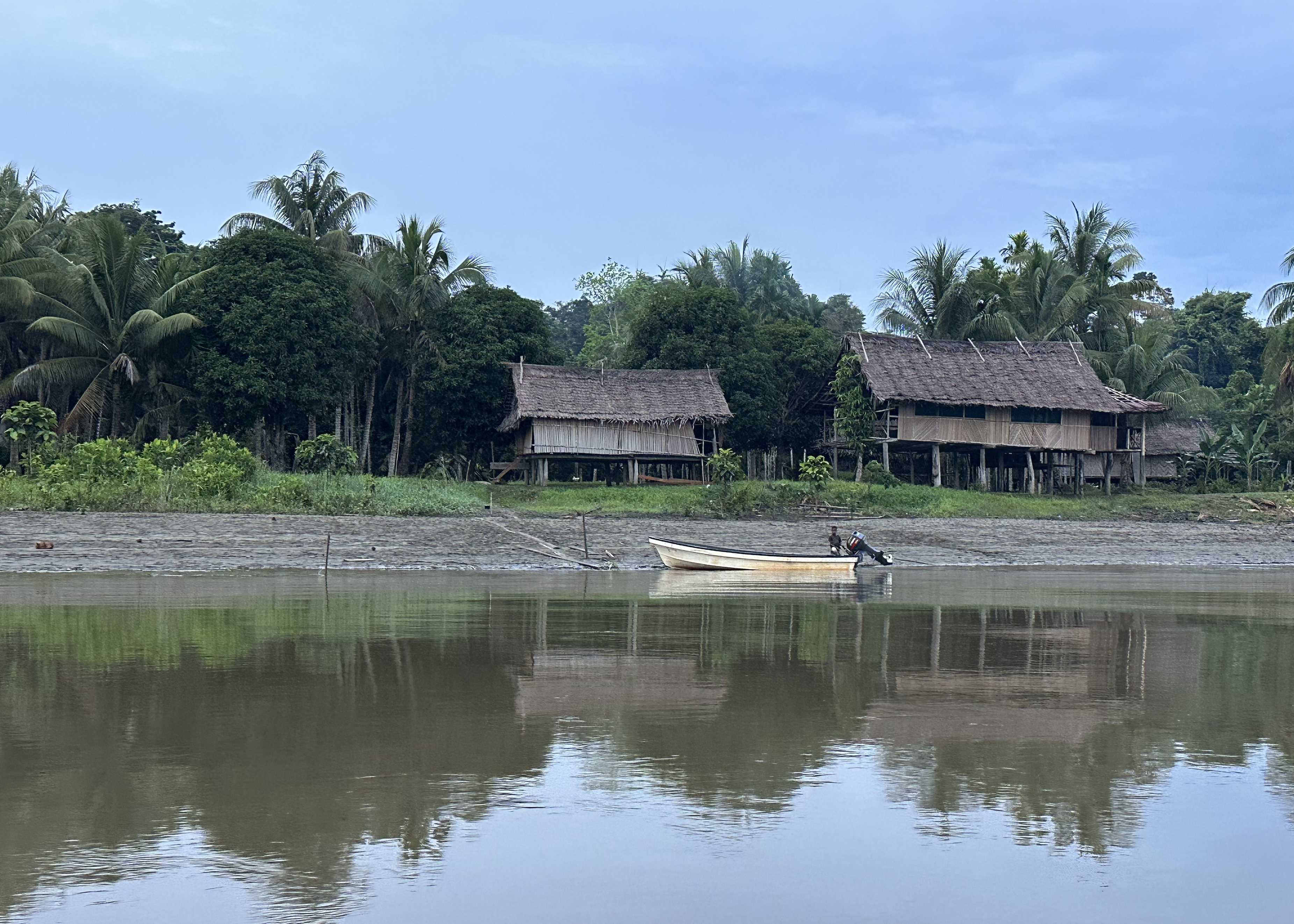
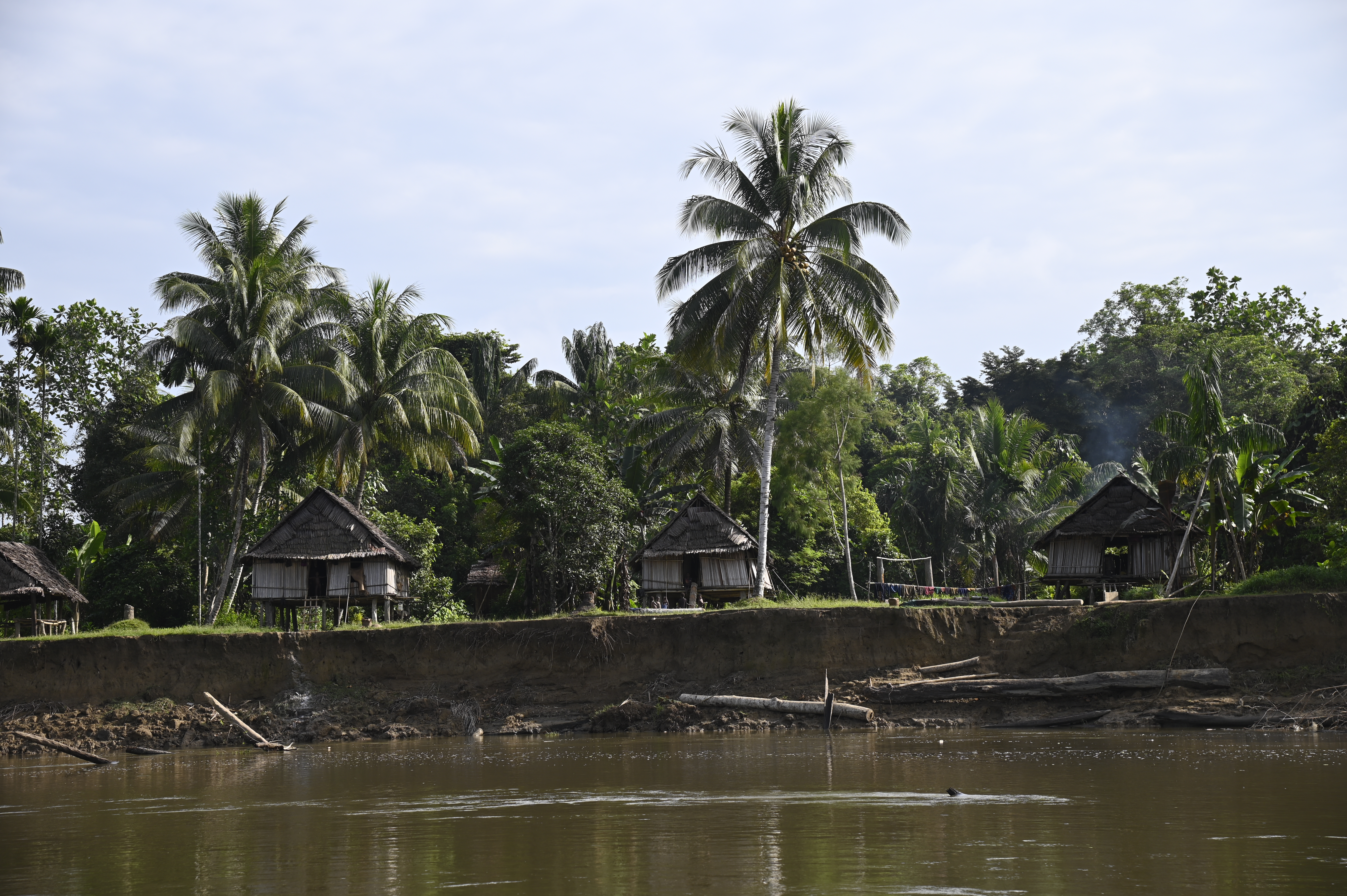
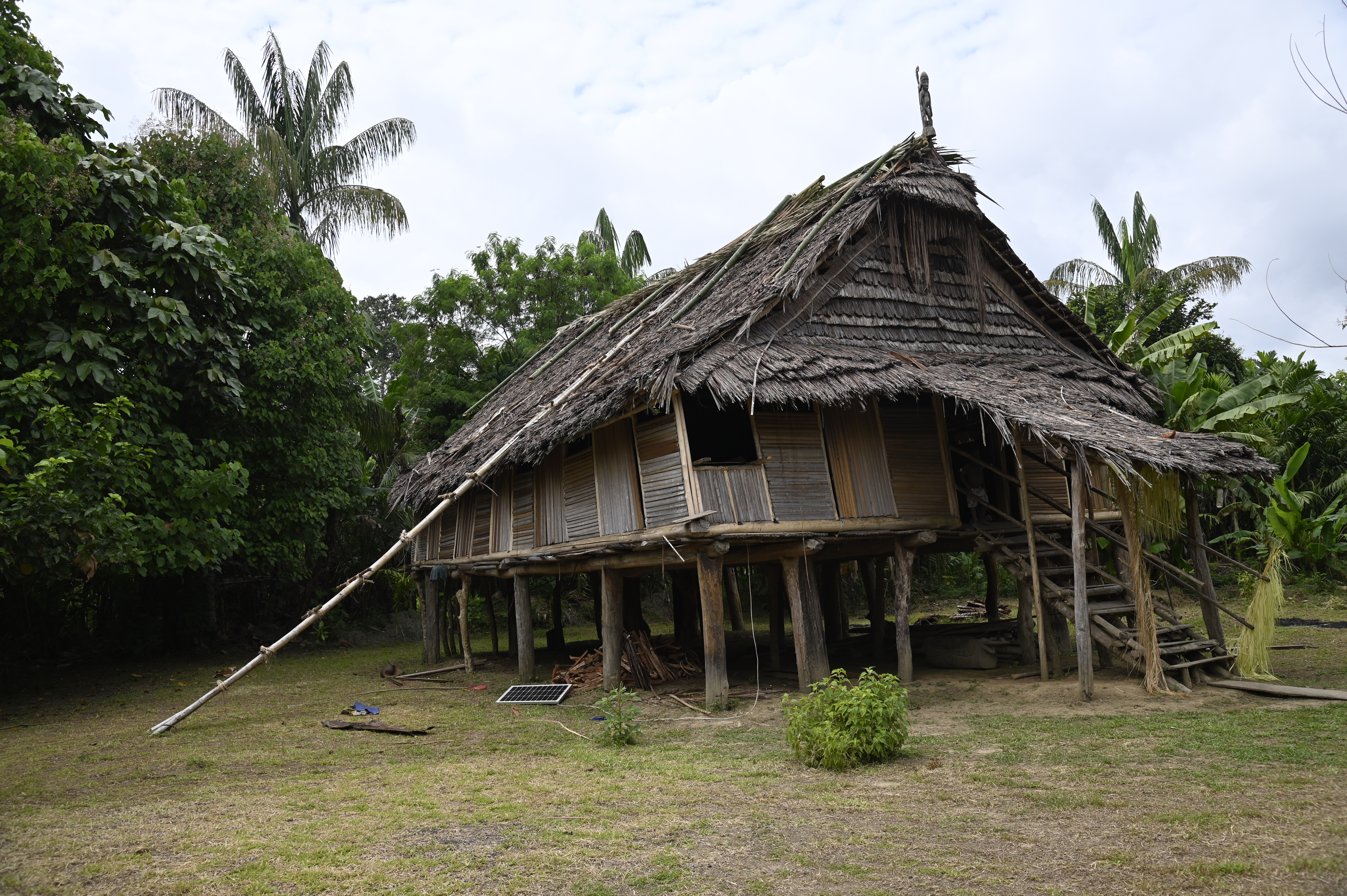
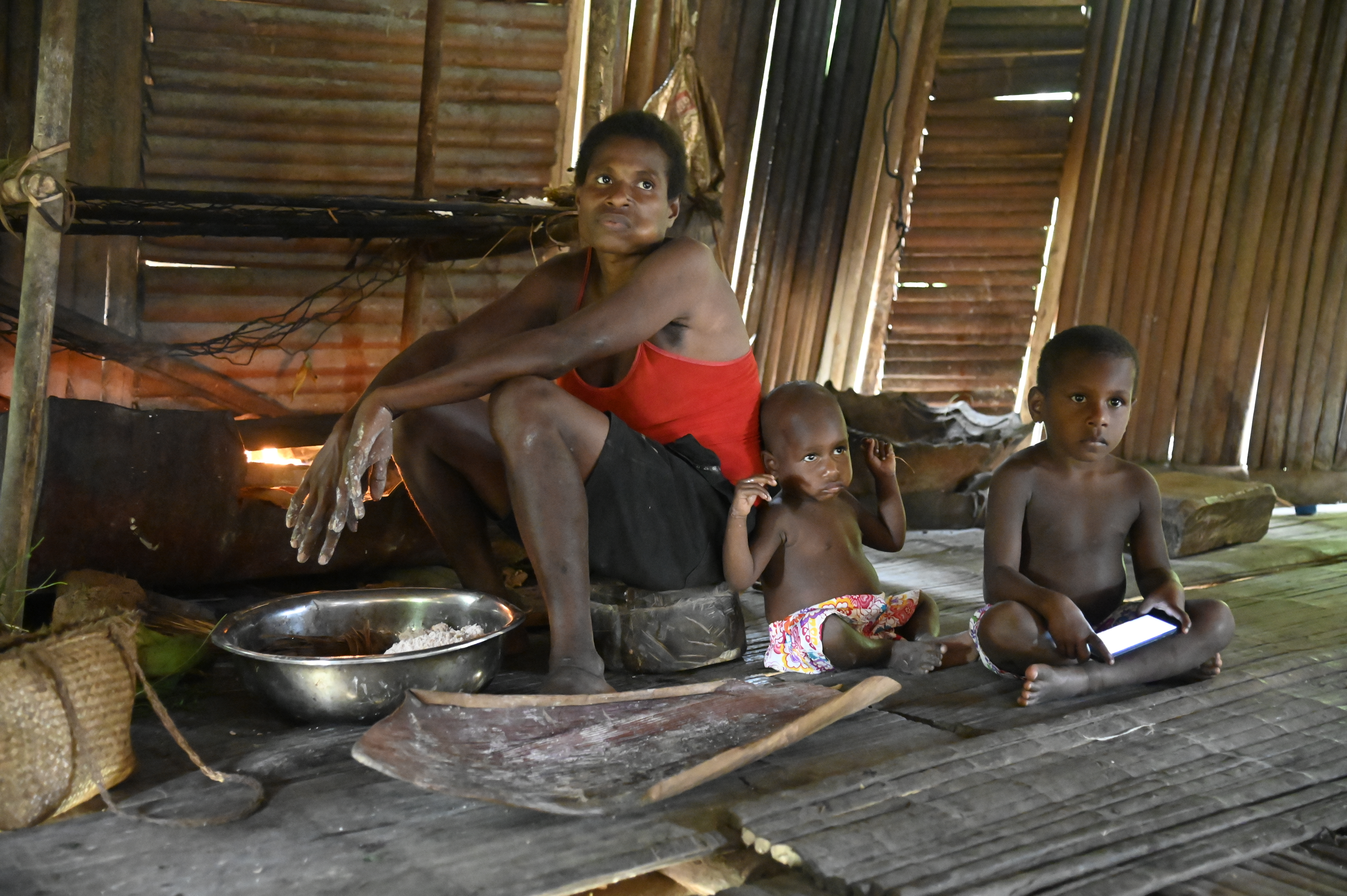
Our second stop gave us a chance to see the inside of a traditional home on stilts; the elevated homes help with air circulation in the warm weather and help prevent flooding during the rainy season. This home was shared by two families, with a cooking area inside. There was a solar panel outside, and a little boy inside holding a cellphone.
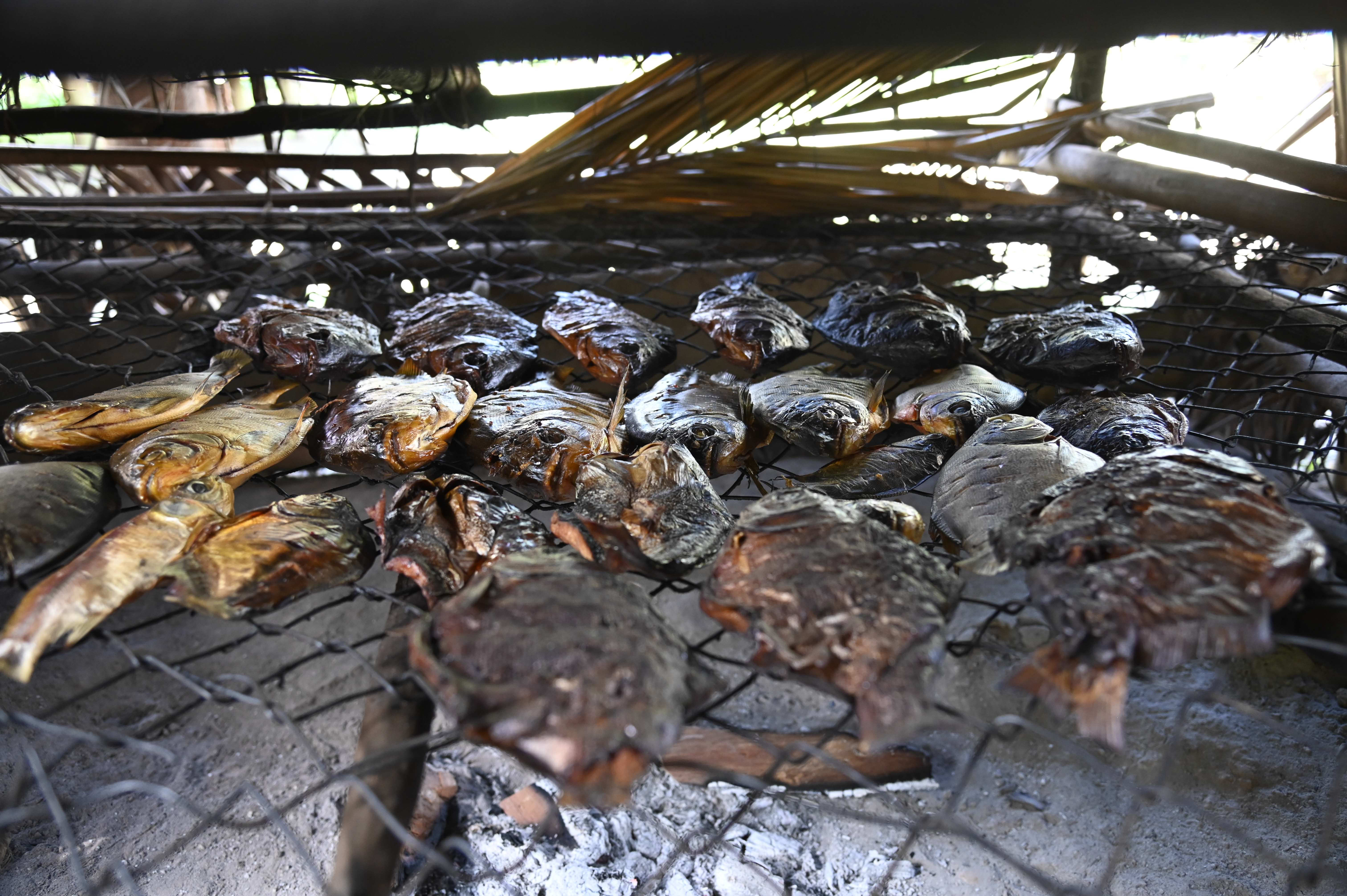
Our third and last stop was the Mikisai Fishing Camp, where we saw fish being smoked, generally done for 2-3 weeks (as we understood) and then either consumed by the villagers or sold to others. At each of the three stops, as we’d experienced the day before, there always was a small collection of local crafts for sale.
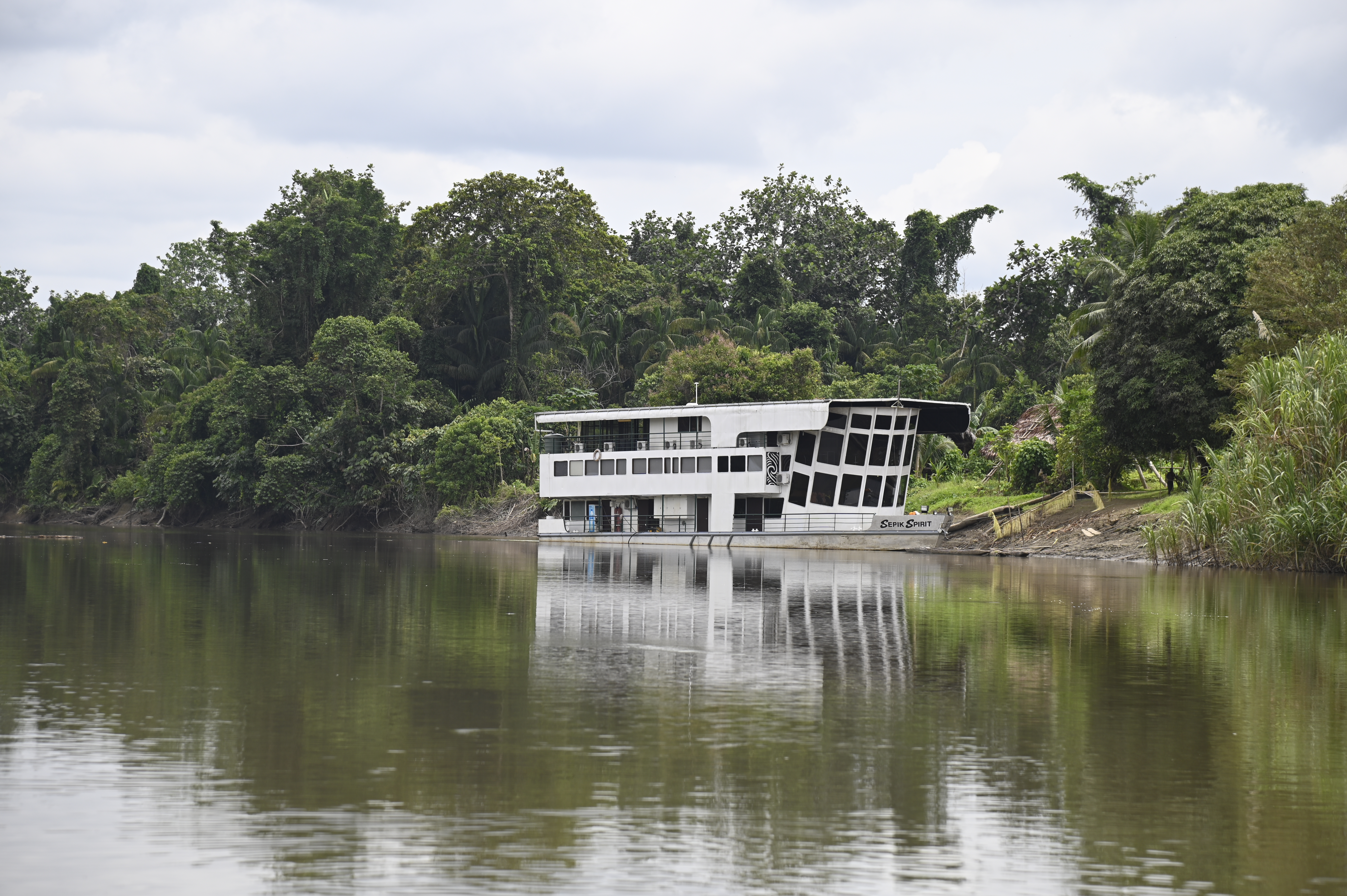
From there we approached and boarded our home for the next three nights – the Sepik Spirit, a 9-room river cruise boat (with air conditioning!), oddly looking, with a lounge, bar, dining room, and kitchen on the lowest deck, rooms on the second, and an observation deck on the upper floor. We’d launch the flat-bottomed boat from the Sepik Spirit for day trips, but first we needed to cruise on the Sepik Spirit to the junction further north of the Karawari River and the Korosameri River (also called the “Cross Mary” and “Angry Woman” River), about another two hours. The boat was staffed by nine local men – sailors, chefs, tour guides, and security – and, because it is almost entirely wood on the inside – we were asked to take our shoes off before entering to help ensure we weren’t bringing any wood-eating insects on-board.
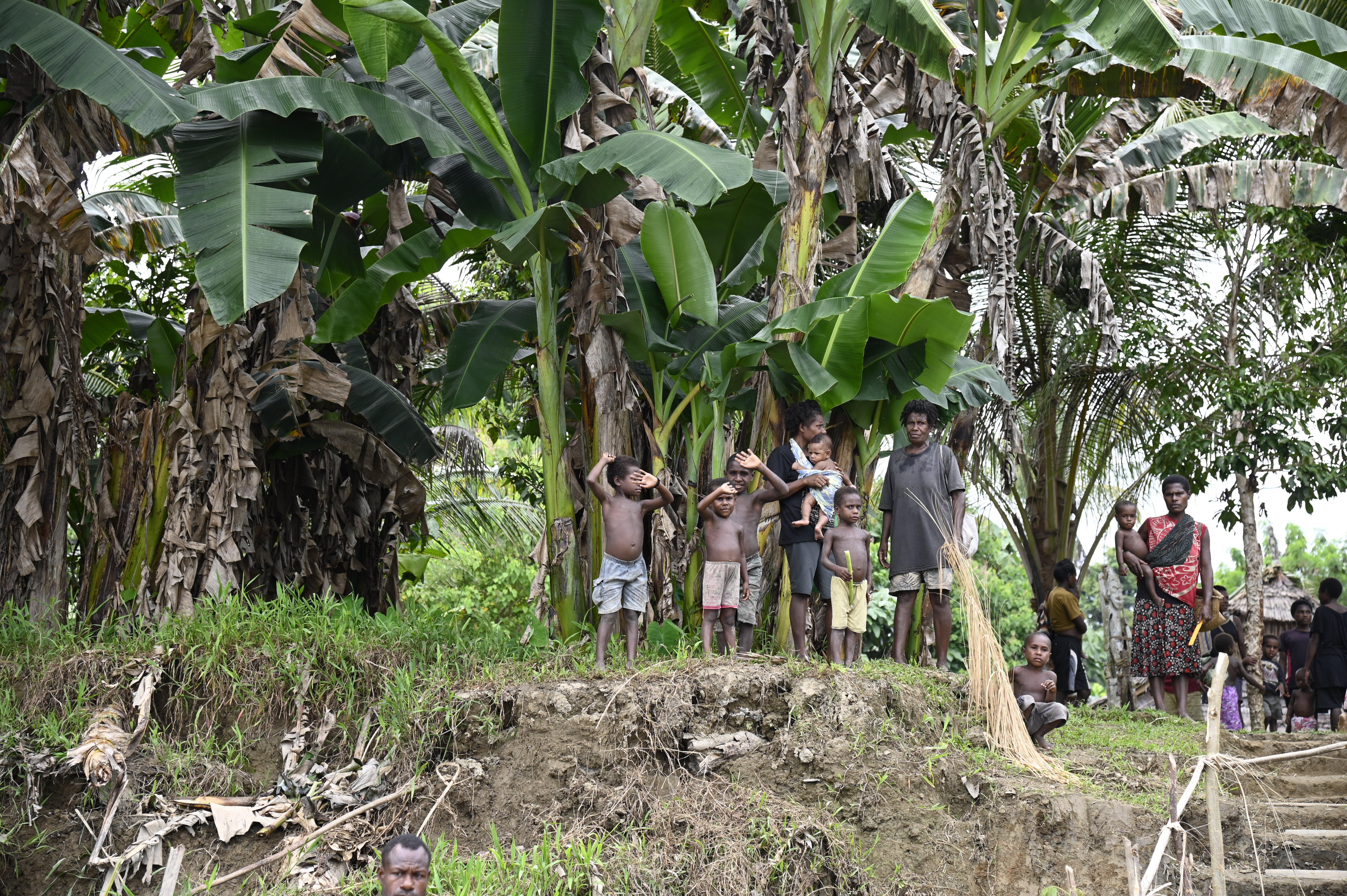
It was an easy easy cruise on the river, and – as was the case the day before and would be the case for the next few days – we periodically saw small structures, and men, women, and children along the banks, and people on the river. We scanned the sky, the tree tops, and the river’s edge for birds, some of which we saw are listed below.
Crested Tern
Intermediate Egret
Great Egret
Great Bill Heron
Rainbow Bee Eater
Brahminy Kite
Male Eclectus Parrot
Black Bittern
Black Kite
Silver-breasted Cockatoo
Whistling Kite
Night Heron
Fish Eagle
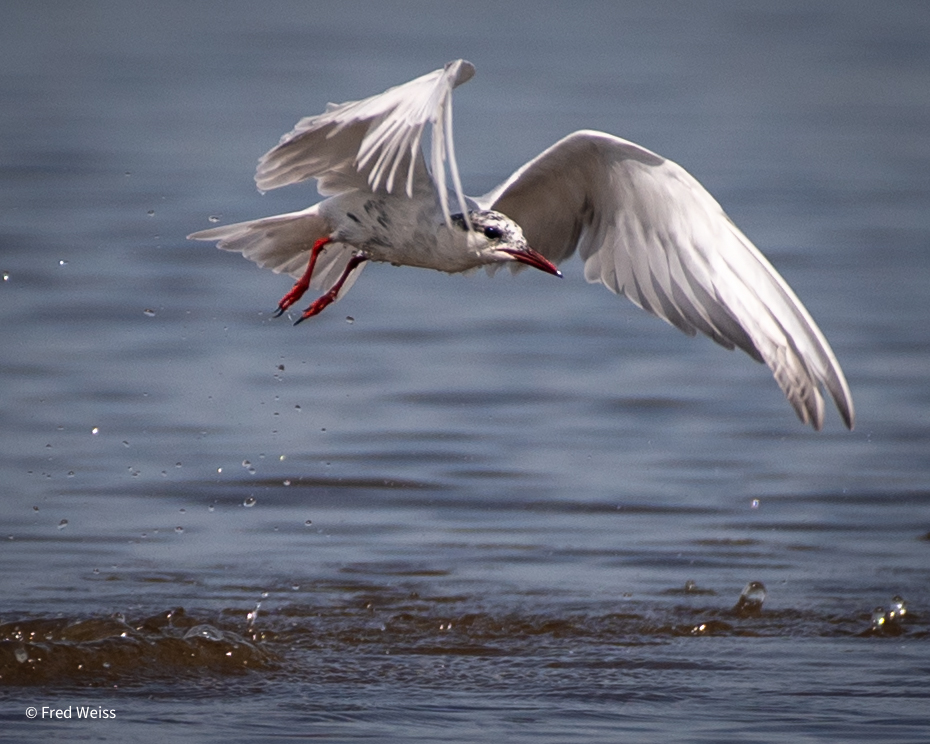
I’m no bird photographer to begin with – and add that both we and the birds were moving and that my long lens always felt too short – but I tried desperately to capture a few; egrets were most common; I remarked that if reincarnation is real, I’d like to come back as an egret on the Karawari River, as their lives seemed pretty darn good.
We were eager to see a croc or two, but that didn’t happen.
(Clicking on an image below will enlarge it in a new window)
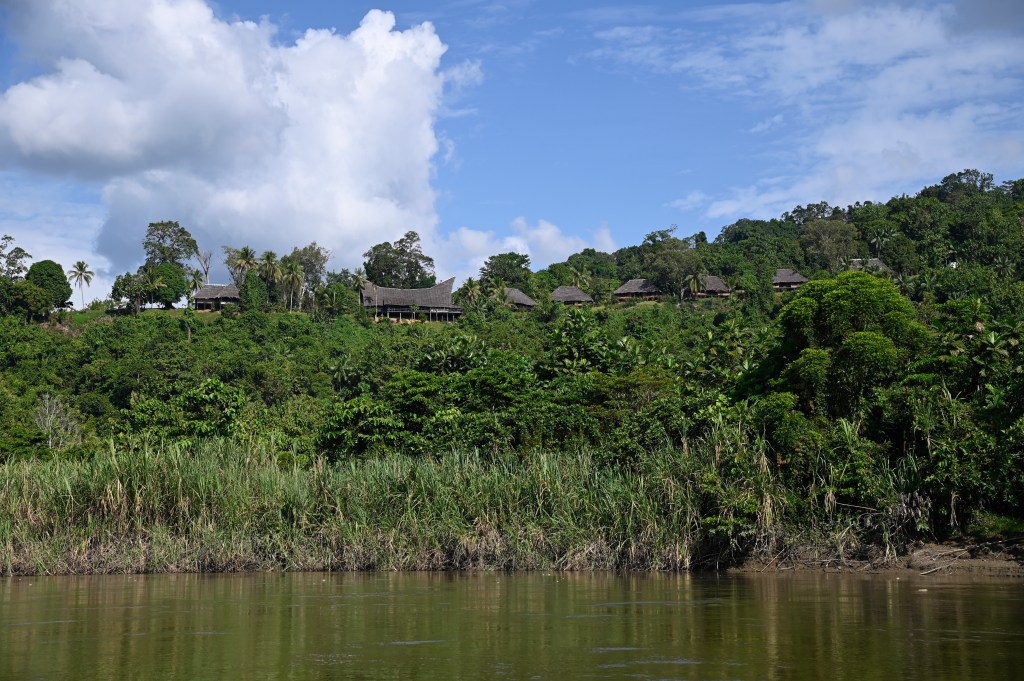
Today we made our move to the Karawari Lodge, located 1,000 ft up a ridge overlooking the Karawari River. This is in East Sepik Province, and the Lodge can’t be reached by road.
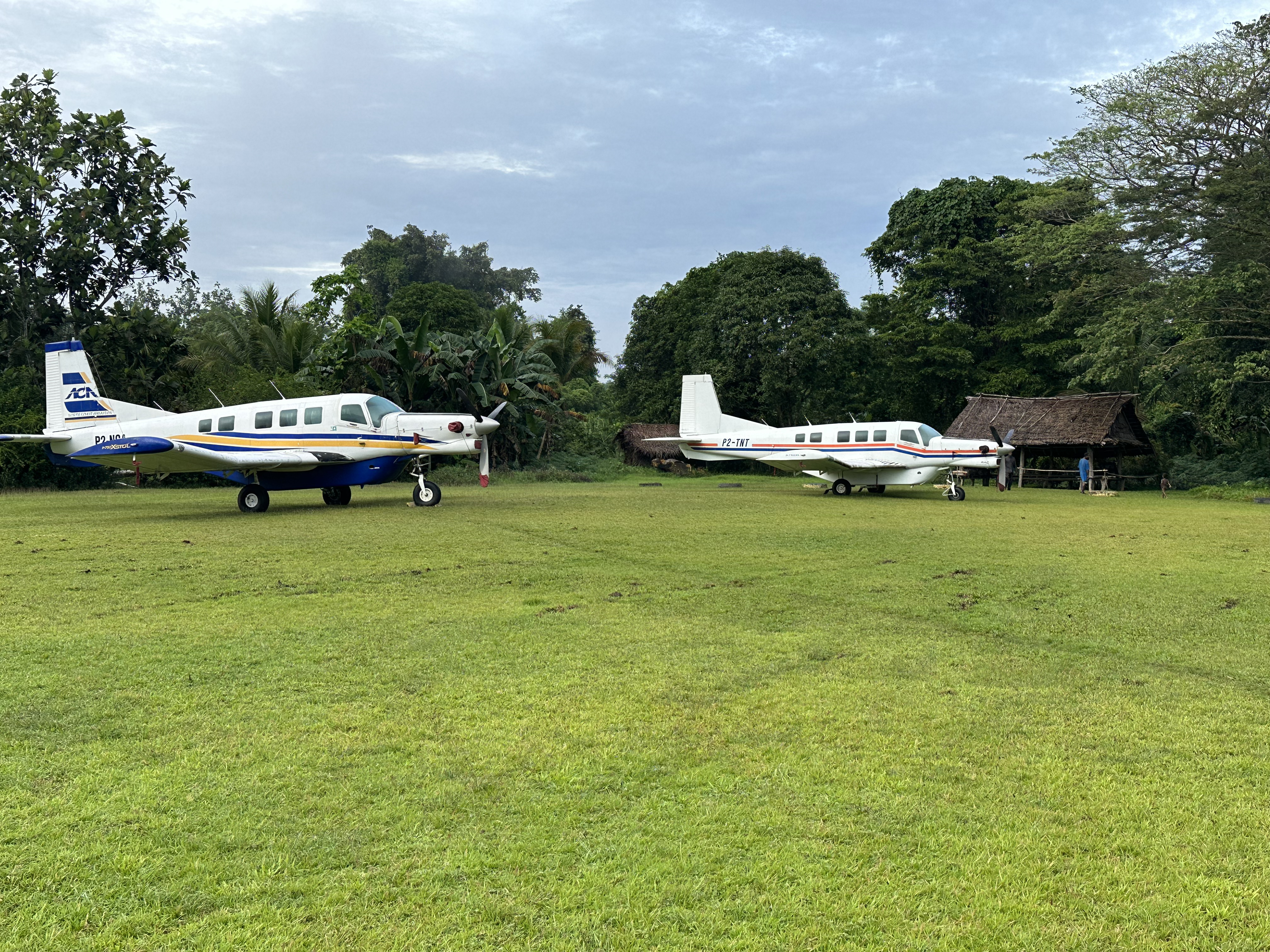
We met Sam, our pilot from New Zealand, with whom we had a scheduled 8 a.m. departure, at the charter air-terminal. After waiting a bit more than an hour for low clouds to clear at the Mount Hagen Airport, seven of us (nicknamed “the Roosters” for our early wake-up and scheduled departure) boarded a 10-seat charter for the 45-minute flight (with a maximum altitude of about 10,000 ft) to the grass air-strip along the river’s edge. You could see the landscape change from the air – from the mountains and valleys of the Western Highlands Province to a low, mostly flat plain.
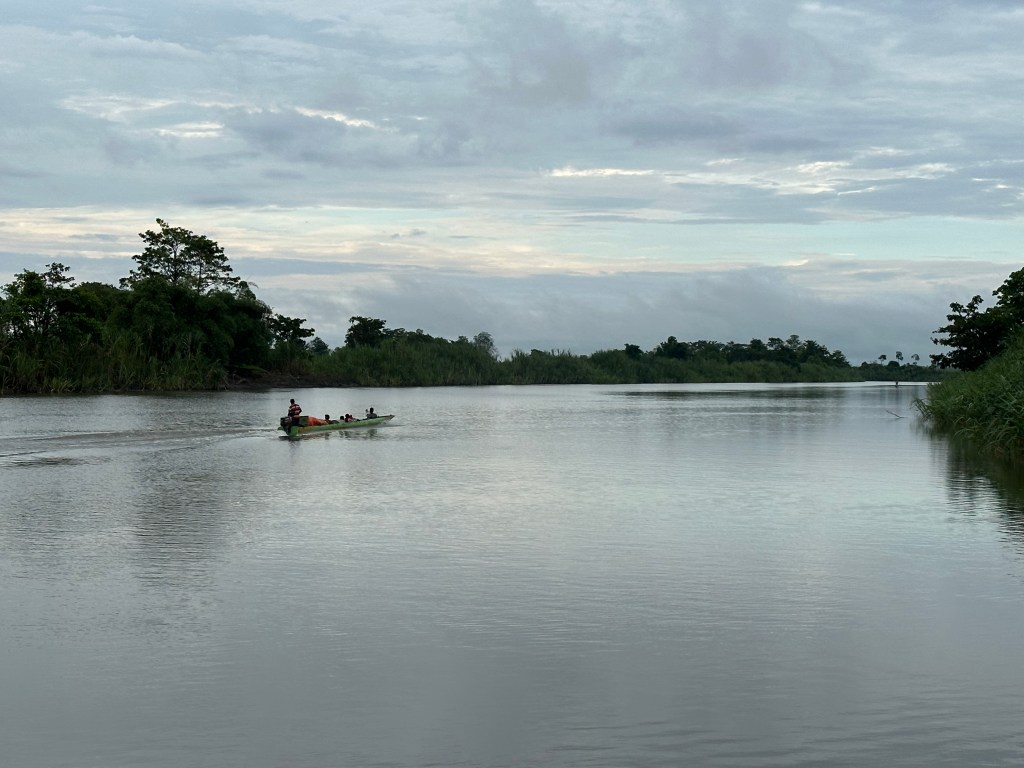
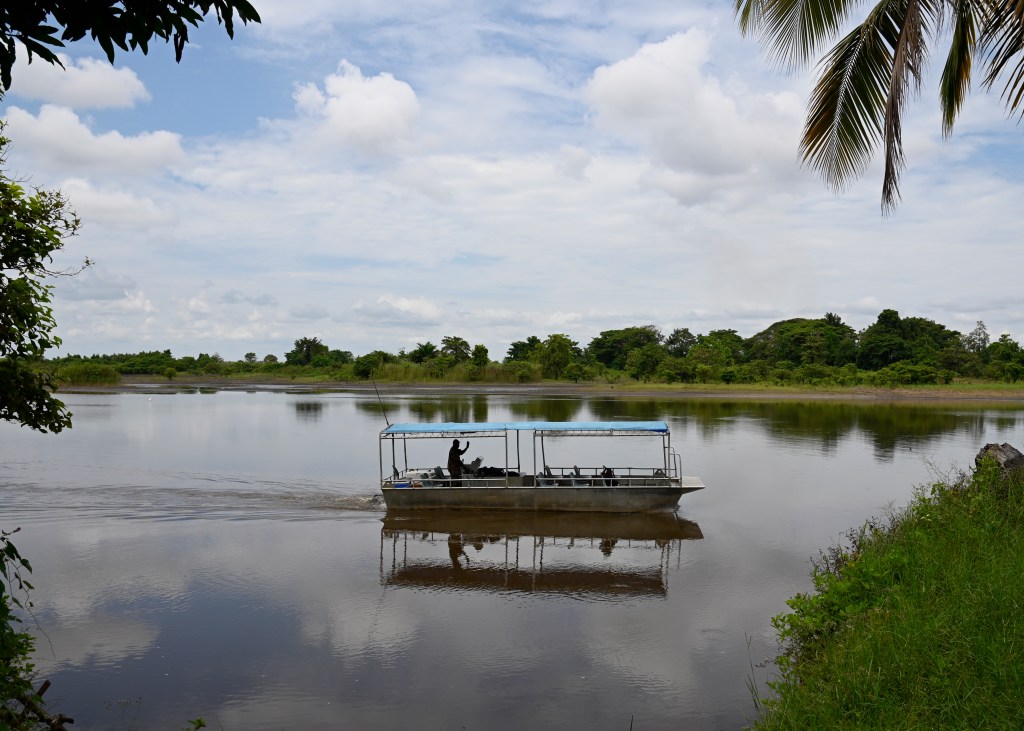
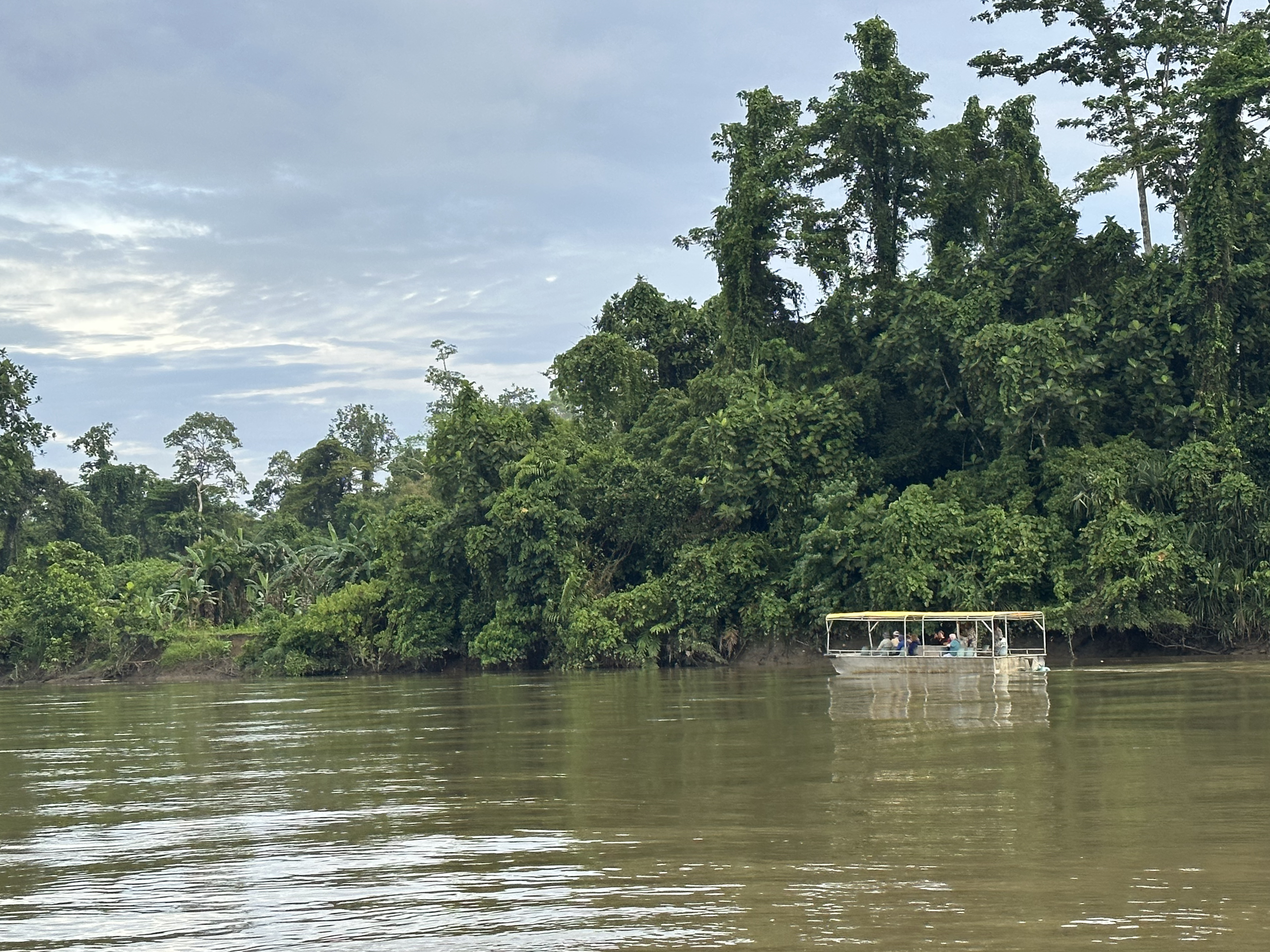
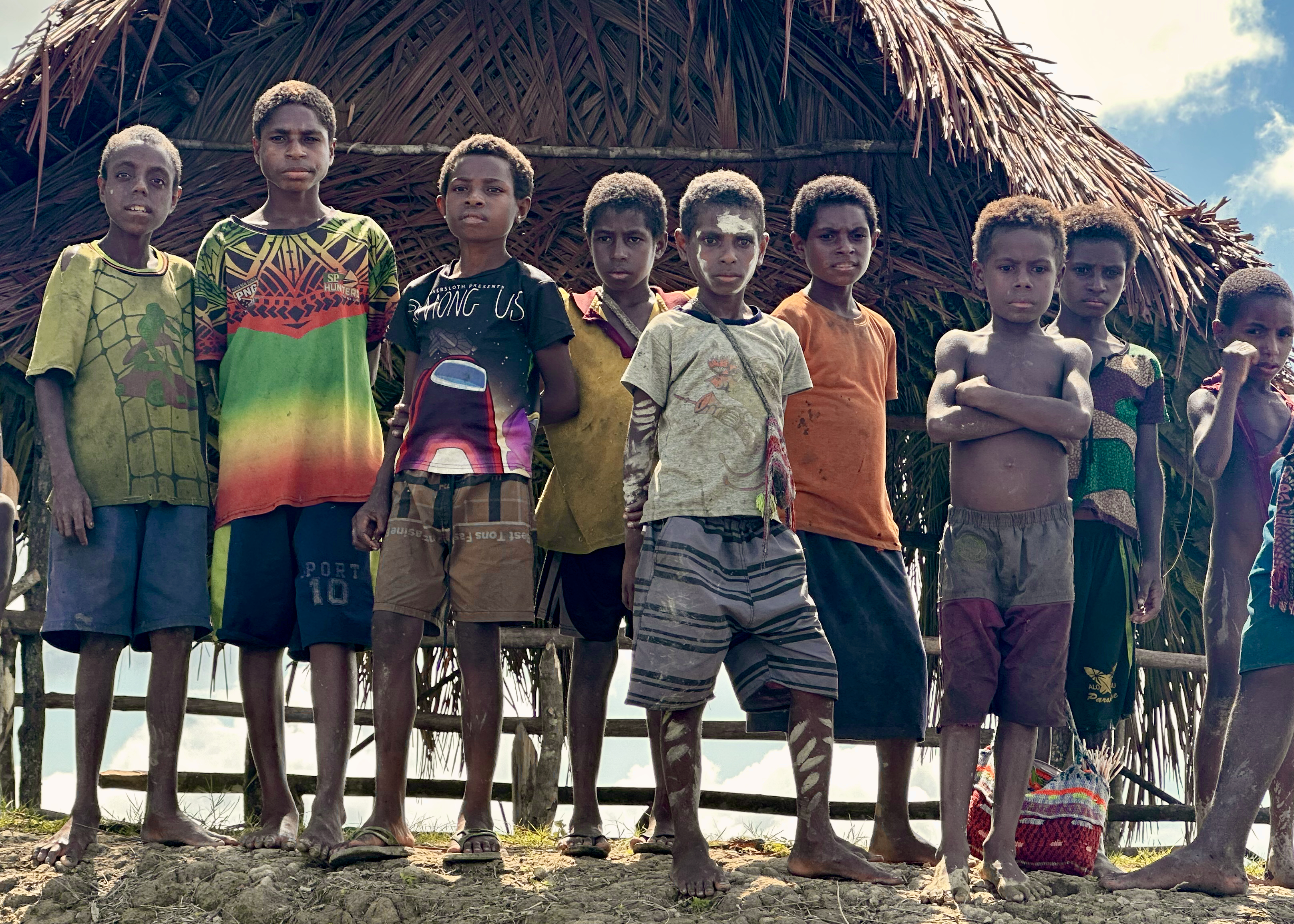
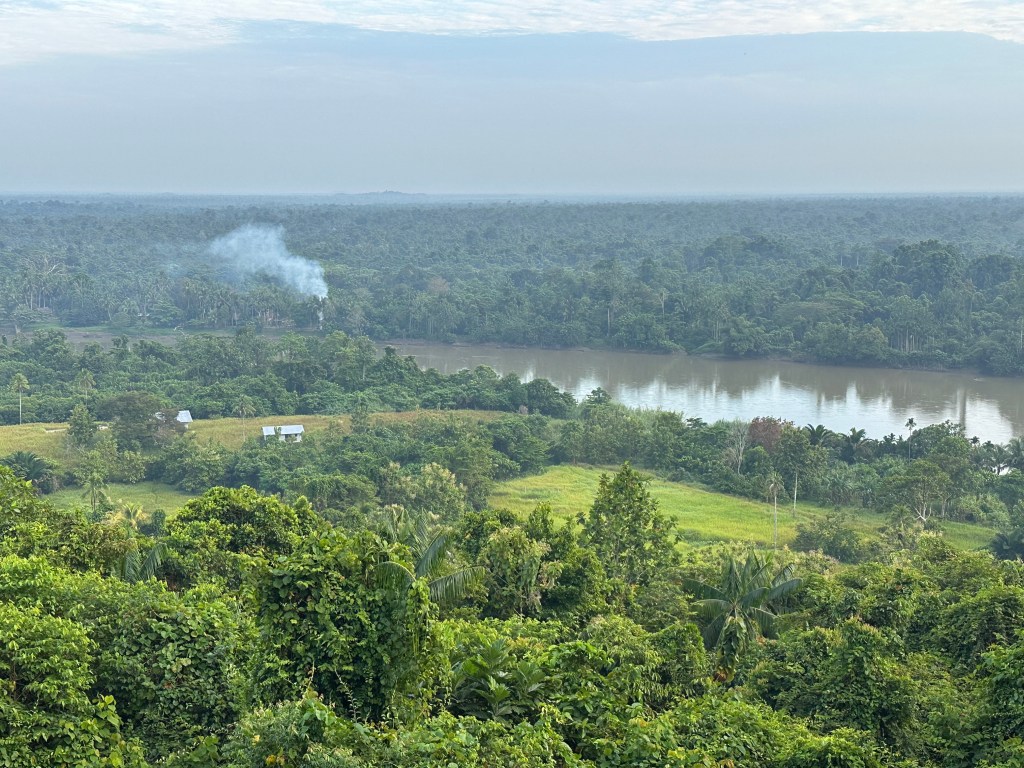
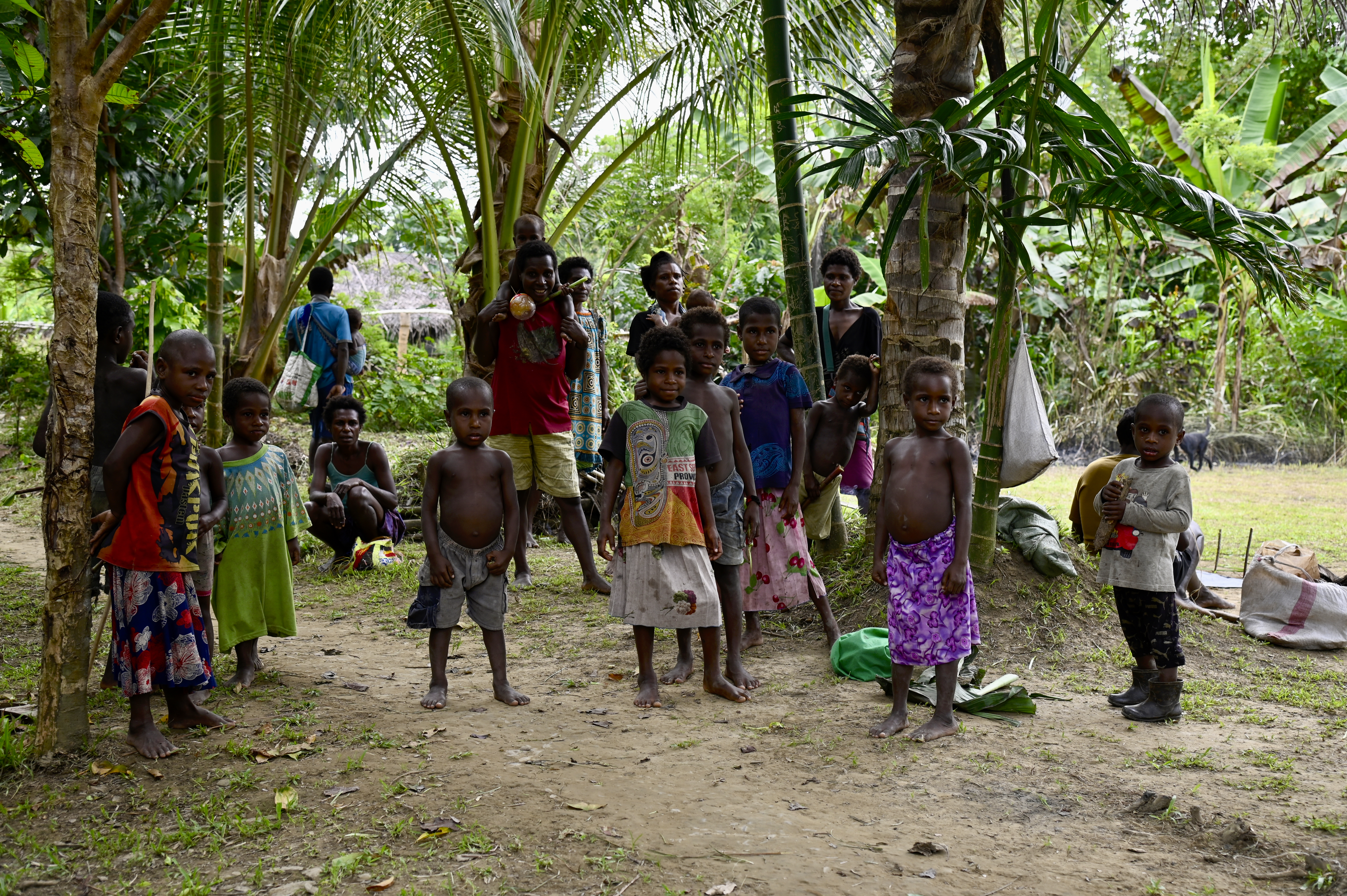
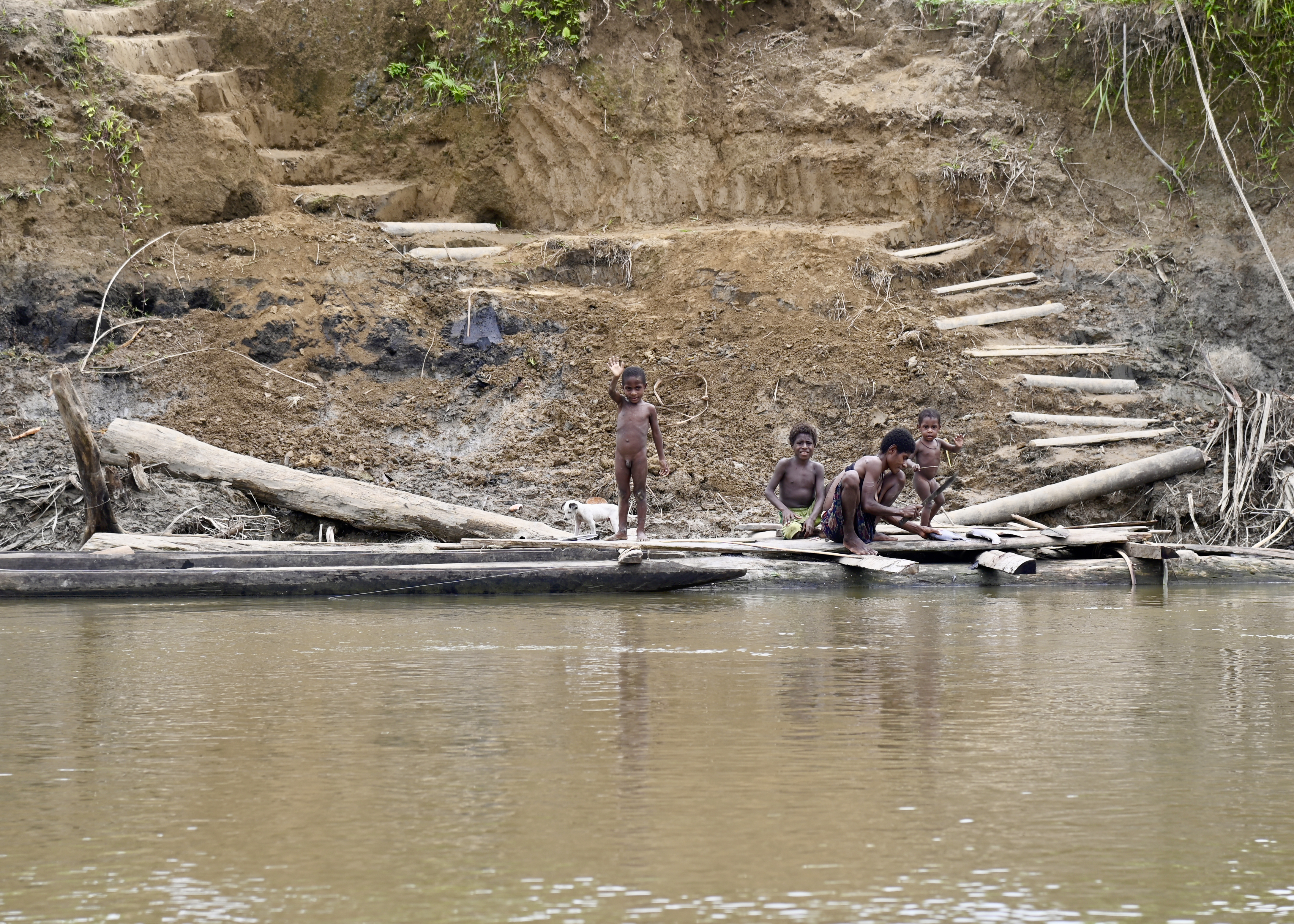
From the airport, located near the town of Amboin, whose terminal was a thatched-roofed wall-less hut where locals – including naked children – watched our arrival, we walked about 100 yards to the river’s edge, where we descended the muddy bank to a waiting 18-seat flat-bottom motorboat. This boat, later launched from more permanent housing, would be our means of exploring the river over the next four+ days. The boat took us on a 10-minute ride on this stretch of the river – about 50 yards wide and 10-20 feet deep, edged by jungle. This was a classic secluded jungle river – the Karawari – a major tributary of the mighty Sepik River, one of the longest in the world and the longest in Papua New Guinea. One of my travel mates was a Vietnam War veteran – a member of the Coast Guard who commanded a boat along the Mekong during the war. He told me our journeys over the next few days gave him many moments of reflection.
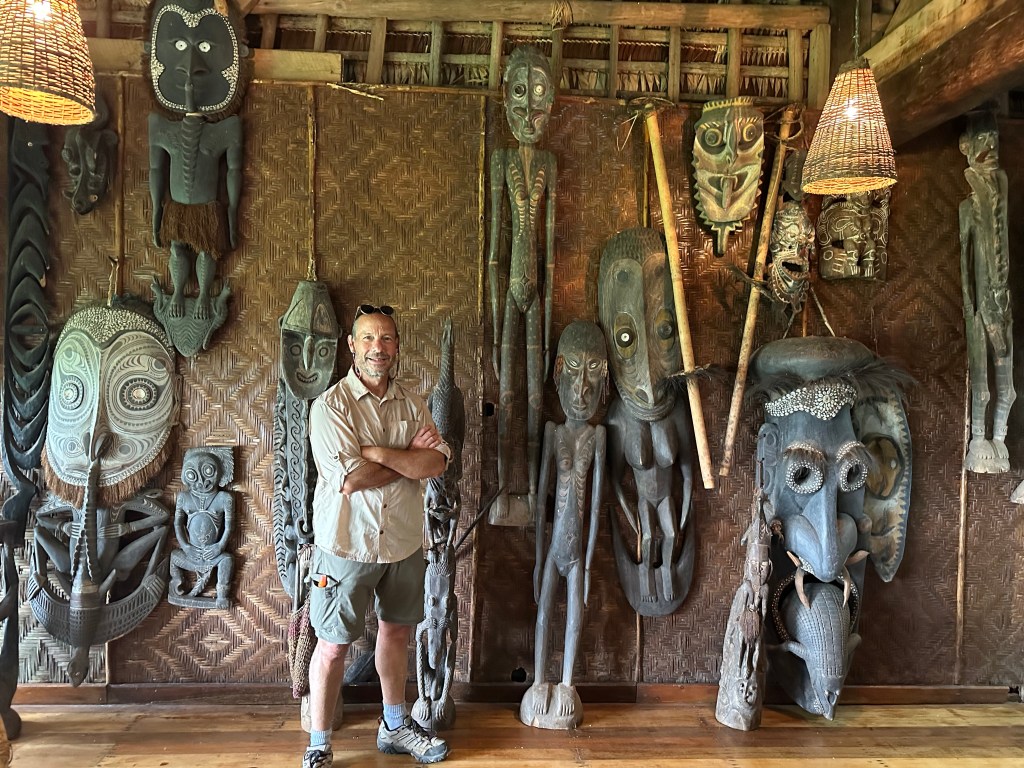
The boat left us at another muddy bank, where a small pick-up truck that had seats installed in its rear bed, picked us up and drove us up the ridge to the entrance to the Lodge. Comprised of a main building that had a lounge area filled with local art, a bar, a balcony overlooking the river, and made completely of wood, the grounds also had several separate buildings, each comprised of two guest rooms.
Here – and for the rest of our stay over the next four nights in the East Sepik Province – we’d have no cell nor internet service and limited hot water.
After hanging out until after lunch – including having my first beer in the Province – we headed out for the afternoon. We rode the pick-up back down the ridge to the river’s edge and re-boarded the boat.
Our guide was Chris, a member of the Yokoim tribe, who formerly practiced cannibalism (Chris told us it ended with his uncle’s generation) and who populate about eight villages along this stretch of the Karawari. Chris believed there were about 3,000 – 4,000 tribal members remaining. There apparently are six different languages in the Karawari area, of the 75 or so different languages spoken in the East Sepik Province. The language they all have in common, though, is Pidgin, with some words and phrases close to their English equivalent. Without this language, the various tribes can’t understand each other; our commercial flight from Port Moresby to Mount Hagen had announcements in English and Pidgin.
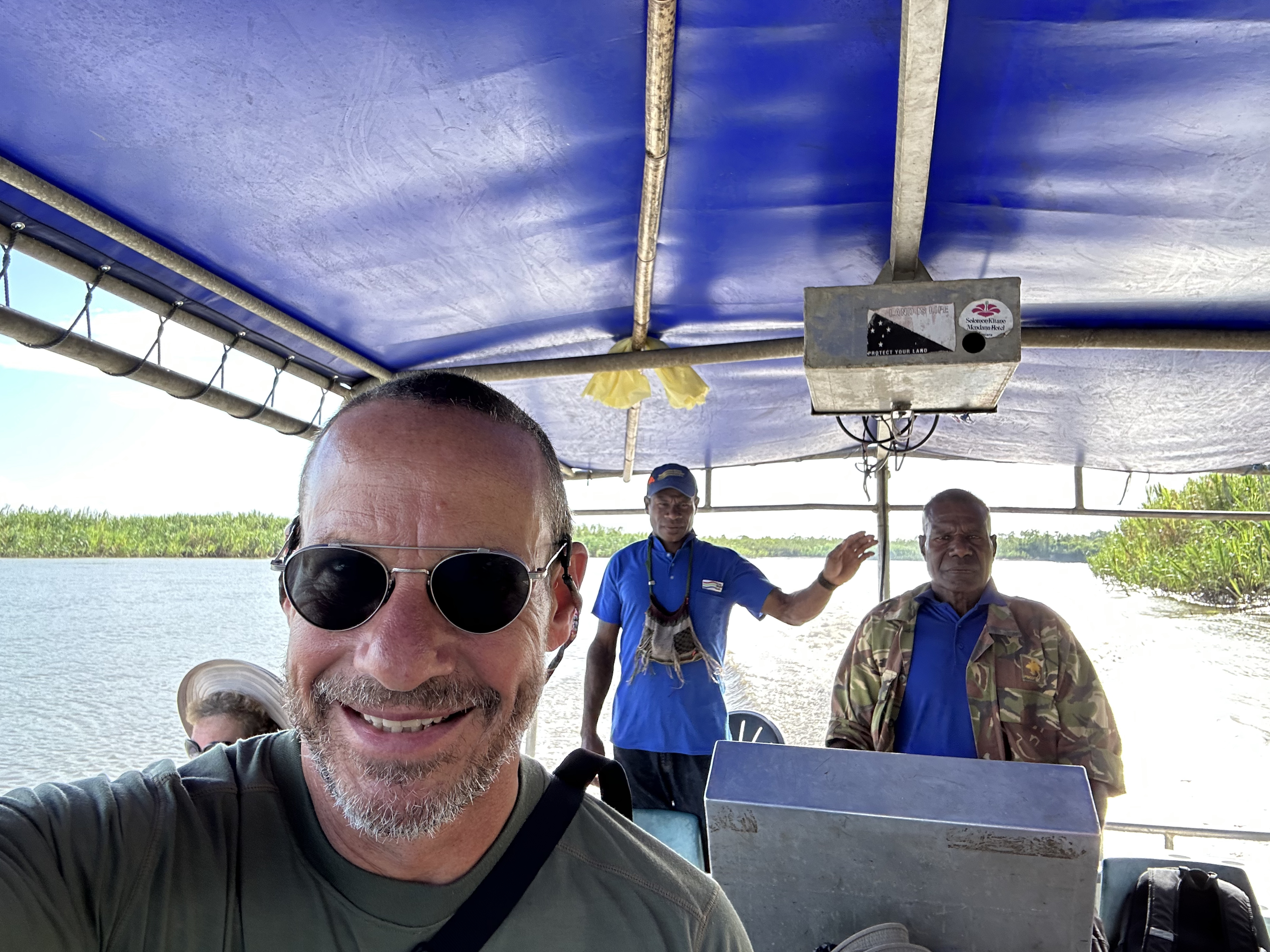
The boat cruised variably from 5-25 miles per hour. Brian, our driver, was fantastic in taking us along the river each day we used the boat. He hugged the shore to give himself a shallower draft which helped him pick-up speed, but also slowed down whenever he saw locals on the river or when he saw birds or some other sight along the river’s edge that we’d want to see or photograph.
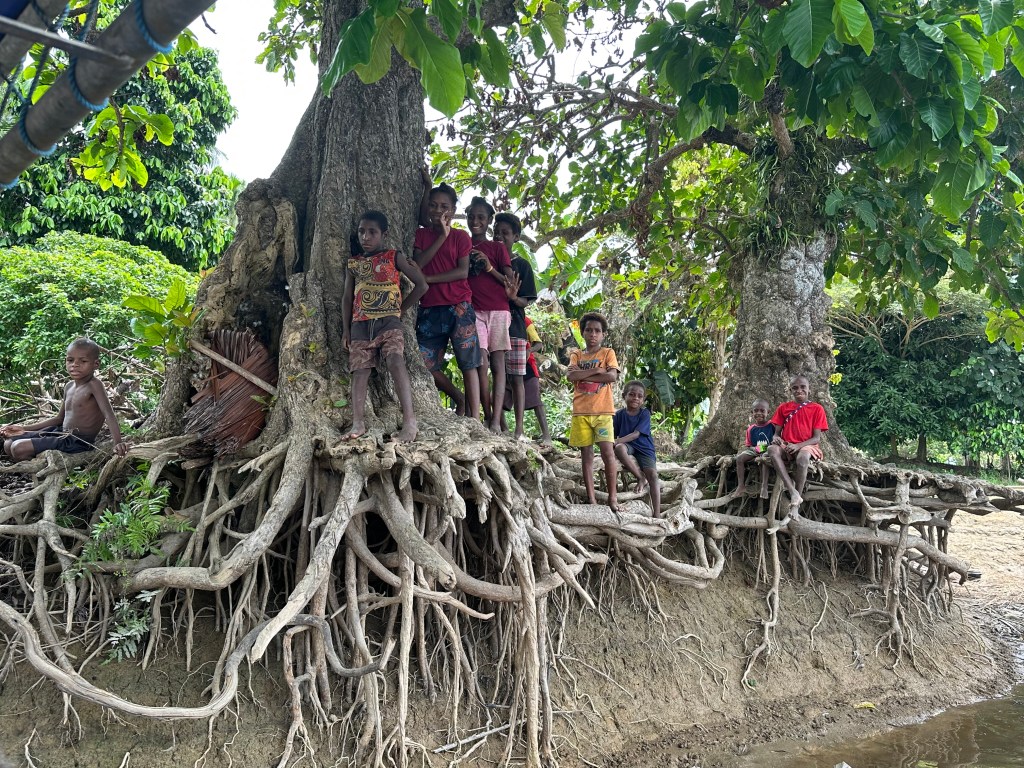
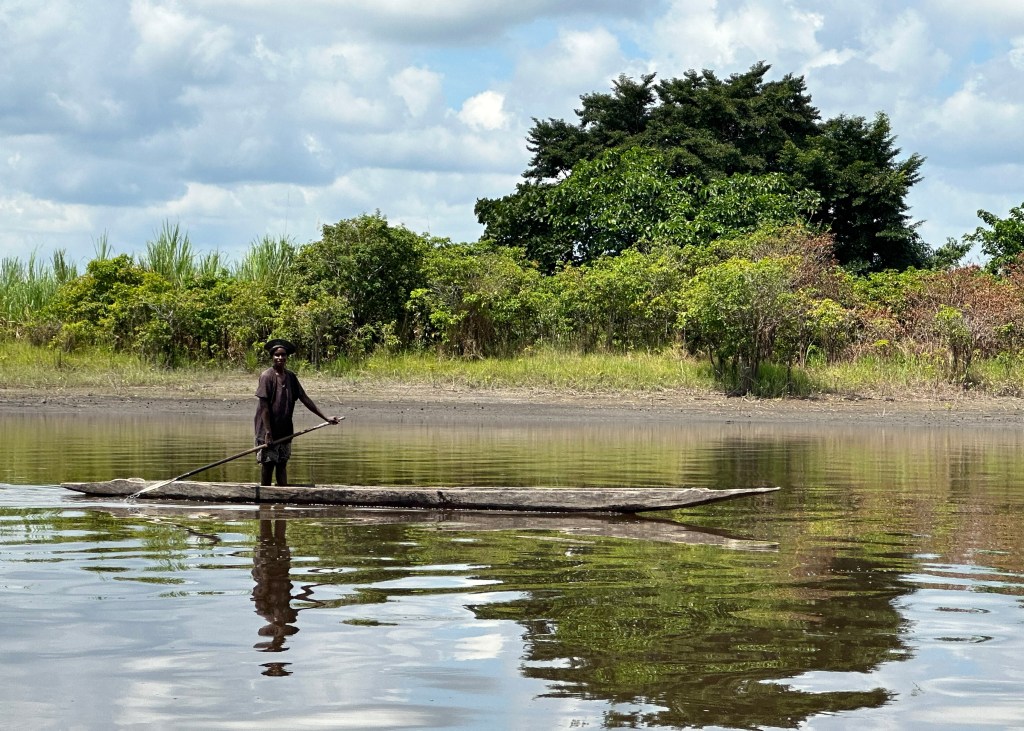
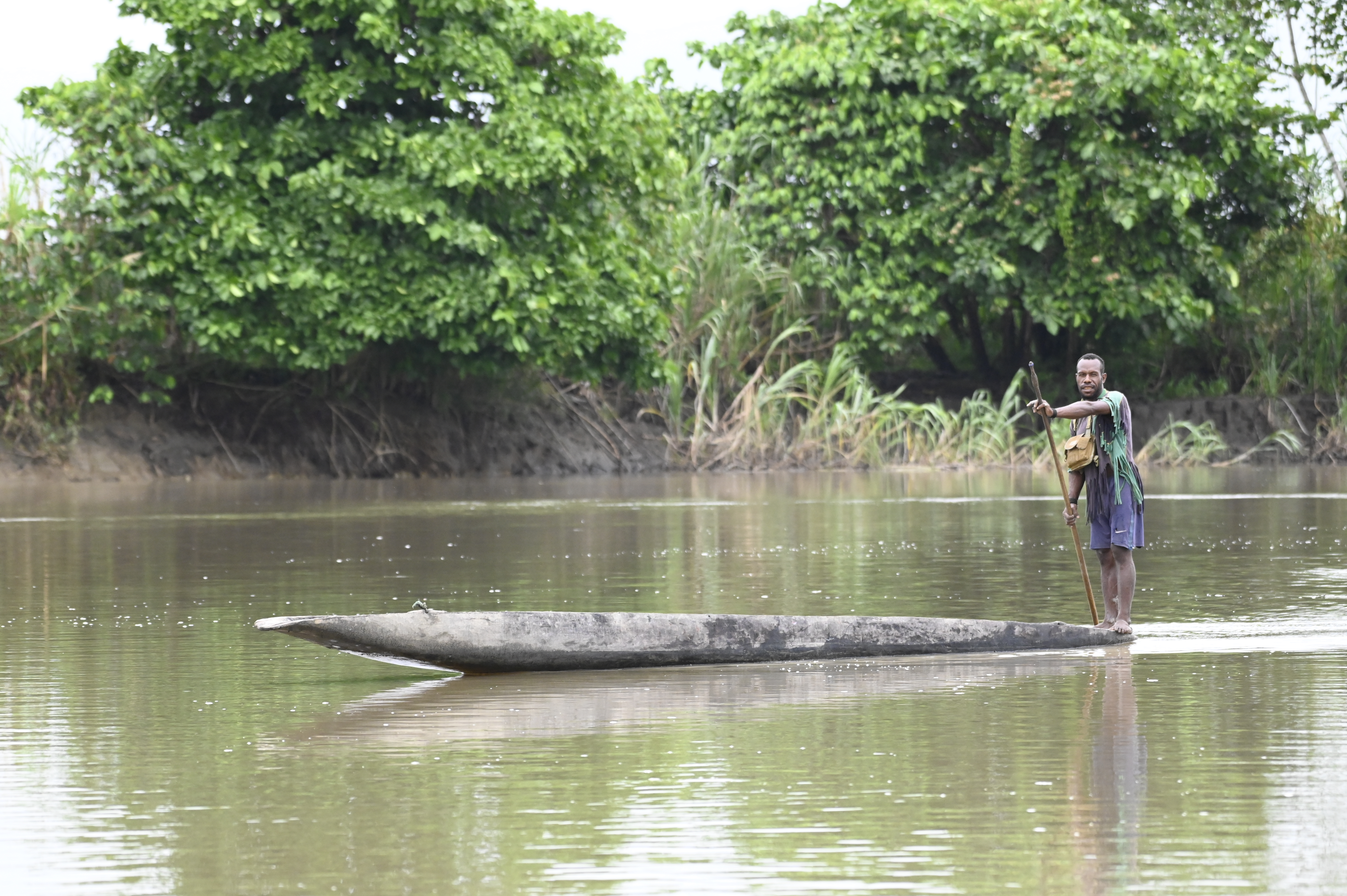
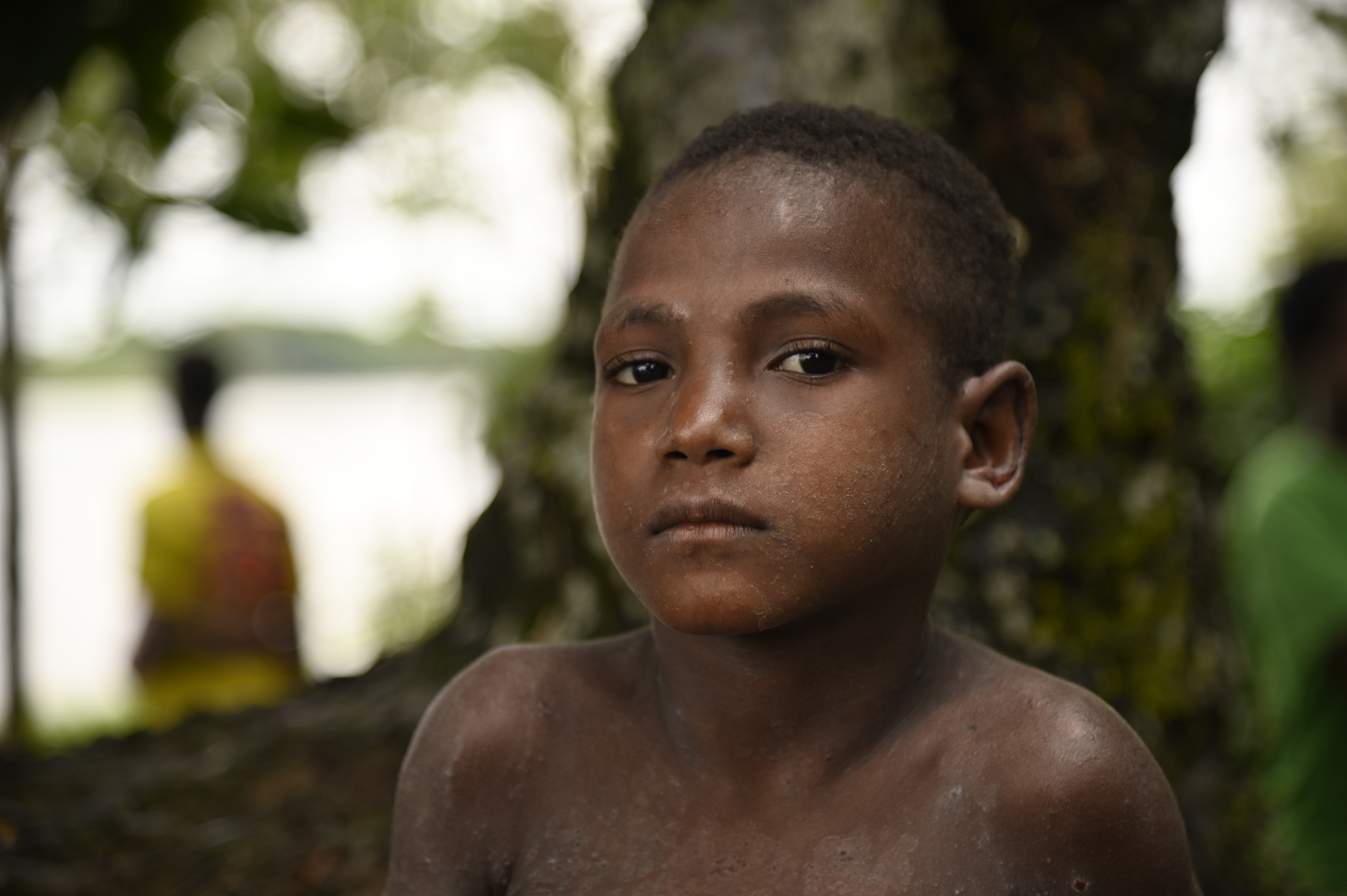
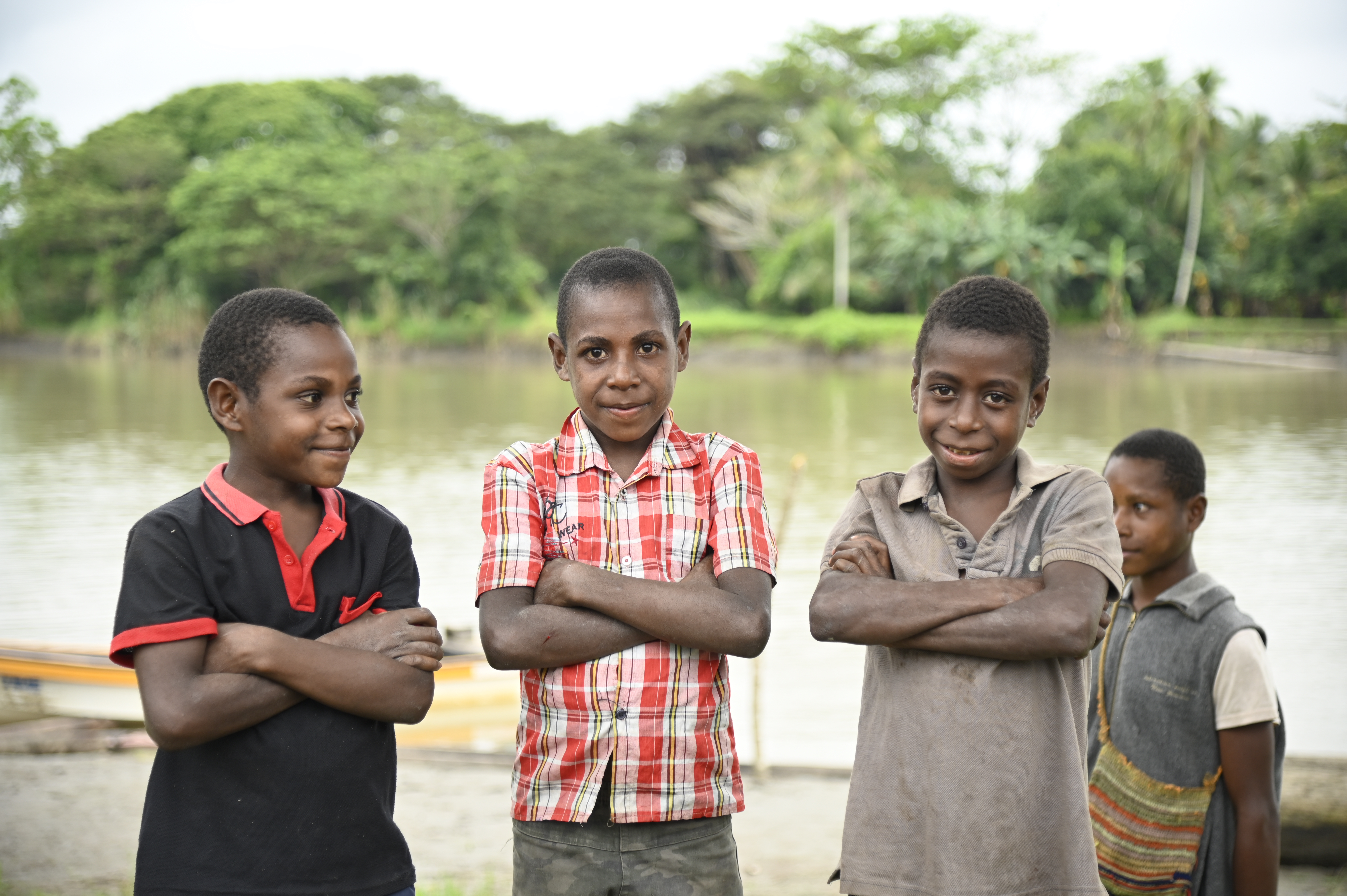
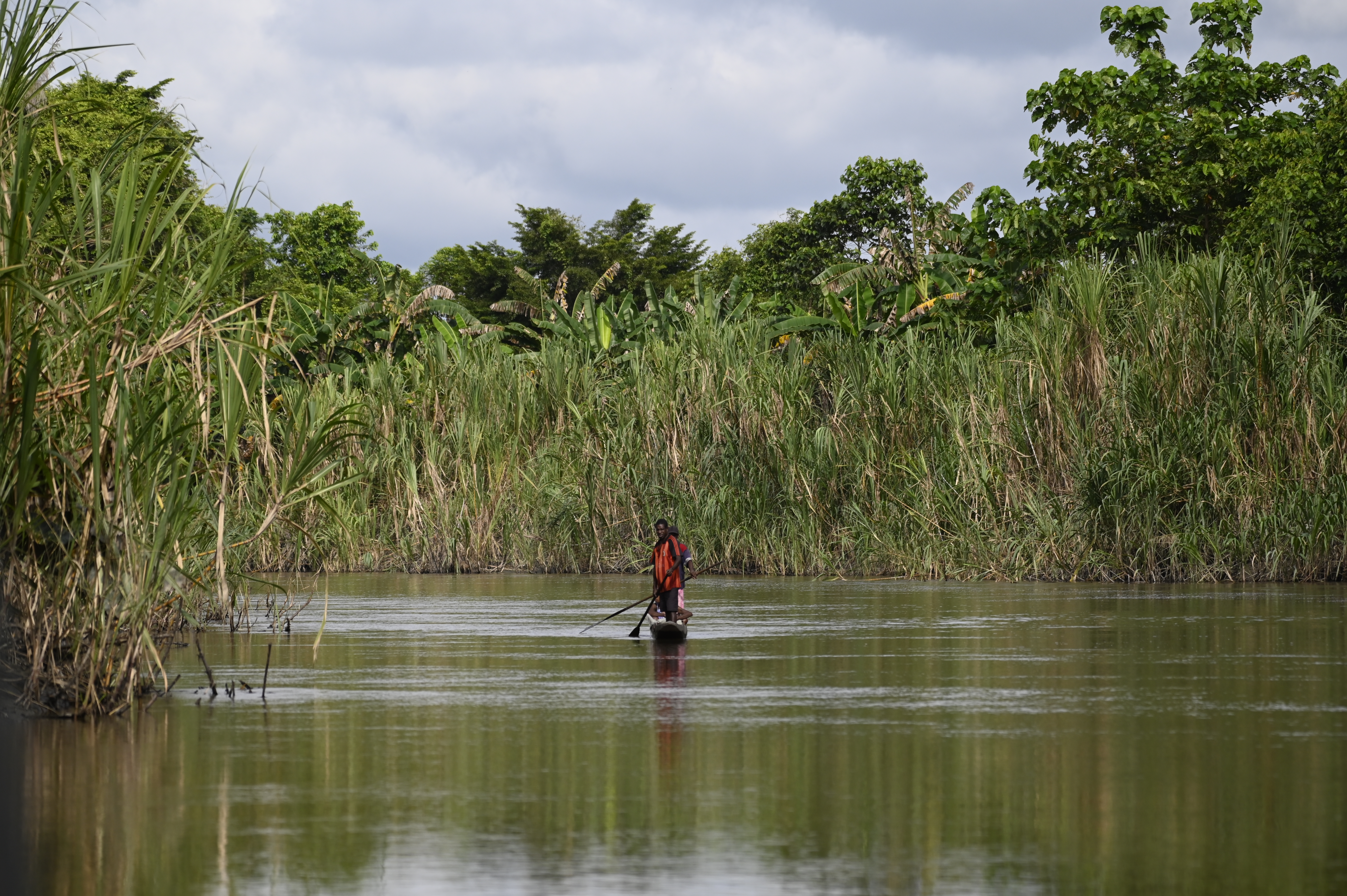
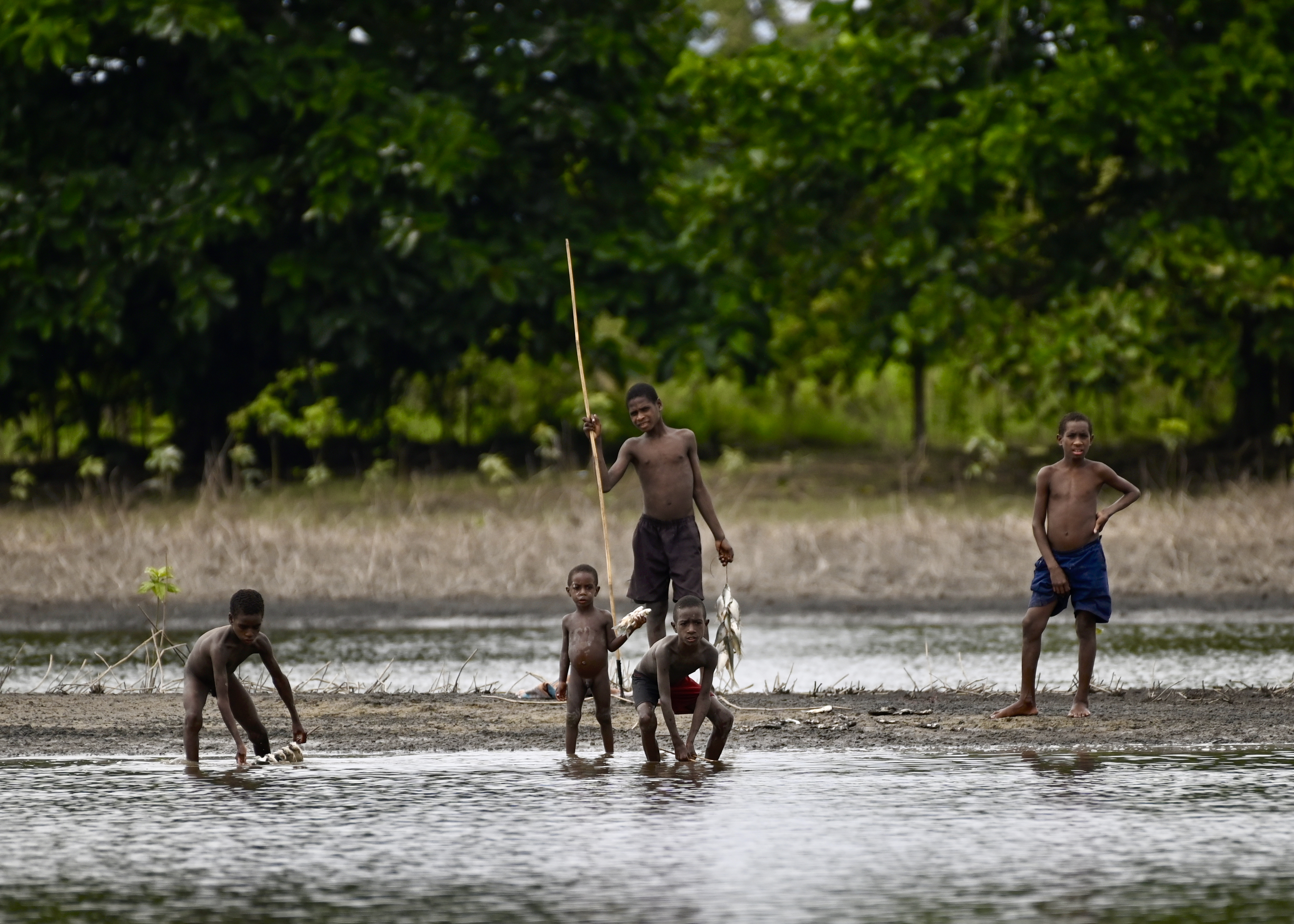
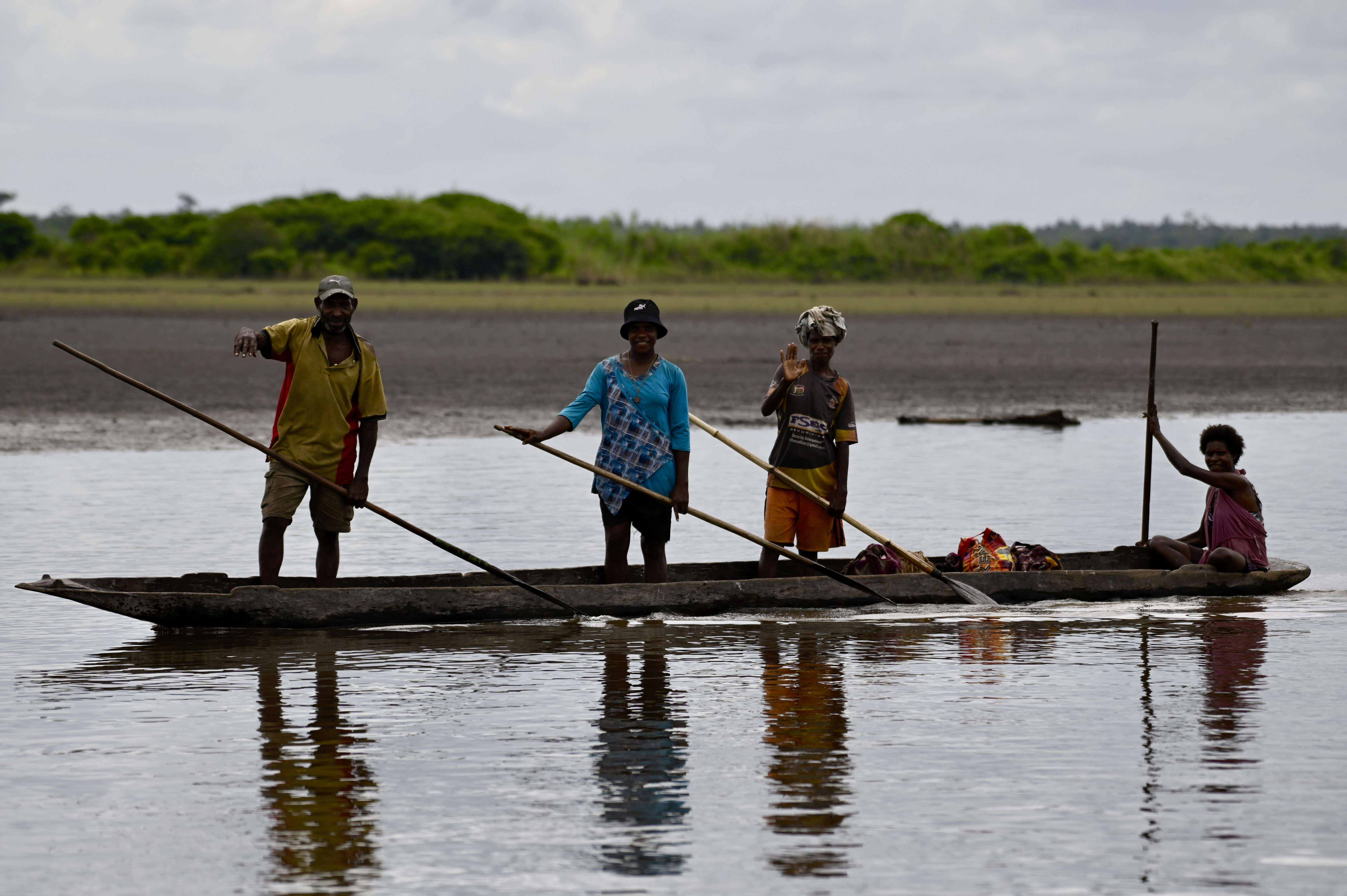
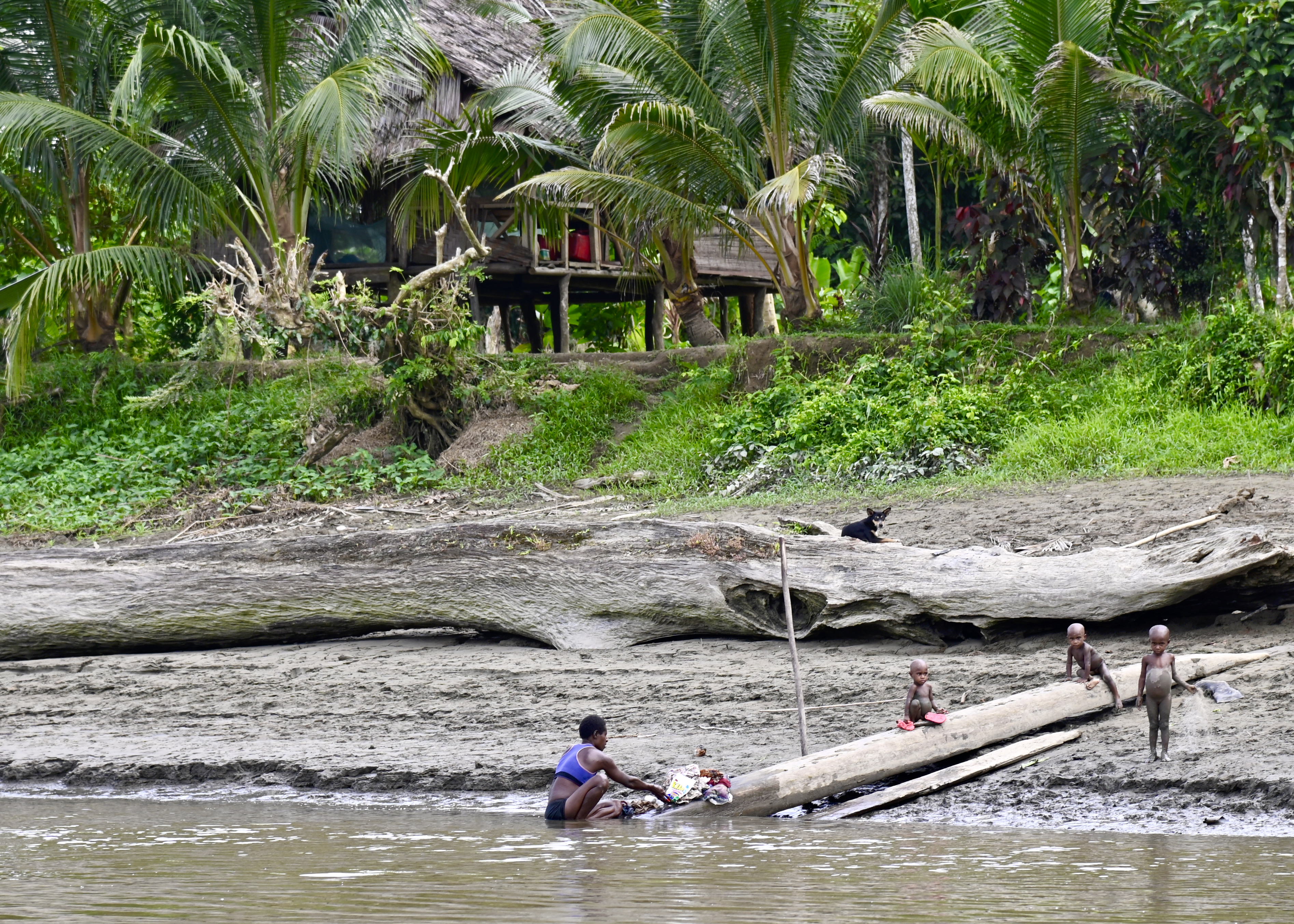
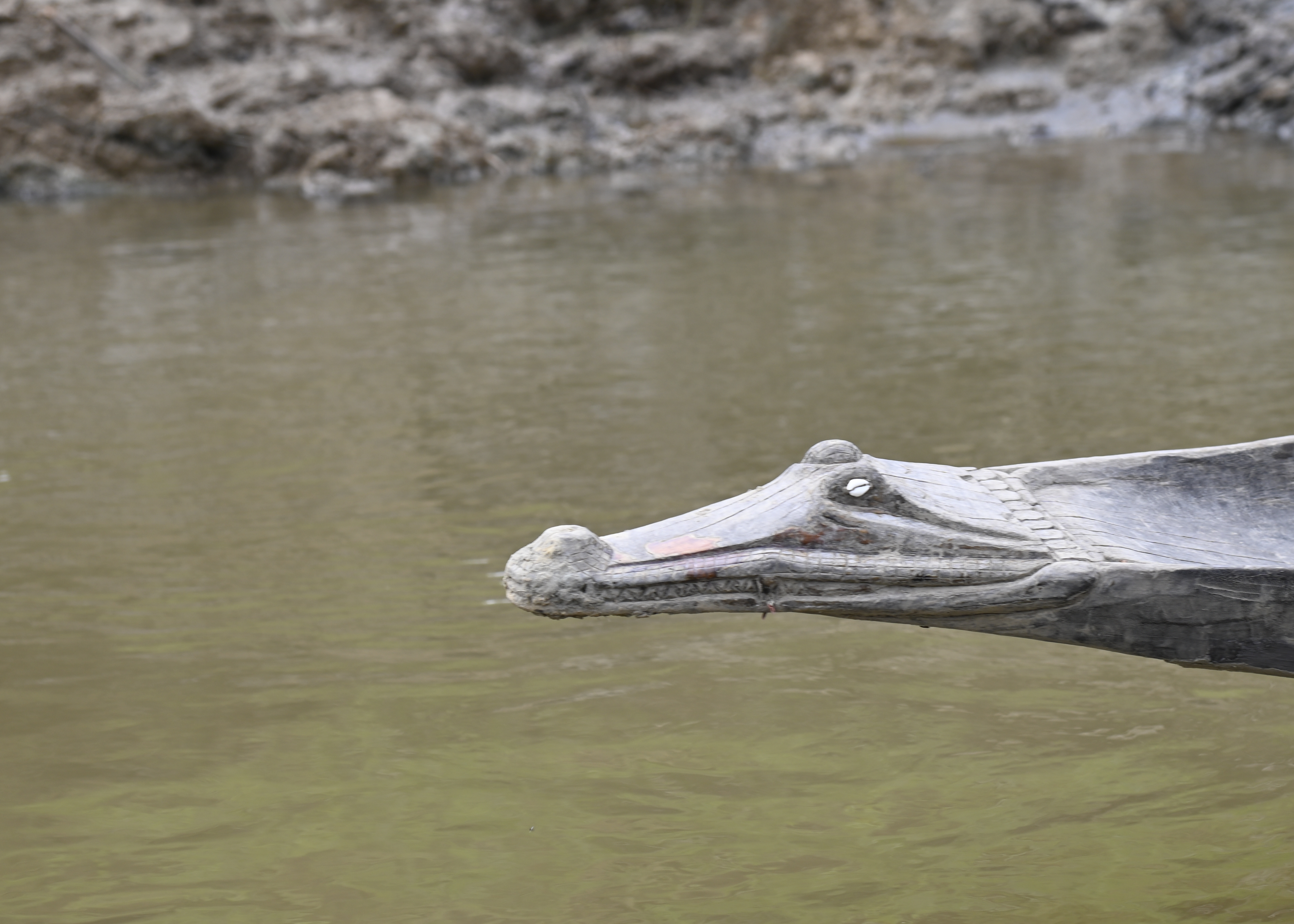
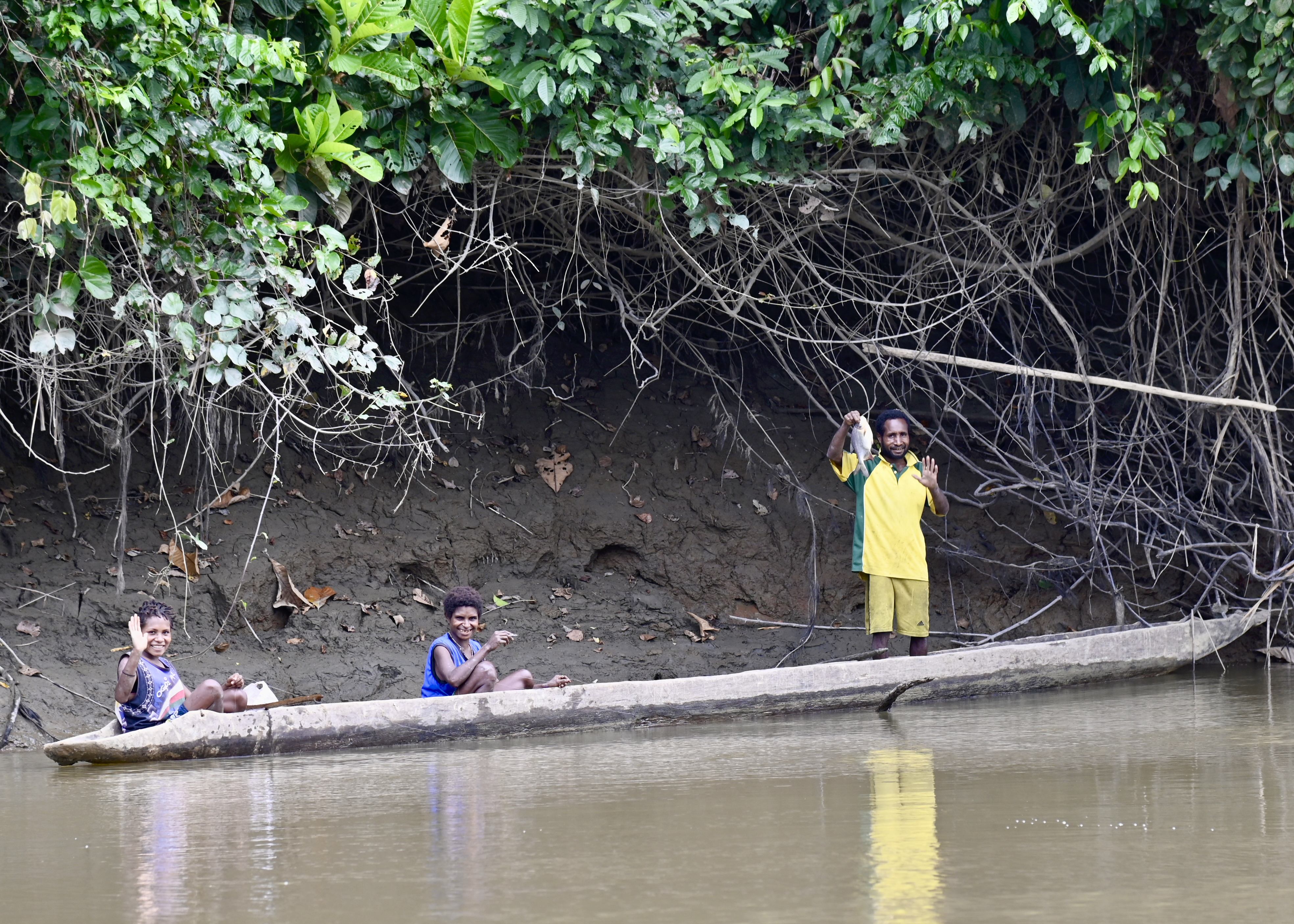
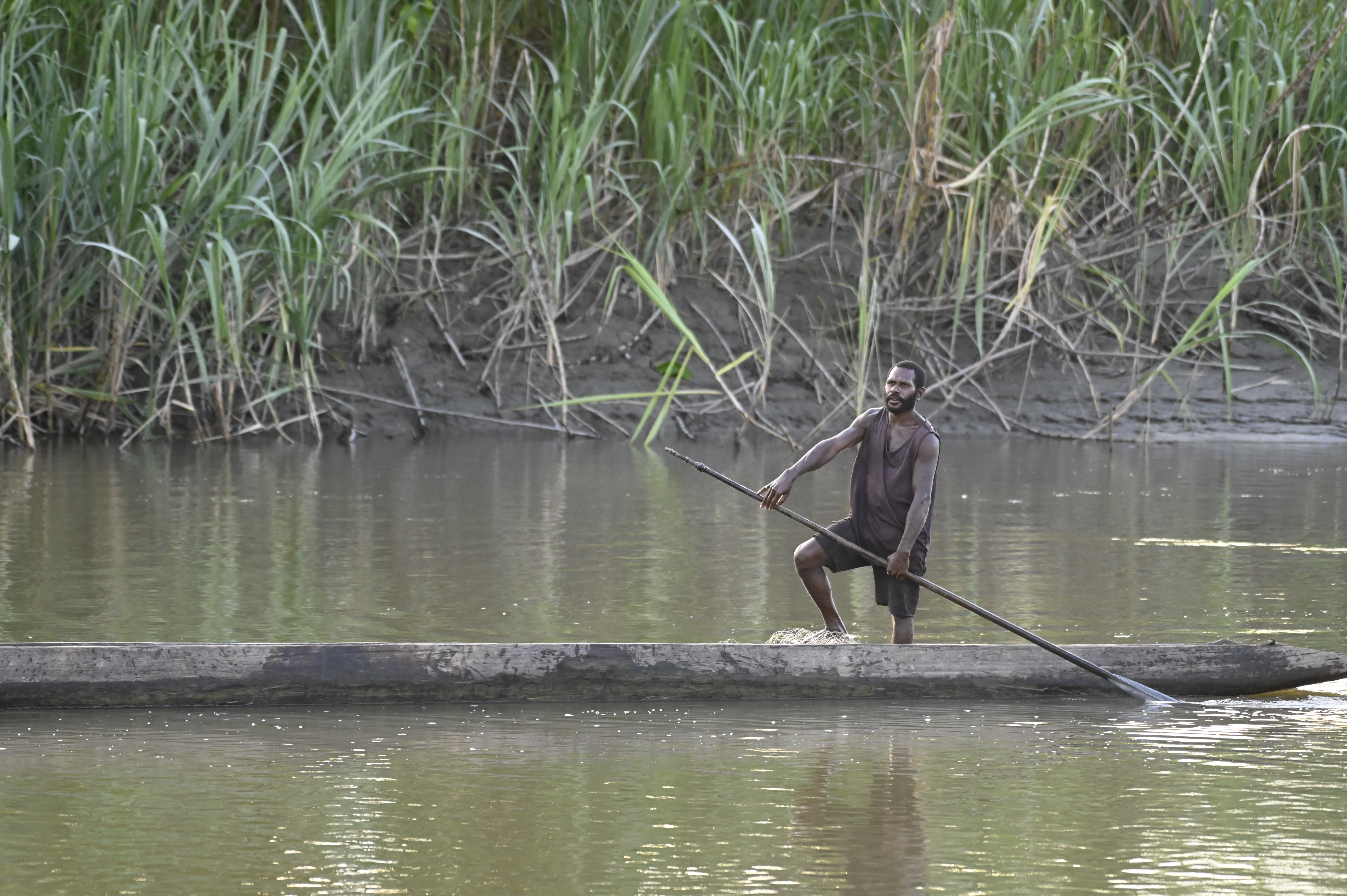
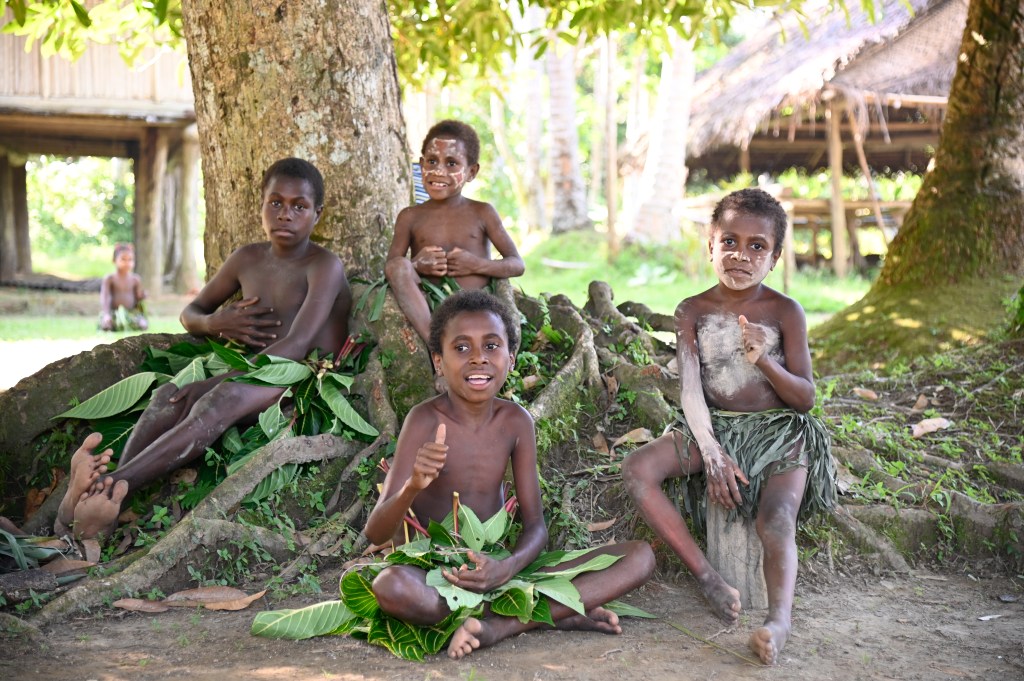
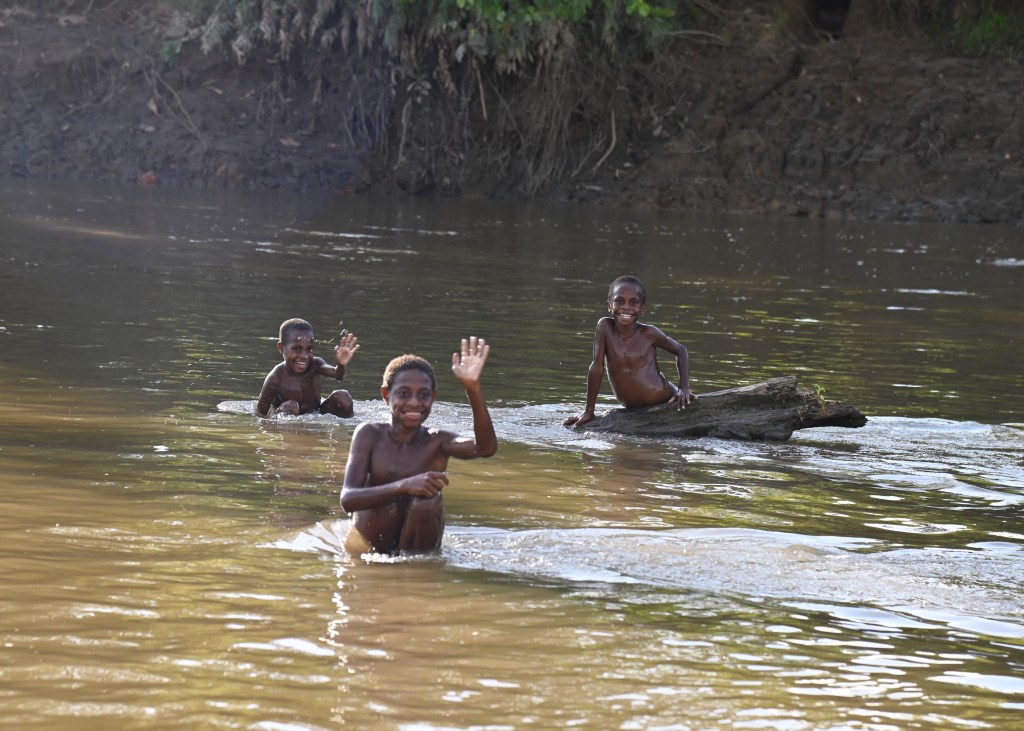
And the views along the river were endlessly fascinating. The people that live here depend upon the river and the surrounding jungle for life and transportation. The river’s edge was mostly tall grass, palms, rain trees, some banana trees, and sago palms, all of which hugged right to the shore. We periodically saw small wooden buildings on stilts and people along the shore, and naked children swimming on the river’s edge. On the river we saw long canoes, sometimes with a single person in them, sometimes with three or four or five or even nine in one circumstance. Sometimes they sat, and sometimes they stood as if they were stand-up paddle-boarding. Clothing was mixed – traditional in some cases and western in others. The canoes were mostly paddled, but we did see a few with outboard motors, and they were used for fishing, for transportation from village-to-village, for commerce, and to begin journeys to elsewhere on the river system.
For the next few days our pattern would be to cruise the river system mostly in our flat-bottomed boat, watching the world go by and looking for birds, until we stopped at one of the local villages, where we would be given a presentation or a demonstration of some traditional aspect of tribal life. Each of these stops invariably included locals displaying and selling traditional art – jewelry, masks, woven baskets, and more. And each stop ended with our making a donation to the village.
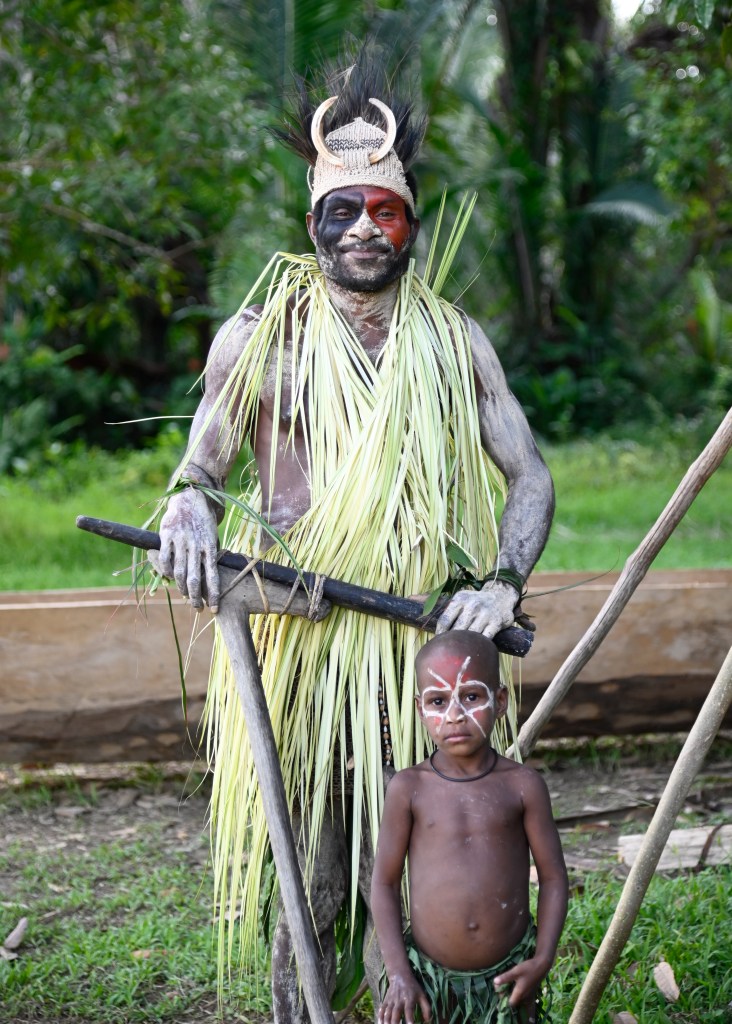
Our stop this afternoon was at a village known as Kundiman II. Here, men, women, and children showed us how important the sago palm – the “tree of life” – is to their existence. With all of the villagers dressed in mostly traditional clothing, head-ware, and face-painting, the men showed us how a palm is cut and broken up to get to the pulp; the women – some bare-breasted (which we would see continuously from Mount Hagen through this part of the journey) – showed us how the pulp was then softened into flour and then cooked into flat pancakes. Local vegetables were mixed with what they called “vegetarian piranha,” a type of fish – the pacu – that had been grilled or smoked.
This was a quiet relaxing amazing afternoon, and a mood-setter for the next four+ days.
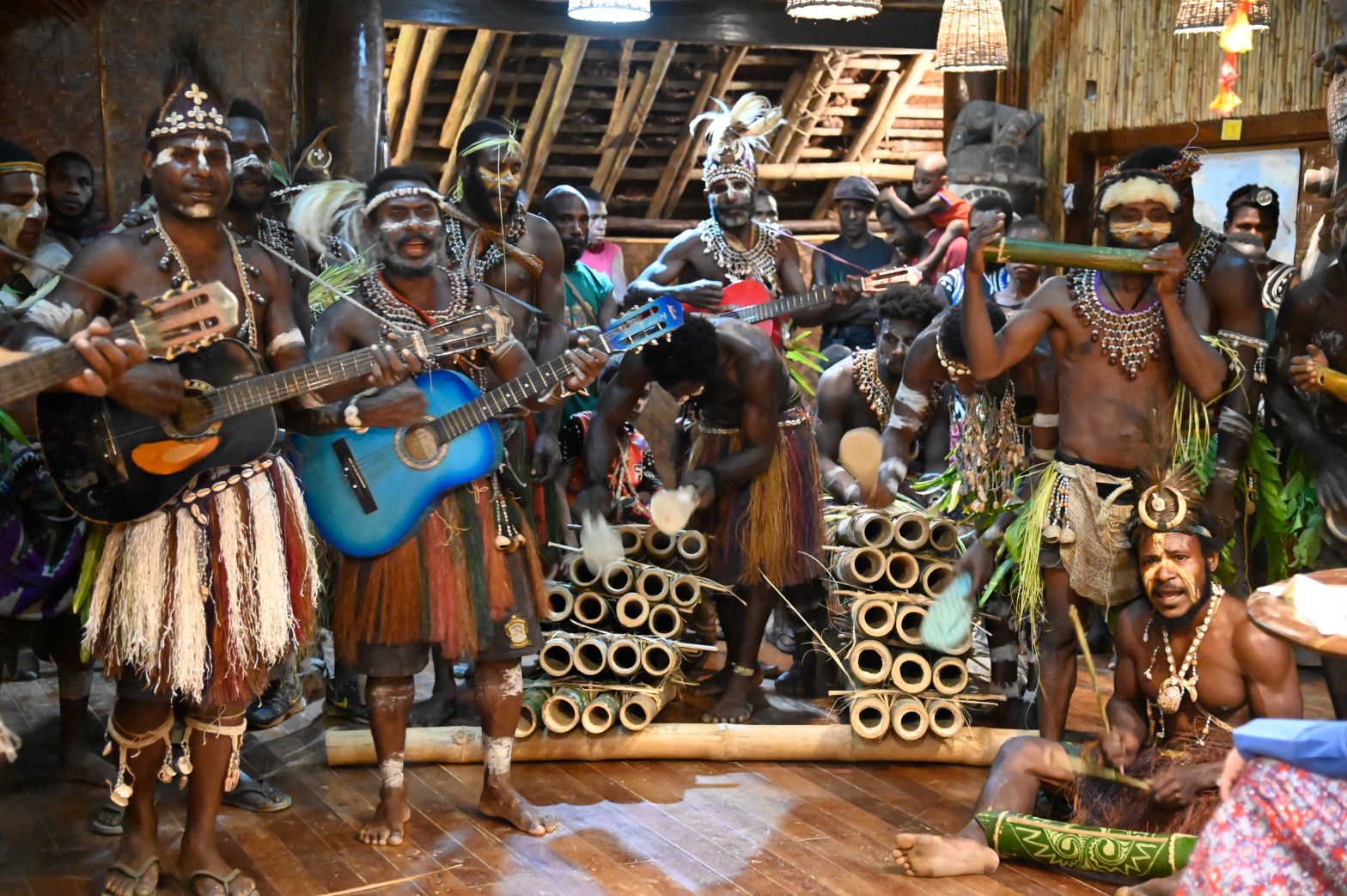
We returned to the Lodge for a short lecture in the main building before dinner. Afterwards, a group of about 30 locals from the Karim tribe – men, women, children – entertained us with traditional songs. The musicians, playing guitars, drums, big flutes, a pan pipe, were dressed in traditional clothing. There were local children dancing, a woman breast-feeding, others from the village watching. It was a remarkably immersive experience.
Electricity would be shut off to all the rooms at around 10 p.m. So – it was back to my lodge at about 9:30, where I proceeded to have a 5-minute fight with a 5” long moth I found in my bathroom (it seemed like a scene out of a movie). My mosquito net covered bed kept the bugs out during the night, and the sounds of the jungle were amazing throughout (if your sound is on, you’ll hear these sounds; if they don’t play automatically, the link is below the photos).
(Clicking on an image below will enlarge it in a new window).
Today we were able to visit four tribes here in the Western Highlands Province, with sometime lengthy drives in-between.
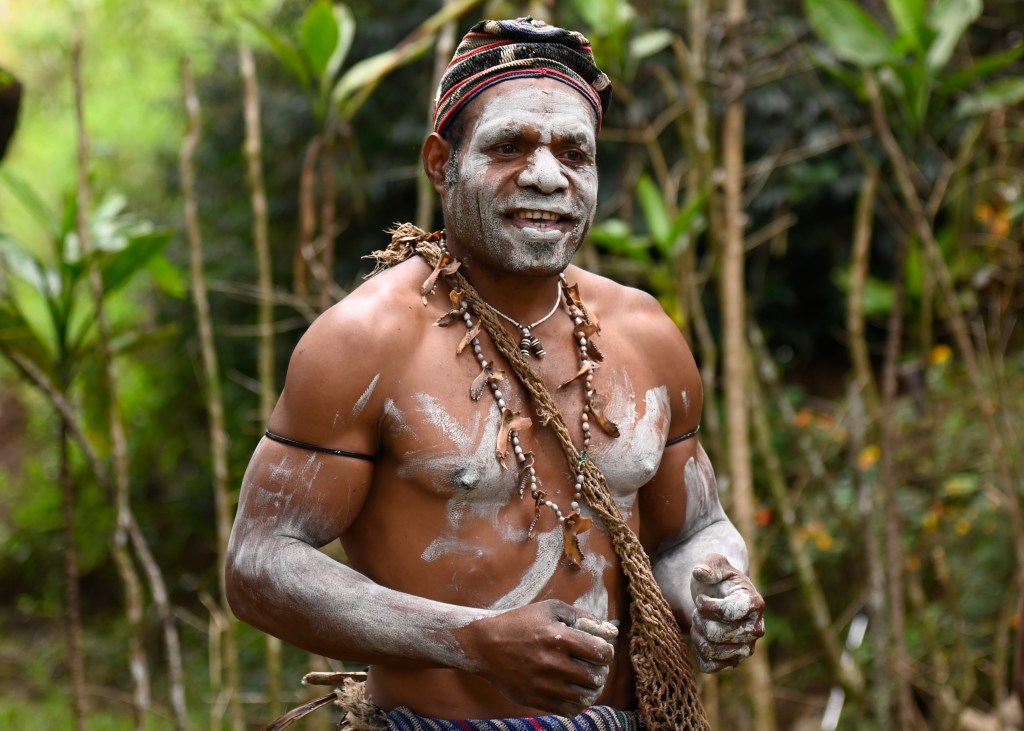
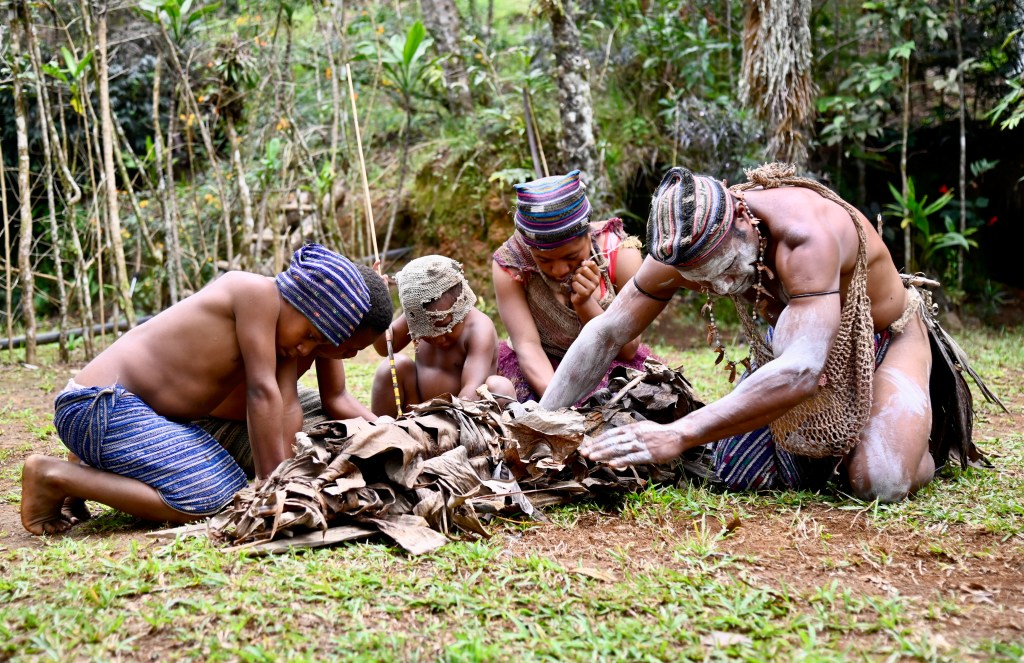
We started with a visit to members of the Melpa tribe, who gave us a demonstration of a burial – from the way in which they communicate with other families in their tribe or clan (a subset of a tribe) about a death all the way through to how they bury a body.
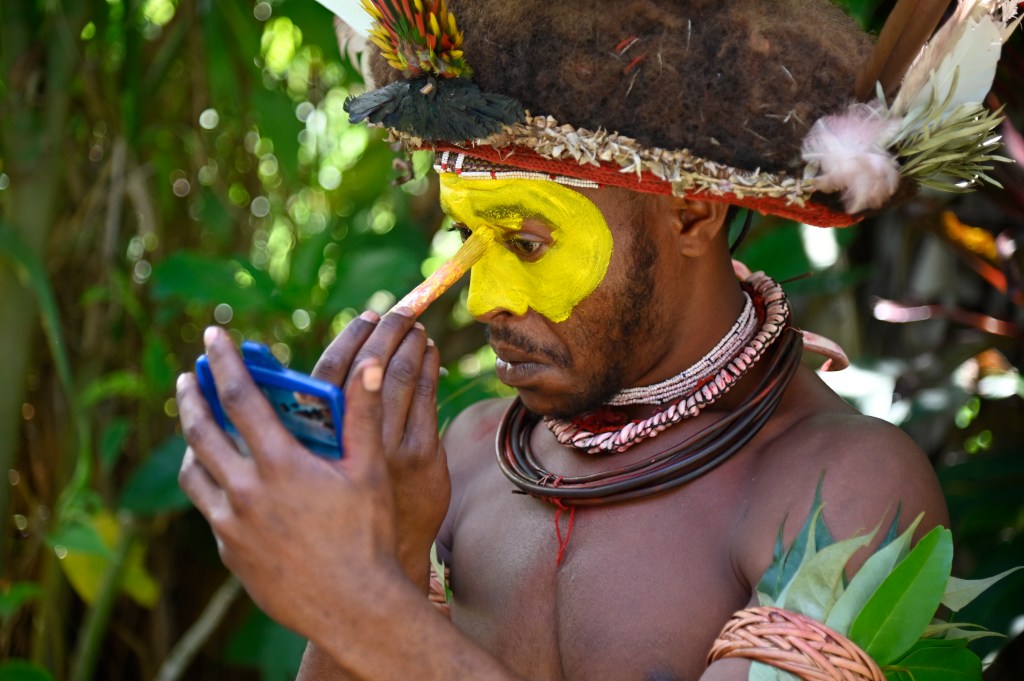
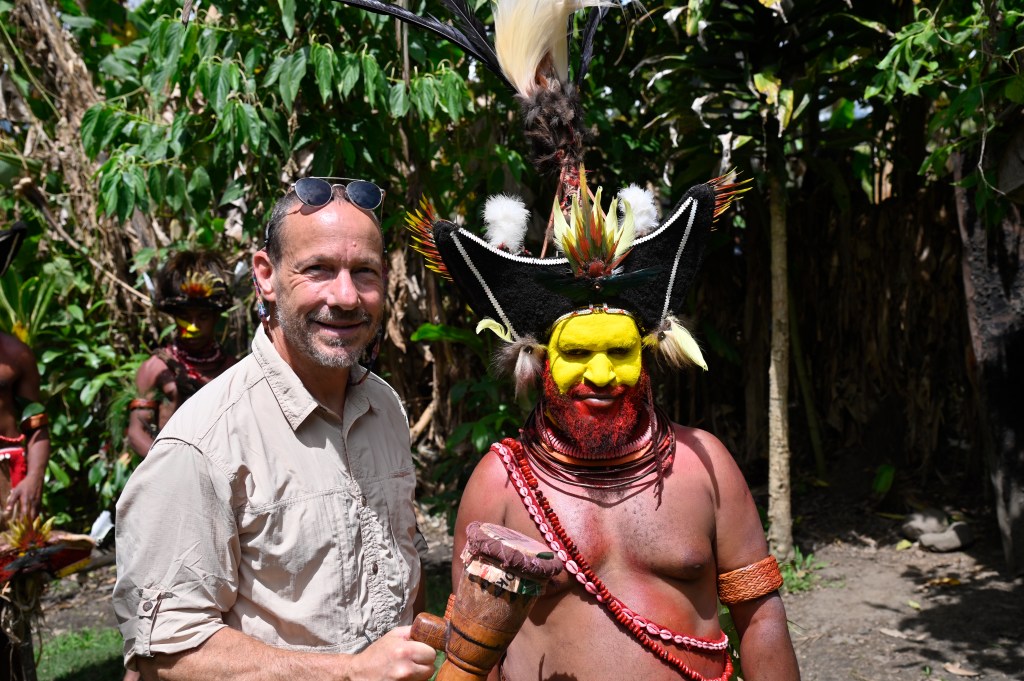
Our next visit was to see the Huli Wig Men, one of the better know tribes in the Highlands. They make hats – wigs – out of their own human hair and use those on top of their own hair. They have “everyday” wigs, wigs for special ceremonies (they wore those for us), and tribal leader wigs. As well, they decorate the wigs with feathers and other natural items, and pain their faces in vibrant colors. We saw them paint and dance.
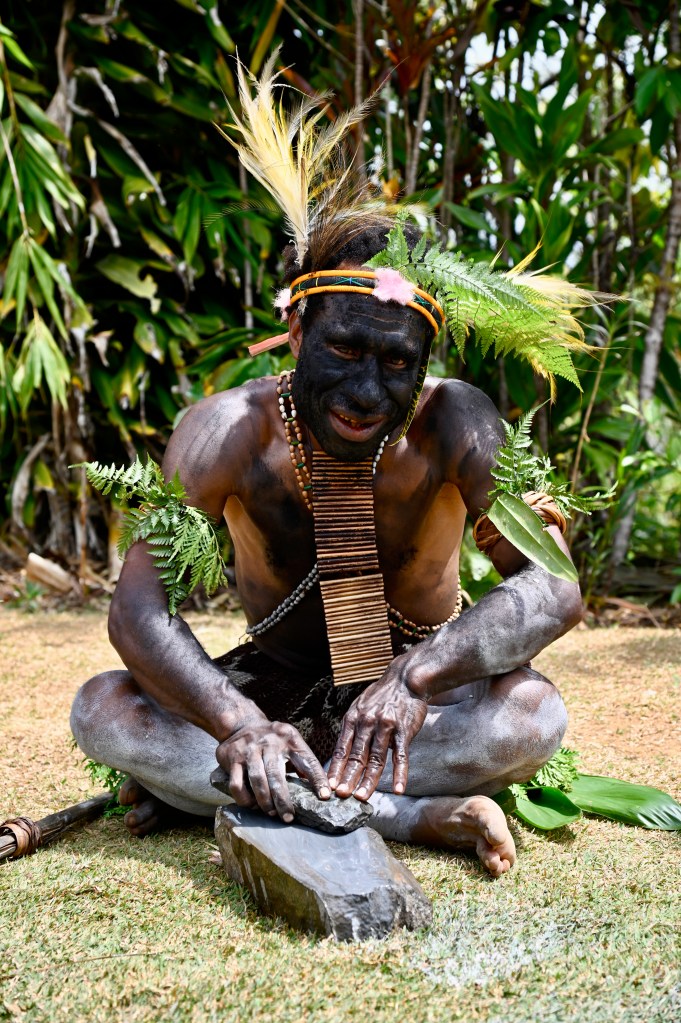
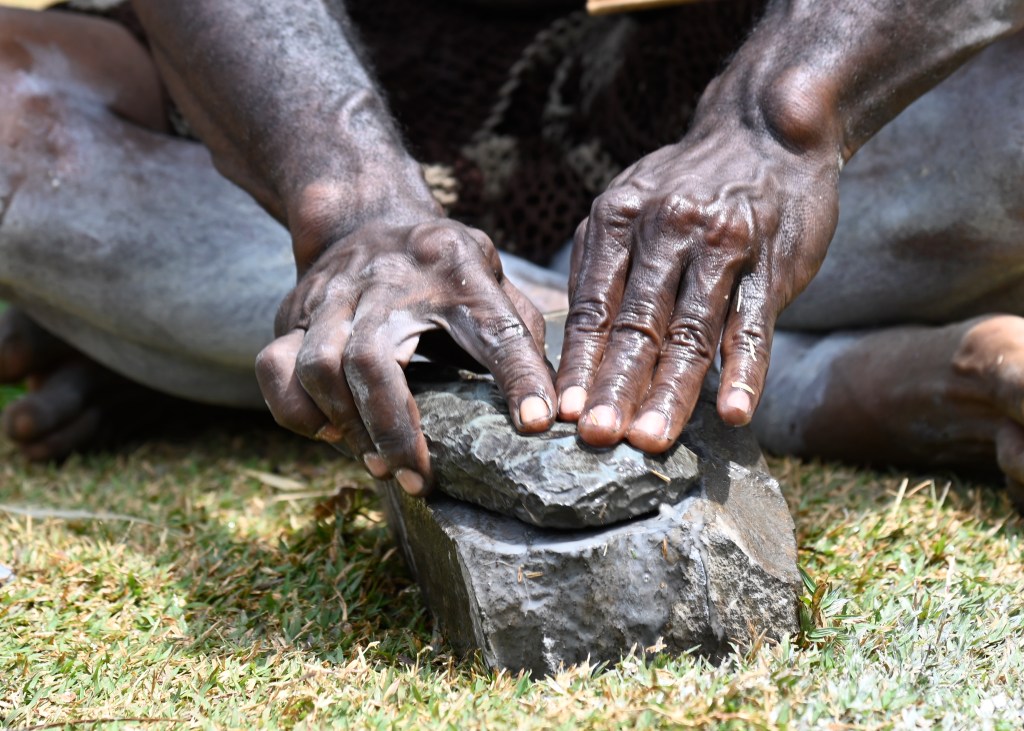
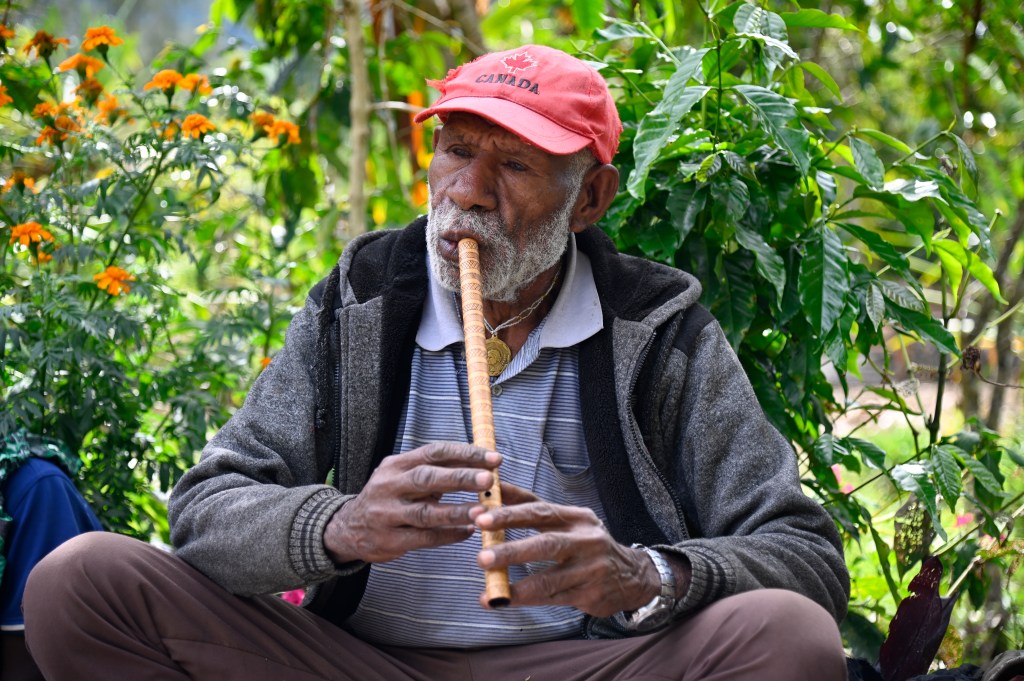
The third visit was with the Giga tribe, which showed us several things – how they sharpen tools, how fire is started, a divorce ceremony, and flute players (the flutes are made of simple bamboo tubes – they’re more like a recorder).
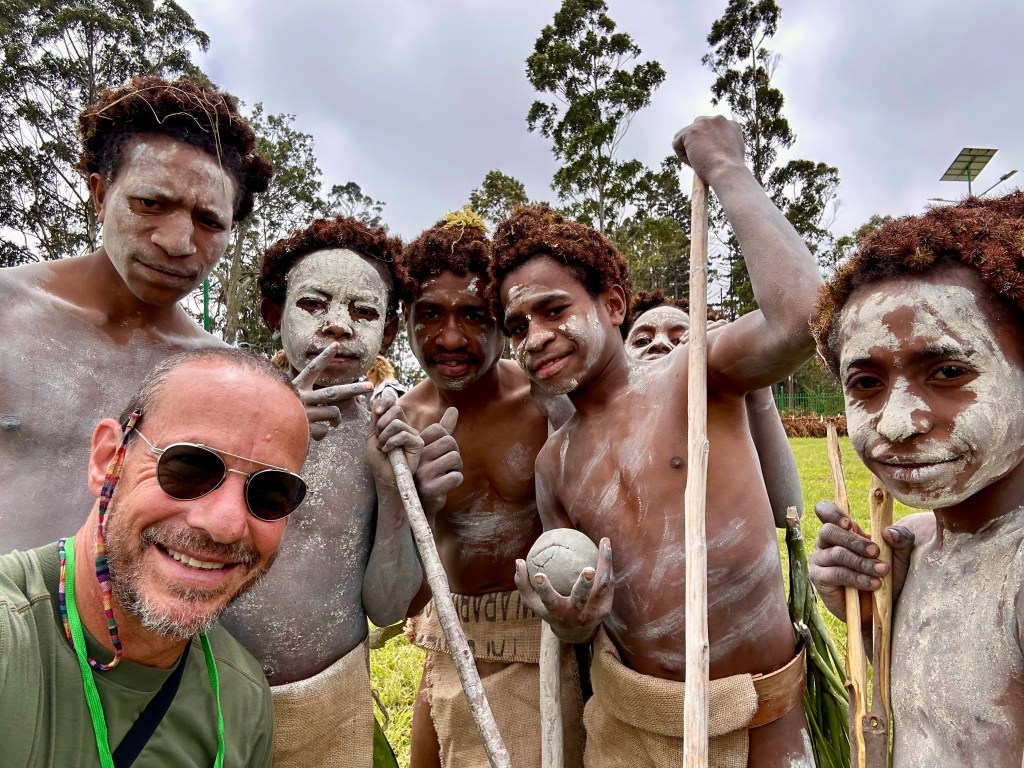
And, our last visit was with the well-known Goroka Mud Men, who make large masks (that cover their entire heads) out of clay, and who cover their bodies with clay as well. They showed us a scenario in which an unwanted visitor builds a fire in their territory and is then “attacked” by several mud men.
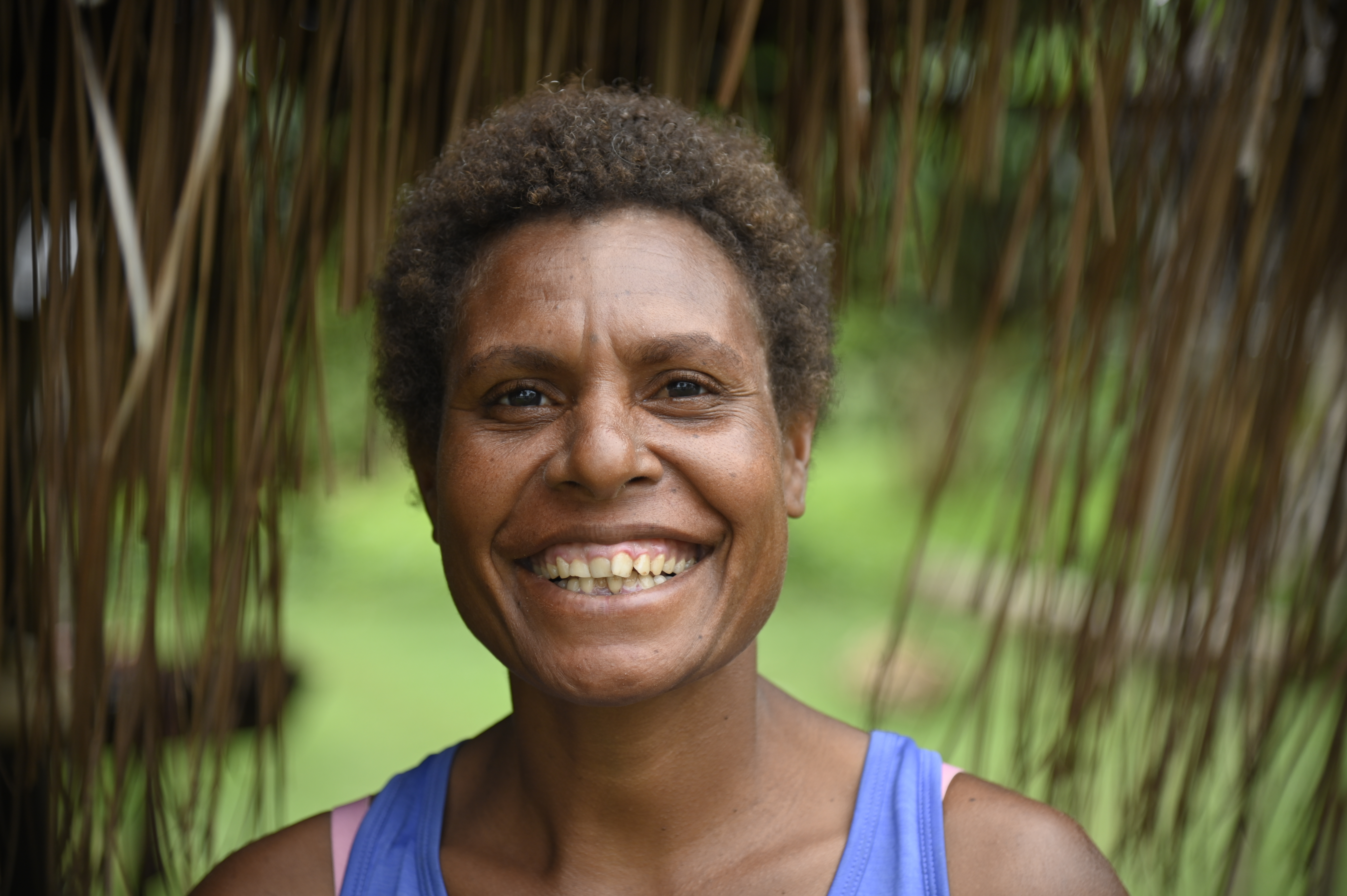
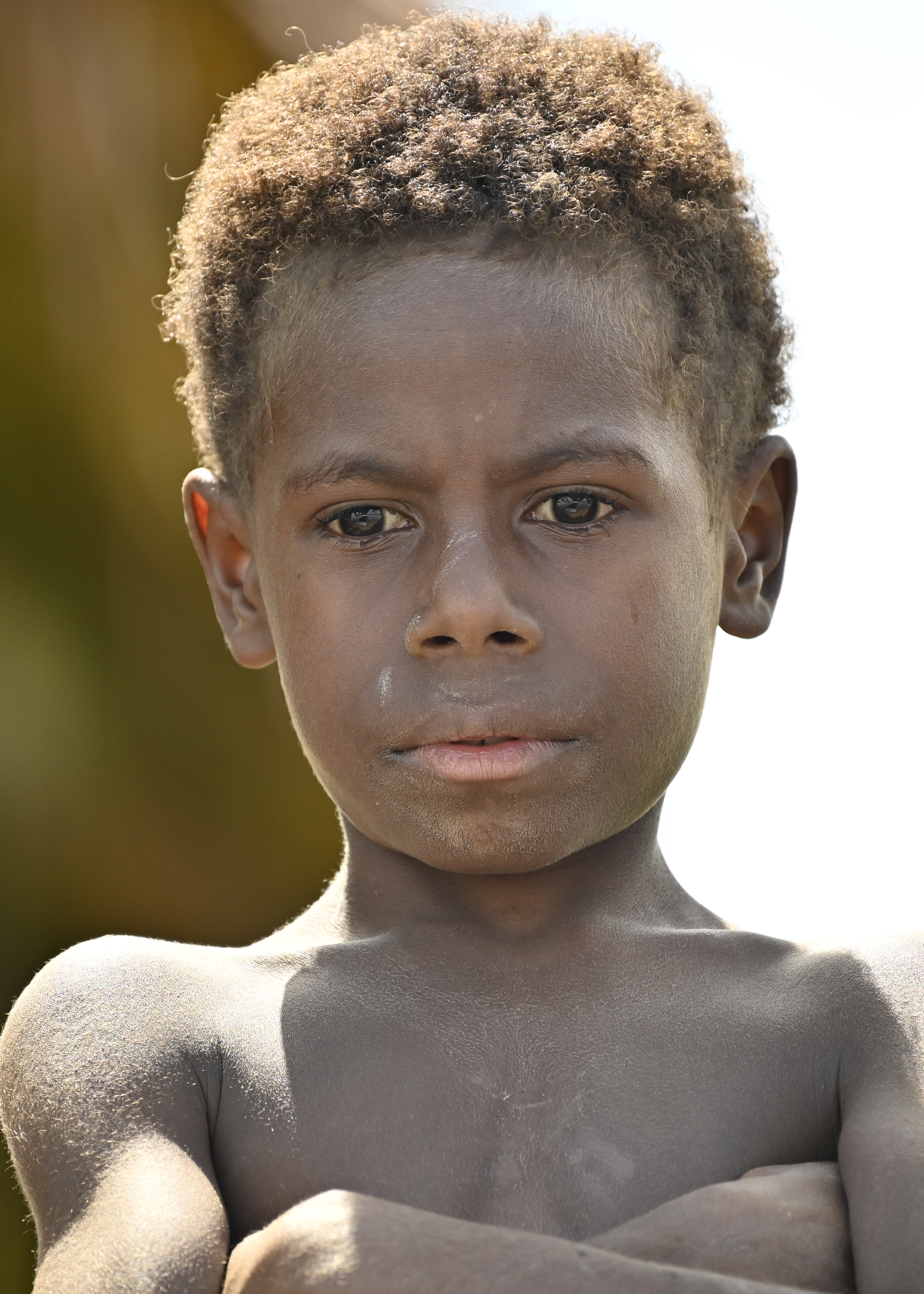
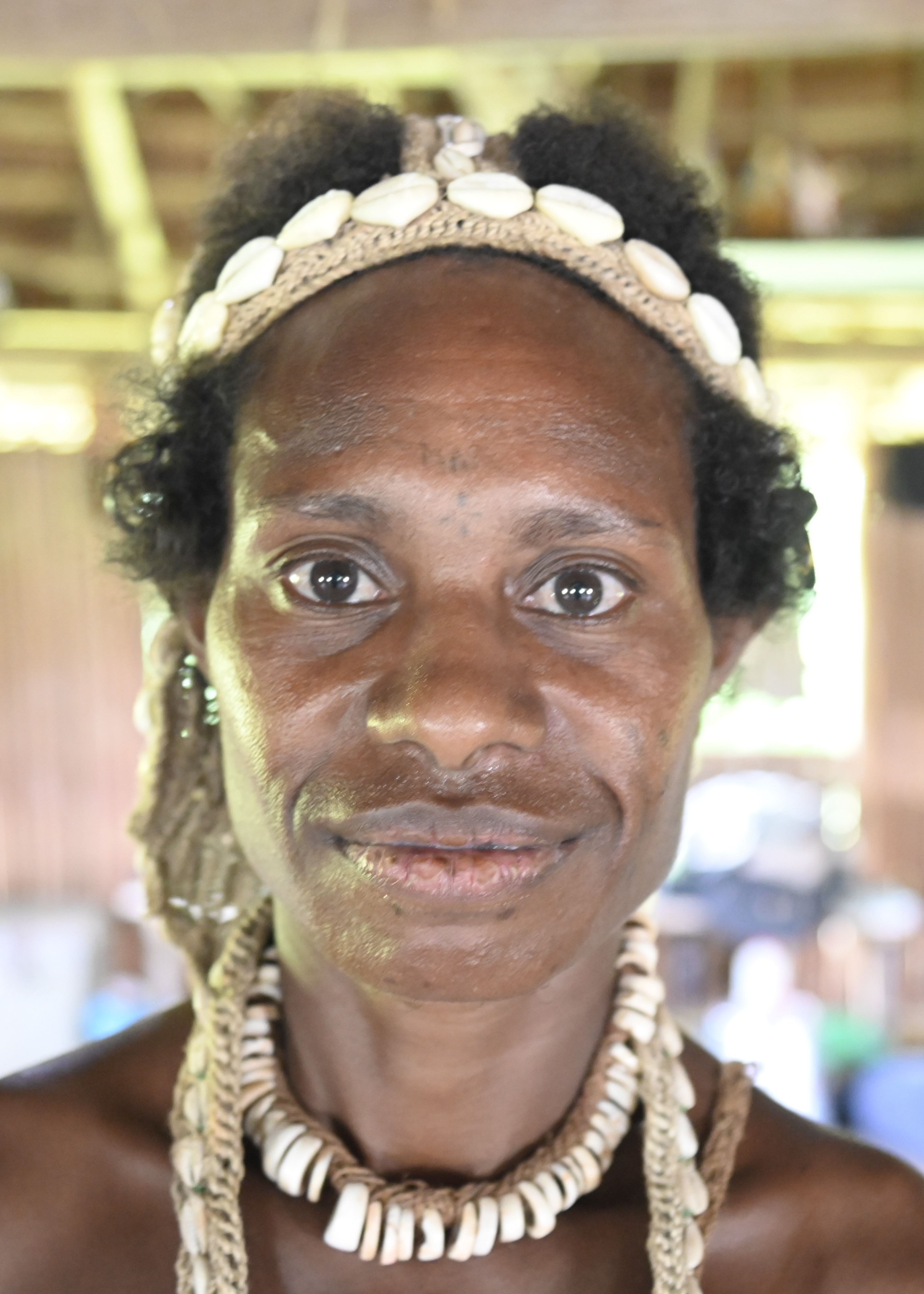
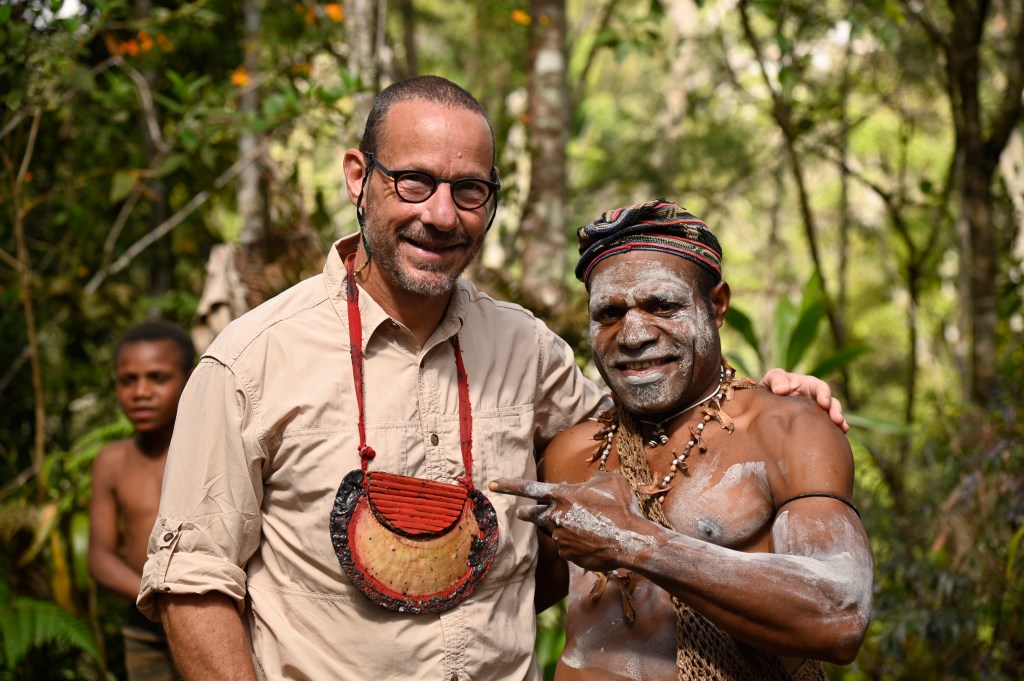
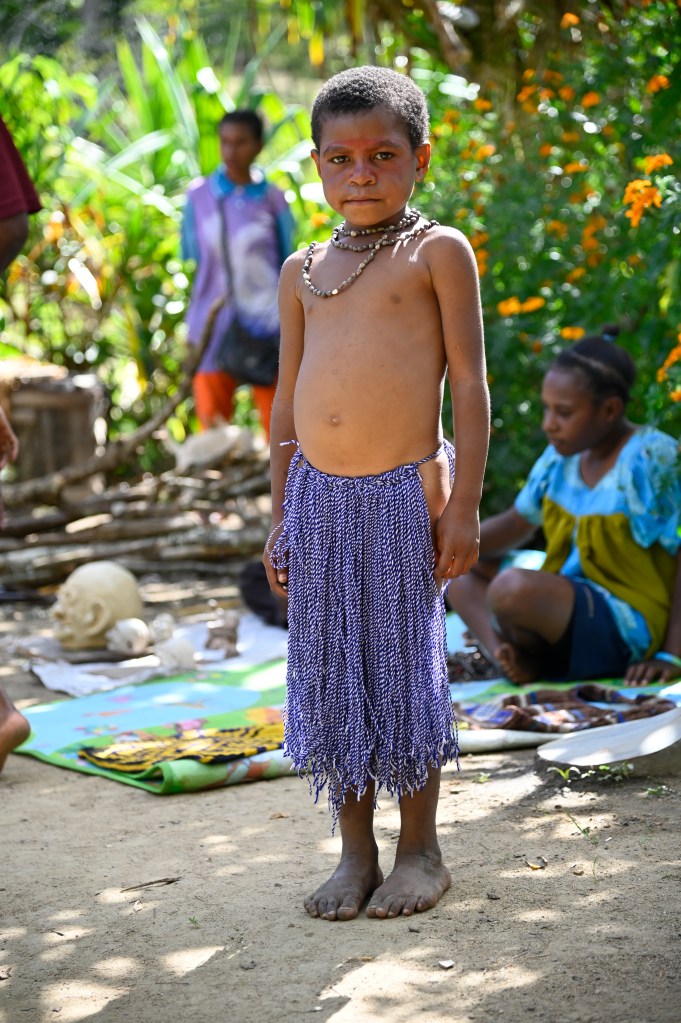
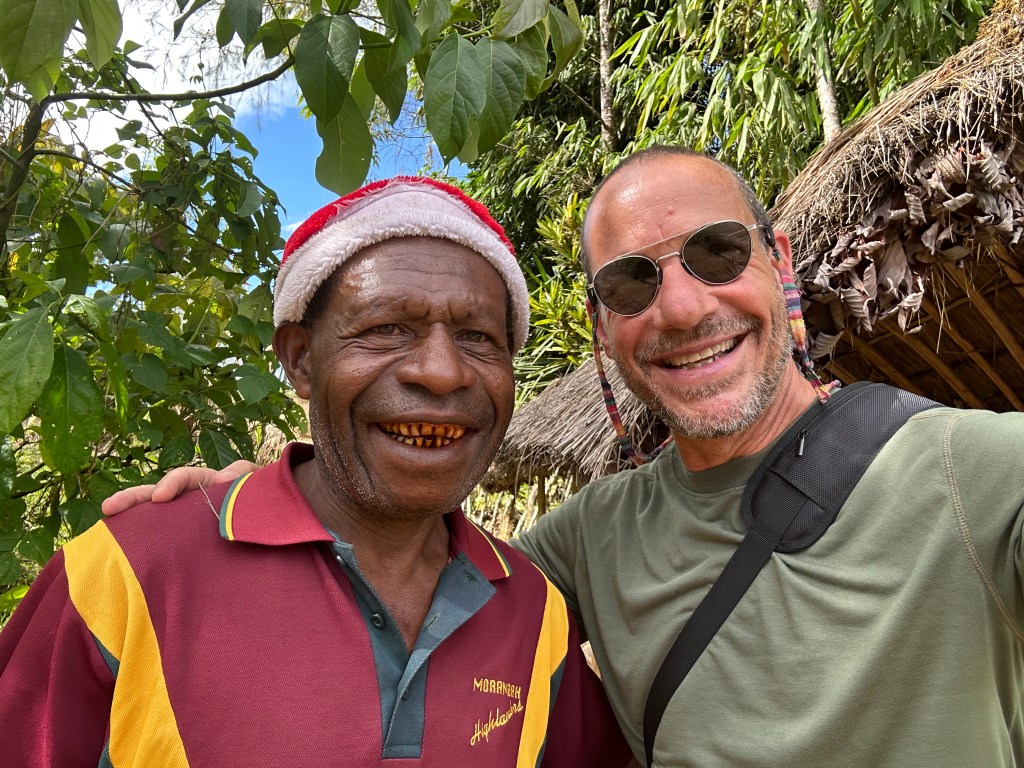
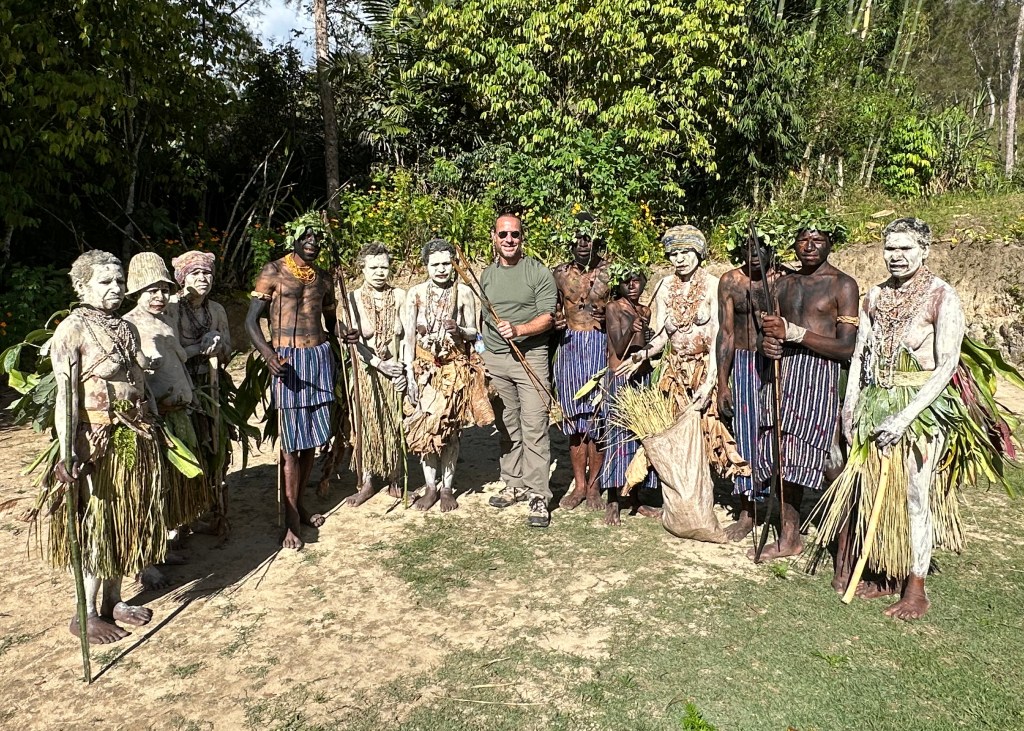
The beginning of each presentation starts with a tribal leader or “cultural center” leader welcoming us, expressing their gratitude for our visit, and letting us know that photographs are completely okay to take. After the demonstrations, the performers are quite willing to have close-up photos taken, shake our hands or embrace us, take pictures with us, and let us try on parts of their traditional clothing. It is really clear that they are happy to have us there, and that they’re deeply proud of their culture.
Our day ended at our Lodge with the viewing of a documentary from 1980 named “First Contact.” The first contact with some of the Western Highland tribes (some of the tribes we saw today) was in 1930; the Australians who had contact with them filmed it. So, in 1980, a documentary was made using that film inter-woven with contemporary interviews with some of the villagers from 1930 as well as two of the Australians. Really fascinating stuff. Available on Vimeo in two parts.
Tomorrow we leave to go to fairly remote areas where we will have no cell or internet available until at least day eleven. I’ll have a lot of catching-up to do after that.
(Clicking on an image below will enlarge it in a new window).
Day five started with an early flight from Port Moresby to Mt Hagen, a city in the Western Highlands province. The flight up took about an hour and the airport sits at about 5,500 feet, while our lodge, which overlooks the Wahgi Valley, sits at 7,100 feet.
Our time over the next few days will be taken up by excursions to villages around this region and the other regions we visit. The wide variety of tribes and traditions and cultures will give us the chance for lots of interaction with locals. The tribes we saw on day five, and I suspect on other days as well, sit in a place between the modern world and traditional culture. Apparently, most of the country is Catholic (though we say many churches of a wide-variety of denominations – Baptists, Evangelicals, Seventh-Day Adventists, among others) and that religion is blended with long-held traditions. The villagers we saw yesterday were a mix of clothing – western blended with tradition; for the performances we saw, it was all traditional clothing. Those we saw on day five live in small communities in the jungle – houses mostly built of trunks of trees bound together – but we saw a flushing toilet and a solar panel as well.
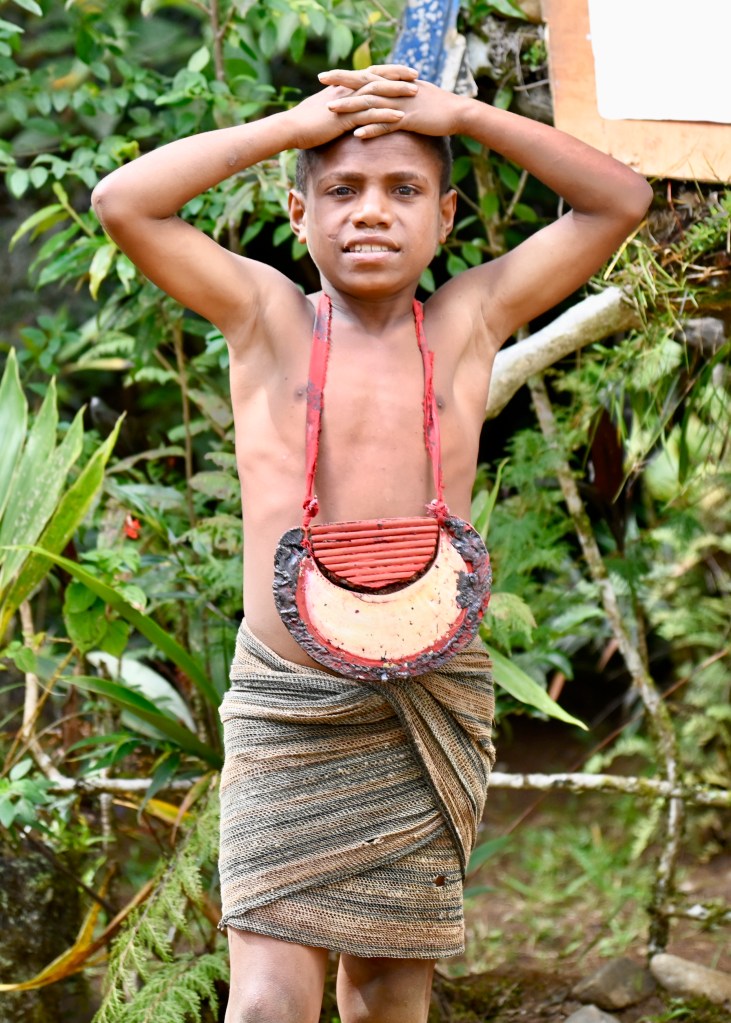
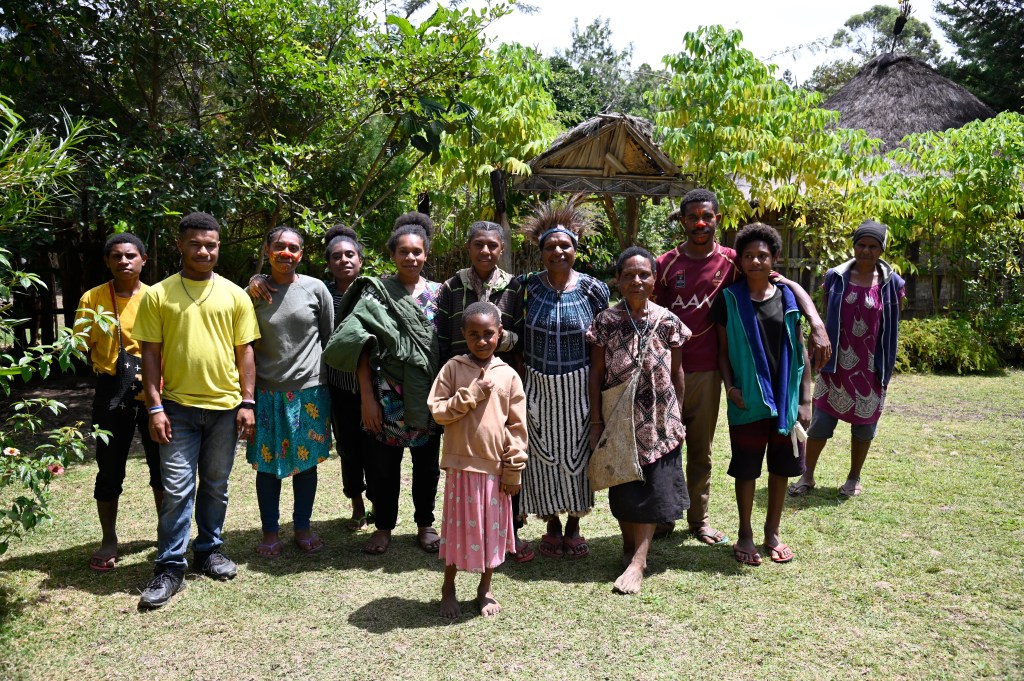
Our first visit was to the Koskala village of 300 people where we saw the Sedaka tribe; we took about an hour drive from the airport, first on well-paved roads (build by the Chinese, though the locals asked them to remove the traffic lights in town), to less well-paved roads, to packed dirt and rutted roads. We passed industrial looking shopping centers and small roadside markets, tho the farther we got from town the fewer of both we saw. We passed by tea and coffee plantations (most small and owned by locals), banana trees, and mostly thick vegetation with view of mountains in the distance. People sitting by the roadside in small stands sold fruits and vegetables. Many people walking along the road – the elderly, children, and every age in between, almost universally waved to us as we drove by; in fact, all our interactions so far have been with local communities that are warm and gracious and share their names and smiles.
At each village we visit we’ll have a chance to see a performance or demonstration of traditional ways. At the first one, we first saw and heard courtship songs, performed by a group of seven adults and one child. They then demonstrated some traditional healing methods.
That visit was followed by a long drive to the Munaga village, home of the Wurup clan of 200 folks; apparently they had broken off from a larger tribe, in order that they could just focus on their culture and cultural demonstrations. Here we saw how traditional battles were held between villages – including, apparently, an agreed upon “rest” period between each attack.
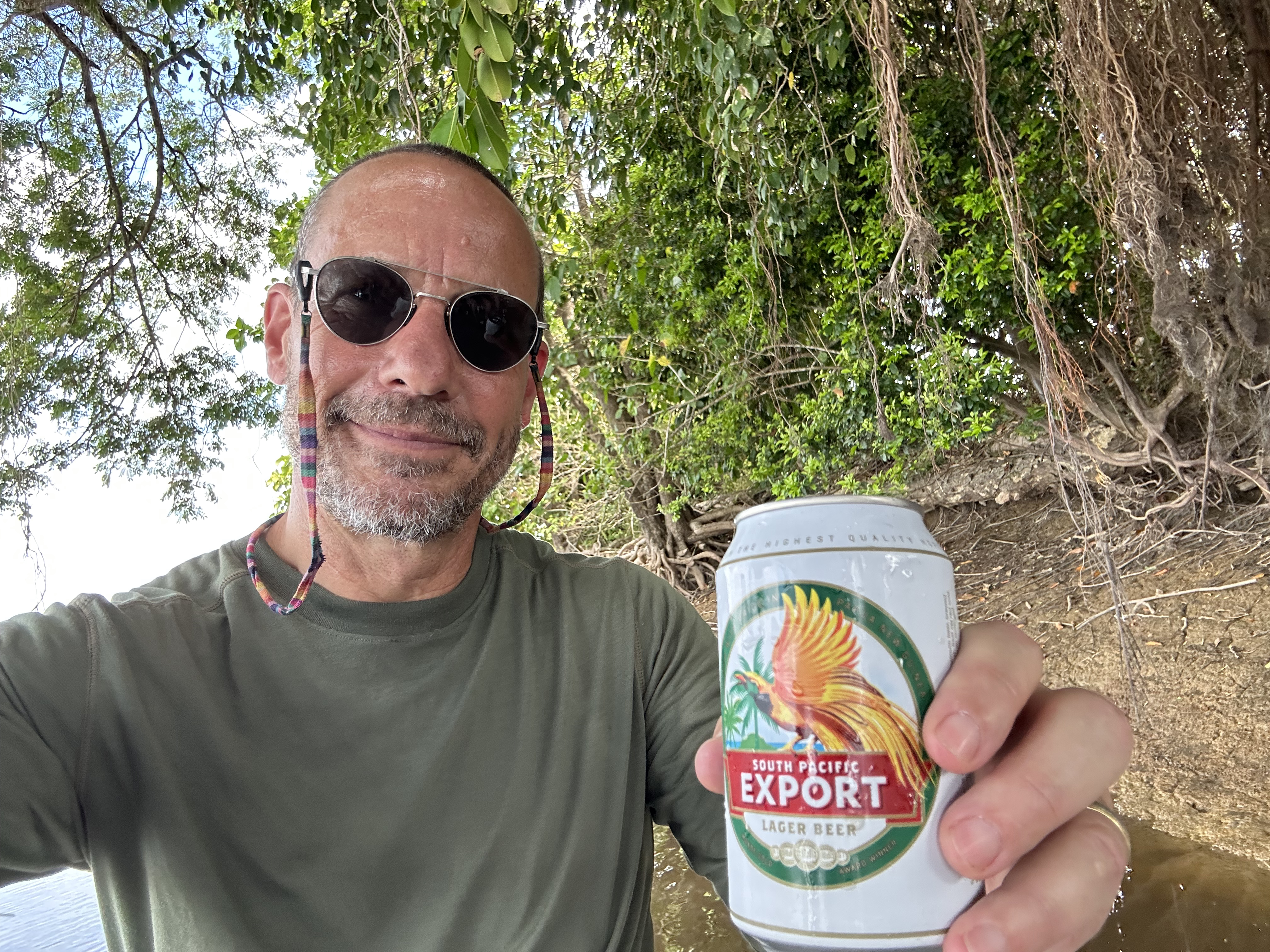
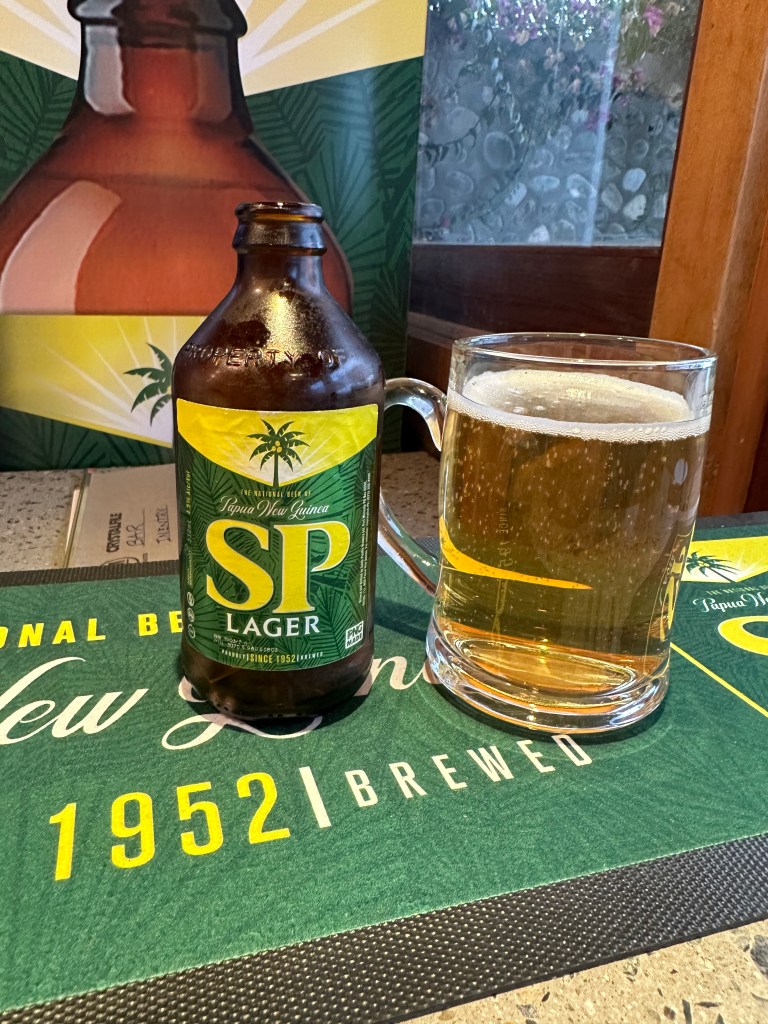
After that, it was a lengthy drive back to our lodge for dinner and my first Papua New Guinea beer.
(Clicking on an image below will enlarge it in a new window).
























 Fred's Travel Blog