Day 16 – An animated light show, a shrine, and some Swallows

My last full day in Tokyo, and I decided to not get up too early after four really busy days.

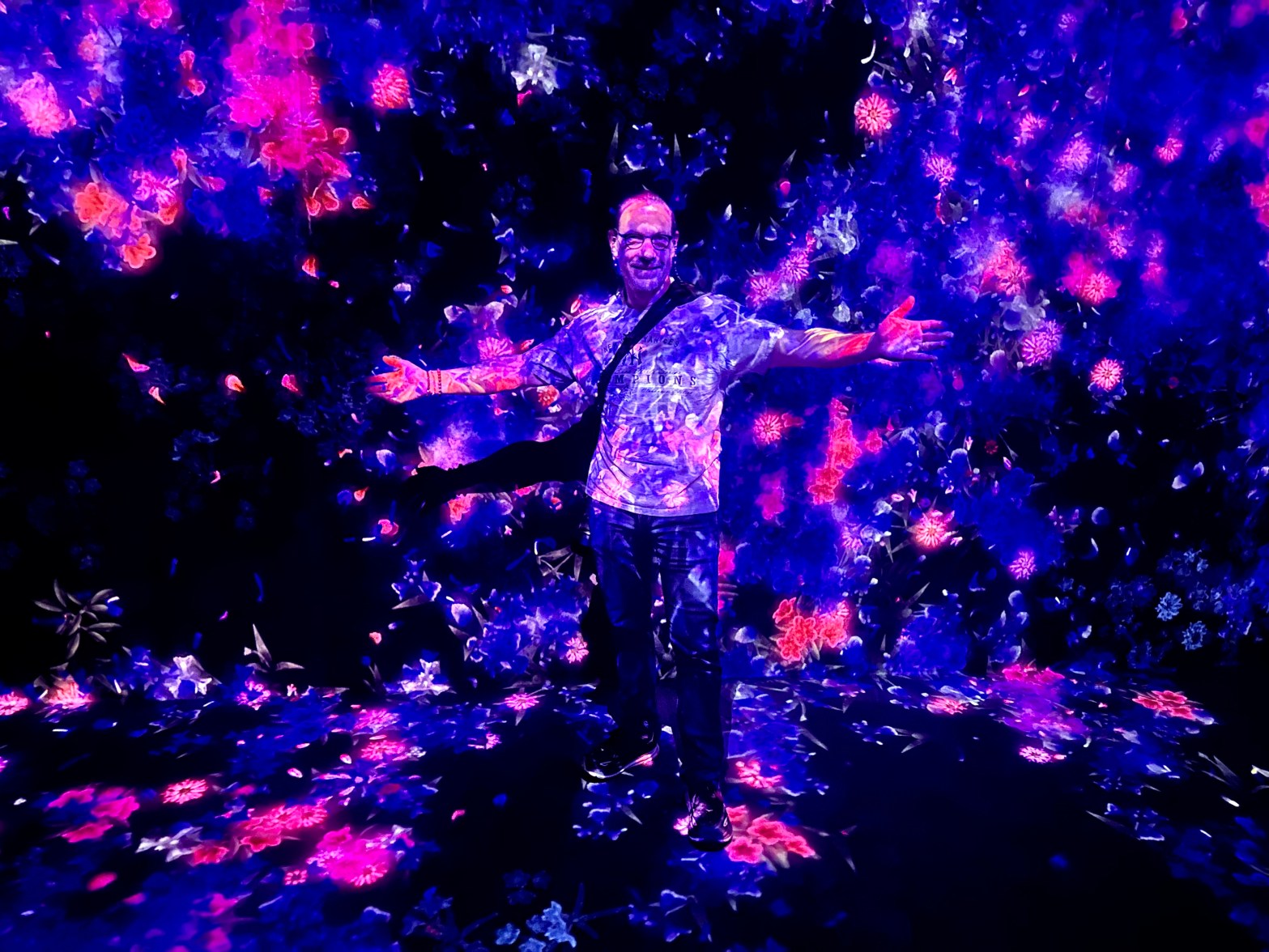
To start, I took the subway to the Roppongi, a very upscale neighborhood with high-end clothing and other retail, as well as newer buildings – office and residential.  Walking over to the Azabudai Hills area and buried in the expansive mall-like basement of the Mori office complex (The Pokemon Company apparently is headequartered there), was the teamLab “Borderless” exhibit; that’s a misnomer though – it really is an expansive immersive digital experience.  TeamLab is an art collective founded in 2001 – artists, programmers, engineers, animators, and others – who create art that combines all of their collective skills.  They’ve got multiple exhibits at various locations in Japan, Macao, China, Singapore, Hong Kong, and other cities around the world.
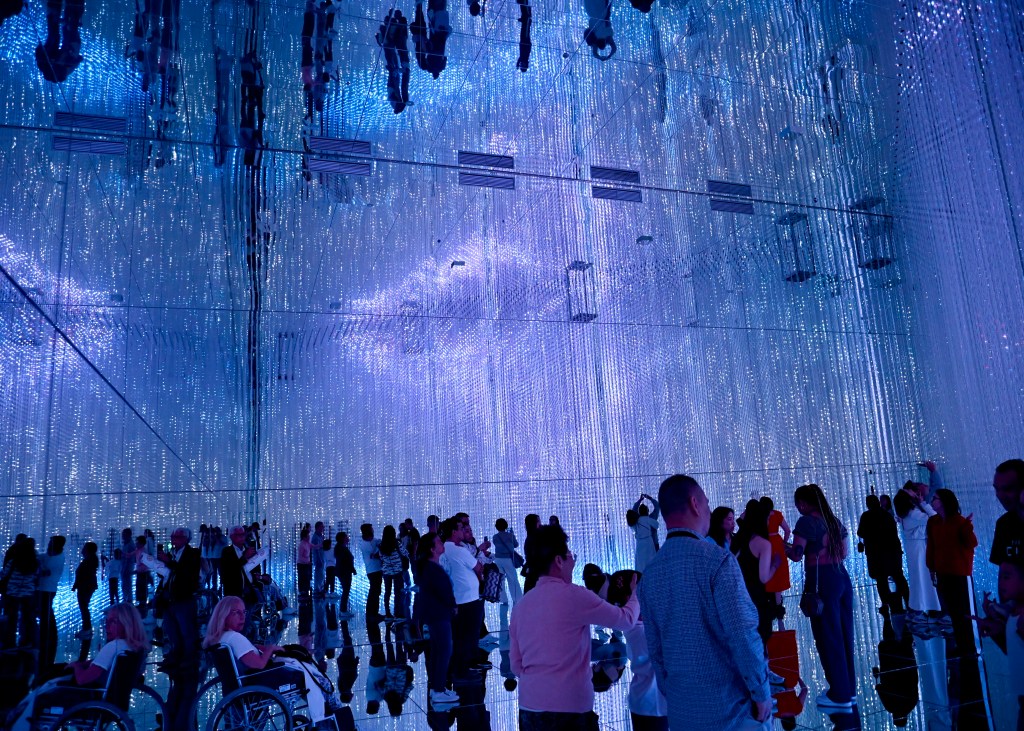
You wander and walk – there’s no guided pathway – in and around a series of large and small rooms and hallways; projected on the walls and ceiling and floors are light shows, animated fish and marching turtles and people; hanging from the ceiling in one room are lighted beads, in another virtually unlit room large cubes are attached to the walls with warnings about sharp edges, in others there are mirrored floors.  It’s close to dark other than the lights and images being projected; in one room I experienced vertigo unlike in any of the other rooms.  Children and adults – me included – looked in awe-struck wonder at the ever-changing images and lights; even if you loop back into the same room, you may see something completely different.  It was pretty darn cool.

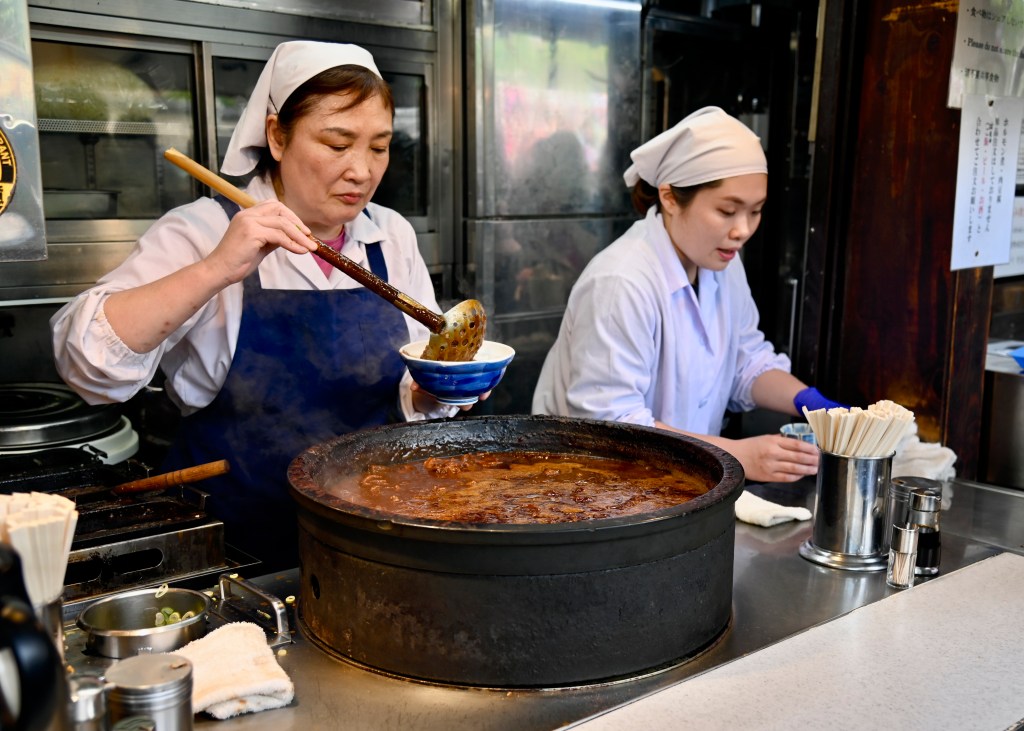
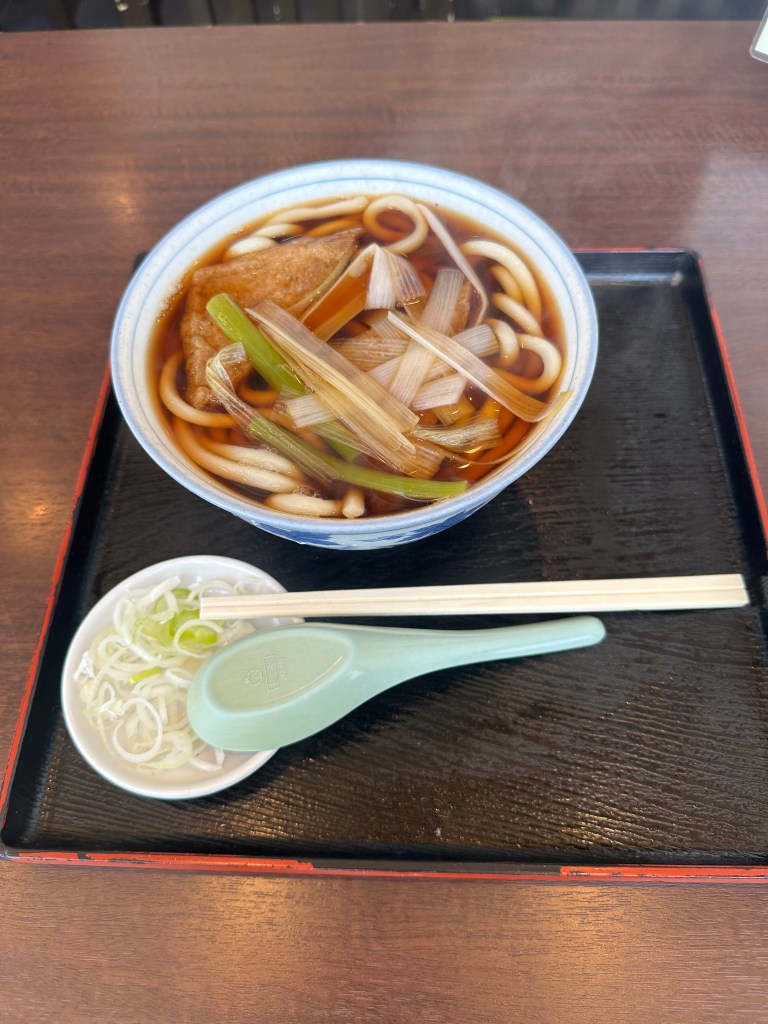
After I finished, I started walking back to the subway.  Not sure what I was going to do for lunch, I noticed a black-suited Japanese business man ducking into what looked to be a small local restaurant, so I followed him in.  The waitress – whom I presumed to be one of the owners with her husband in the kitchen – didn’t speak any English but handed me a point-and-pick menu.  I was the only caucasian in the place, and had a great bowl of ramen.  At one point, I put my iPhone on the table, leaning it up against the menu in order to film myself slurping; the guys at the table next to me, not knowing I was filming, grabbed the menu, only to see my phone fall; they apologized – by nodding their heads and laughing a little at what I was doing.
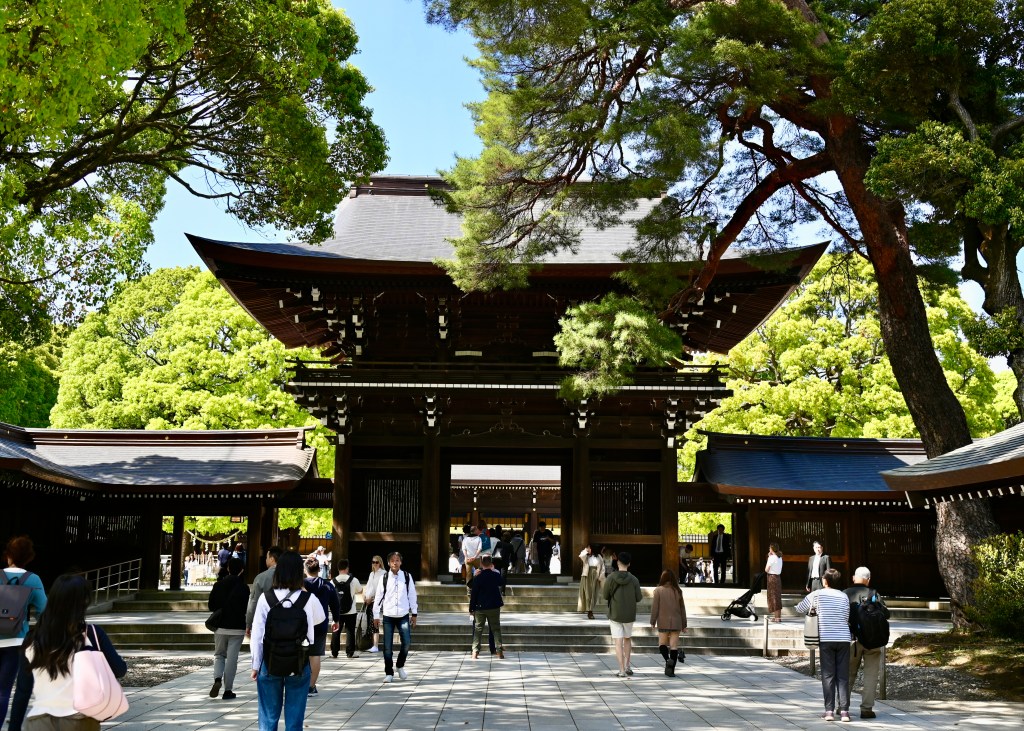
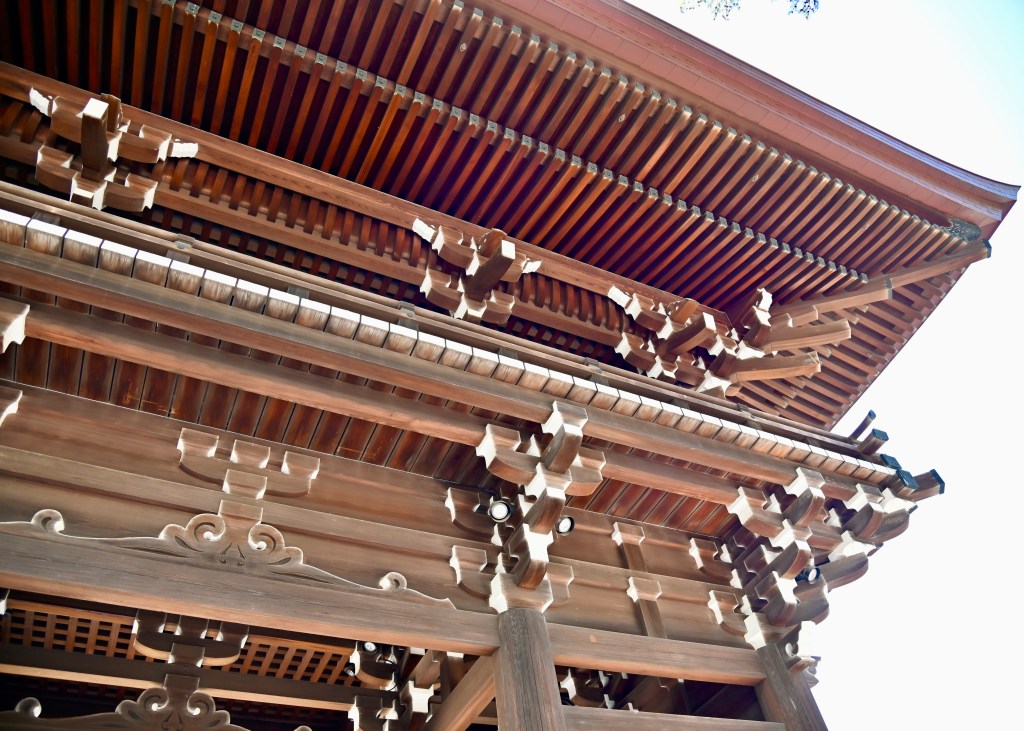
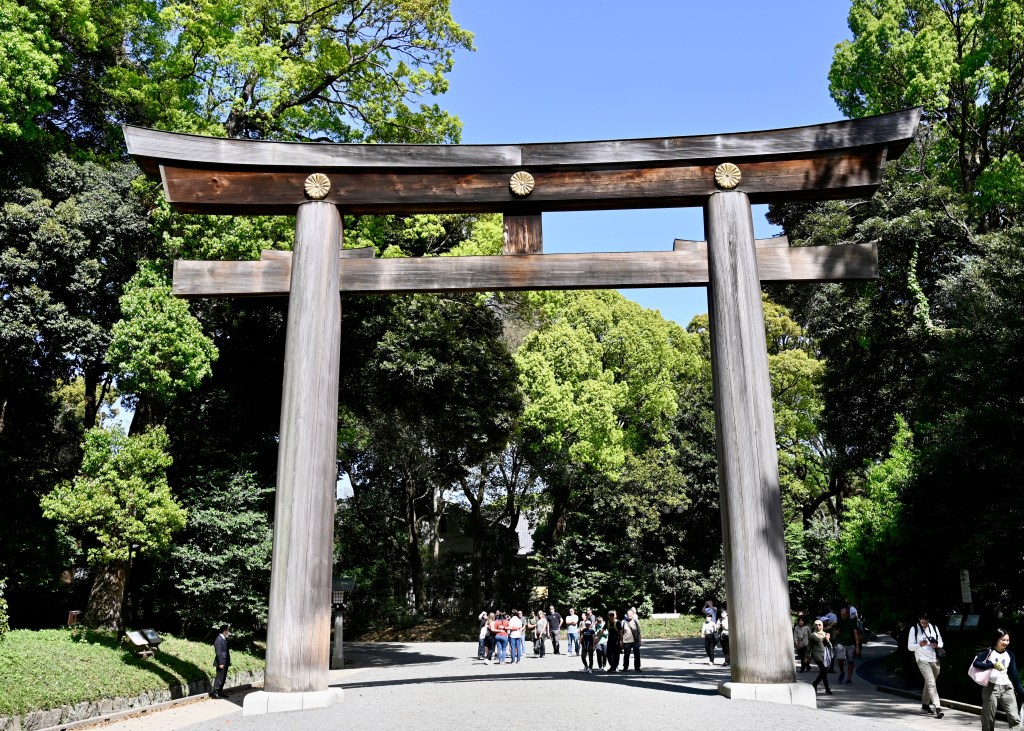
From there, I was off to the Meiji Shrine; the subway left me with about a 15-minute walk first through city streets and then into a large public forest with evergreen trees.  Amidst all of this was the Shinto Shrine complex – dedicated to the Emperor Meiji (the first emperor of modern Japan) and his Empress wife; he died in 1912, and the Shrine was dedicated in 1920, though was destroyed during WWII air raids on Tokyo.  It was rebuilt and dedicated in 1958 and is one of the country’s most popular Shrines, visited by tourists and locals alike.

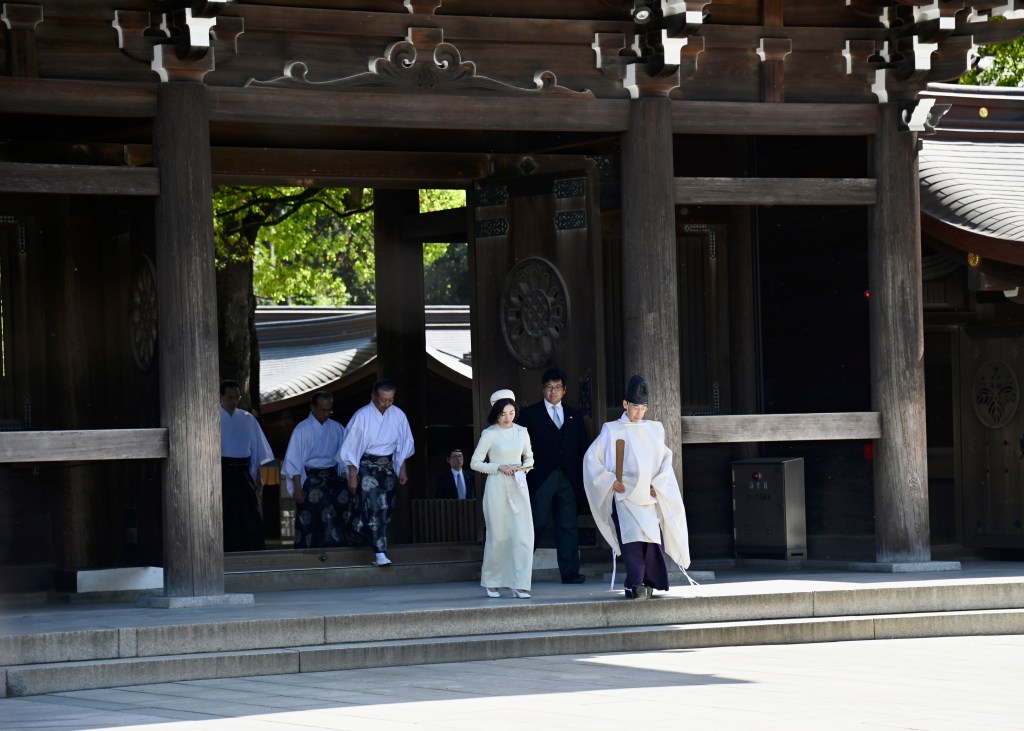
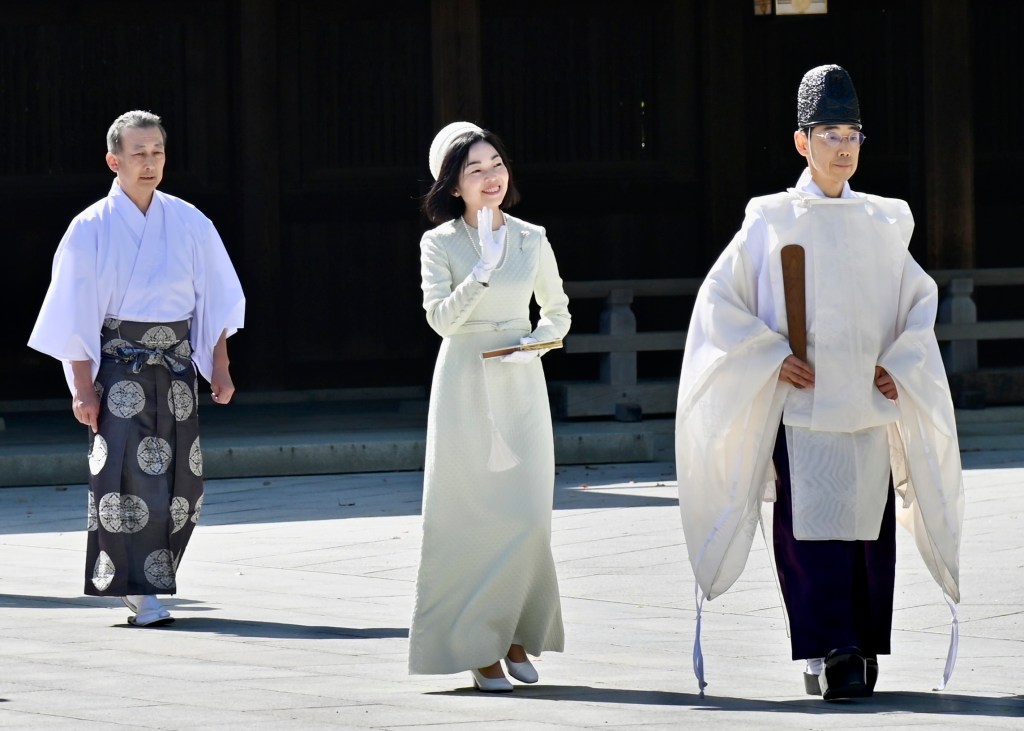
During my visit I noticed news camera crews and Shrine personnel sweeping leaves off the large plaza in front of the Shrine.  Slowly, a group of low-key security – guys in black suits, no uniforms, and no visible weapons – pushed everyone off to one side of the plaza for some unknown reason.  Finally, one guard told us that the princess – the current Emperor’s only child – was coming to visit the Shrine.  We waited for about 20 minutes and Aiko, Princess Toshi entered the plaza with several priests; they walked across it, went behind some screens and then entered where the main altar is located, stayed briefly (we were too far away to see what was happening there), and then walked out the way she came.  The whole thing lasted about 20-25 minutes, but it was exciting to see.
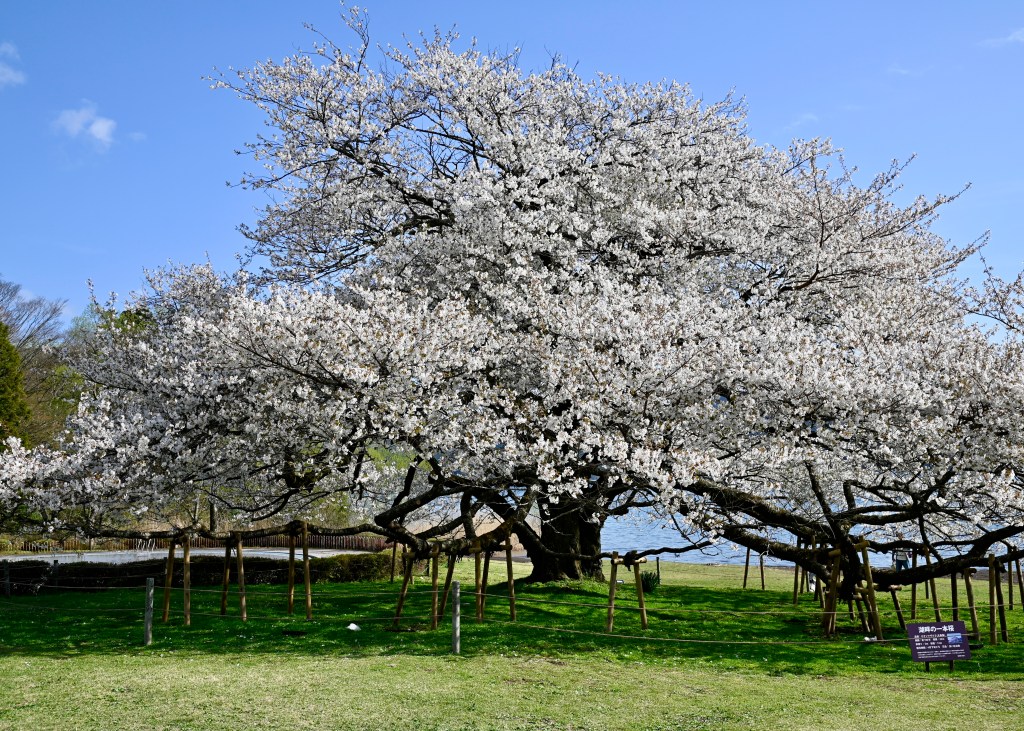
I took the subway back to my hotel to rest-up before my evening’s activity.

When I decided I was going to Tokyo, there were two things I wanted to be sure I did:  see sumo (which I did on day one) and go to a Japanese professional baseball game – NPB or Nippon Professional Baseball.  Not knowing exactly how to pull this off, I dug into Reddit and learned about JapanBall and JapanBallTickets – both amazing resources for learning about Japanese baseball, history, stadium, players, and how to buy tickets.  There are two teams that play in metropolitan Tokyo (and five overall that play within reasonable distance); the Tokyo Yomiuri Giants play in the Tokyo Dome; they are, for better-or-worse, considered the New York Yankees of Japanese pro ball – the first team, the winningest team, and two of the games’ biggest stars played for them, one being Sadaharu Oh (868 career home runs).  The Tokyo Yakult Swallows plan at Meiji Shingu Stadium, the second oldest ballpark in the country (built in 1926) and where Babe Ruth and Lou Gehrig once played.

Fortunately, the league’s scheduled allowed me to see one of these teams – the Swallows – playing the Yokohama DeNA Baystars.

I took the subway down to the Stadium figuring I’d arrive early – when the gates first opened – to see what the scene was like.  The stadium definitely needs an upgrade, but the fans already were waiting to get in, a good sign for the enthusiasm they’d show.  The starting line-ups were to include two former US MLB players.

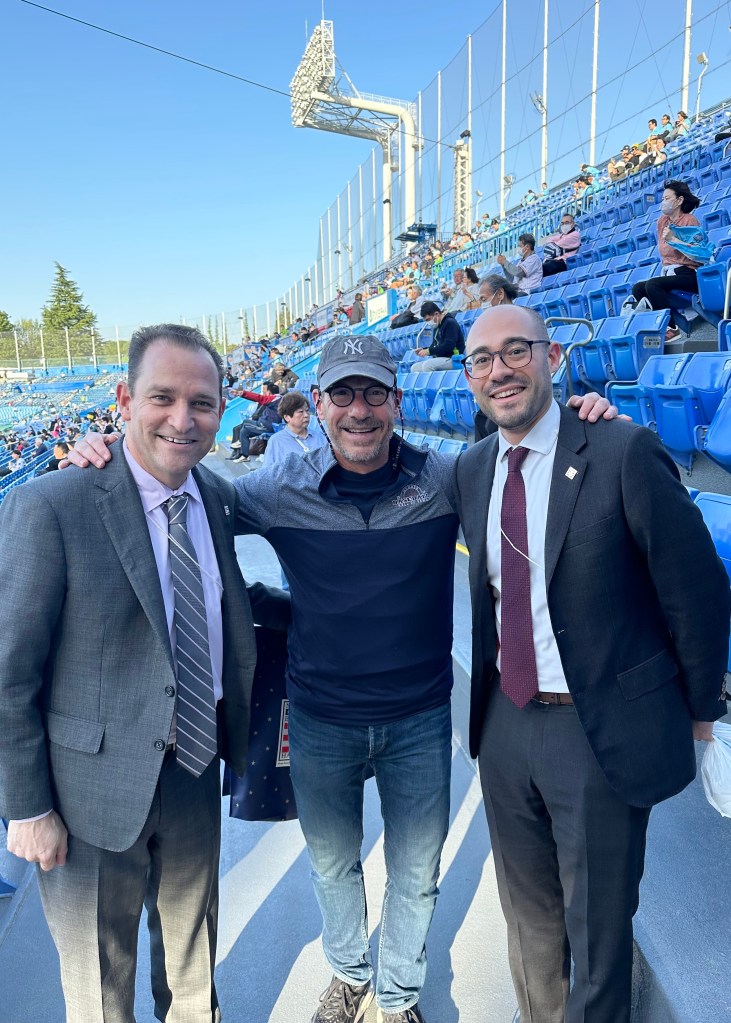
Once I walked in I took a stroll around the the entire seating area, from the right-field foul pole, headed past first base to behind the plate and up the third-base line to the left-field foul pole. I was wearing my MLB Hall of Fame jersey, and as I was walking, I noticed a few guys in suits walking down an aisle. Two of them stopped and pointed at me, then at my jersey; it was then that I noticed they were wearing MLB Hall of Fame lapel pins. Turns out it was the president and one of the vice presidents from the Hall of Fame, in Tokyo to announce a new partnership between NPB and the HOF. Small world! We had to grab a photo!
So what’s different inside the ballpark?  Cheerleaders!  Both before the game and during player announcements and between some innings.  Vendors – almost all of them were women, and they basically carry kegs on their backs, with hosed spouts and plastic cups; want a beer?  They pour you a fresh one out of their keg.

And the cheering is just fantastic – two different official cheering sections for the home team – one that sings and cheers and chants when they’re at bat, the other cheers and chants and sings when they’re in the field.  Home team scores a run or hits a a home-run?  Fans’ umbrellas come out and get opened and spun around.  There’s just a ton of enthusiasm.

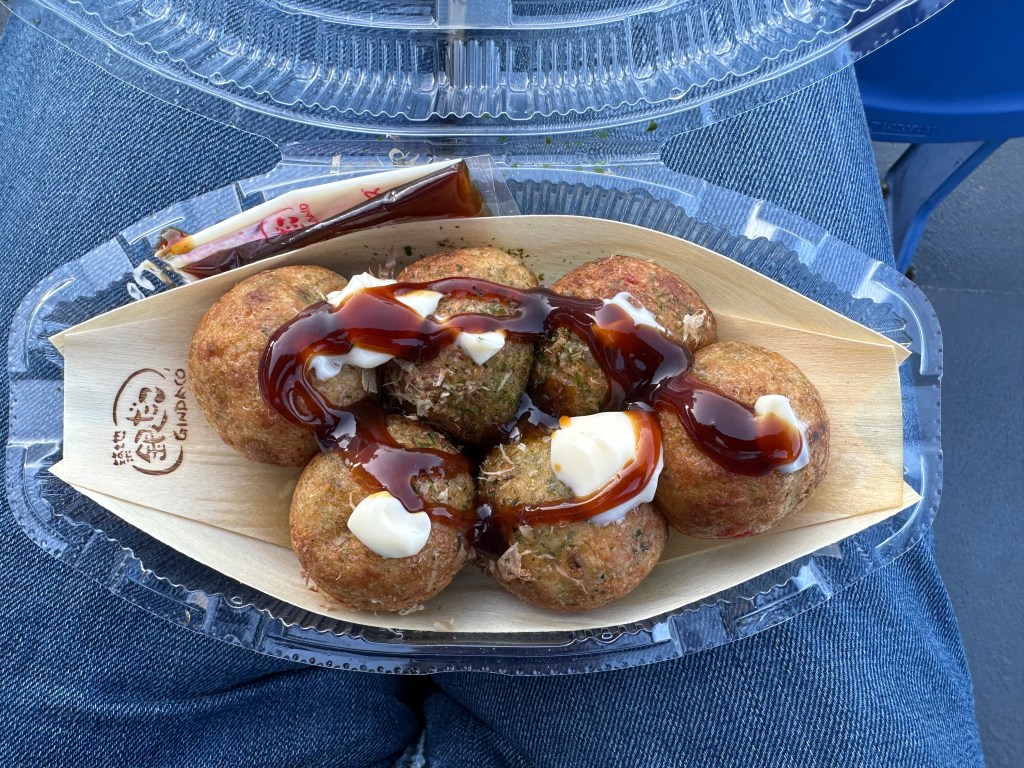
And the food for sale?  Well, I didn’t know what most of it was – there weren’t a lot of English-language signs at the food stands in the concourse, so I found something that looked pretty tasty based upon the signs.  There was a dude standing there hawking whatever it was; so I asked him – what is it?  He indicated he didn’t speak English well, so grabbed his phone, typed something in, and showed me the resulting picture:  it was an octopus.  So, what he was hawking was essentially clam fritters but made with octopus.  Sounded good! Tasted good too.
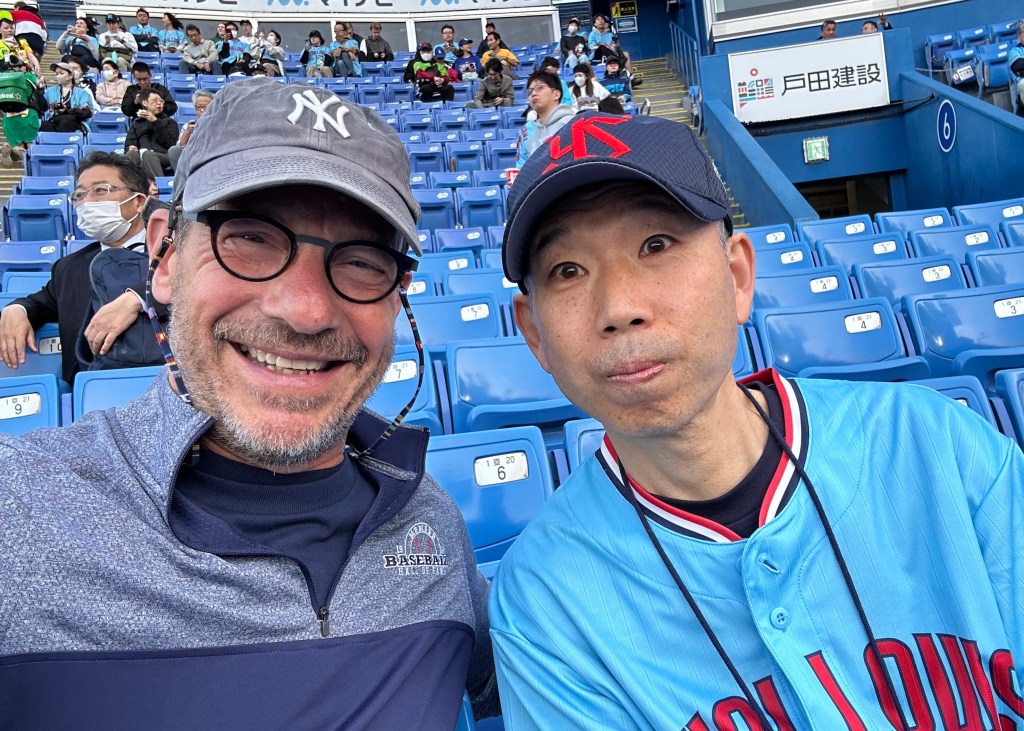
My seat was about 10 rows behind home plate, seated next to Yoshi, one year older than me, a die-hard Swallows fan and former season ticket holder.  He’d brought his own food with him, as well as his umbrella.
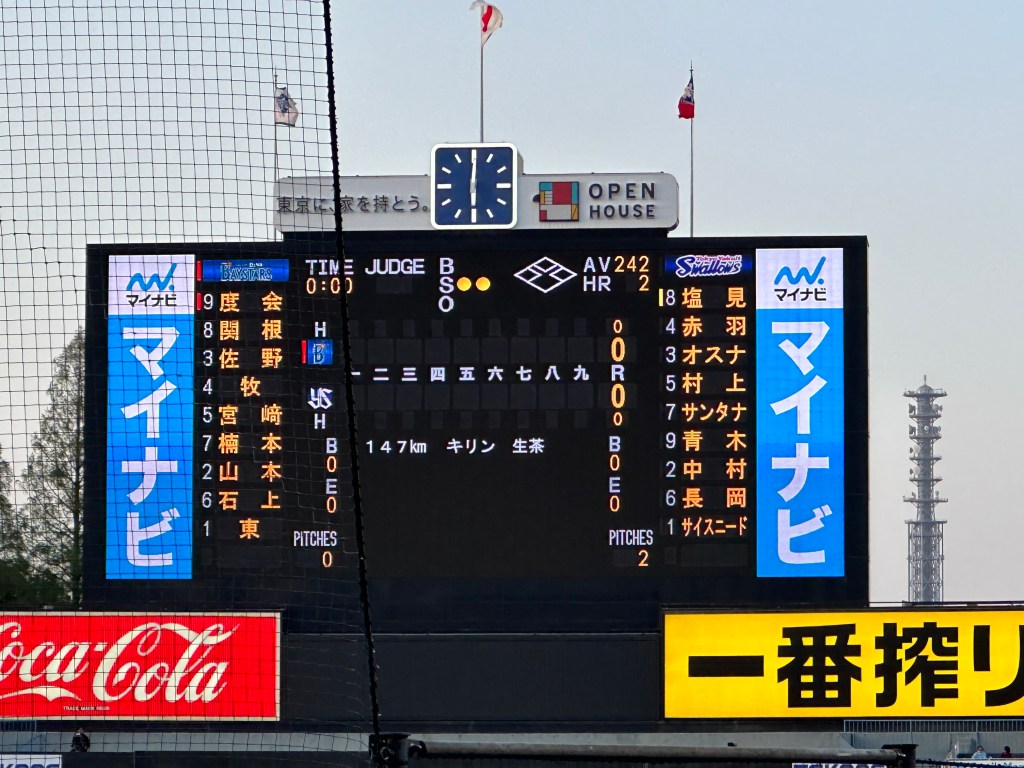
It took me just a few minutes to decipher the scoreboard – everything was in Japanese, but so much was familiar, just in a different format than I was used to.  The pitch speed was in km/hr instead of miles; there was no pitch clock.  They did have video review on the scoreboard, and no DH during the game.  The Stadium was only about 3/4 full when the game started, but there were a lot of late arrivals and by the 3rd or 4th inning it was full.  It was loud and boisterous throughout, even more so when the Swallows came back from 2-0, 2-1, and 3-1 deficits to ultimately win the game 4-3 on home-runs by Osuna (to tie) and Muramaki (to win).  Super fun.

After a subway ride back to my hotel, I finished my last full day in Tokyo with a Wagyu burger and a couple of cocktails, happy about having been to the game and seeing a home-town win.  My stay in Tokyo had started with sumo and ended with baseball.
Day 15 – Tokyo Seafood and Bathrooms (it’s not what you think)

For years one of the highly-touted things to do in Tokyo was to see the morning fish market (allegedly, the world’s largest) at Tsukiji – what was known as the “Inner Market”; each morning, it held a famous tuna auction where you could stand on the floor with the fish sellers and buyers to watch the activity.

Well, this “inner market” was moved in 2018 and is now indoors and viewing it, as a tourist, can only be done from a second floor viewing platform behind a large window. So much for seeing that.

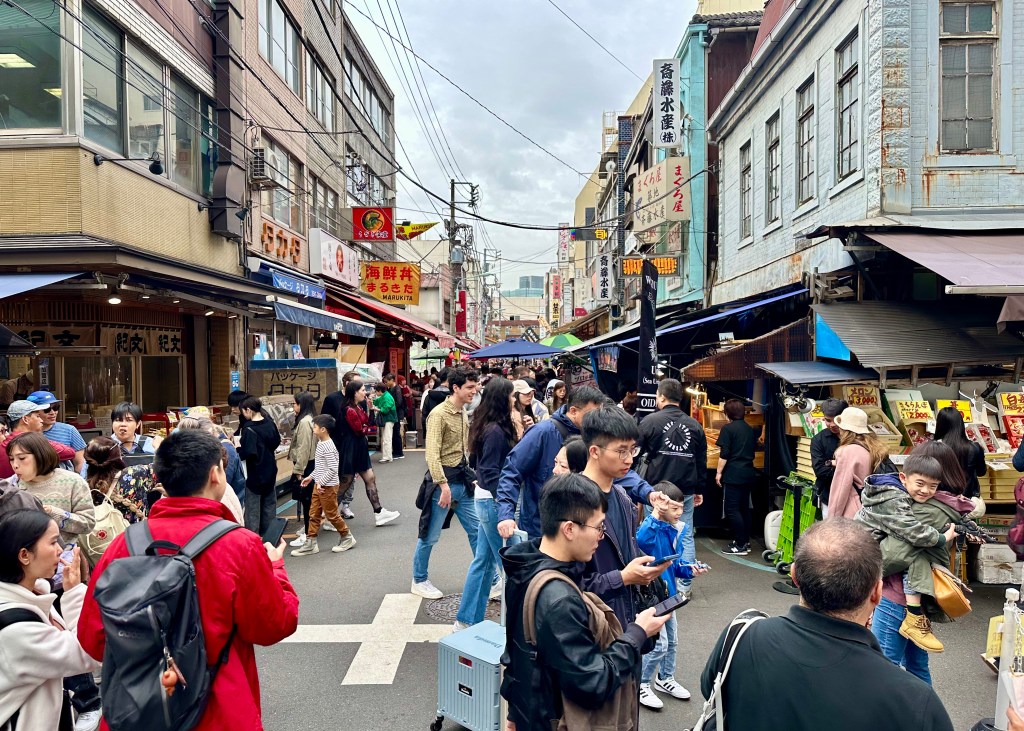
But, what remains in Tsukiji is the “Outer Market” where many vendors and restaurants still do business.  It’s popular with locals and tourists, and a visit was on my list of “must-do” activities.  So, I decided to start my fourth day in Tokyo with an 8-person early morning “tasting tour” of the Tsukiji Outer Market.

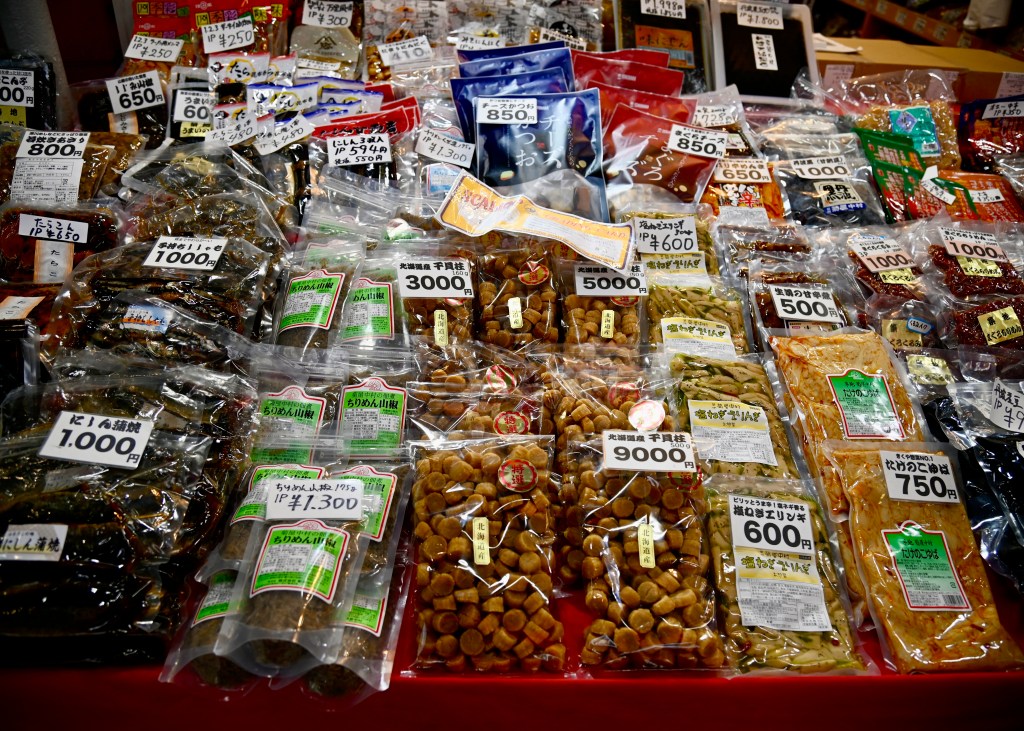
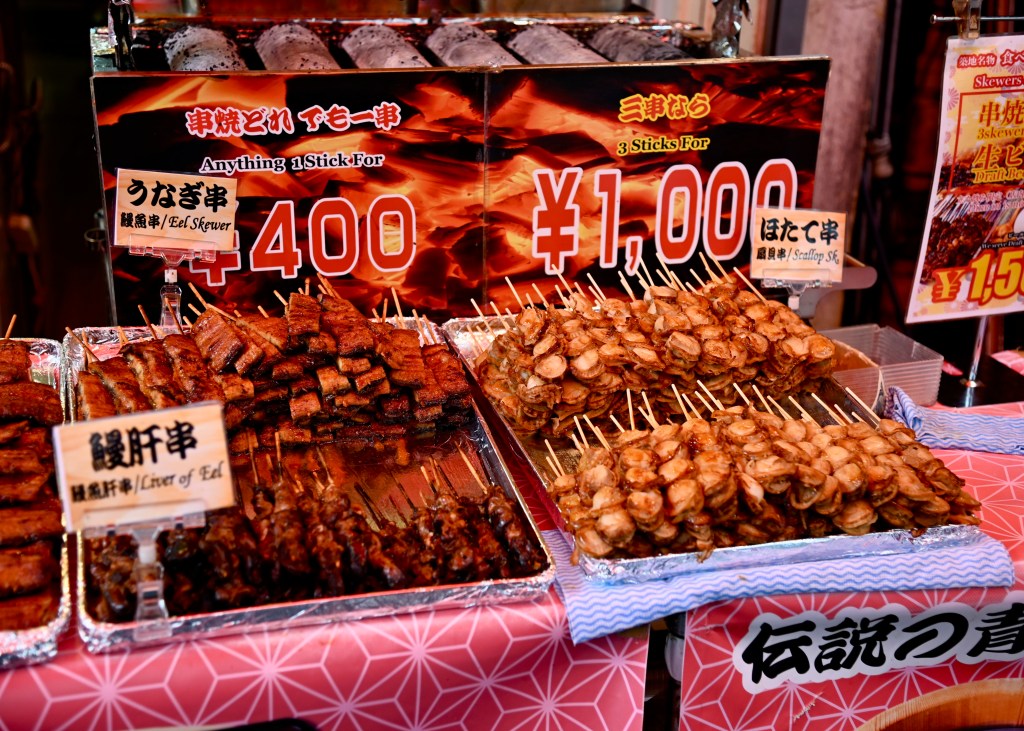
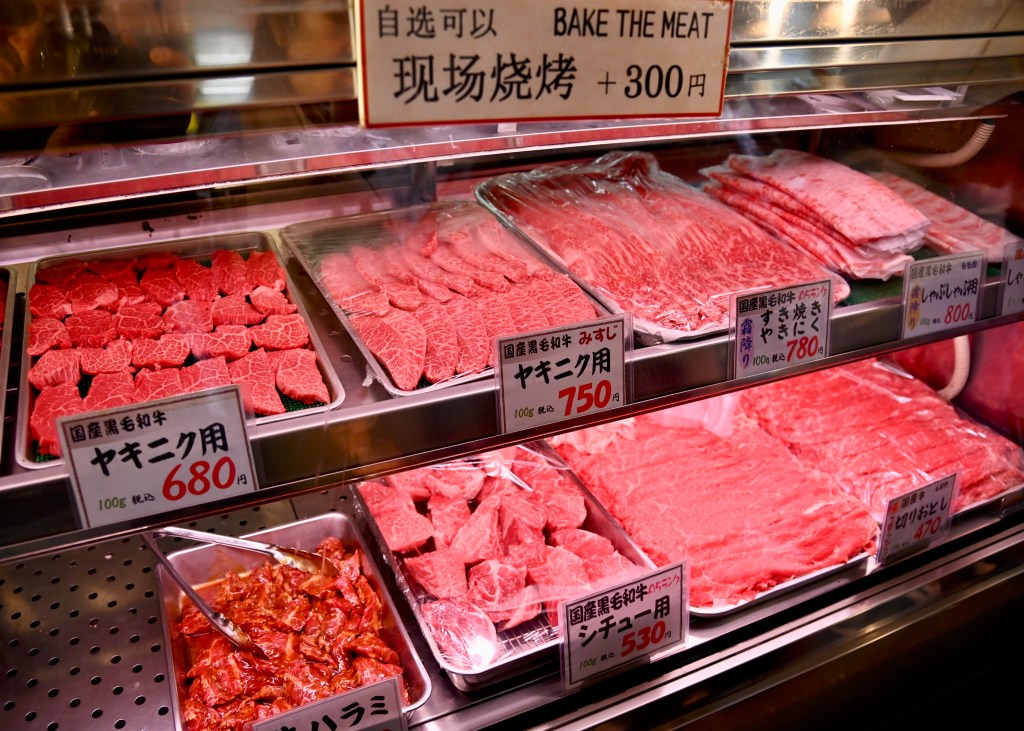
And what a fun and wild experience it was.  Shops galore – food and souvenirs in a wide wide range – raw fish, cooked fish, dried fish, fruits, vegetables, meats, sweets, coffee, tea, spices, egg dishes, knives, chopsticks, ceramics, t-shirts, tote bags, and more and more.

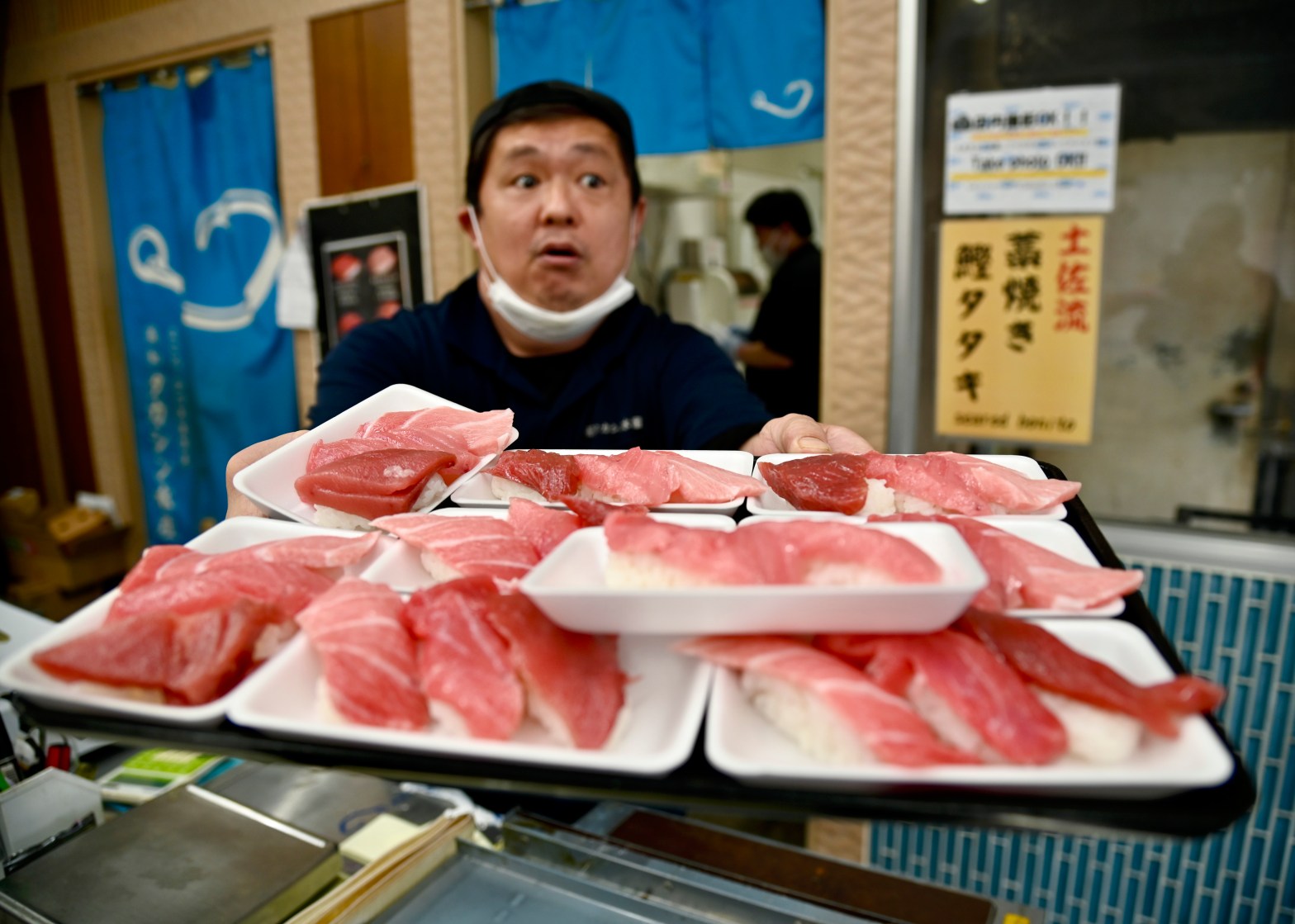
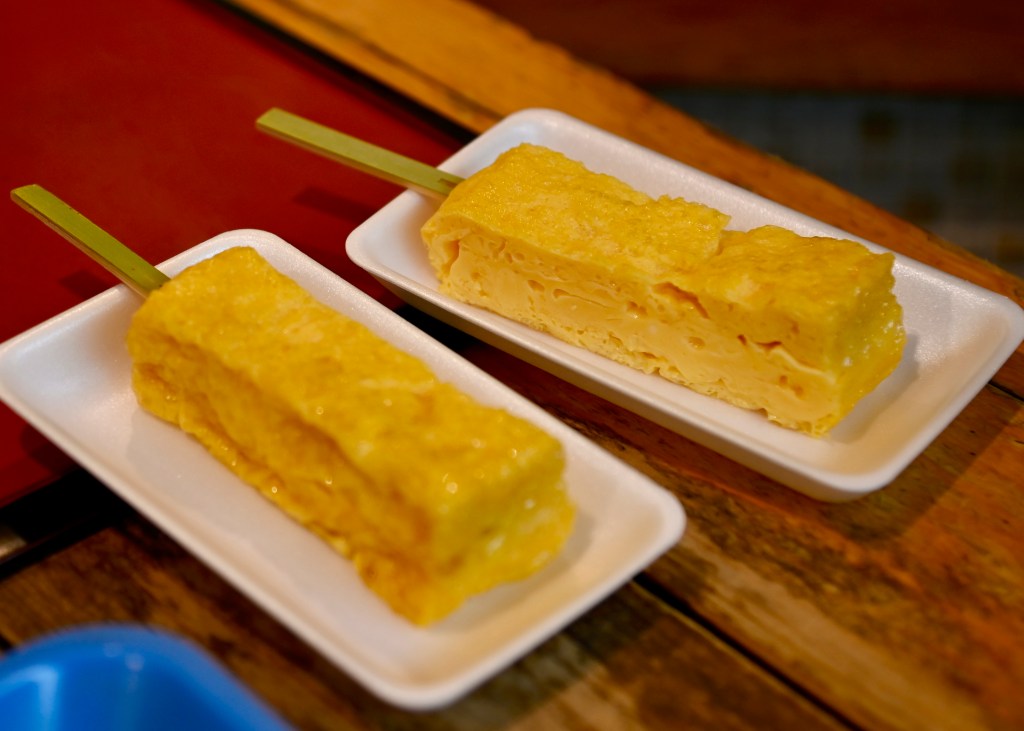
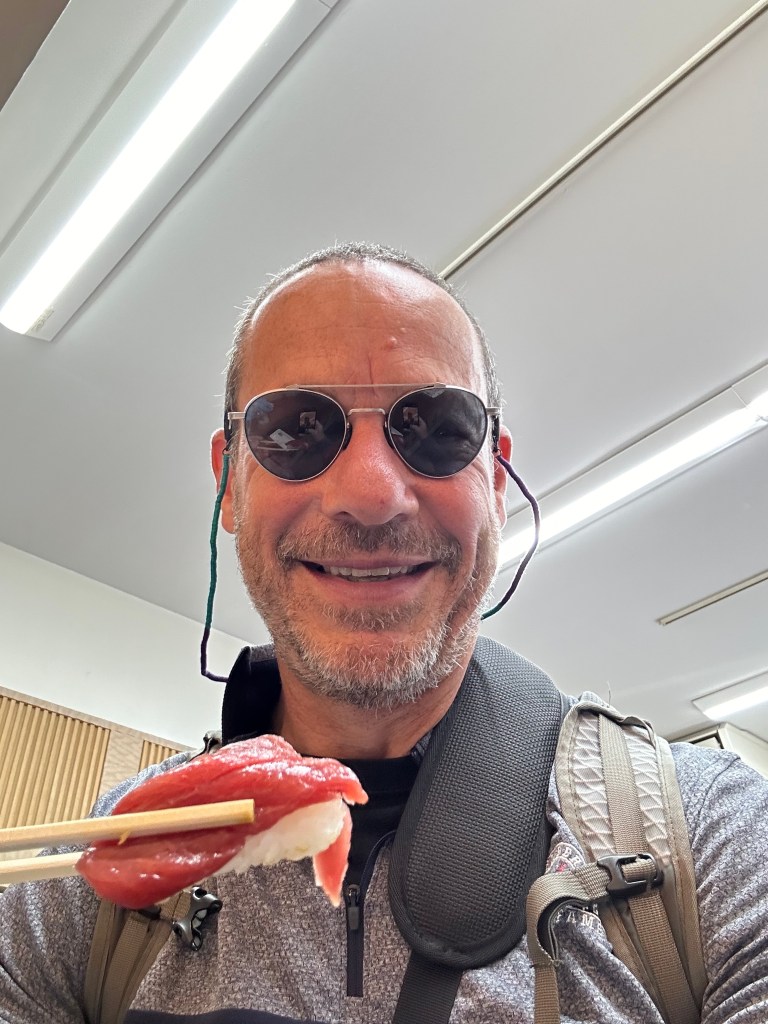
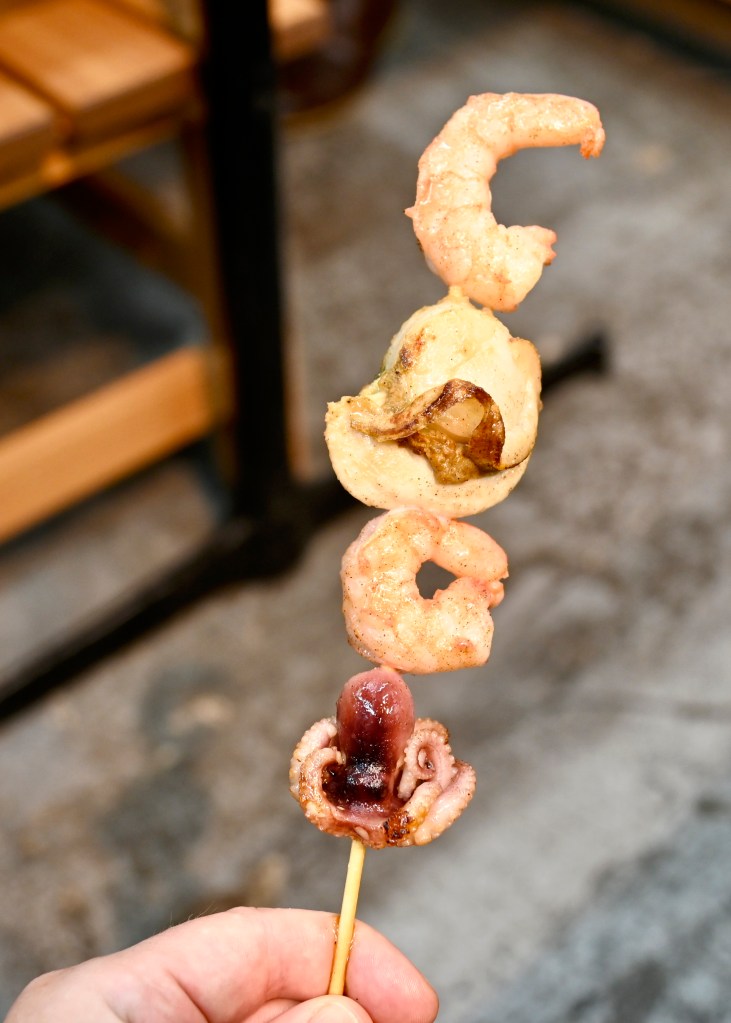
We tasted an omelette on a stick, a chicken skewer, grilled fish on a stick (shrimp, scallop, octopus, fish), sashimi (three different types of tuna), and the freshest of pineapple chunks.  All while negotiating around narrow streets, hundreds of people, and delivery trucks and motorbikes.  When we arrived at about 7:30 a.m. it wasn’t terribly crowded, but by the time we finished up at around 9:30 the place was an exciting sea of people and sights and sounds.

I took a bit of a walk when we finished up at the market to head to what is considered the premier high-end shopping district in Tokyo, Ginza.  There was no way I was buying anything; this would be a chance to just walk around a bit.  It was still early, and a lot of shops hadn’t opened yet, so it was a nice quiet walk, and a very different experience from the fish market.

In 2023, the film “Perfect Days” was released.  Japan’s entry for the International Feature Film at the 2023 Oscars, and its male lead won Best Actor at the 2023 Cannes Film Festival, it tells the story of a few routine days in the life of an older Japanese man who lives and works in Tokyo.  He resides in a small home, listens to cassettes of classic rock (including Lou Reed, whose song “Perfect Day” is part of the film’s soundtrack), reads classic literature, visits the local bathhouse daily, takes photographs, and takes great pride in his work cleaning public toilets in-and-around Tokyo.  The movie is calming and mysterious and wonderful.

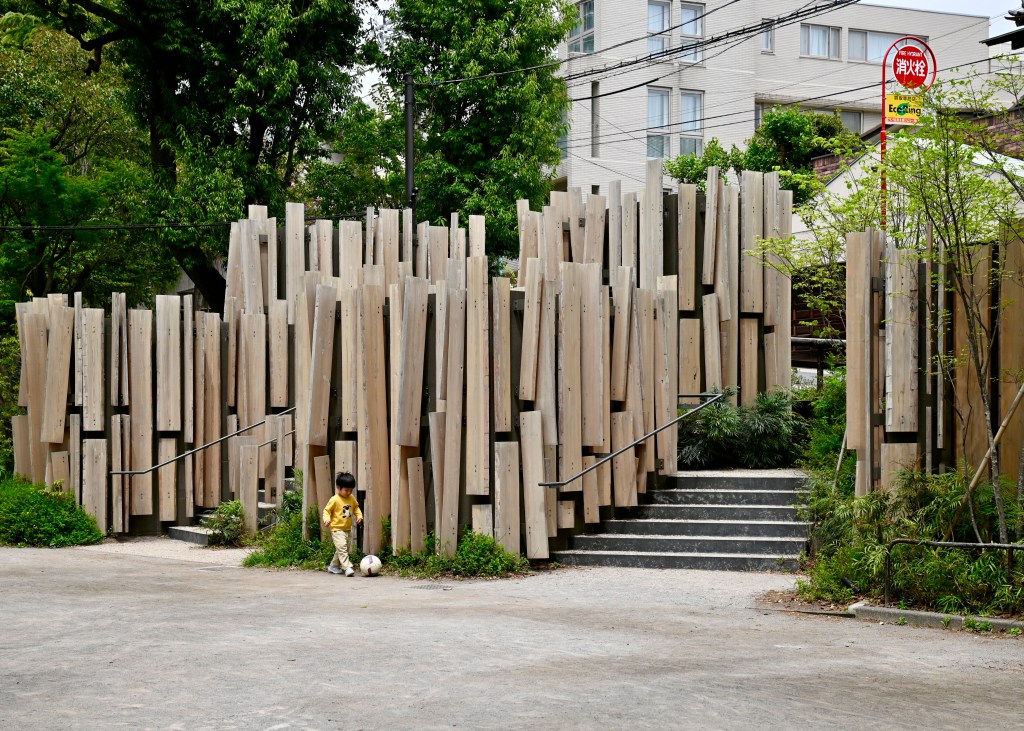
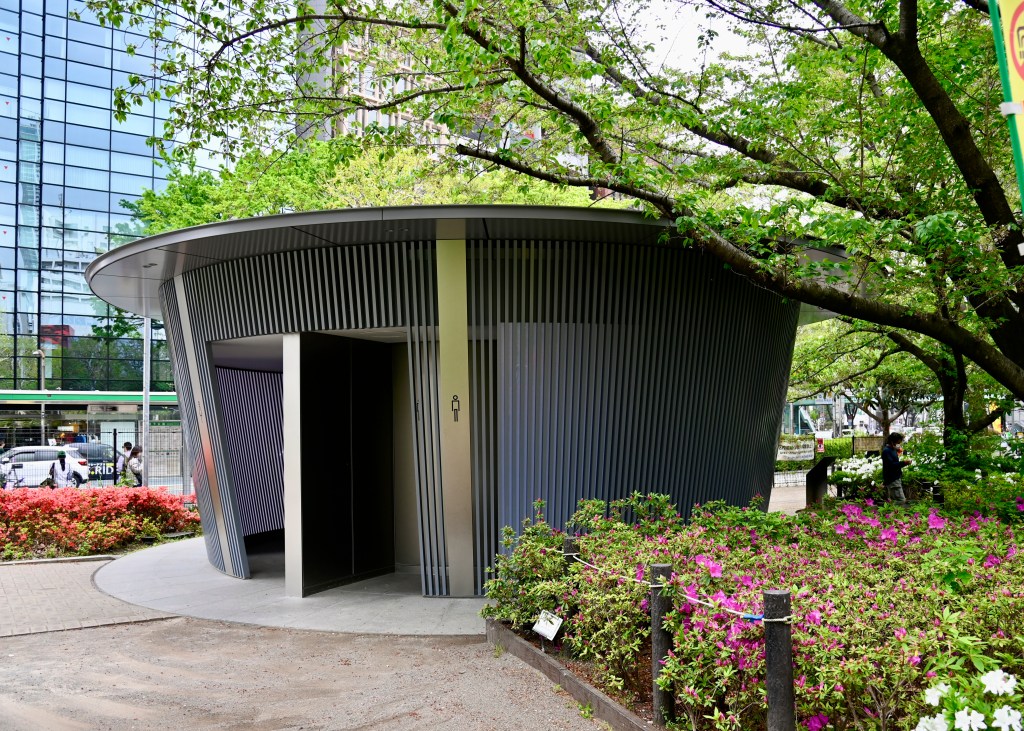
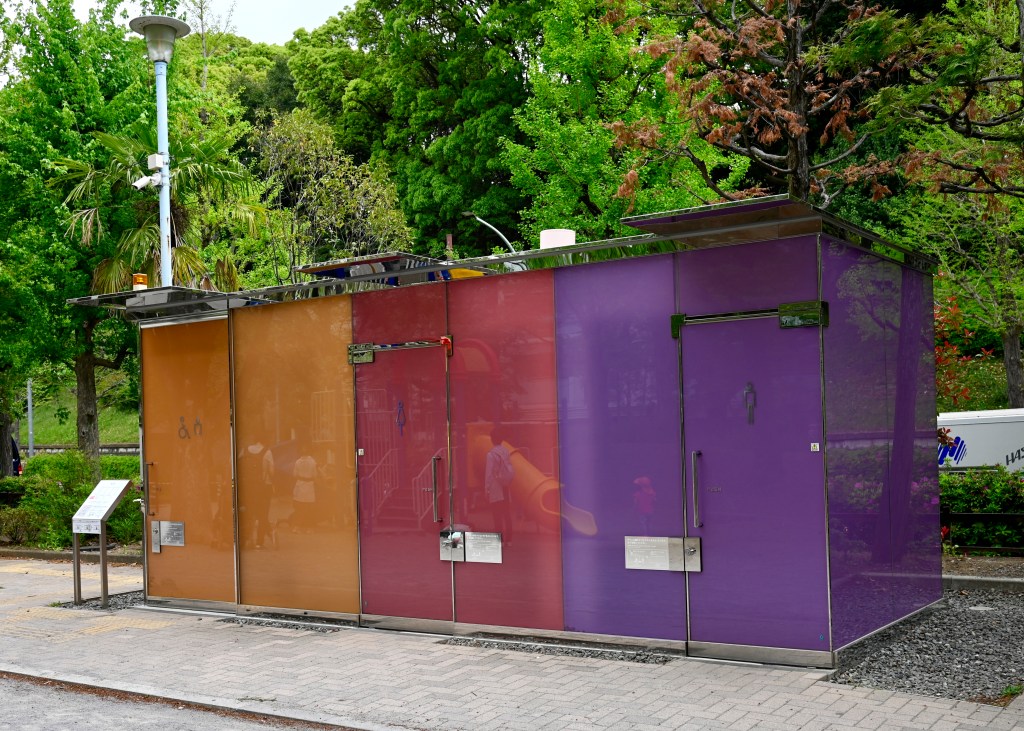
But the toilets he cleans aren’t just any toilets – they are some of the 17 “Tokyo Toilets,” each beautifully designed by artists and architects.  One for example, is characterized as a “toilet village,” huts designed to fit into the lush public park where it stands.  Another has exterior colored glass that is transparent until the door is locked in each toilet, when the glass turns opaque.

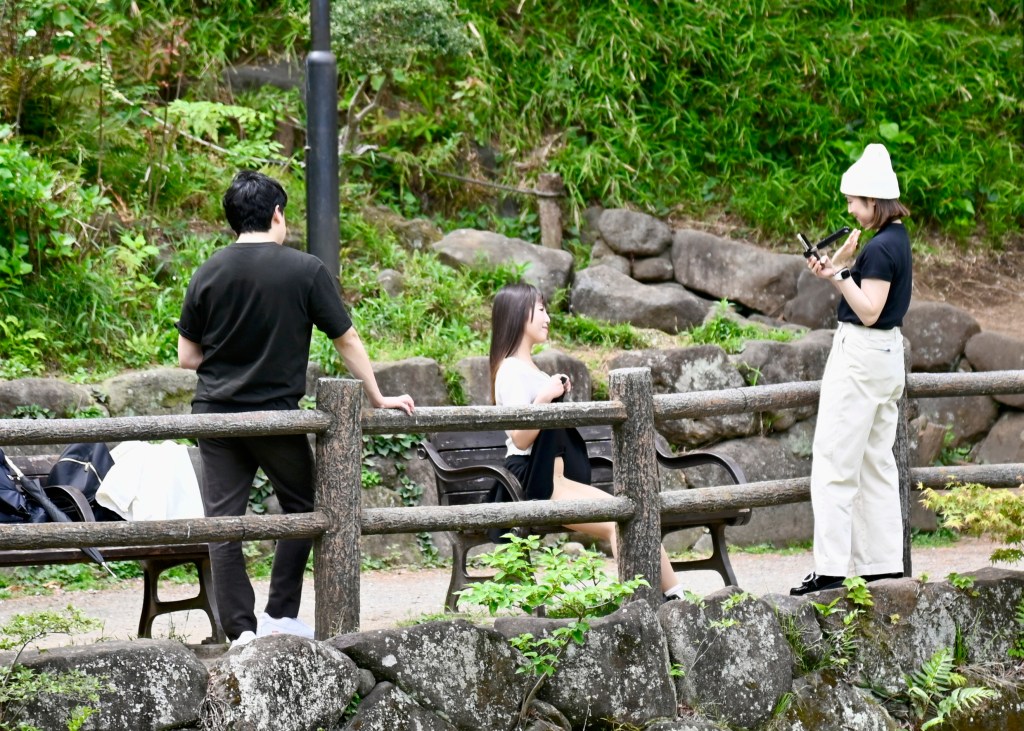
So – for the next part of my day, I took a cab to the neighborhood of Shibuya to visit three of the toilets, including the two I mention above.  At the park where the first one is that I mentioned, located in a fancy neighborhood, I caught sight of – from a distance – a young woman and two young filmmakers filming some type of adult-oriented ad, the model pulling her skirt up and lowering her top.  The second two toilets (one of which I used) were located in small pockets of calm among busy, busy urban areas of shopping, large buildings, and interior malls, and even a Tower Records store (maybe they didn’t get the memo?).  The neighborhoods felt to me like commercial districts in Brooklyn.  Lots of locals and lots of tourists.

For lunch it was a stop at a small local ramen shop.

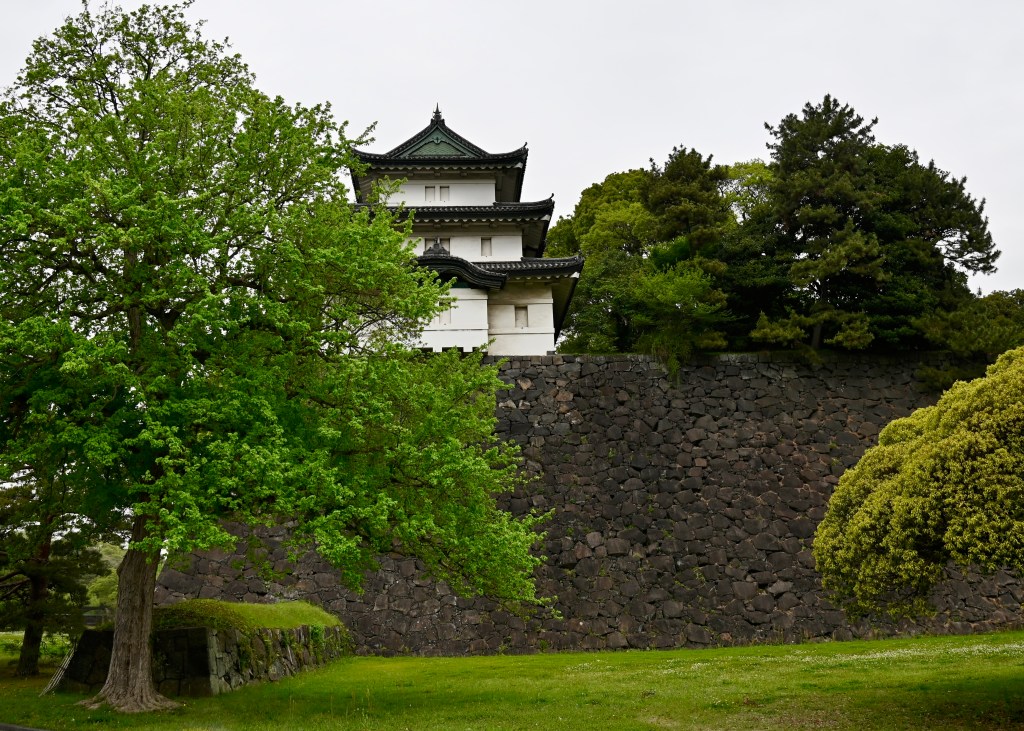
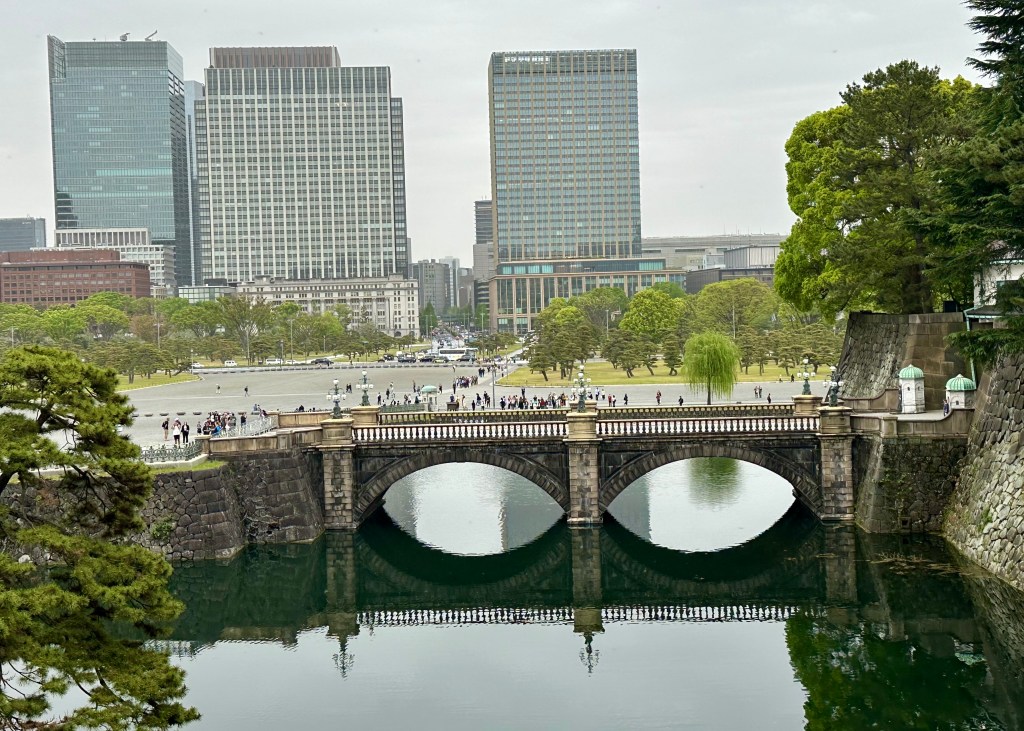
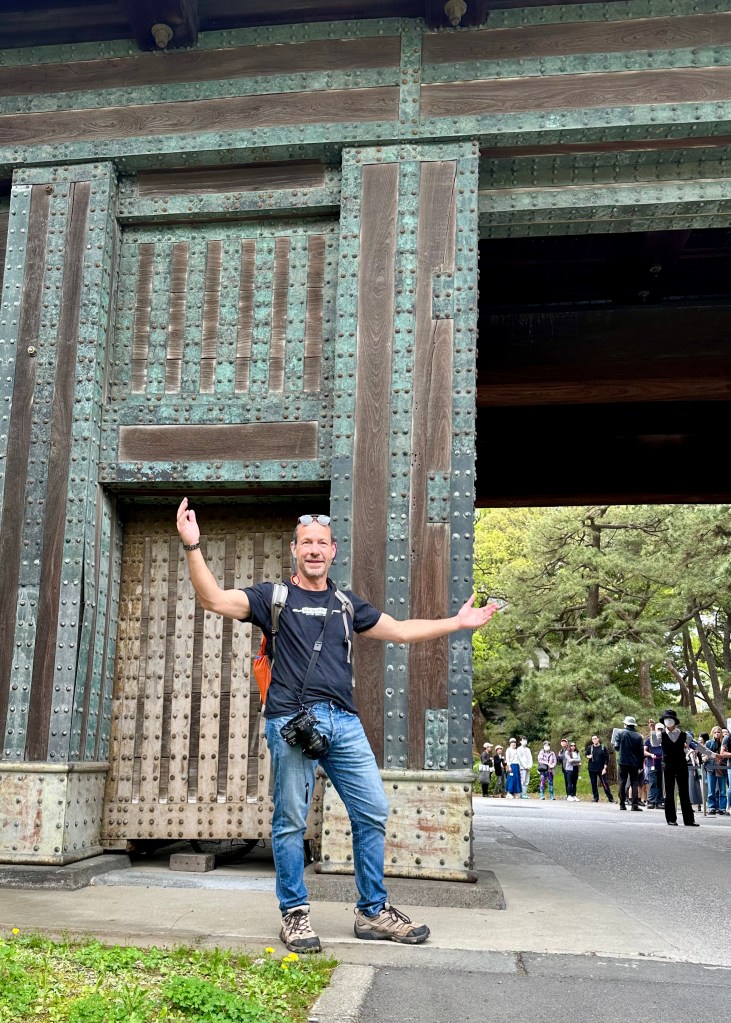
After lunch it was time to head to the Imperial Palace for a scheduled tour; this is the primary residence of the emperor and is located in Chiyoda, across town from where I was.  I’d booked ahead of time, just to be sure I’d have a spot, and expected a small group tour.  Nope, didn’t happen that way.  I checked-in with a security guard who had my name on a list and then entered a waiting hall.  Hundreds – I mean hundreds of people were seated inside; announcements were made in Japanese, Chinese, French, Spanish, and English, and finally we were told to gather outside by language.  The English and Chinese groups appeared to be the two largest (maybe 200-300 people each).  Our tour guide had a microphone and a small speaker strapped to her waist; if you didn’t stay close to her, you couldn’t hear a thing. We didn’t get to go inside any buildings, or even see the outside of the residence, but we did get to see the outsides of ceremonial buildings and reconstructed forts, and gardens at a distance.
I took the subway to my last stop for the day – Shibuya Scramble Crossing, known as the world’s busiest pedestrian crossing; per Wikipedia, as many as 3,000 people cross it at each light change, every two minutes.  It’s appeared in countless TV shows and movies, including the film “Lost in Translation,” and it seems like there were as many tourists there as locals, with hundreds taking pictures and videos, from the sidewalks and while crossing.  By my count, there are five pedestrian crosswalks, and the whole thing is surrounded by tall buildings with a wild array of neon lights and signs.  There’s a (currently closed) Starbucks that overlooks the crossing as well.

It.  Is.  Wild.  I’ve spent a bit of time in Times Square, and this felt like Times Square on steroids.  Eye-candy.  Lots of it.

Per Wikipedia, “Shibuya scramble crossing during Halloween 2023, actually less crowded than usual, high police presence
Syced, CC0, via Wikimedia Commons

There was one last towering view of the city I wanted to make sure I got, so before dinner I headed to the Metropolitan Government Building, located close by my hotel, to check out it’s observation deck on the 45th floor, which also had a small gift shop and cafe.  It was drizzling a little – the first rain I’d seen in the last 16 days – but not enough to terribly disrupt the views of the city.

For dinner I headed to a nearby neighborhood by one of the train stations, popular with an after-work crowd for its bars, restaurants, and Pachinko parlors.  I found a conveyor belt sushi joint (not great sushi, but great fun).  They charge by the color and number of plates – the color varies based upon the type of fish or shellfish on each, with big bowls of shaved ginger.  The crowd was mixed – local businessmen and tourists. Nine plates and a beer for $28.  I was full. Helluva deal.  A short walk around the ‘hood, popped into a parlor to check out the scene (all men except for one woman) and the noise and the lights.
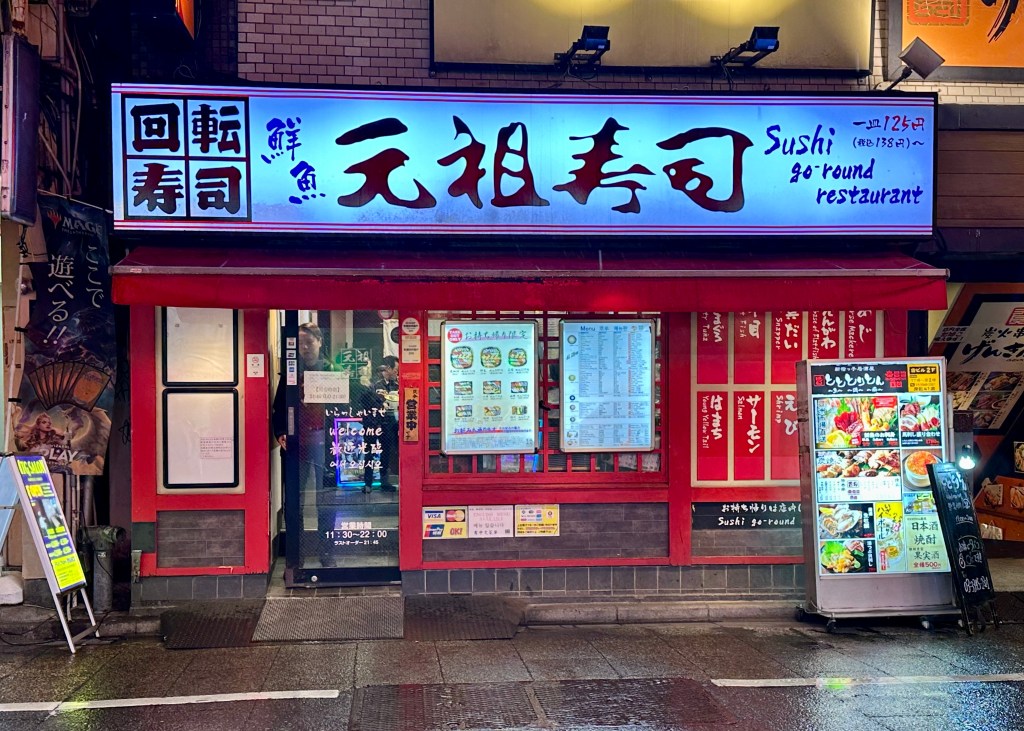
It was a good day in Tokyo.

Day 14 – Tokyo & Mt Fuji

Even though I’d committed to spend my entire five days in Tokyo, there was one day-trip I wanted to take:  a chance to see Mt Fuji, the tallest mountain in Japan.  It’s only located about 62 miles from Tokyo and can sometimes be seen from the city, but given its proximity to Tokyo, it’s easy enough to get closer to it for better views.

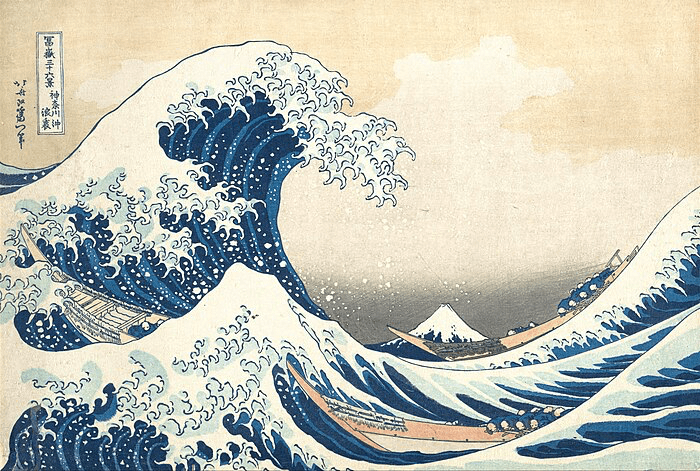
We’ve all seen images of it, with perhaps the most well known being that shown in “The Great Wave off Kanagawa,” part of a collection known as “Thirty-six Views of Mount Fuji,” a series of landscape prints.  That great wave is seen on posters, coffee cups, coasters, t-shirts, and in movies.  It’s become so familiar that we don’t even recognize it as great art any more, nor even notice that Mt Fuji is in it.

The mountain itself is a volcanic cone, and it last erupted in 1707 to 1708.  Eruptions over time gave it the beautiful upside-down conical shape it has today.  At a little more than 12,000 ft, it is roughly equivalent to six Skytree Towers (the tower I’d visited the day before).  The base diameter is about 25-30 miles, encompassing an area of about 500 sq miles; by comparison, the entirety of New York City is about 300 square miles.

To get there I decided to sign-up for a tour that would include a visit close by Fuji and a stop in Hakone, which I’d heard good things about – for its outdoor sculpture museum and its mountain lakes.  I thought I’d joined a small group tour, but when I arrived (in the lobby of my own hotel), I was on one of eight buses that’d be going there that day just as part of “my group”!  Oh well, so be it.  Fortunately, I was in the second row of the bus and not sharing my two seats with anyone else.

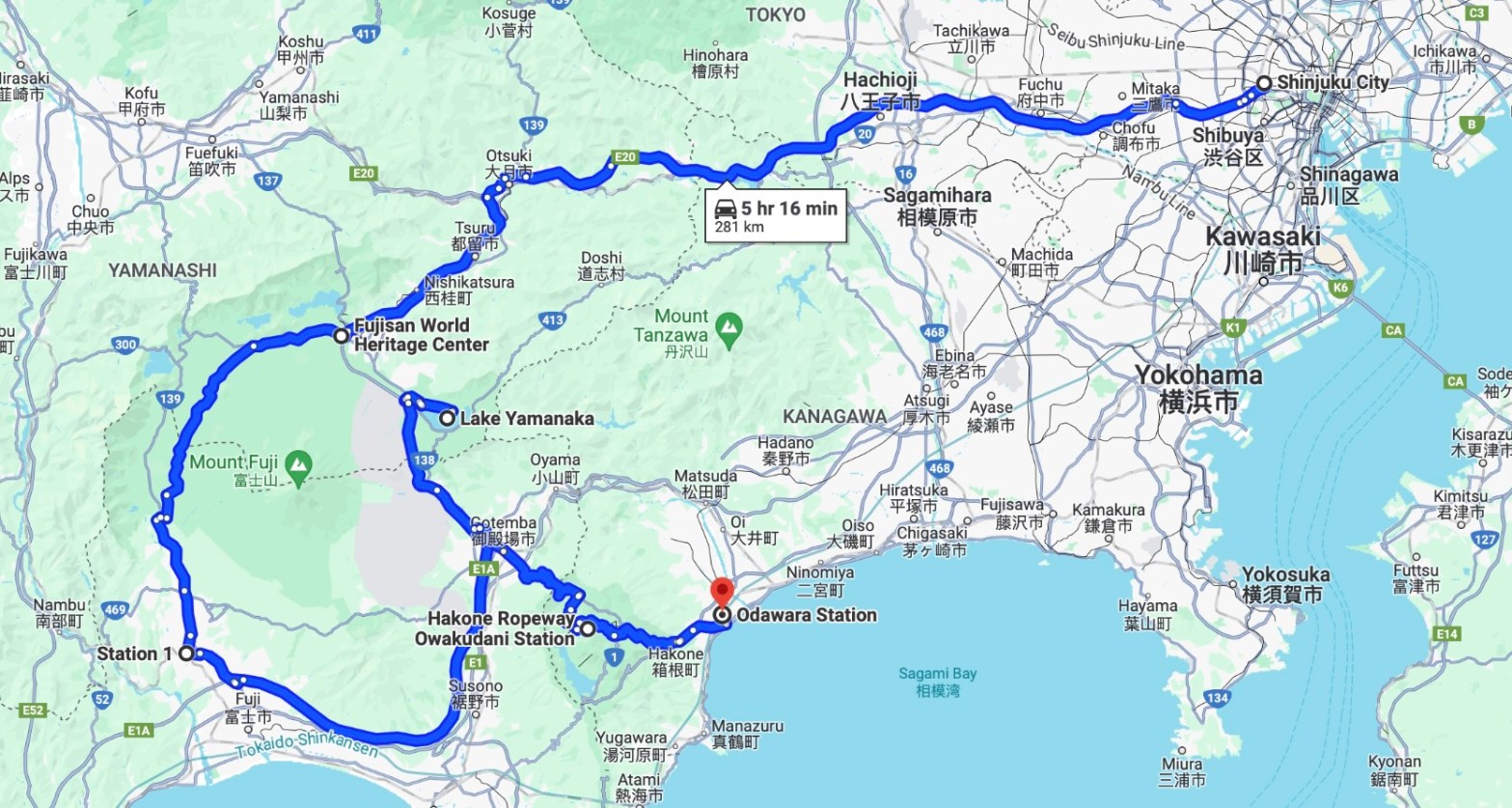
Climbing Mt Fuji is quite popular, especially to do so overnight so that you can see the sunrise from its summit.  In fact, the tour guide on our bus told us he’d done it 16 times, having seen the sunrise on 15 of those.  To facilitate climbing, ten stations – or stops – have been created, with the first at its base and the tenth at its top, with the roads paved until Station 5.  And – that was the goal for the tour – a drive to Station 5.  But – given that it was still mid-April, there apparently was still snow on the roads and, as such we only would be going to Station 1.  In addition, Fuji is known as a “shy” mountain, meaning that it only is fully visible about 30% of the time given cloud cover (our tour guide explained that the mountain is big enough to create its own weather).

Would we see Fuji?

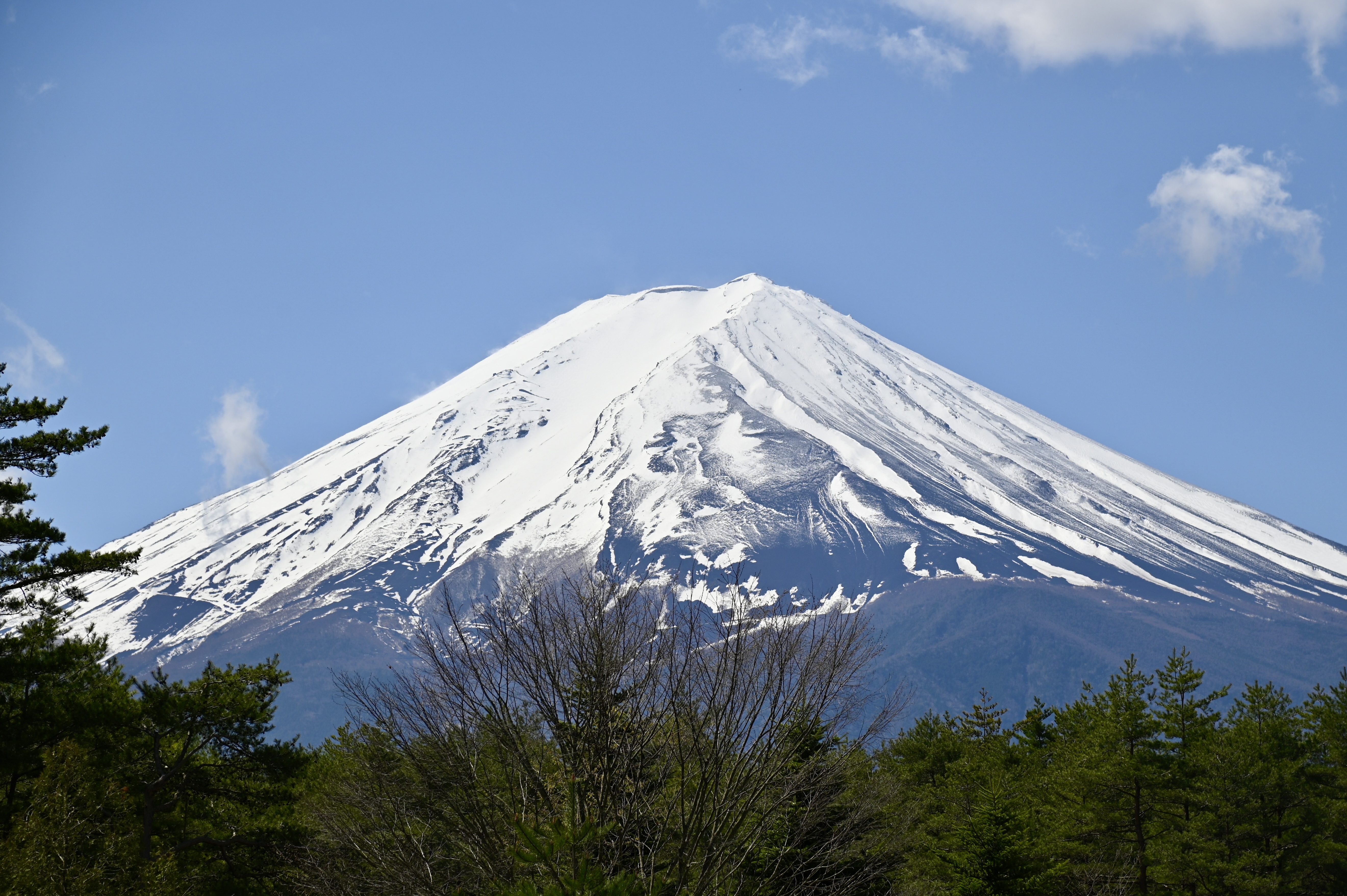
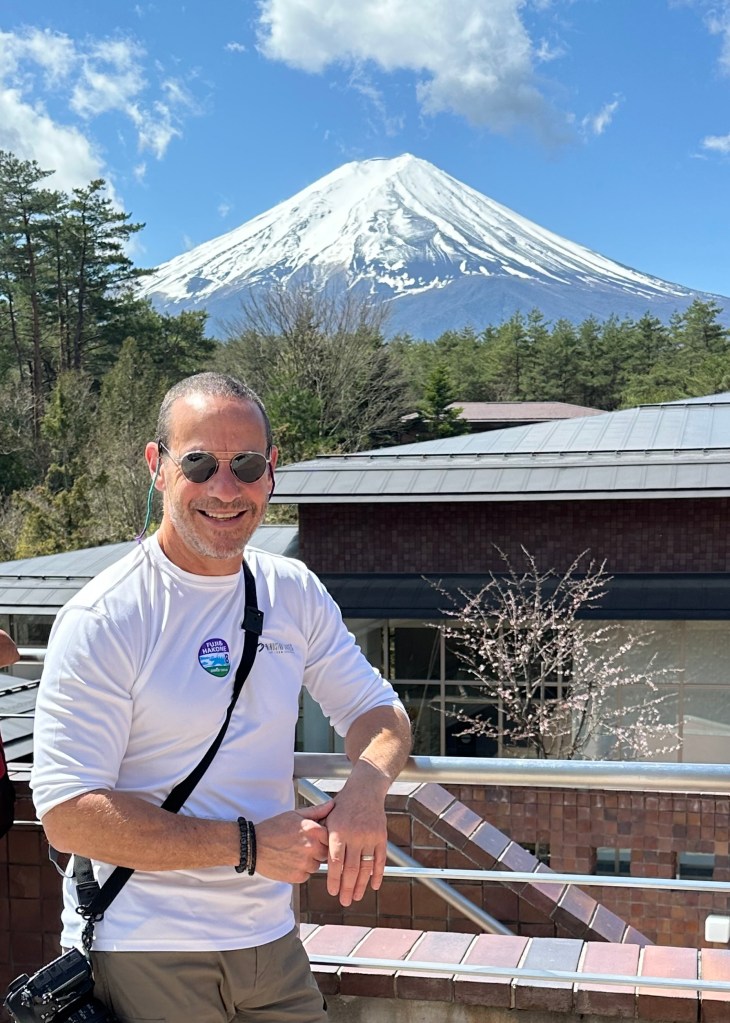
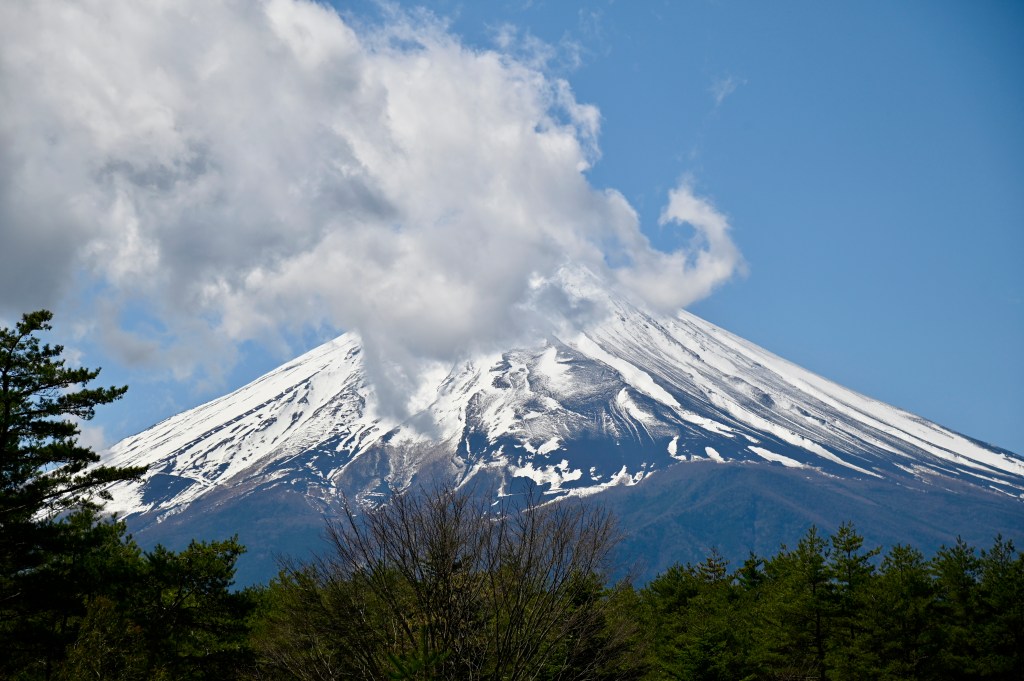
The short answer:  yes!  Our full drive to the mountain would take 2 1/2 hours and, as we exited the city along the way we began to see its peak.  And we continued to see it. Our guide was cautious – telling us it may not last long – but as we approached our first stop about 1 1/2 into the trip it continued to stay clear.  Where we stopped had a viewing platform and, yeah, there it was.  Magnificent.  Snow-capped.  Iconic in shape.  What a freaking treat on a beautiful day with blue skies.  The crowds from the buses were invisible to me, as I focused on the view of Mt Fuji.  Wow.

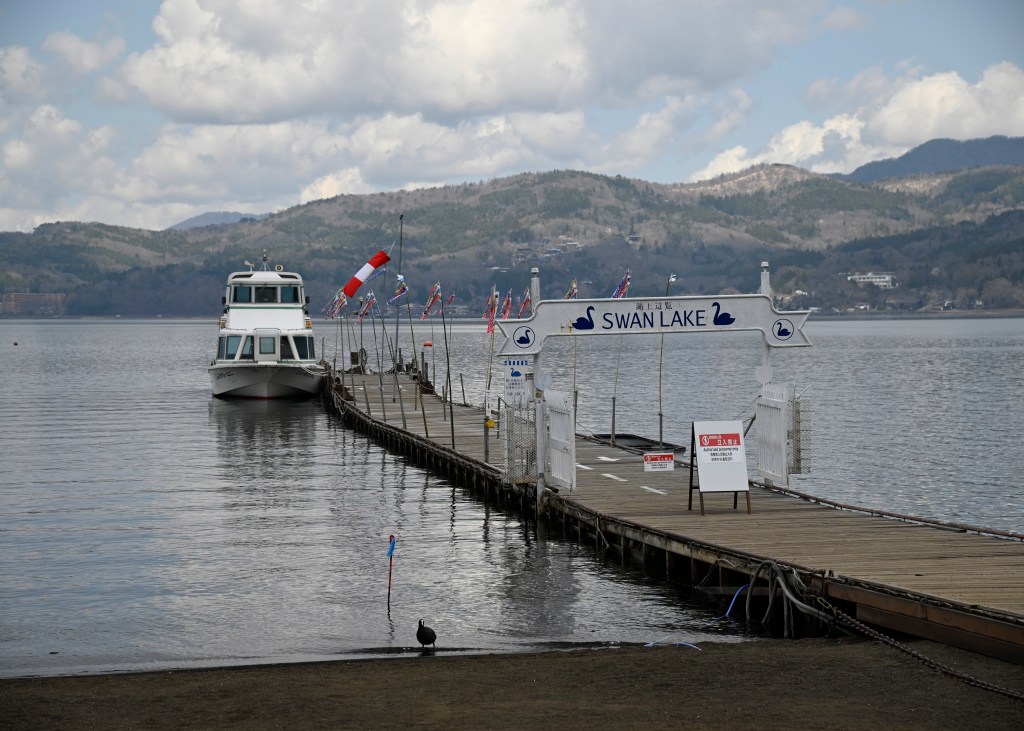
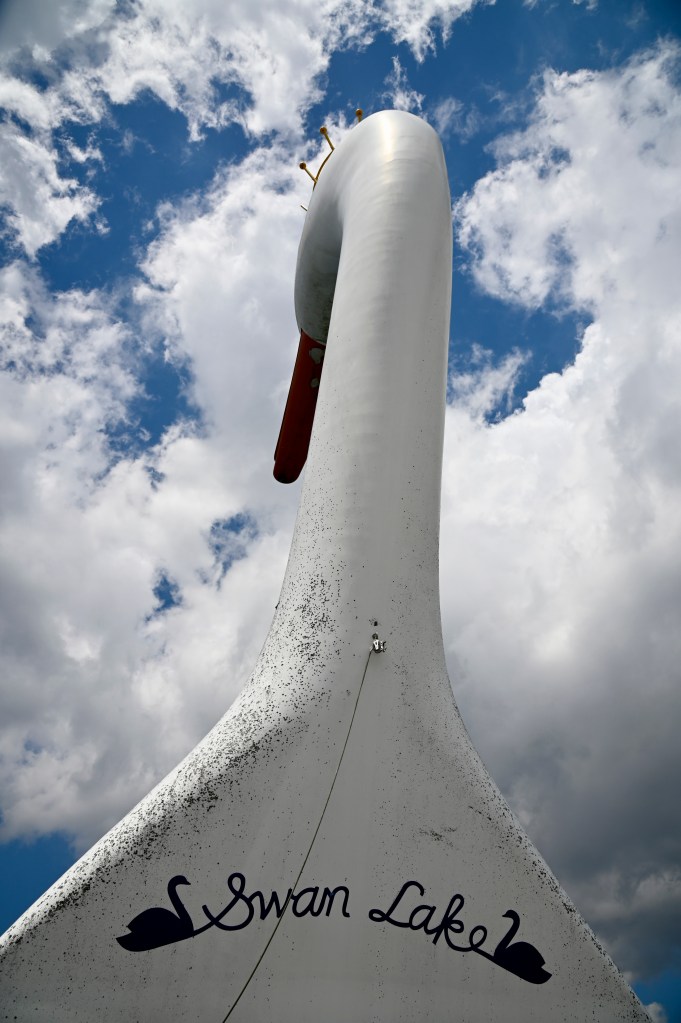
We made one other stop – at Station 1 – but the view wasn’t nearly as good, before continuing on for a 20-minute boat cruise on Lake Yamanaka (one of the “Five Fuji Lakes”), a mountain lake with views of Fuji and known for its swans – both real life and boats shaped like them.  But by the time we got on-board, clouds had begun to block the Fuji summit, and we would never see its top again that day.  The ride was tranquil and nice, but no more Fuji.

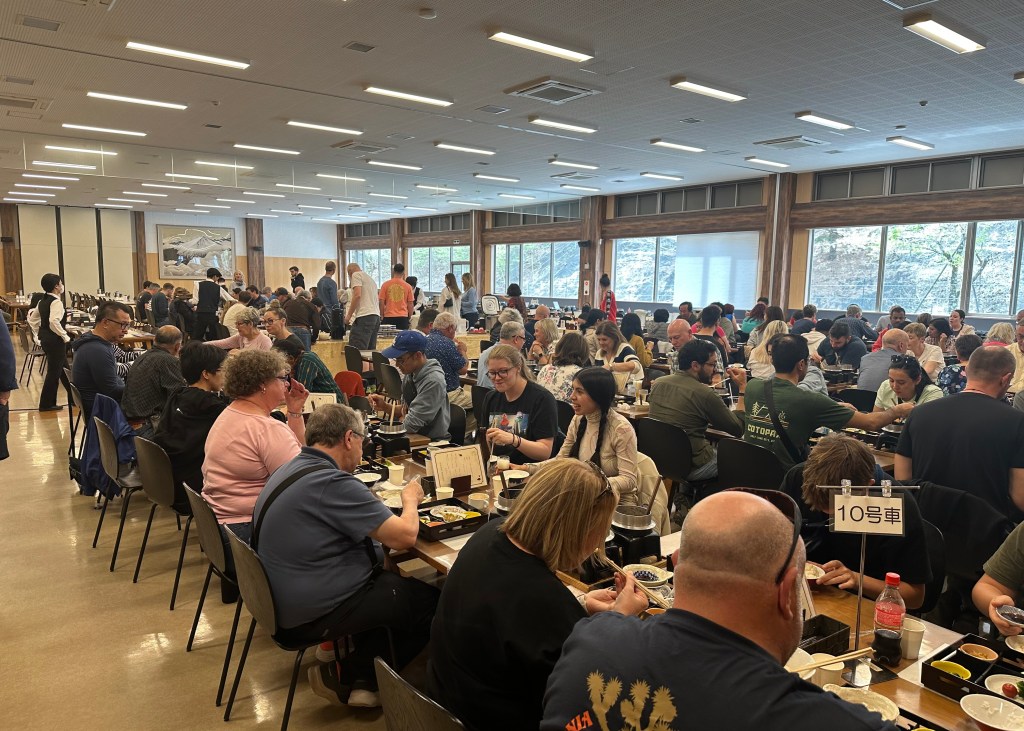
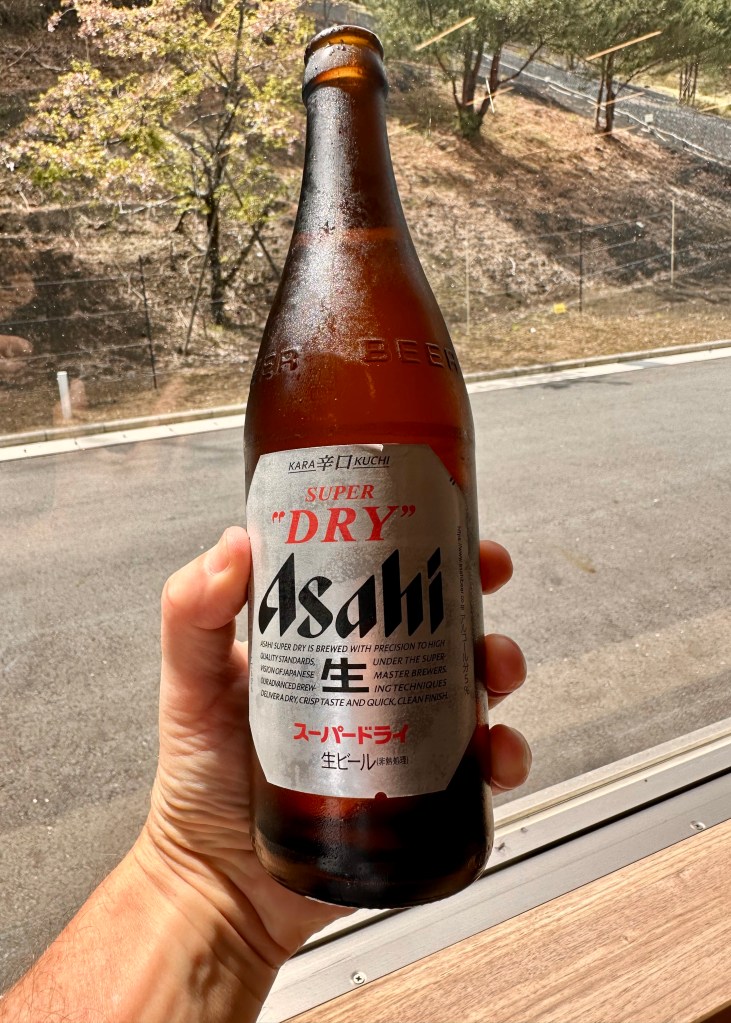
Lunch was in a large – very large – hotel function room with apparently everyone from all the other buses.  Each of us had our own Japanese hot pot, which was a lot tastier than one might think, and it was a chance for me to have my first Asahi beer in Japan.

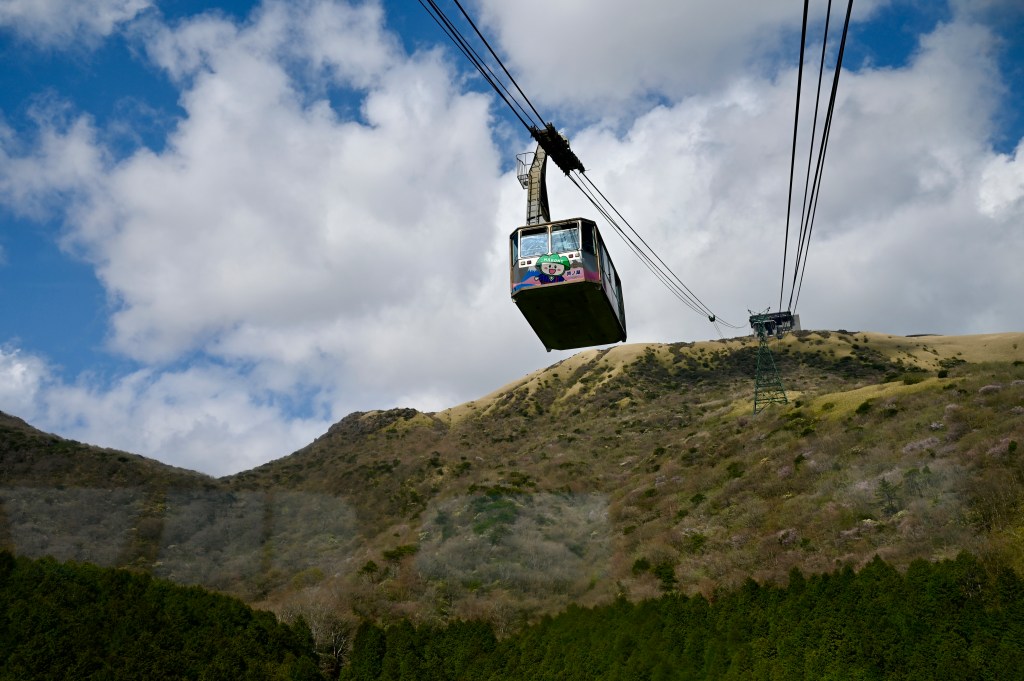
After lunch we headed to the Hakone Komagatake Ropeway – the name given to what is really a cable car that, at its top, provides gorgeous views of the area (around Mt Hakone), including the ability to see a caldera lake – Lake Ashi – and the Pacific Ocean east of Tokyo in the way off distance.  We had time for a brief walk around the top of the mountain where we were (though we couldn’t see Fuji due to clouds), before returning back down the cable car.

From there, we headed to Odawara Station, where we’d pick-up the bullet train for the return to Tokyo.

Ah, the bullet train, or the Japanese High-Speed Train, or the “Shinkansen.” Amtrak – which I’ve traveled innumerable times in and out of New York City as well as between DC and New York – has nothing on this baby.  In about 30 minutes we’d cover 45 miles.  The announcements, in both Japanese and English, were easy to understand.  It was unbelievably clean and comfortable, with lots of legroom, and punctual (the Japanese are very well known for the timeliness of their trains – apparently the average delay is only 24 seconds).  And boy, it was fast. 

After arriving in Tokyo, at the Tokyo Station, I transferred to the subway back to my hotel.  The Japanese subway also was a pleasure – great signage, electronic ticket machines in multiple languages with clear directions, easy to follow maps despite their size and complexity, and clear announcements.  Amazing people-watching in the stations and on the cars.  And what an odd subway experience, though I’ll save that for another time.

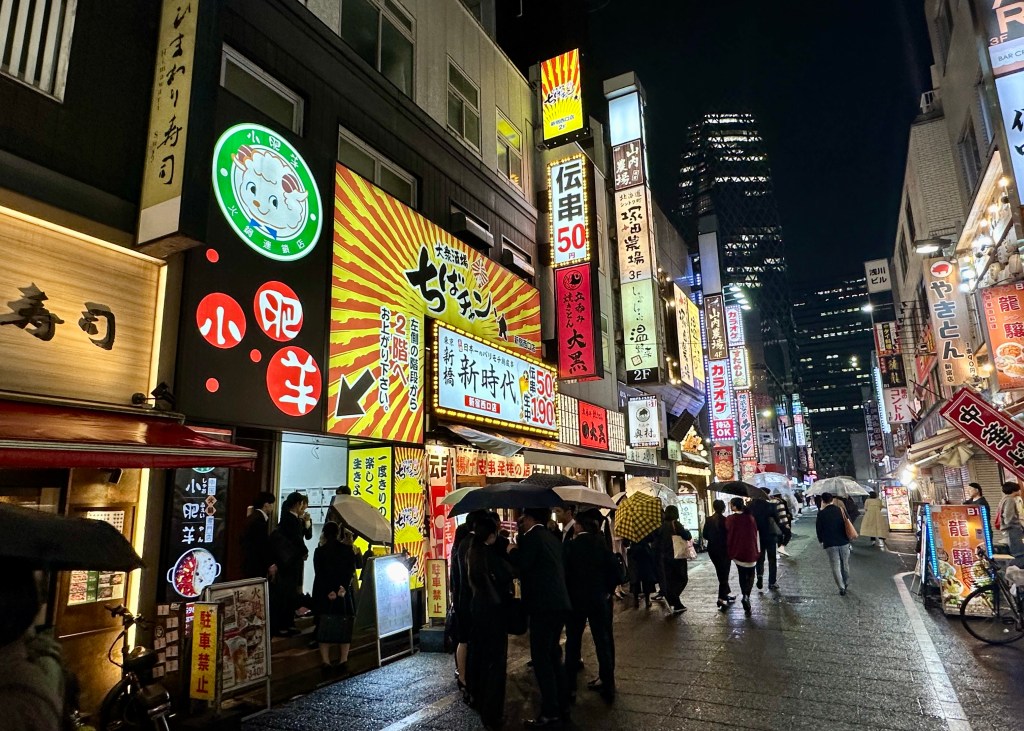
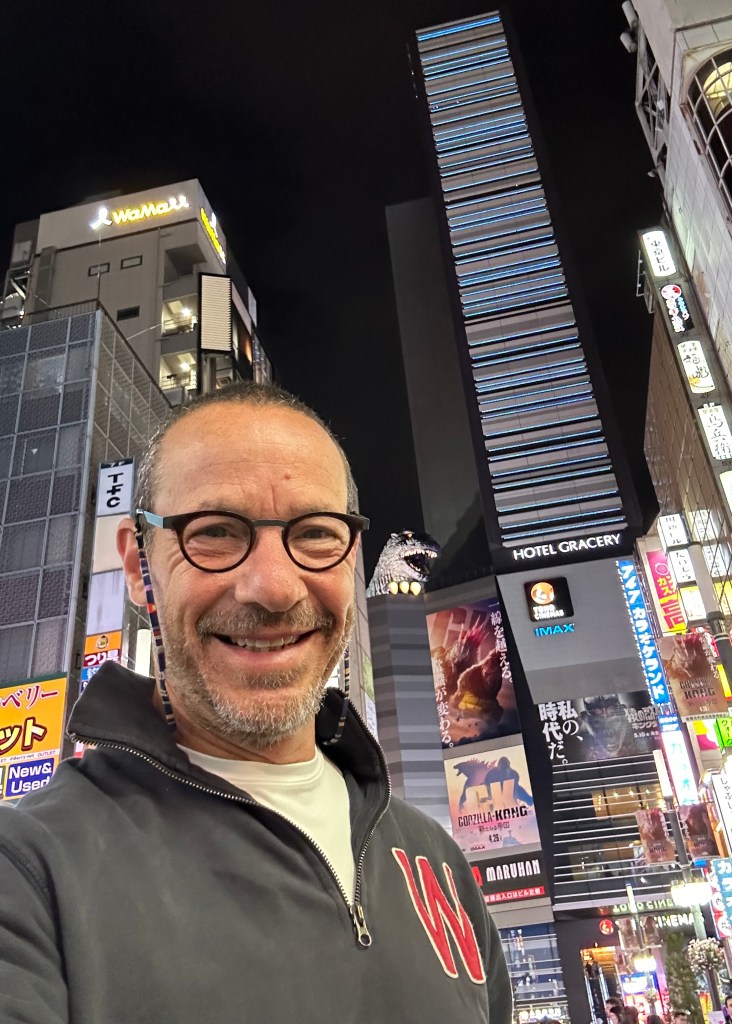
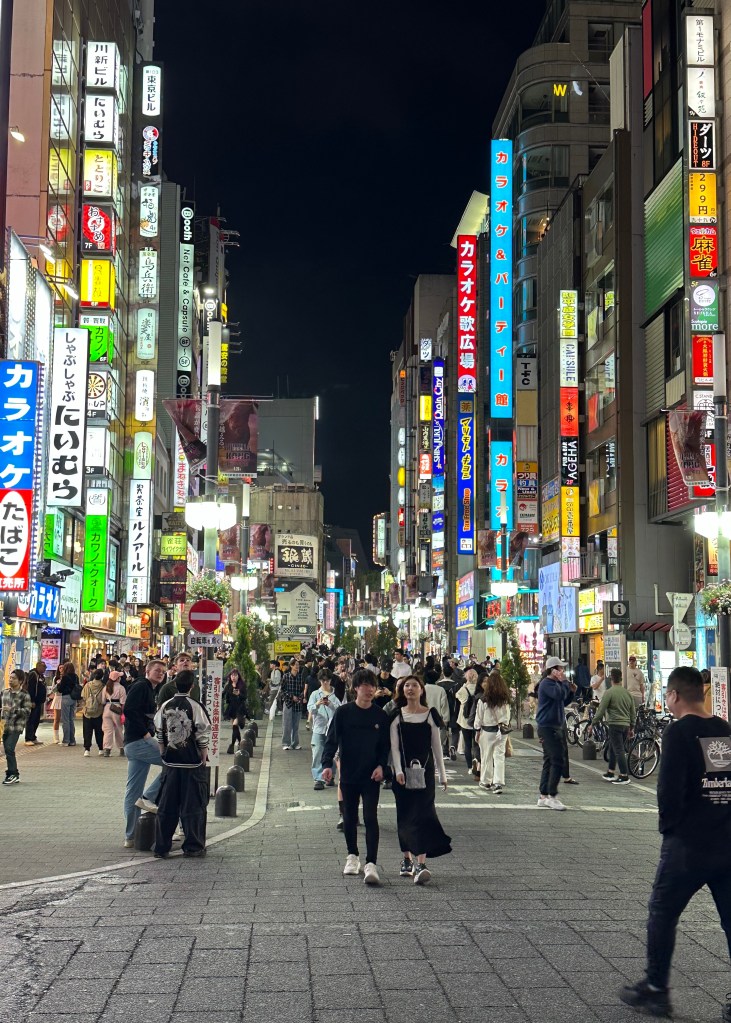
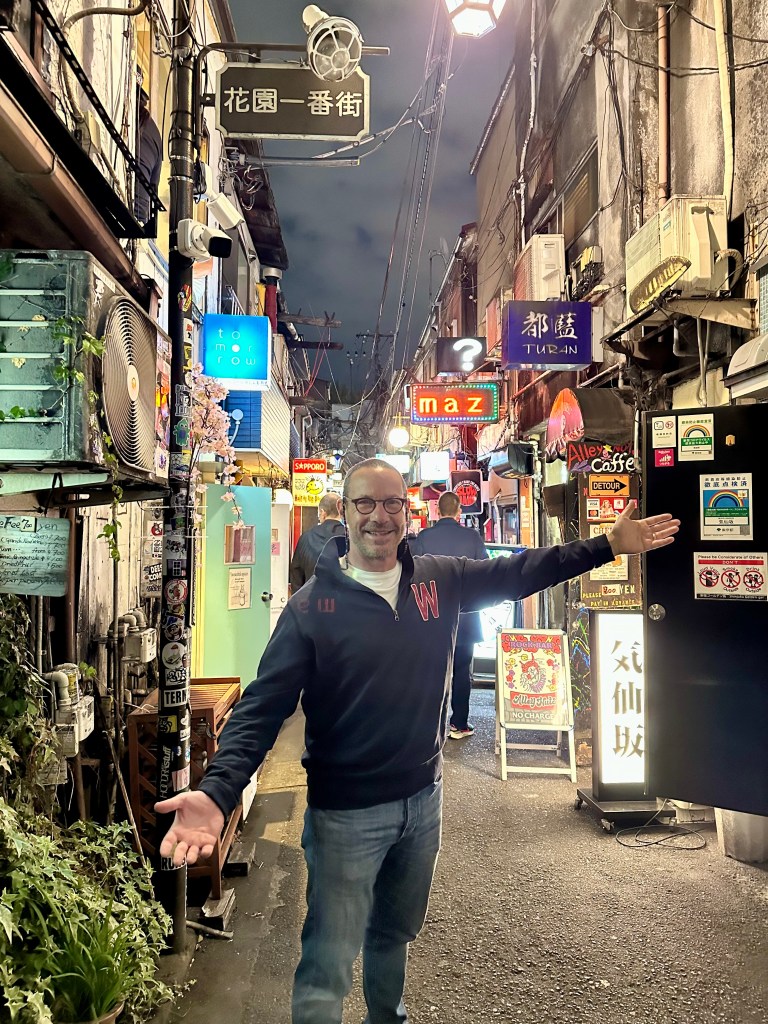
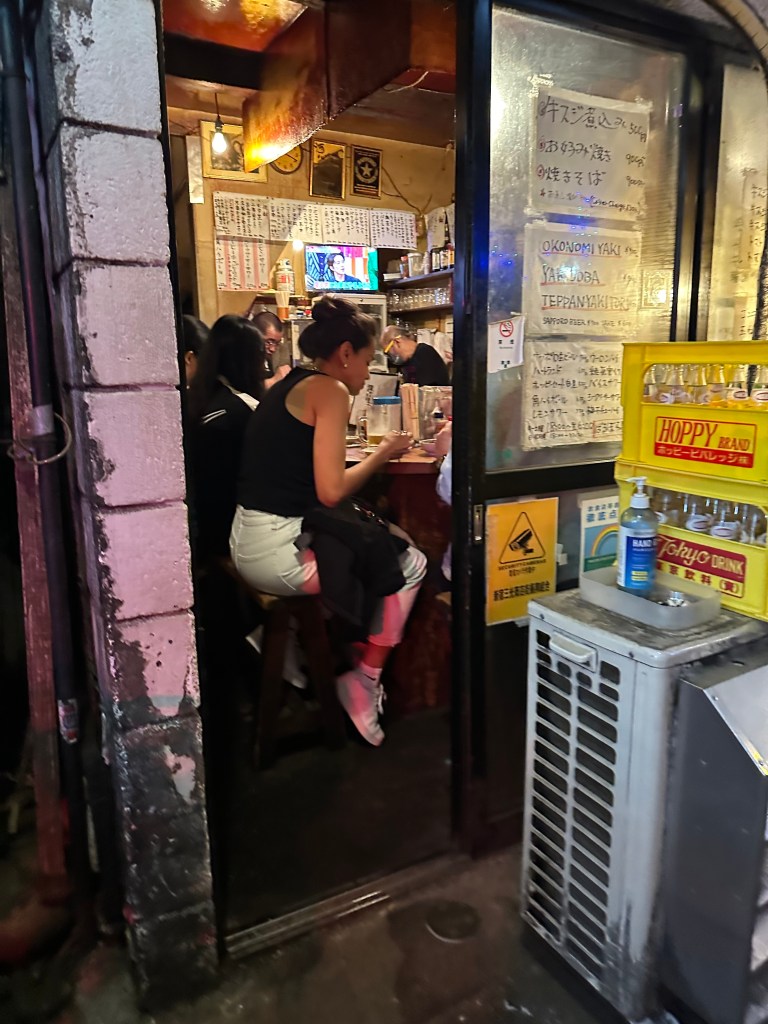
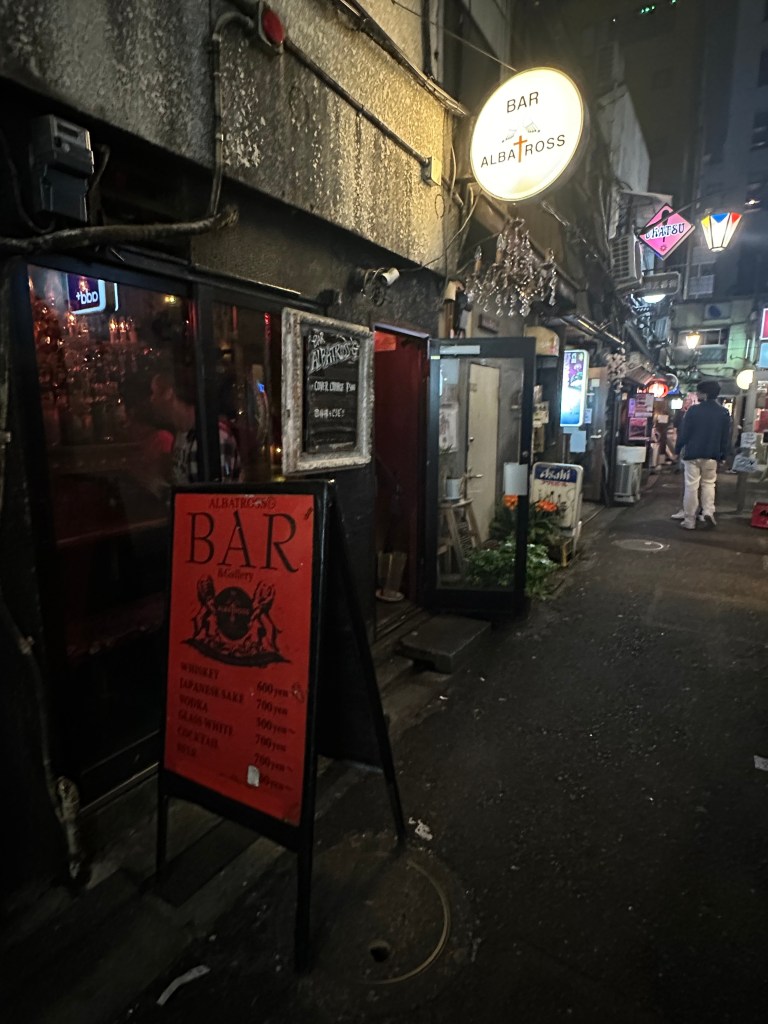
I spent my evening in a neighborhood – Kabakichu – nearby my hotel.  It’s an entertainment district, with lots of bars, restaurants (I ate at a small noodle joint), a batting cage, and nightclubs, as well as a red-light district, with love hotels, shops, and host and hostess clubs.  Amazing neon.  Tons of people.  Oh, and Godzilla!  Great eye-candy.  And a neighborhood within the neighborhood called “Golden Gai,” a section of about 8-10 narrow streets – more like alleys – lined with tiny bars that fit only 6-10 people each; if you’ve watched Anthony Bourdain’s “No Reservations” episode about Tokyo, this will be familiar.  Some had cover charges, some didn’t.  Some seemed to cater to locals, some to tourists.  All were fun to pop into.

Days 12 & 13 – Tokyo

Day 12 was a travel day – a 7-hour flight from Bangkok to Tokyo’s Haneda Airport, the fifth busiest airport in the world. The majority of flying routes I had to choose from, taking me from Thailand back home, had me going through Tokyo, so I decided I’d visit Japan for a few days, a country I’d never been to. Day 12 would have been a full day in Bangkok, but since I’d been there before, I chose to use it for travel, which would also buy me an additional day in Japan.

Over the course of the last few months, I’d been going through and scanning a 2″ thick photo and memorabilia album that my dad had put together, presumably in the late 1940’s, to capture his time in the US Army, part of which he spent in occupied Japan in 1946, after the Second World War. He’d been stationed in Kobe, but the album shows that he’d traveled elsewhere in the country – Kyoto, Nara, and Narita. There didn’t seem to be evidence he’d been to Tokyo, but I thought I’d spend a few days there by myself., while considering where else to go in Japan. After doing some research though, I realized I could spend five days in Tokyo and stay busy the whole time, given its size and how much there is to see and do there, with the one exception of wanting to get outside the city to see, if possible, Mt. Fuji.

My dad, third from the left, holding the camera, in Japan in 1946.

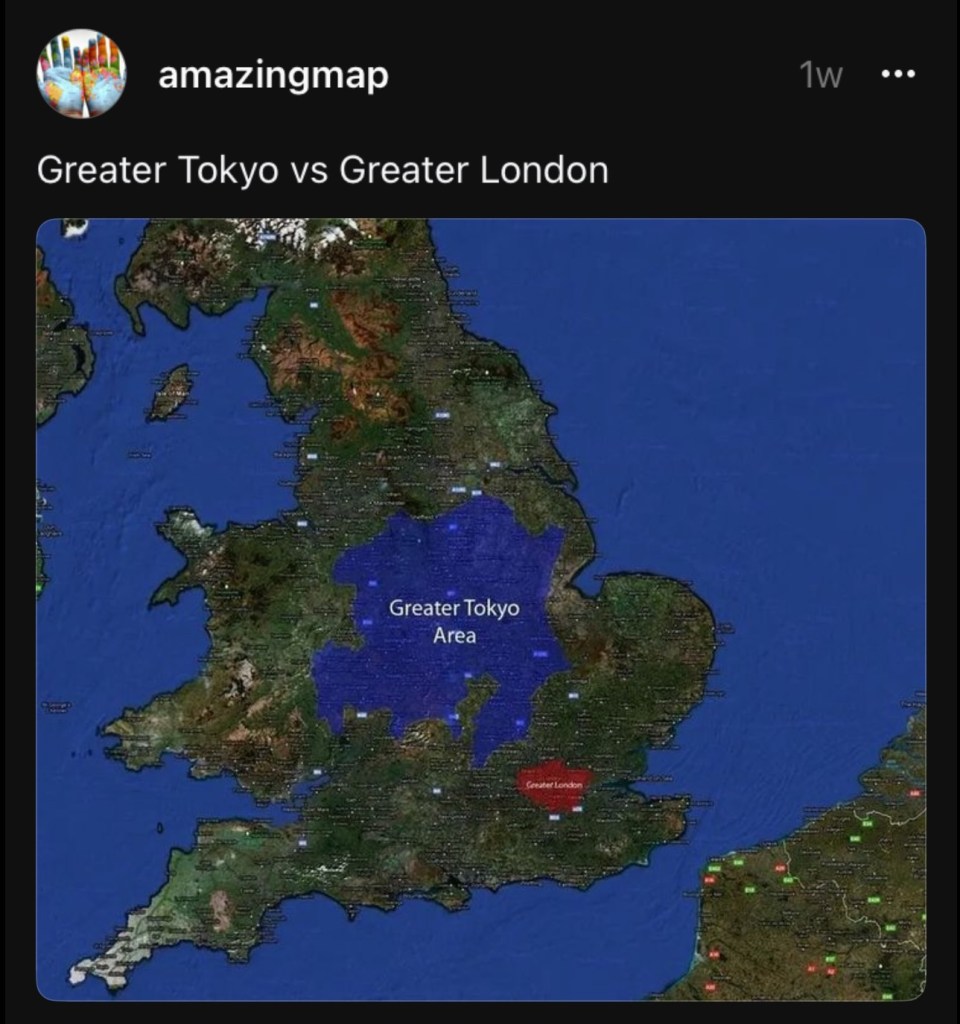
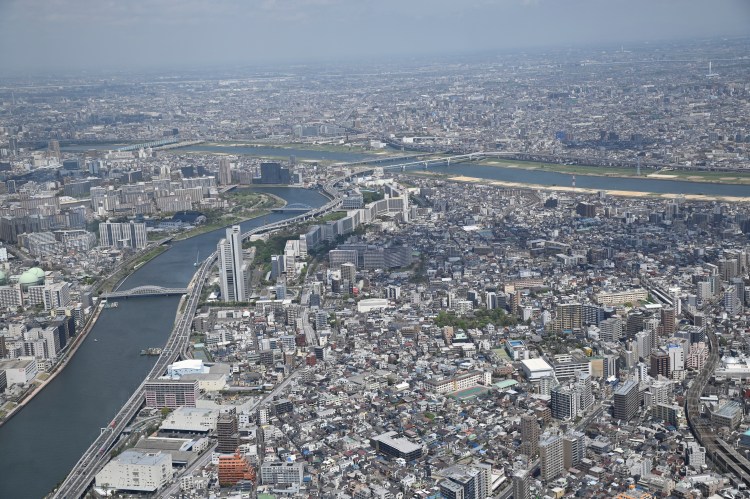
How big is Tokyo? By population it is the largest city in the world, with estimates of it being about 37 million people. Delhi is the next largest, at about 33 million. We New Yorkers always think of our city as “big,” but New York is only about 8 million people – less than a quarter of the size of Tokyo. And geographically, how big is Tokyo? Well – take a look at this map:

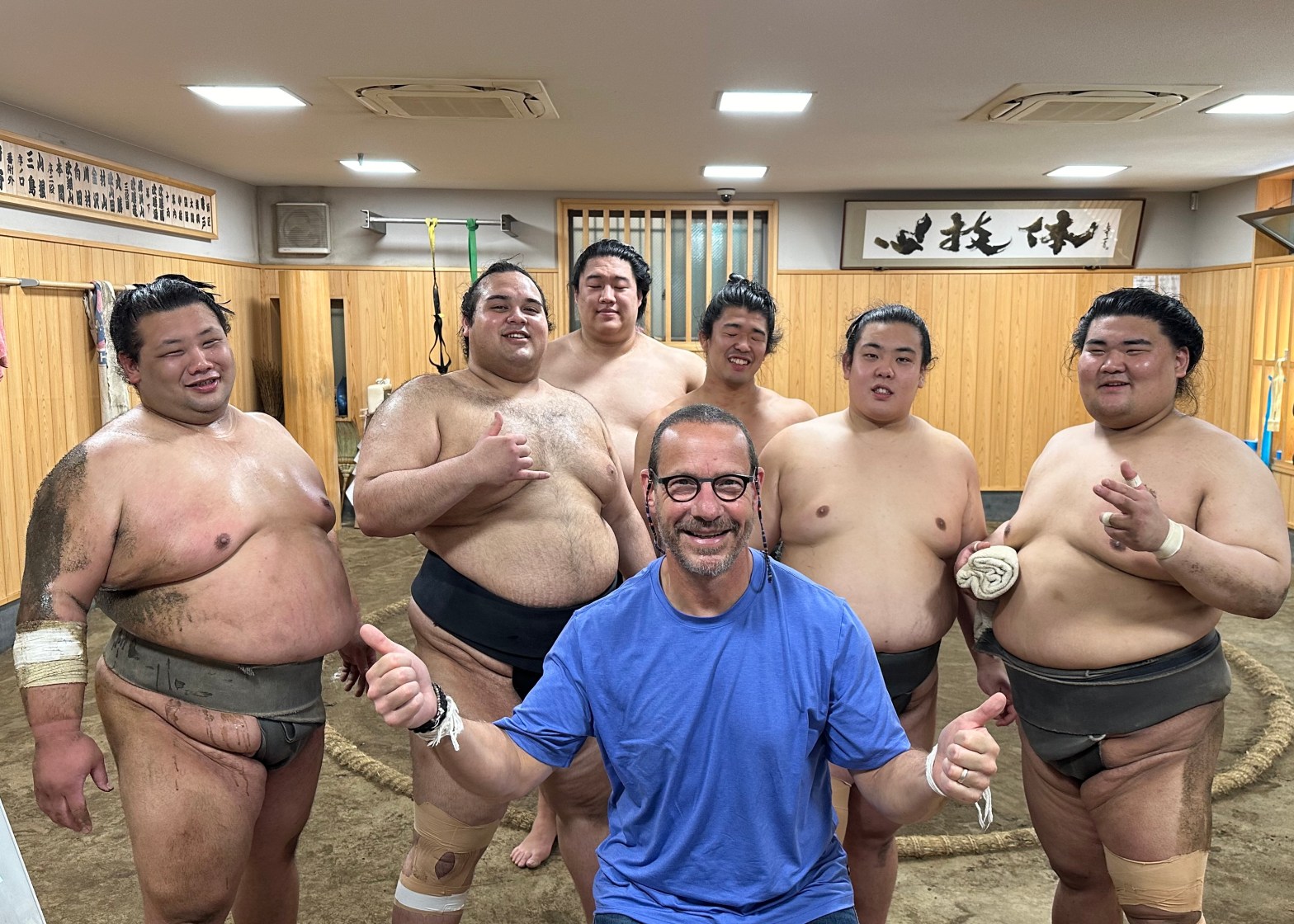
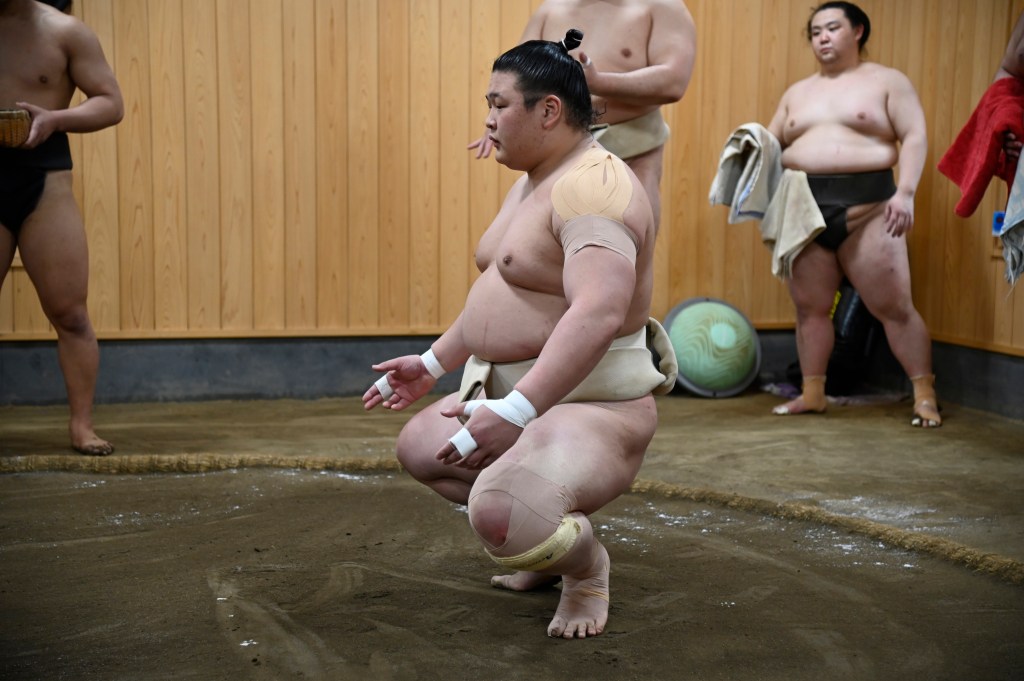
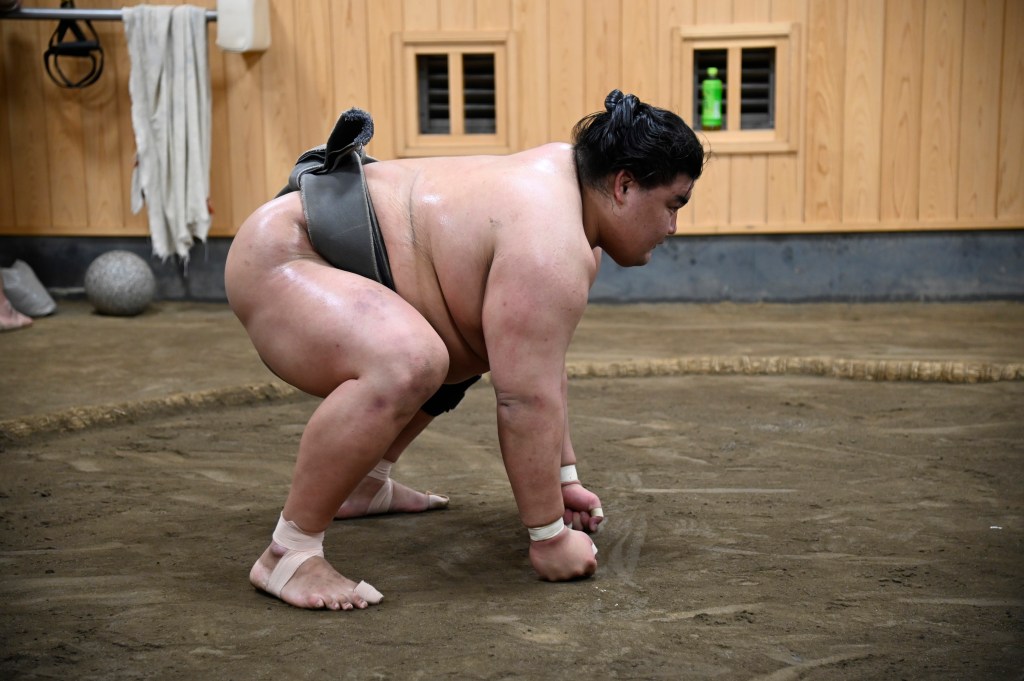
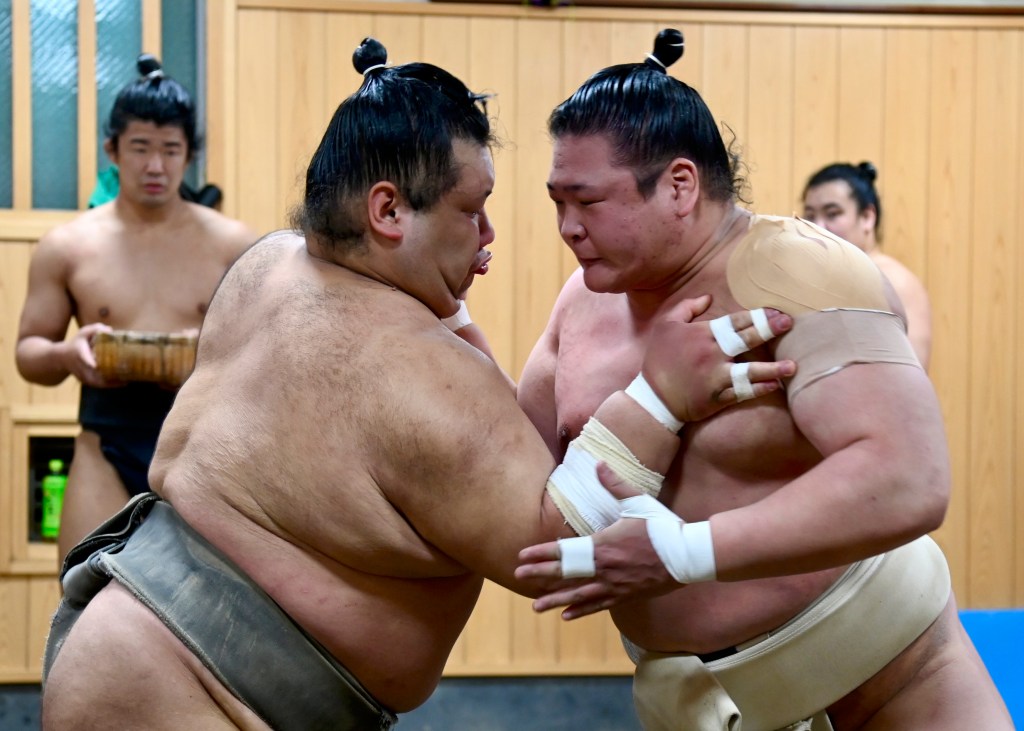
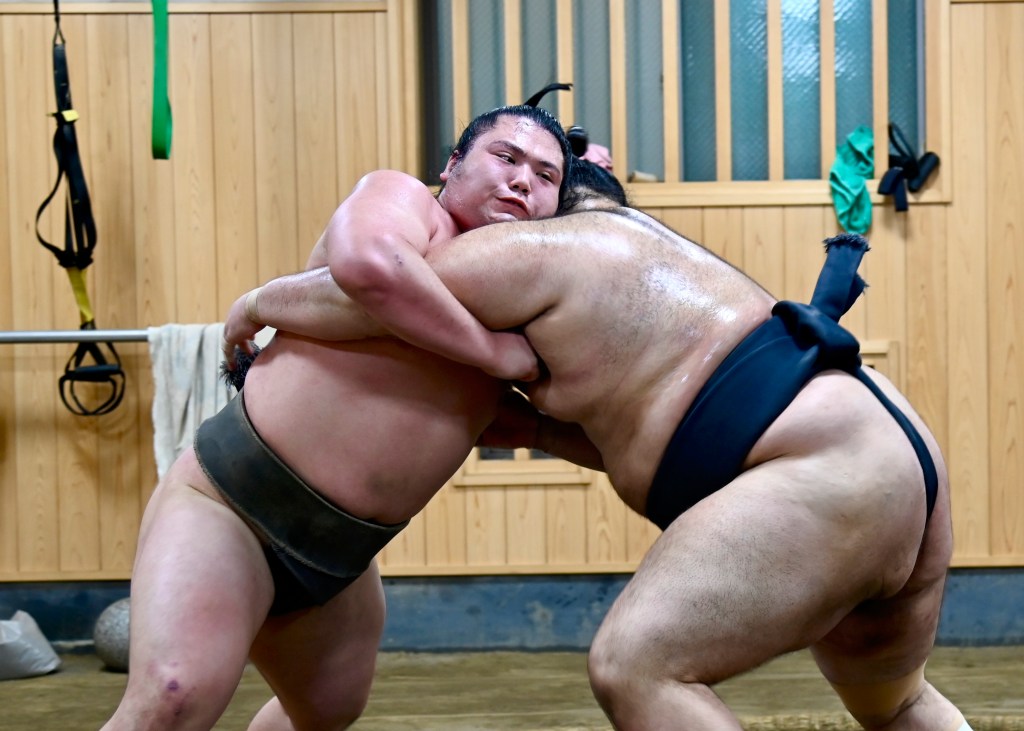
So, Tokyo it was. I was a little too late to see the cherry blossoms – “sakura” – but there were some other “must do” items, including sumo. Unfortunately, there were no tournaments while I’d be in Tokyo, but on my first morning in the city, I got a chance to go to the Naruto Stable to watch a sumo training session, stables being organizations of sumo wrestlers with provided facilities – housing, kitchens, training. There are about 40 such stables in Tokyo, and the one I got to see was led by a Bulgarian – the first European who achieved enough success in sumo to have his own stable; one of the members there, who we saw practice, is Ōshōma Degi, an accomplished Mongolian wrestler. Practice started about six a.m.; I arrived with a small group at about 8:30, and we got a chance to watch 90 minutes of training, seated just 15′-20′ from a group of 10-15 wrestlers, all of whom lived in the building where we watched. We had to sit shoeless and quietly, with photography and video being ok, and without the soles of our feet facing the training area (it is considered sacred). Massive, limber bodies, without weight classes, hurtling themselves at each other, lifting weights, and stretching, sucking wind and gasping for breath as they each went through their training matches. We walked away with a different appreciation for their sport.

The members of the stable seemed to be in groups of three, and each group did this 15-20 times each.
At the end of a group’s practice matches, this exercise, which each pair did a few times, seemed to wrap things up. Think the one guy’s tired?

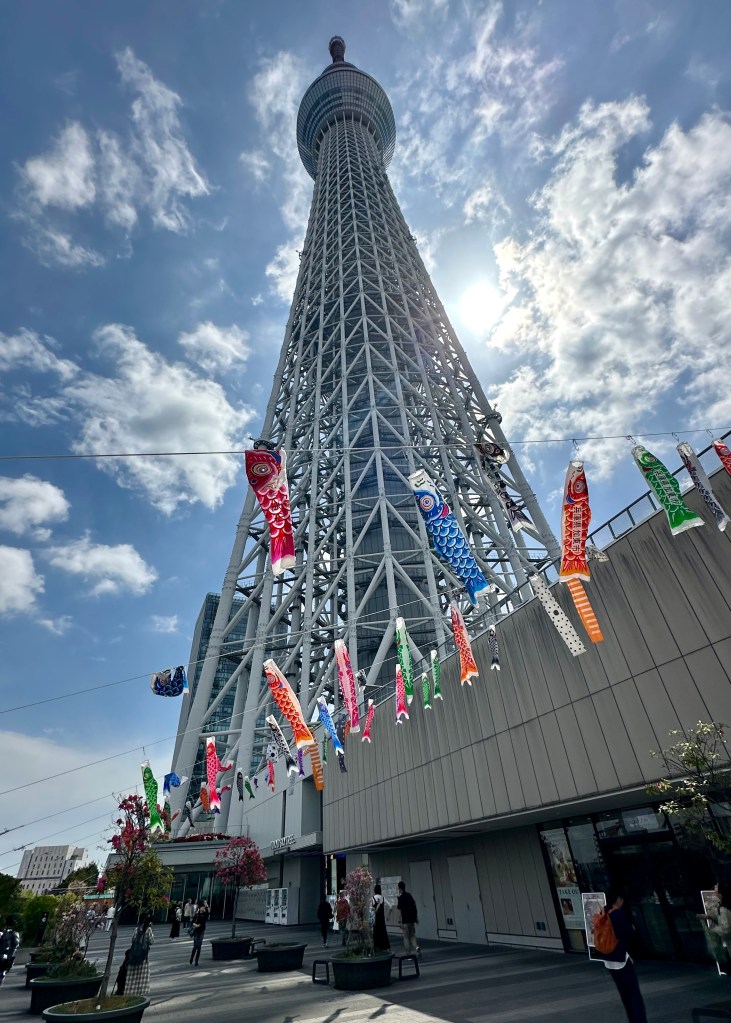
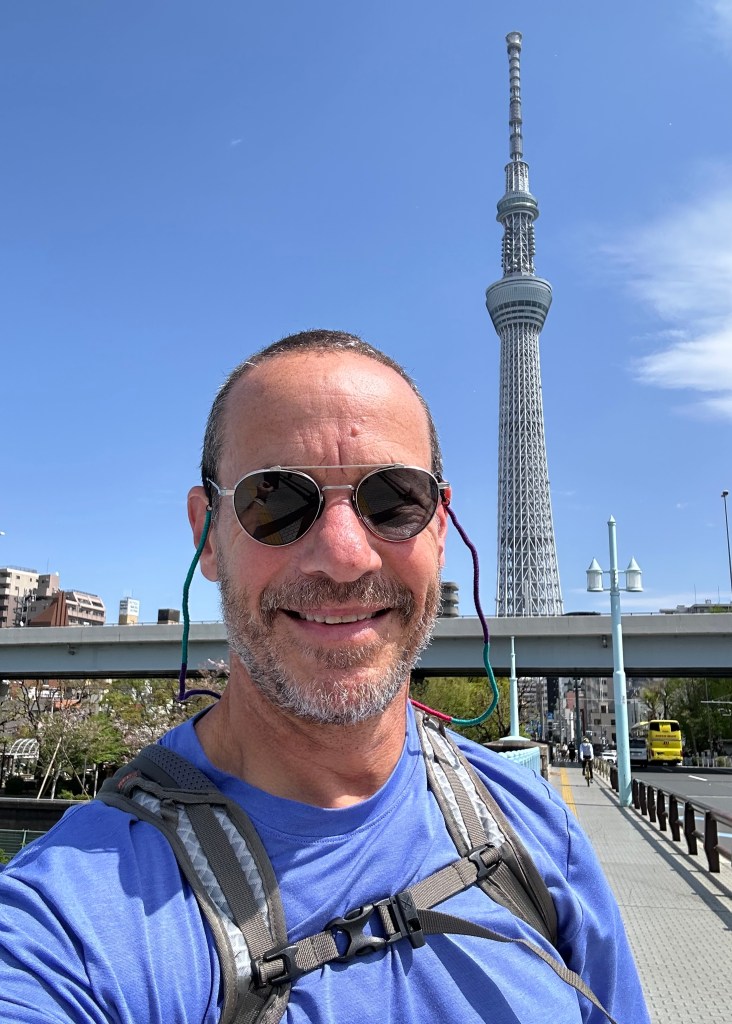
I was close by the Tokyo Skytree, a broadcasting tower that happens to be the tallest tower (as opposed to “structure”) in the world, with observation decks a little shy of 1,500 feet high. It is one of the most recognizable structures on the Tokyo skyline, and it has a cameo in a host of Tokyo-based films and TV series.

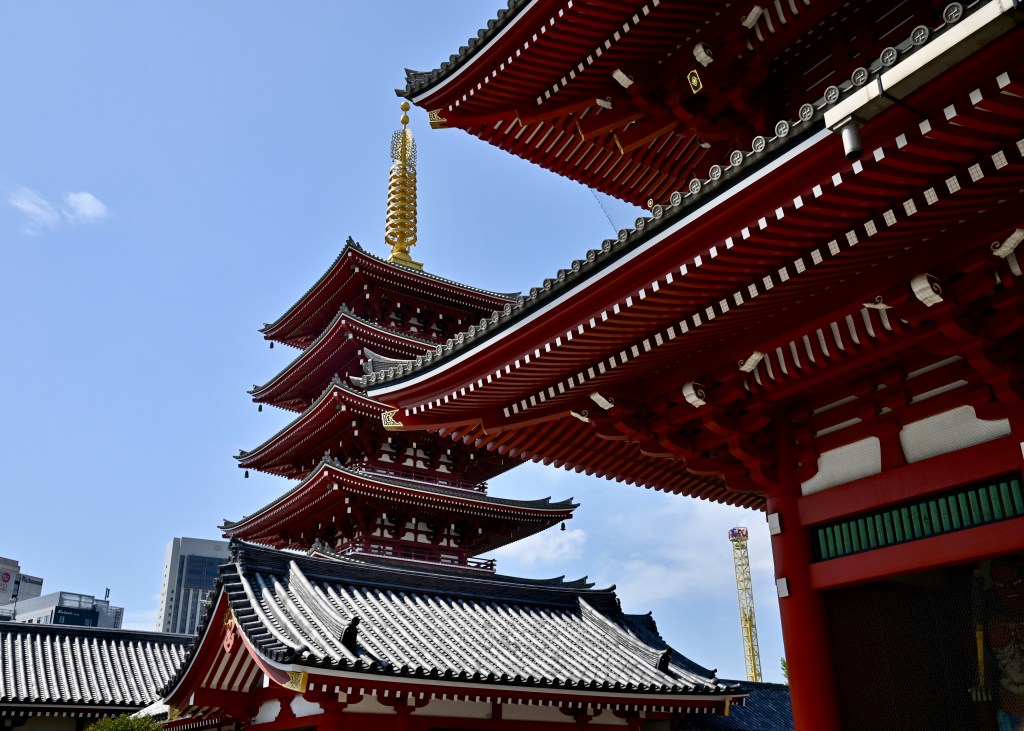
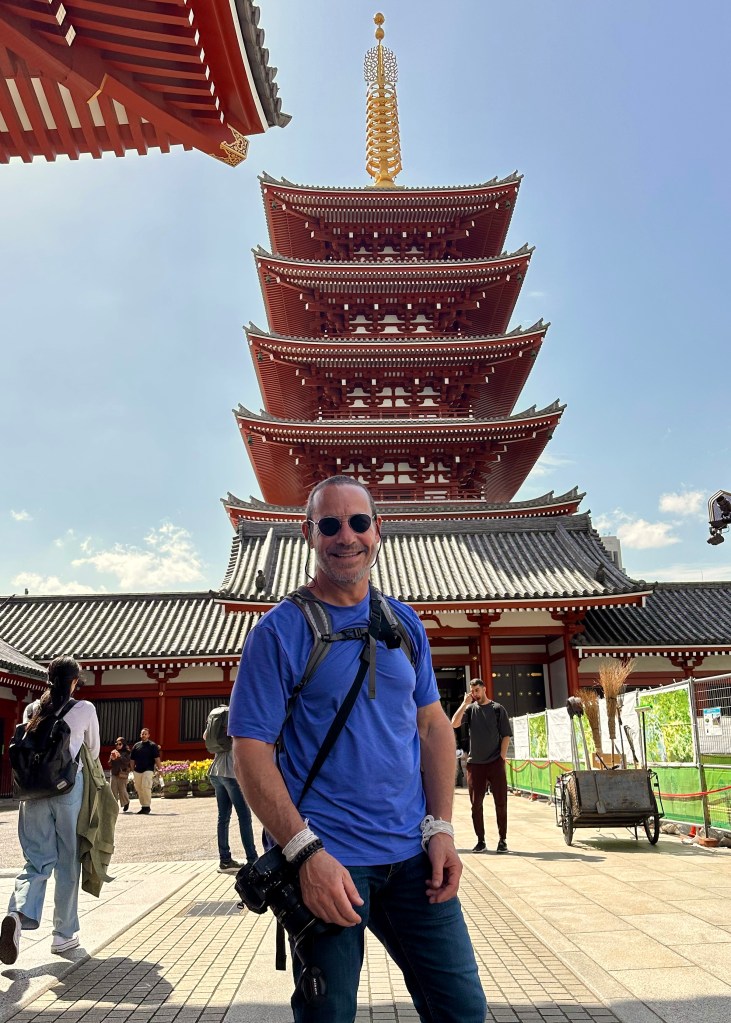
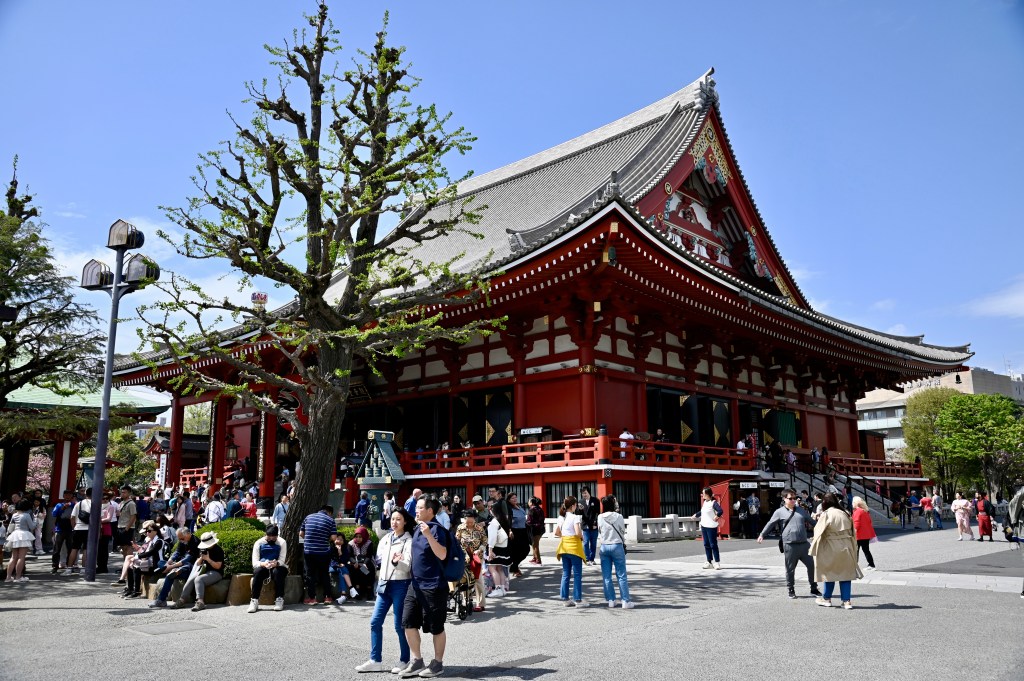
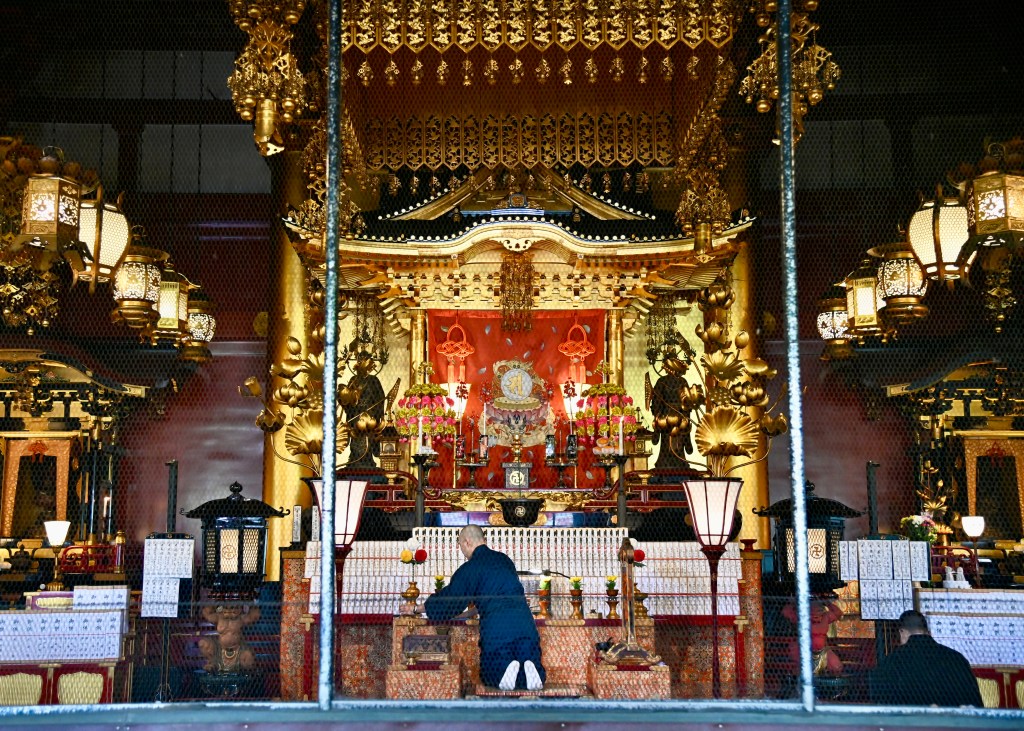
After lunch (more on food another time), I walked to the Senso-Ji, an ancient Buddhist temple and complex that also houses the Asakusa Shrine, a Shinto shrine that is one of the most famous in the city; the Shrine (though not the Temple) apparently is one of only two structures to have survived the bombing of Tokyo during WWII. The first temple dates to 645 AD.

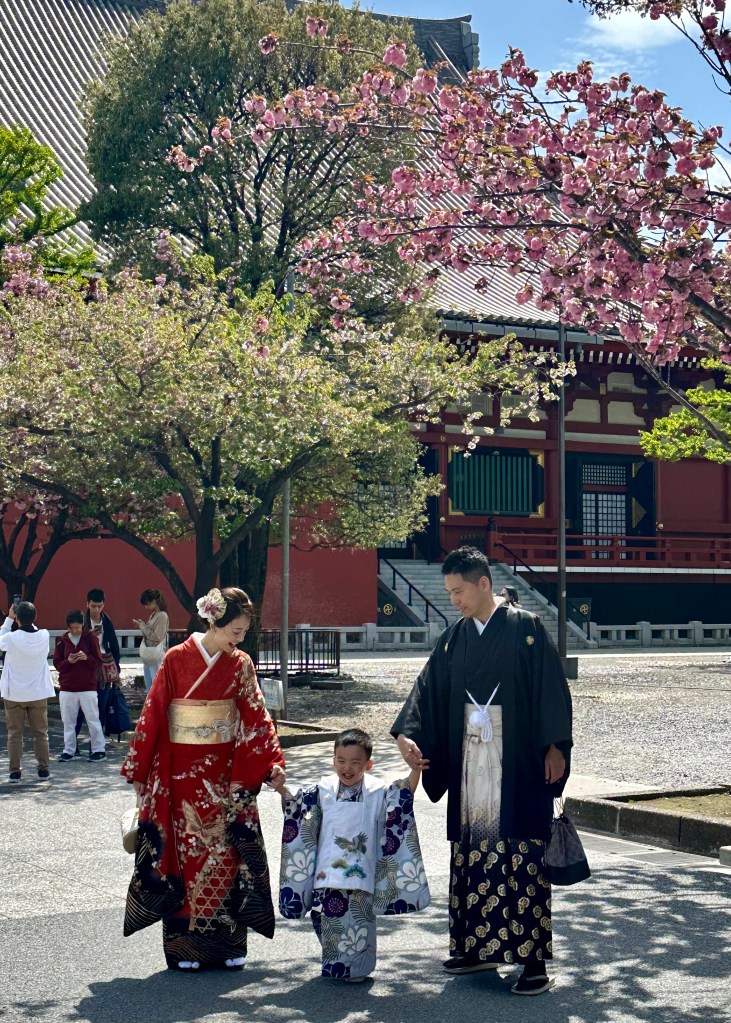
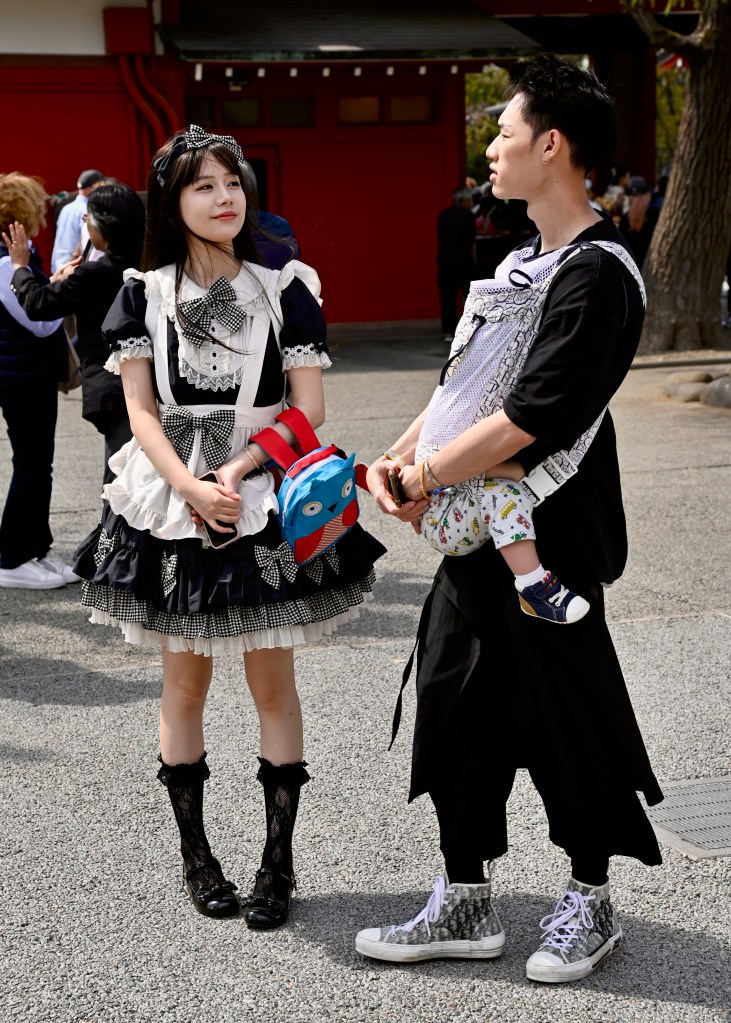
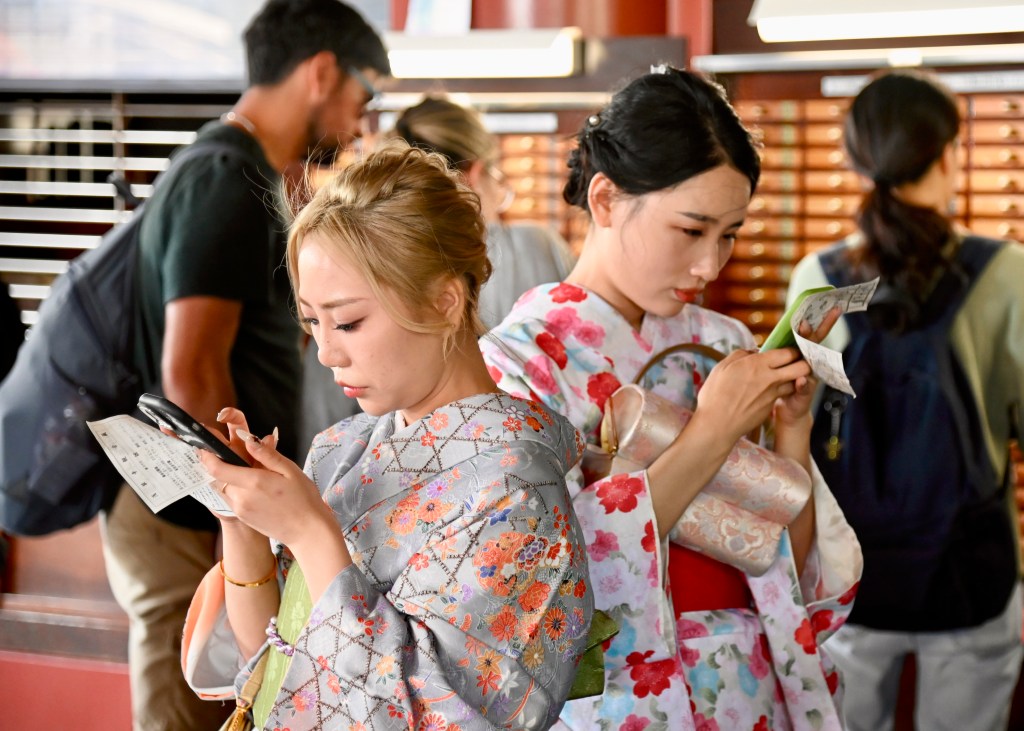
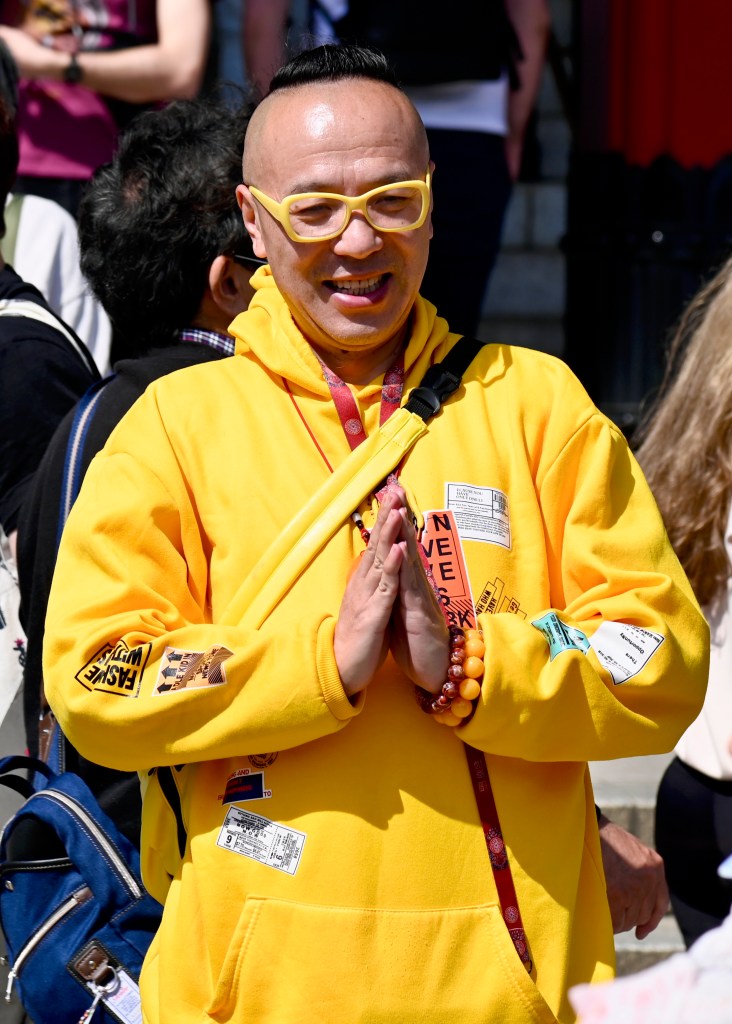
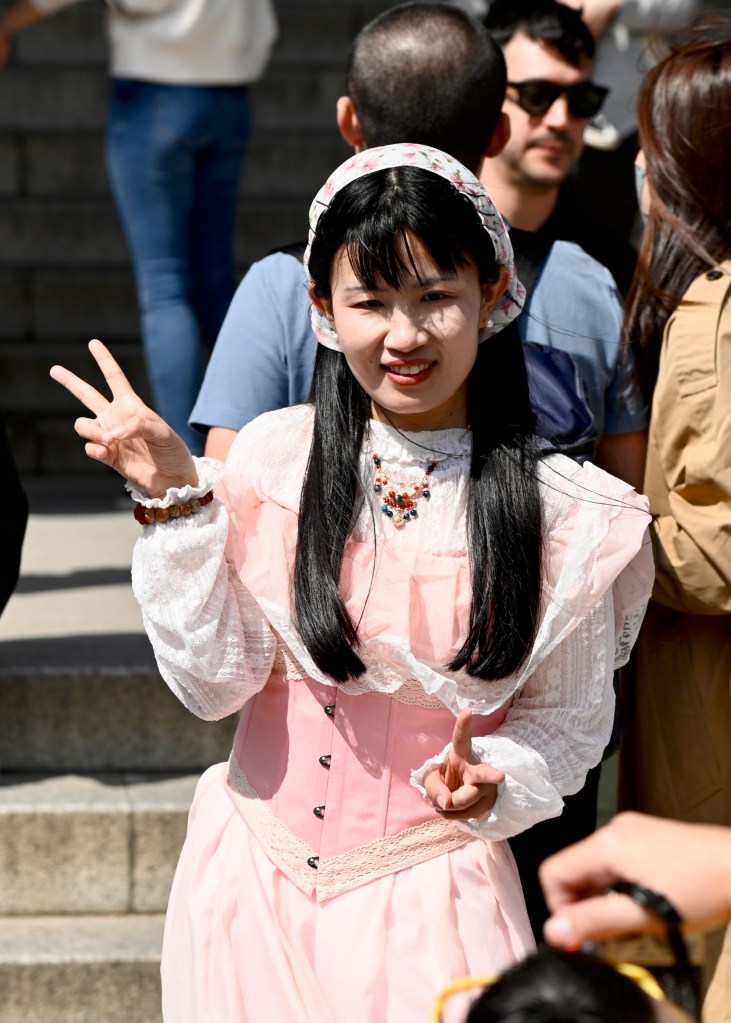
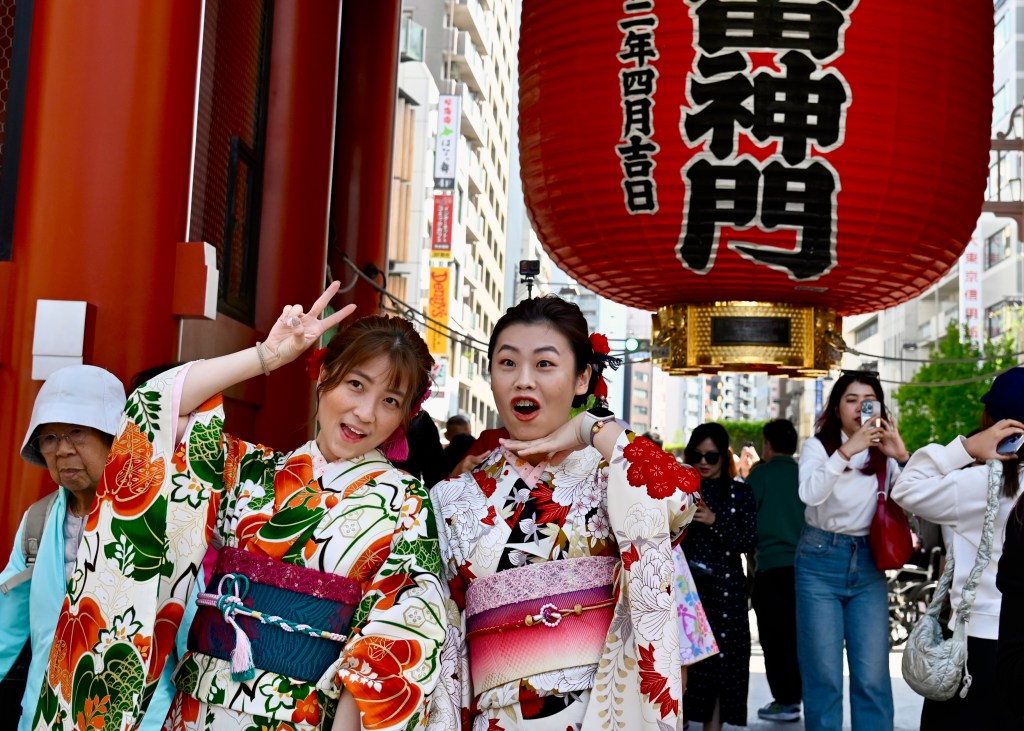
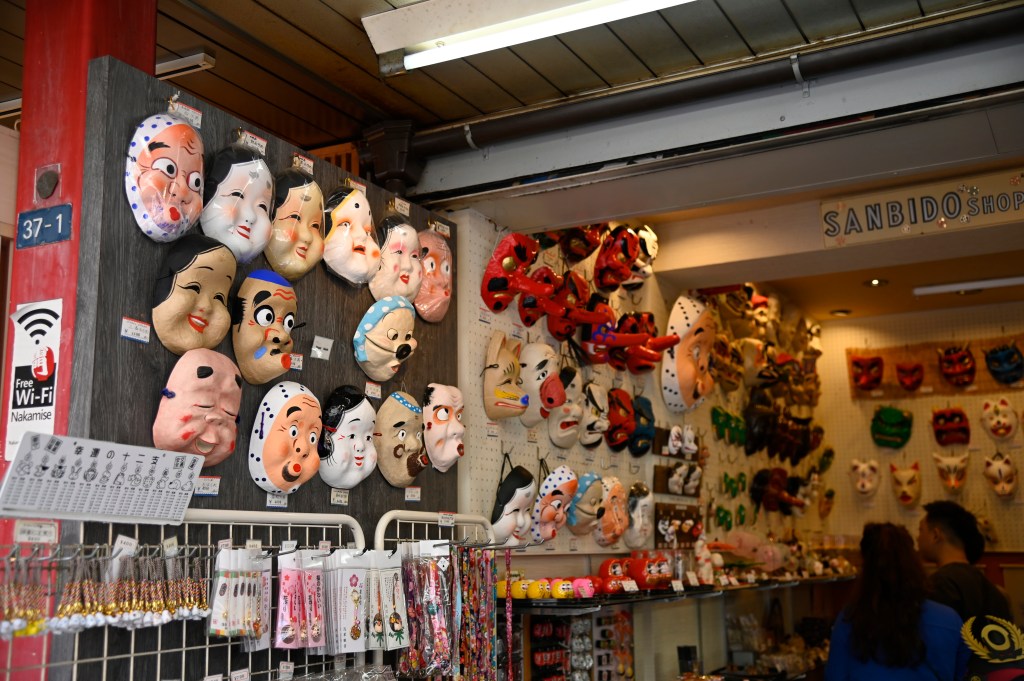
Beautiful. Should be tranquil. But hordes of people. Like an amazing amount of people. This would be my experience at most of the sites I visited in Tokyo as well as while walking on most of the streets, though the temple complex also is one of the most popular tourist spots, both for Japanese and foreigners, while still being a place that worshippers go to. And then there’s the Nakamise-dōri, the long street that approaches the temple that is lined with vendors, a tradition that apparently started in the 18th century. Masks, chopsticks, flags, t-shirts, sweet treats, fruit, tchotchke of all types. And more people. But the people-watching is fantastic, especially given the number of traditionally-dressed women and men as well as the amount of fashion-forward people you see; this, too, was true of everywhere I visited in Tokyo.

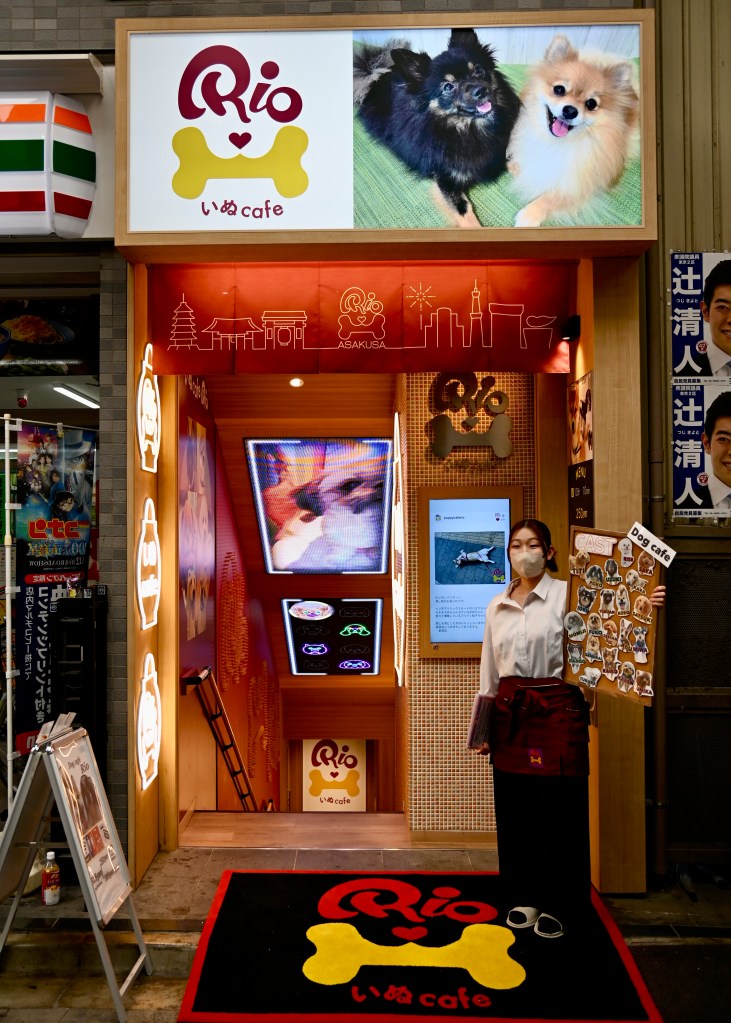
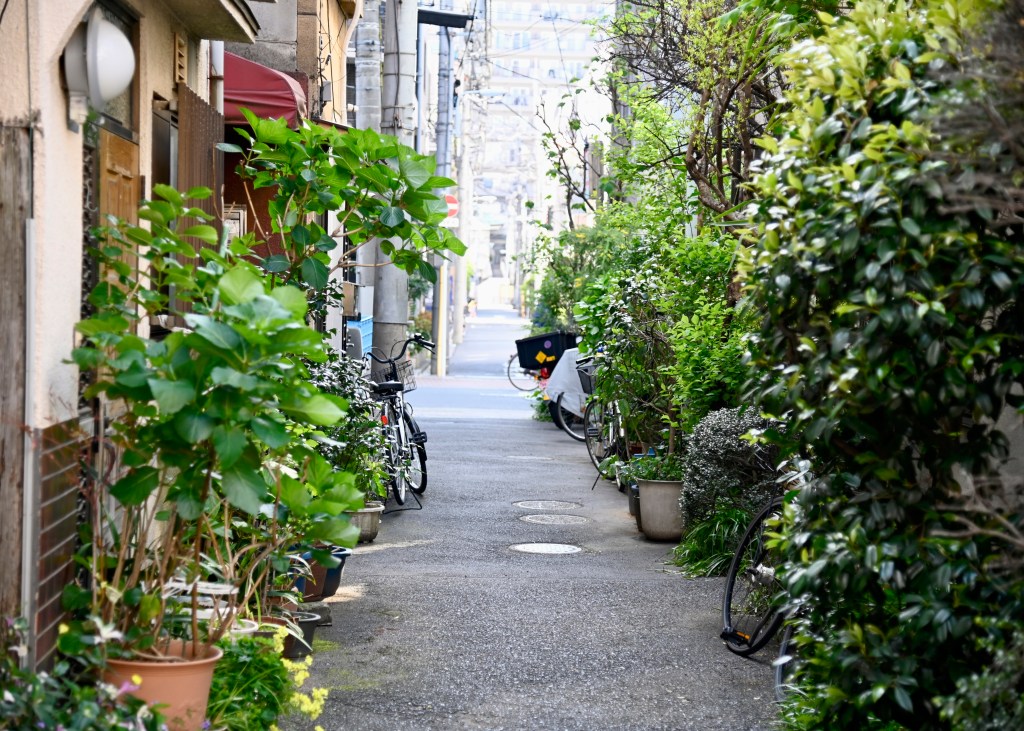
Tokyo is so big that I tried to arrange my days by neighborhood, though I wasn’t always successful, but this day it worked out well. After time at the Temple complex, I walked through a variety of city streets – an outdoor retail mall (clothing, shoes, knives, dog cafes, restaurants, coffee joints) and quiet narrow side streets – almost alleys – to first reach Kappabashi Dougu Street, an area known for its abundance of kitchen supply stores (pots, pans, utensils, chopsticks, knives, flatware, plates/pottery/serving dishes, stainless steel racks, plastic containers/squeeze bottles). My goal was to look at and perhaps purchase some Japanese knives. “Check.”

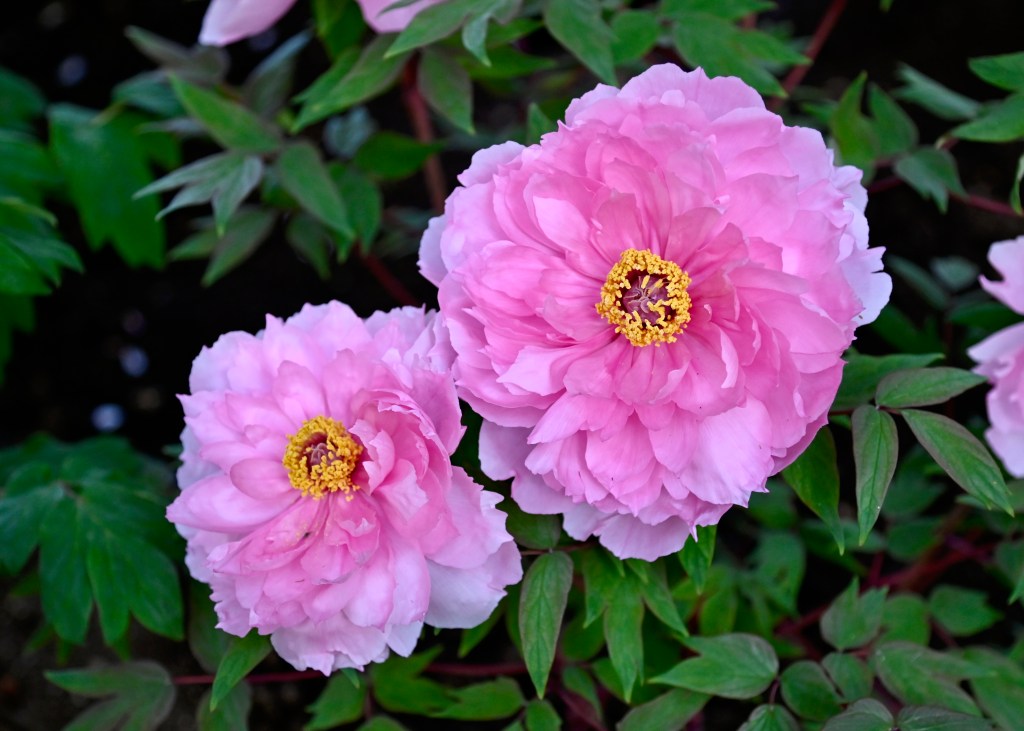
After that it was off to Ueno Park, a large public park in the middle of this part of the city, and home to a number of museums and gardens, including – while I was there – one that specialized in peonies. It was a beautiful sunny day, and there’s no better way to spend it than walking around and enjoying the outdoors.

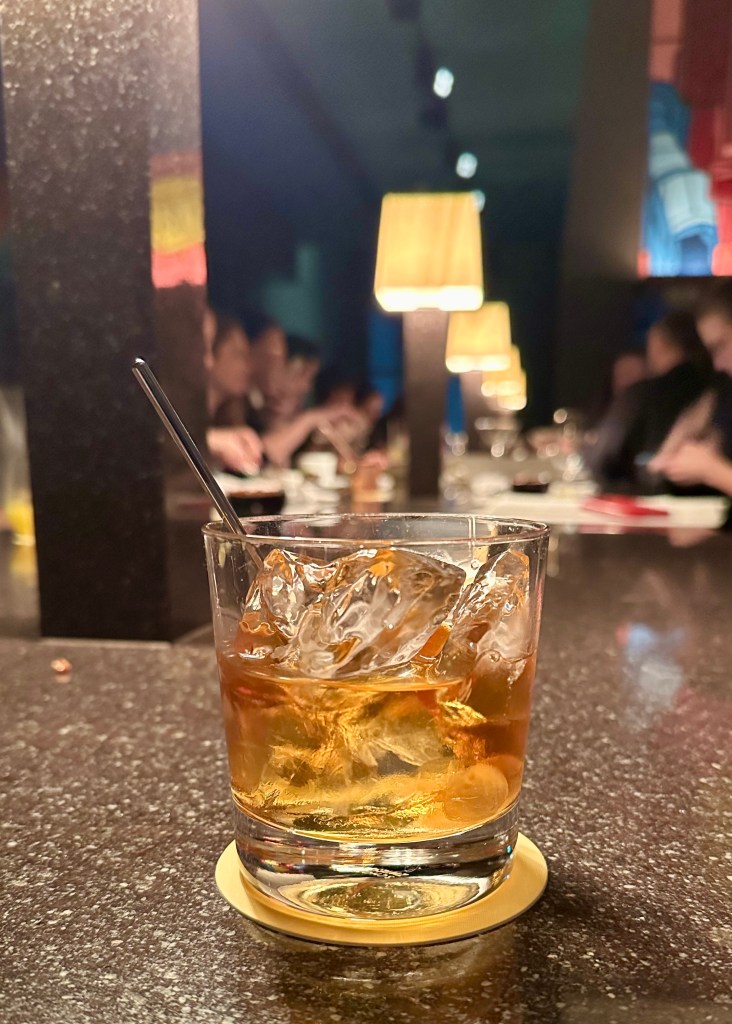
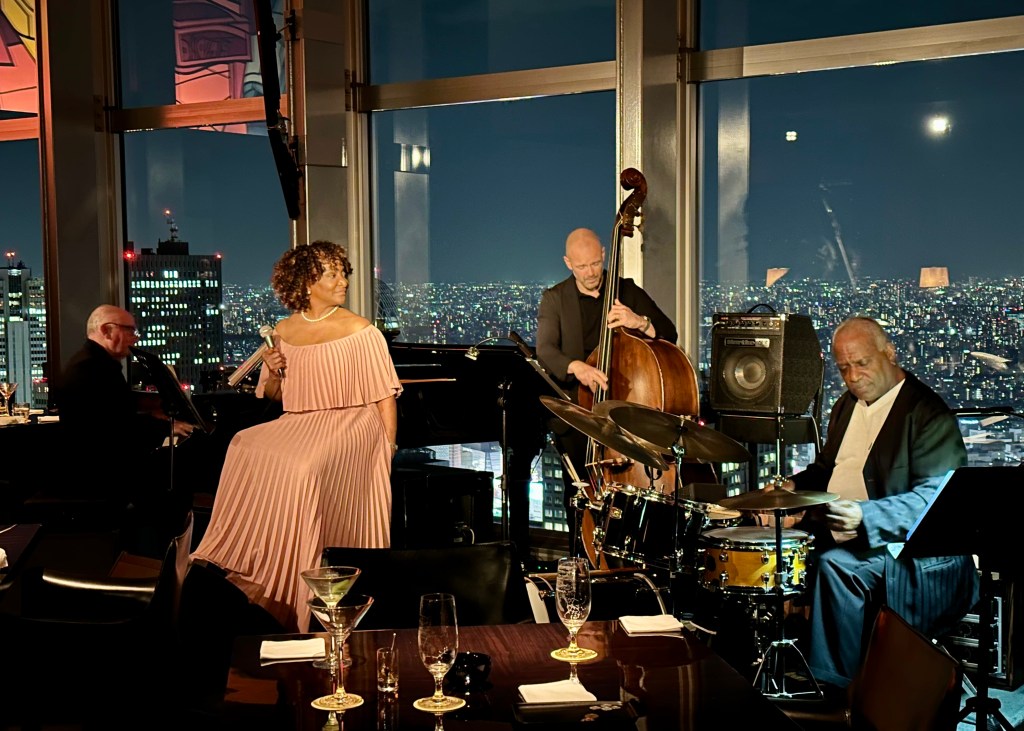
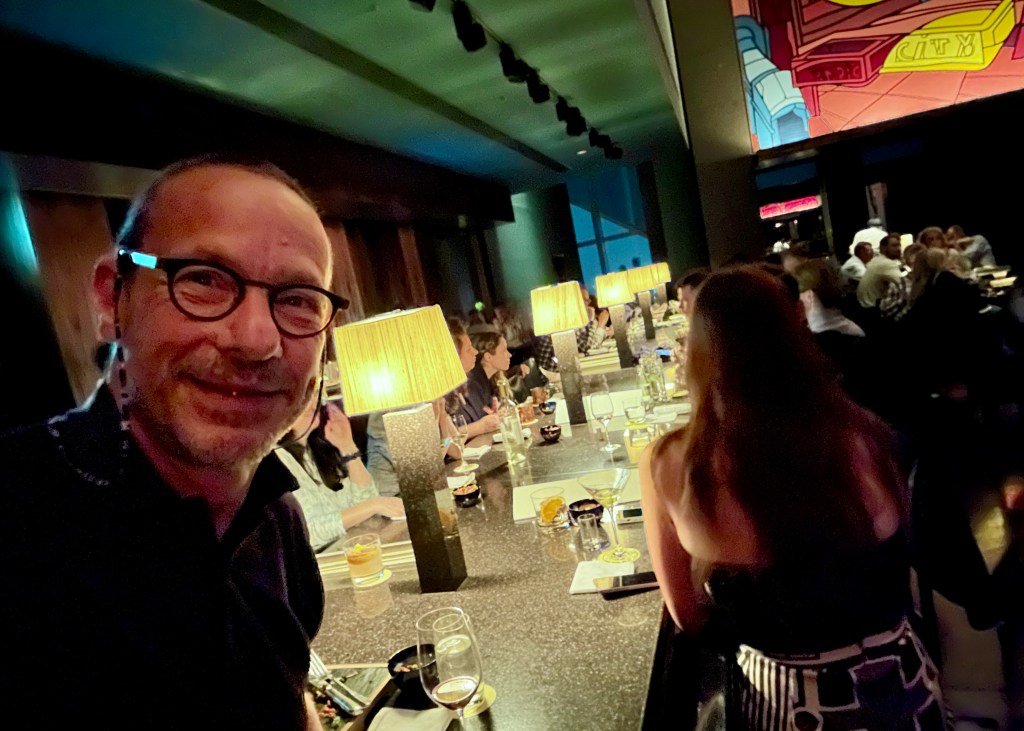
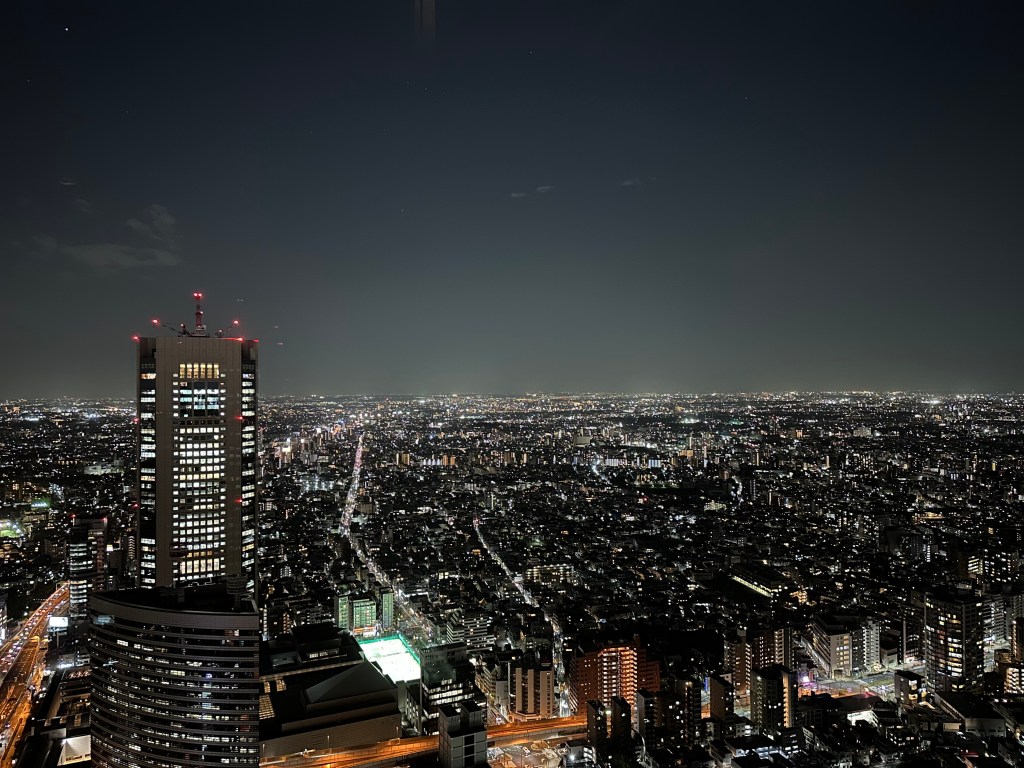
For dinner, the last stop of the day was special. Anyone who has seen the film “Lost in Translation” is familiar with the bar where so many iconic scenes were filmed. The characters played by Bill Murray and Scarlett Johansson stay at the Park Hyatt, a 10-minute walk from where I was staying, and the bar, on the 52nd floor, is the New York Grill and Bar. It looks exactly the same as in the film – the long table where the two protagonists sat, the large windows with spectacular views of Tokyo, even a small combo band (though not “Sausalito”; IYKYK) with a female singer was performing. I had to wait a few minutes to be seated and then was lucky enough to snag a seat at the end of the long table, with perfect views of the small lamps, the band, and the city. A perfect way to end a great day that included covering close to 5 1/2 miles by foot.

Days 10 & 11 – Luang Prabang, Laos

Our guide here learned English in a buddhist school, which he attended for four years.  His parents are illiterate, as they grew-up during the French colonial period, when only the elite were allowed to go to school.

During the Vietnam War, Laos became the most bombed country in the history of warfare.  The US dropped about 2 million tons (yes, tons) of bombs on the country, roughly equivalent to 1 ton for every person in the country.  To this day, tens of millions of bombs that failed to explode exist as UXO – unexploded ordinance – and still maim and kill Laotians.  Some important archeological sites – including the Plain of Jars, which dates to sometime between 1240 and 660 BC – can’t be fully explored due to the UXO.

A land-locked country bordered by Vietnam, Cambodia, Myanmar, and China, our place of exploration was in Luang Prabang, a UNESCO World Heritage city and the former capital, with a population of about 60,000, making it the smallest city we’ve visited across Vietnam, Cambodia, and Laos.  Today, Laos is a country of close to 8 m people, more than double what it was in 1975, when Saigon fell in Vietnam.  The average age is about 25, and you could feel the youth and the energy during our stay, though it is also the buddhist heartland of the country.

We arrived during the three-day Lao New Year celebration, and our guide alerted us to blocked streets and that one way the locals celebrate is to douse people with water – from water pistols, water rifles, hoses, and buckets, no matter whether you are walking by or driving by – in a tuk-tuk, on a motor-bike, or in a car; there even were pick-up trucks loaded with people in the back who doused people at roadside in return.  It represents a form of purification for the new year, and, yup indeed, we got purified.

We visited the National Museum, originally a home to two kings, and it was jam-packed with tourists, primarily Chinese ones, due to the easy travel from China to Luang Prabang, then we headed to several buddhist temples – “wats” – before I was dropped for lunch at a local restaurant, where I could eat outdoors overlooking the Mekong River and have a beer.  Rather than riding back to my hotel in a tuk-tuk, I decided to walk the c. 2 miles, passing lots of celebrants along the way, getting fully drenched with a smile on my face.

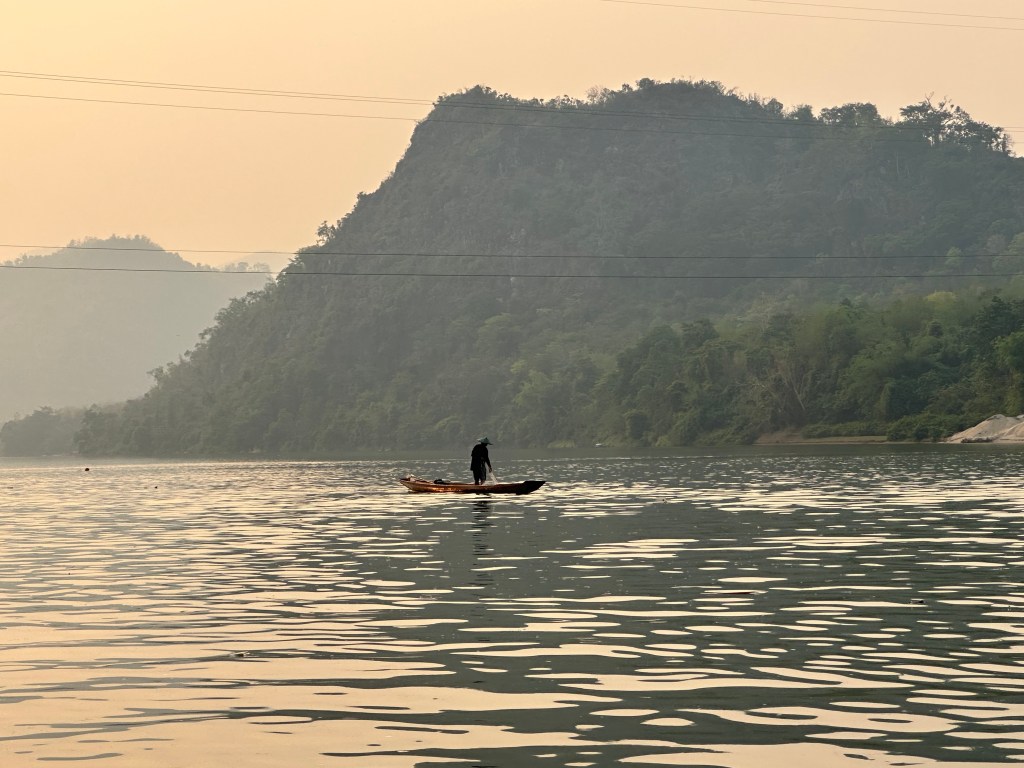
Our day ended with a sundown cruise on the Mekong, past rugged mountains and lush green forest, followed by a walk through a nighttime market before dinner.

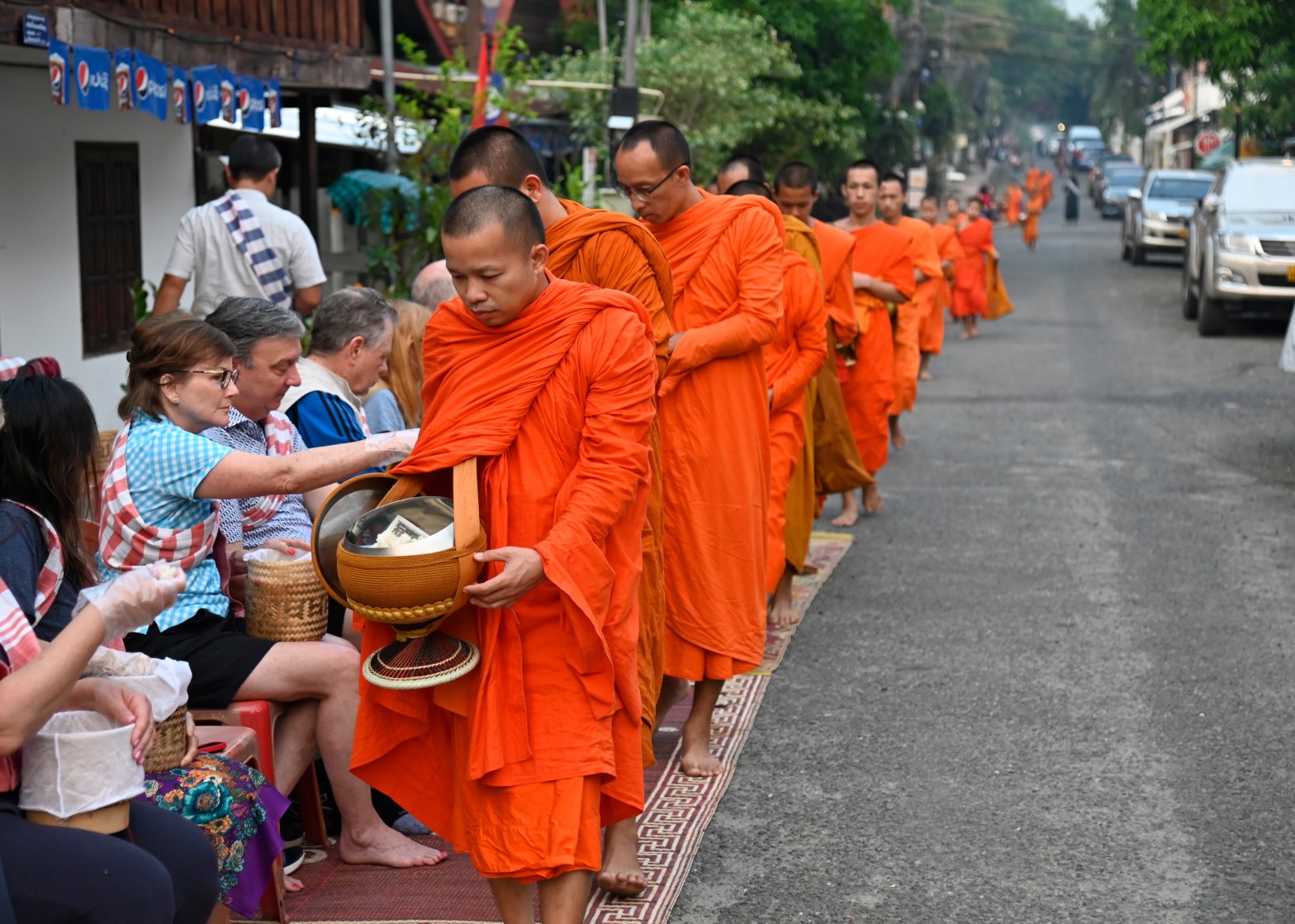
The real treat of our visit was the next morning, however, when we left the hotel at 5:30 to participate in “tak bat” – the morning ritual of donating food to the local buddhist monks.  Locals and tourists alike sit outside homes, silently placing small handfuls of sticky rice or other food into the baskets of monks who silently walk by; there are hundreds of monks in Luang Prabang, and my group of fellow travelers sat with ritual shawls around our shoulders and barefoot (out of respect) on plastic chairs under which had been placed a carpet, each of us with a small bucket of rice prepared by a local woman just for this purpose.  Next to us on either side were locals outside their homes, doing the same.  The saffron-robed monks walked by – at almost a relentless pace – putting pressure on us to move quickly so as to put rice in each of their bowls.

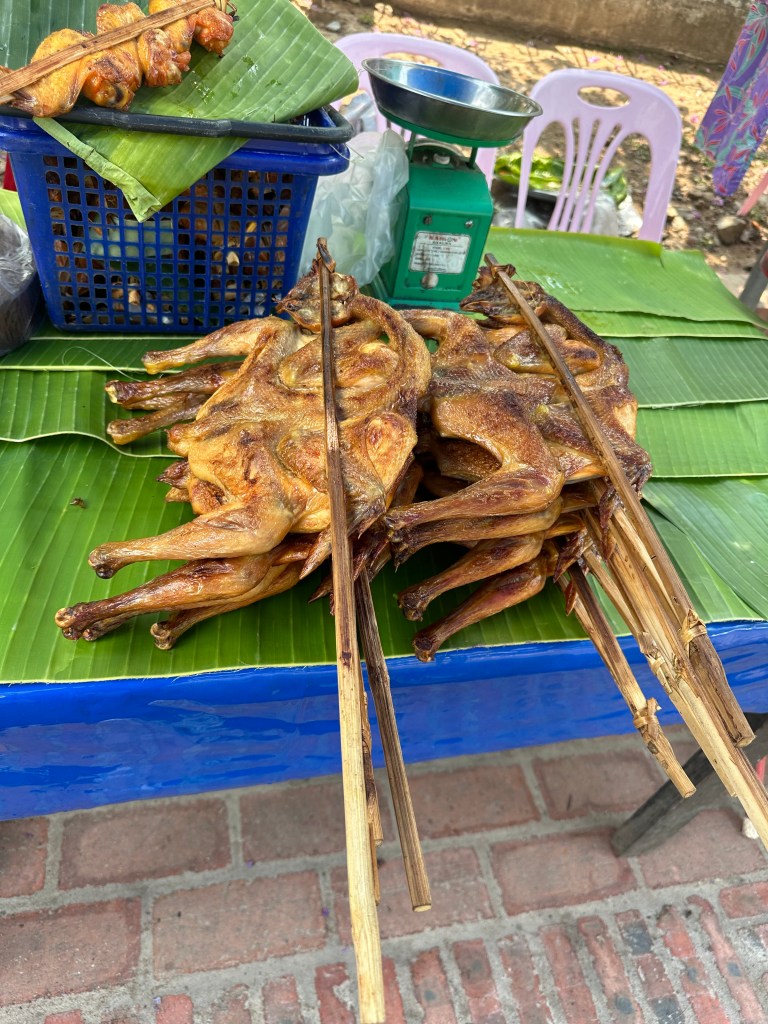
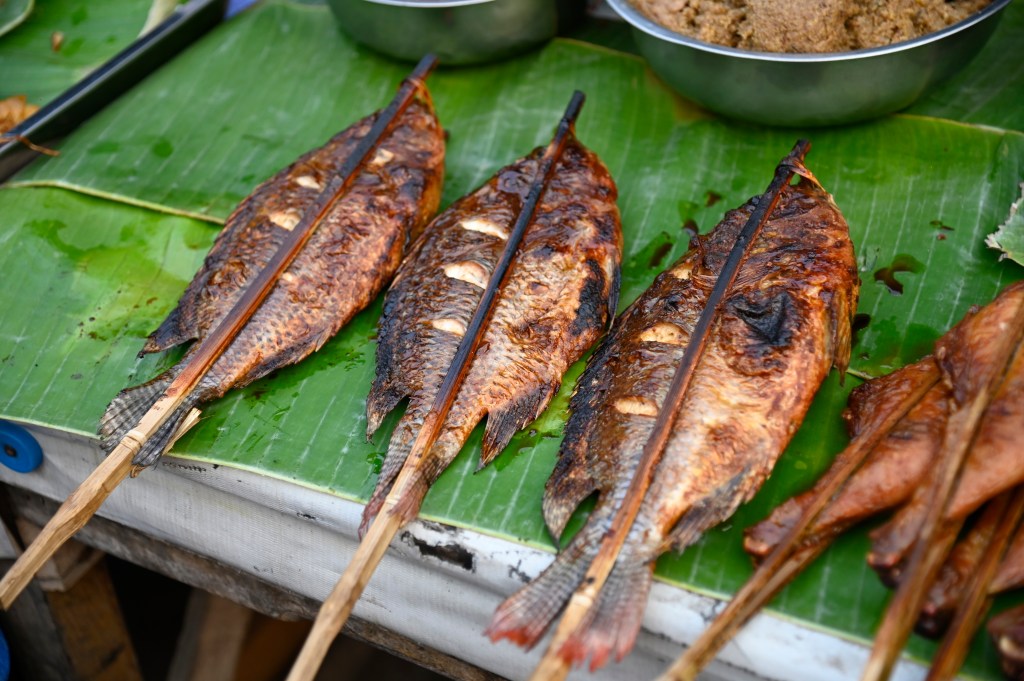
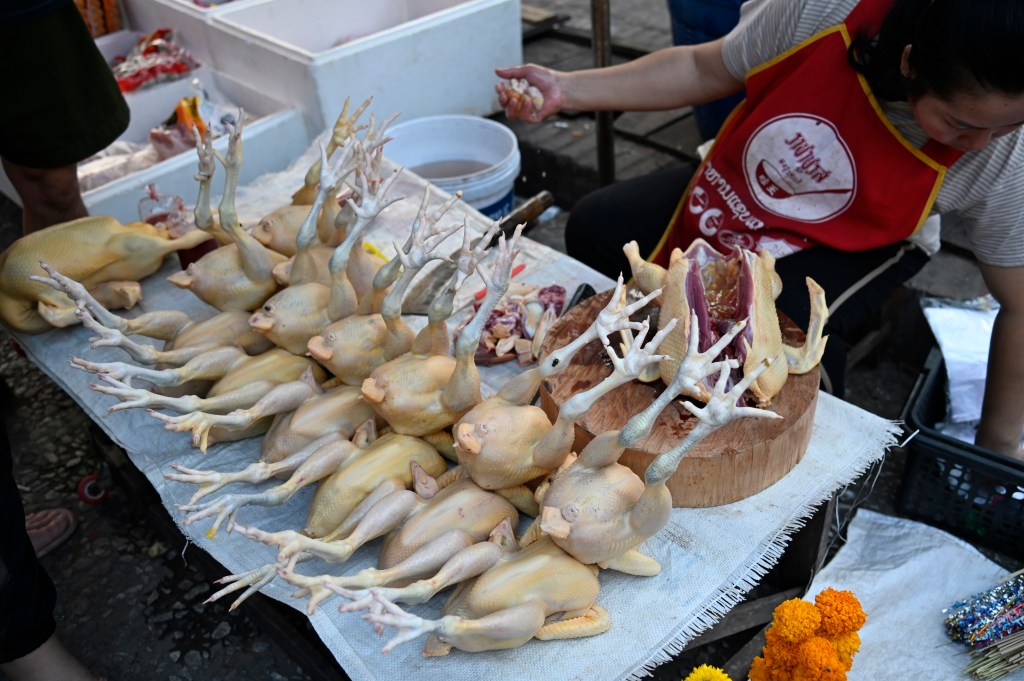
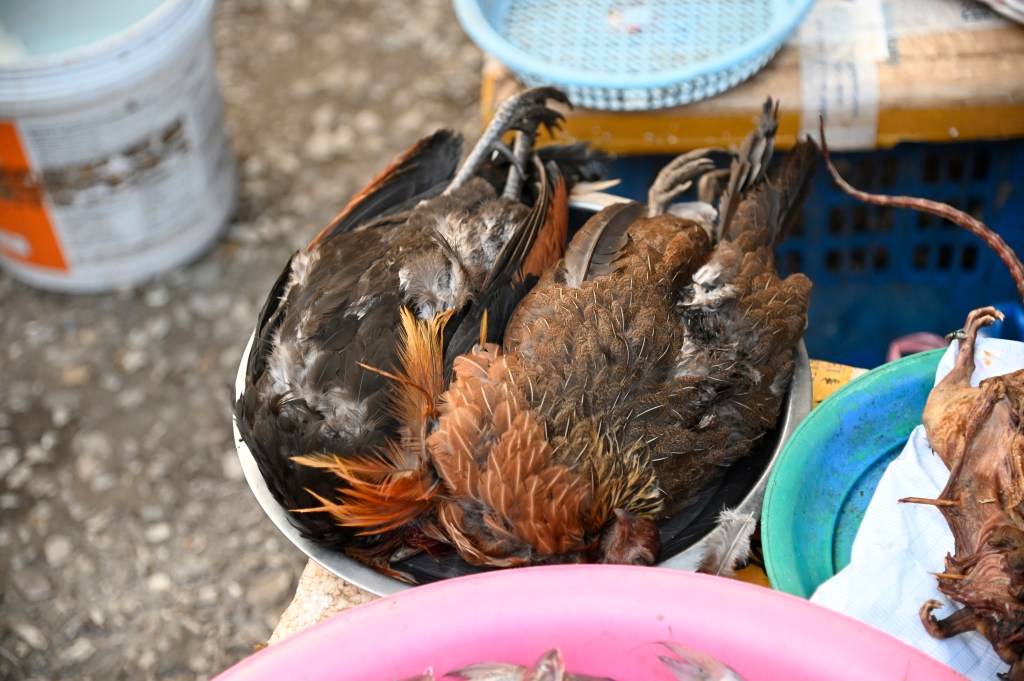
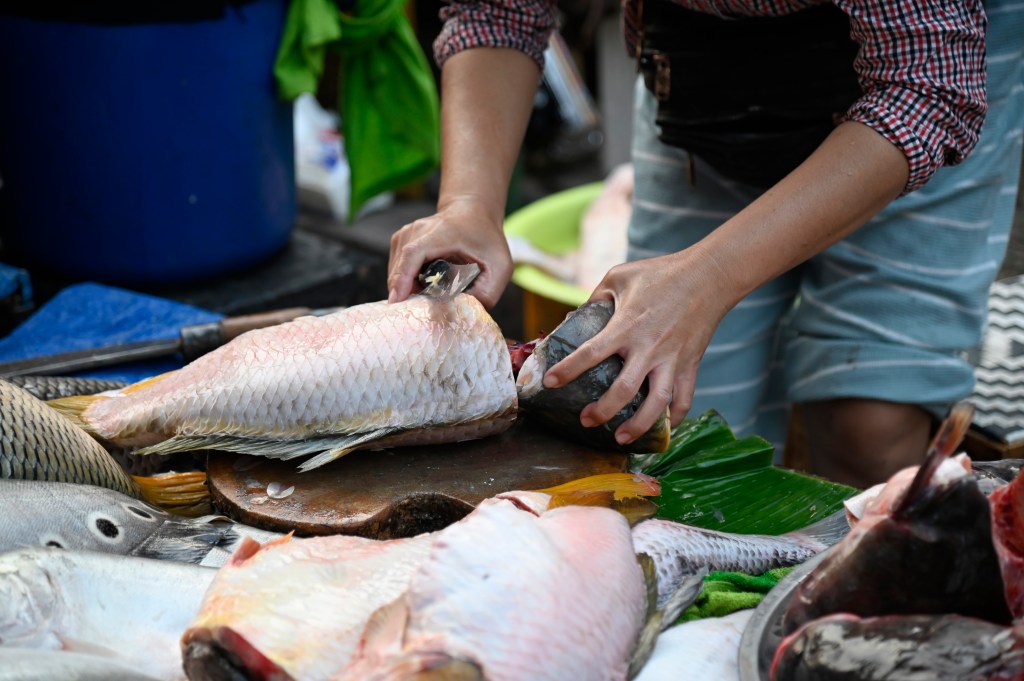
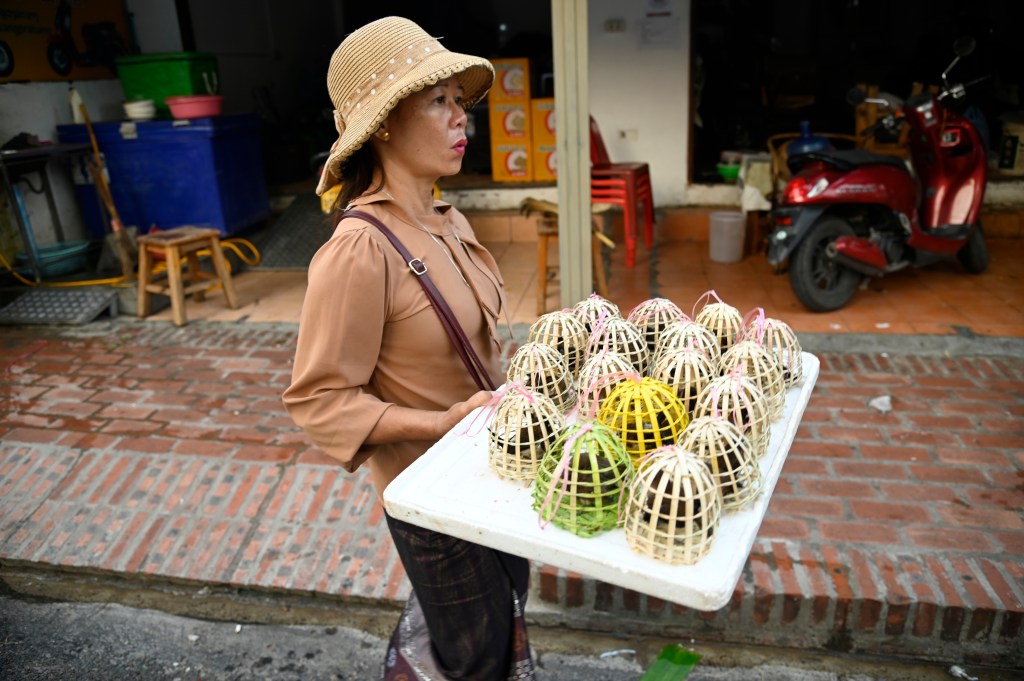
We then took a walk through a local market –  mostly food, cooked and uncooked, being butchered and already butchered – pork, beef, chicken, rat, fish of all types, bread, spices, fruit, vegetables, even small birds in small cages.

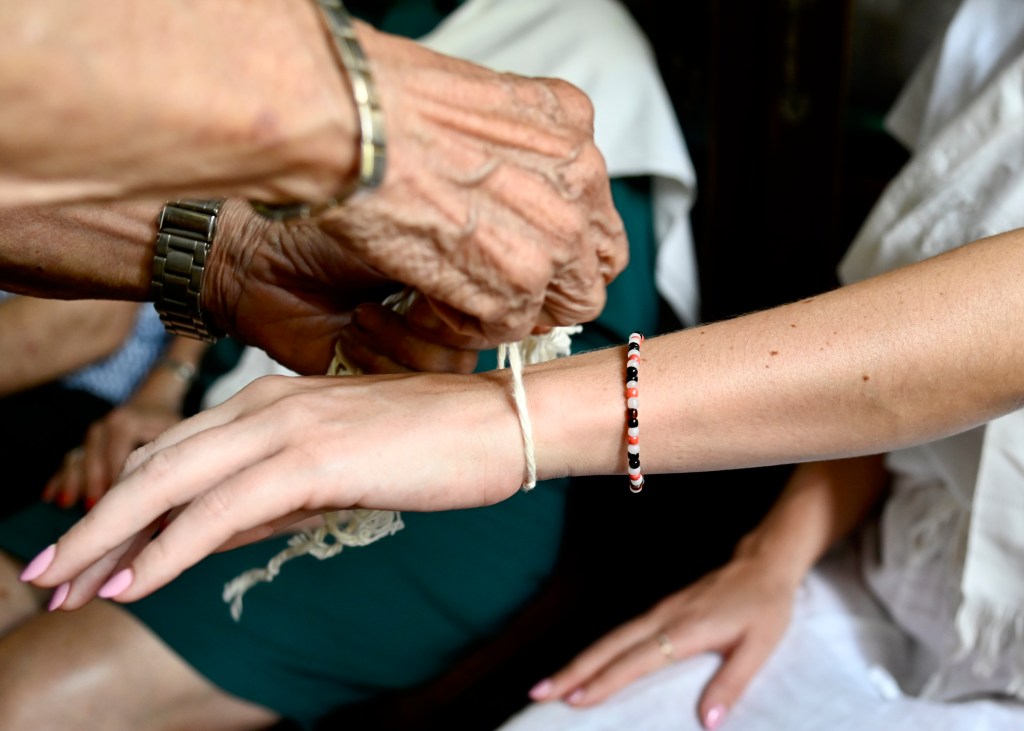
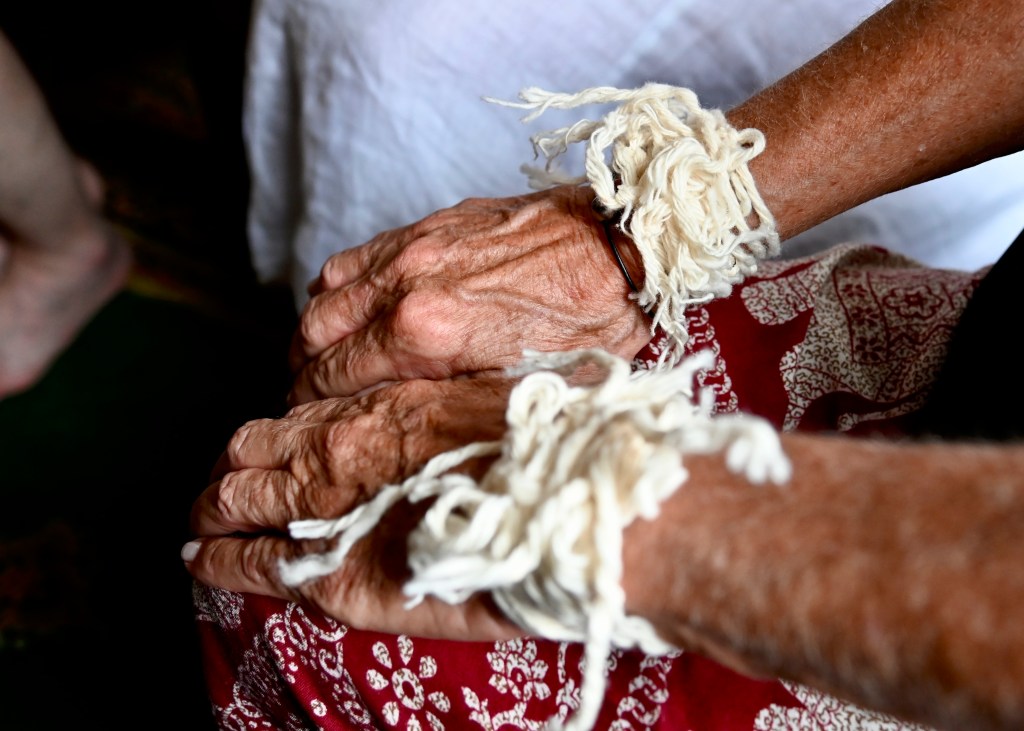
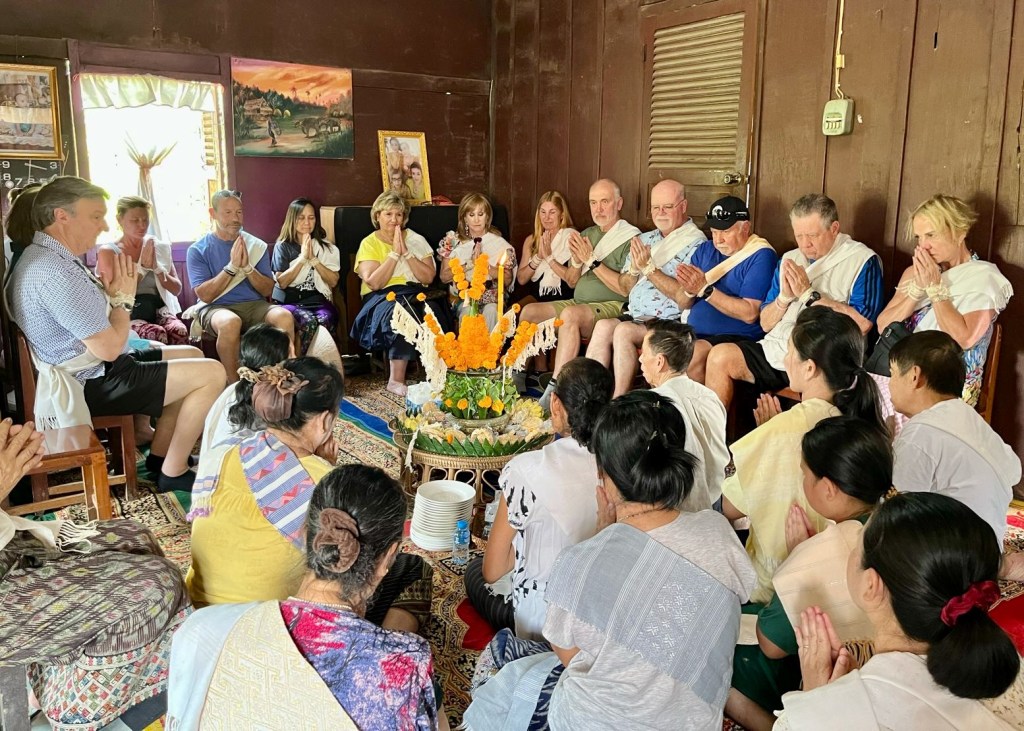
From there, we were off to our next morning treat, participation in a “baci” ceremony, a traditional Lao peoples ritual to celebrate important events and to provide blessings.  We gathered at the home of local couple, who had been joined by eight of their neighbors and a shaman.  The shaman led off the ceremony with some prayers, and then each of the ten individuals tied a small length of plain white cotton cord around both of our wrists, so 10 on each wrist, 20 in all.  We ended the ceremony by sharing bananas, rice cakes, and shots of “lau lau” – homemade rice wine, that burned as it went down.  We were to leave the cotton on our wrists for a minimum of three days, after which they could be removed (by being untied, not cutting them off).
Our time in Laos ended with lunch at a restaurant overlooking the Mekong, with local dishes and cold beer.  We then flew on to Bangkok, where I had my final dinner with this group of travelers.  As always, the low prices were stunning – there were 14 of us who ate dinner, shared eight bottles of wine and multiple cocktails and hors d’ouevres, for the unbelievable price of $61/person.  I enjoyed final cocktails with these friends at our hotel before I left the next morning for several days at my next location.

Days 7, 8, and 9 – Cambodian Temples

Cambodia.  We arrived here on April 10th, and we spent that afternoon, all of the following day, and the morning of the third day exploring the temples in and around Siam Reap.

It’s a country of about 17m people; before Pol Pot’s “cultural revolution” and the killing fields (I re-watched the film on the flight over), it had a population of about 7m and by 1975 that had been reduced to 4m, with 2m of the dead coming directly from Pol Pot’s reign of terror.  Today, about 50% of the population is below the age of 18.  You can feel the youth.

Our guide believes he was born between 1975 and 1979 – he has no birth certificate.  His early years were spent in a camp, and a woman who claimed to be his grandmother grabbed him out of it.  He knows who his birth father is (a Cambodian), but not his birth mother (he suspects she was Chinese, tho he does not want to take a DNA test), and he doesn’t truly believe that the woman who claimed him was his grandmother, as our guide said he is the only dark-skinned member of “his” family.  When the revolution ended, he was allowed to pick his name but his birthdate was assigned to him.  In school, he got to choose the language he wanted to learn, and he chose English, as he liked the way it sounded.  He said his generation is the last one to have arranged marriages, though that still probably exists among the hill tribes.  His military service was mandatory – saying that he was essentially kidnapped.

He has been a guide for more than 20 years, and told us stories of the early years, when he had to leave Cambodia to pick-up his groups in another country, strap US dollars on his body to bring money in (there were no ATMs) to pay for food, and transportation, and hotels, and travel 17 hours with his groups by un-air-conditioned pick-up trucks to cover 100 miles, since the roads were in such bad condition.

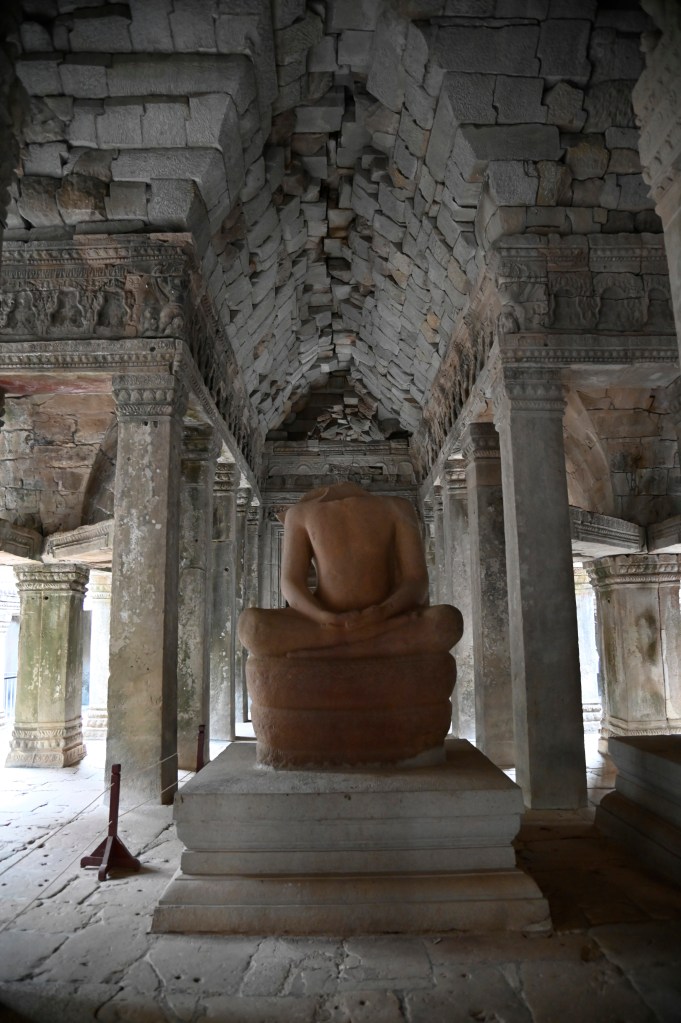
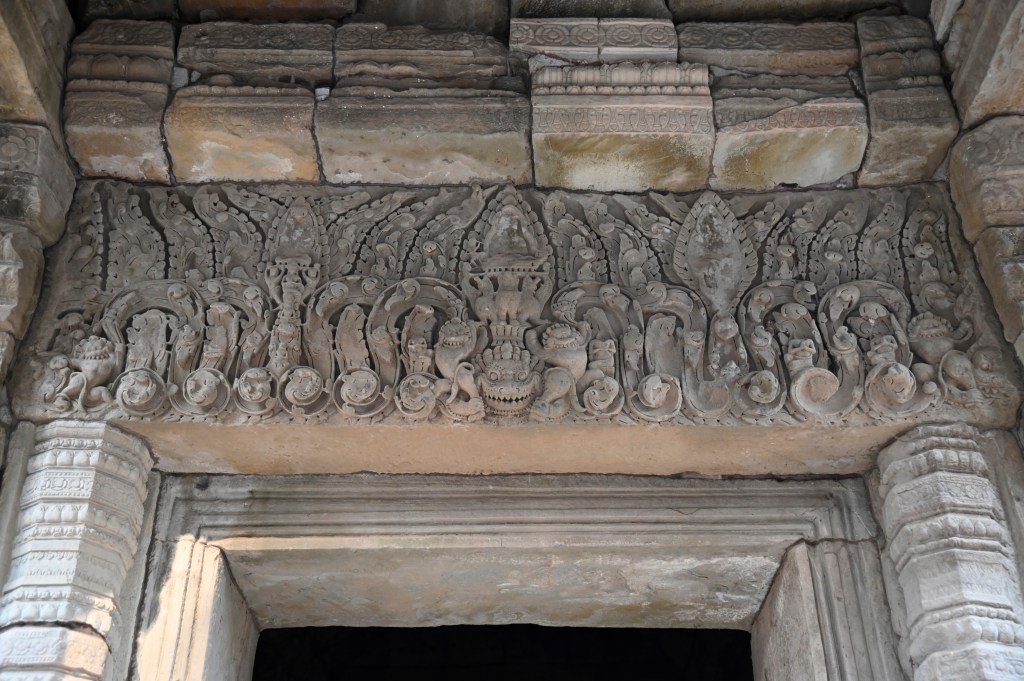
We spent our time in-and-around Siam Reap, which is nearby all of the Angkor temples, including the most famous, Angkor Wat. Angkor means “kingdom” or “city,” and it was the capital of the ancient Khmer Empire, which flourished from the 9th to 15th centuries. At its height, it’s estimated that it hosted as many as 1m people.   The numerous temples that are nearby usually were built by a king to honor . . . himself!

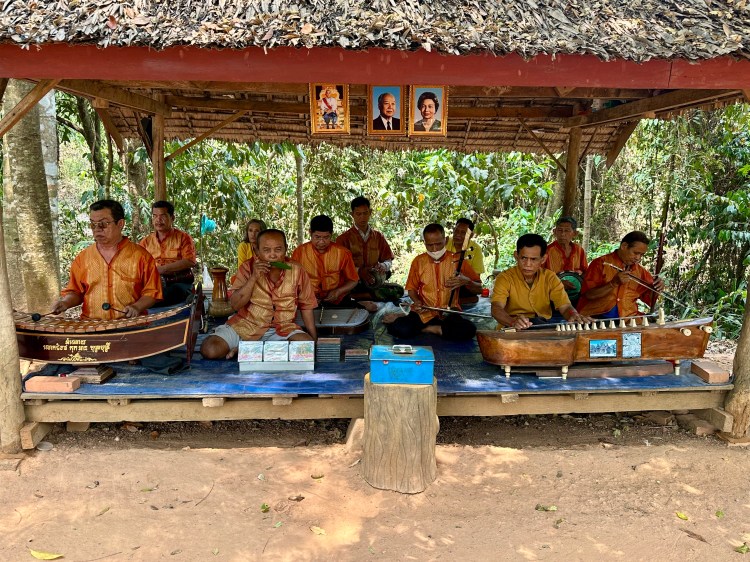
Siam Reap itself is the second largest city in the country, with about 250,000 people; Phnom Penh, the capital (which we did not visit), is the largest at about 2.3m. Of course, Cambodia was terribly bombed during the Vietnam War and today there are still 3m-4m unexploded bombs, which still kill and maim people, children especially.  Today they claim 3-4 individuals per month, a tragedy, but much lower than in the past when it was 6-8 people per day.  Clearing them is very time consuming and terribly expensive – around $350 for each cluster bomb, with larger bombs being more expensive to clear.  We listened, outside one of the temples we visited, to a band made up of adults who had been injured – blinded, missing limbs – by unexploded ordinance (“UXO”).

One of the other local issues faced by the people near Siam Reap is the lack of clean water and plumbing, even as close as 10km to the city center.  That means no running water and no indoor bathrooms, which leads to disease among children and families.  There are a number of non-profits focused on addressing that issue, and we visited one family that is getting relief from a NPO that provides wells, pumps, and filters to about 1,500 families; this one now has a well from which they extract clean water that they use for agriculture and cleaning, and which they then filter for drinking and cooking.

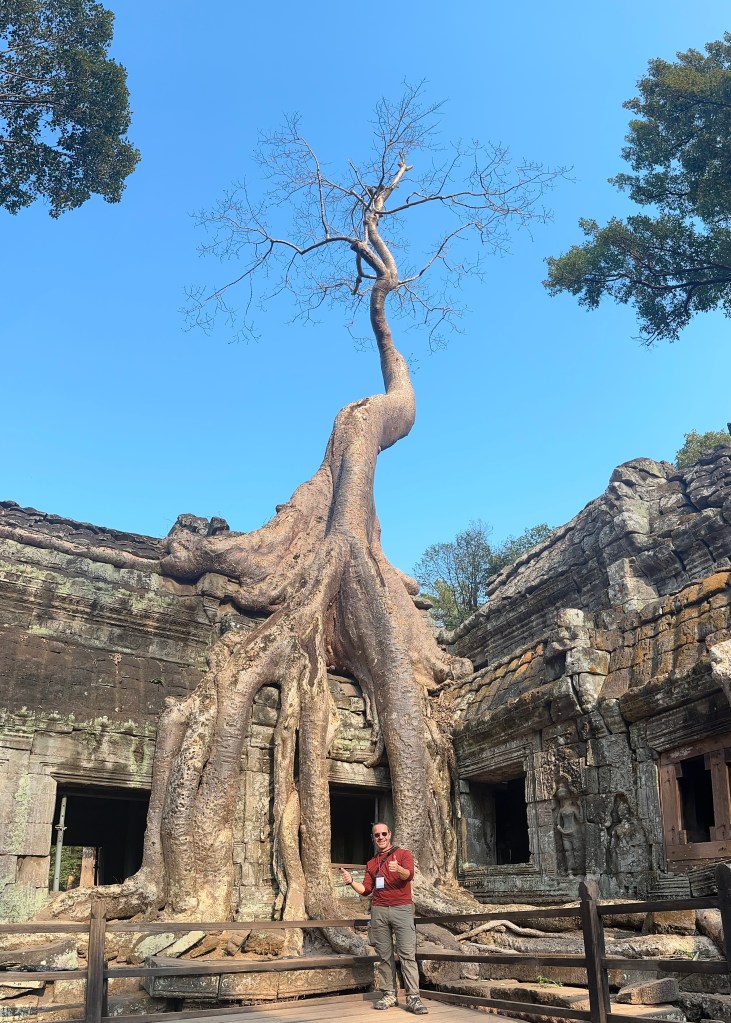
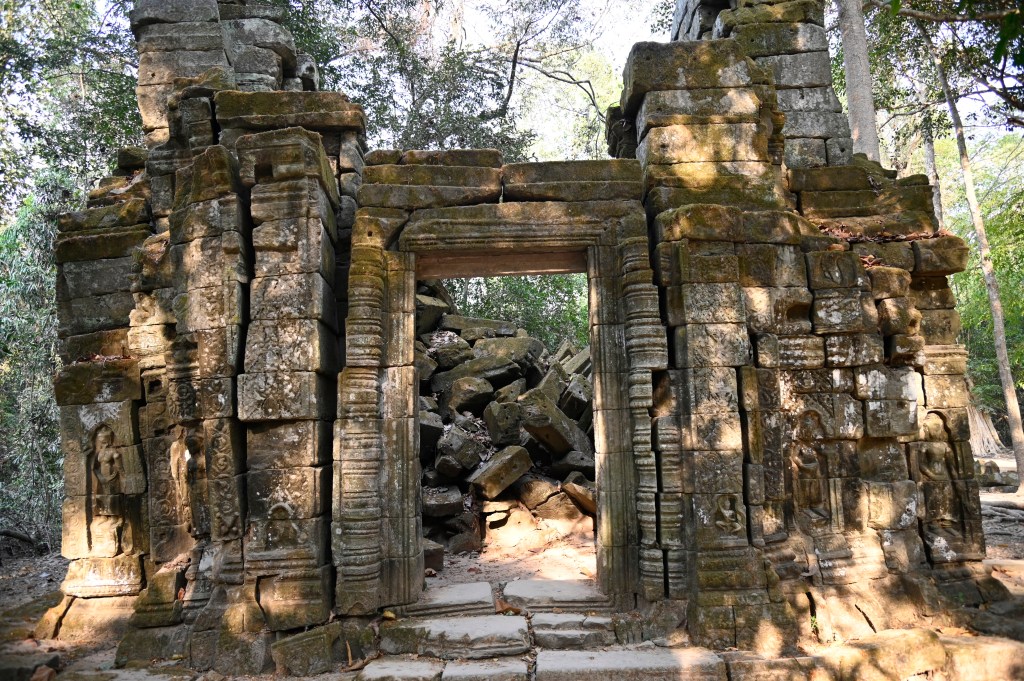
Over the course of our time in and around Siam Reap, we visited four temples:  Angkor Ta Prohm (on our first day), Banteay Srei and Angkor Thom (on our second day), and – on our last day – Angkor Wat.  Our guide told us that pre-COVID, the area could get as many as 10,000 – 12,000 tourists per day (lots of Chinese tourists, given its proximity), but now that number is down to about 2,500.  Banteay Srei is quite small and, if the old crowds return, it is likely to be closed to avoid further damage.

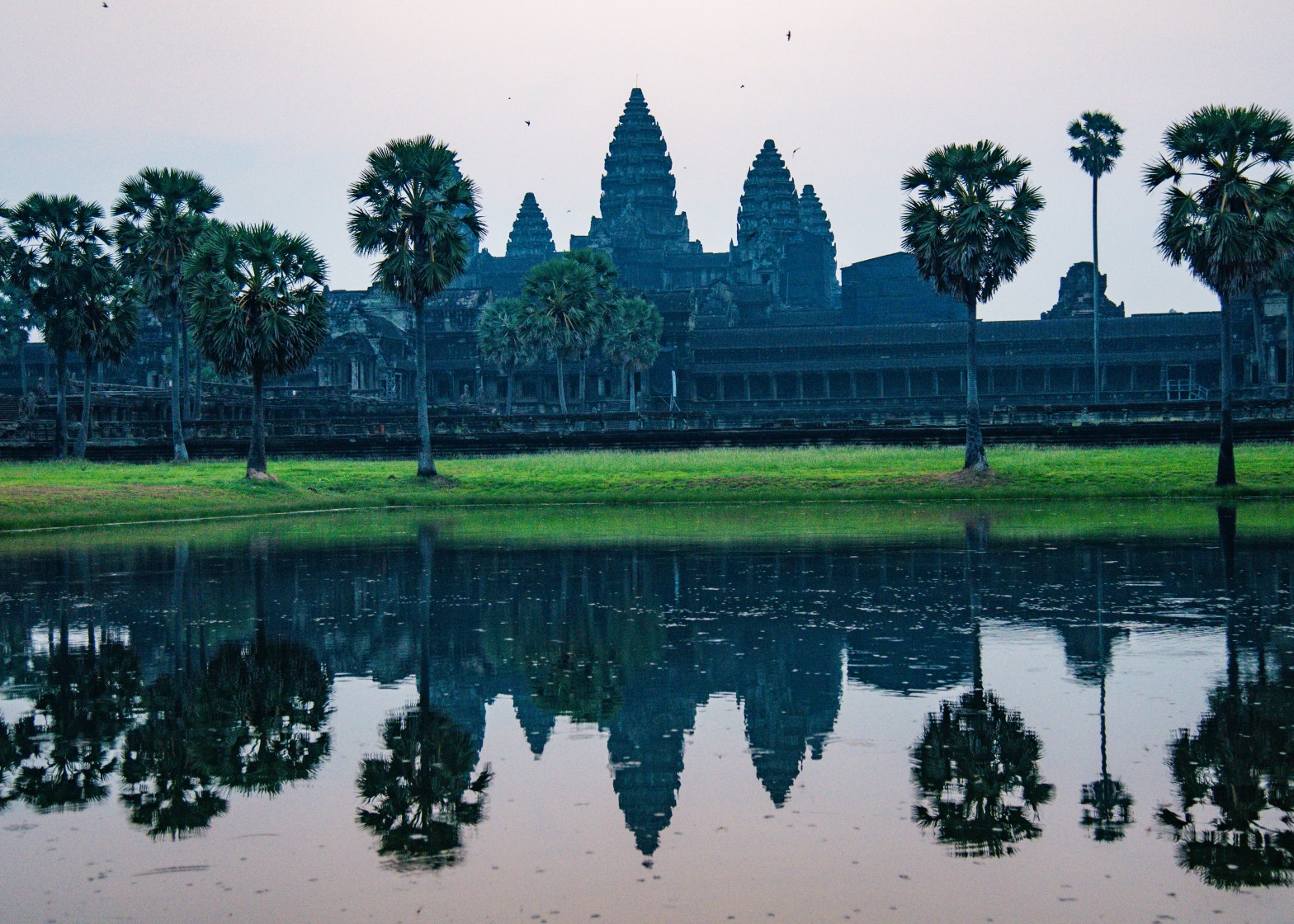
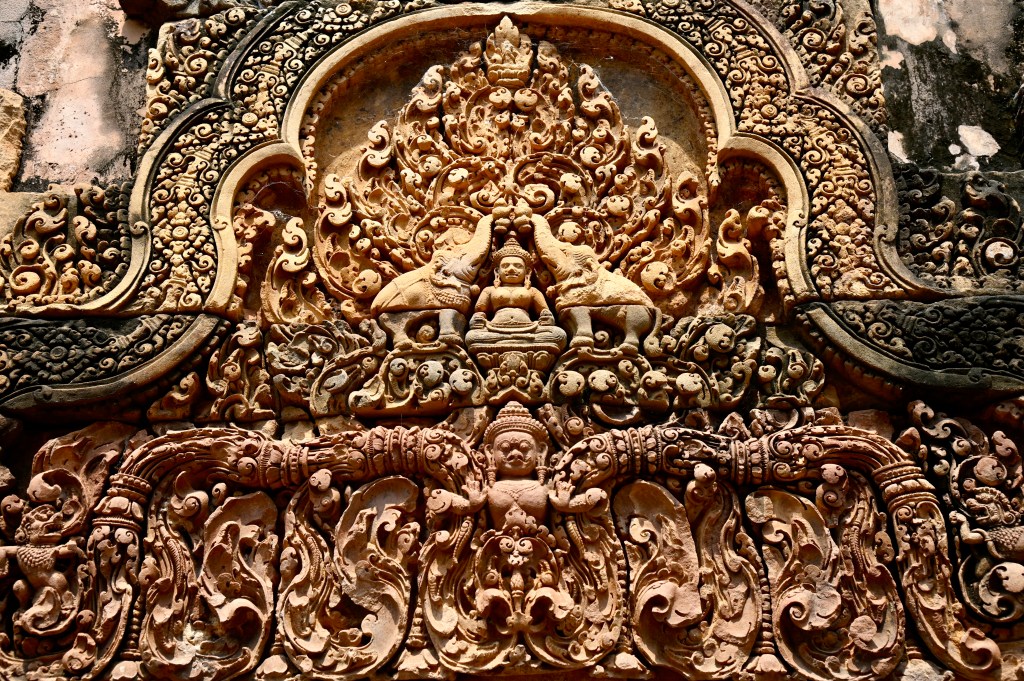
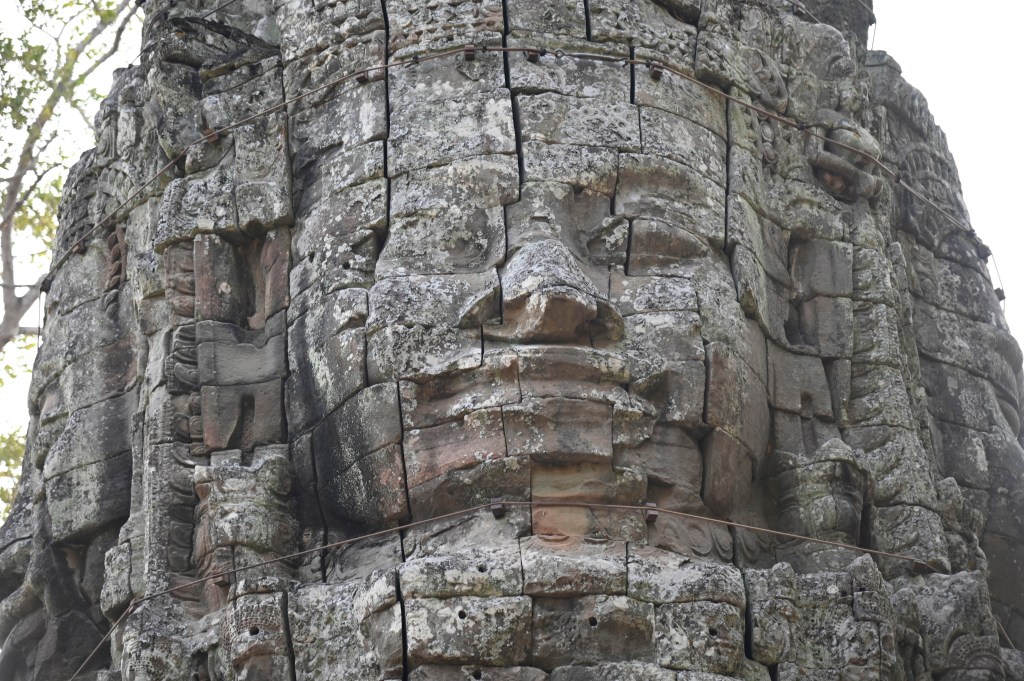
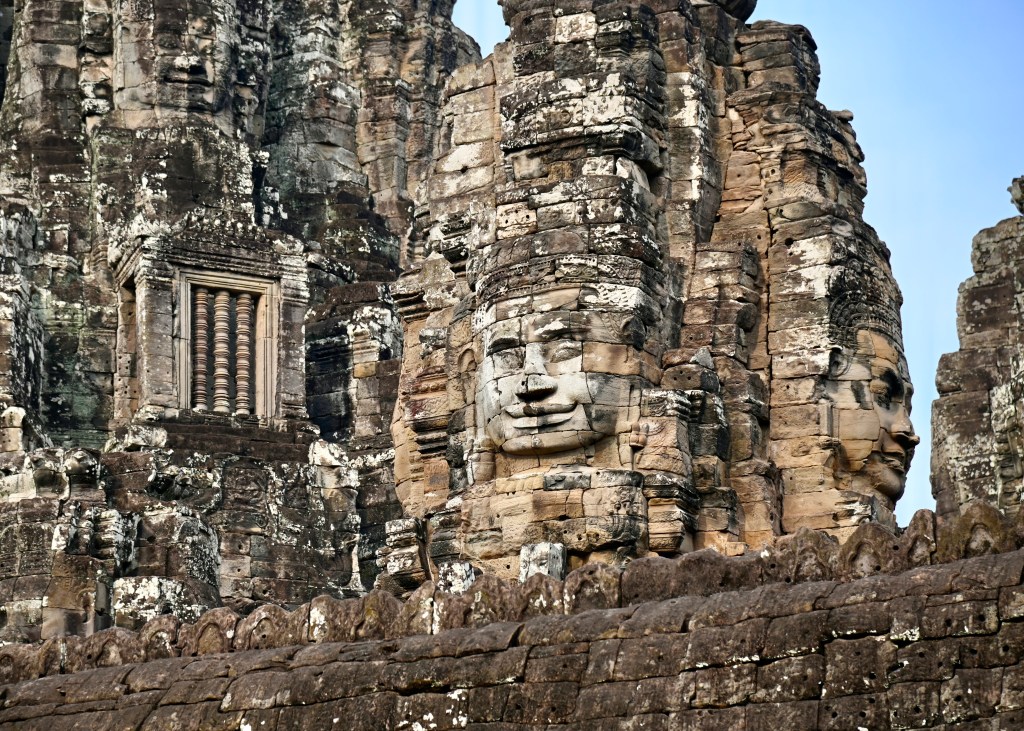
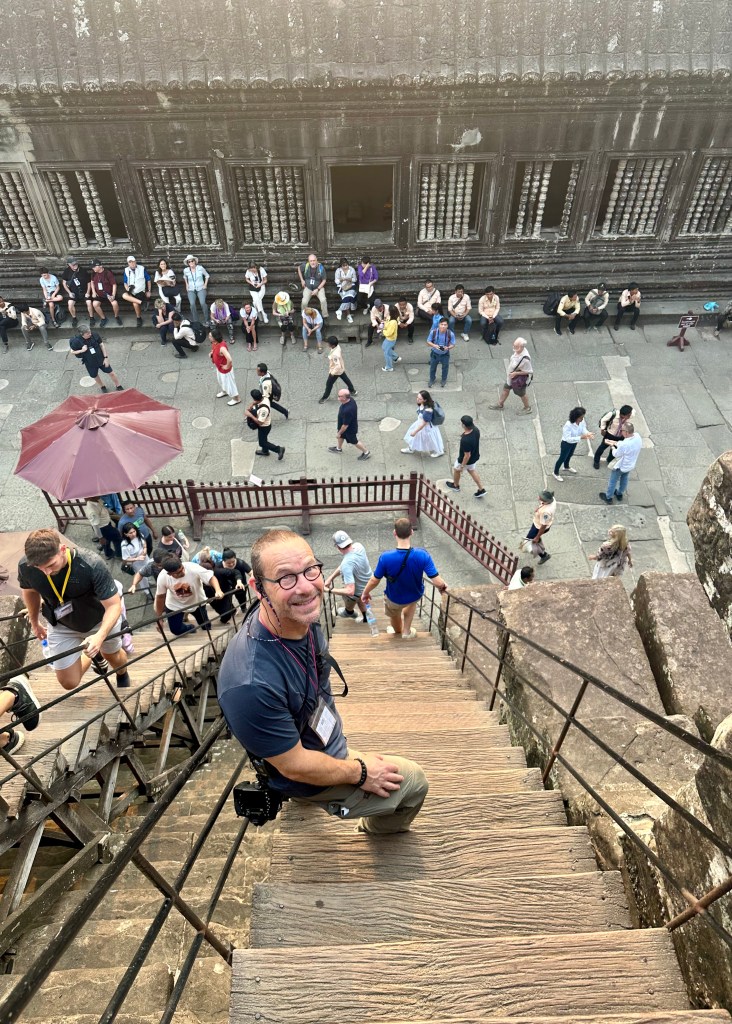
Ta Prohm is beautifully haunting because of the way in which fig and kapok trees have latched onto and twisted and grown to huge heights around its walls.  Banteay Srei is also known as the “Citadel of Women,” due to its numerous and detailed carvings of feminine deities.  Angkor Thom is quite famous because of the more than 170 faces built into the stone towers.  We approached Angkor Wat by tuk tuk pre-dawn so we would be there at sunrise (though it was more cloudy than sunny).  The crowds watching the temple from behind a moat reminded several of us of golf fans watching the Master’s from behind a water hazard.

I’d be remiss if I didn’t mention how darn hot and humid it has been during our entire visit to Vietnam, Cambodia, and our next stop.  We purposefully and usually spend early afternoons after lunch not doing much to try and avoid the sun at its highest.

Our visit coincided with preparations for the New Year celebration, which meant we saw streamers and flags and signs going up around town for the 3-day celebration.  When we visit our next destination, it’ll be during the celebration.

Day Six – Vietnam War-era Tunnels and an Exhilarating Saigon Experience

Not a tale of two cities, but a tale of two completely different experiences in Saigon.

Our morning was spent visiting the Cu Chi Tunnels, about 1 3/4 hours outside the city.  This is a sequence of over 75 miles of tunnels that date to the French War and that were used extensively by the Viet Cong during the American War, especially given their proximity to Saigon, when they served as a base of operations during the Tet Offensive in 1968.

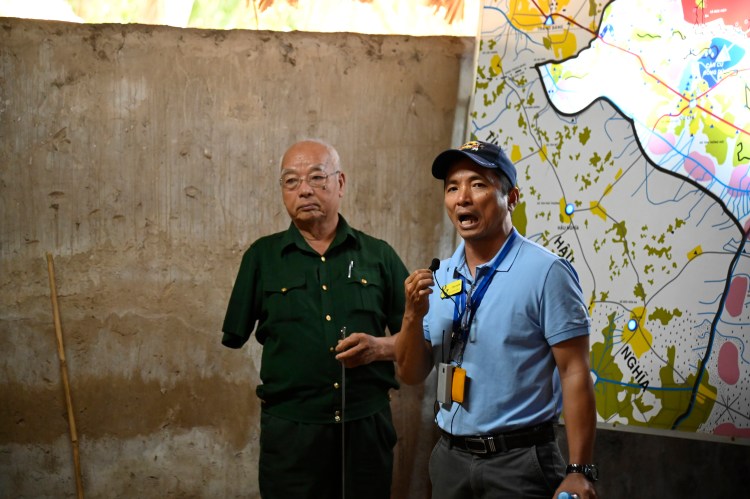
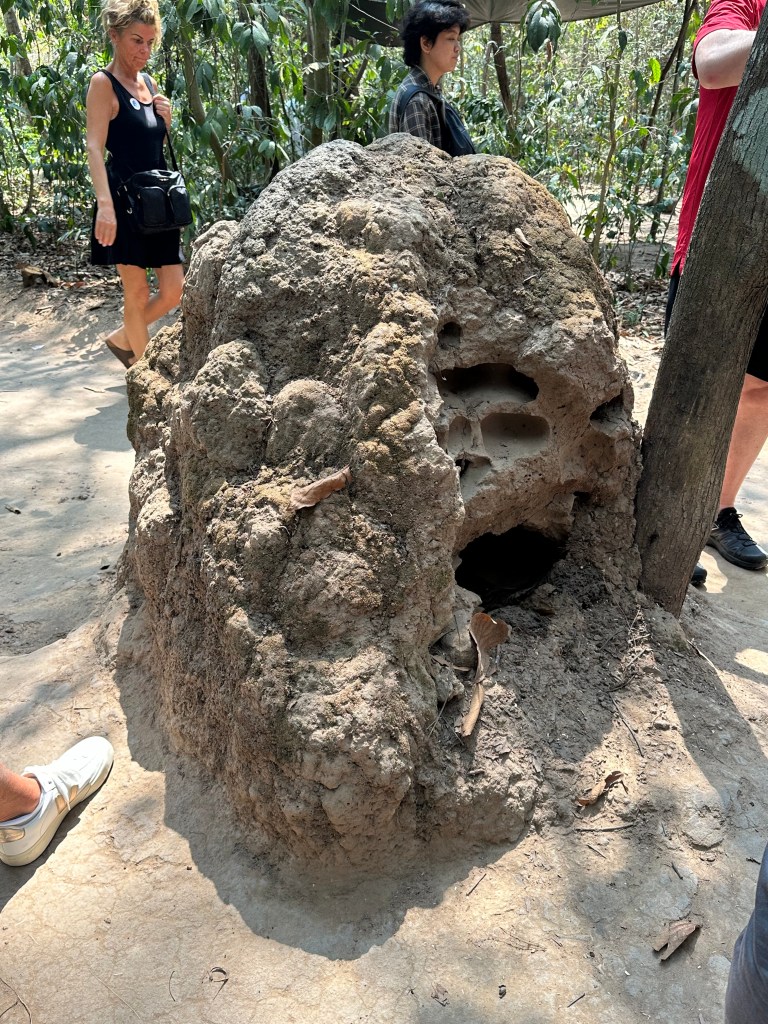
We had a chance to first meet with a Viet Cong veteran, a now older gentleman who was missing his right arm below the elbow.  He didn’t speak any English, so our guide translated his description of his upbringing in the town of Cu Chi and his joining the Viet Cong at the age of 16.  He pointed out on a map the territory in and around the tunnel complex, explained the history of the tunnels, and which areas on the map were (primarily) controlled by the South Vietnamese army vs. the Viet Cong.  He then explained how the tunnels worked and what they were used for – sleeping, cooking, storing arms and ammo.  He explained how ventilation worked – using termite mounds above the service – showed where booby traps might be placed in the event enemy troops got into a tunnel, how the tunnels could be blocked in the event enemy troops tried pumping them full of poison gas or water.  Generally, the tunnels were three levels deep, with the arms and ammo stored at the lowest level so that they wouldn’t be impacted by bombing on the surface.

He answered a few questions – he lost his arm as a result of an M16 hitting it, and answered “no” when I asked if he’d killed any enemy troops, but our guide later said that that undoubtedly wasn’t true:  he had a choice of killing or being killed.

Life in the tunnels was brutal – dark, wet, filled with bugs and snakes and sickness (mostly malaria), and the people that spent their time below the surface really only came out at night – to scavenge and go to the bathroom.  

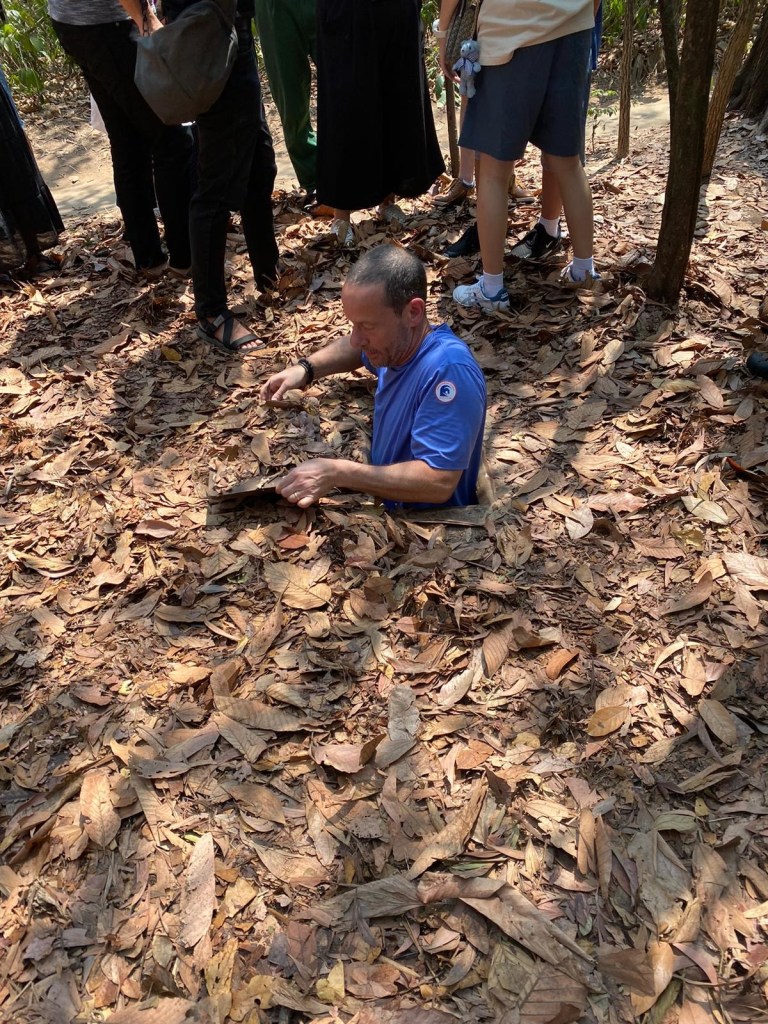
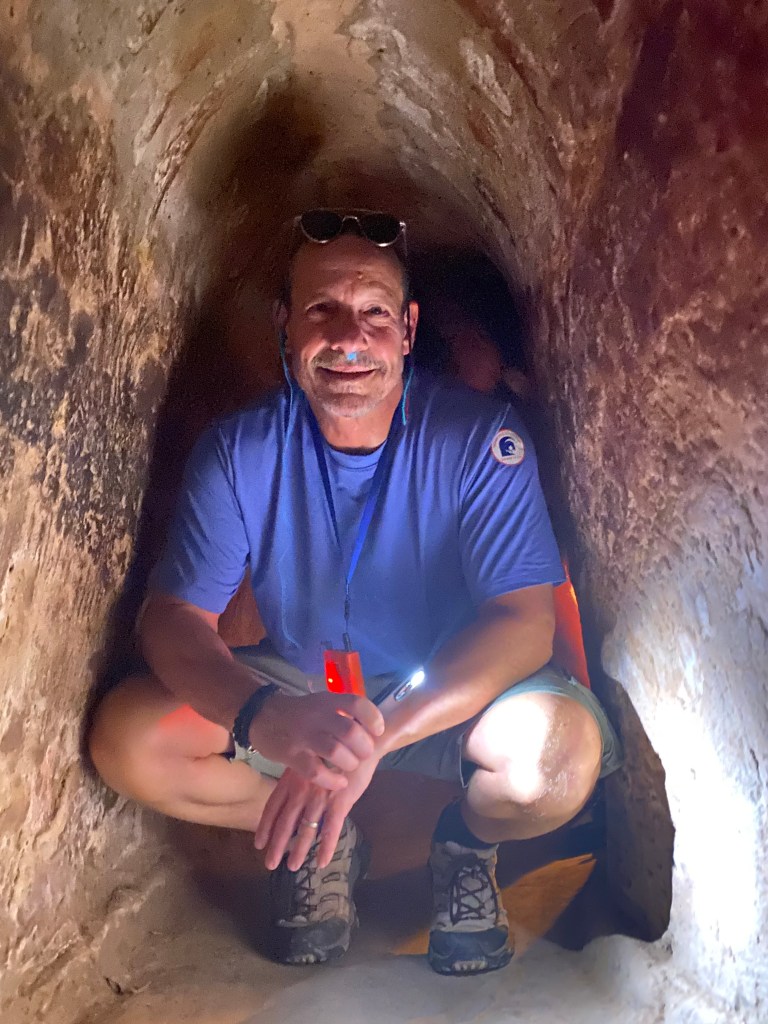
After that we had a chance to explore the exhibits that explained more about the tunnels and how the Viet Cong engaged with the enemy.  Displays of booby traps, bunkers where weapons or sandals or rice paper were made, termite mounds so we could see the ventilation, what a tunnel entrance looked like, the remains of the crater from a B52 bombing.  And, as well, the ability to enter one short – maybe 60 yards – tunnel where you either crawled or duck-walked in almost complete darkness to get through.

Also on the grounds is now a shooting range, where for a fee you can try to fire an M16 or AK47 rifle.  As we walked around the tree-lined and dirt-pathed complex, you could hear the gunfire from the range.

The whole experience was eerie and sobering and saddening and maddening.  The description we heard of the Viet Cong soldiers was “bare feet, wills of iron.”  We had a quiet ride back to the city.

Make sure your sound is on for this video

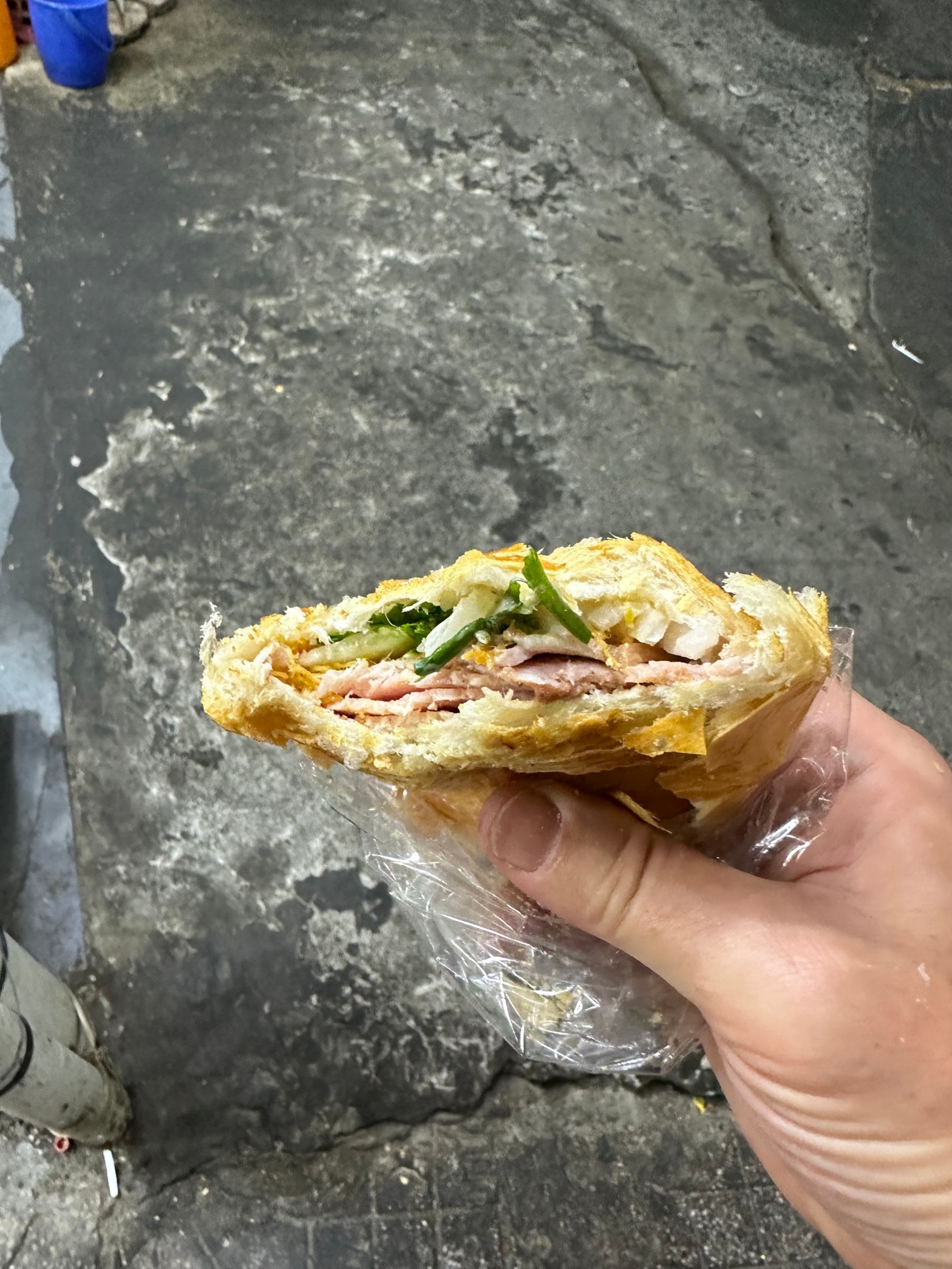
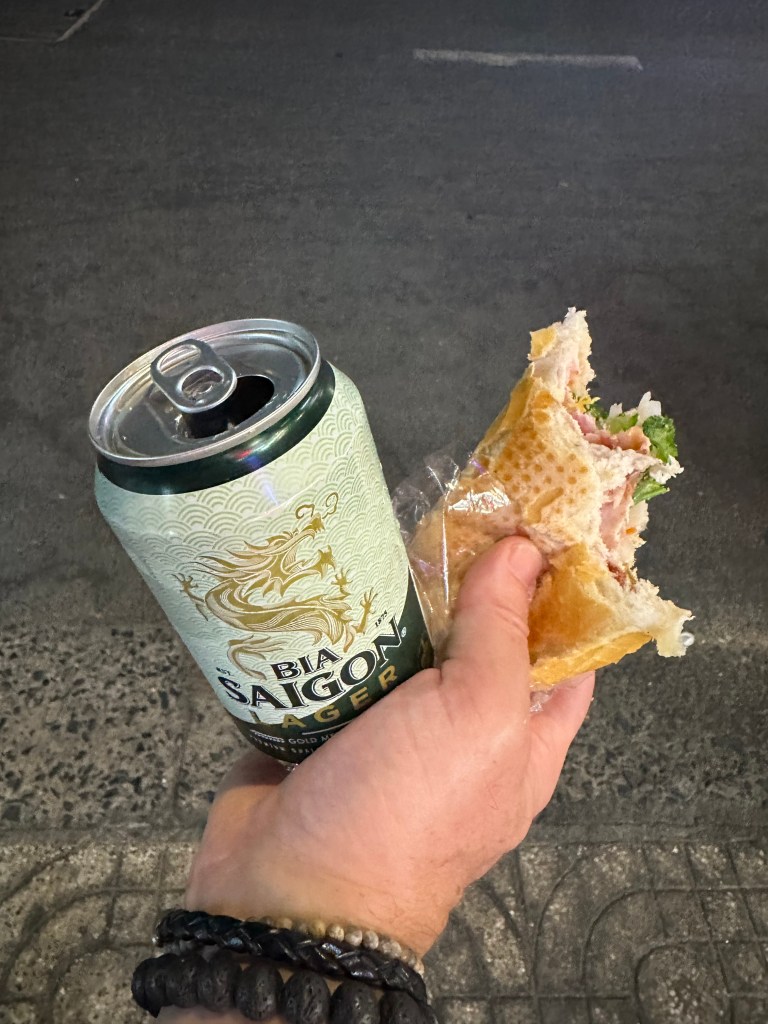
A few of us took a short walk around the city after lunch, with a chance to taste our first street-made Banh Mi sandwich and then, at a different stop, a traditional Vietnamese dessert, before some time to ourselves.

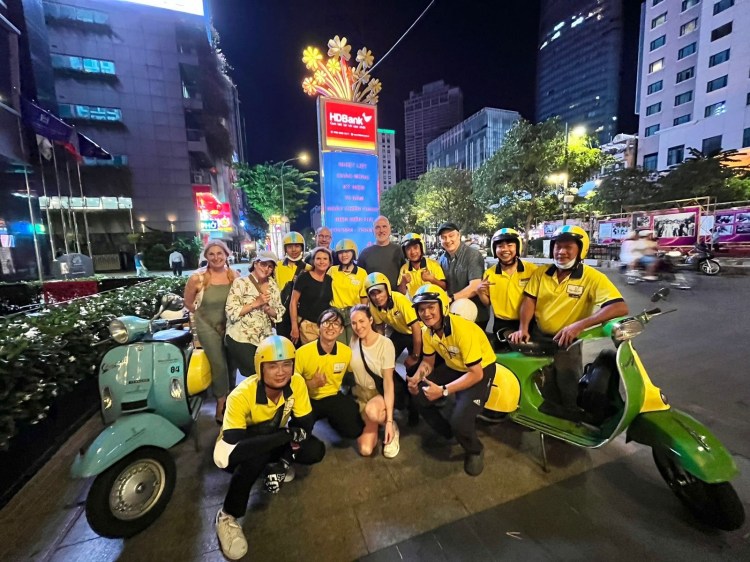
And then our evening activity:  tooling around the city at night on vintage Vespas!

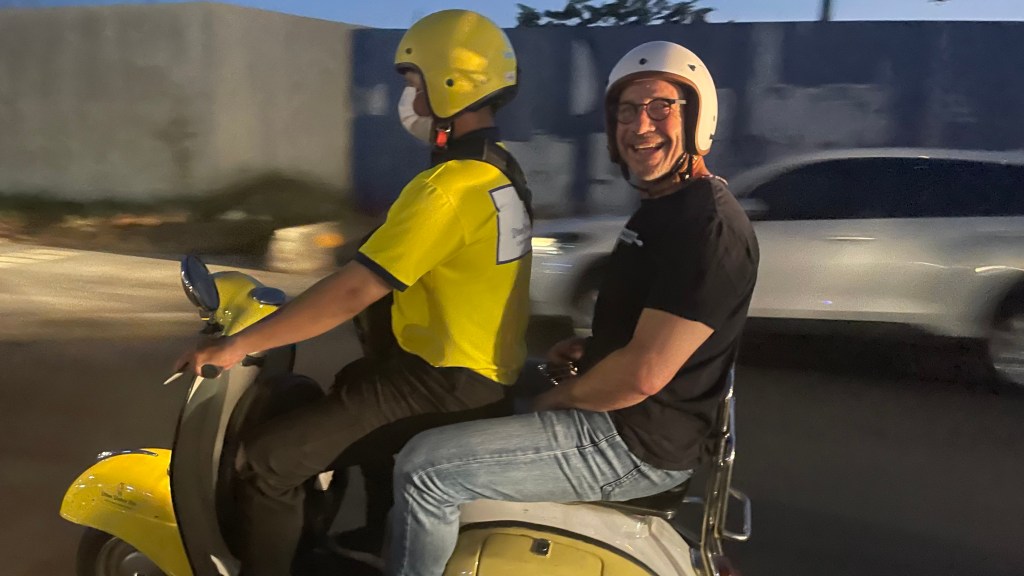
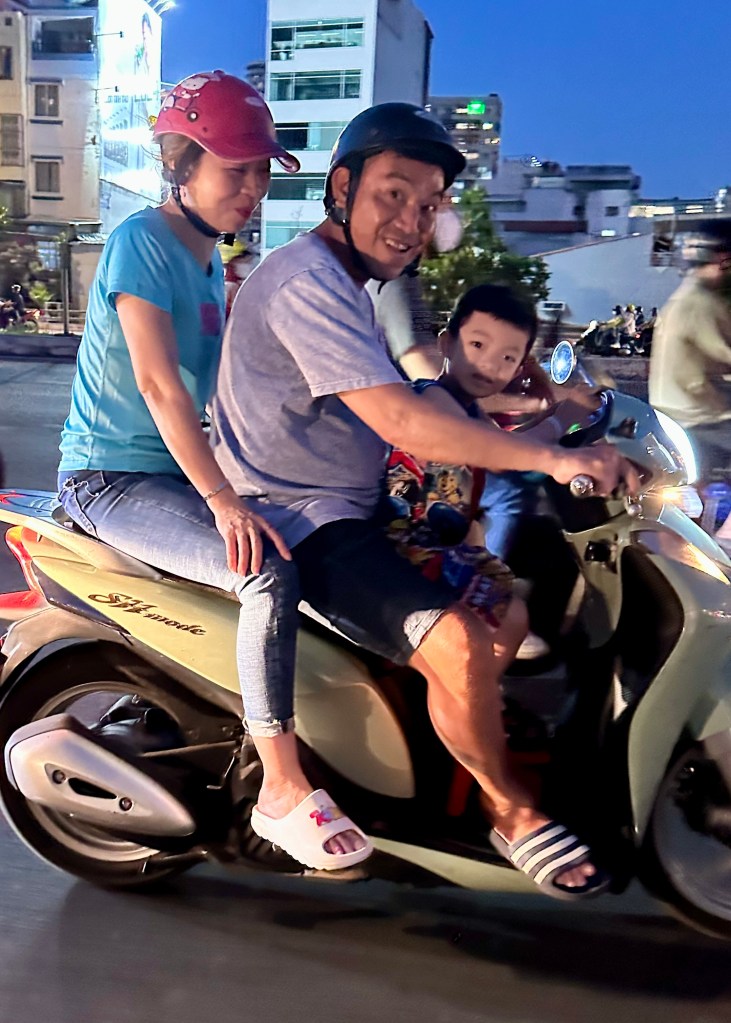
It is almost impossible to describe how exhilarating this was.  Just me and my driver (both wearing helmets) buzzing around, winding in and out of traffic, going through quiet alleys, past little store fronts and people sitting outdoors at cafes and restaurants.  Crossing the river, first in one direction and then in another, seeing the bright lights on the new and not-so-new skyscrapers, the wind wizzing by us, and greeting other motor-scooter riders along the way, negotiating for space at a stop-light, turning into a busy lane of traffic.  We saw a kite festival along the river.  As I told our guide, if this was New York City, people would be giving each other the finger and yelling at each other, but here it all just works.

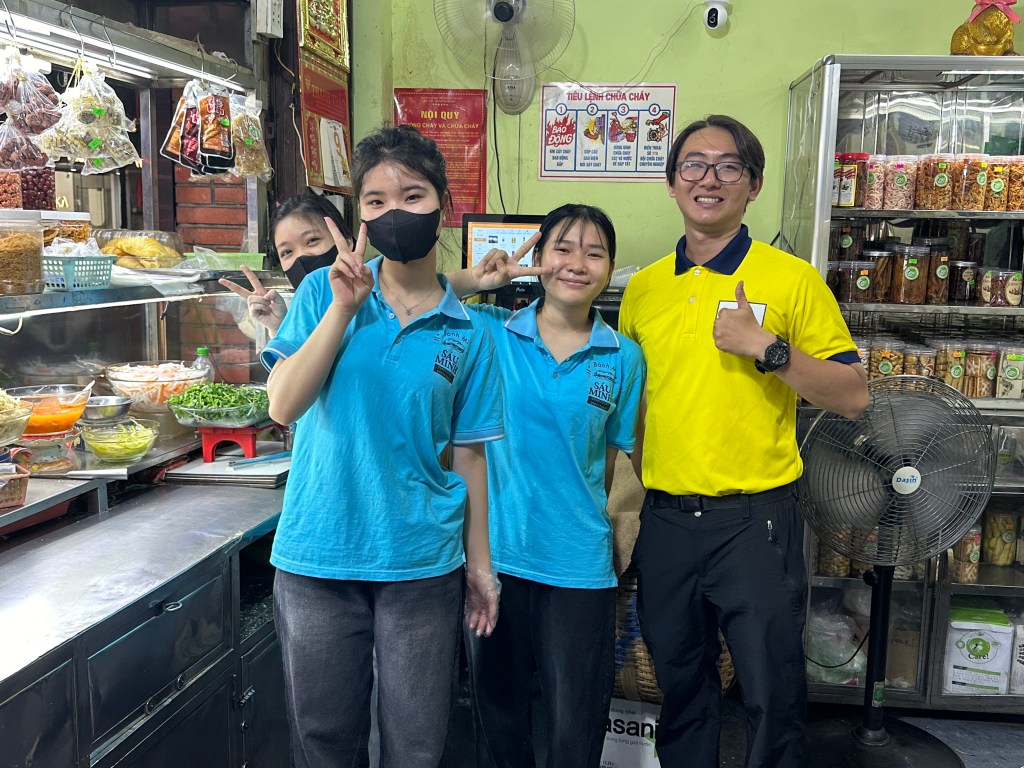
We made a few stops along the way – after driving for about 30 minutes, we first stopped for a drink at an outdoor rooftop bar, with great views of the city.  Then we rode further to a street-side stand that remains open 24/7/365 (even during Tet) for their famous Banh Mi sandwiches (I had two) and a beer, while just hanging out on the sidewalk.  We rode further along to our next stop, for a meal of a variety of seafood dishes and beer at an outdoor restaurant, sitting on the commonly seen small chairs.  Riding again, we went to our last stop, a bar with live music performed by a 7-piece house-band and a variety of singers.  And finally, riding back to our hotel.

It was over four hours of just a fantastic experience.

This was two visions of Saigon:  brutal stories of the Vietnam War, from over 40 years ago, contrasted with a vision of Saigon in the 2020’s – a modern vibrant place.

Day Five – Immersion in Saigon

It was a relatively early morning in Saigon when we took our rickshaw ride to see how the city wakes up; the population seems to be somewhere between 10m and 15m (it was about 3m in 1975 when the Vietnam War ended), making it the largest city in the country, with something like 6m scooters/motorbikes.  The old name is Saigon, which apparently the majority of Vietnamese still call it, though the official name is Ho Chi Minh City, a change made in 1976 not long after the unification of North and South Vietnam.

Like everyone we’ve had a longer conversation with, our guide – about age 49 – has a Vietnam War story.  His father fought for the North Vietnamese, signing-up at age 16. His uncle on the other side of the family – his mom’s brother – fought for the South Vietnamese and, after the war, was in a re-education camp for nine years, and he eventually moved to the States.  Meanwhile, his father joined the community party, but then rejected it after all that he had seen during and after the war.  Our guide told us that he grew-up poor, like much of the country; that when young he had to wear clothes that his mother made out of her own old dresses.

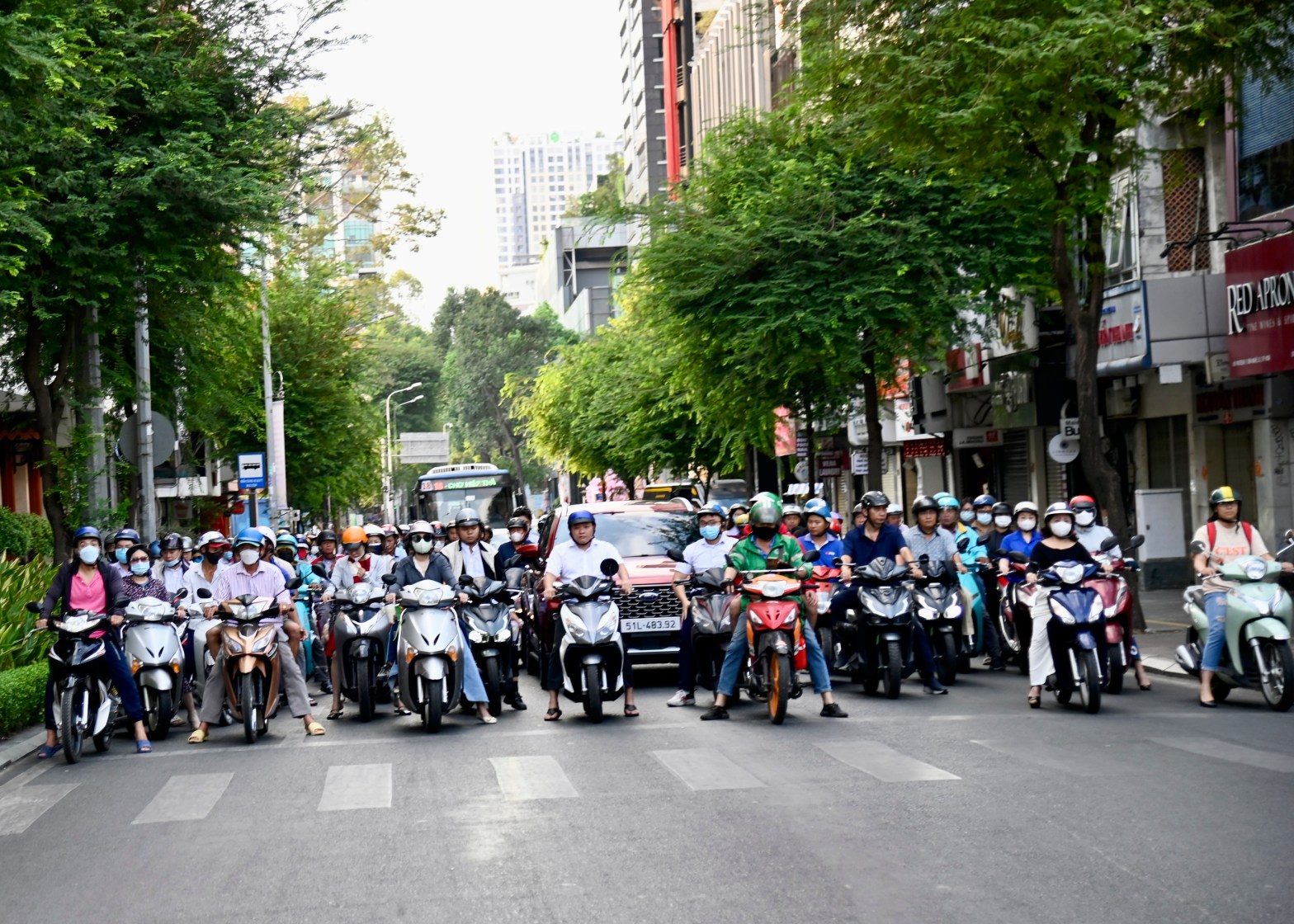
Today, though, we saw a loud and boisterous Saigon, even at 7 a.m. as we tooled around the city.  Like Hanoi, the number of motorbikes and scooters and vespas is mind-boggling and far out numbers the number of cars.  Men, women, duos, and even families of three or four squeeze onto the bikes and the traffic just ebbs and flows.

Our ride took us to a local park, where we saw people exercising – running, stretching, doing Tai Chi, dancing – and people just relaxing and having coffee while it was still – at around 85 degrees – relatively cool.  We stopped at a cafe in the park for some Vietnamese coffee – traditionally made with condensed milk, making it a sweet cool treat at that hour.

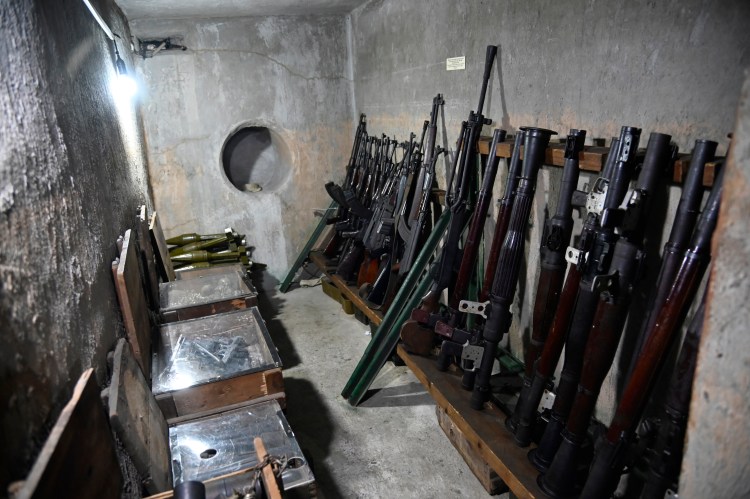
From there we headed to an alley, where shops and stands were set-up; directly across from he woman selling whole (dead and plucked) chickens was the site of a small former weapons bunker, well hidden below the tile floor, where guns and rocket-launchers and ammo had been stored by the Viet Cong for the Tet Offensive in 1968.

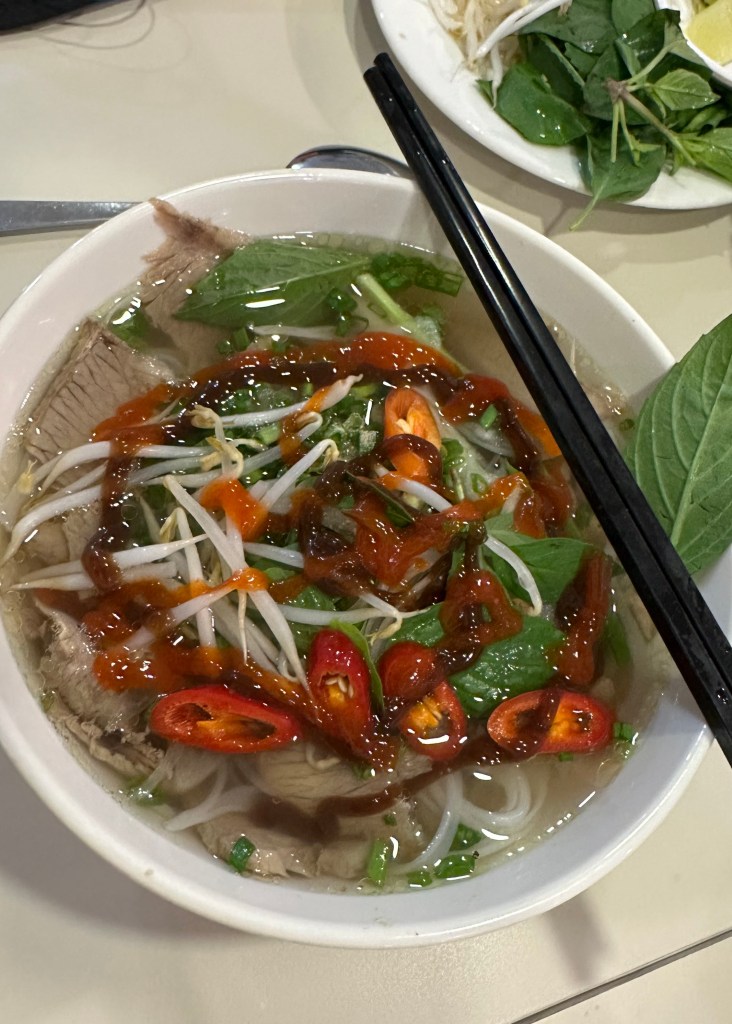
It was then time for breakfast and we headed to a restaurant for pho, the well-known and traditional Vietnamese noodle soup with chicken and pork, which is frequently eaten early in the day.  The joint we went to had pictures of Bill Clinton on the wall, as he’d eaten there when he visited in 2000.  I asked our guide if Clinton also had used the bathroom there cause, you know, I wanted to go where Bill and gone.  Turns out this wasn’t the EXACT location where Bill had been – the owner had moved the restaurant to a different spot since Clinton’s visit.  Regardless – delicious broth, some noodle slurping, a decent out of heat courtesy of some fresh chilis and sriracha sauce.

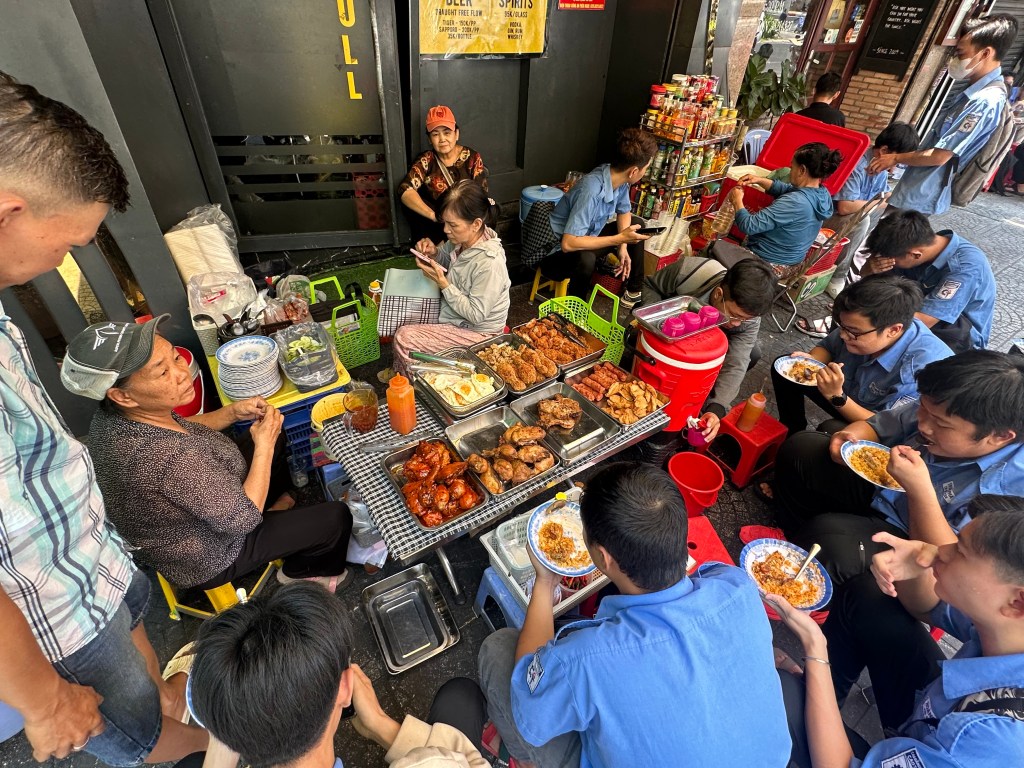
We had a bit of a break, some I walked with some friends to a local chocolate shop, started by a couple of French guys a number of years ago who wanted to exclusively use Vietnamese-grown cacao beans.  I learned about the shop in the Saigon episode of “Somebody Feed Phil,” and, as one of the founders said, all they had to do was learn how to make chocolate.  At the location we went to, they roast and grind the beans, then make a wide-variety of stuff – hot chocolate, ice cream, chocolate bars, chocolate candies, cakes, and bars.  I opted for the chocolate milkshake with broken cookies.  Wicked good.  Chocolate rush.  Sugar crash.  The walk back to the hotel gave us a chance to see street-life around 11:30 a.m., with a number of school-going teenagers out for lunch at street-side restaurants and coffee shops.

We had lunch at a restaurant about 30 minutes outside of where were where we got a demonstration on how to make Vietnamese pancakes stuffed with shrimp and pork and veggies – kind of like a small omelette – before we headed back into the city.  This was our chance to see the old French-colonial era post office, but, as well, a number of landmarks from the Vietnam War ear.

We first drove past the old US Embassy, which is now a consulate, as the Embassy has relocated to the capital city of Hanoi.  As we drove around, we continued to see a mix of old and new Saigon – street level shops in old buildings, narrow alleys and street-side vendors, and large modern office towers and apartment buildings. After the war, the economy suffered terribly – the money across the country was changed, each family only got the equivalent of $2,000 American dollars when they transferred their money (regardless of how much money they had before hand), rations and supplies were handed-out based upon a coupon system, with the value of your coupon based upon whether you were a member of the party or not and, in the case of children, their age.  After the US embargo was lifted, however, the economy has boomed and virtually all we saw has been since 1995.

The colonial-era French post office sits a few hundred yards away from the building that once housed the US CIA headquarters; it was the roof of this building (not the US Embassy, as was mis-reported) where the famous photograph shows people being evacuated during the Fall of Saigon in 1975.  In front of that building today sits a coffee shop; nearby there’s a Tumi luggage store, and behind it towers a modern office tower.

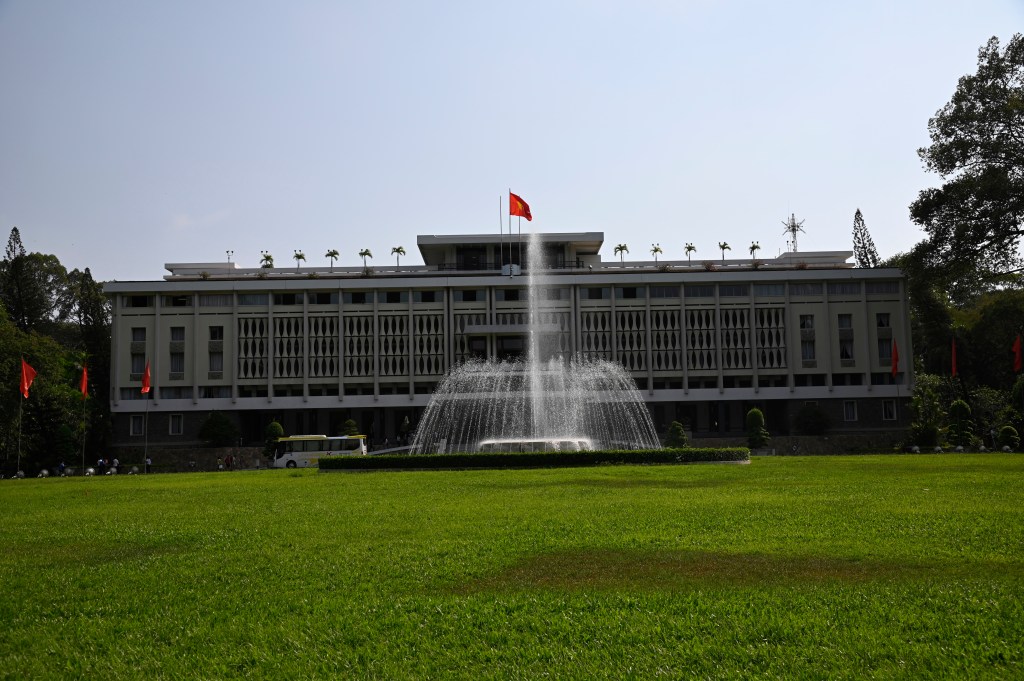
By now the outside temp was around 100 degrees with high humidity, and we were off to visit the old presidential palace which, after unification, became the Reunification Palace.  The air conditioning – to the degree it existed – wasn’t on, and most of our tour was on outer unenclosed walkways anyway, and we had a chance to visit the underground bunker that housed offices, a huge kitchen, and communications equipment.  Parked outside on the lawn were Vietnam-era tanks and a fighter jet, as this was where a North Vietnamese tank crashed through the gates Saigon Fell.
Our last stop of the day was at a temple for the Cao Dai religion; during the period from 1975-1986 religion was banned here, but now there is significant freedom of religion, though something like 40% of the population say they have none. Buddhism is dominant at 38%, followed by Catholicism at 8%, and after that its a smattering of other stuff, including this localized religion which was founded in 1926.

While we are all incredibly curious about the Vietnam War and its era, the Saigon we see is a very different place.  As our tour guide said numerous times, “OMB” – “Oh My Buddha” – when he compares the Saigon of today with the one of 50+ years ago.

Days 3 & 4 on Ha Long Bay

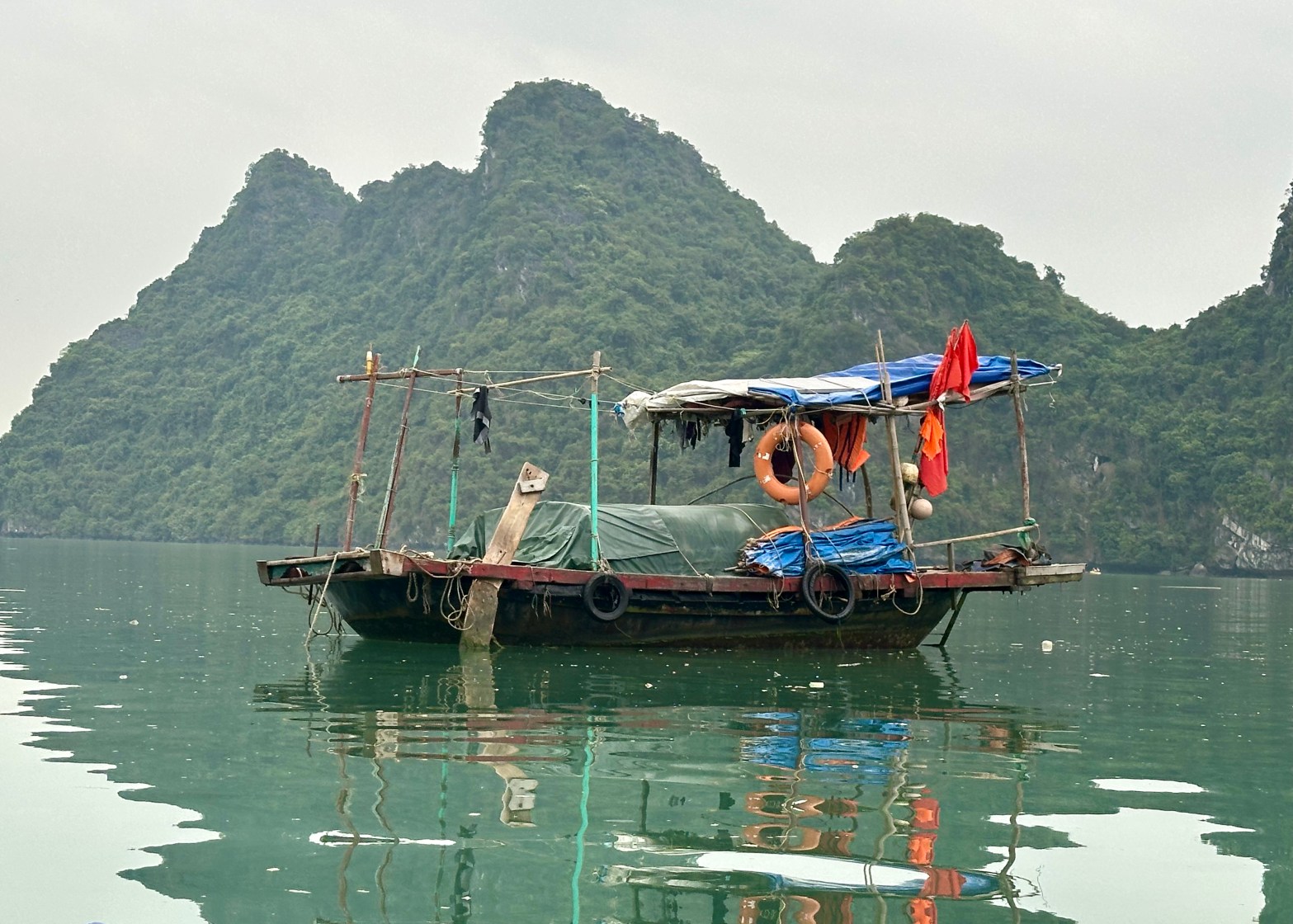
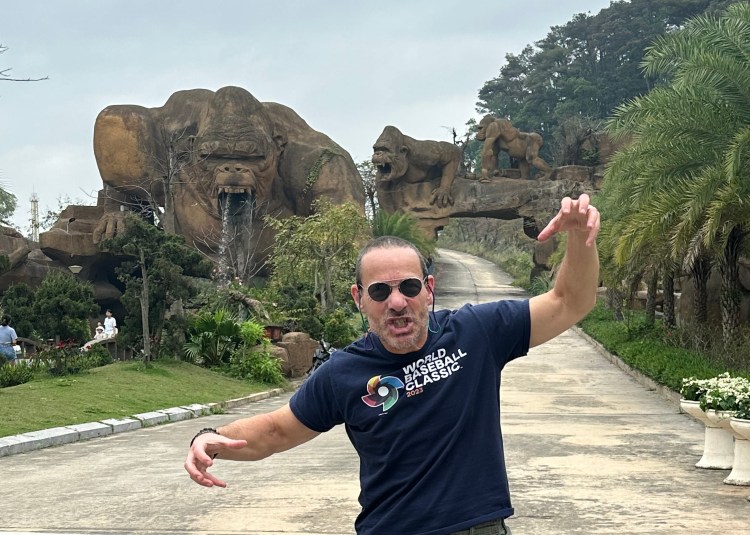
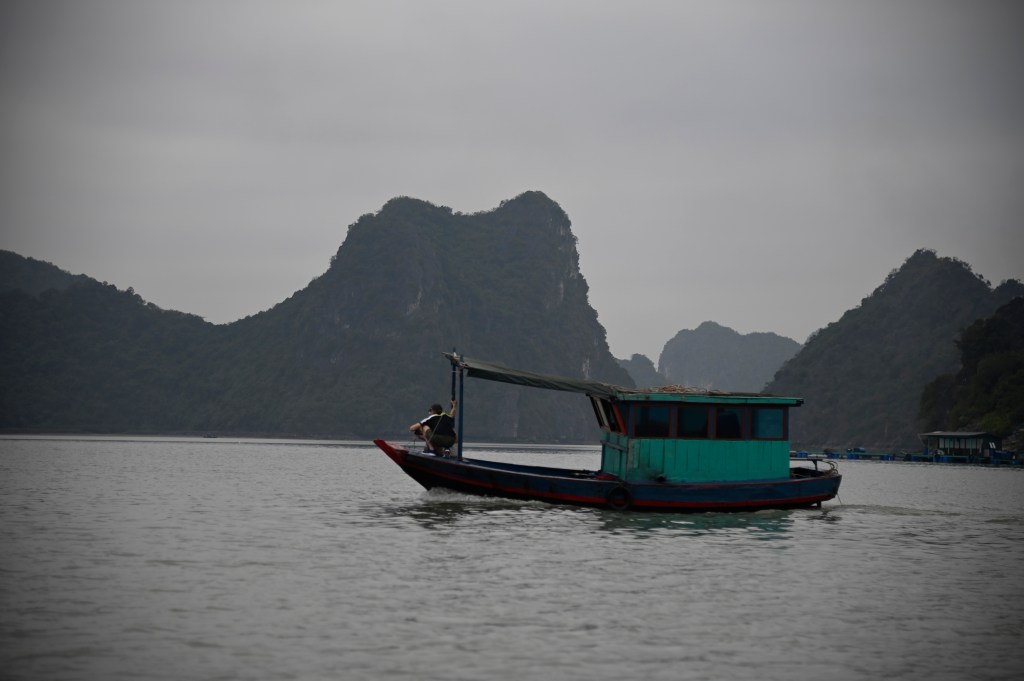
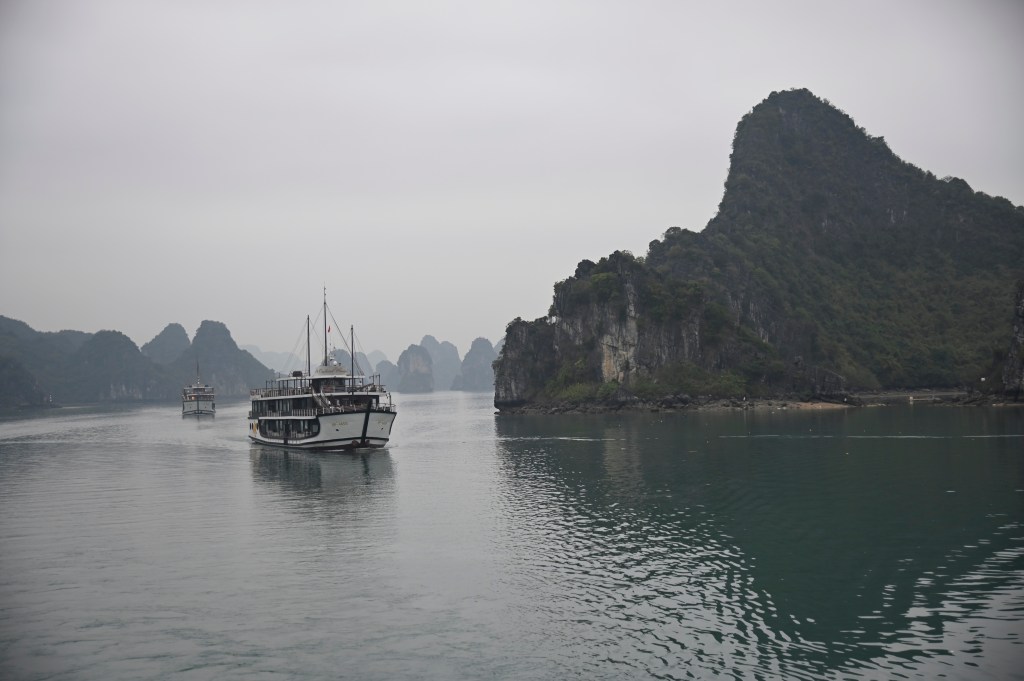
We started out around 8:30 a.m. on a two-hour drive east of Hanoi to Ha Long Bay, a UNESCO World Heritage Site that sits in the northern part of the Gulf of Tonkin.  The Bay is made up of over 1,900 islands, jungle-covered limestone formations – named karsts – that, in some cases, appear to rise straight out of the water.    These are the same formations I’d seen in Ninh Binh on my first day, with the difference being that this is the sea and that was an enclosed river valley where rice was farmed.  Parts of the film “Kong: Skull Island” were filmed in both places and now, as we approached the pier where we’d be picking up our boat for an overnight stay, we passed by a relatively new Kong-based theme park. Unfortunately, we had grey overcast skies the whole time we were on Ha Long Bay.

Along the drive, we stopped at a rest-area that doubled as a significantly-sized pearl shop; the Bay is the site of numerous pearl farms, and this spot was a place where you could learn about how pearls are raised (think of it as mollusk IVF) and purchase pearls of a wide-variety of color, size, perfection, and luster, as well as bracelets, rings, necklaces, and jewelry also made from mother-of-pearl.
The Bay, before COVID, was the site of 10m+ tourists per year and, as a result, a good many condos and apartments and hotels have been built along its coast; the pandemic, of course, clobbered the tourist business and it hasn’t yet fully recovered, so we saw buildings abandoned midway through construction as well as buildings that, while completed, were deserted.
UNESCO apparently had threatened to take away the World Heritage status of the Bay, given an escalation in its pollution, so a significant effort has been made to clean it up.

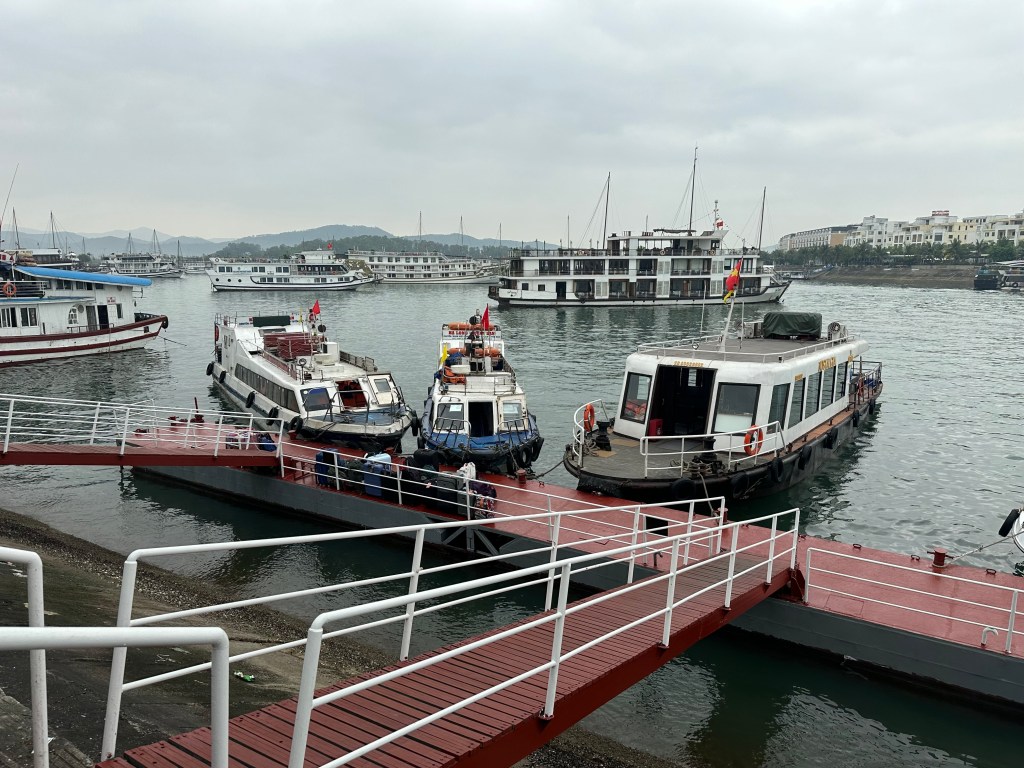
We saw a good number of tourist boats in the harbor, some designed for one-day cruises, others designed for overnight stays.  We took a small tender out to our ship, the Orchid 4568, which was big enough to handle up to 22 people, with unexpectedly large guest rooms each with ensuite baths; while not fancy, the boat had a restaurant, a spa, and a small jacuzzi on-board, along with an outdoor bar on the sizable sundeck.

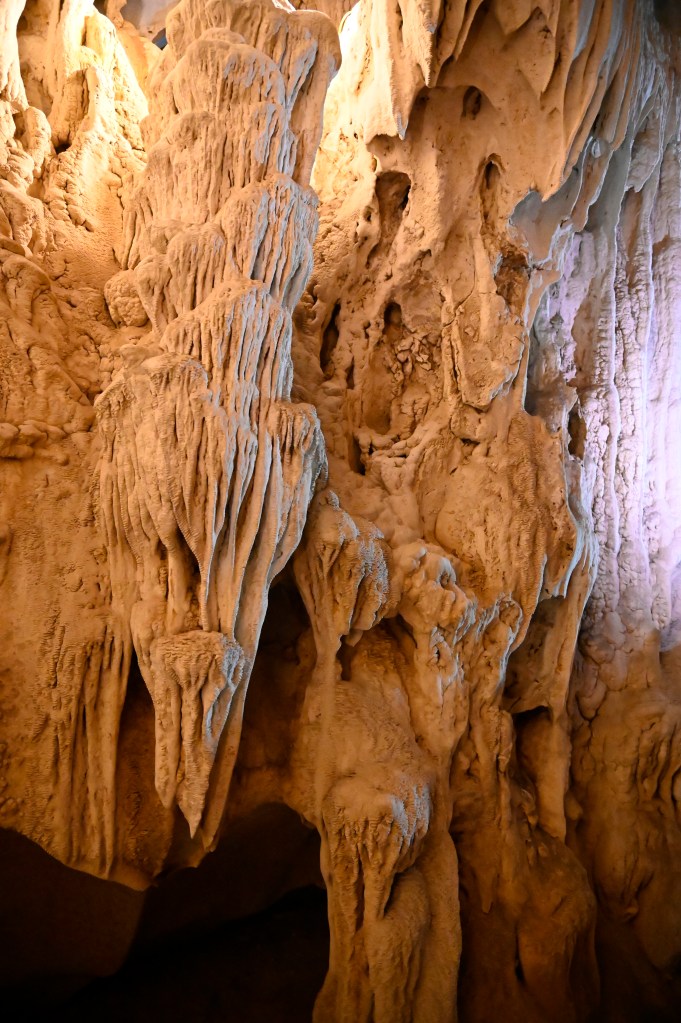
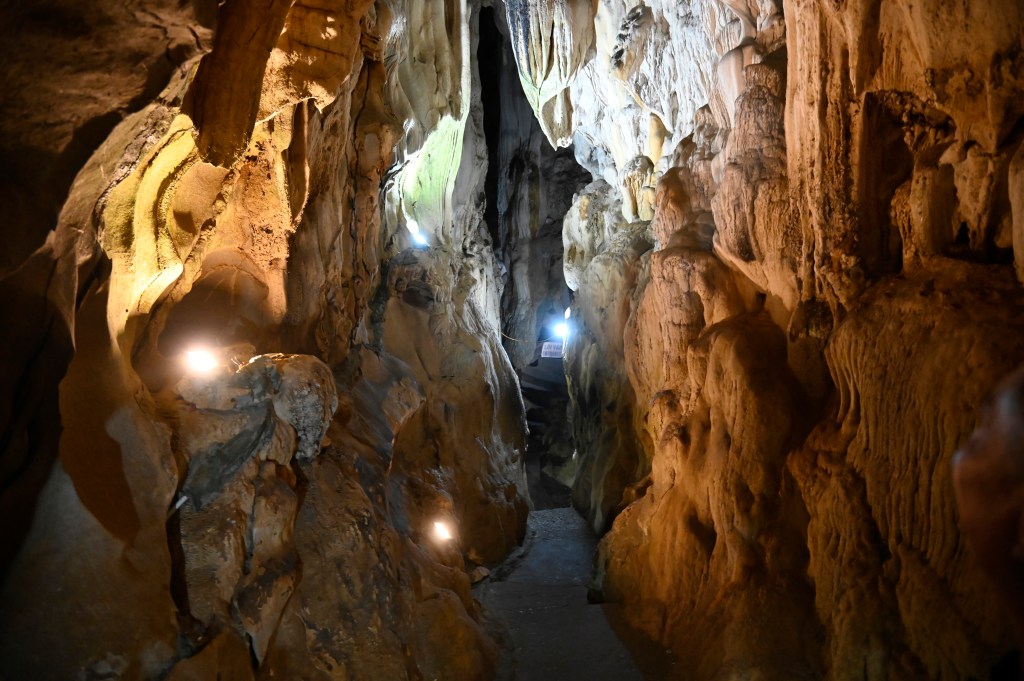
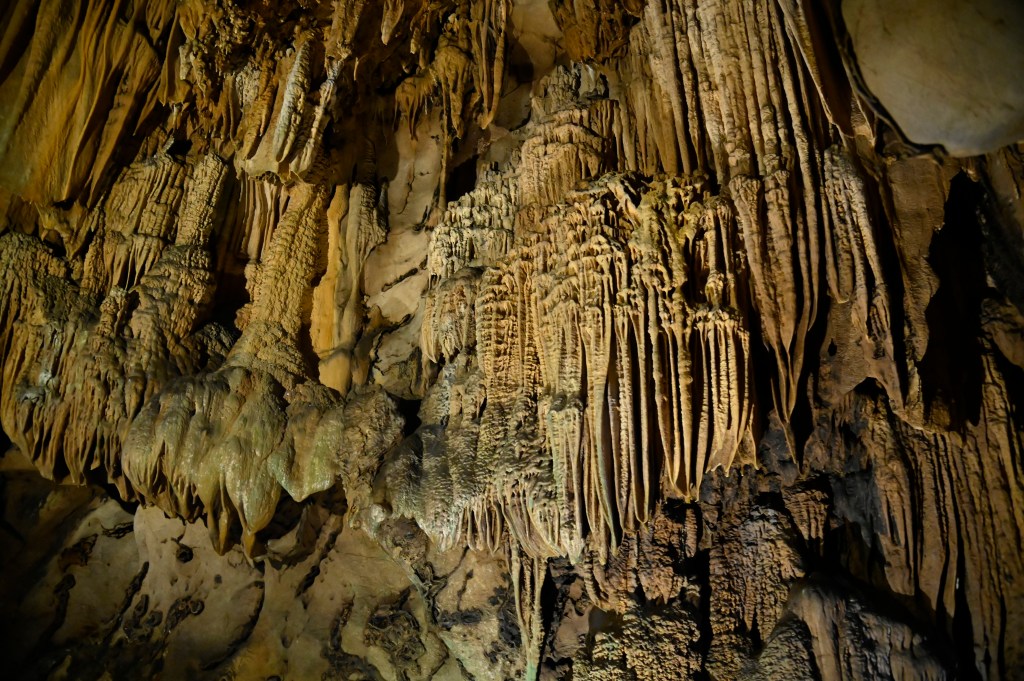
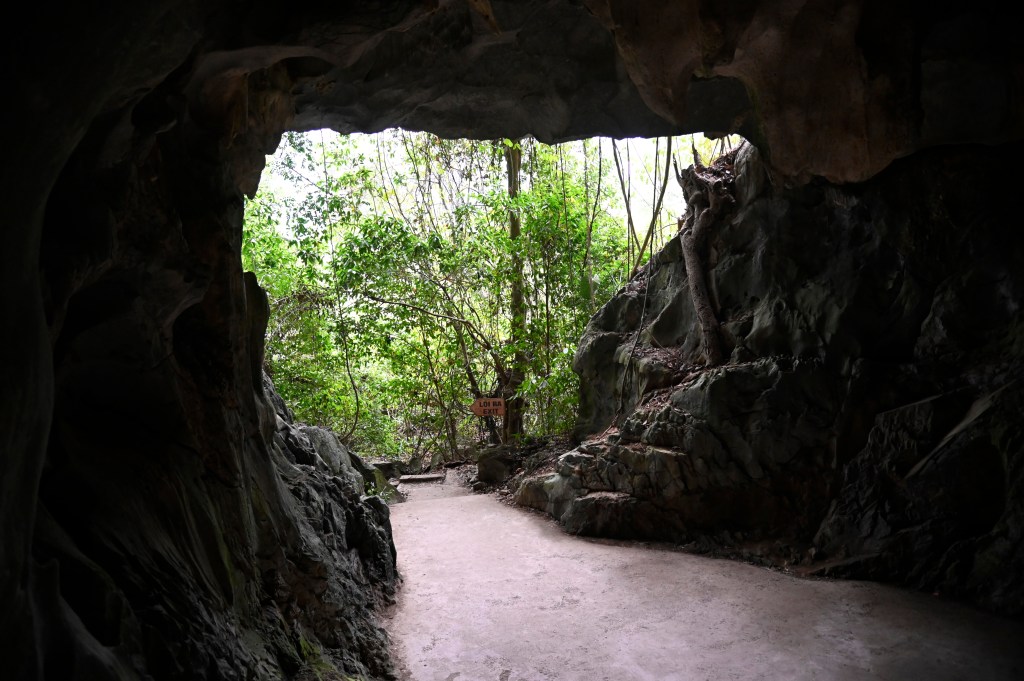
We boarded and took a short cruise to a point where I could take an excursion to see the Trung Trang Cave which stretches a distance of 300 yards through one of the karsts.  It’s estimated that the cave is hundreds of millions of years old, and was rediscovered in 1938; it served as a US hospital during the Vietnam War.  The cave is approached by climbing 150 stairs up a karst valley, and – though the path in the cave is now paved – its walls and ceilings are covered with stalagtites, some reaching to the floor and formed over the course of many years – we were told that one millimeter growth takes 15 years.  When there are hollow stalagtites, you can knock on them and hear a variety of sounds. Some ferns grow along the path, and you can see the water cistern that was used during the War.  The ceiling in some cases reached up to 20’ or 30’ feet high, but I also needed to duck at certain places along the path to avoid banging my head.

After the return to the boat, I passed on the chance to take a swim in the Bay.  Just as the swim was announced, a fuel boat had pulled up alongside us and its engines churned up the Bay’s bottom; the mud in the water along with the unfortunate occasional presence of floating plastic garbage bags, bits of cardboard, and empty plastic bottles made that a hard pass for me.  Instead, it was happy hour, a demonstration of how to make Vietnamese pork spring rolls, and dinner, and I think everyone skipped the participatory squid fishing – our guide explained that it took a lot of patience with usually no reward.  As a few of us sat on the deck late into the evening, it was unfortunately too cloudy to see any stars, but the tourist boats that surrounded us were lit-up, giving an eerie glow to the Bay.

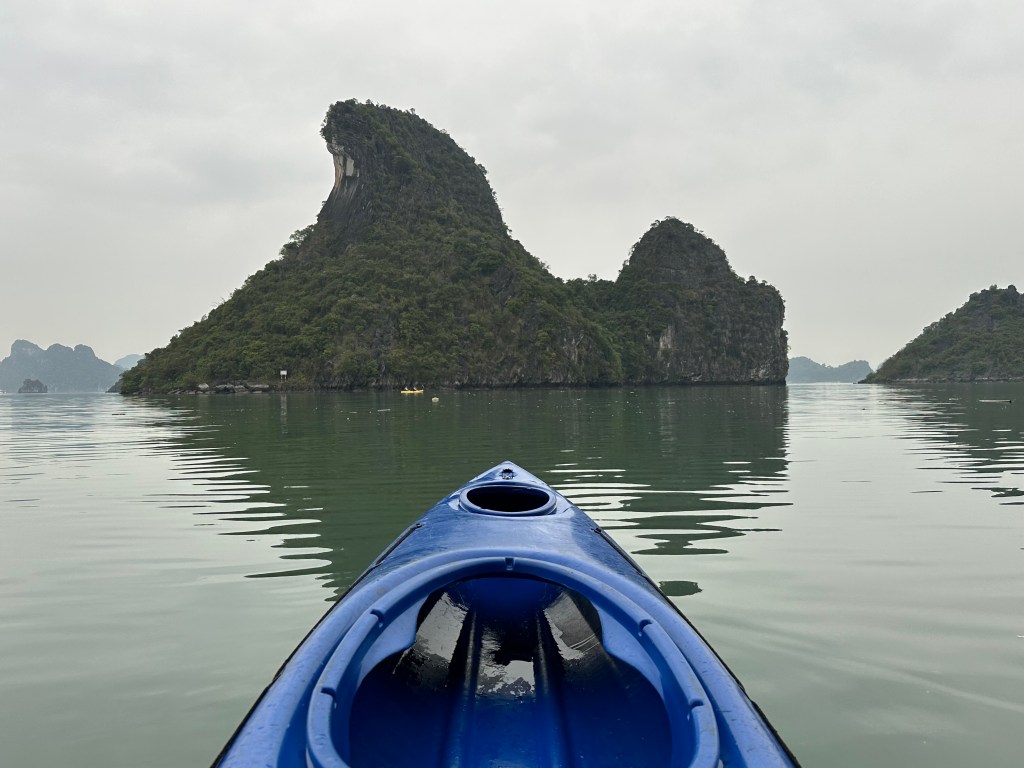
On day four a few of us awoke early for 6:15 a.m. tai chi on the sundeck, followed by breakfast (when I had a chance to taste my first “egg coffee” – a Vietnamese speciality that tasted like a cappuccino) and then a chance to kayak in the Bay.  That was tranquil and chill, with the water being glassy and still, and we were able to get in close to the base of the karsts; it was all good despite the occasional presence – really the crime – of the floating garbage.  With time to quietly reflect, I couldn’t help but think of the war and the devastation it brought to these places and these people.  Here I was on a northern bay of the Gulf of Tonkin, where the incident in August 1964 served as an impetus for greater US involvement in the Vietnam War.

That kayak ride was a peaceful way to end our visit to the Bay.  The rest of the day was spent in transit – first returning on the boat to a nearby pier, then taking about an hour drive to Hai Phong (the third largest city in Vietnam, with about 3m people), followed by a two-hour flight to Saigon, where we’ll spend the next three nights. Dinner out with some new and old friends tonight at a great restaurant within walking distance of the hotel, but more on Saigon to come.

Day Two – Hanoi

A few little tidbits about Vietnam – it’s a country of 100m people, more than twice the population it was in 1975 at the end of the war.  That means it’s pretty young, and the stat I’ve heard is that 65% of the population is younger than 35.  So – for many of them, the war didn’t take place in their lifetime and is nothing other than family stories.  An analogy that’s useful for me is that in 1995 the end of World War II had been 50 years earlier – that’s roughly how long ago the end of the Vietnam War was.

And I was surprised to hear that Vietnam is the world’s second biggest producer of coffee, after only Brazil and, based upon what we saw in Hanoi yesterday, the coffee culture here is alive and well, but I didn’t see a single Starbucks or a Dunkin’.  And the coffee here is crazy good.

So is Vietnam a communist country?  The answer feels complicated to me.  Yup, it is a one-party government and that ruling party is named the Communist Party of Vietnam, and it rules the roost, but apparently only about 3.5% of the population is members of the party.  And – from what we saw and heard, this place is built on capitalism.  Residents are privately owned, the amount of retail was extensive, there’s a significant service industry, we didn’t hear nor see evidence of the state controlling pricing, the quality of healthcare is wholly dependent upon what you’re able to pay, and more. It seems like something will have to give – the people will ask for a more representative government and/or the government will tighten the noose if that begins to happen.

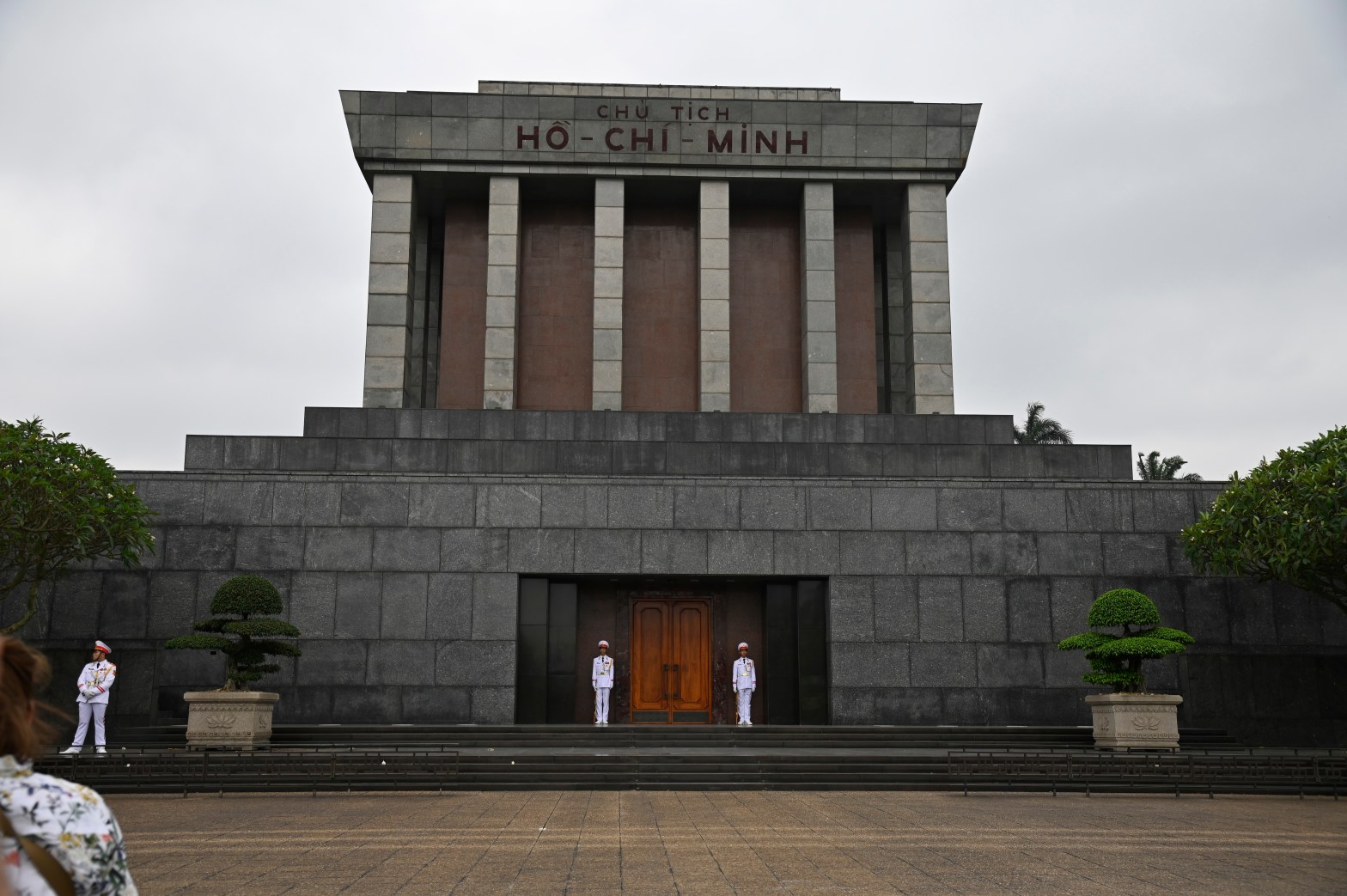
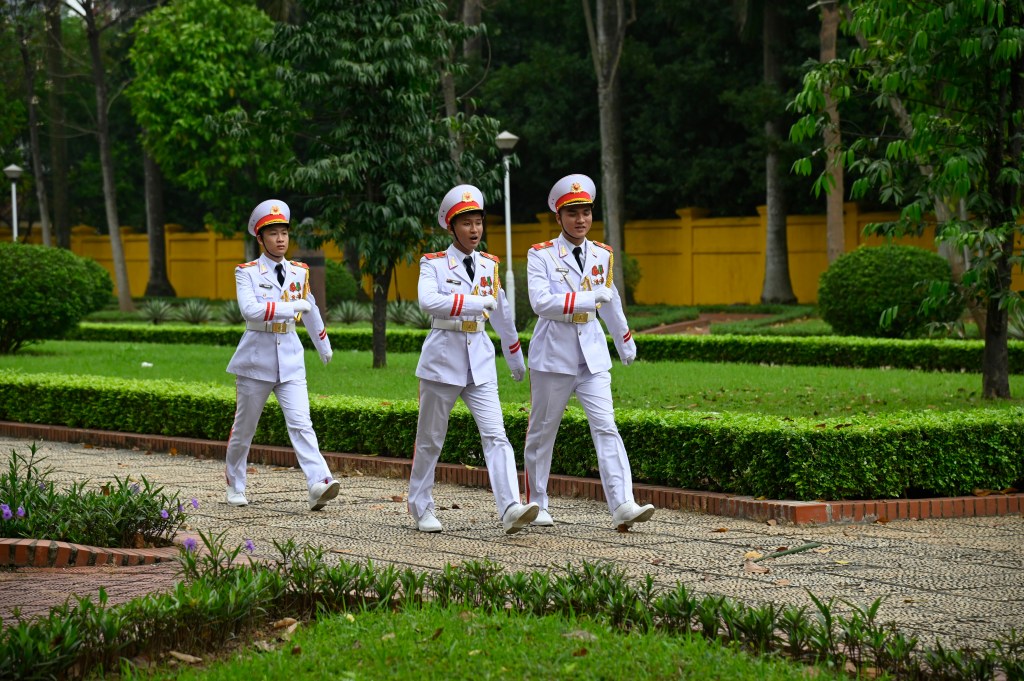
Day two was spent in and around Hanoi, starting with a visit to the location of Ho Chi Minh’s mausoleum, based on Lenin’s and, yes, containing Uncle Ho’s remains, available for public viewing.  He didn’t want it that way, per his will, but his followers thought this was the best thing to do.  Nearby are the parliament building and several other buildings, including the home of the president.  As well, Ho Chi Minh’s living compound, for lack of a better word, also was nearby – his homes and office, some of his cars, his underground bunker.  He’s held in the esteem here equivalent to George Washington in the US – the father of the country.

We also made a visit to a confucian temple complex and university before taking a rickshaw ride through the Old Quarter.  Because the French were here for c 100 years, there is a ton of French colonial architecture, beautiful and beautifully restored from the Vietnam War bombings.  And because the city has grown so much, there also is a significant amount of modern architecture and high-rise buildings and the city has spread further out and has become, apparently, expensive in certain area – we heard values of $2,000/sq ft.  The Old Quarter is the urban core and it remains densely populated, with narrow streets, lots of retail shops and hostels and apartments, pagodas, and temples.  The streets used to be named for the things sold on each one – chicken street, bamboo street, sails street, etc. Of course, this has evolved to now different shops on each street.

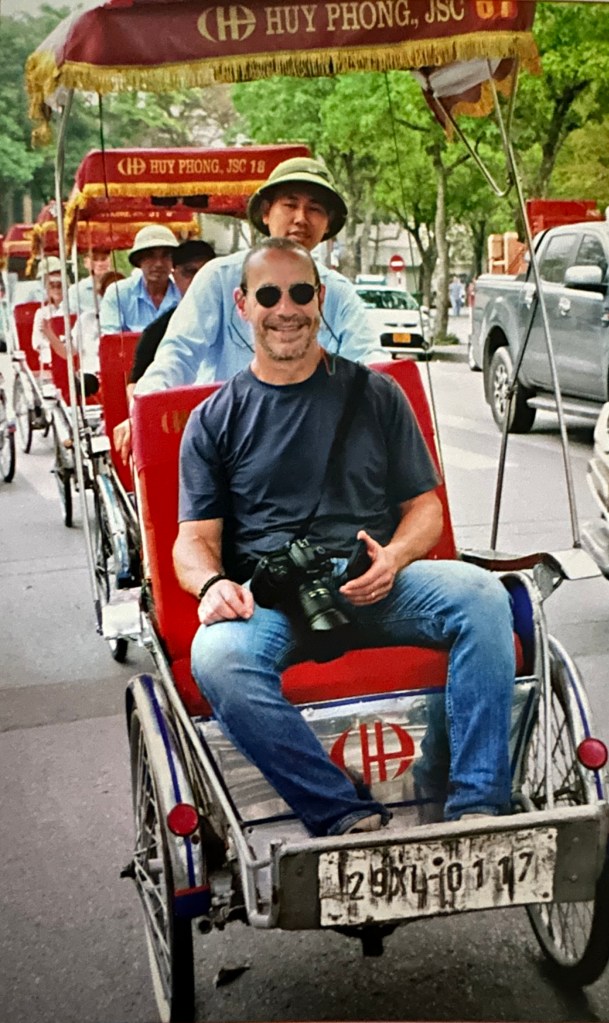
So that rickshaw ride was wild – not fast (it was a rickshaw after all), but total eye candy given all the activity.  It was the Lower East Side on steroids – an amazingly dense street scene of motorbikes, scooters, bicycles, cars, rickshaws, pedestrians, restaurants, retail shops, tourists, locals, coffee bars, foodstands, delivery people, and more.

Lunch at a local restaurant where I finally got the hot and spicy experience I craved, though it came courtesy of my guide from Ninh Binh who had brought me fresh chilis – a variety of appetizers followed by pork with noodles in a broth.  My lips tingled.  I got sweaty.  And the ice cream for desert felt great.

The Hanoi Hilton was our next stop, the infamous prison in the city where John McCain had been kept for years after his plane was shot-down and he broke both his arms and a leg and was severely beaten.  The prison is now a museum – well, part of it is a museum, the other part had been torn down so a tall modern office tower could be built.  The exhibits focused on the two phases of the prison’s life – first as a French prison where Vietnamese prisoners had been kept, and then a Vietnamese prison where Americans were kept.  Every country has its propaganda, and I felt like this museum was trying to make it seem like the French were much harsher than the Vietnamese had been.  Regardless, it was a sobering experience to be there.  But, like any museum, we had to walk through two gift shops along the path through it.

Our afternoon ended with a water puppet show, inside a medium-sized theater, where live musicians and singers performed alongside an apparently traditional form of entertainment that started in the rice fields.  Performers, hidden behind a curtain in waist-deep water, use long bamboo sticks to control wooden and lacquered puppets – people, dragons, unicorns, fish, phoenixes that appear to dance on the surface.

And, before dinner back at the hotel we were able to meet with a 79-year old Vietnamese air force veteran, Nguyen Hong My (pronounced “mee”), who in 1972 was shot down by an American pilot. Mr My told us the story of how he had been recruited in 1965 to be in the air force, sent to Russia to learn how to pilot MIG-21s, and returned to Vietnam to fight in the war, where he had shot down an American in January 1972.  Three months later, USAF Major Daniel Cherry shot down Mr My.  Fast forward to 2008, and Mr My and Daniel Cherry met in-person, and the two reconciled and were able to put their past behind them.  Major Cherry wrote a book about the entire experience, My Enemy My Friend.

This was the only day in Hanoi, but it was a great day of learning and seeing and talking and eating.