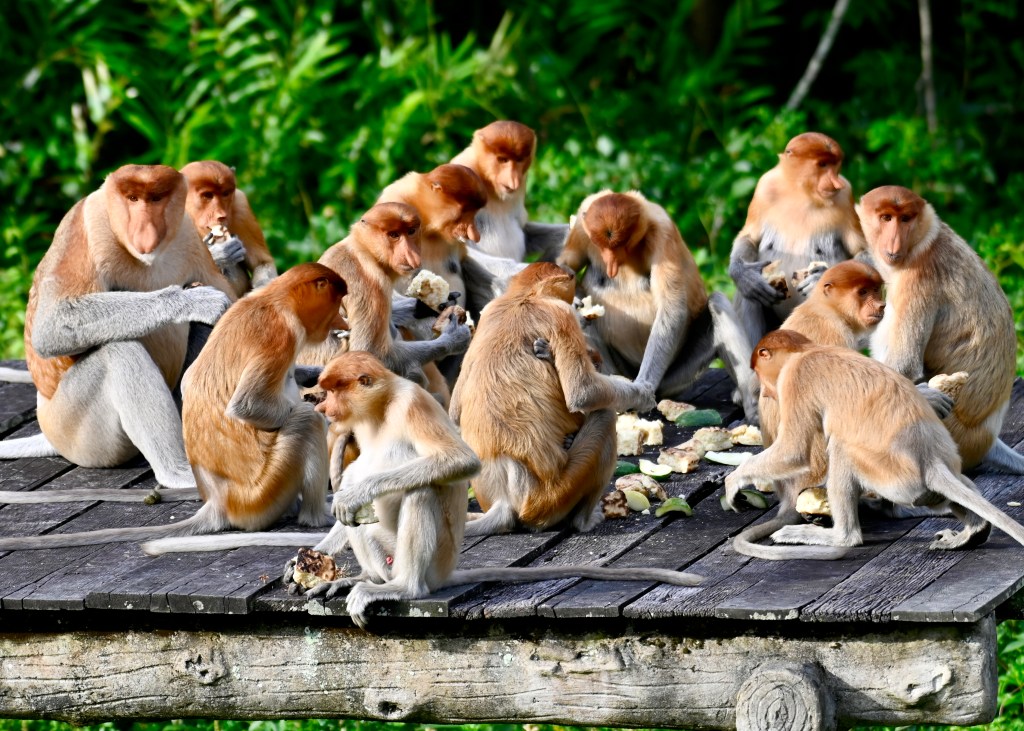
Malaysia (Borneo!) – Day Four

Starting the day with a three-hour flight from Kuala Lumpur to Sandakan wasn’t the most exciting activity in the world, but it did, of course, mean arriving on the island of Borneo. Sandakan is the second largest city in Malaysian Borneo (in the state of Sabah), is located on the east coast, facing the Sulu Sea, and, at one time, it was the capital of British North Borneo. It’s a city of about 450,000 people.

Borneo itself is the third-largest island in the world (after Greenland and New Guinea), and the island is divided among three countries – Indonesia (which controls about 73% of the territory, but also is spread among many other islands), Brunei – in its entirety – which controls about 1% of the island’s territory), and Malaysia, which controls the remaining 26%. The equator stretches across Borneo, pretty much cutting it in half (Malaysian Borneo is in the Northern Hemisphere), and – as such – it’s tropical and the rainforest(s) are estimated to be about 140m years old, making them some of the oldest in the world.

Malaysian Borneo is itself split between two states – Sabah, where I’d be spending the reminder of my time in Borneo – a little more than seven days – and Sarawak.

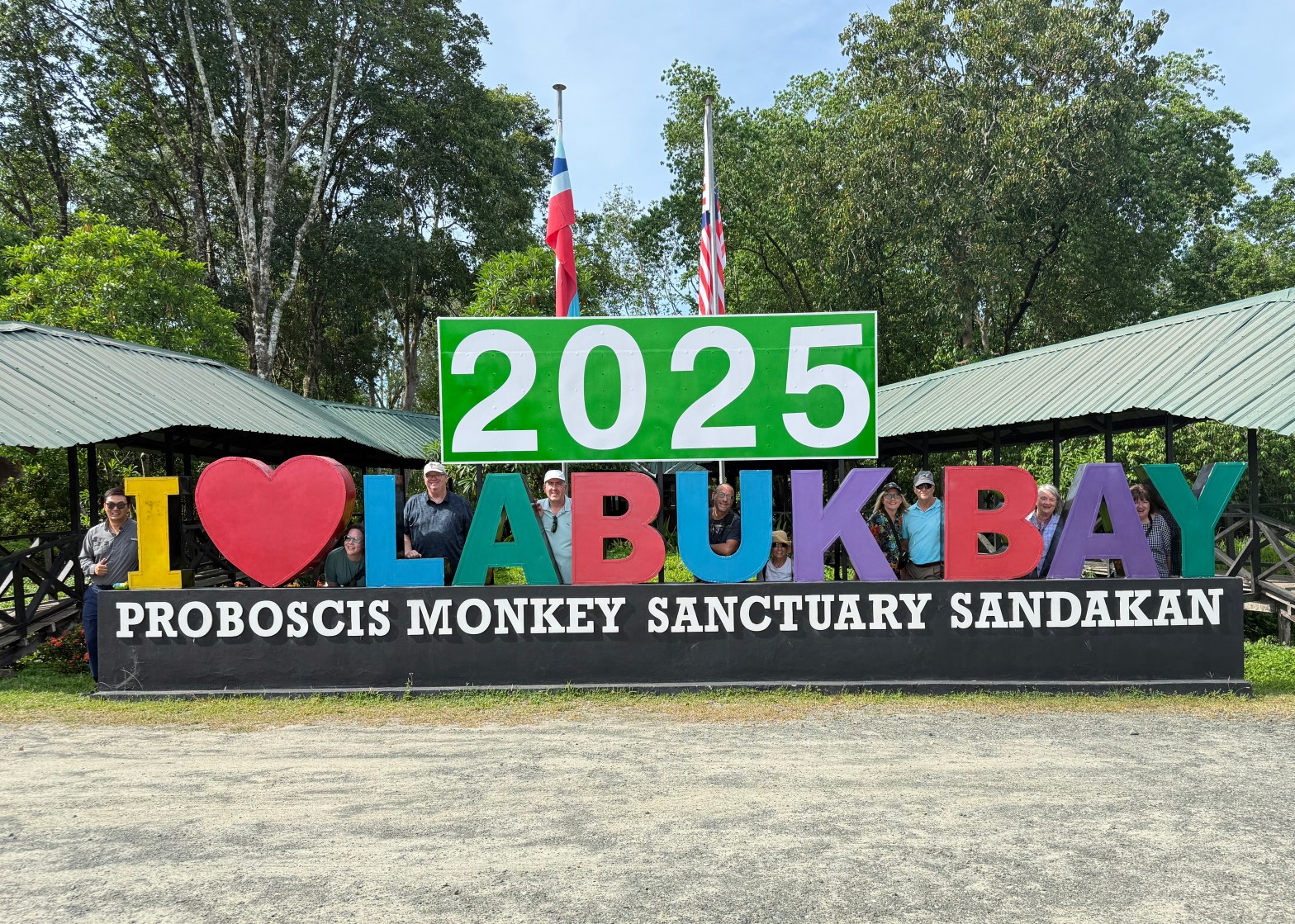
The first decision, before we landed, was to decide what to do. We’d be spending the rest of today and the morning of tomorrow in and around Sandakan; tomorrow we’d be going to see sunbears and orangutans, both in sanctuaries, and today we had a choice – see orangutans (in the same sanctuary as tomorrow), or opt instead to see proboscis monkeys in a separate sanctuary. Our group of 14 split up – nine of us, plus our Tour Director, opted for the monkeys, while the remaining five headed to see orangutans.

The 40-minute drive from the airport to the Labuk Bay Proboscis Monkey Sanctuary took us past a landscape that reminded me of traveling from a small Caribbean island airport – roughly paved roads, older model cars, lots of trees and vines and power lines, road-side strip malls with grocery stores and car repair joints.

We arrived at the Sanctuary with about an hour to wait until the scheduled feeding. The monkeys – none of the wildlife – are caged; the Sanctuary is surrounded by an open mangrove forest, but has viewing areas and platforms where feedings are held a few times a day. Even without a feeding, there were a few monkeys hanging around platforms, munching on leaves and stems, casually swinging from tree-to-tree, or sitting on the ground, waiting for the appointed hour.

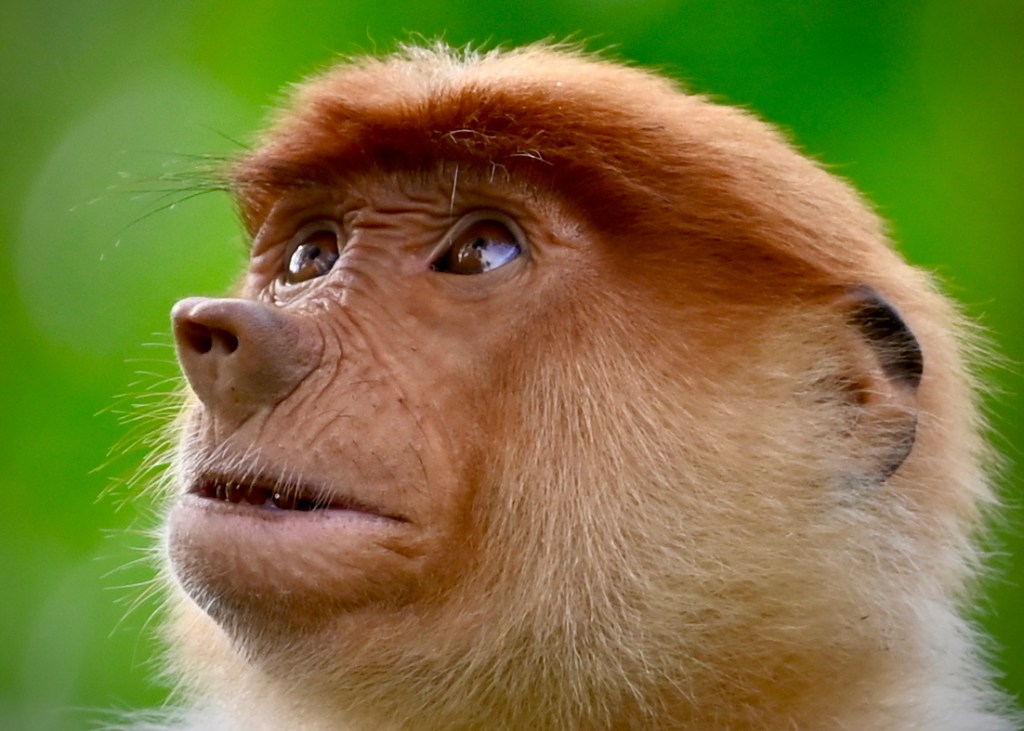
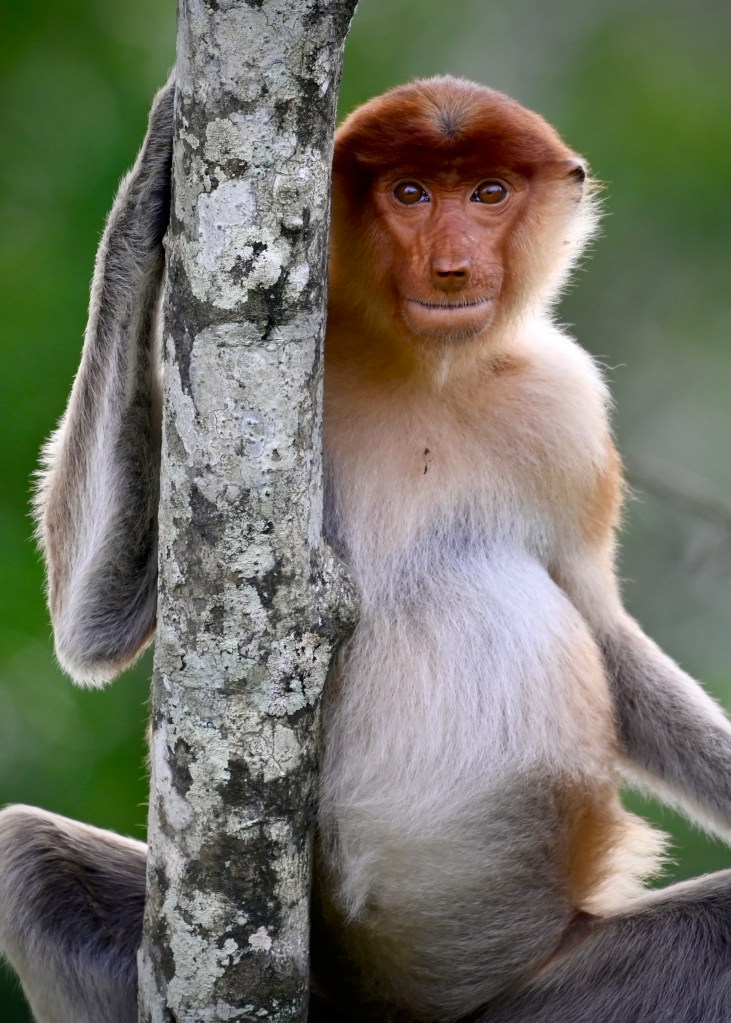
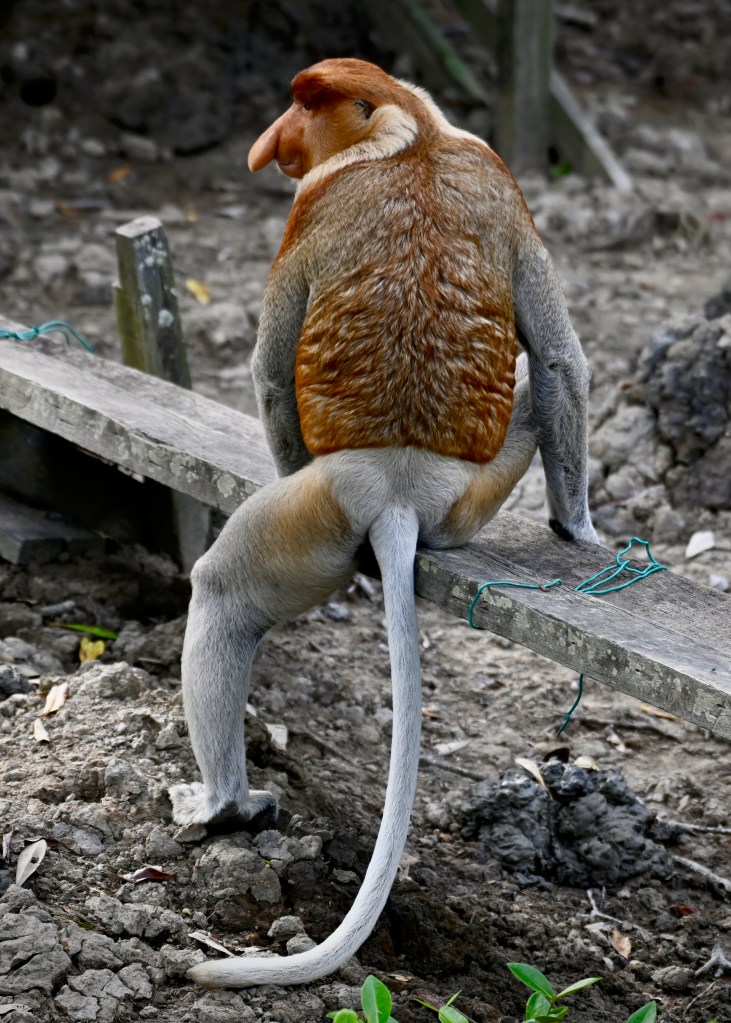
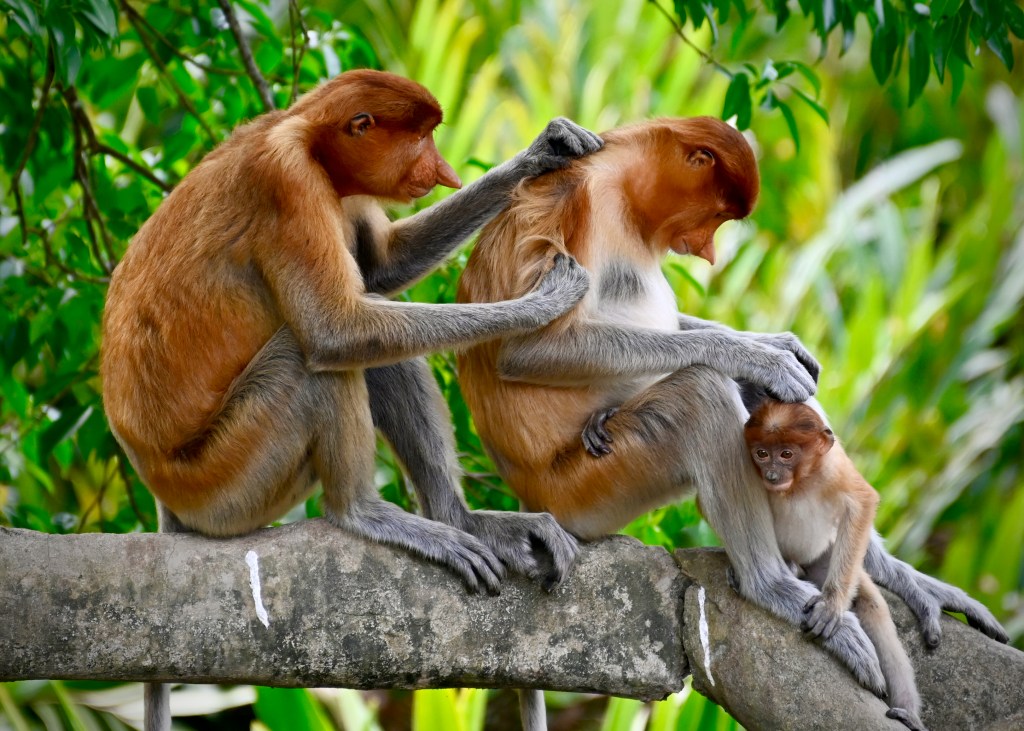
And what an hour it was. A few staff showed up and started to put food out on the platforms and – as they did – there must have been 30-40 proboscis monkeys who arrived – large males leading the crowd, then mothers with their babies clinging to them, and every age of male and female in between. The viewing area was two levels, a large-scale wooden structure, with a roof over it and bathrooms, while the feeding platforms were anywhere from 10-25 feet away, over mostly bare ground, with the forest not far beyond.

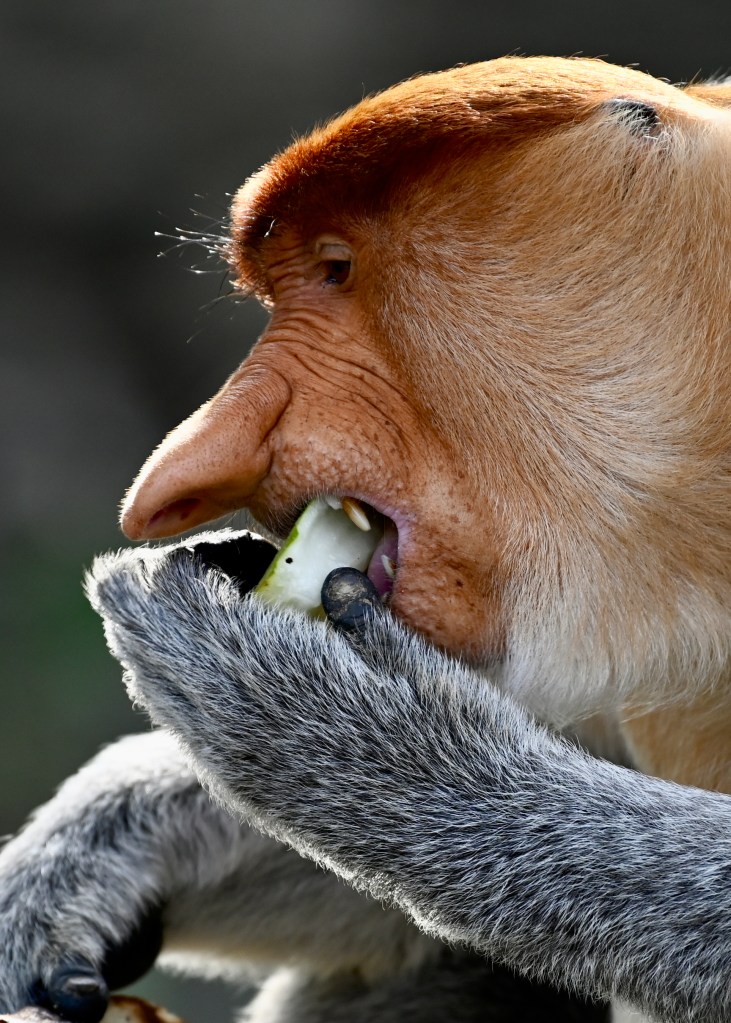
It is the males, among the proboscis, who have the large noses, which sometimes get in the way of their eating. Naturalists and biologists believe that the reason for the large noses is for them to make louder and lower sounds as a means of attracting mates.

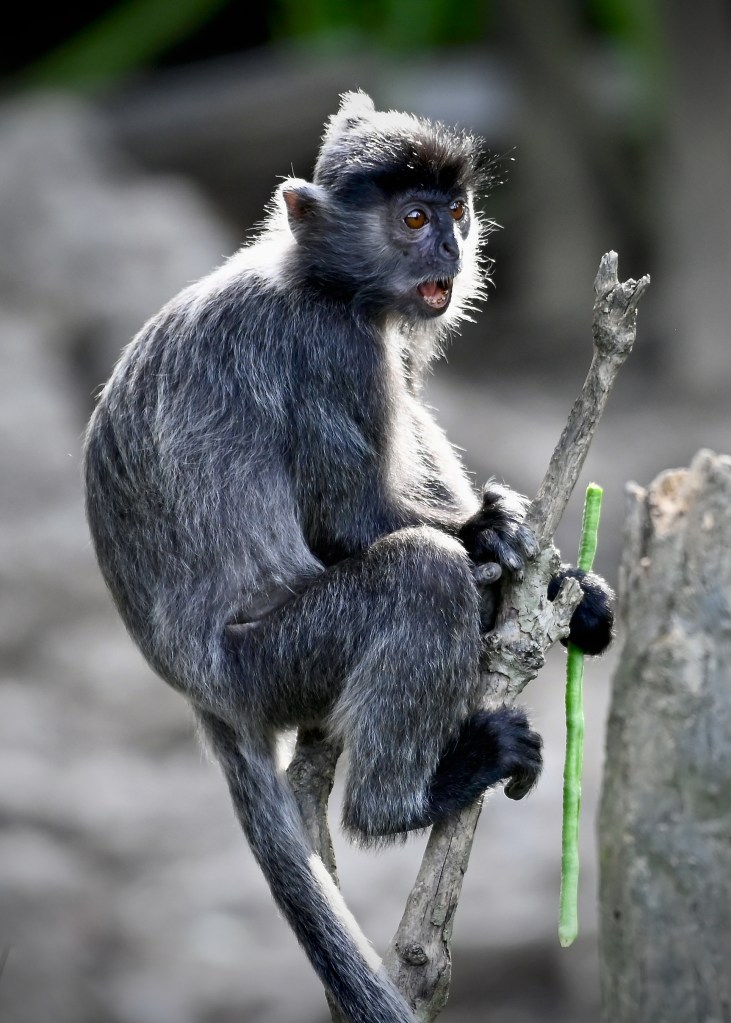
In addition to the proboscis monkeys were a handful of silver leaf monkeys, also just fascinating to watch. (just a reminder that you can click on any photo in the gallery below to see a larger version of the image, then use your arrow keys or mouse to scroll through them; these are among some of my favorite pics from this entire journey)
We watched well past the end of feeding time, as there were battles for last scraps, and some of the monkeys just hung around the platforms for a bit.

And, with the forest beyond the platforms, we kept our eyes out for birds; we were lucky enough to see a woodpecker way beyond and above where we were standing.

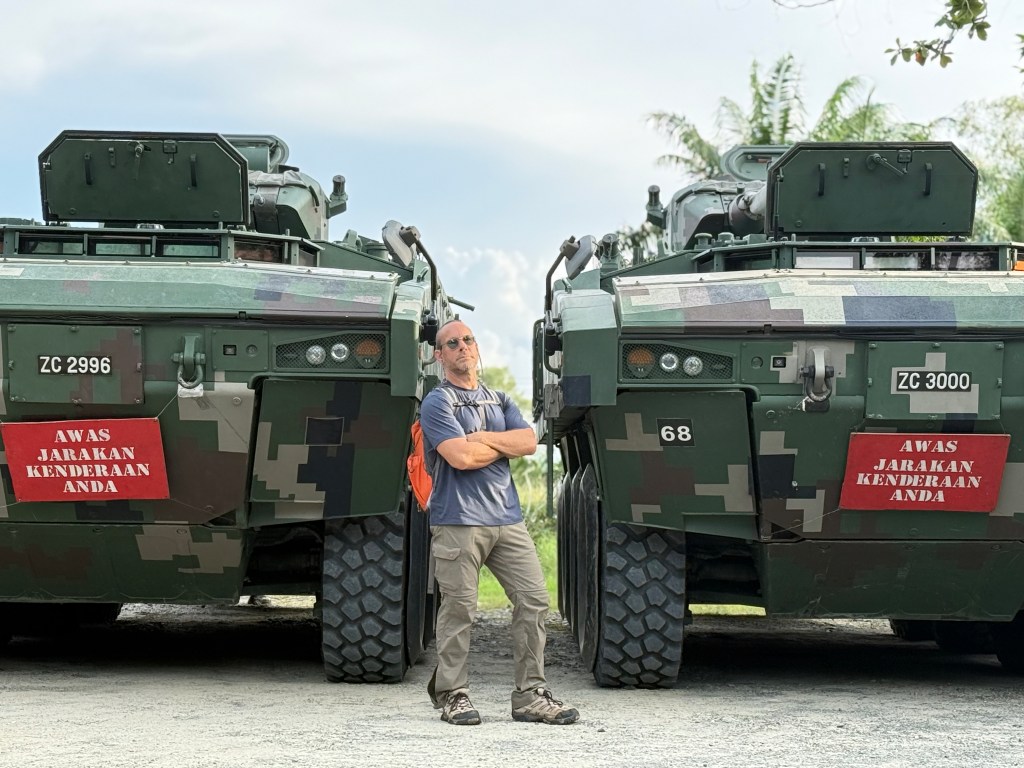
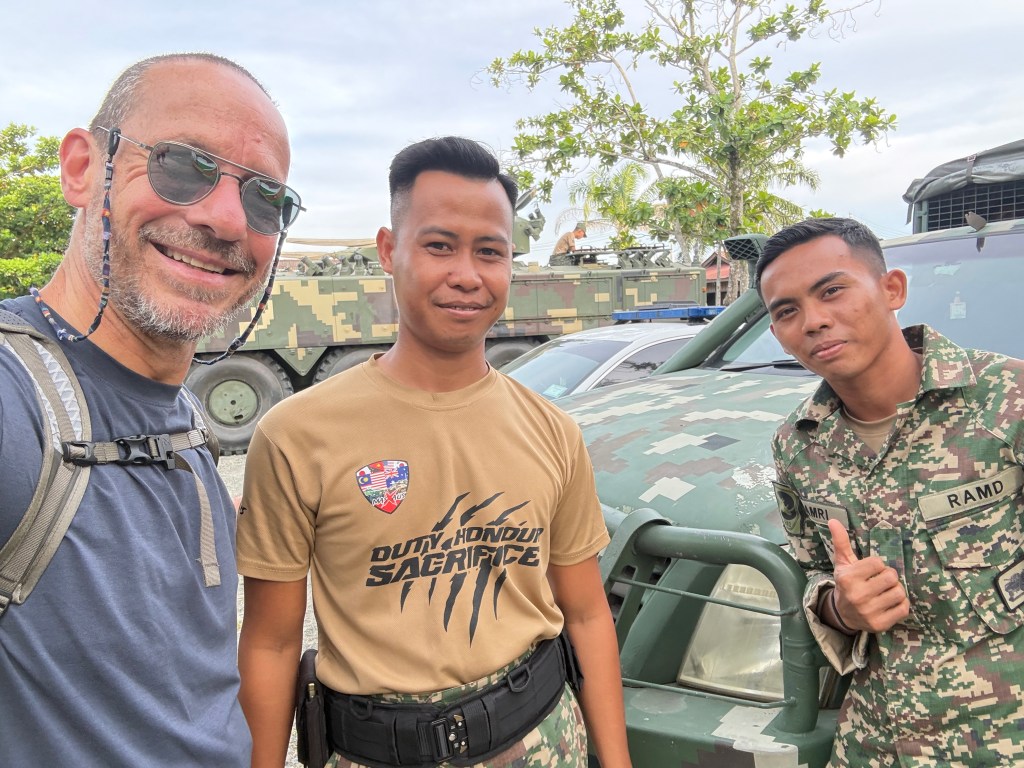
A super-fun time; as we were leaving the sanctuary there were, for whatever reason, a few military tanks parked outside along with some of the troops.
We headed to our hotel for the night – nothing special – where we attended, before dinner, a presentation about the oil palm industry which, frankly, sounded like a big PR campaign wherein a local oil palm producer got a chance to make an argument for how good they were while destroying indigenous plants and trees, and relocating indigenous populations.

Decent Chinese food for dinner, at two huge tables with massive lazy susans placed at the center of each table, too much food, but four Absolut vodkas costing only about US$25!

And tomorrow I’d see orangutans!
Malaysia (Kuala Lumpur) – Day Three

My third and last day in Kuala Lumpur was the first day that the group I’d be traveling with met each other – over coffee at our hotel – and we went as a troop of fourteen to three locations in the city, along with having lunch and dinner together (while the company was great at both those meals, the eating experience wasn’t nearly as much fun as my prior two days).

Our first stop was the observation decks of the Petronas Towers, which I’d only seen from the outside in my first two days. We first went up to the 41st/42nd floor, where the “Skybridge” is between the two towers, with a chance to walk out across the bridge to catch the views. Some neat facts about the bridge, listed on a poster there:

  • The Skybridge is “the highest 2-storey bridge in the world.”
  • “The length of the bridge is 58.4 metres and located at a height of 170 metres from the street level.”
  • And – really amazingly: “It is not attached to the main structure but is instead designed to slide in and out of the towers to prevent it from breaking due to strong winds.”

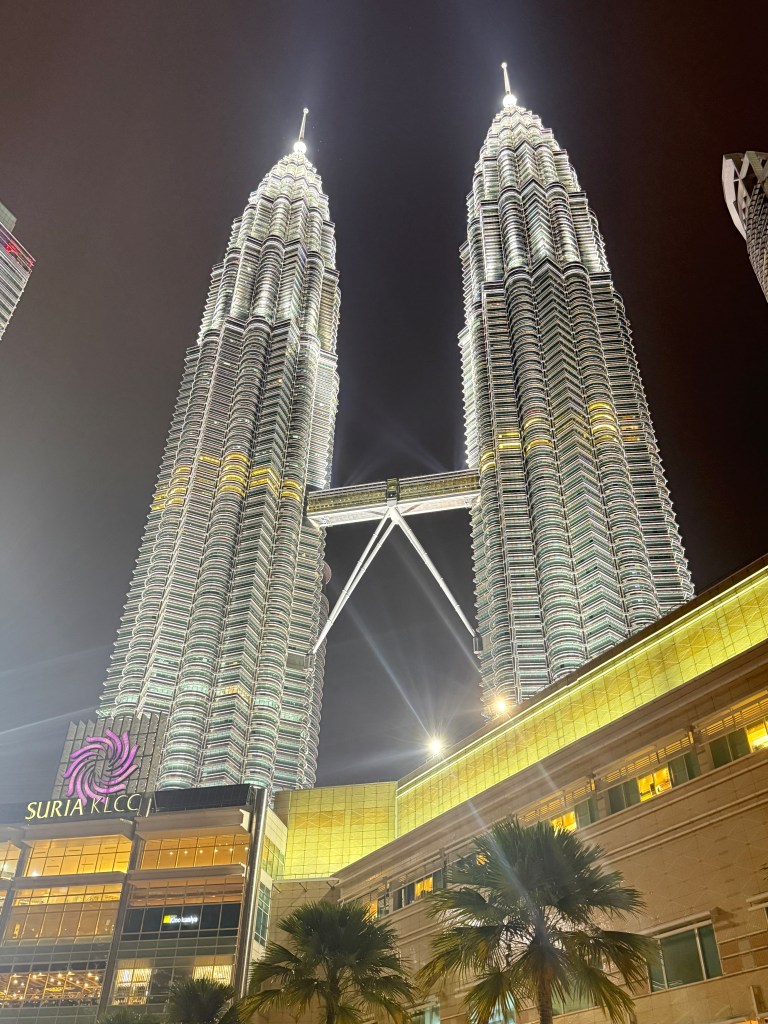
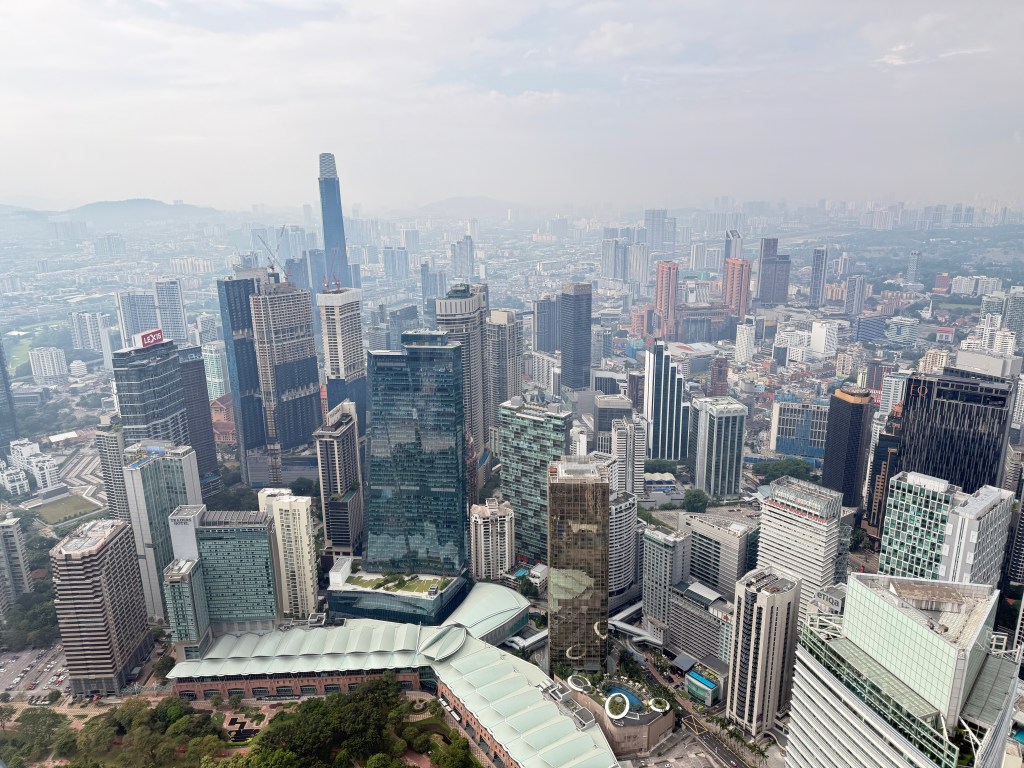
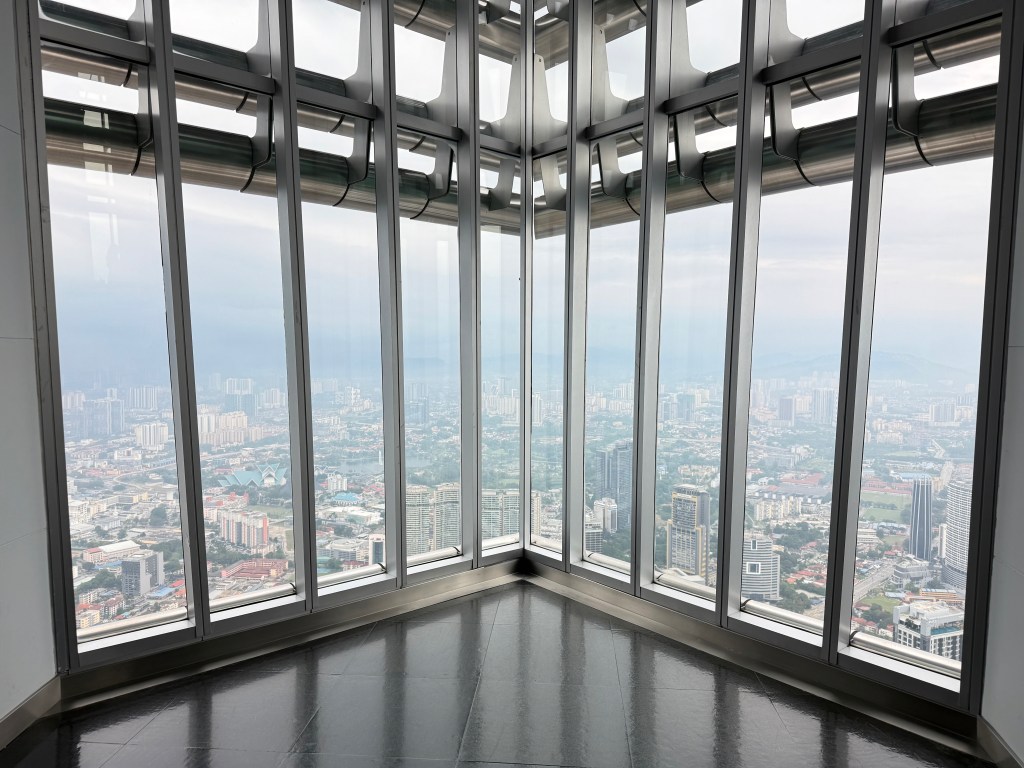
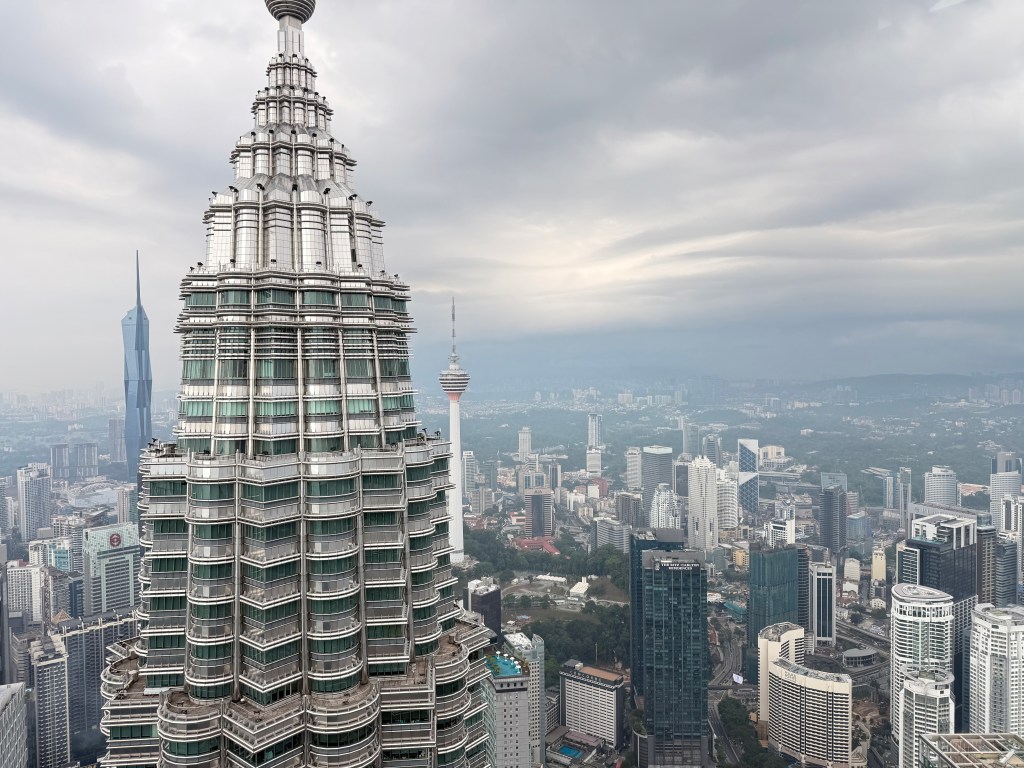
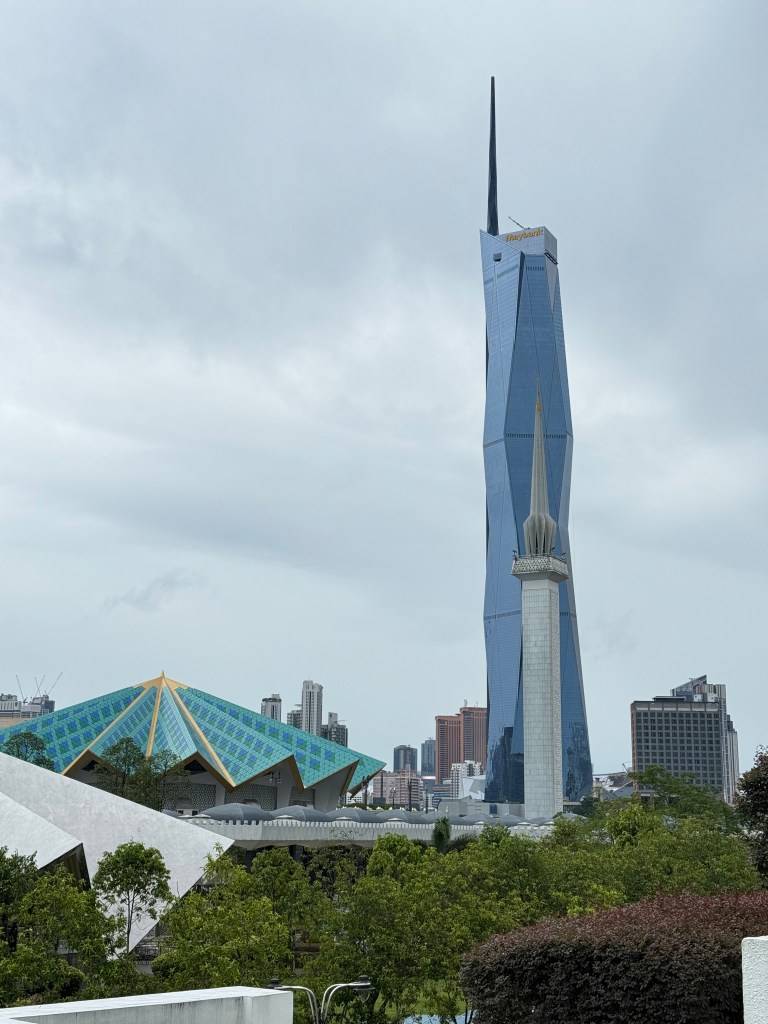
After that, we headed up to the observation decks on the 86th floor of “Tower 2” from which, of course, the views are incredible but no photograph does justice. A couple of neat facts about the Towers: they’re constructed of reinforced concrete and walls of 33,000 stainless steel and 55,000 glass panels, and the Towers were built to withstand winds of up to 15km/hour – about one third the strength of the winds in Hurricane Katrina. (The nighttime photos of the illuminated towers in the gallery below were actually taken my first evening in KL, one from outside my hotel and the other from inside the restaurant I went to).

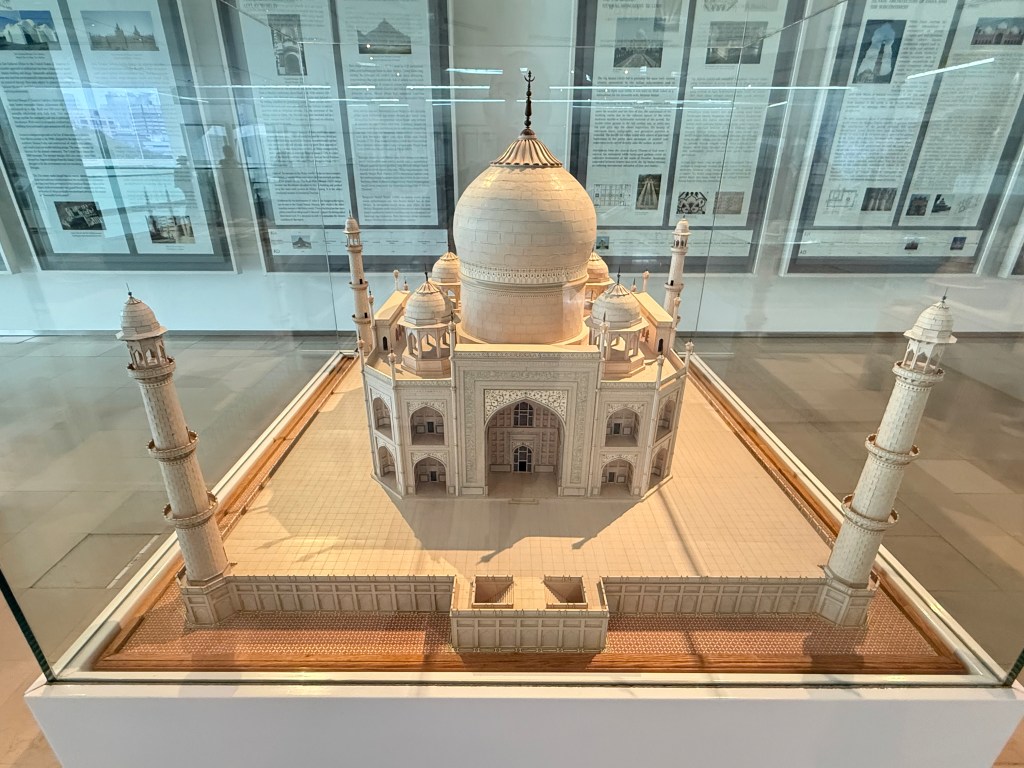
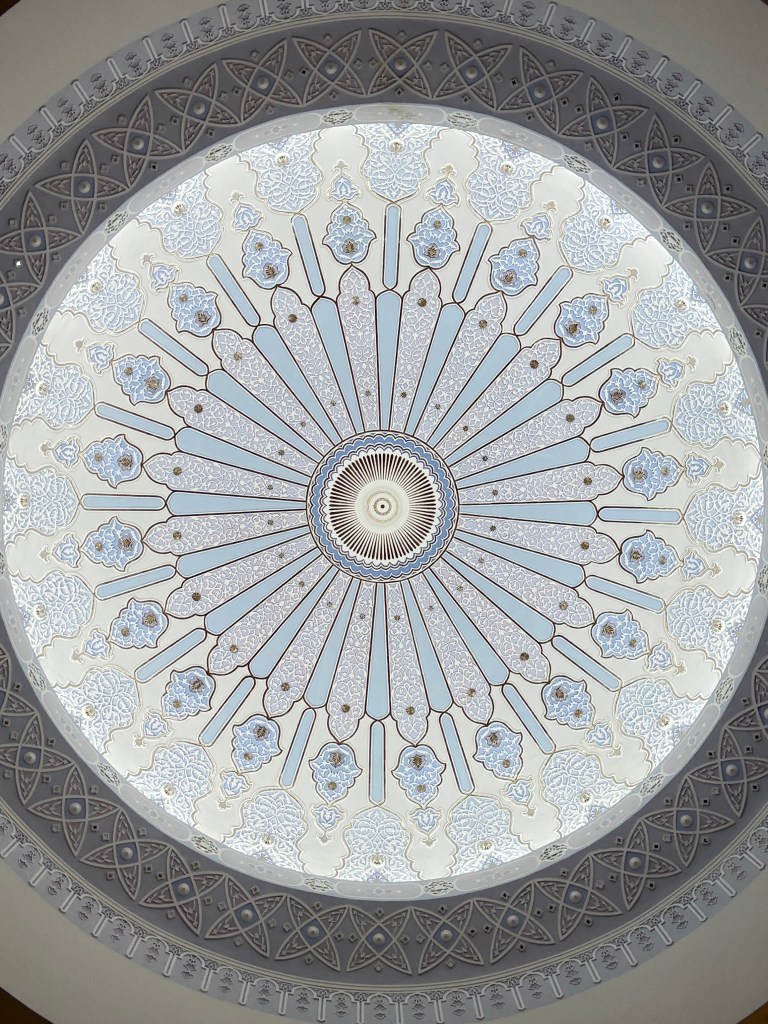
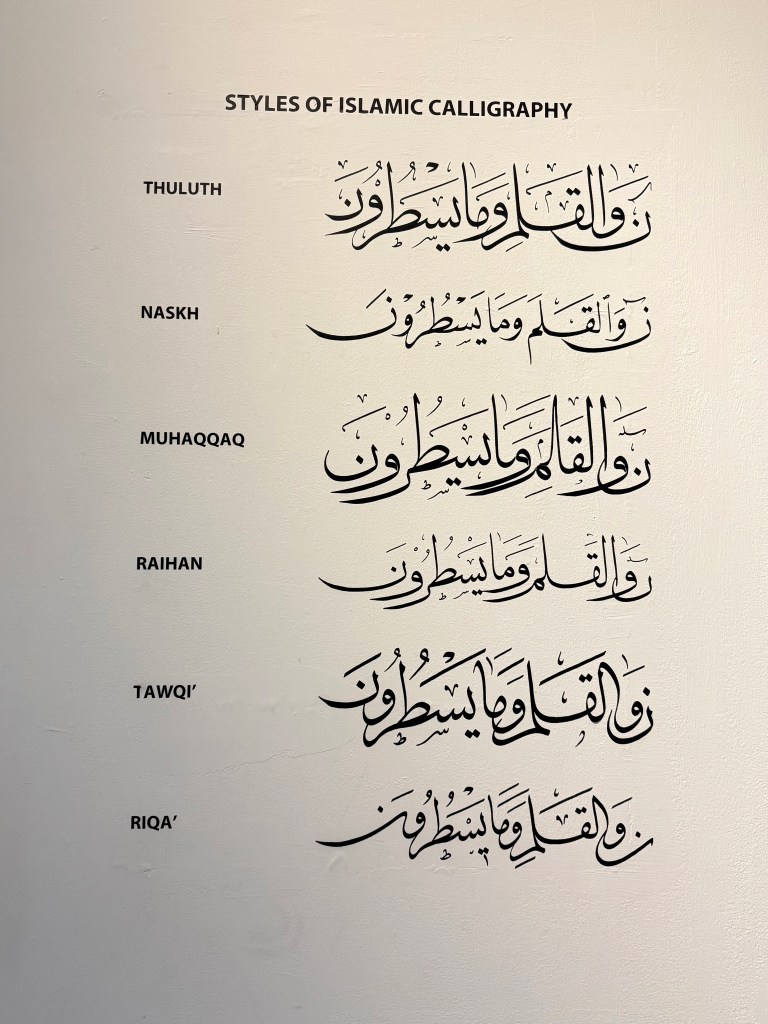
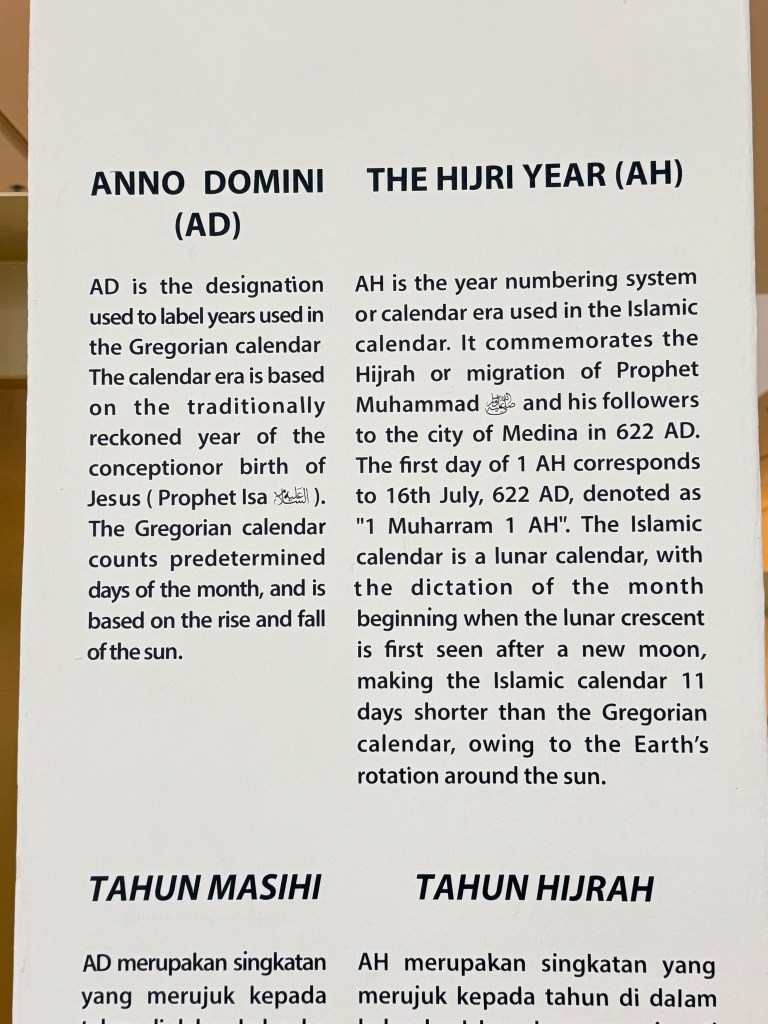
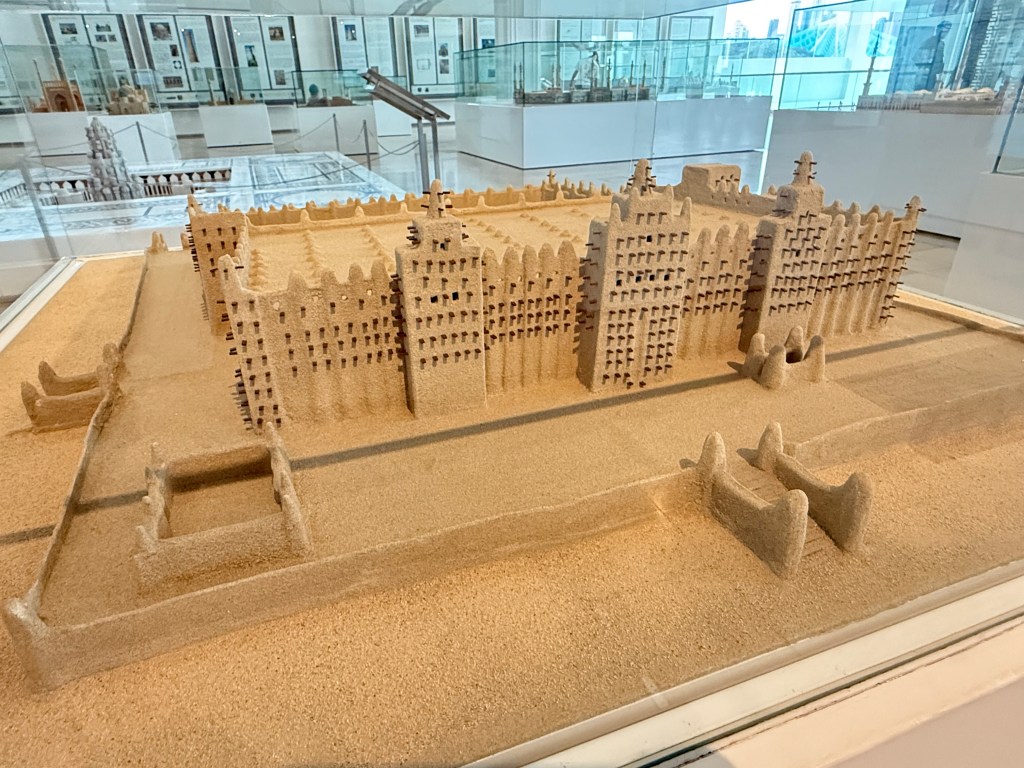
The second stop was the Islamic Arts Museum in KL – the largest museum of Islam-related arts and artifacts in Southeast Asia, with, apparently, more than 7,000 items in the collection. So, yeah, no time to go through it all. I spent my time in two big areas. The first of these, had scale-models (still at good scale – maybe three, four, or five feet wide) of noted mosques from a wide-range of cities around the globe. The second exhibit was absolutely wonderful and fascinating – it was all about the the art and production of the Quran, including the vellum and paper used, inks and pens, binding, styles of writing, art on pages, and other related books – critical interpretations and the life of the prophet. And there was, of course, a beautiful collection of Qurans from across the years, in a wide-variety of sizes, even ones that were so tiny that you’d need a magnifying glass to read. I could have spent more time just pouring over this exhibit.

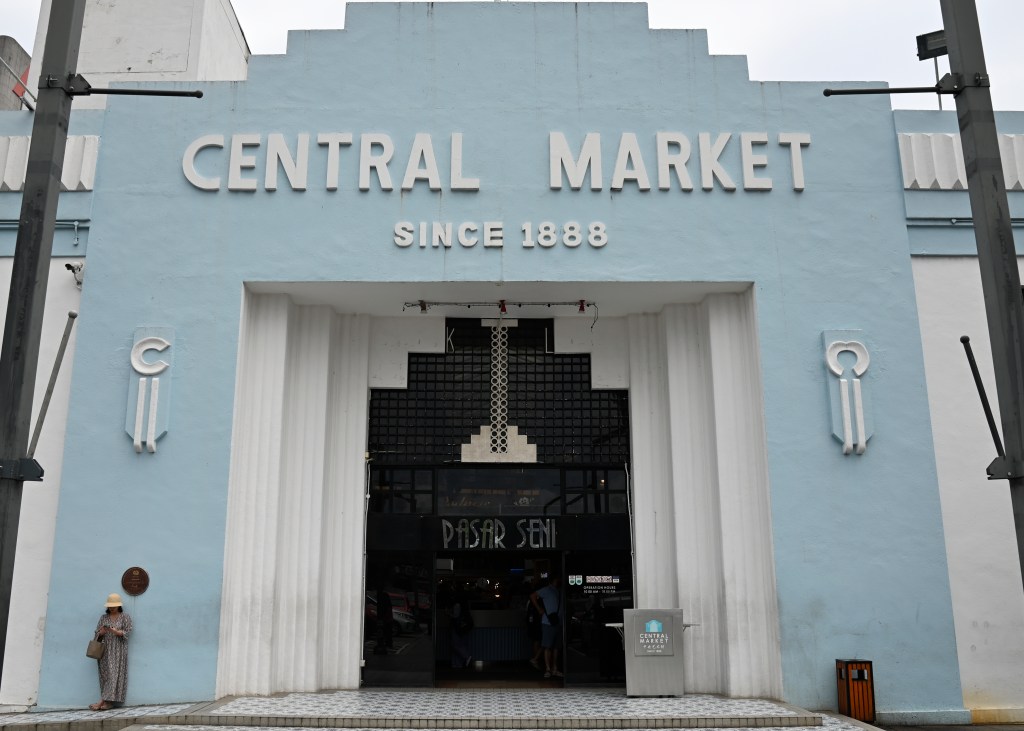
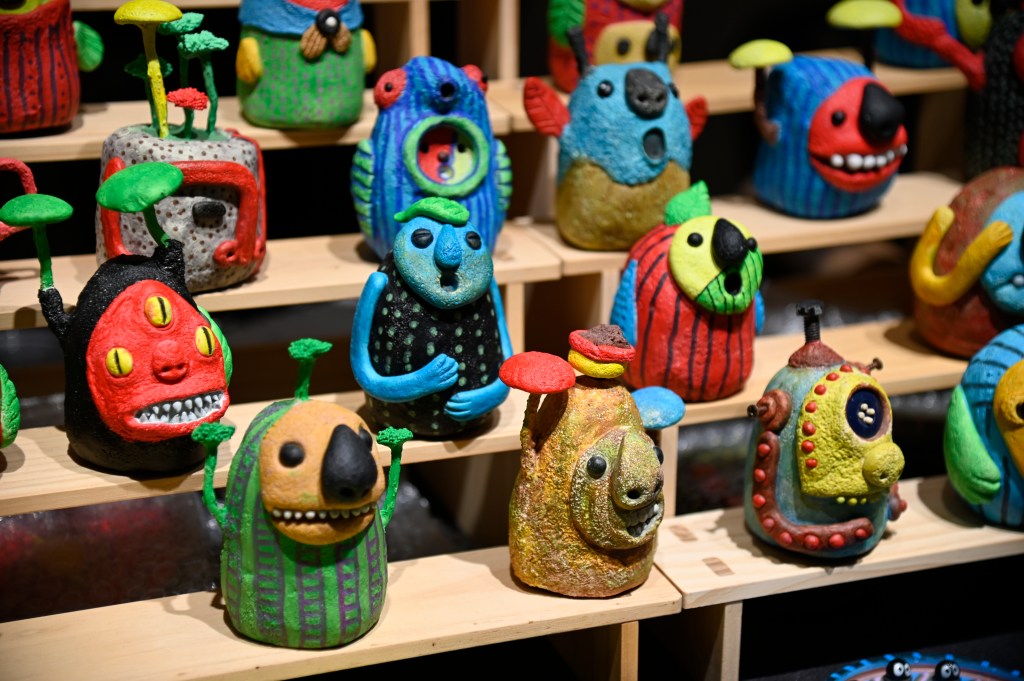
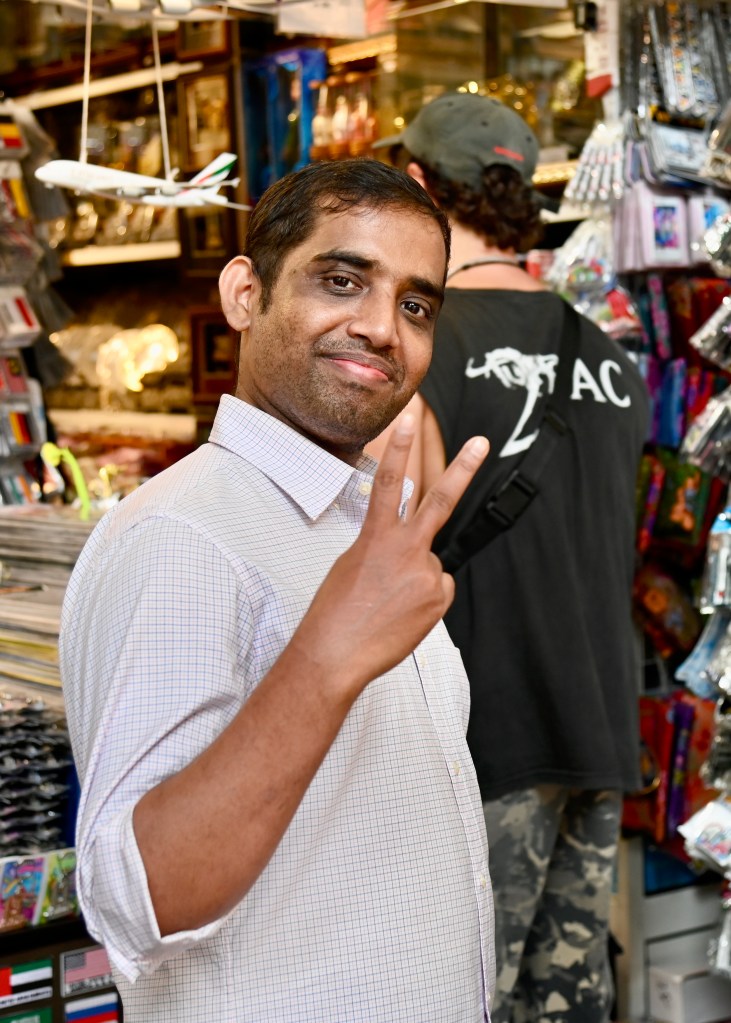
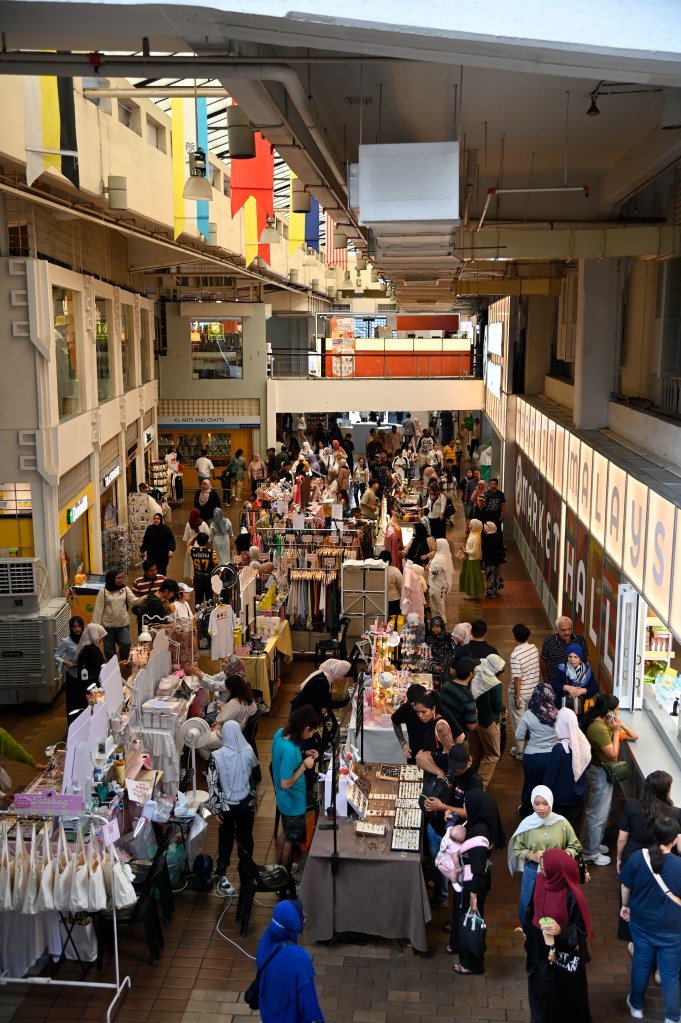
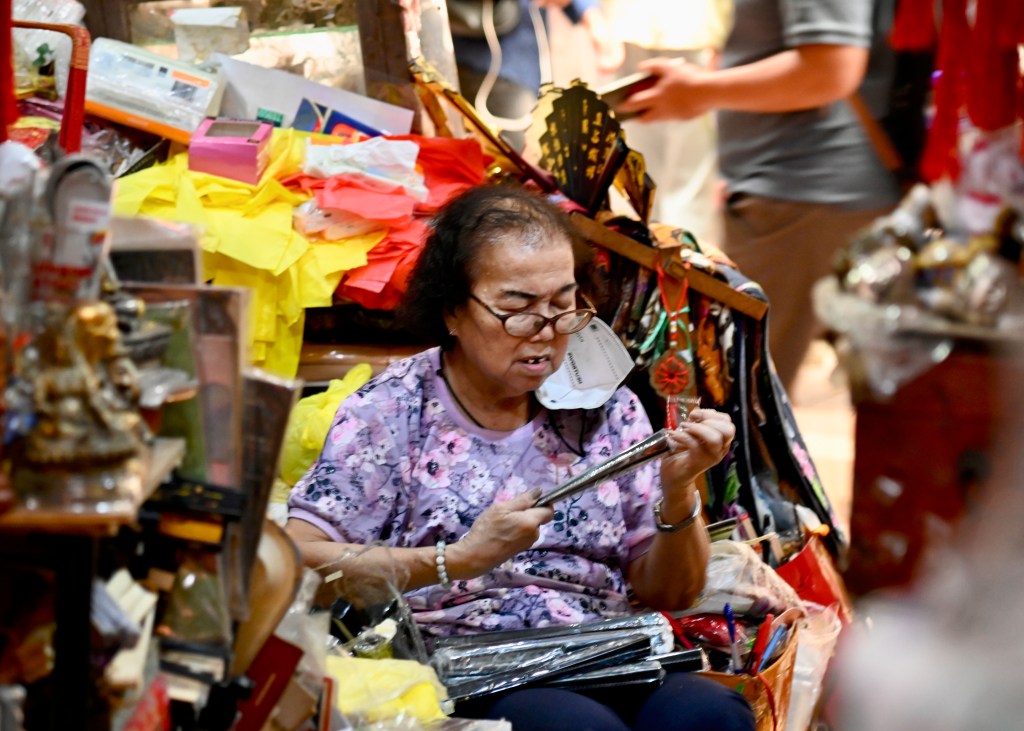
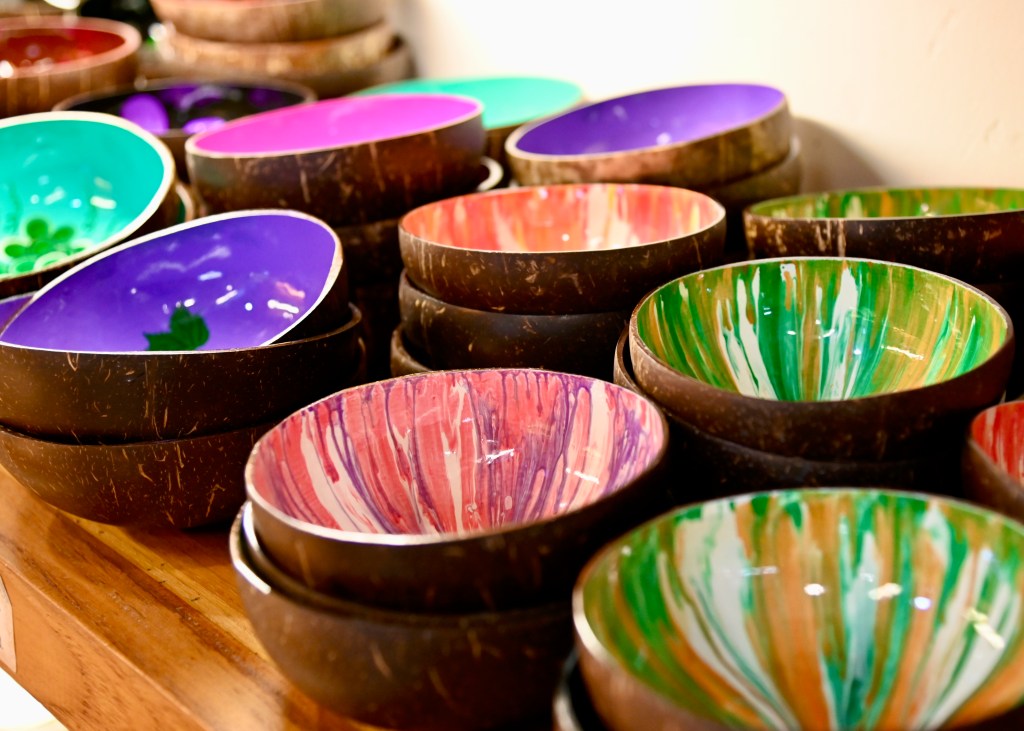
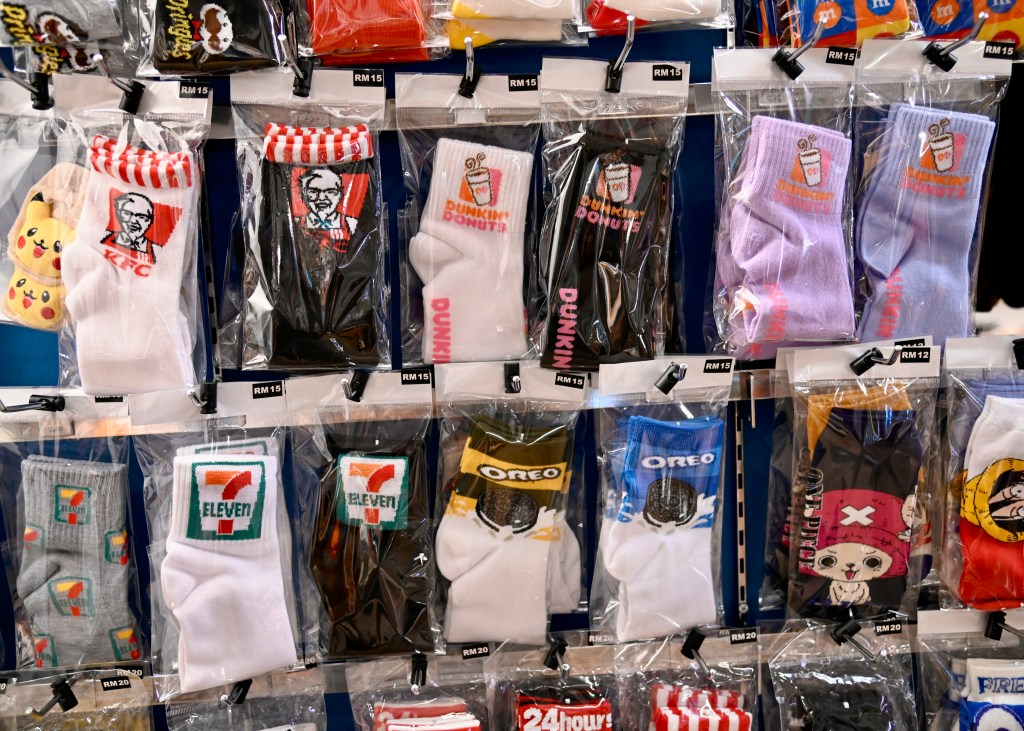
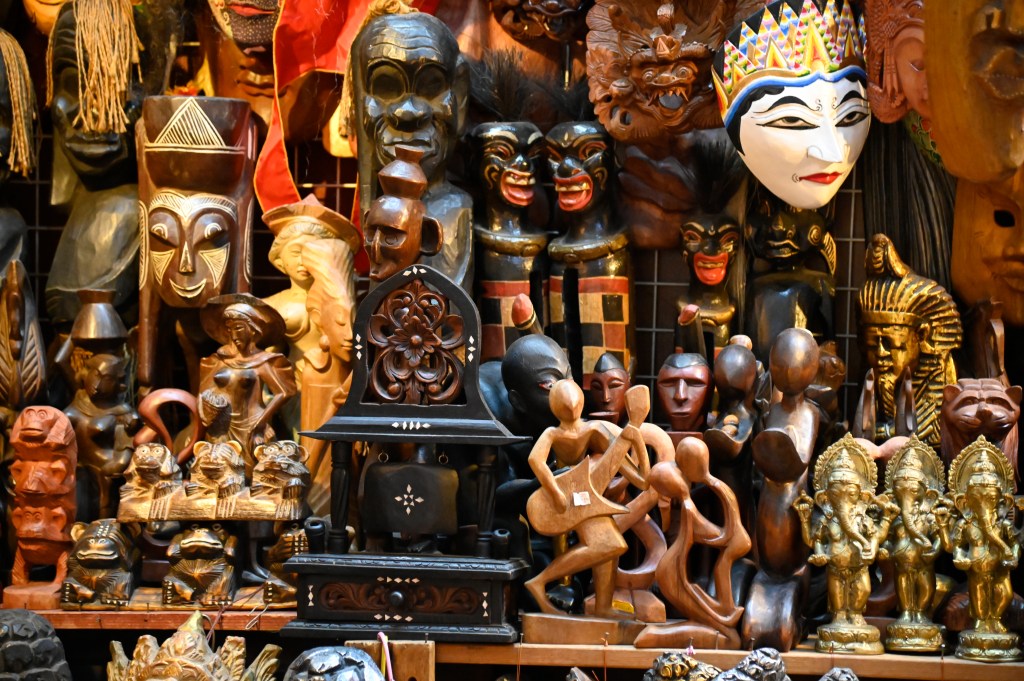
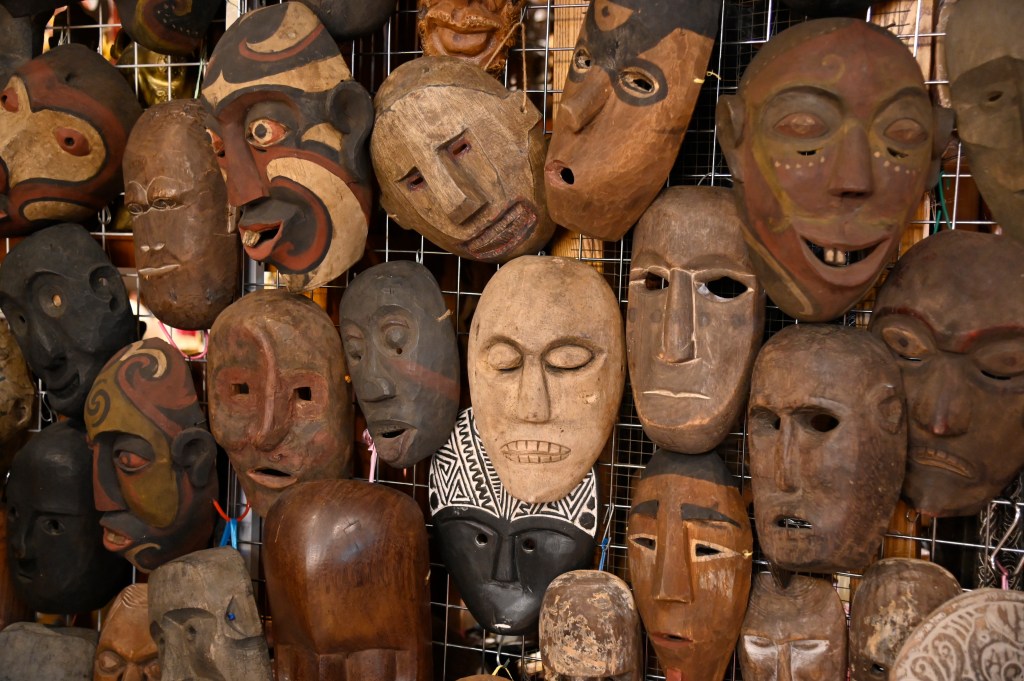
Our last stop was the “Central Market Kuala Lumpur,” in a building that dates to 1937, but at a location that has had a market since 1888. I’d almost spent time there on my first day in KL, but quickly realized what it was and knew I’d be back on day three. It’s got two floors, the second of which is more-or-less a food court, while the first is filled with stalls with clothing and art and tschotchke of all types; hats, shirts, pants, belts, children’s toys, masks, small sculptures, jewelry, food (crackers, chips, candy, dried fruit), coffee beans and ground coffee, books, stickers, pens, model-sized Petronas Towers, brass pots and tea kettles, masks, boxes, lights, bowls, socks, and more. And great people-watching!

But tomorrow – ah, day four – we leave for Borneo!!

Malaysia (Kuala Lumpur) – Day Two

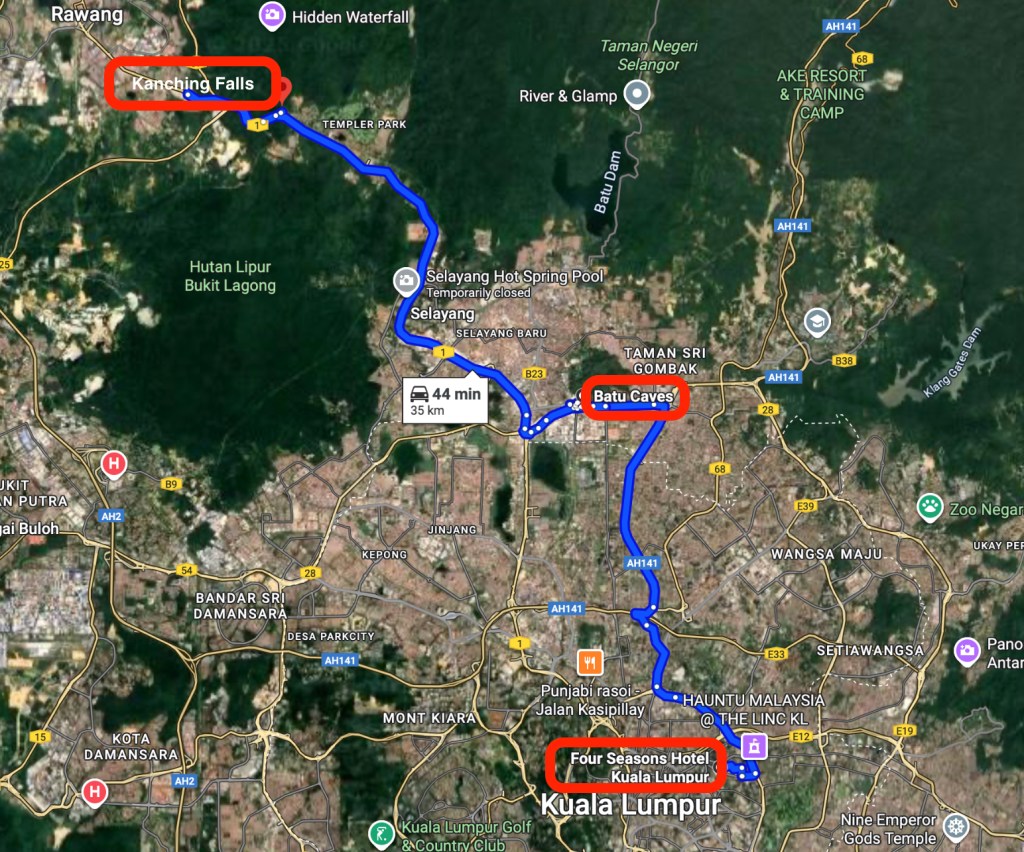
If my first day in KL was about galavanting around the city, getting some exercise in, and breathing some city air, day two was about trying to get outside the city for the day and seeing what I’d be able to visit without having to drive too far away. My ChatGPT queries identified the Batu Caves, the nearby Ramayana Cave, and the not-too-far-from-them Kanching Waterfalls. I found a pretty inexpensive ($38) “GetYourGuide” day-trip that covered all three sites, with a short morning walk to the pick-up site, where I stepped into a small van driven by Vijay with five other people, all of whom seemed to be Americans (though no one actually talked with anyone else).

A map showing the location of Kanching Falls and Batu Caves near Kuala Lumpur, with highlighted routes and nearby landmarks.
Screenshot

It was a Saturday, so lots of people were out on the road in the morning, leaving the city for the day. After about forty minutes we hit gridlocked traffic heading into the massive (like, football field-sized) parking lot for both Batu and Ramayana. Scattered around the exterior of the lot were tons of food stalls, souvenir stands, and places where you could buy flowers to make offerings in one or both of the caves. Our driver had forewarned us about the macaque monkeys that would be around, looking to steal food and shiny stuff from anyone who wasn’t keeping an eye on their things.

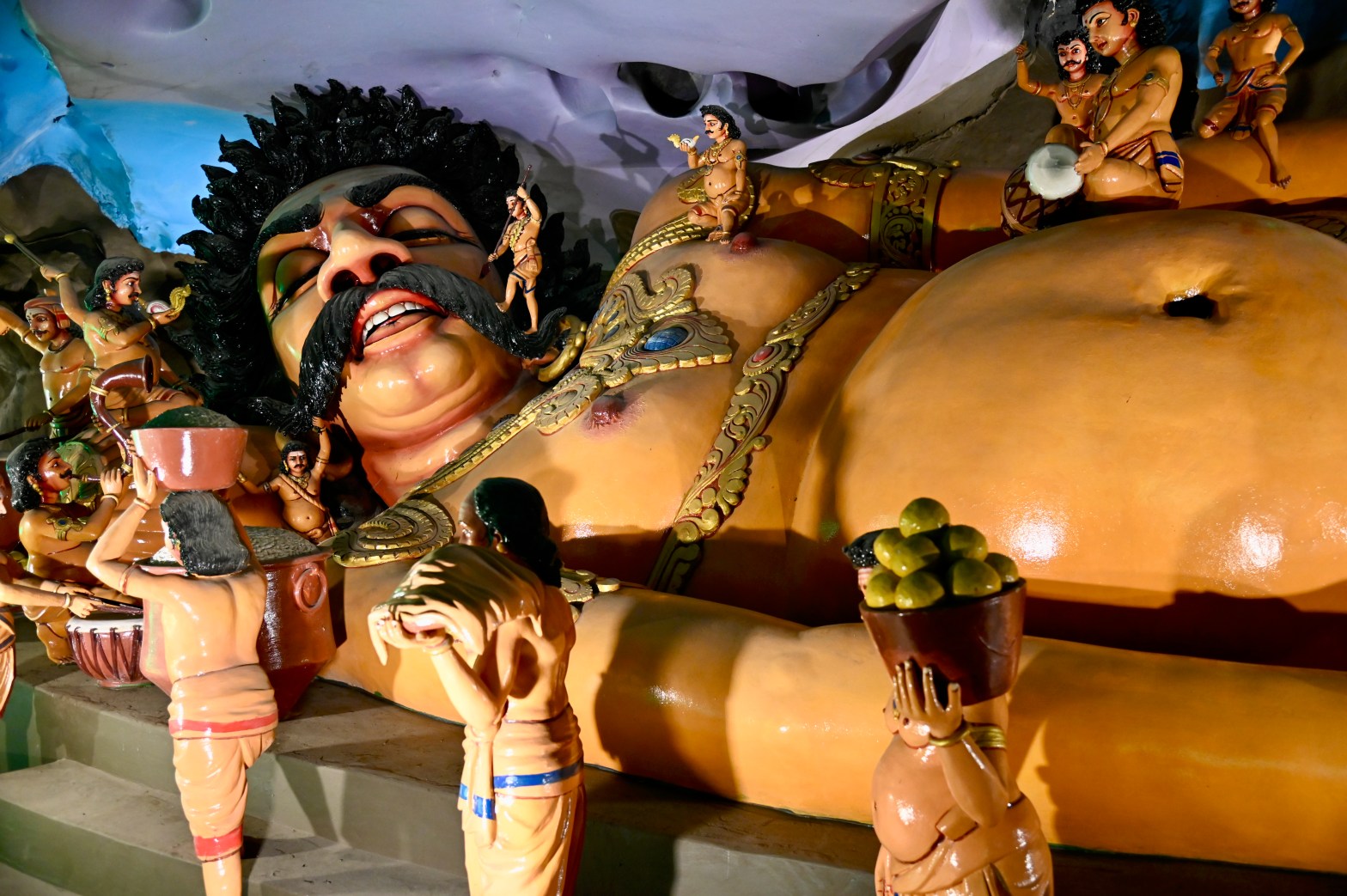
I decided to hit Ramayana first, as clearly Batu was the attraction, and I wanted to save that. The entrance to the cave was on at ground level, but once inside the cave was long and deep and had a series of carved stone and wrought-iron steps to take you up and back to the a deep part of the cave, which is lined with LED lights along the ground and walls. It wasn’t crowded – despite the number of people and cars in the parking lot – a clear indication that Batu was really the attraction here. The cave is dedicated to the story of Ramayana, apparently a popular Hindu tale. The cave is lined with murals and statues representing different characters from the story – and the colors and lighting almost make it psychedelic. The picture at the top of this post is a giant inside Ramayana.

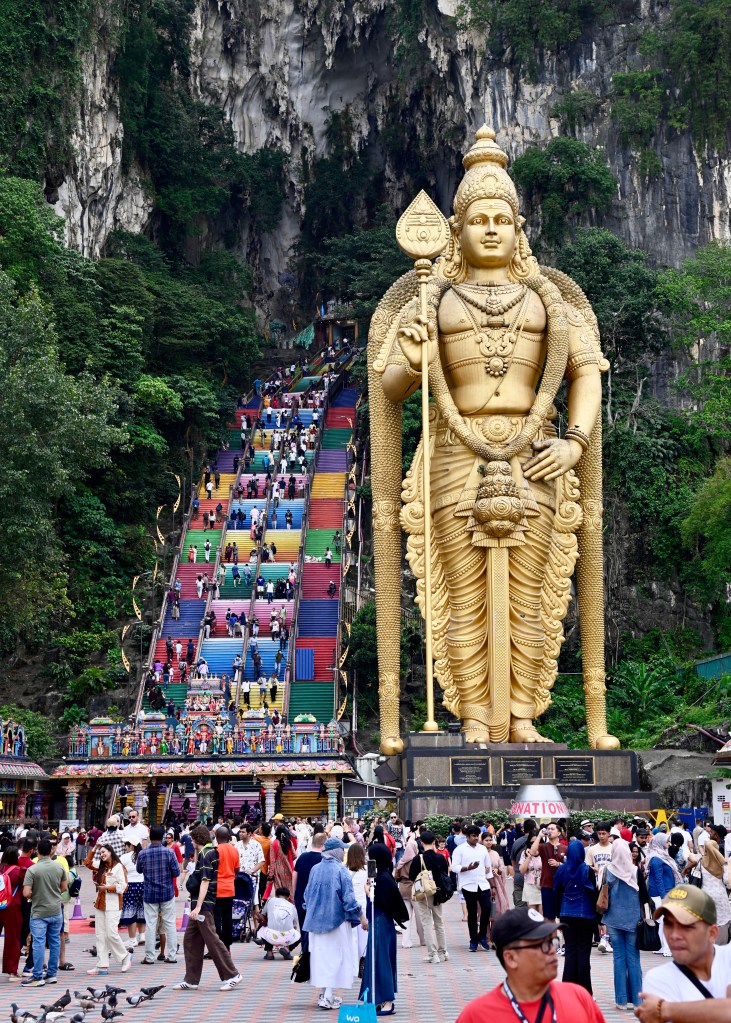
Once I exited the cave (at the same point I entered), I walked about thirty yards down the sidewalk along one edge of the parking lot to the plaza in front of the stairs leading to the Batu Caves. These are inside a limestone mountain and are believed to be over 400 million years old. Inside the caves are temples that date to 1890, and it is the largest indoor temple complex in Malaysian.

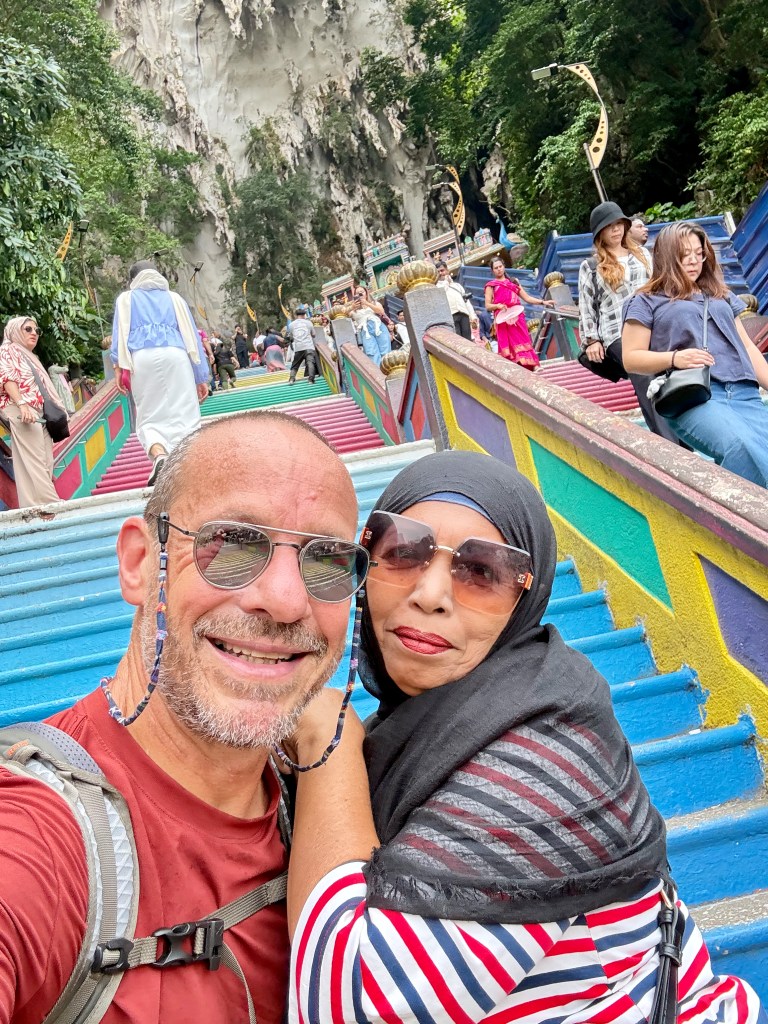
And to get there from the plaza: a climb up 272 steep concrete steps – brightly painted and a photographer’s dream, guarded by a statue of the Hindu god Murugan that is 140 ft tall, weights 360 tons, and made of concrete and steel. It is the tallest statue in Malaysia, and the second tallest Murugan statue in the world.

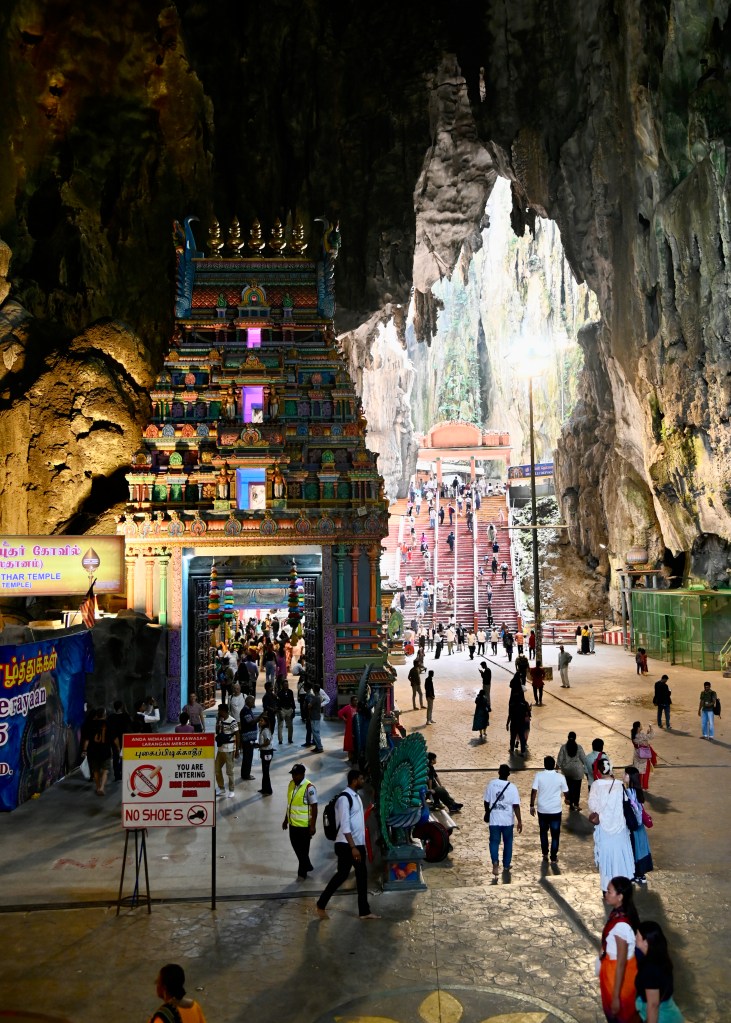
The plaza out front had tons of people – lots of locals – some making the journey to pray and make offerings, others just for the interest. A colorful, vibrant, invigorating scene with the statue overlooking it all. People stopping for pictures in the plaza, and on the steps and in the caves, asking friends and family and strangers to take pictures and waiting for a clear view. Once you get inside the main portion of the cave – incredibly high with holes in the limestone at the very top, letting in light (and water if it were raining) – there are several shrines, places to buy water and trinkets, and even more steps leading to the farthest reaches of the complex.

Walking around the plaza, walking up the steps, strolling in the caves – just total eye-candy and worth the heat-and-humidity (and sweat). And, of course, once you’re done in the cave you have to walk down the 272 steps – your “whoa muscles” hard at work. And -btw – there are no shortcuts that I saw – in fact, I saw some workers carrying boxes up the steps to the kiosks inside the cave.

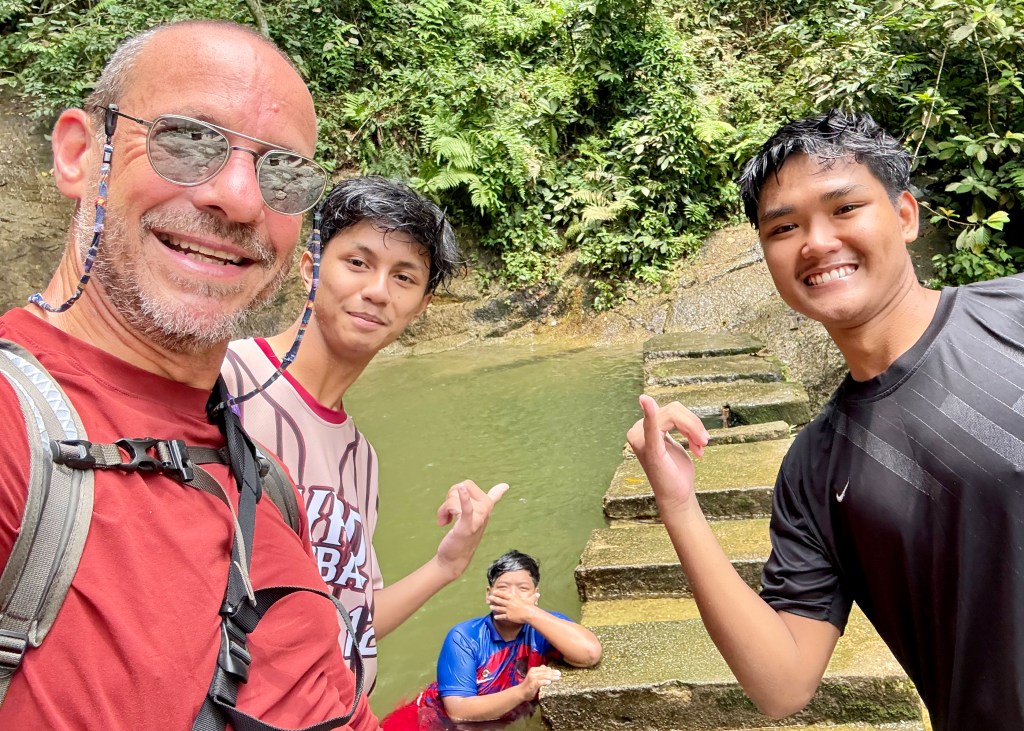
The next stop – about 20 minutes away by van – was the Kanching Waterfalls, a series of seven levels of waterfalls, gradually up the side of a small mountain, with a marked trail from the parking lot initially concrete, then dirt. Vijay, our driver – who walked with us – told us we would go to level three only ( the fourth level, he said was “at your own risk”, but I was thinking – wasn’t the whole thing “at our own risk?”). At the bottom of each falls were natural pools with no rocks at the bottom, making them great spots for swimming (which I didn’t do).

We walked past levels one and two, then stopped at level three. Given that it was a Saturday, there were lot of locals there – several small families and teen-age boys and couples – swimming, picnicking, just relaxing and enjoying themselves. And – hundreds of wild monkeys looking for food, grooming themselves and each other, sipping from the water pools. Our driver Vijay asked me if I want to go to level four and pointed the way – up more steps, then a jog to the right where there were taller and more robust falls. More small families, boys, and couples, and monkeys. Clearly a nice way to spend a Saturday afternoon. 

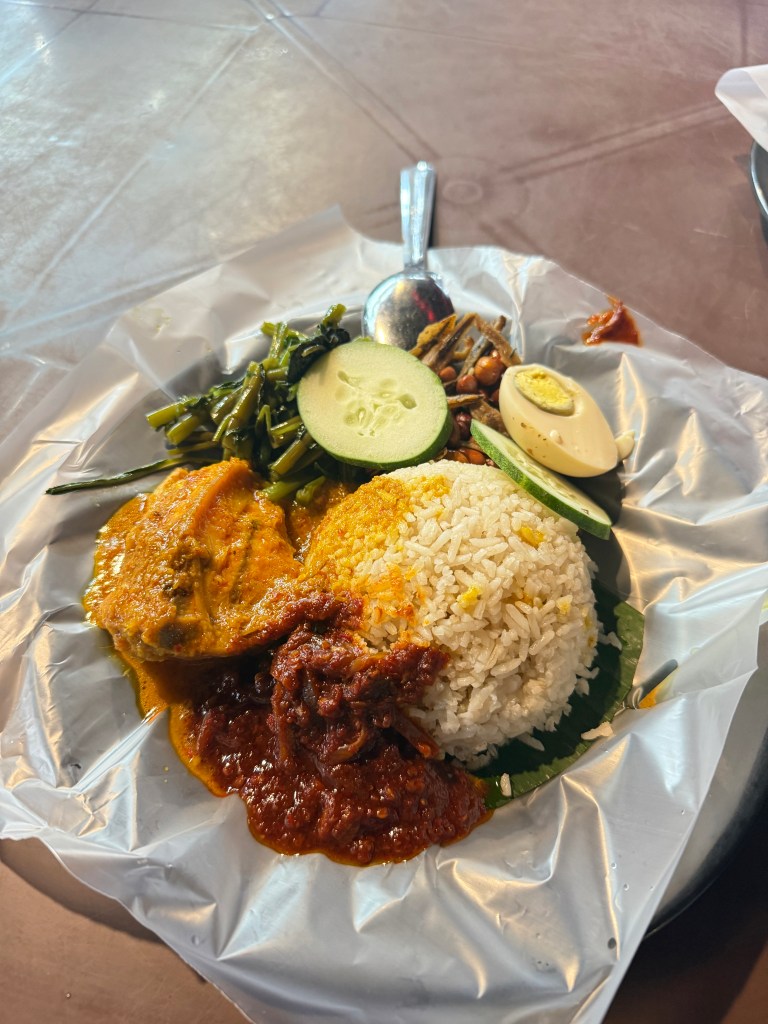
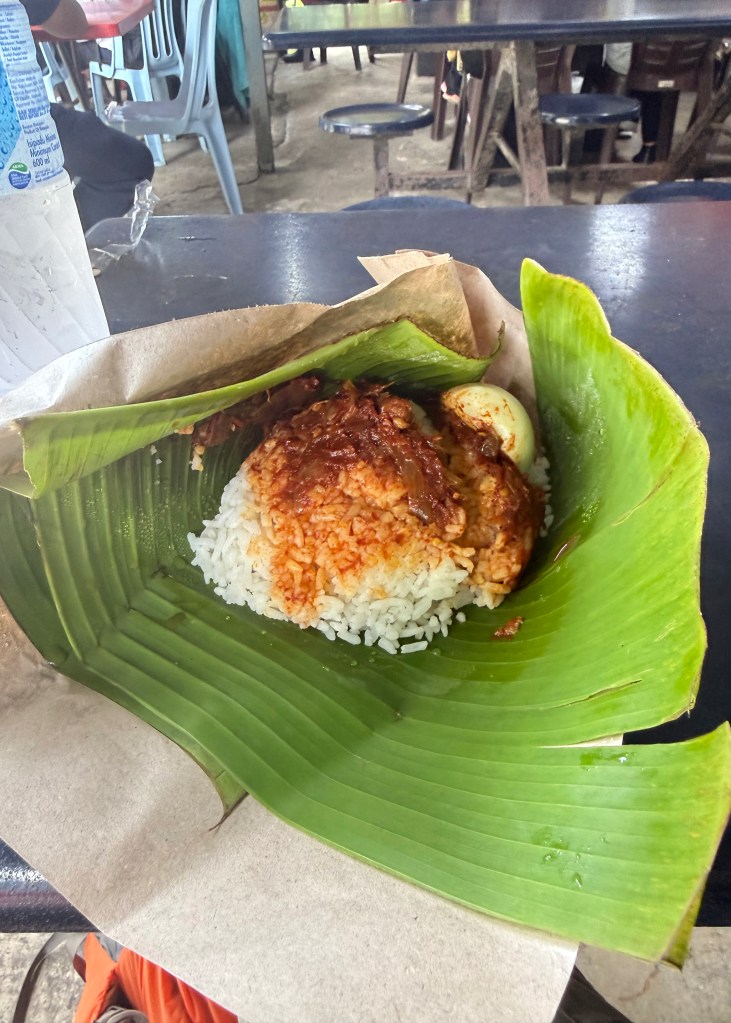
By that time, I was getting hungry, so headed back down the path toward the parking lot, where there was a small stand with a variety of food for sale – chips, candy, sodas, water – but I was indecisive until the proprietor offered me a banana leaf-wrapped package of rice with spices and an egg (I didn’t eat the egg!). I had no idea what it was (until later that night), but it spelled my appetite. 

After a little nap at my hotel back in KL, it was time for a Saturday night in Kuala Lumpur. If the prior evening was about a 14-course meal in a Michelin-starred restaurant, this night would be about street food. I found another GetYourGuide offering – this time a night-time food tour at the Jalon Alor markets. It turns out that I was the only one on the tour and that the guide was a professional chef named Faris, raised locally, who had come into the city for the day with his wife, daughter, and 13-year old son, the latter of whom would join us on the tour.

He asked me about food allergies and what kind of food I liked; no allergies, and “I’ll eat anything, just don’t take me to eat ‘tourist food’ – I don’t need to have a cricket on a stick.” He liked my answers, and we were off.

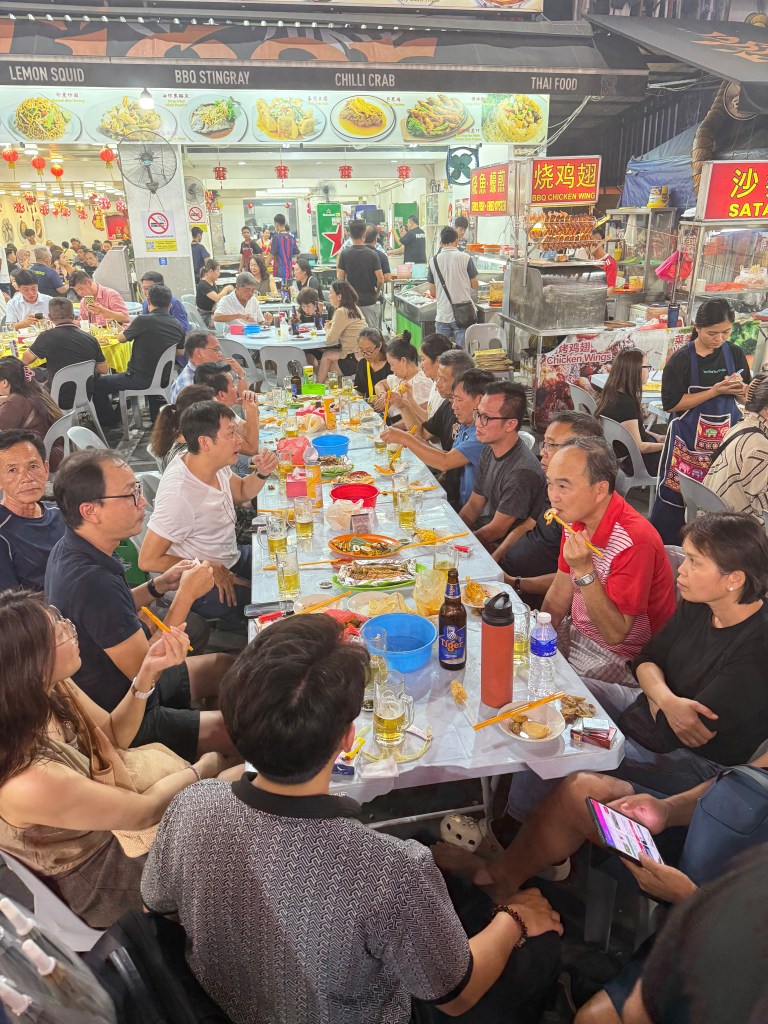
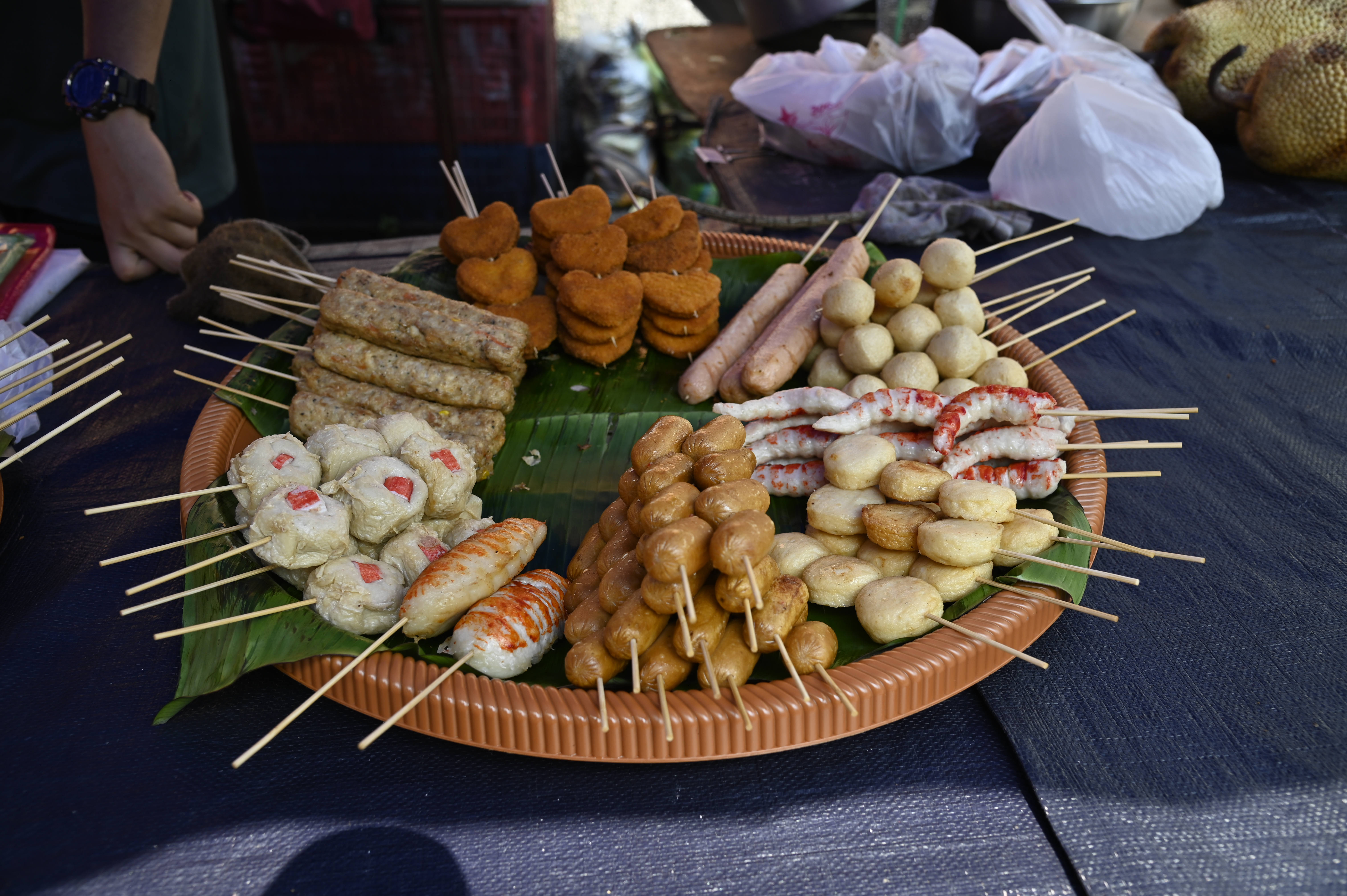
The food market was crazy busy – probably 4-5 blocks long, with stand after stand and restaurant after restaurant and just a hugely crowded scene.  Faris said that 99% of the people there were tourists – including the vendors – and that it was this busy all the time. He explained that he doesn’t cook professionally anymore, but that he does cook at home (though his son said that his mom was the better chef!), and he does do these food tours, so he knew where to go and what we would eat.

Over the course of the next 2 1/2 hours, we made five stops to eat six things:

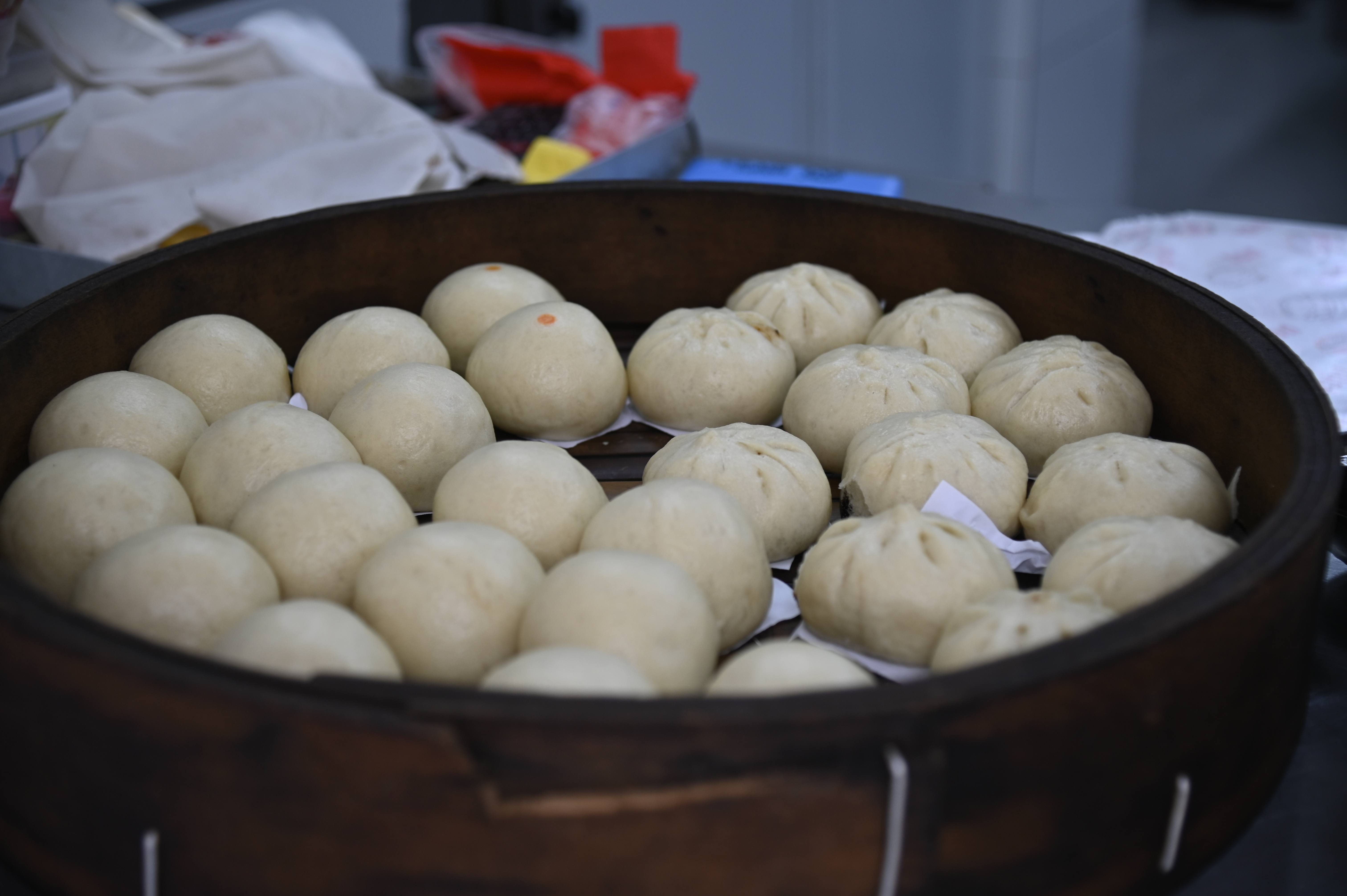
  • Char siew pow – a pork bun – with the bun being more flaky and baked then steamed and soft; these were in a display case, so the proprietor just pulled ones out for us.
  • Putu piring – steamed rice flour with palm sugar and coconut; typically a dessert, but he wanted me to taste it earlier in the night. We watched two guys make batch after batch of these at their small stand.
  • Nasi lemak with chicken rendang – a traditional dish:  rice with chicken, a spicy sauce, fried anchovies and peanuts, cucumber, braised greens, and half an egg.  It turns out that this is what I’d eaten that afternoon at the Kanching Falls (though I only had the rice, sauce, and egg). Tonight’s was at a busy, busy stand, with small tables set-up in front of it, and we ate it along with a type of tea served in a plastic bag that you could tie around your wrist to walk around with. Nasi lemak was Faris’ son favorite food; he had his with fried chicken.
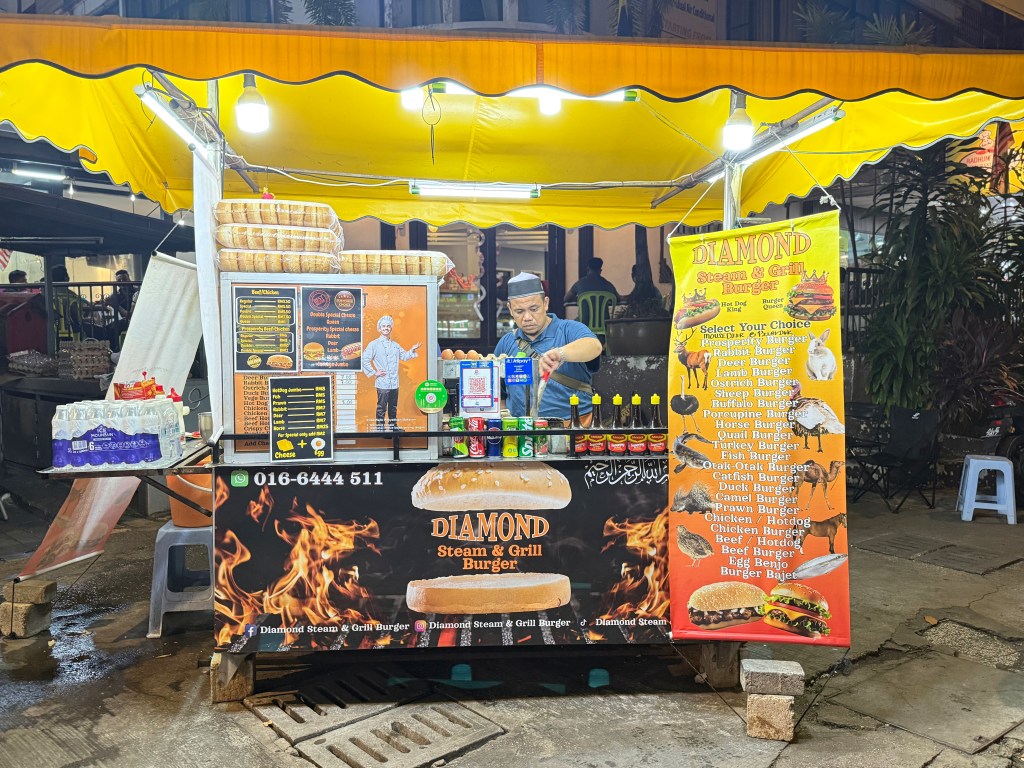
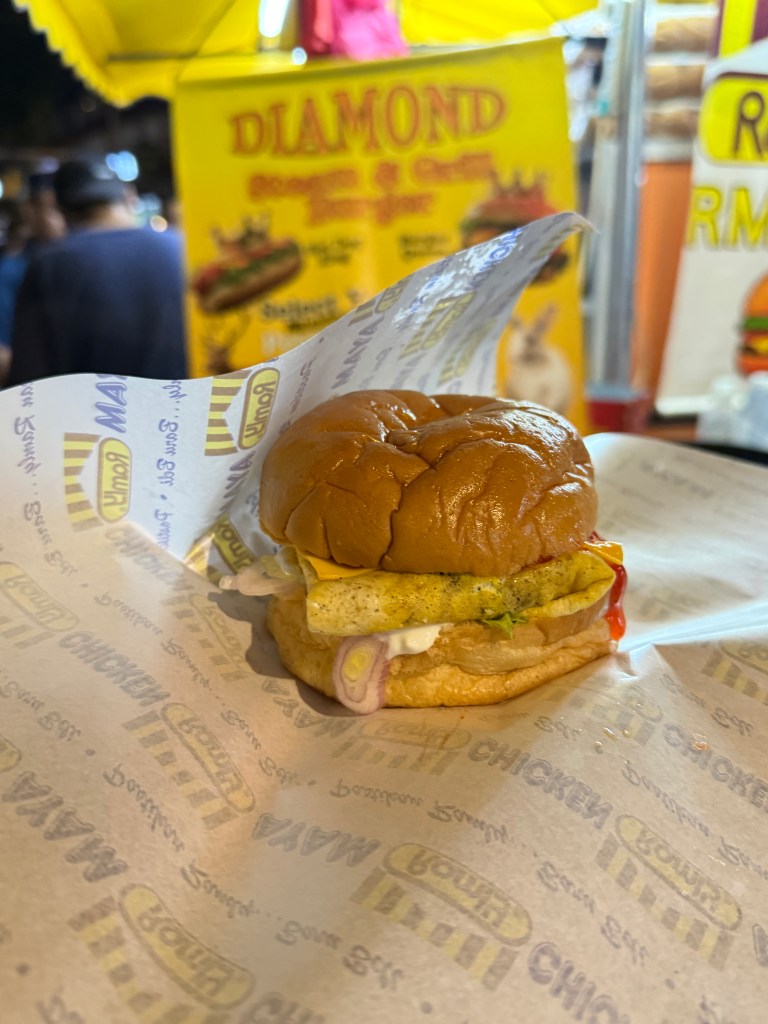
  • Ramly beef burger special – a smashed burger patty, wrapped in an egg, with a special sauce, mayo, lettuce, and tomato on a steamed bun – this is cheap, cheap late night food and unbelievably good. This was a small cart – like a hot-dog cart – and we watched the owner cook the burger and put the whole thing together. I was already full before we got to this, but I just had to try it and gobbled it down.
  • And – at our last stop – roti canai – a traditional type of Indian flat bread – the “best bread in the world” – served with lentils and/or condensed milk (we tried both), along with teh tarik – a traditional Malaysian hot tea. These we ate at an open-sided restaurant, nearby one of the main thoroughfares in the neighborhood.

What a night of eating and eye-candy. I was stuffed . . . and Faris pointed me in the direction of what he called “heaven” for tourists and late-night denizens: a busy bar zone with lots of outdoor seating, live music, traffic, pushy waiters, and people from all walks of life.

I walked through heaven, then back to my hotel, where I ended my night with a drink at the (much quieter) hotel bar.

Malaysia (Kuala Lumpur) – Day One

Upon arrival at about 8 a.m., and after about an hour wait for my luggage at the airport (exactly what I wanted after 26 hours of travel!), it was then another hour to get from the airport to my hotel by car. But it felt good to finally be someplace where I could relax, get a good breakfast, and shower before my day out in the city.

Kuala Lumpur is the largest city in Malaysia, at 2m people (8.8m in the greater metropolitan area). Founded in 1857, in Malay its name means “muddy confluence” (maybe not the best marketing), and it has three of the ten largest shopping malls in the world; a local explained to me that the reason they love malls is because of the air conditioning.

Of course, I’d done a bit of on-line investigating prior to my arrival to figure out how to spend a day in the city. Some of my best sources are the NY Times’ “36 Hours in . . . ” series, TripAdvisor, and a simple search. But – if you haven’t tried it yet – give ChatGPT a whirl for a recommended itinerary. You’ll want to give some context on what you like to see and do – walking vs driving vs public transportation, museums/religious sites/parks/architecture/shopping, what days of the week you’ll be there, how many hours you’ll be out, and the like. But keep in mind that ChatGPT won’t necessarily know the details of what’s going on NOW (such as openings/closing times or maintenance issues, current exhibits) – in two instances I learned this the hard way – so you’ll want to do some of your own snooping. But I’ve used ChatGPT in several cities, and it works just great.

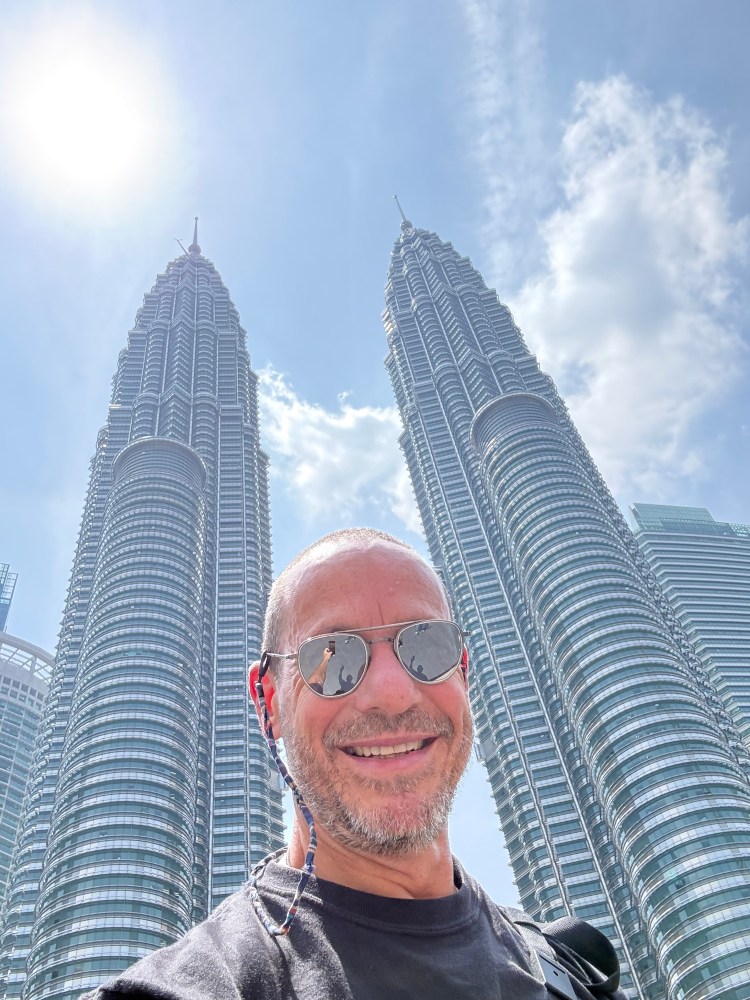
So – I was off. I’d already decided that this would be a day of walking, despite the distances to some sights I wanted to visit, because after sitting on an airplane for as long as I had, without exercise, I wanted to stretch my legs and get some fresh air. Of course, it was hot and humid air – the temps were probably in the 90’s – and I sweat ALOT – but it felt good. Nearby my hotel were the Petronas Towers – a pair of interlinked towers, each 88 stories high and, from 1996-2004, the tallest buildings in the world. Photo opp!

Selfie in front of the Petronas Towers in Kuala Lumpur, showcasing the tall twin skyscrapers against a blue sky.

My first stop was to be the Kuala Lumpur Eco Forest Park – apparently a garden- and tree-filled oasis in the middle of the city with elevated walkways that enable views of the city and the top of the forest. But . . . it was closed for renovation! So much for ChatGPT! But on the way I did get a chance to stop at the (sad-looking) Telecom Museum – which had a much-needed public bathroom.

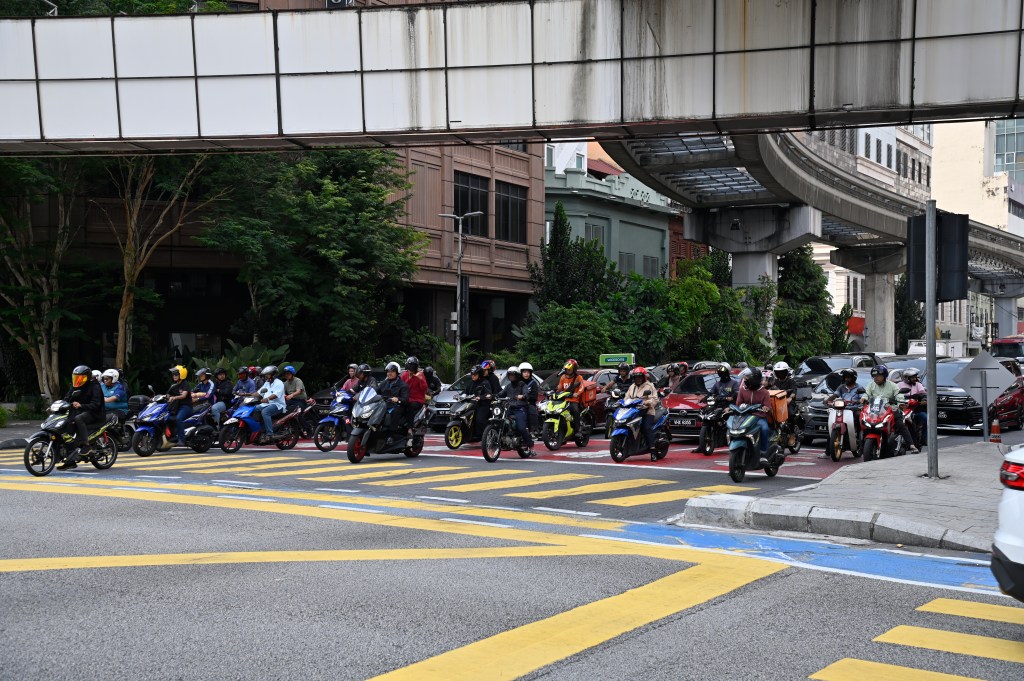
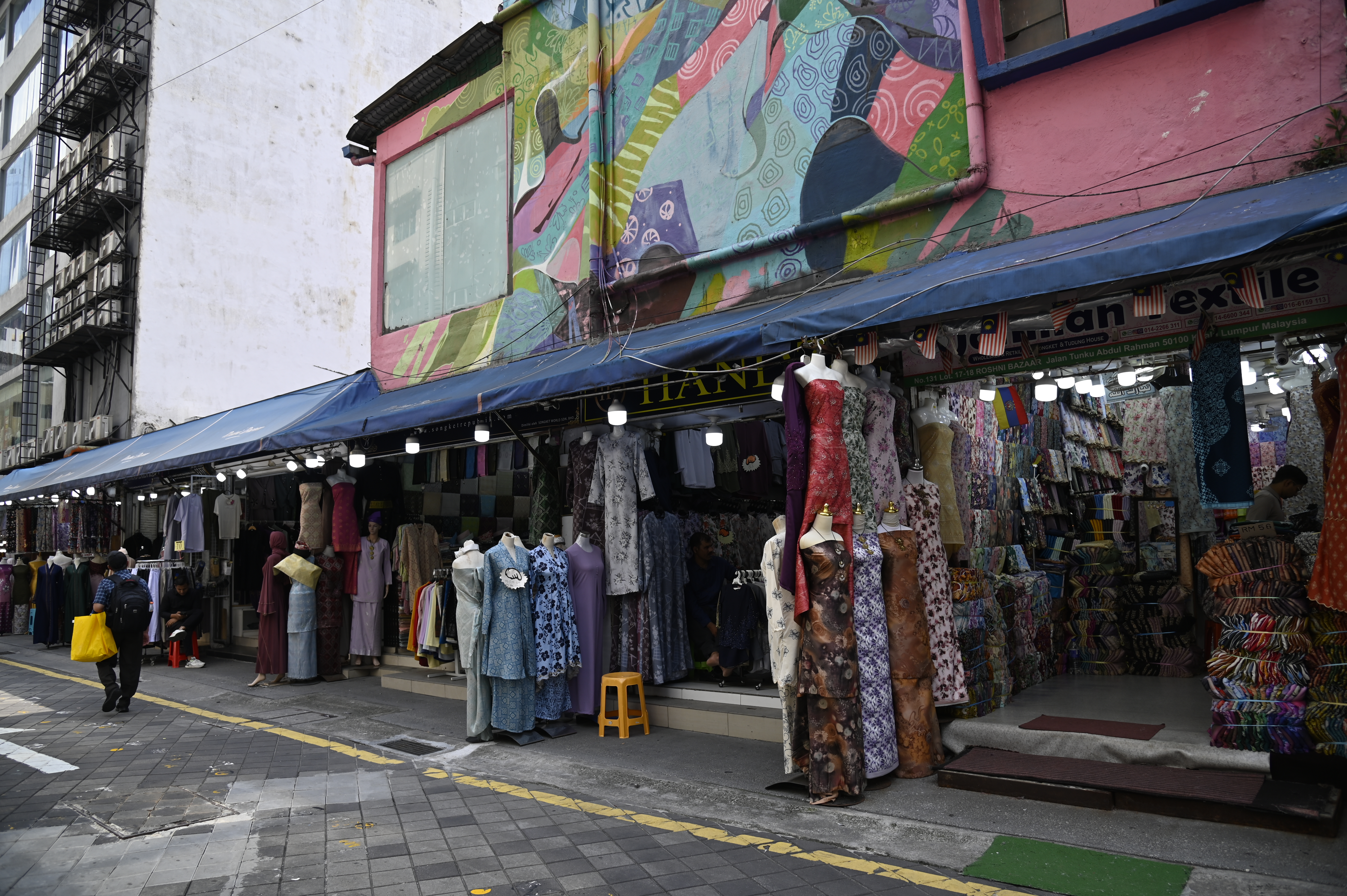
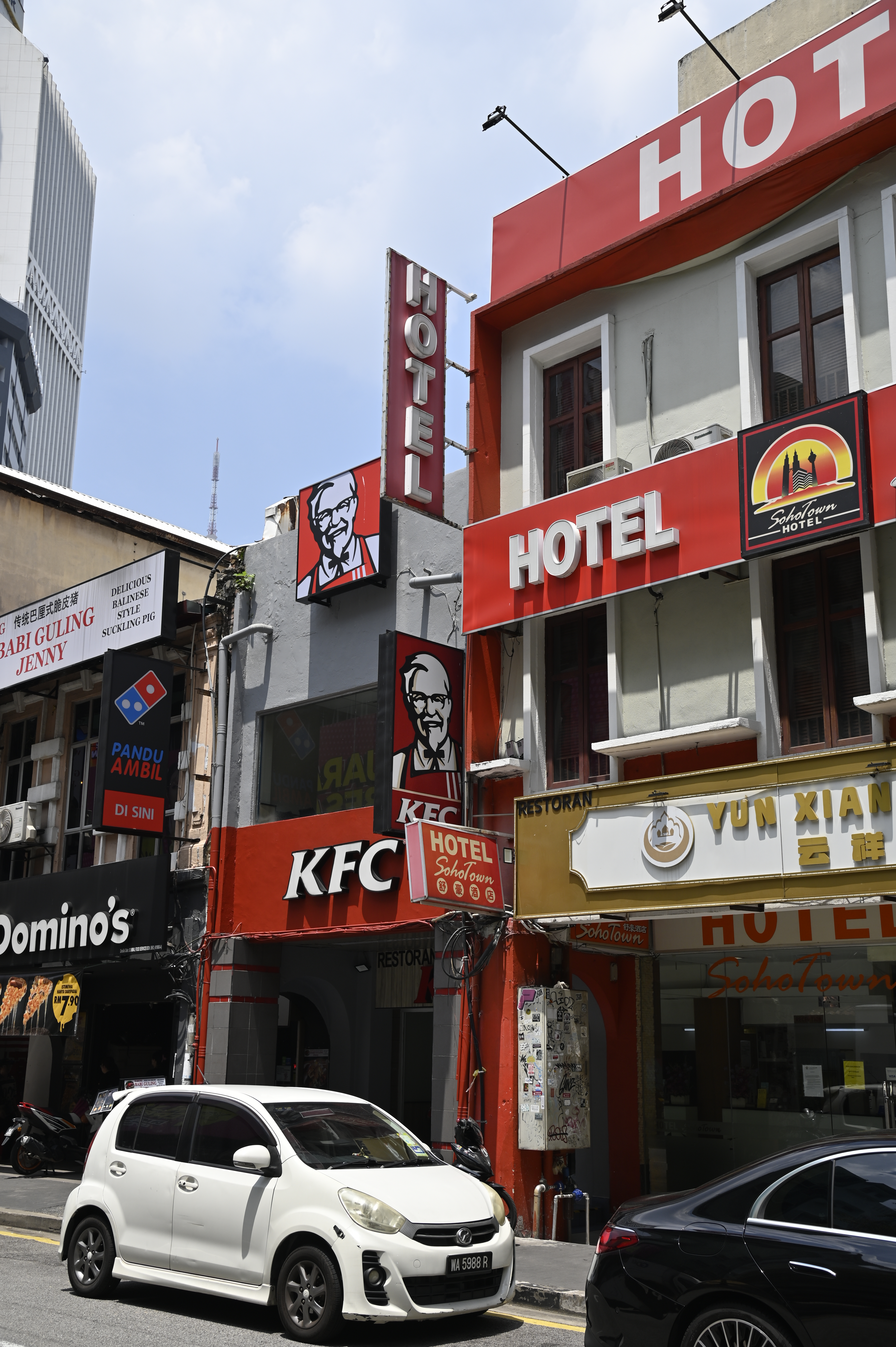
From there, though, (almost) all was successful. The city has a remarkable blend of towering skyscrapers, including the Merdaka 118, the second tallest building in the world, and narrow streets lined with small retail shops for the locals – an innumerable number of clothing shops among them. The wider boulevards are loaded with motorcycles (though not nearly as many as Ho Chi Minh City), cars, and trucks, and the smell of exhaust along those main roads is, well, horrible. So you’re torn between keeping an eye on the traffic, looking in the windows of all the retail (hotels, restaurants, cafes, hostels, lots of little shops selling cheap men’s and women’s clothing – dresses, wraps, head scarves, men’s slacks, polo shirts; most joints empty of customers and only with bored staff sitting out front. How do they all stay in business?) and looking skyward at all the skyscrapers. I wouldn’t say it’s a beautiful city – at least not the parts that I walked through – but it is sprawling and, like all big cities, teeming with activity and noise and the the urban mix of high-and-low.

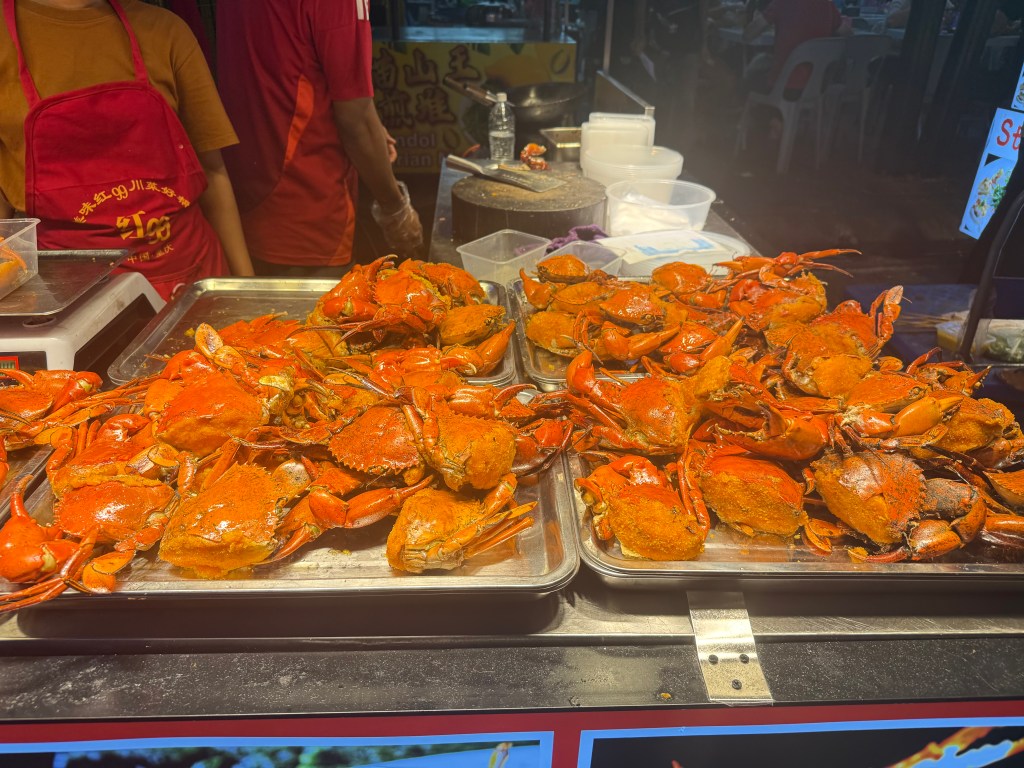
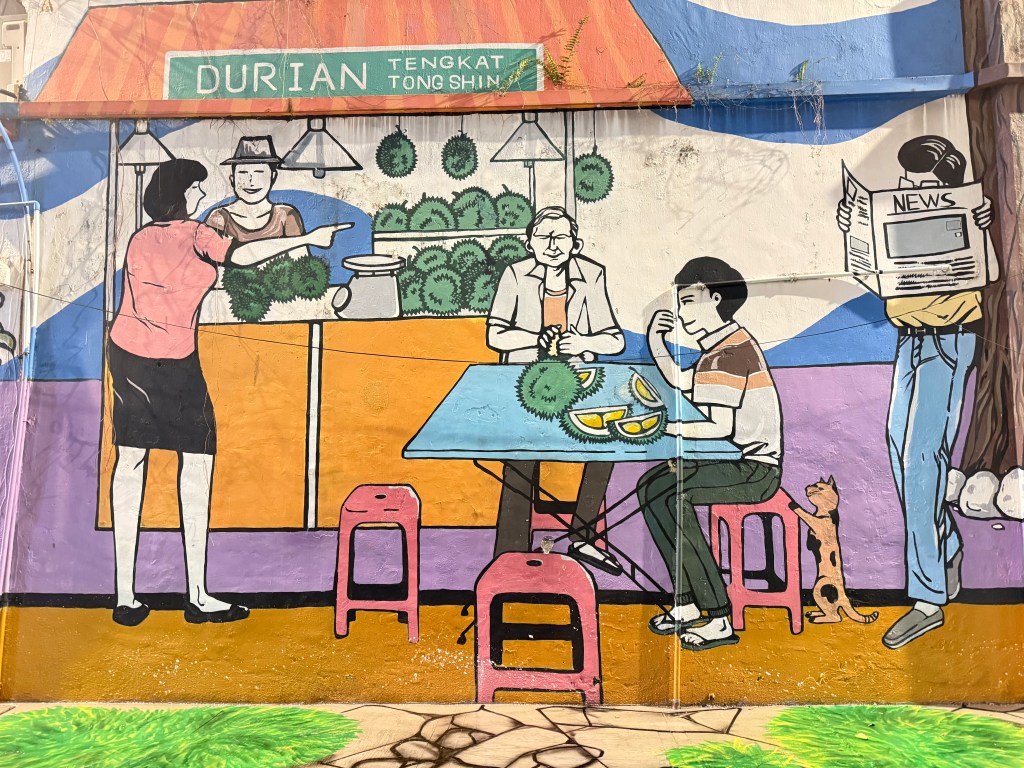
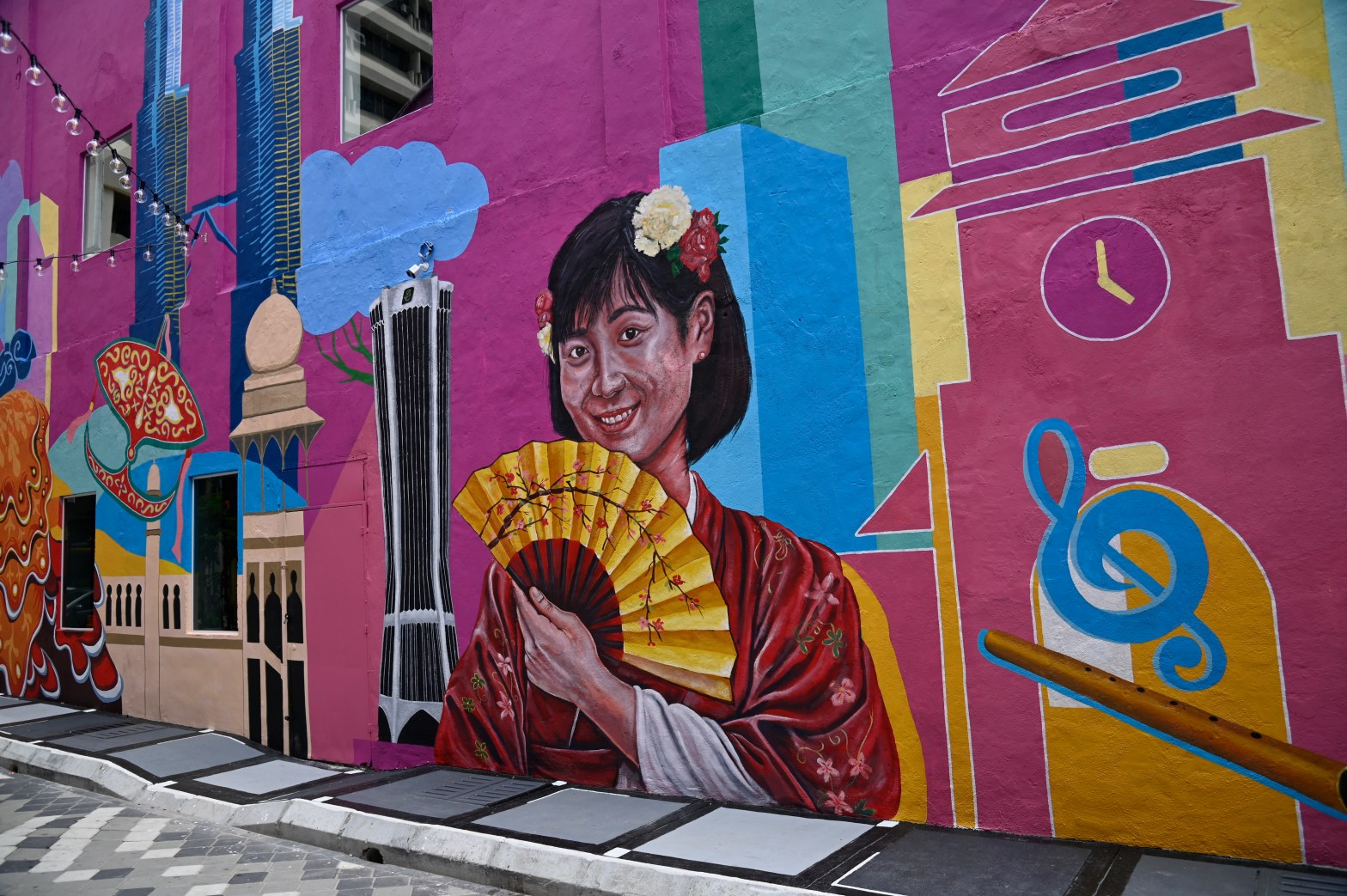
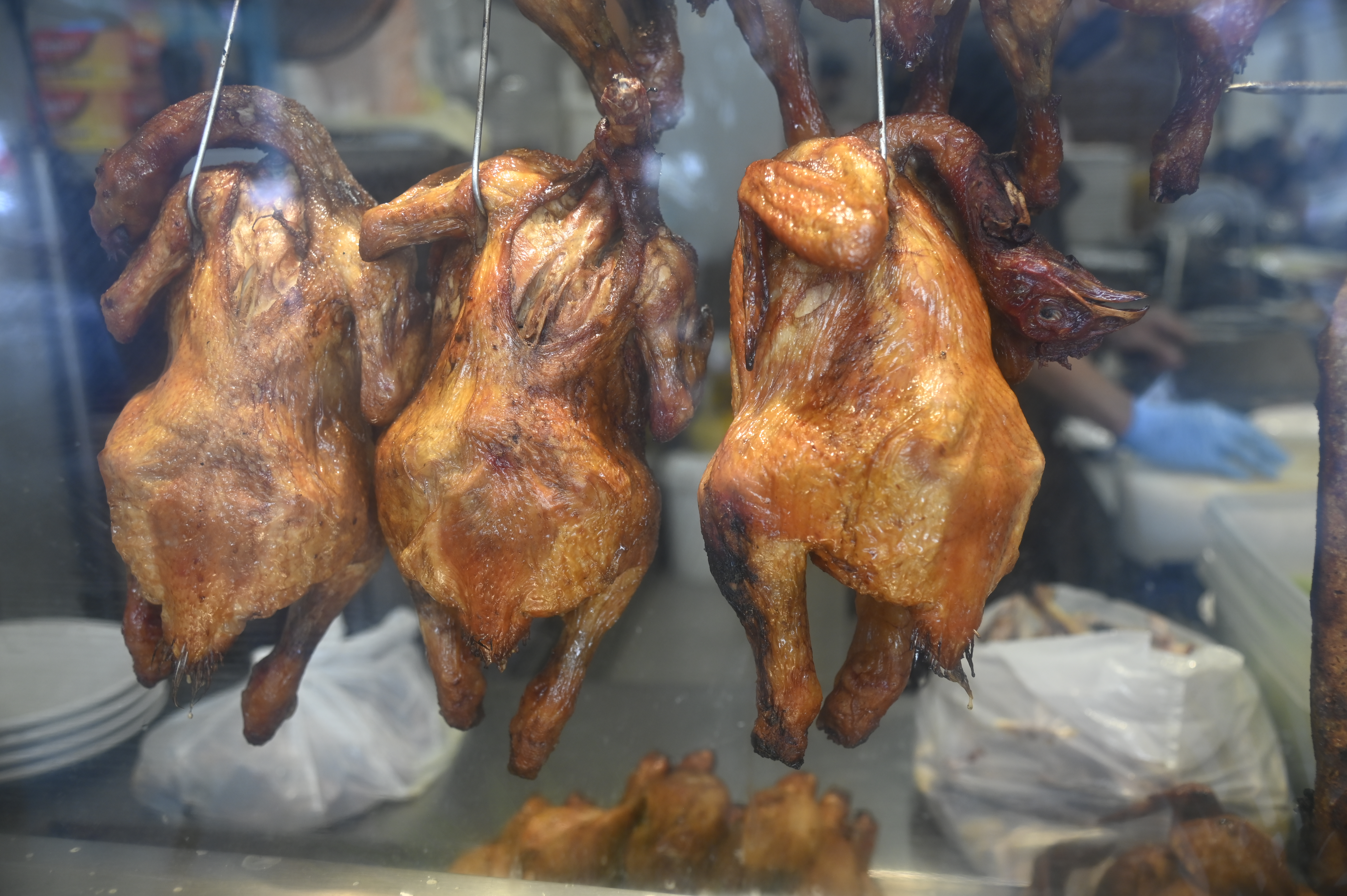
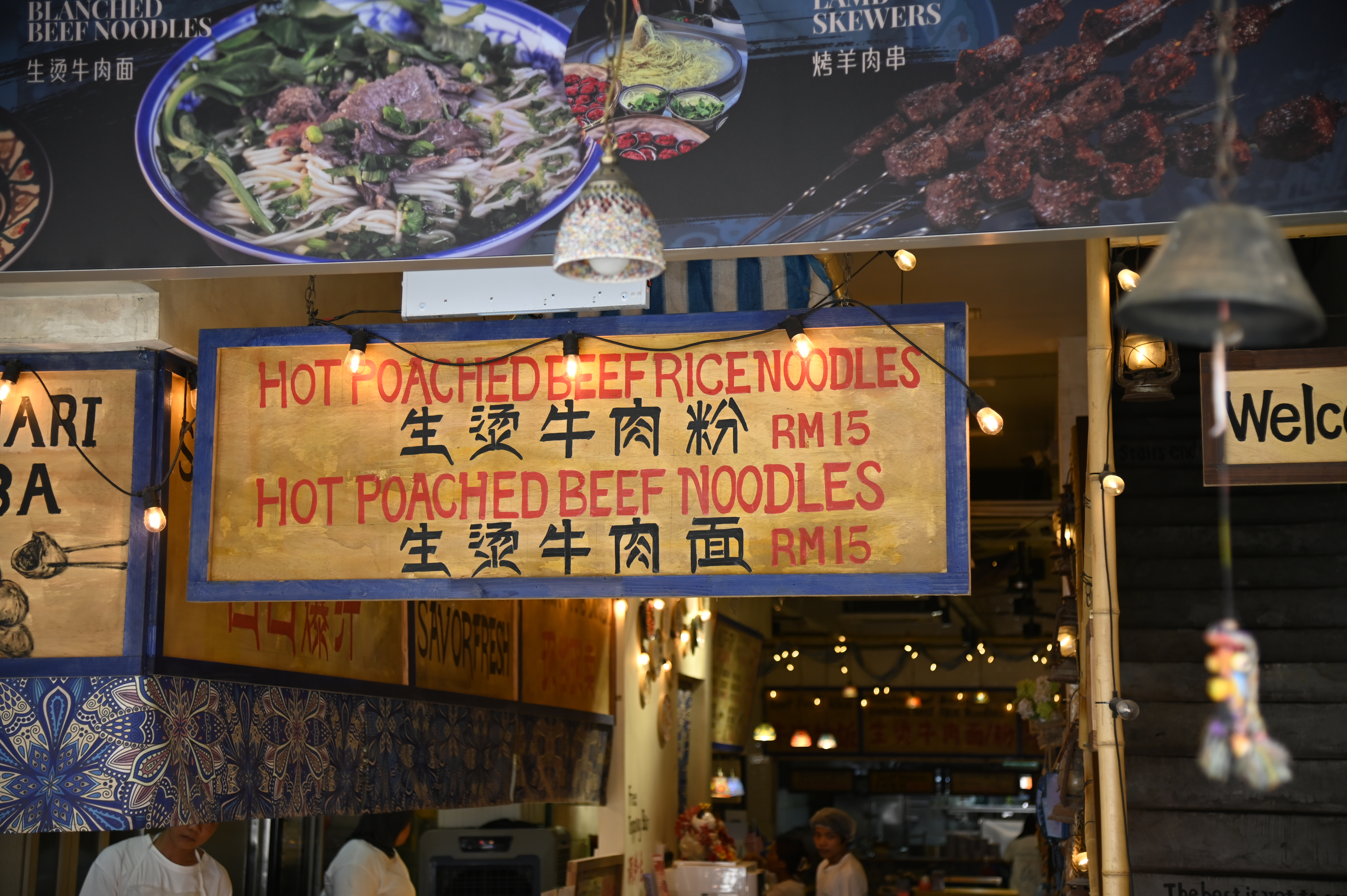
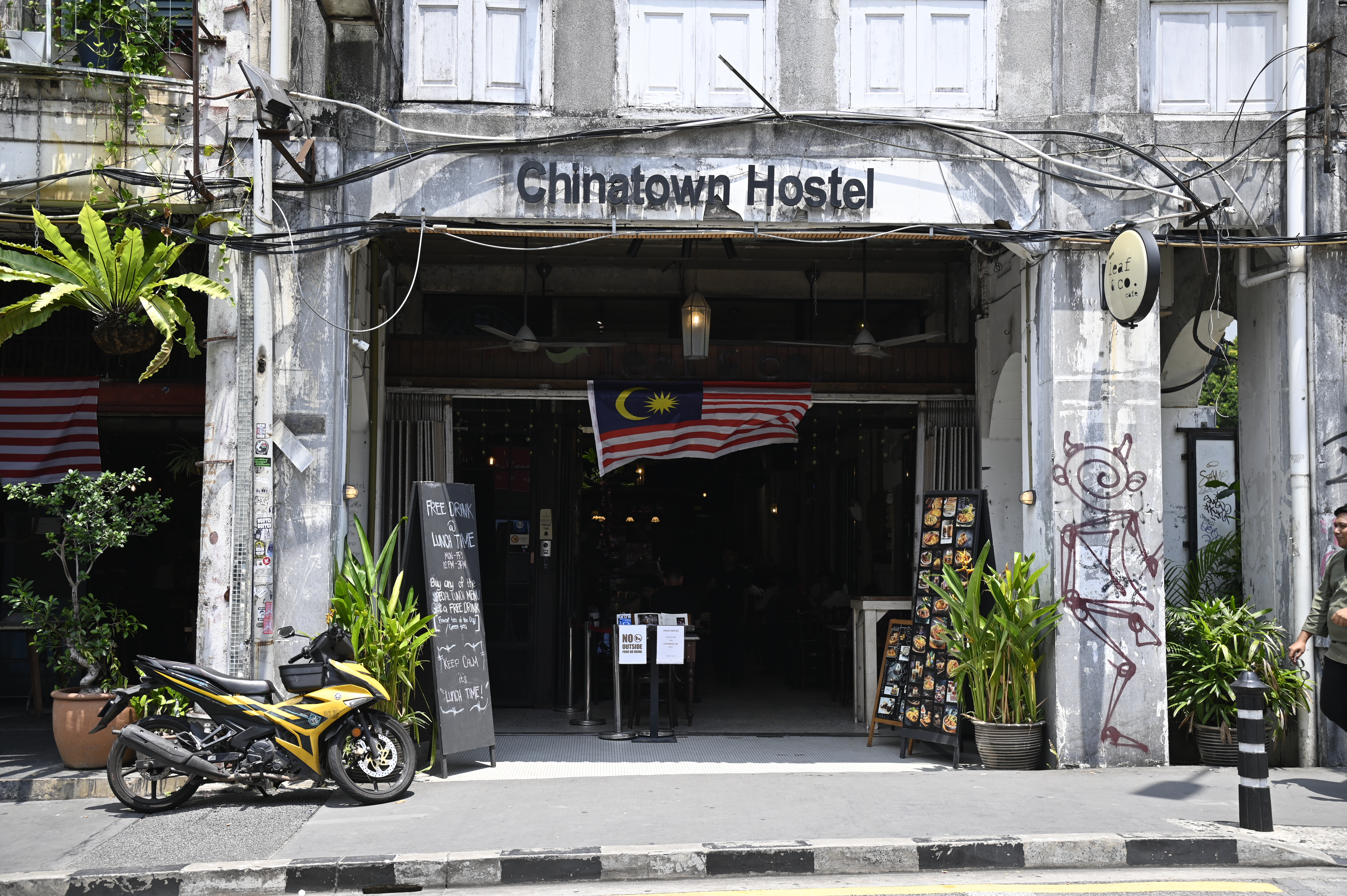
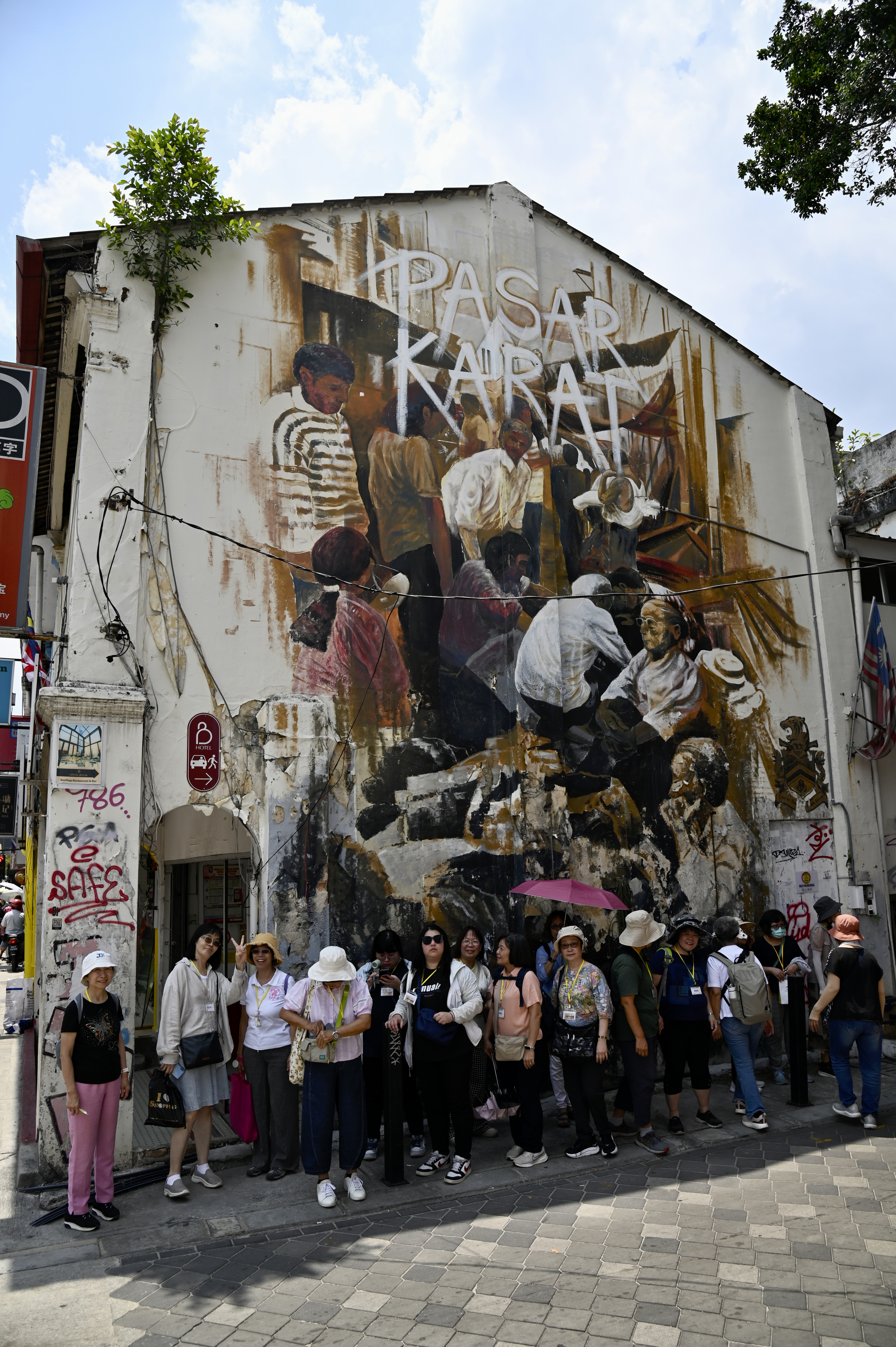
My stops included Chinatown and Petaling Street, an outdoor shopping strip of small stalls – sneakers, T-shirts, jerseys, baskets, slides, jewelry, elephant pants and shorts, purses, wraps, leather goods, electronics; food stands – fruit and vegetables, ramen, duck, ham hocks, pig ears, soup, ices, fried mushrooms and roti and tacos and fries, cookies, cakes, ice cream. Tiny alleys, small eateries, locals and tourists alike. And big, huge wall murals – bold and colorful. 

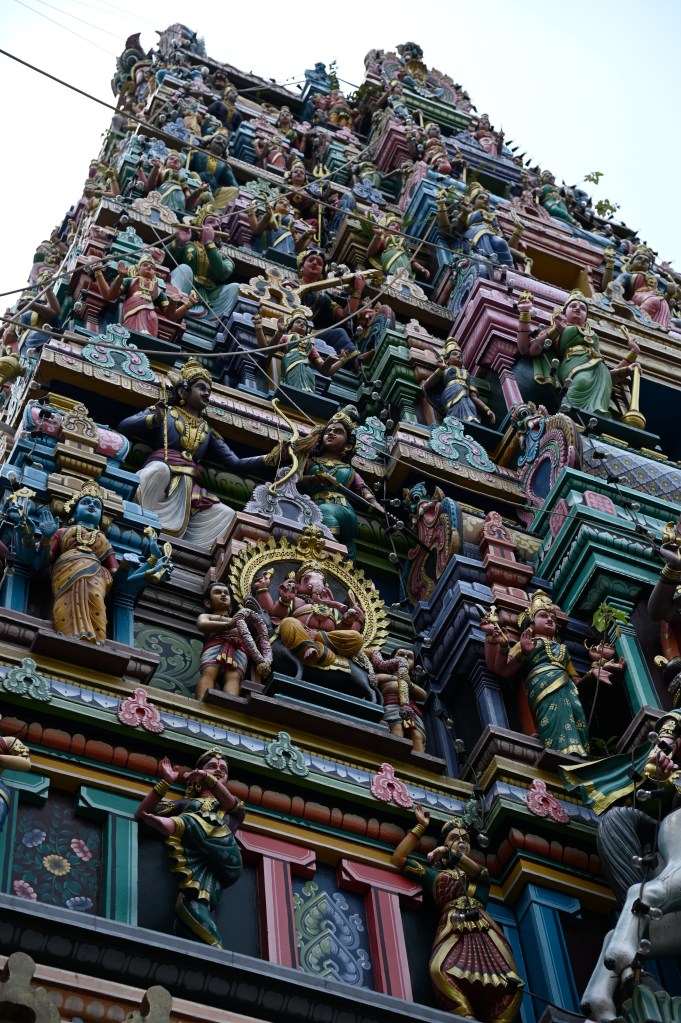
I also paid a visit to the Hindu Sri Mahamariamman Temple, built in late 19th century. I had to check my shoes to enter – the proprietor wanted 20 cents, but I only had a 5RM bill, so he let me go in without paying. It has an amazingly ornate outer tower – lots of carving of people and animals and gods, brightly painted. Inside, the Temple complex had just a handful of people walking around, admiring the several little chapels and carvings.

Close-up view of the ornate tower of the Hindu Sri Mahamariamman Temple, featuring colorful carvings of deities and decorative elements.
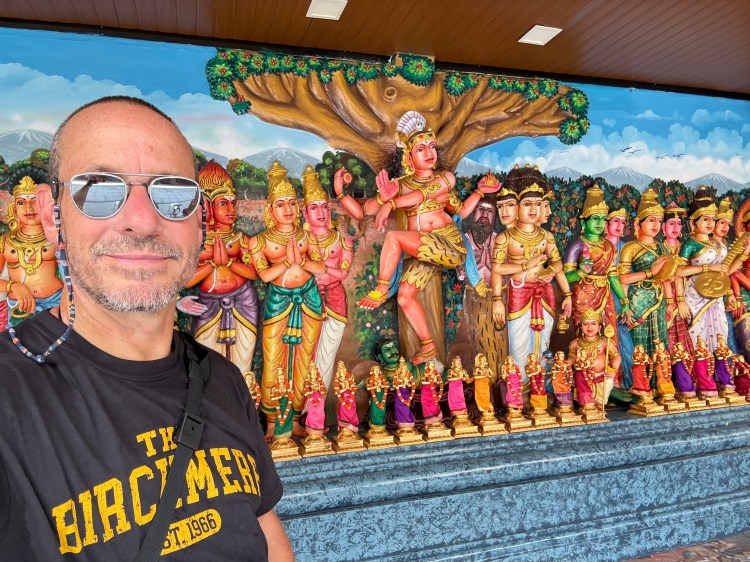
A person stands in front of a colorful mural depicting multiple Hindu deities, with intricate details and vivid colors.

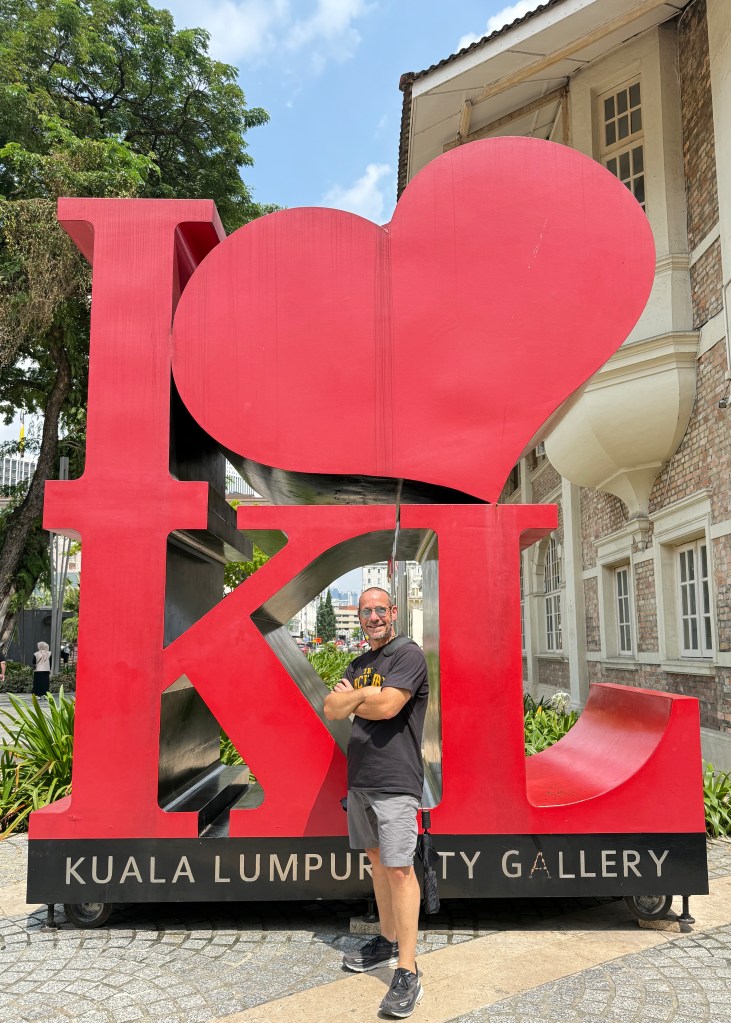
Another stop was to be the Sultan Abdul Samad Building, a massive old government building, but – it too was closed for renovations (curse you ChatGPT!) and draped in scaffolding and coverings. But that had me near the “River of Life” – a concrete river with view of a mosque at confluence site, and close by the Kuala Lumpur Cultural Center and an “I ❤️ KL” statue.

After five hours, more than 6 1/2 miles, and lots of sweating, I’d had enough back to my hotel before dinner.

And what a dinner it was. I’d decided to treat myself to a Michelin-starred joint for dinner, in this case “Dewakan,” because of its focus on ingredients endemic to Malaysia (and it actually has two Michelin stars).

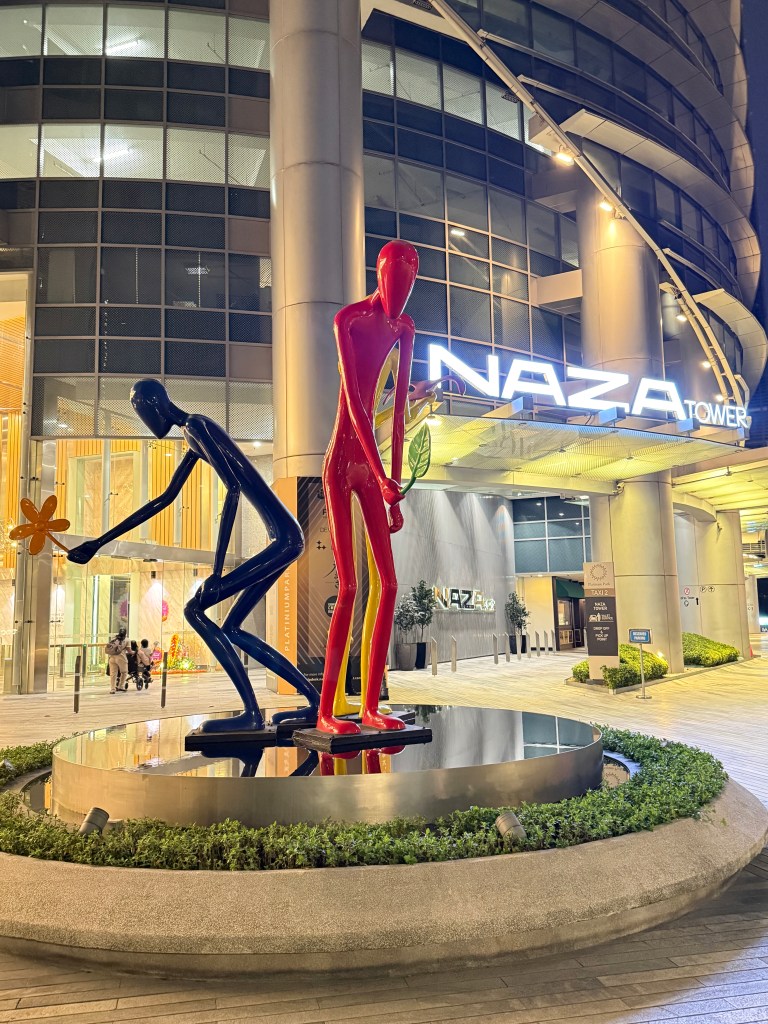
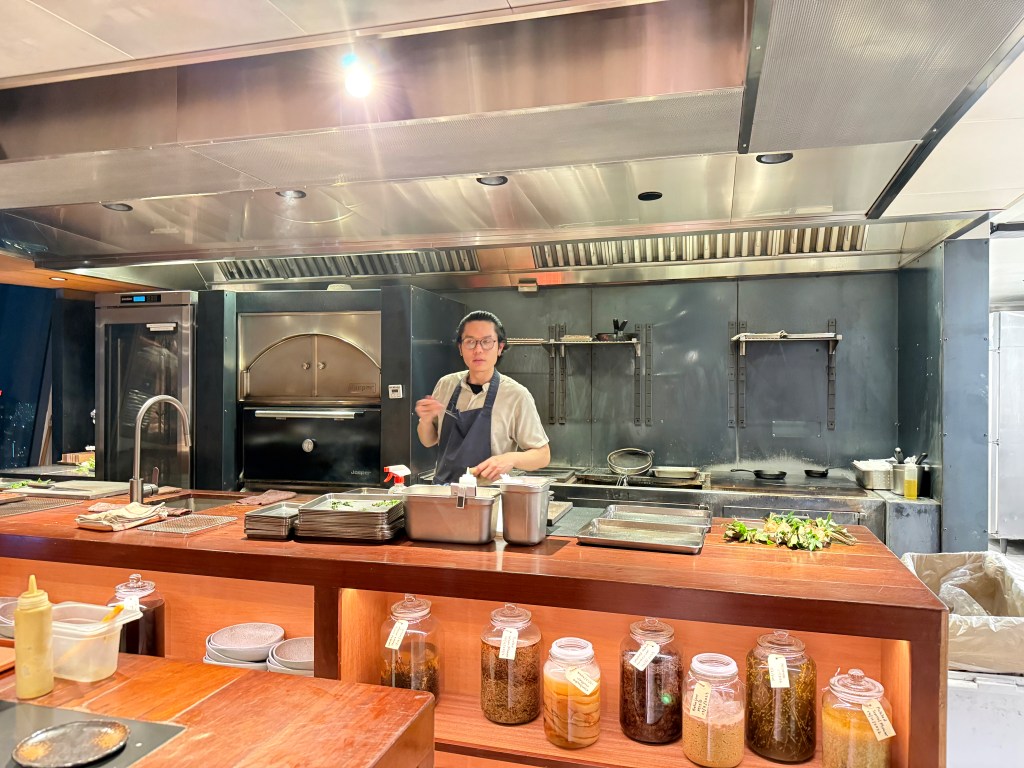
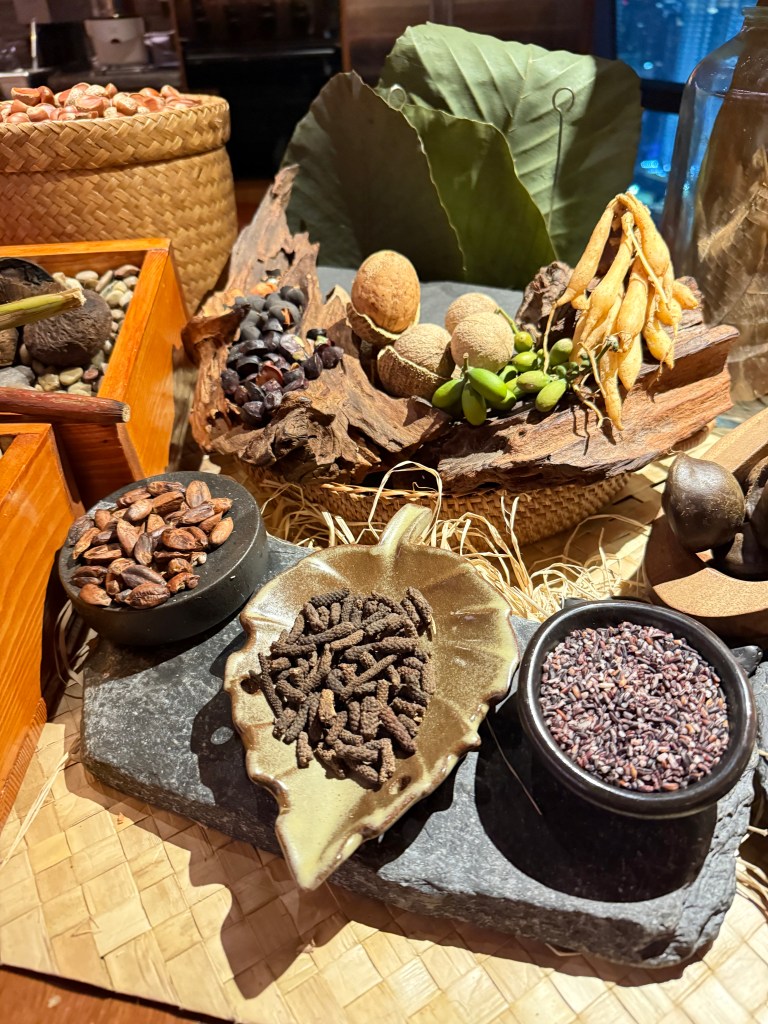
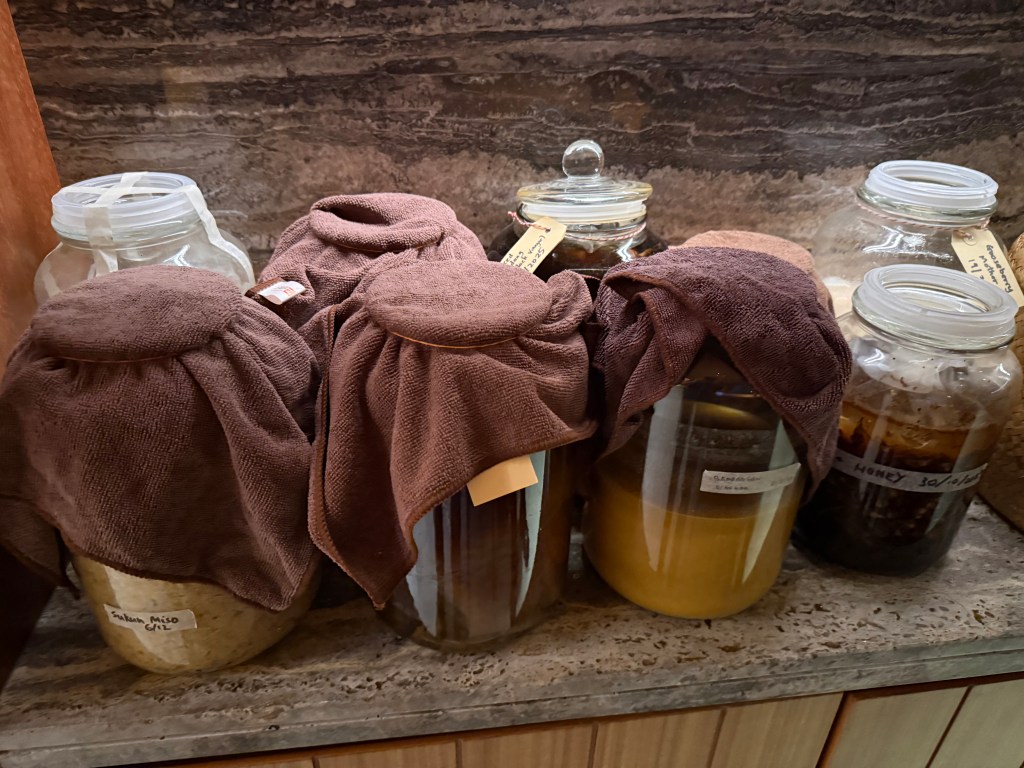
After a 10-min walk to the Naza Tower, where the restaurant is on the 48th floor, I was escorted upstairs to the restaurant by the building’s lobby security guard, and was then met by a server, who took me into the kitchen where she introduced me to Nic, who – in turn – gave me a tour of the kitchen and explained the food prep stations, several local ingredients, and showed me where they ferment food items. From there, I was escorted to a small lounge waiting area until my table was ready – a wait of about 10 minutes for the second sitting they do each evening.

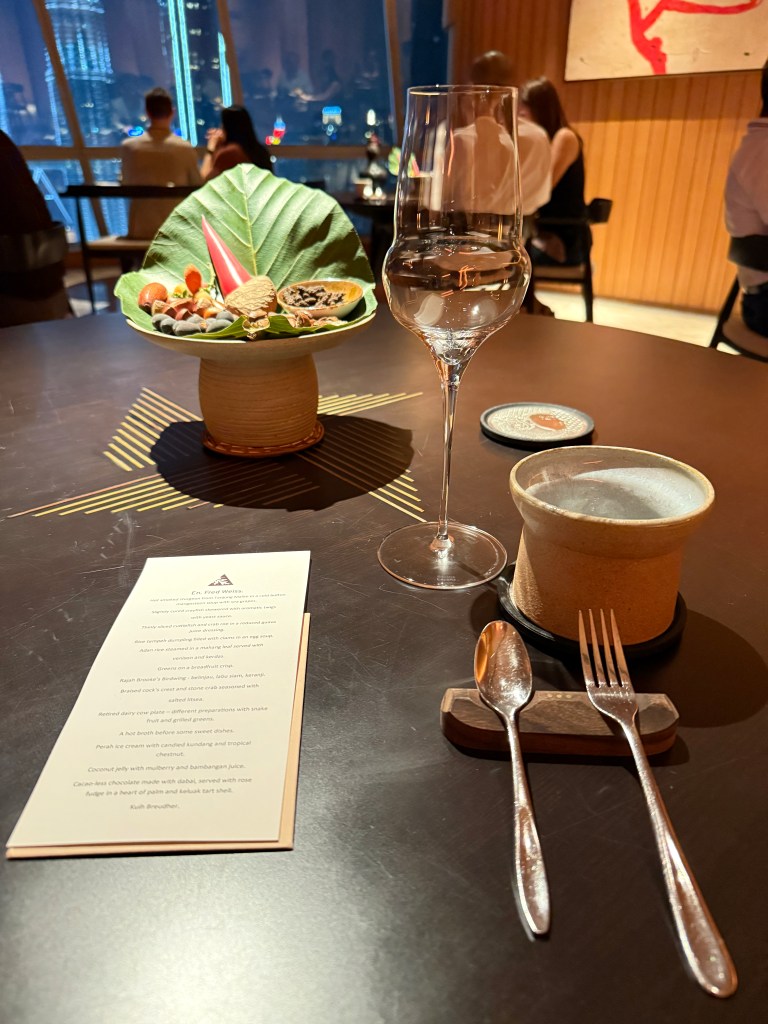
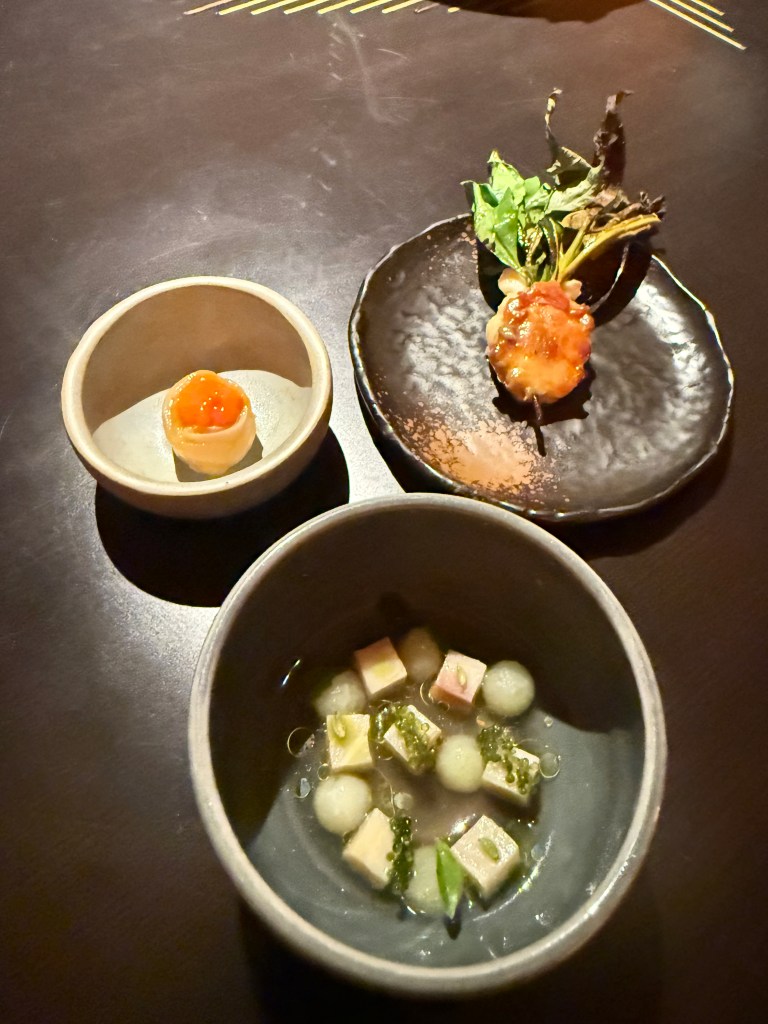
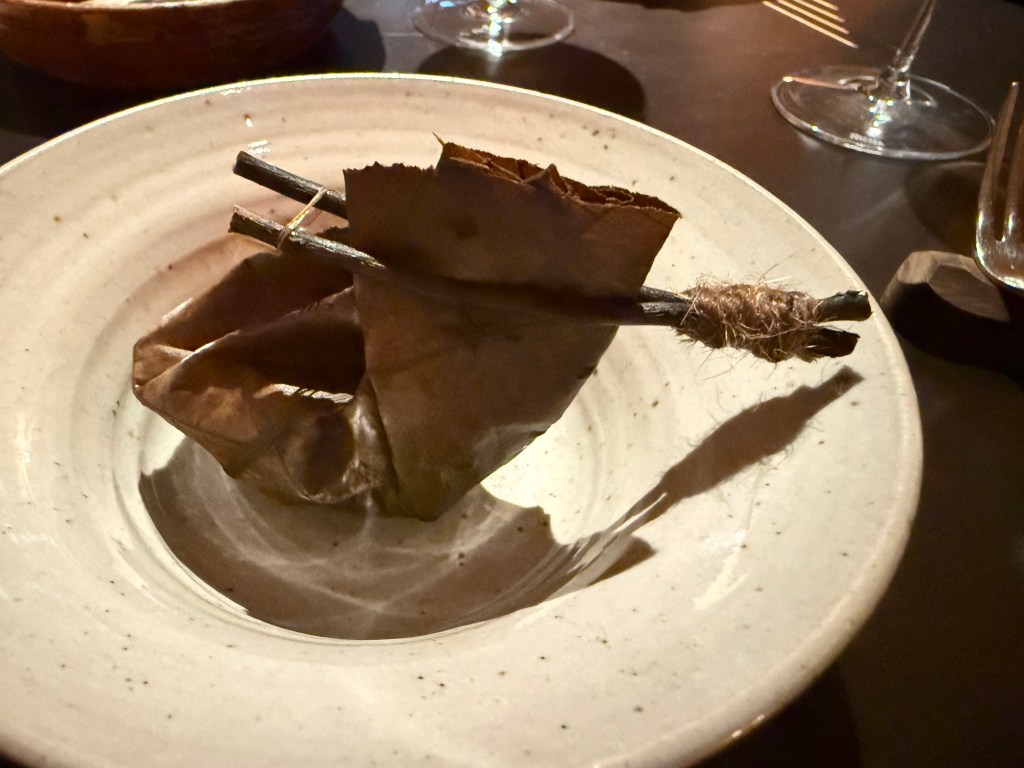
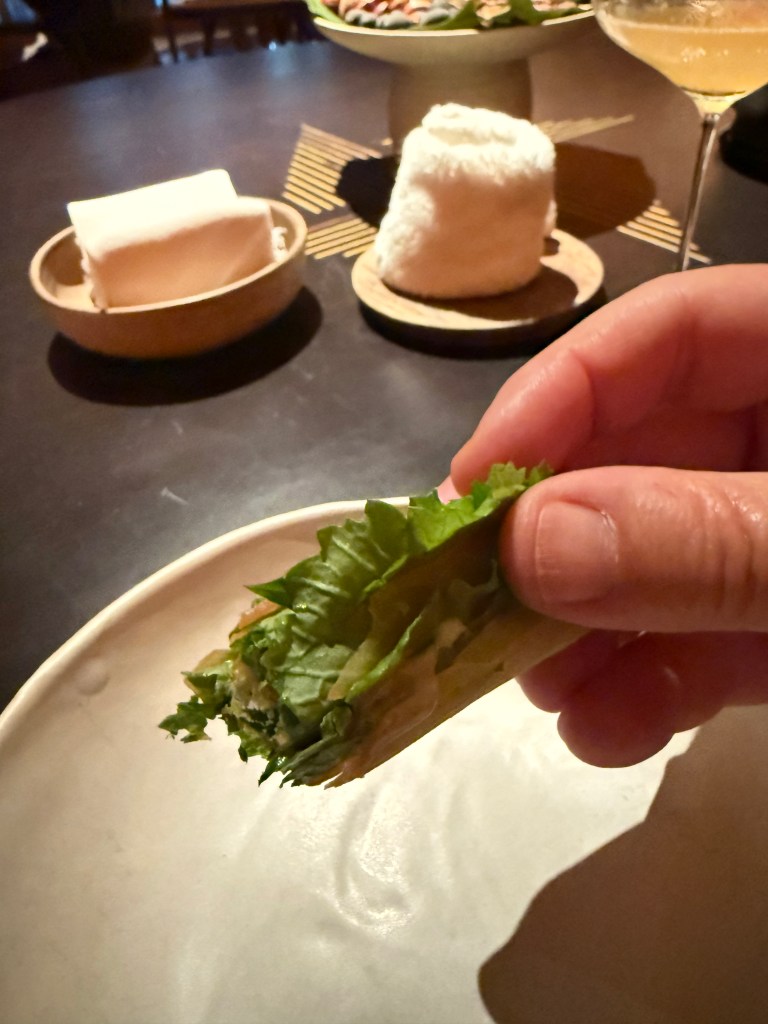
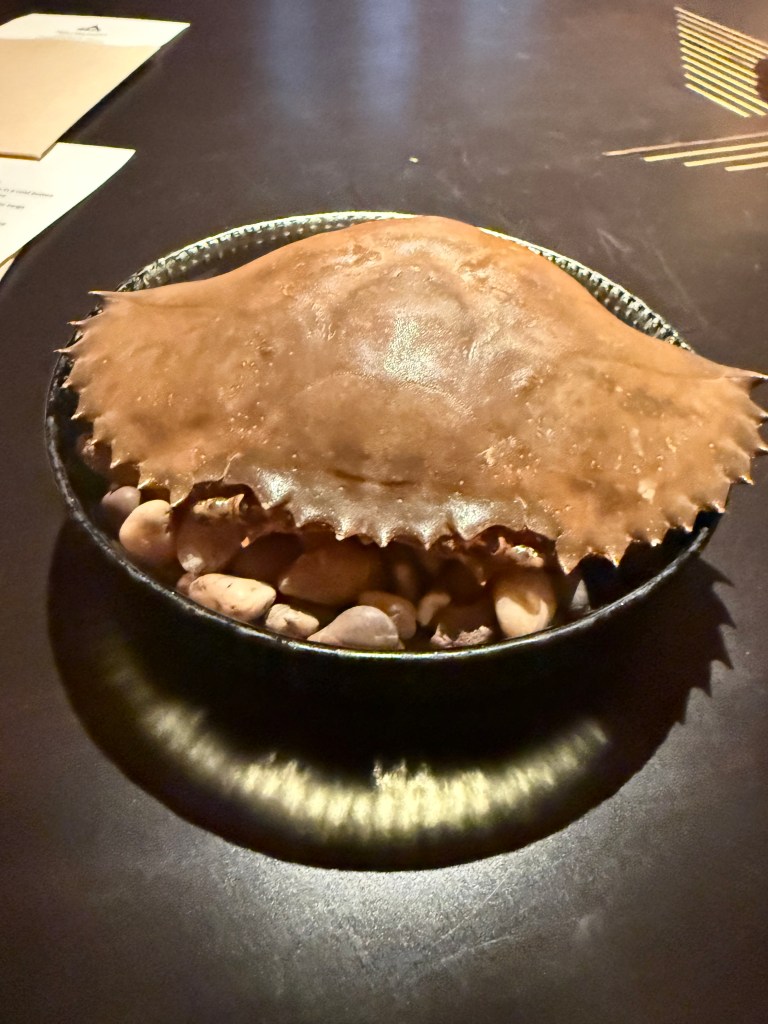
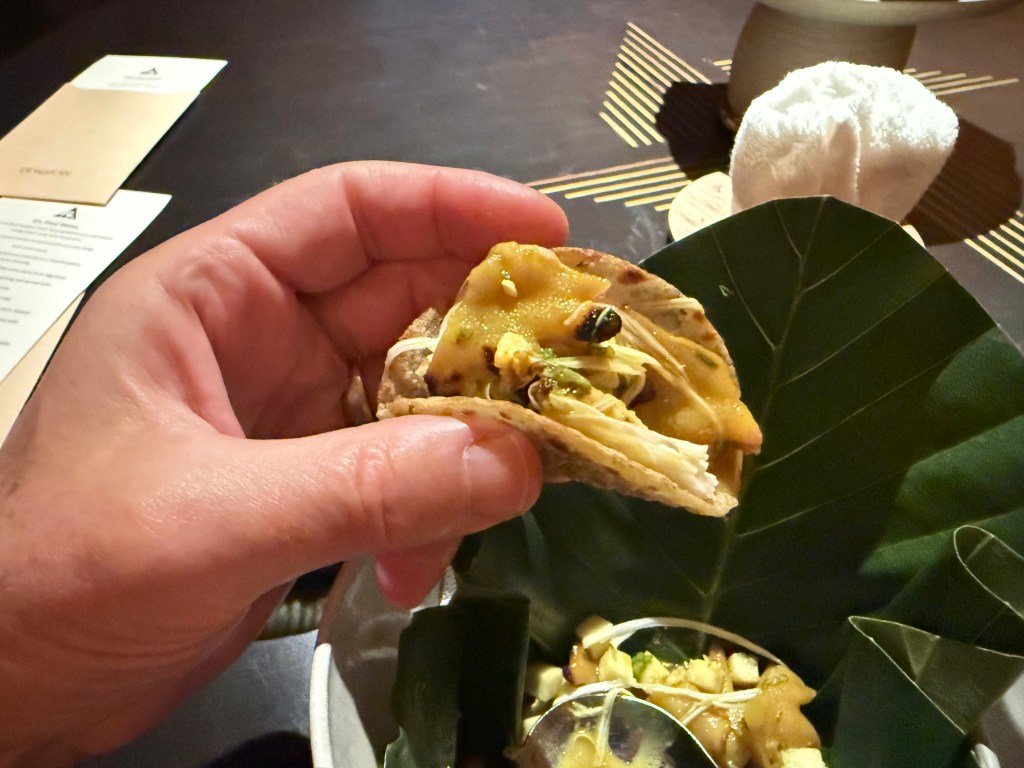
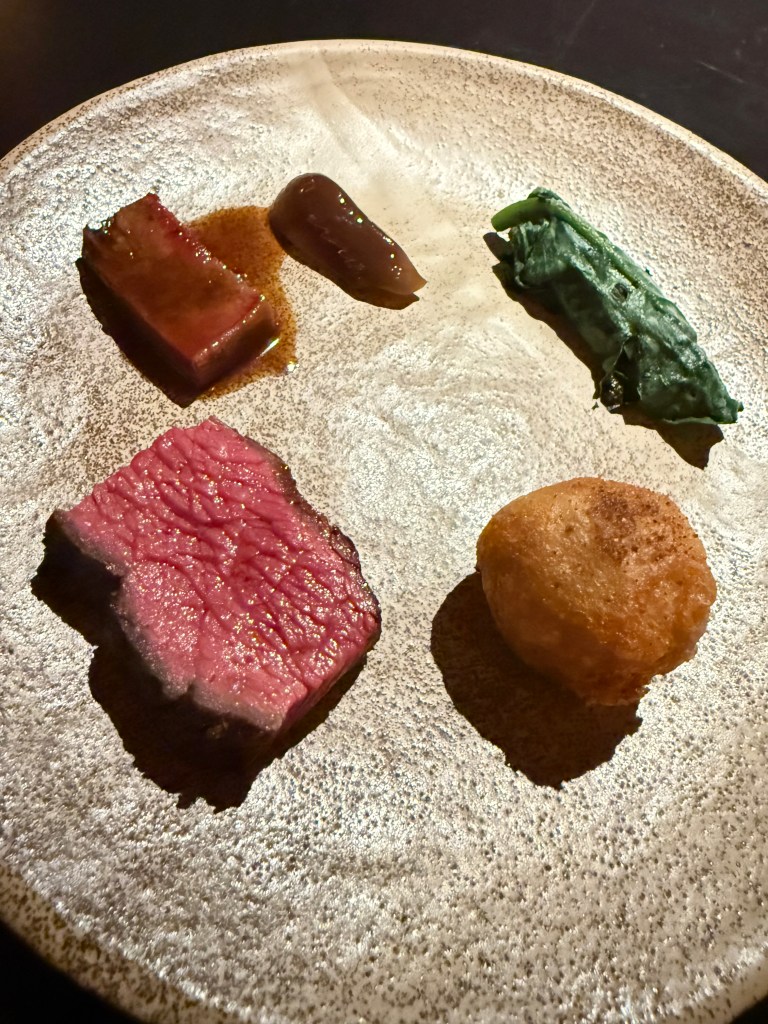
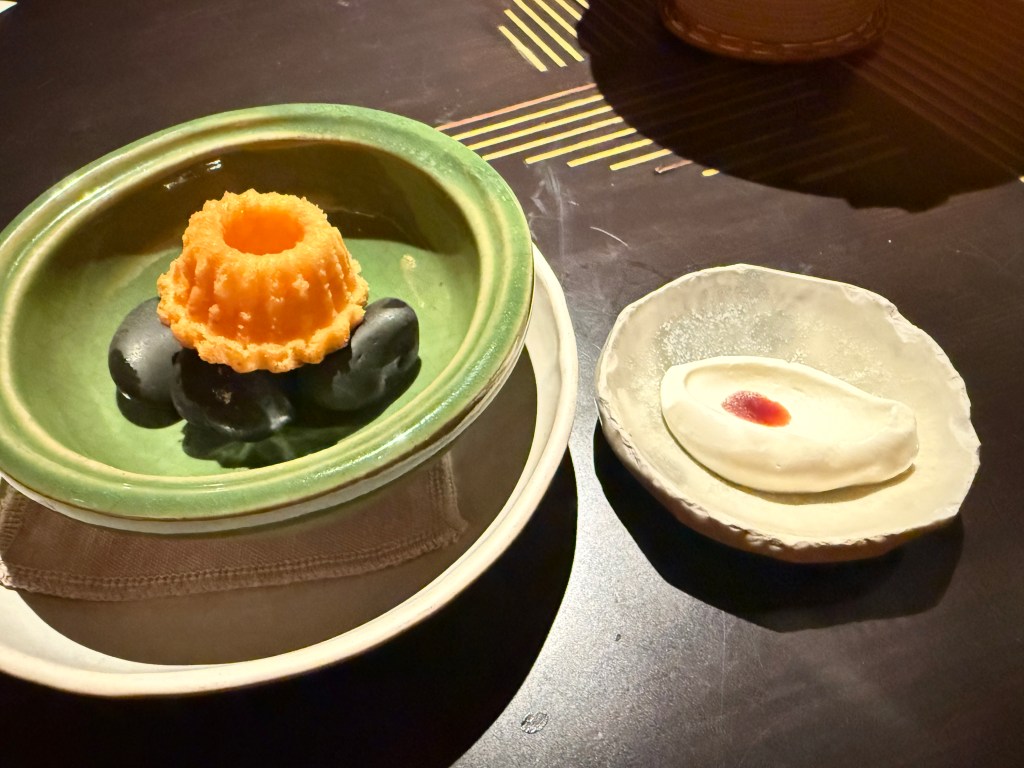
The 14-course (!) meal unfolded over 2+ hours, with a rotation of young and very friendly chefs and wait-staff introducing each course. I added a five-glass wine flight, and a young sommelier introduced and poured each glass. One big plus is that they explained how to eat each dish – which utensils to use or with fingers and making your own taco or – with the final dessert course – just dipping the cake into the side of cream. Some favs – the rice tempeh, the slice of beef on the cow plate as well as the brains on the same plate, that final dessert course, the non-cacao chocolate, and the broth just before dessert. The rooster cockle had a spicy flavor and was delicious.

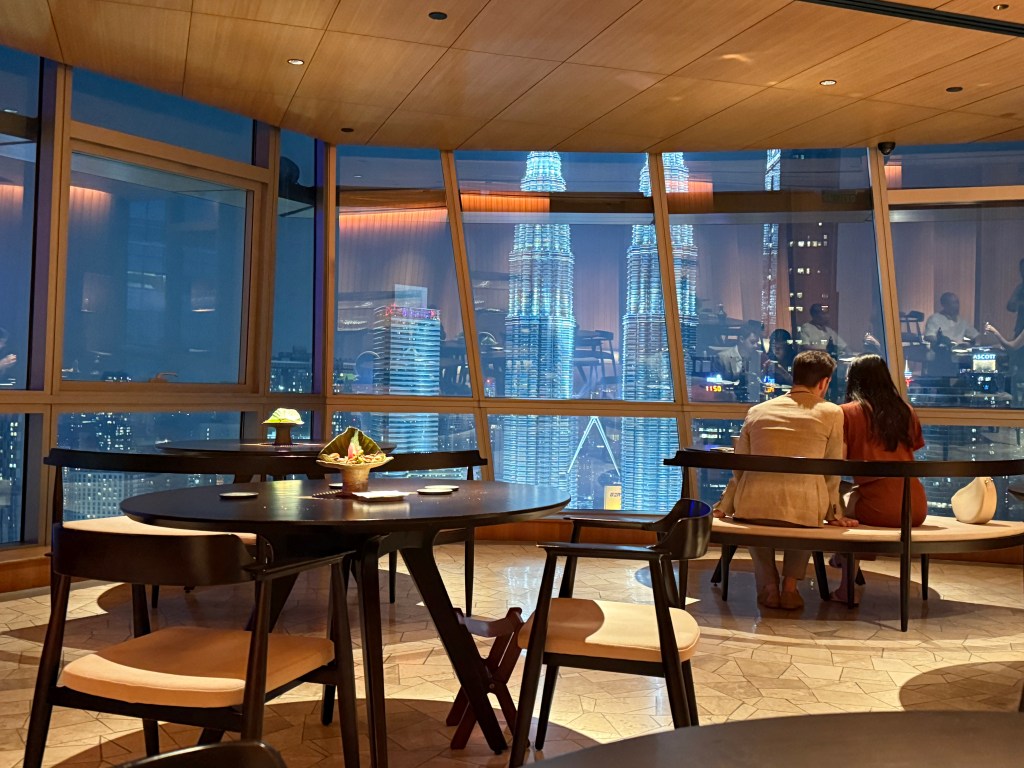
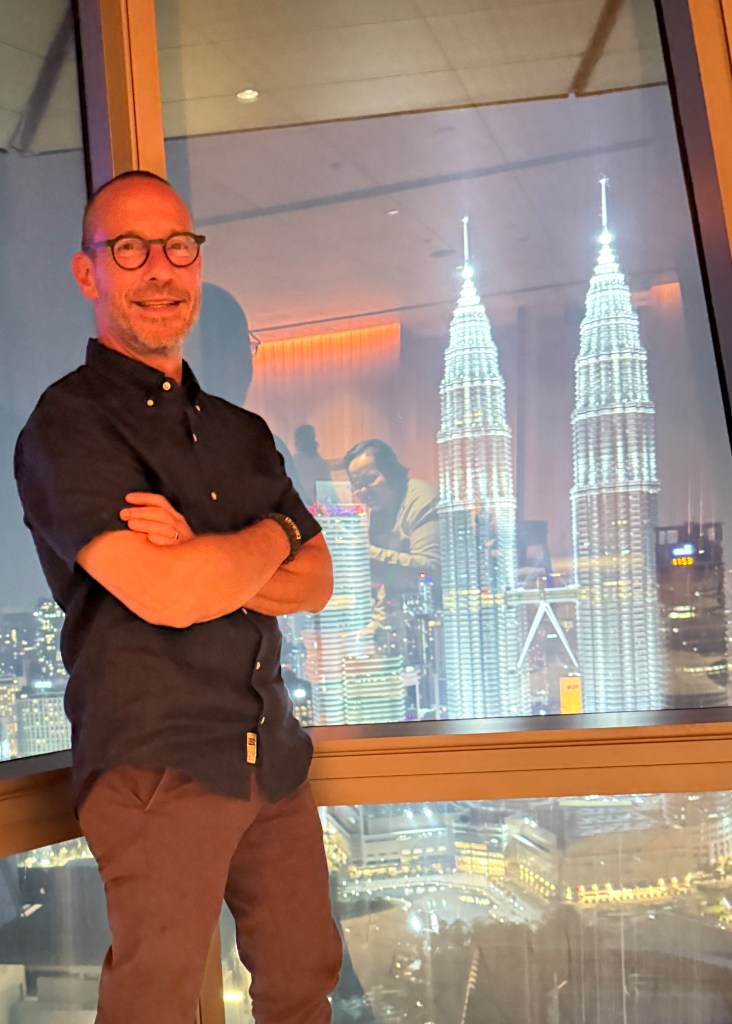
And – to put it all in perspective – there was a spectacular view of the Petronas Towers from the floor to ceiling windows. All-in-all, a really wonderful experience and a nice 10 minute walk back to the hotel on a slightly cool and comfortable evening, the end of my first day in Kuala Lumpur. 

A person standing indoors with their arms crossed, smiling, in front of a large window showcasing the illuminated Petronas Towers at night.

Malaysia: Kuala Lumpur and Borneo – Sept/Oct 2025 – Intro

I REALLY thought my first trip to India would be this Fall and, in fact, I’d booked the trip. But then . . . well, I saw a different itinerary that would give me the chance to see orangutans (among other beasts, but – really – I thought it was all about the orangutans), so cancelled India and re-booked for Malaysia. India will have to wait.

Depending upon who’s counting, there are 11 or 12 countries in Southeast Asia – eleven if you only include the members of ASEAN (the Association of Southeast Asian Nations) but twelve if you also include Papua New Guinea, which – really – is part of the region if not a part of the Association. So – Malaysia would be my sixth of the twelve countries to visit. Prior to my trip to Vietnam, Cambodia, and Laos, I’d spent time listening to a multi-episode (currently 138!!!) podcast about the history of the region. I barely remembered all I listened to, but absorbed enough of it to know there was a long, rich, multi-cultural history.

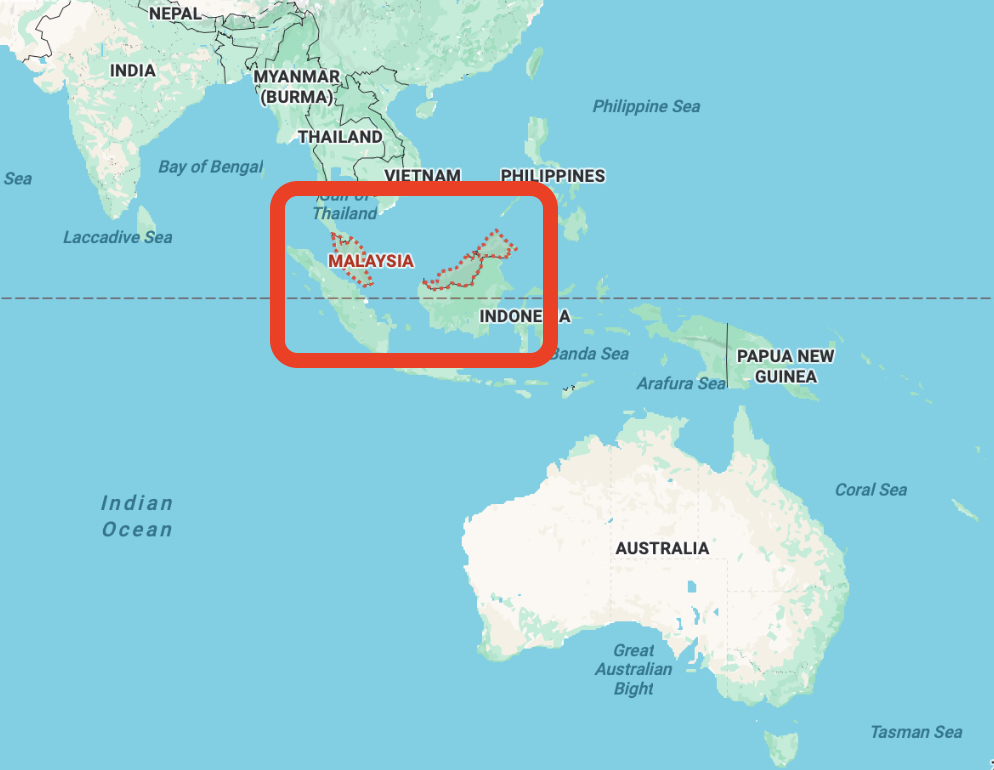
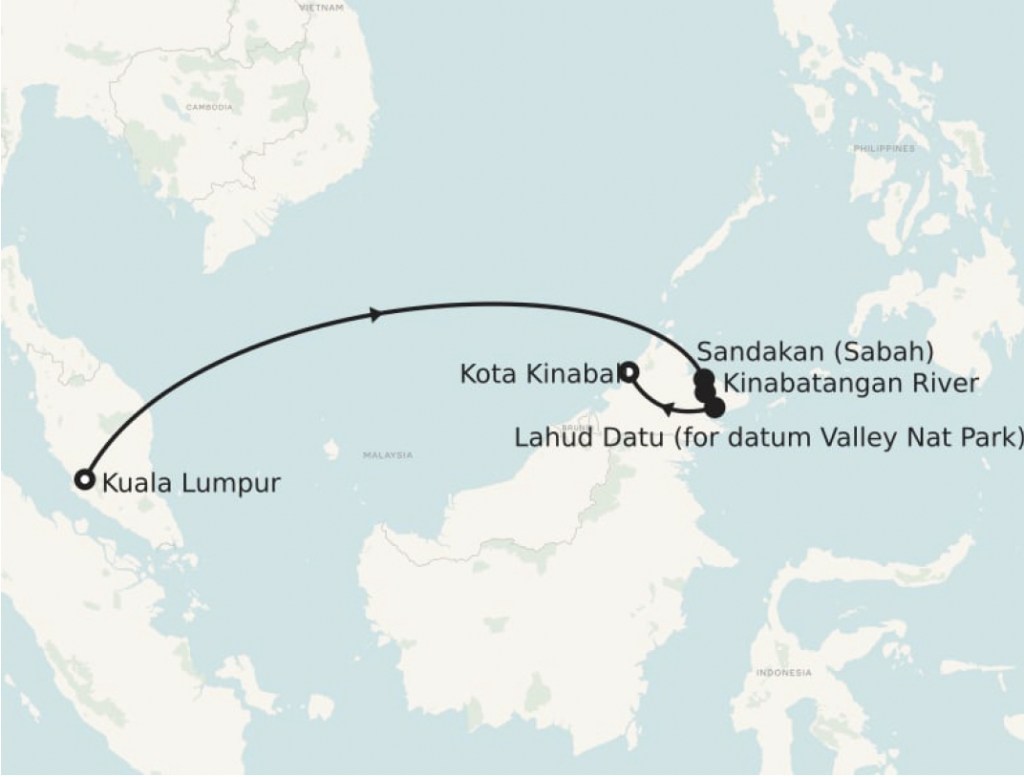
Malaysia itself is a combination of the peninsula where Kuala Lumpur is located as well as two states located on a large portion of the island of Borneo (itself, the third largest island in the world, divided among Malaysia, Indonesia, and Brunei); this Borneo portion is referred to as East Malaysia or Malaysian Borneo. My journey would start out in Kuala Lumpur for three full days before heading out to the Borneo State of Sabah.

Human habitation of Malaysia goes back 40,000 years, with strong Indian and Chinese influences from the first century on. It was part of the Malacca Sultanate, and later was conquered by Portugal. Then, in the 18th century, it became part of the British Empire, it was occupied by Japan for three years of the Second World War, and then gained initial independence from Britain in 1957, then – in 1963 – it was combined with British Borneo, Singapore, and Sarawak (a Borneo state), and – finally – in 1965, it became its own nation with the borders it has today, including the two Borneo states of Sabah and Sarawak.

It’s a nation of close to 35m people, of which roughly 67% are ethnic Malay and 25% Chinese; Islam is the official religion, though many others are practiced; Malay is the official language but English is taught in schools, and it’s government is modeled on the British parliamentary system.

Phew! OK – with all that out of the way, on to my journey. At its heart, this was to be a wildlife adventure in the tropical rainforests of Borneo, with the potential to see animals (primarily primates, but others as well), birds (they have over 600 species), and insects (anti-malaria meds packed!). Temps in the “hot to wicked hot with humidity,” the potential for rain – torrential at times, and – oh yeah – don’t forget to pack your “leech socks” (which I admittedly forgot to pack).

But first, after 25 hours of travel from home in DC to Kuala Lumpur, I’d get to spend three days and three there before moving on to Borneo.

Map of Malaysia showcasing the route from Kuala Lumpur to various locations in Sabah, including Sandakan, Kinabatangan River, and Lahud Datu.
Screenshot

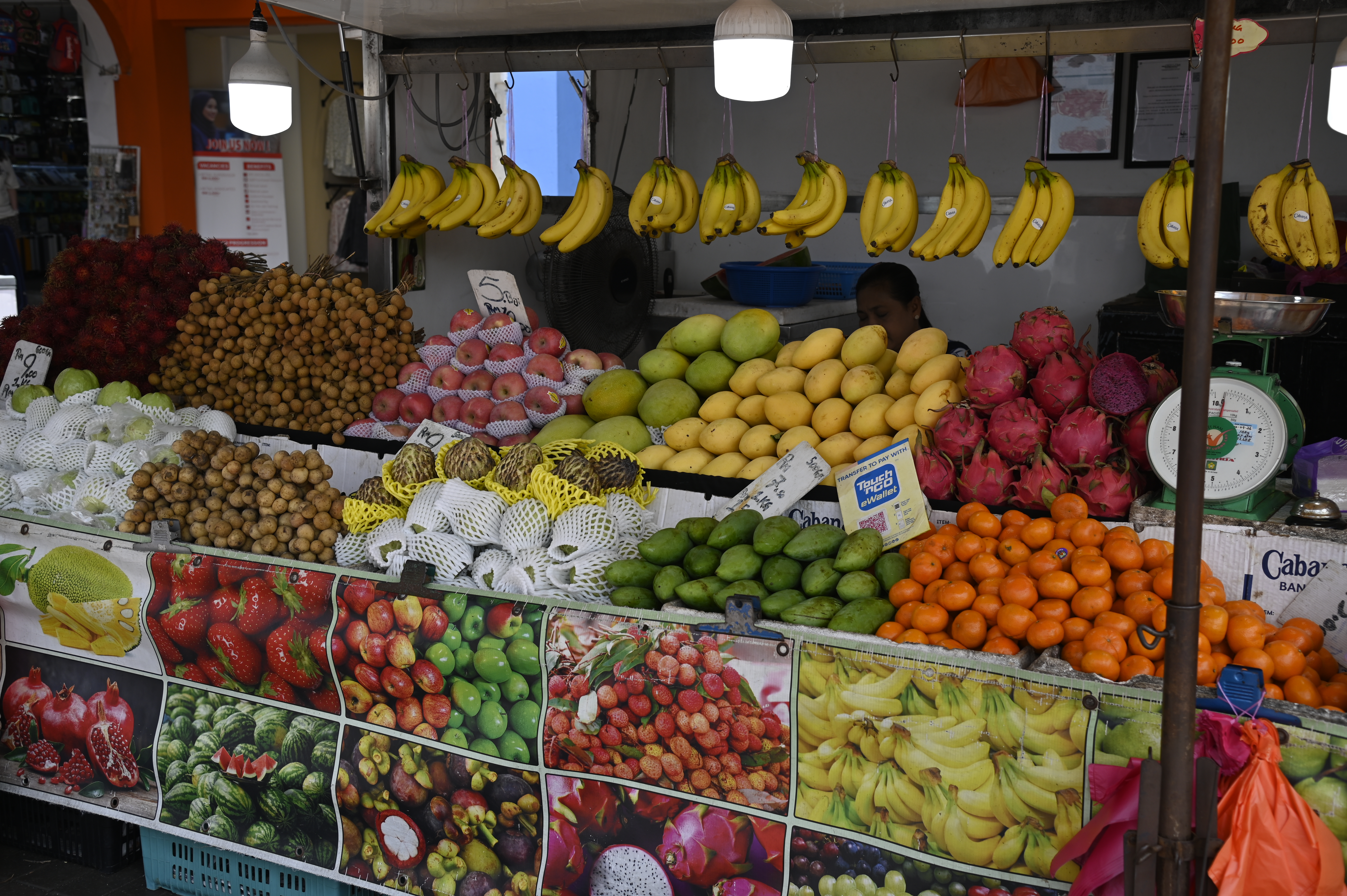
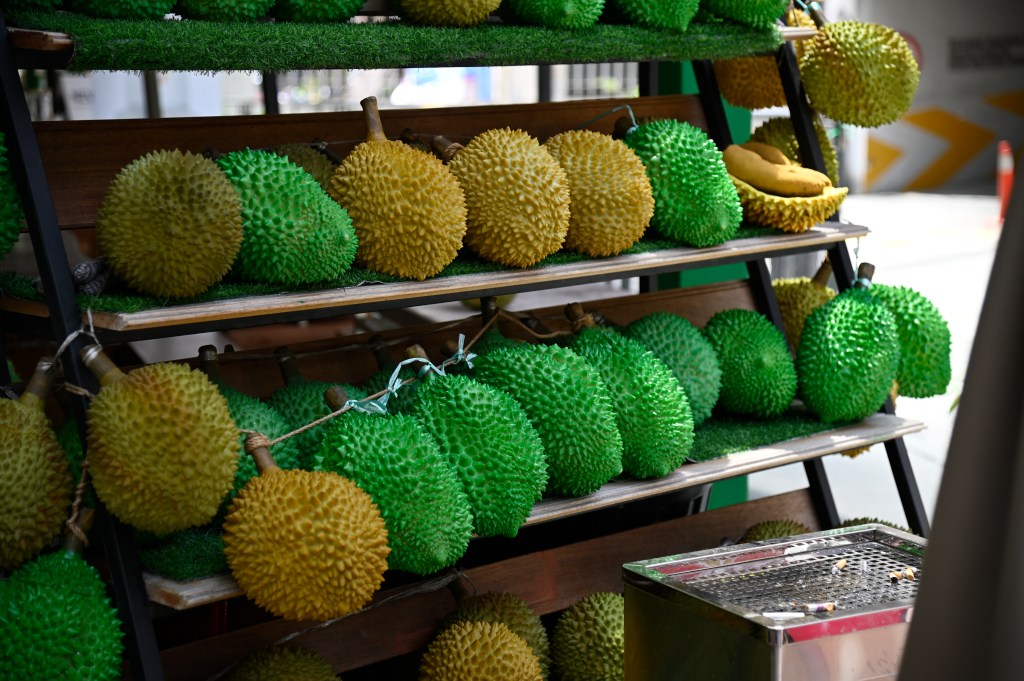
And, oh yeah, Borneo is the home of durian! I happened to arrive in Kuala Lumpur during its annual multi-month Durian Festival.

A display of durians, showing various spiky fruits in shades of green and yellow, arranged on shelves in a market setting.

Finnish & Swedish Lapland, and Norway – Final Thoughts

This trip was really a tale of two environments. Scandinavian capitals – Helsinki, Stockholm, and Oslo. All fun cities to visit with what you’d expect of cities – good restaurants, museums, theater, music, super streets for walking, urban culture – though in smaller settings than elsewhere I’ve been. Stockholm was just a wonderful spot, a place I’d love to return to as there’s still so much to offer there, and its setting is just gorgeous.

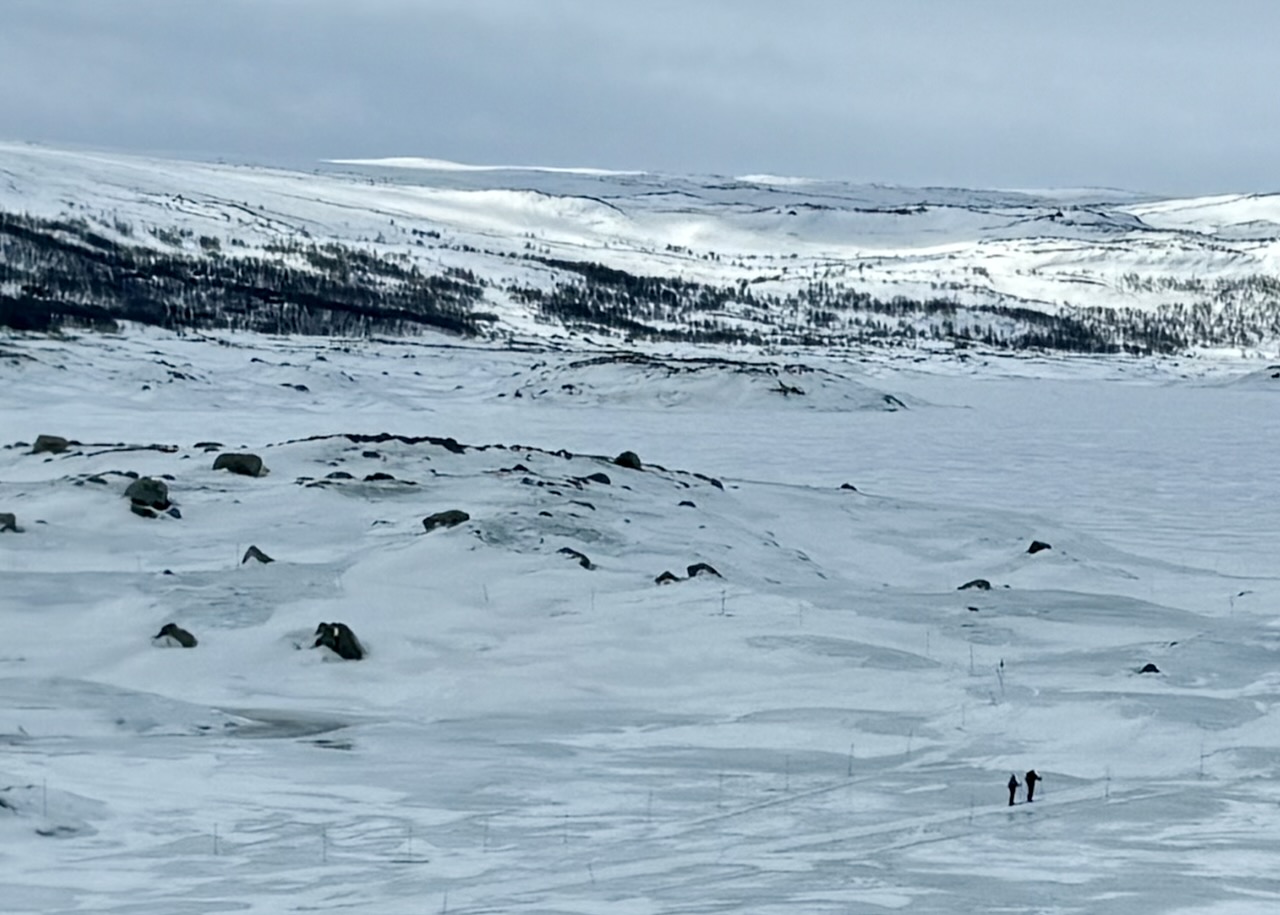
The second environment was the natural beauty and great outdoor experiences of being north of the Arctic Circle in Finnish and Swedish Lapland and the fjords and landscape of Norway. I know I barely scratched the surface of all these places, but to go snowmobile riding, sled-dog mushing, reindeer sledding, float in an icy lake, take a cold plunge in an icy river, ride a steep railway through the mountains, and cruise in deepwater high cliff-water ways, are experiences that just can’t be beat and are hard to duplicate in any other places in the world.

Learning about the Sami culture was an important part of my time away. They have suffered greatly over the centuries, facing some of the same injustices visited by other indigenous peoples in other countries, and their culture is – like the others – unique to their environment. They need voices and support and understanding to survive and thrive. People like Anna help spread their stories.

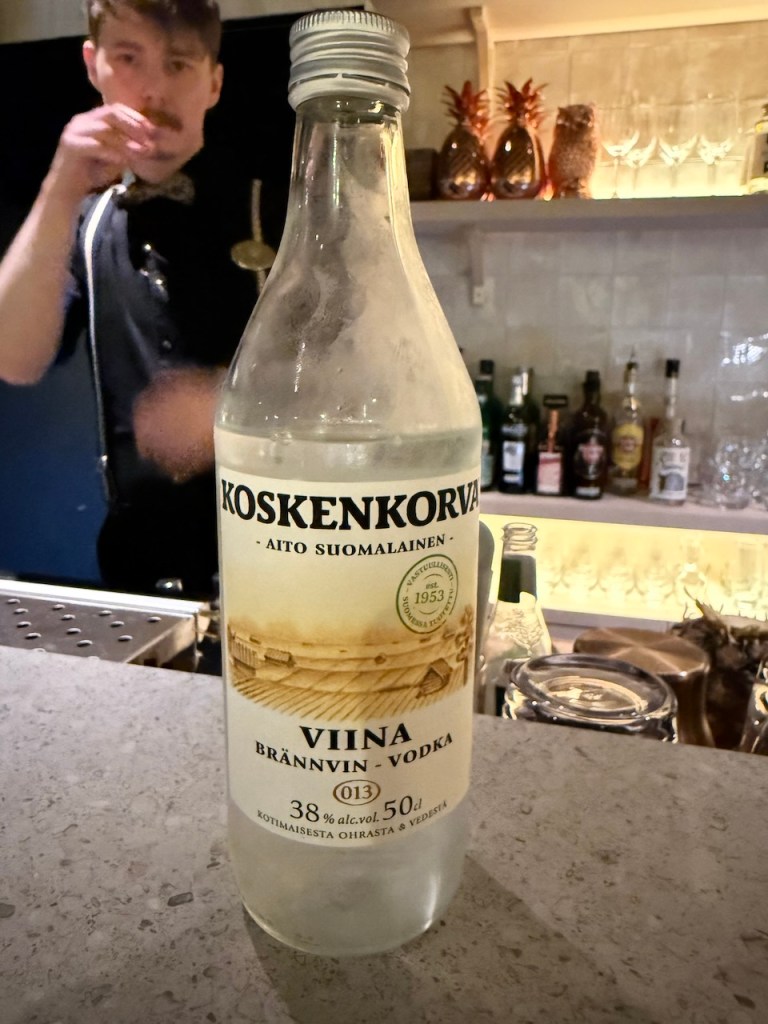
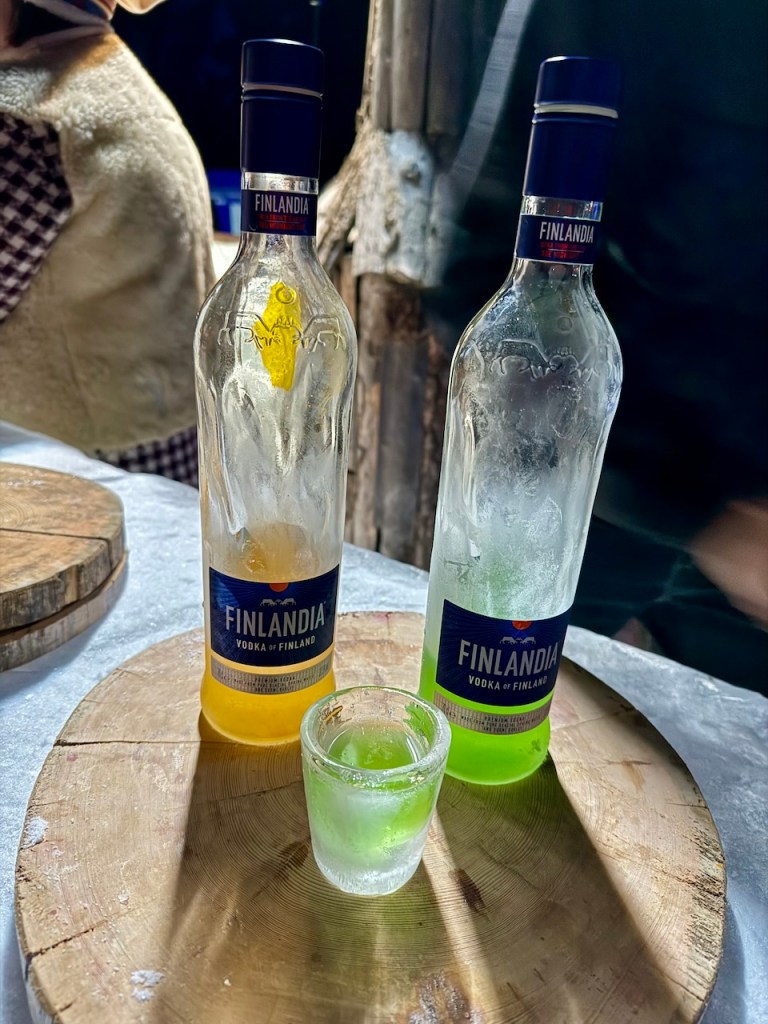
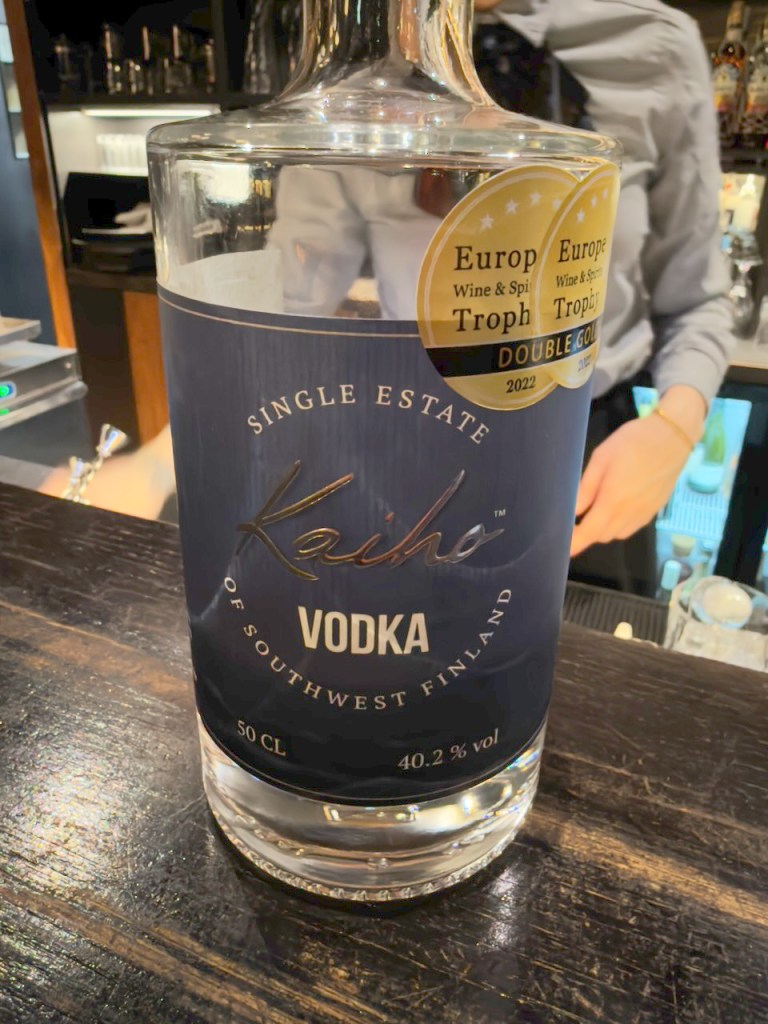
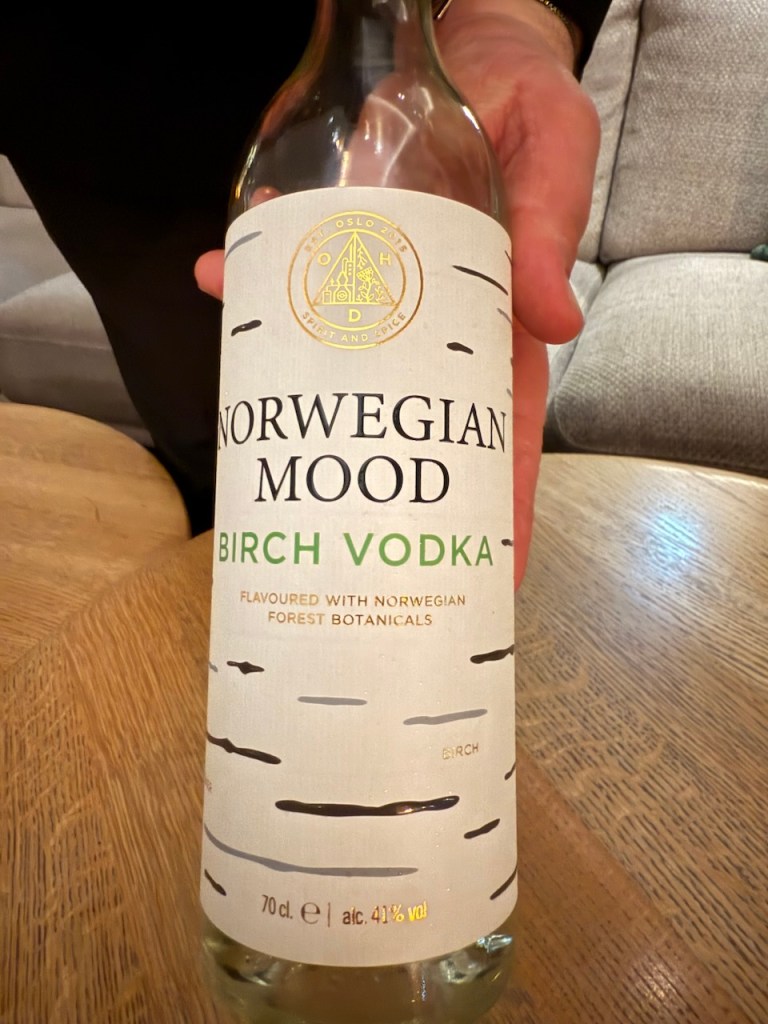
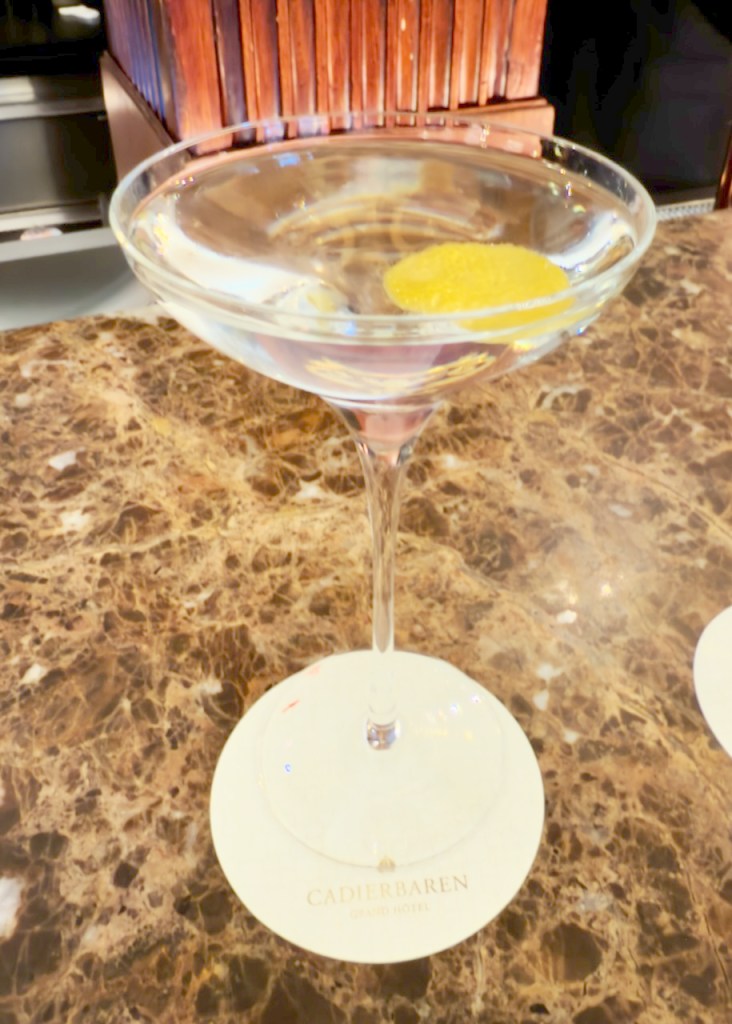
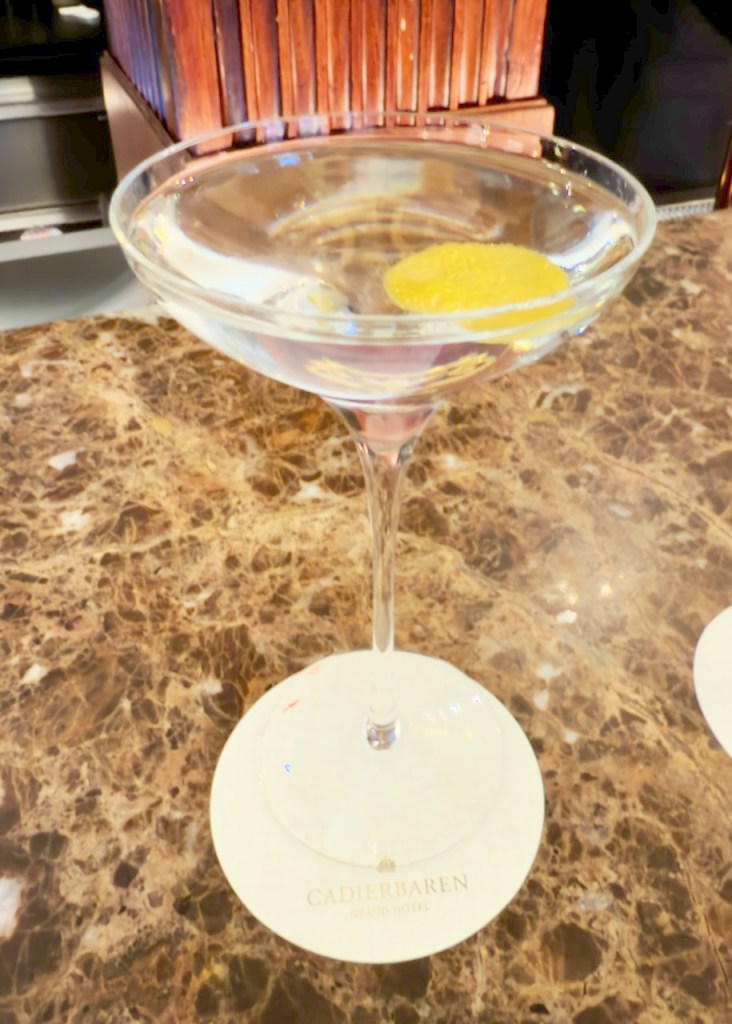
I also got a chance to try many different vodkas while I visited these places – all slightly different, all flavorful, and some I know I can find at home and others I hope to. And that vodka martini at the Grand Hotel in Stockholm (where they did NOT have Absolut!), stirred to -2 degrees. Amazing.

But I think it’ll be the northern lights that will stick with me the most. To stand under a star-filled sky for five or six nights and just be overwhelmed by the sparkling colorful atmosphere that stretched from horizon to horizon is a reminder about how small we are, how stunning the environment is, and how you can still be awed and surprised by the natural world around you. Wow.

Oslo – My Last Day of this Journey

My overnight train from my day-trip to the Flam Railway, the fjords, and Bergen, arrived back in Oslo at about 6:30 in the morning of my last day in Norway. I’d planned to spend the day visiting a few more of the sights in Oslo, and darn if I wasn’t going to try to go back to the hot dog kiosk that was closed two days ago.

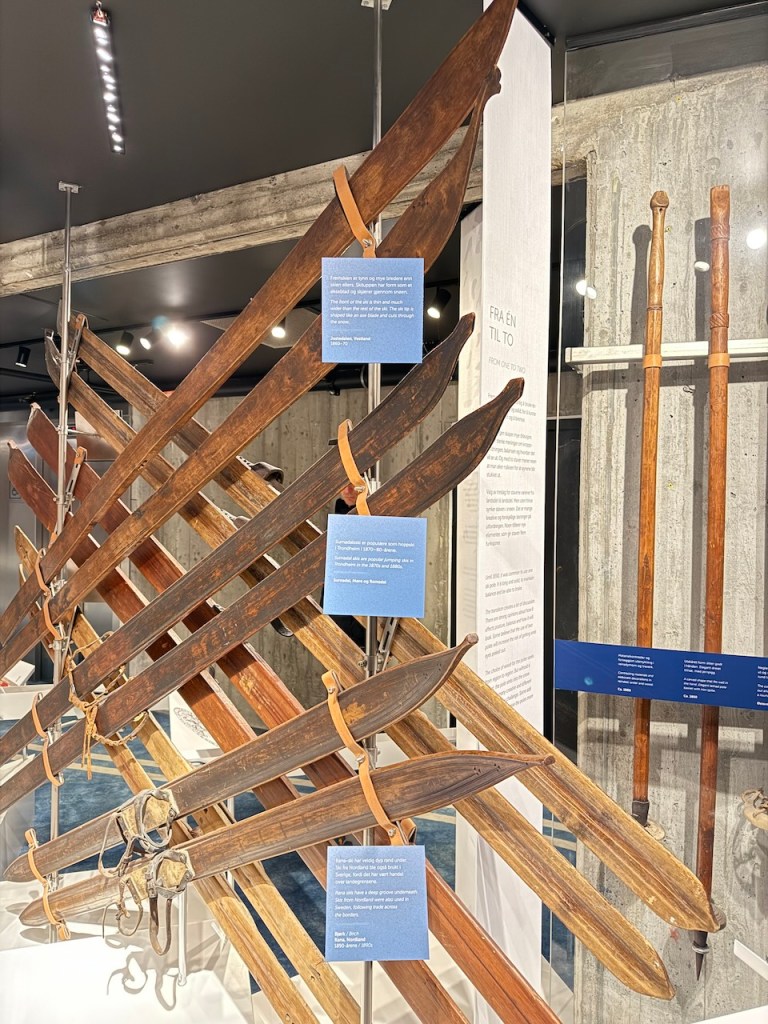
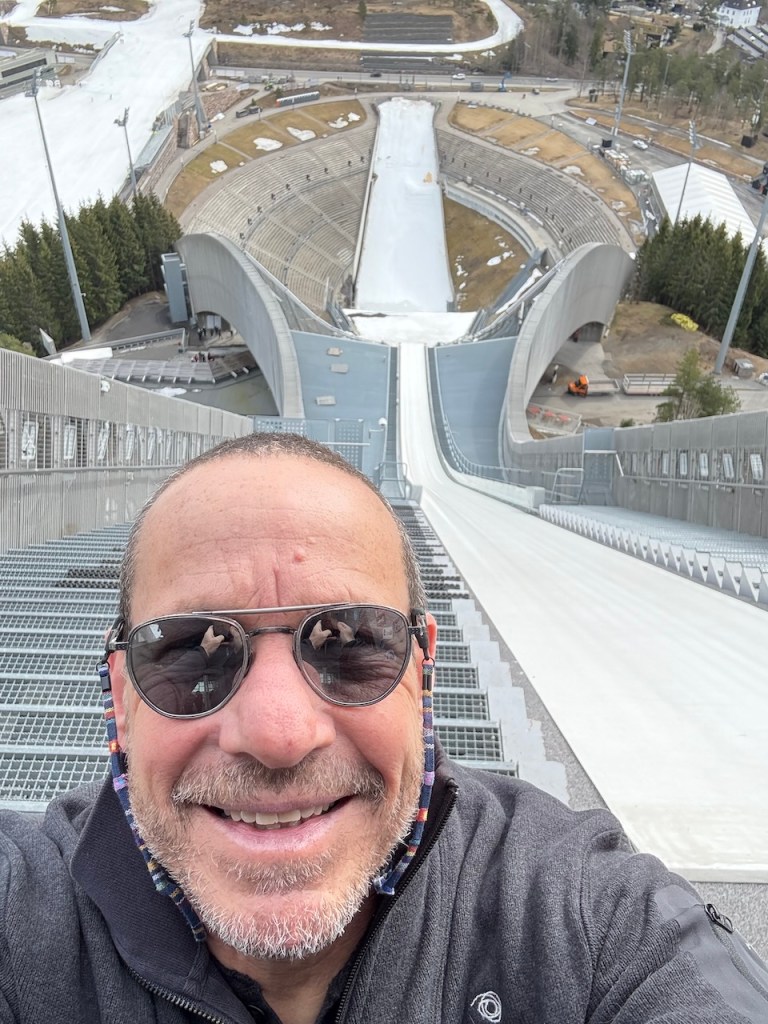
After my last good bagel and smoked salmon for breakfast at my hotel, I started the day with a subway ride and a long uphill walk to Holmenkollbakken – the ski jump located about 7 1/2 miles outside the city that’s been there since 1892, with a few upgrades over the years (its apparently been rebuilt 19 times!), and that was used at the 1952 Olympics. There’s a fantastic ski museum (history of skiing, history of the jump) as well, and there is skiing open to the public nearby the base of the jump. On the subway I saw folks with skis heading to the ski jump, and I followed a few of them walking up the hill. After visiting the museum, you take an elevator ride to the top of the jump, which provides gorgeous views of the surrounding landscape and Oslo off in the distance.

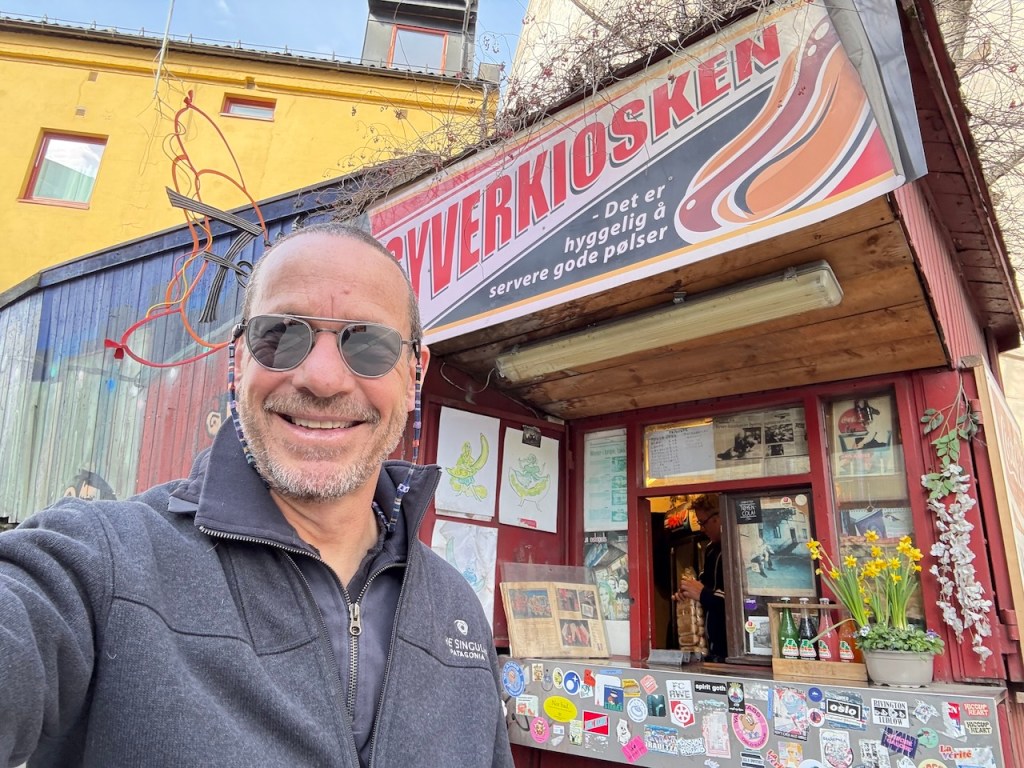
Then it was a walk back down the hill, back to the subway, and then a bus ride to the hot dog kiosk – Syverkiosken. And you know what?!?!??! This time it was open. The owner – Erlend is his name and he’s worked there since hew as 13 – was there and he explained that he’d had an eye problem (you could see that it was still little screwed up), and he’d spent the day in the hospital on Monday. The kiosk has been there since at least 1939, and Erlend’s father has bought it from the Syversen family in 1979, which is what gives it its name.

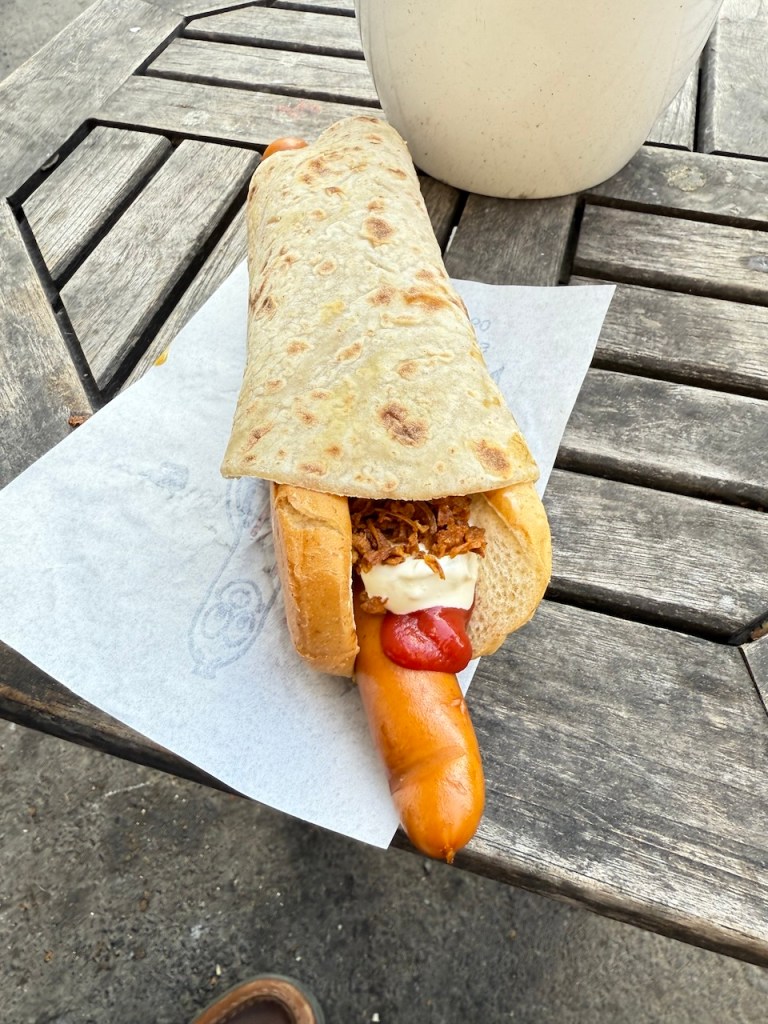
As for the hot dog, I asked him what I should order and his only question to me was “sweet or spicy”; well, duh, who has a sweet hotdog, right? So I opted for the spicy. I was going to order more than one, but not knowing how big it’d be and also knowing I had more food in my future that afternoon, I opted for just one.

The hotdogs are boiled, but not in water; instead, in a broth (apparently a secret recipe that Erlend inherited from his father), then wrapped – one on top, one below – in sausage bread and a “lompe” – a traditional flatbread made from potatoes. The toppings for my spicy version were homemade ketchup and mustard, jalapeño salad, and crispy fried onions. Wicked good, and cheap too!

A great little snack, and I knew I’d be walking the rest of the day, so the energy boost was definitely needed!

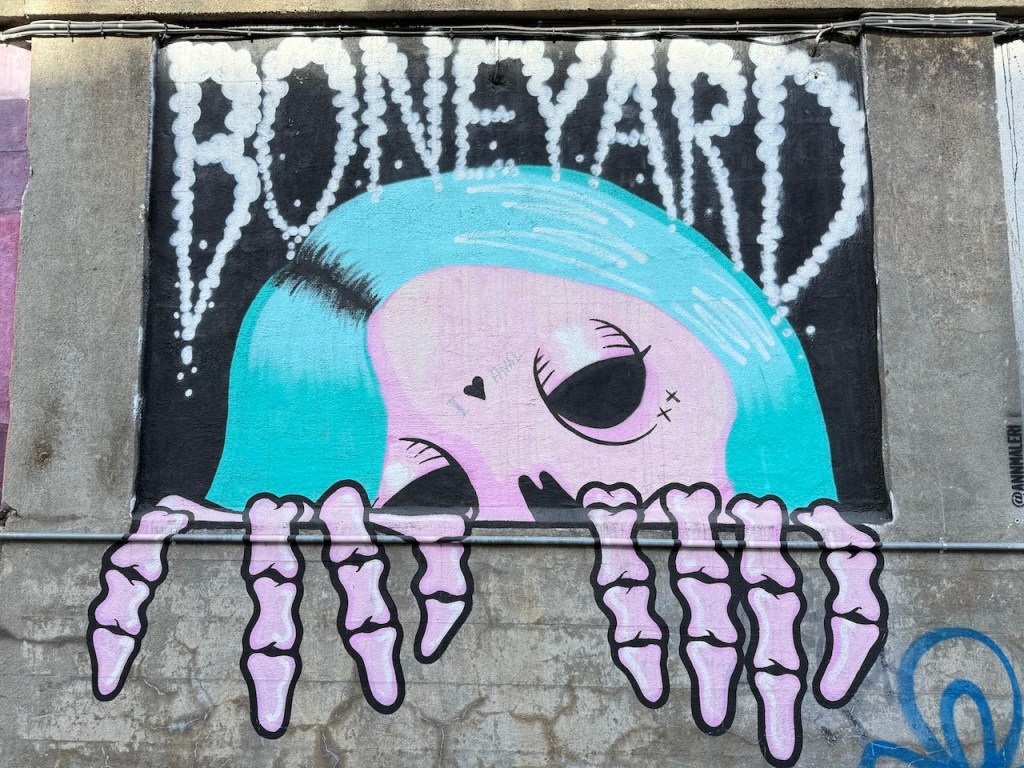
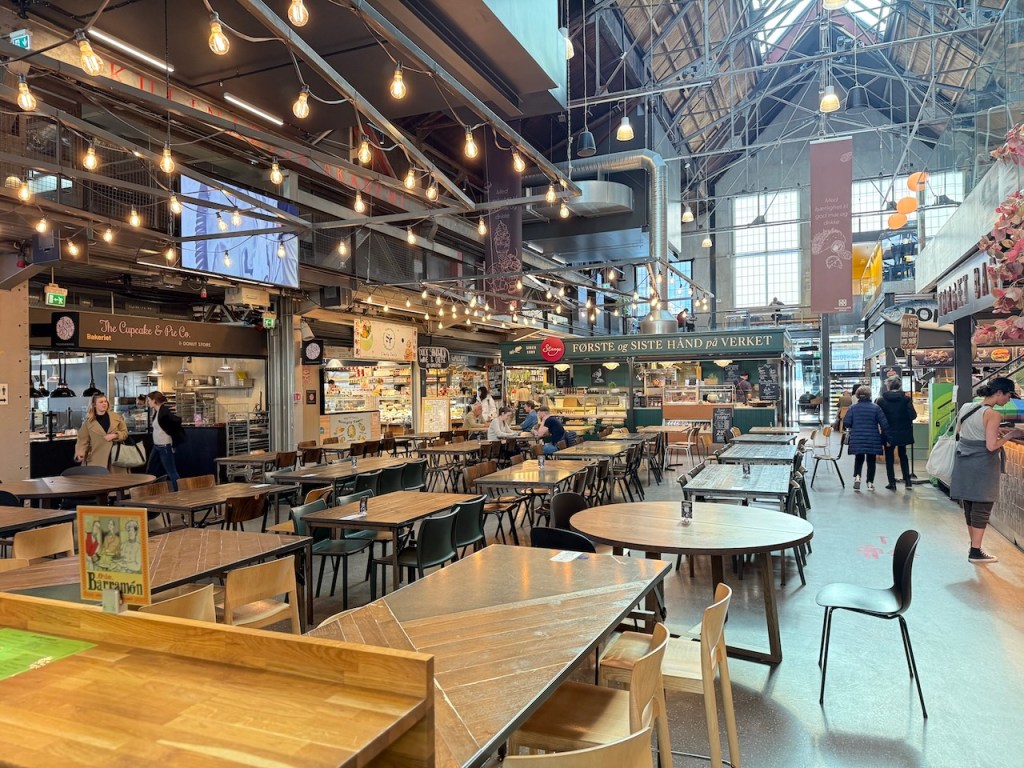
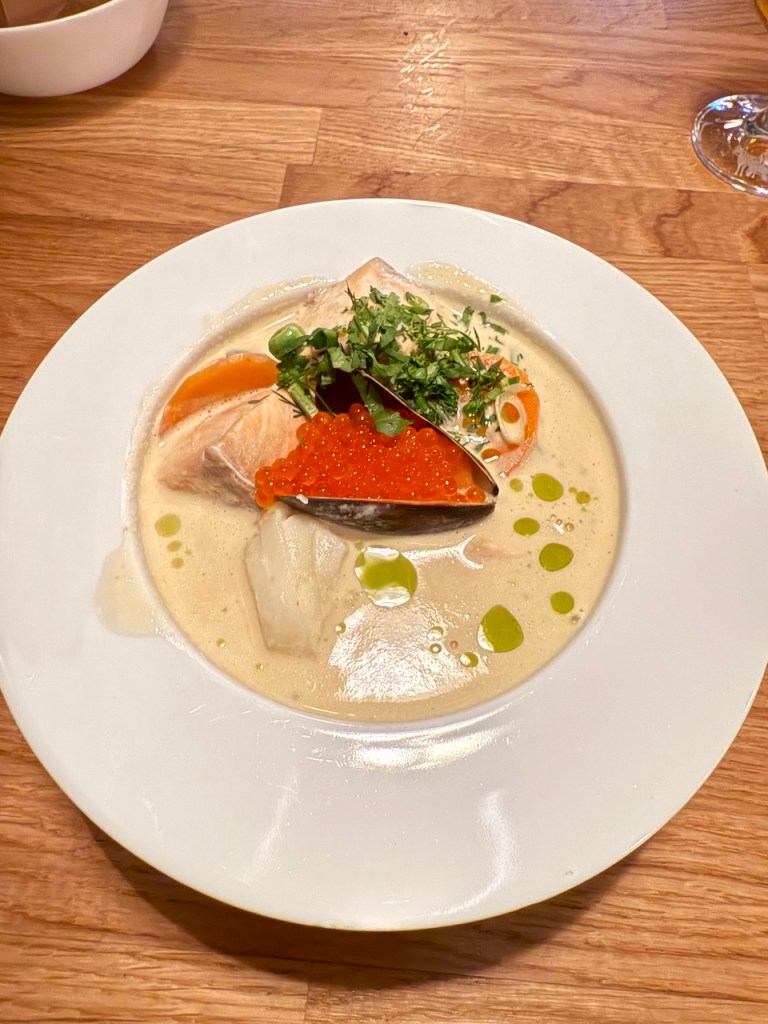
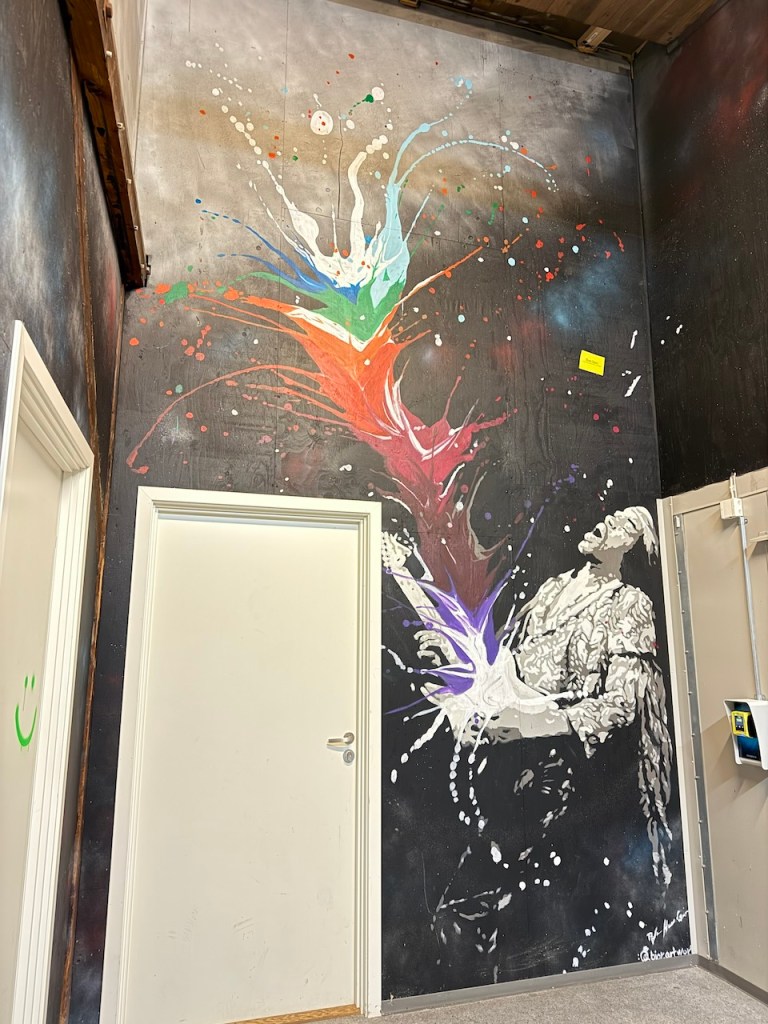
My next mission was to walk to the Mathallen Oslo, an upscale food court in the Vulkan neighborhood. That stroll – mostly downhill on a beautiful sunny day – took me down some unpretty main drags – but where I ran into the dog in a harness at the top of this post – and then past a sweet small park and into a funky neighborhood with lots of fun graffiti. The hall itself had lots of restaurant stands – tapas, tacos, seafood, hamburgers, bao bao, Italian – and food stands – bakery, butchery, chocolate, gelato, and bars. I settled in for probably the best fish stew I’d ever had – and darn pretty too – along with a beer and some fresh bread.

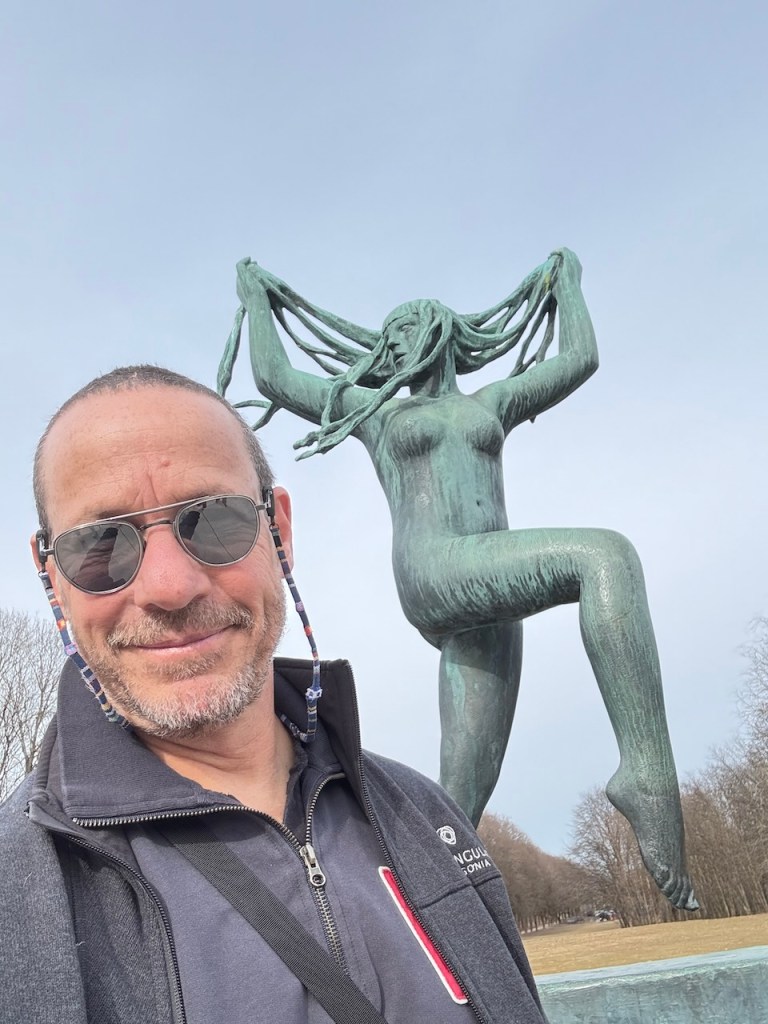
The New York Times had done one of their “36 Hours in . . .” travel stories about Oslo in 2023; I always find those useful to figure out where to go and where to stay (in fact, I stayed, this trip, at one of the hotel recommendations in that article – the place with the “decent bagels”). But just as good as the stories can be, the comments are also great sources of information and – in this case – they pointed me in the direction of the Vigeland sculpture park – which is actually the Frogner Park that happens to have a massive installation of sculptures by the artist Gustav Vigeland. So – my next walk was about two miles to the Park.

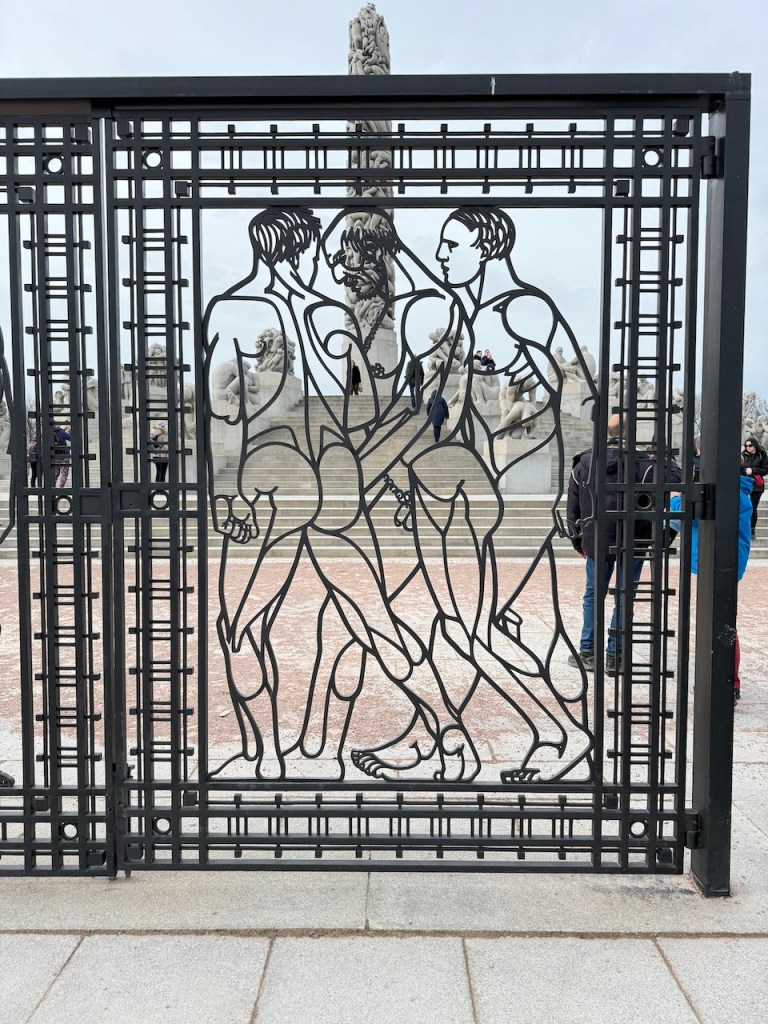
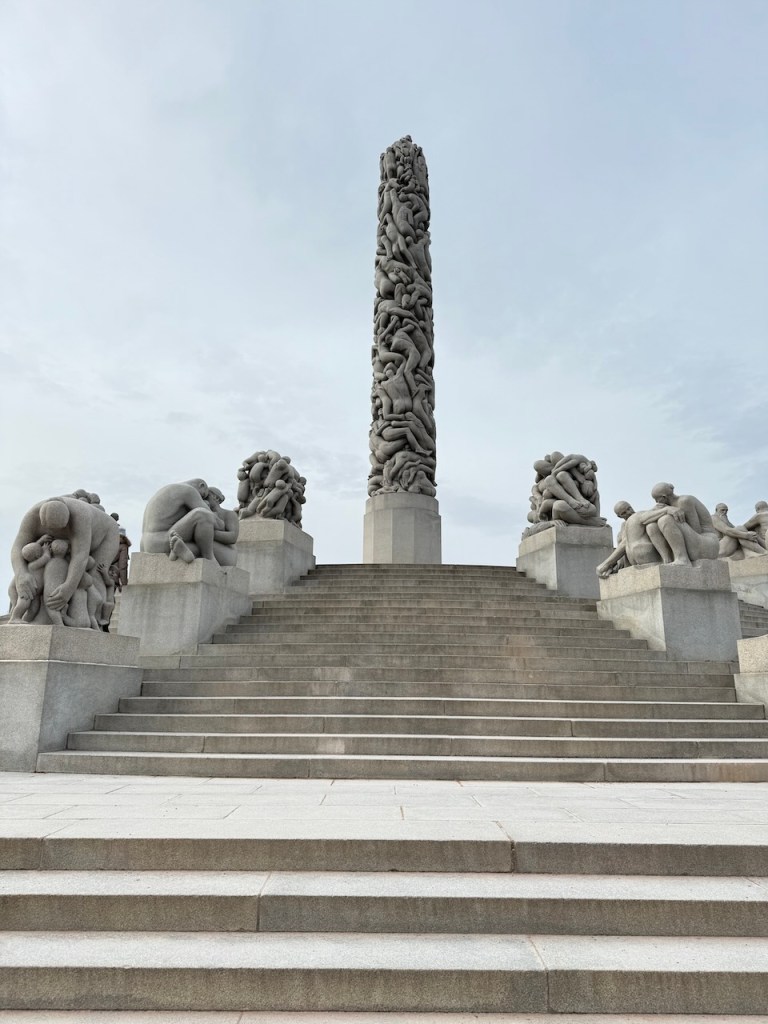
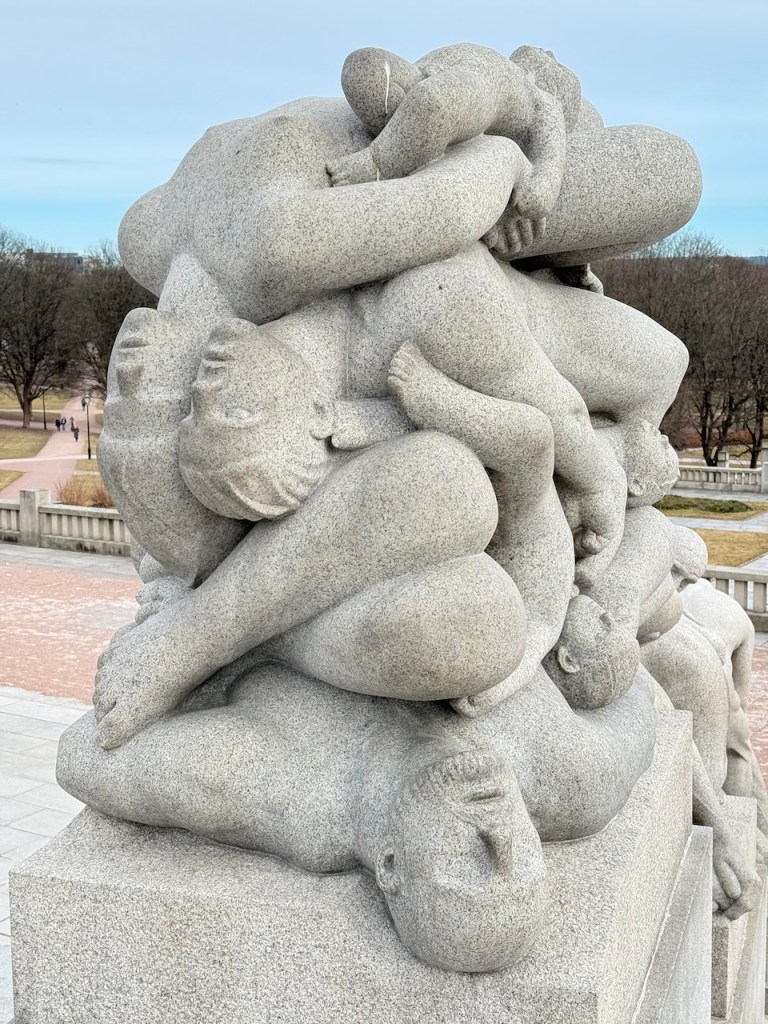
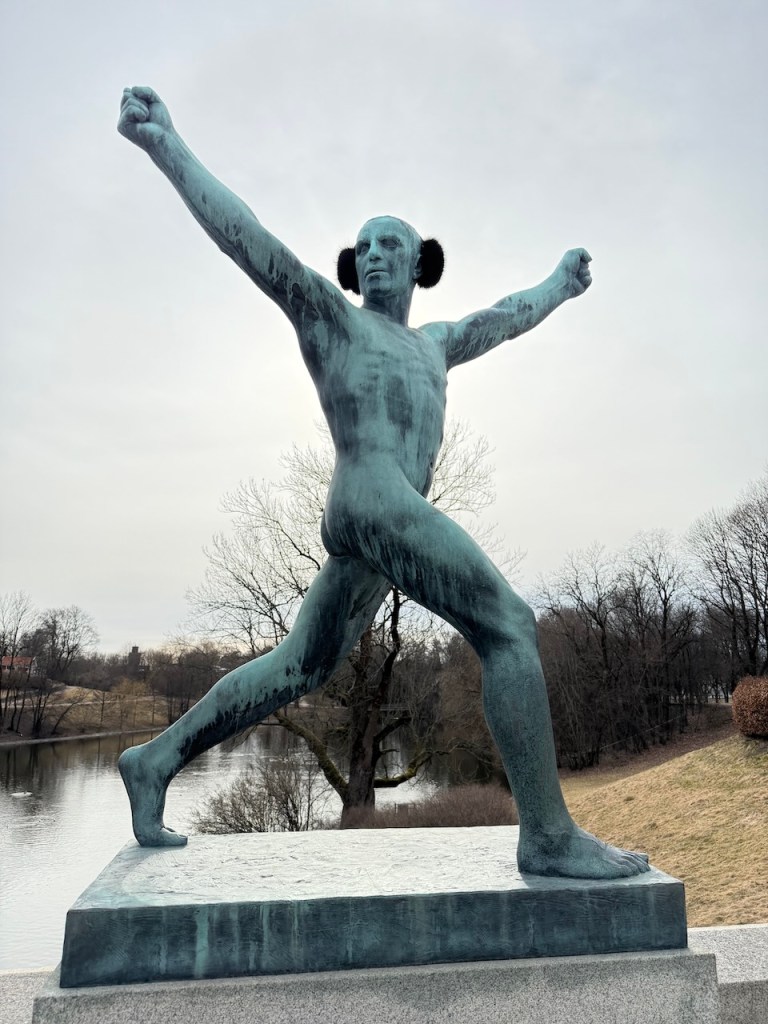
The Vigeland sculptures there – made of bronze and granite and primarily circled around what is called the Monolith – are big, bountiful, gorgeous, composed primarily of thick human bodies covering the range of human experience – from birth to childhood to adulthood and parenthood to old age. You want to take them all in, going around the circle, looking at the bronze gates, thinking about what is being expressed in each. On a sunny and mostly warm spring day, this was a pleasure.

The last part of my walk for the day took me from Frogner Park through a neighborhood of embassies and diplomat homes – beautiful and big – and then through the central arts and shopping district. Of my time in Oslo, these two neighborhoods were clearly the most fun to see and enjoy and spend some time wandering around in. Once back at my hotel, I had some time to relax before dinner.

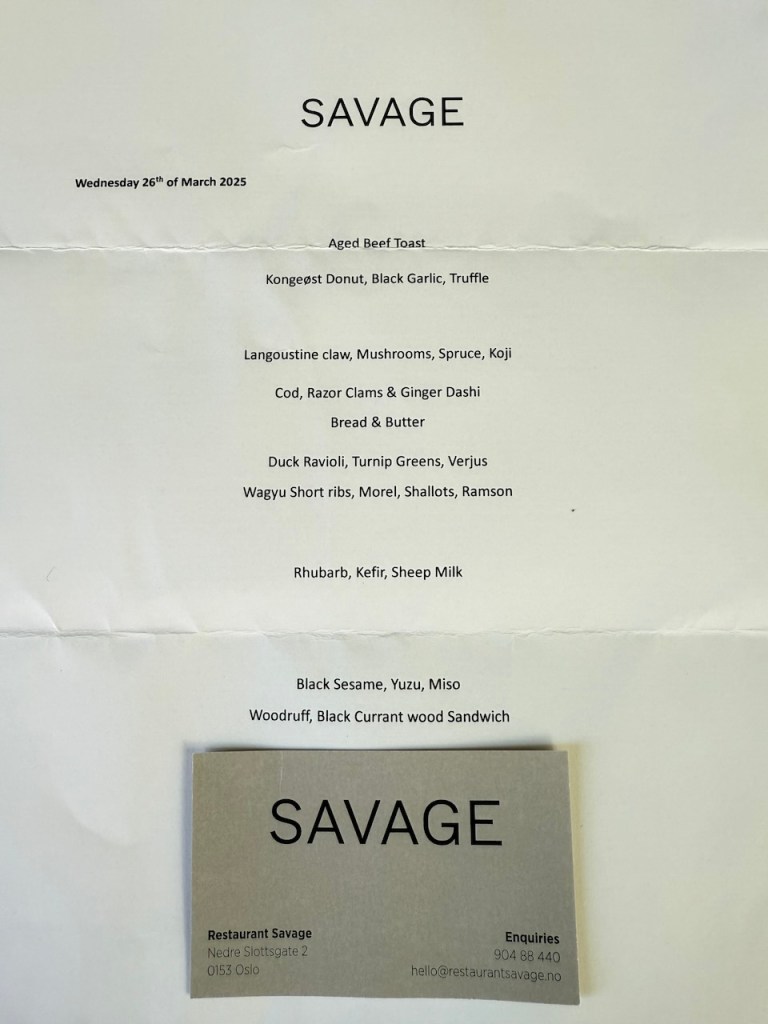
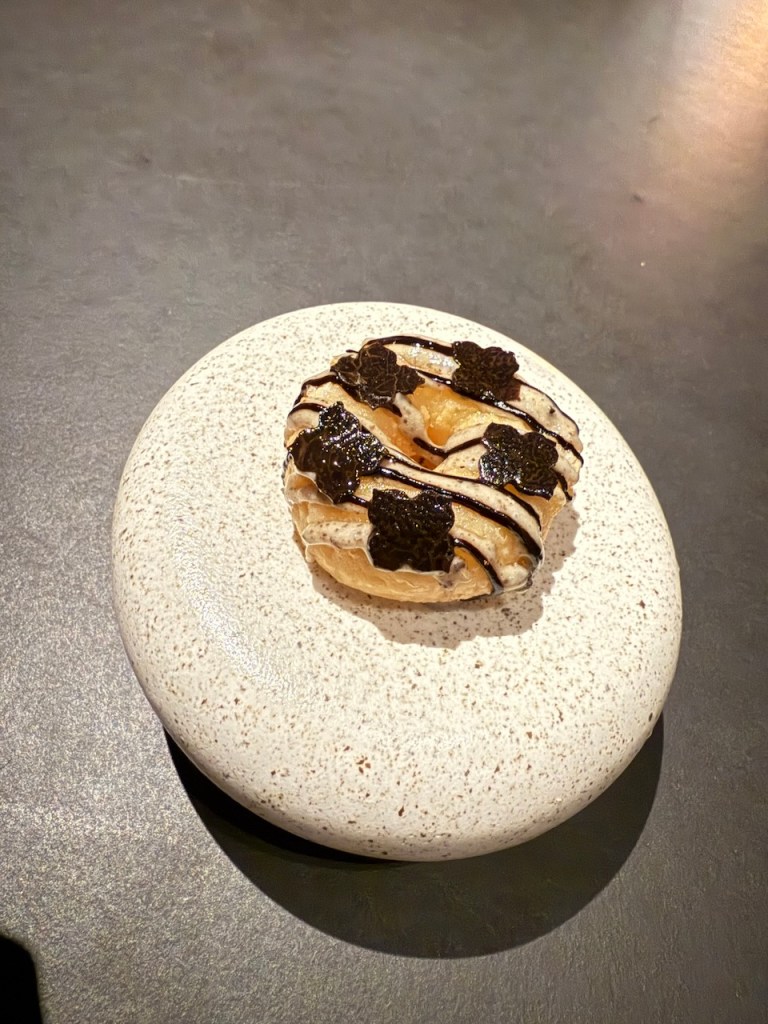
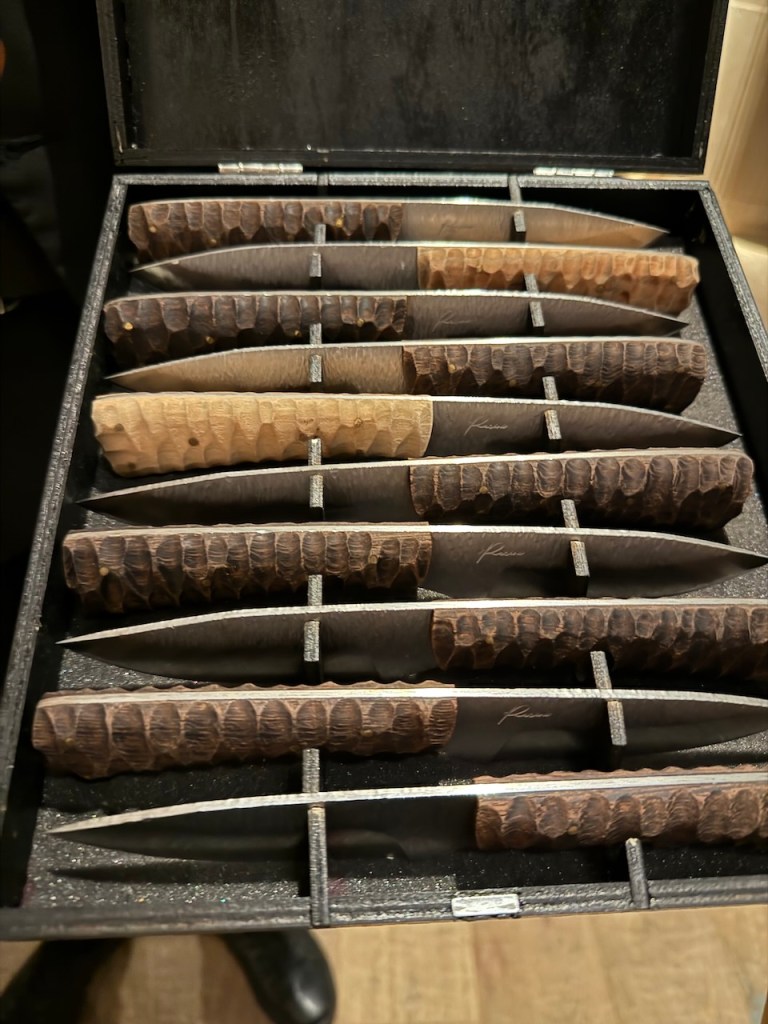
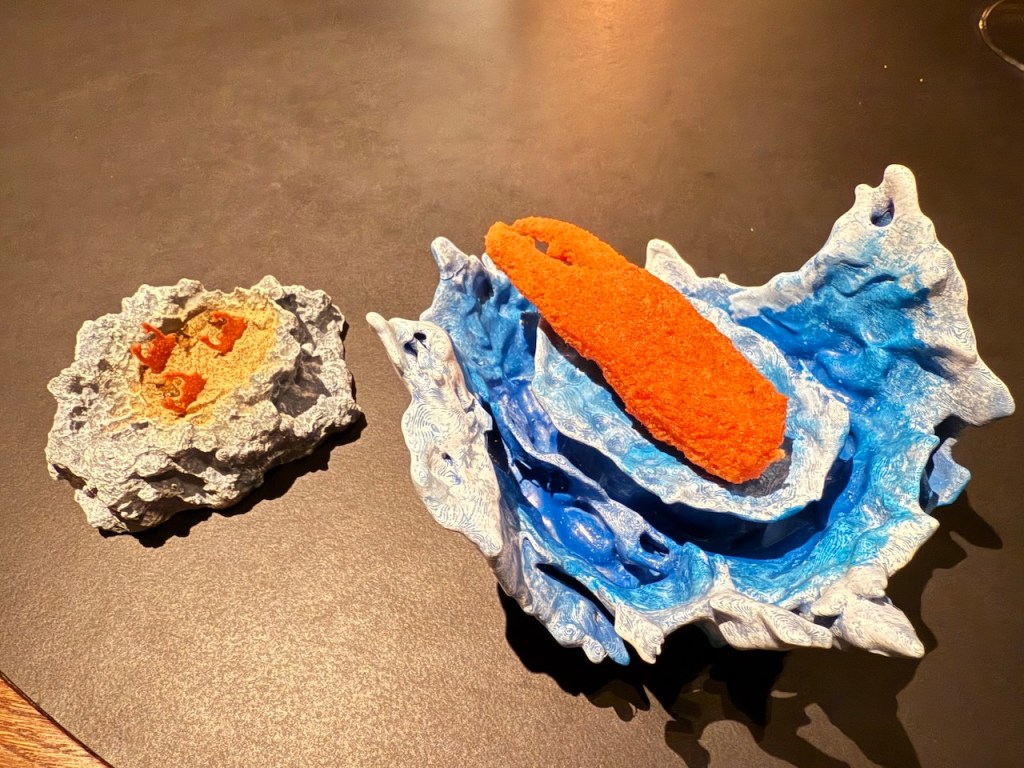
And the dinner joint was a Michelin-starred restaurant named Savage, which came with a prix-fixe menu. It was a very quiet night there – I was one of only four tables and maybe 10 or 12 guests tops. But the food was fantastic, the service was great, and the place was beautiful to look at. I even got to choose from a selection of knives for my Wagyu short ribs!
It was a super last day. I walked about 10 miles total and finished it up with a last vodka at my hotel before heading to bed for a very early wake-up and the flight home.

A Day Trip from Oslo – the Flam Railway and Western Fjords – Day Twelve

How could I visit Norway without going to see the fjords? I mean, it’s almost as if the country is more well-known for these deep, narrow, glacier-carved, sea inlets overlooked by towering cliffs than it’s being known for anything else! So I sought a day trip I could take from Oslo to see what I could see.
Conveniently, the trip I found – while long – would allow me to see a few things; fjords, of course, but also a journey on the Flam Railway and a visit to Bergen, the second largest city in Norway and home to a UNESCO World Cultural Heritage Site.

Of course, Norway has alot going for it other than fjords. Founded in 872 (yep, more than 1,150 years ago), it’s a country of about 5.6 million people. They’ve got universal healthcare, comprehensive social security, is ranked as the world’s “most democratic country,” was the first country in the world to pass gay and lesbian anti-discrimination laws, and it was the sixth country to legalize same sex marriage. Parents have forty-six weeks of paid parental leave. It has the sixth highest GDP per capita, is the world’s fifth largest oil exporter, the third largest gas exporter, and the second largest fish exporter after China. In 2025 it ranked seventh in the World Happiness Report (it was ranked first in 2017) and – perhaps more important that anything else – it has won more Winter Olympic medals (405) than any other country (the US is second with 330).

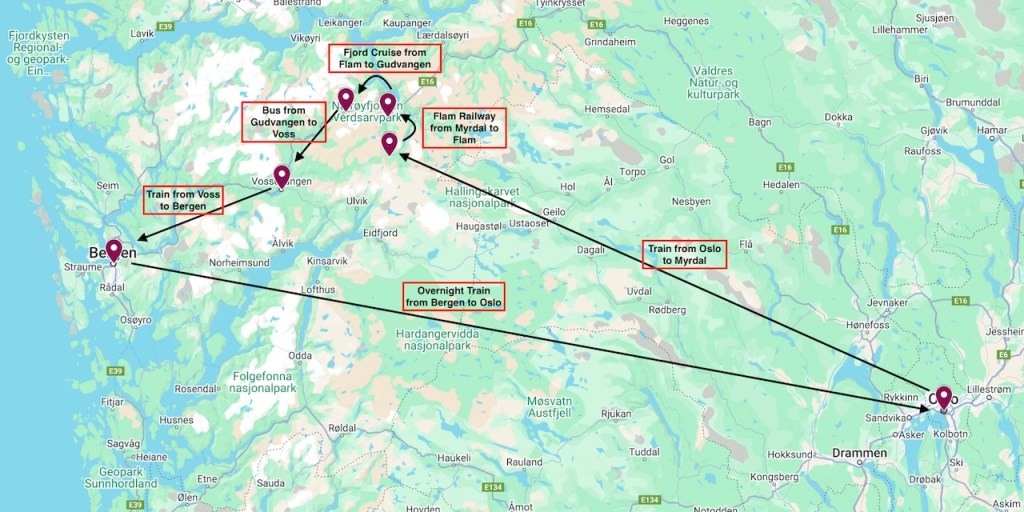
My “day” trip would include 1) an 8:25 a.m. train from Oslo to Myrdal (4 1/2 hours), 2) the Flam railway (50 minutes), 3) a cruise in the fjords (2 hours) to Gudvangen, 4) a bus ride to Voss (1 hour), 5) a train ride to Bergen (90 minutes) where I’d walk around and have dinner, and – finally – 6) an overnight train (in a sleeping car) from Bergen back to Oslo (7 1/2 hours), arriving at 6 a.m.

It was a great day.

A map of Norway illustrating the route taken during a day trip from Oslo to Bergen, highlighting the major travel segments including the Flam Railway, fjord cruise, and overnight train.

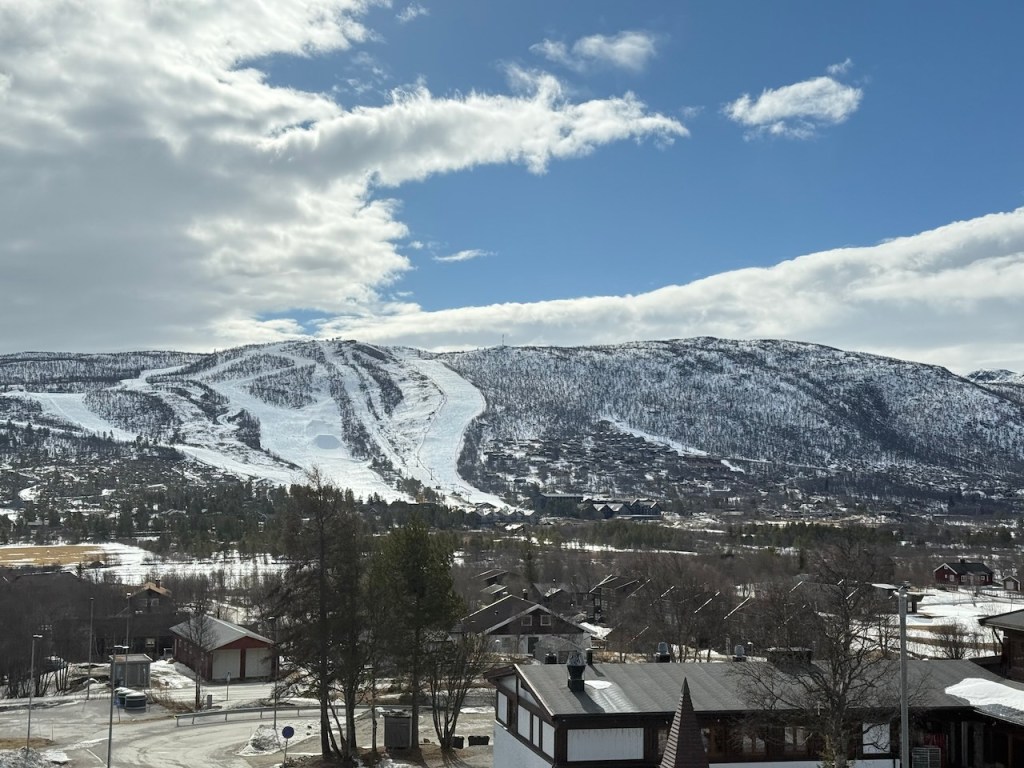
That first train trip – what a blast. The city-scape faded pretty quickly, leading to a landscape of woods and fields, without any snow. But that too faded away as we got a bit farther north and a bit higher in elevation (Myrdal, our destination, is at about 2,900 feet), leading to snowy landscapes. These two videos show these two perspectives (the picture at the top of this blog entry is from this part of the journey), and the picture following these shows one ski resort we passed by.

Snow-covered ski resort landscape with a clear blue sky and distant mountains in Norway.

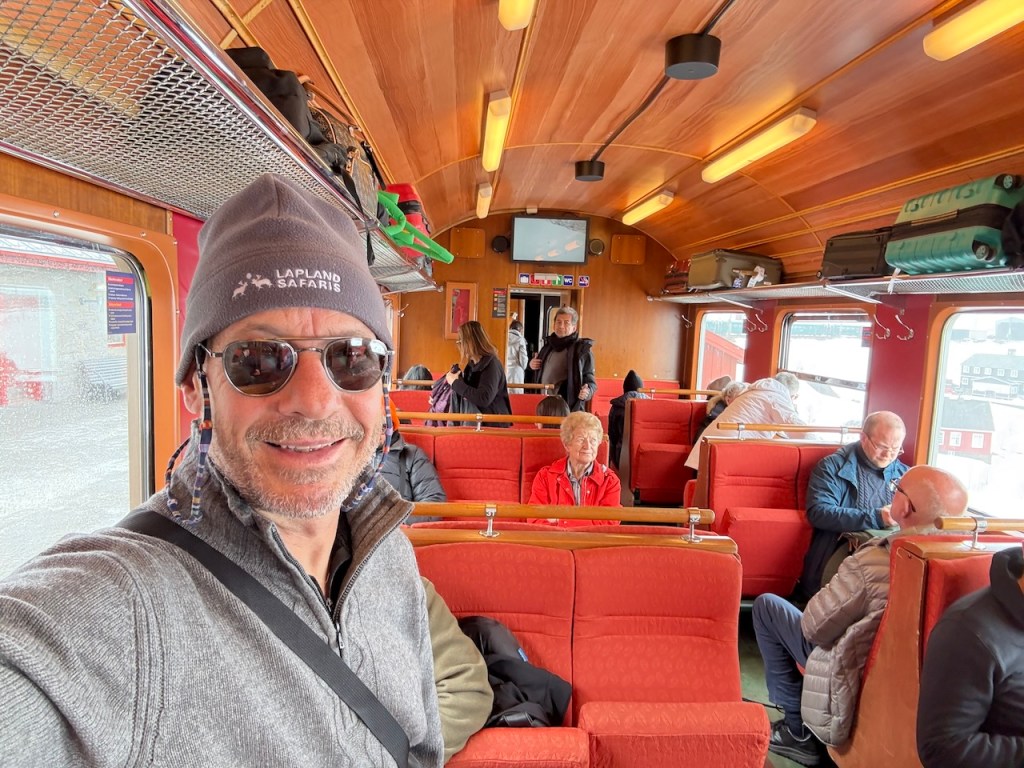
Once I arrived in Myrdal I only had to cross the platform from one train track to the other side where the Flam Railway awaited. This great old wooden train, multiple cars, had big windows on either side of each car, but only the windows at one end of the car I was on opened, by sliding it up and down. The first decision, then, was where to sit; unfortunately, the seats by the windows that open already were occupied. So, ok, left or right? I first sat on one side, but the women across the aisle said they heard the other side was better for the views, so I switched. But, you know what? It made no difference; everyone moved from side-to-side to get the views and take pictures. And the seats by the windows that opened – well, there were two young couples seated by both, all with Eastern European-accented English (one of the guys wore a New York Yankees cap), and they opened the windows and those of us who wanted to take pictures through them.

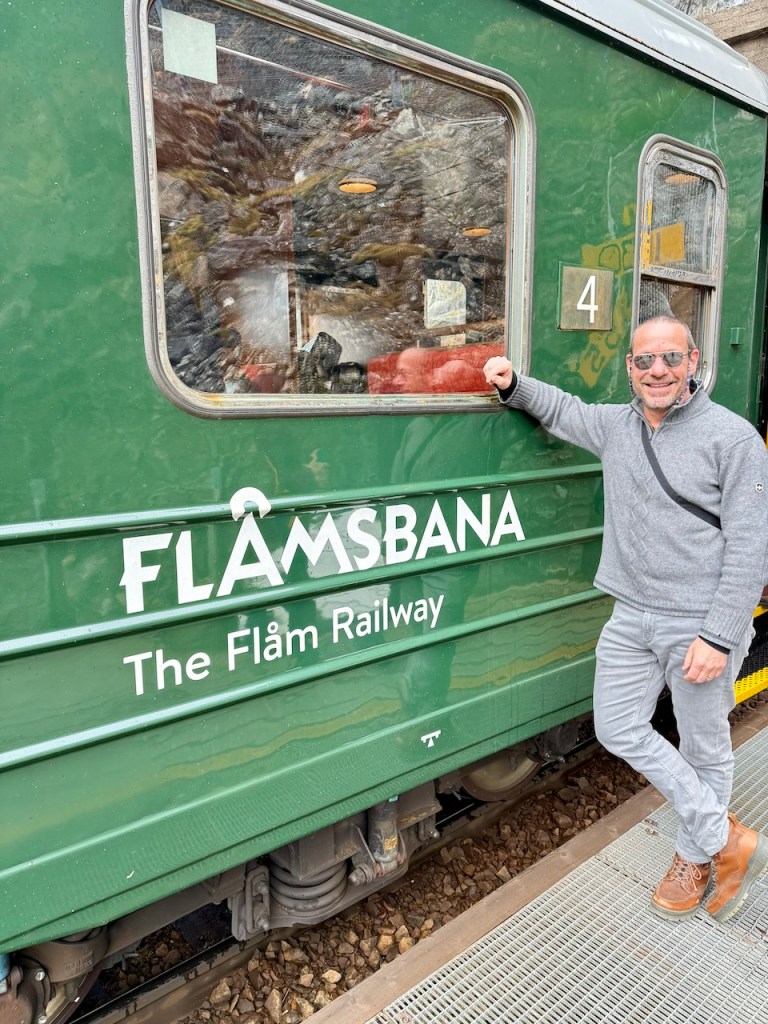
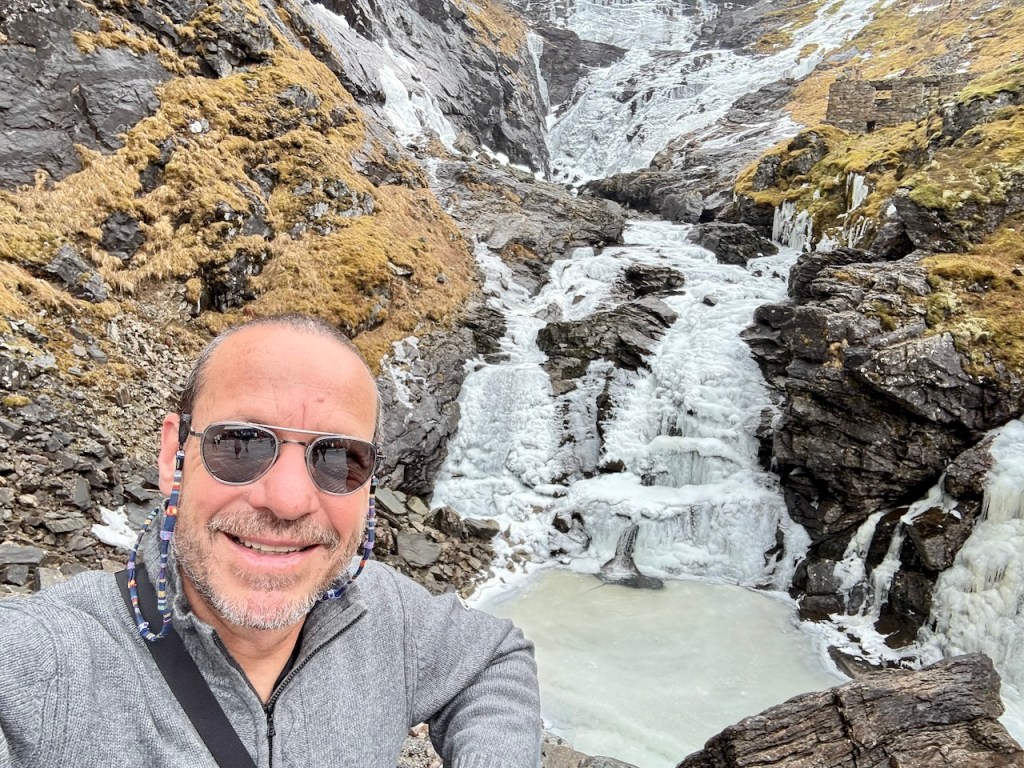
The Flam Railway is the steepest standard-gauge in Europe, and it winds around and through mountains and valleys, with spectacular views on both sides; we made one stop by a frozen waterfall, and we went over at least one bridge and through about 20 tunnels. Super fun and – at only 50 minutes – I only wish it lasted longer.

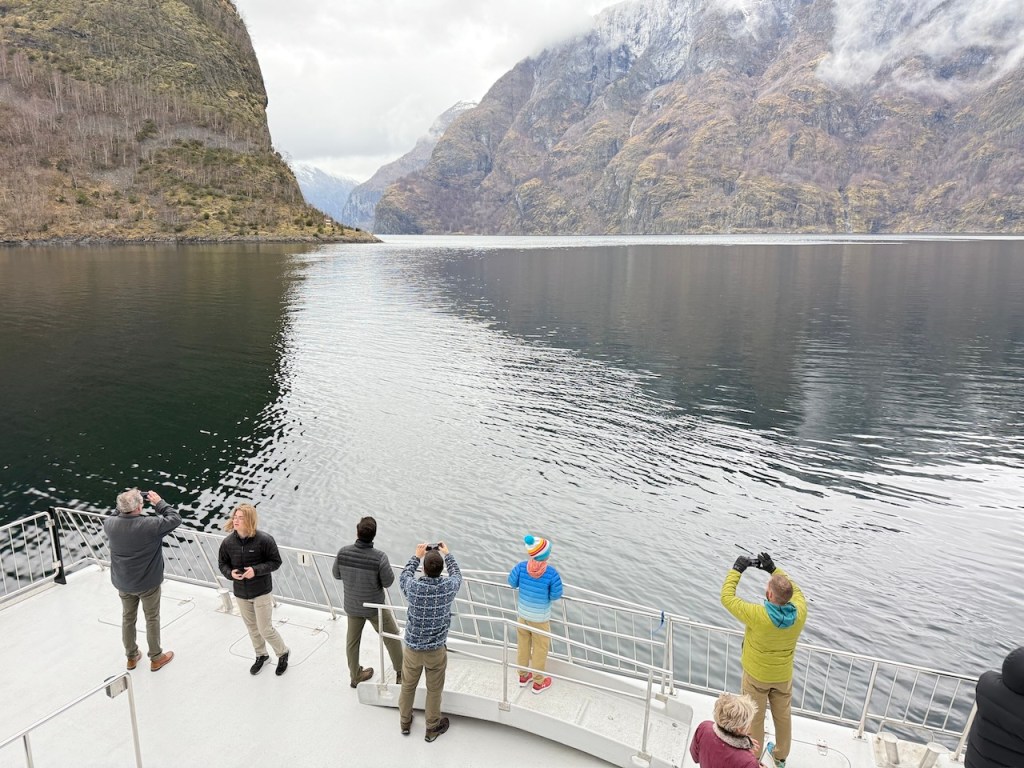
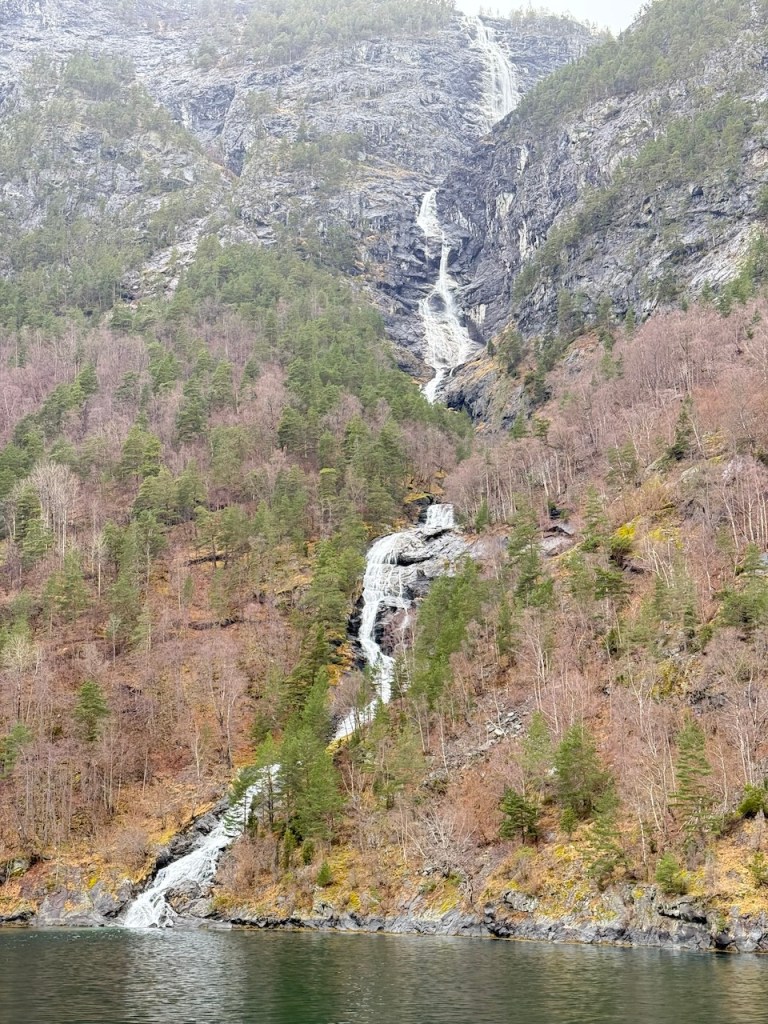
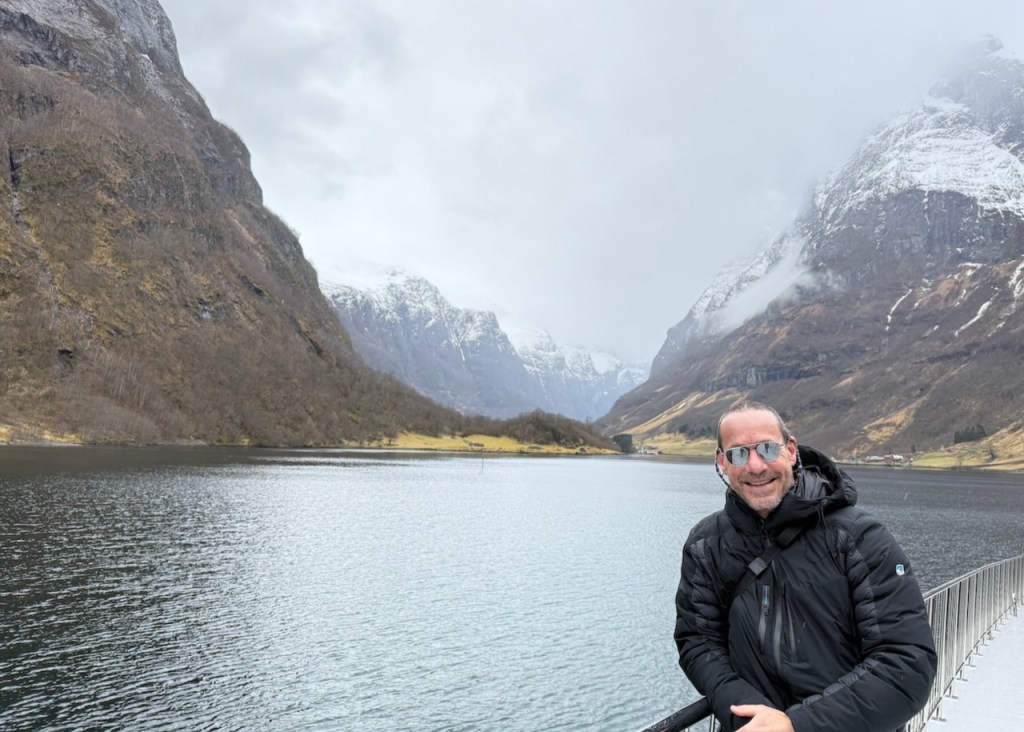
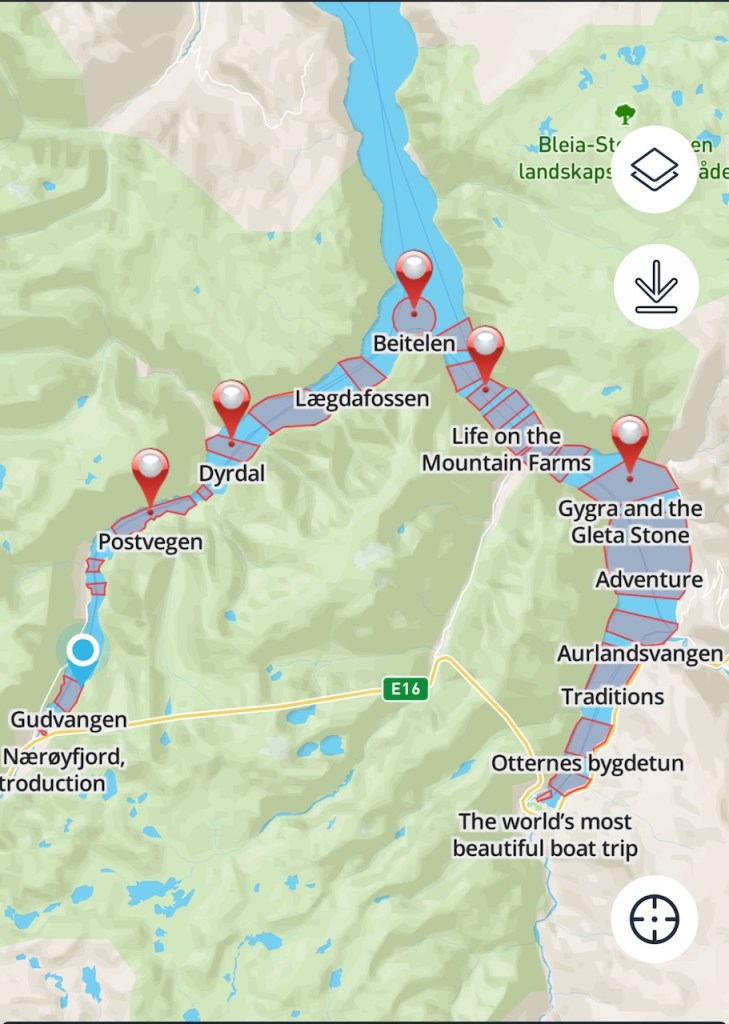
The next part of the journey was the ferry cruise. I arrived at the port of Flam right in the middle of the Aurlandsfjord, which reaches 3,156 below sea level and is about 1.2 miles wide at its widest. I had to wait a little bit for the ferry to depart, but once boarded there were two floors indoors and lots of outdoor space to wander around and watch the steep mountains on either side as we steered by. At one point we made a big left hand turn into the Naeroyfjord, a UNESCO World Heritage Site that National Geographic has ranked as the world’s number one natural heritage site. The weather was chilly with periodic sprinkles and some wind, but not so cold where I couldn’t stay on deck the majority of the time, along with lots of other cruisers, all angling for the best photos. Of course, the boat’s captain knows what we’re all there for, so he would slow down by neat sites – special cliffs, waterfalls, small buildings.

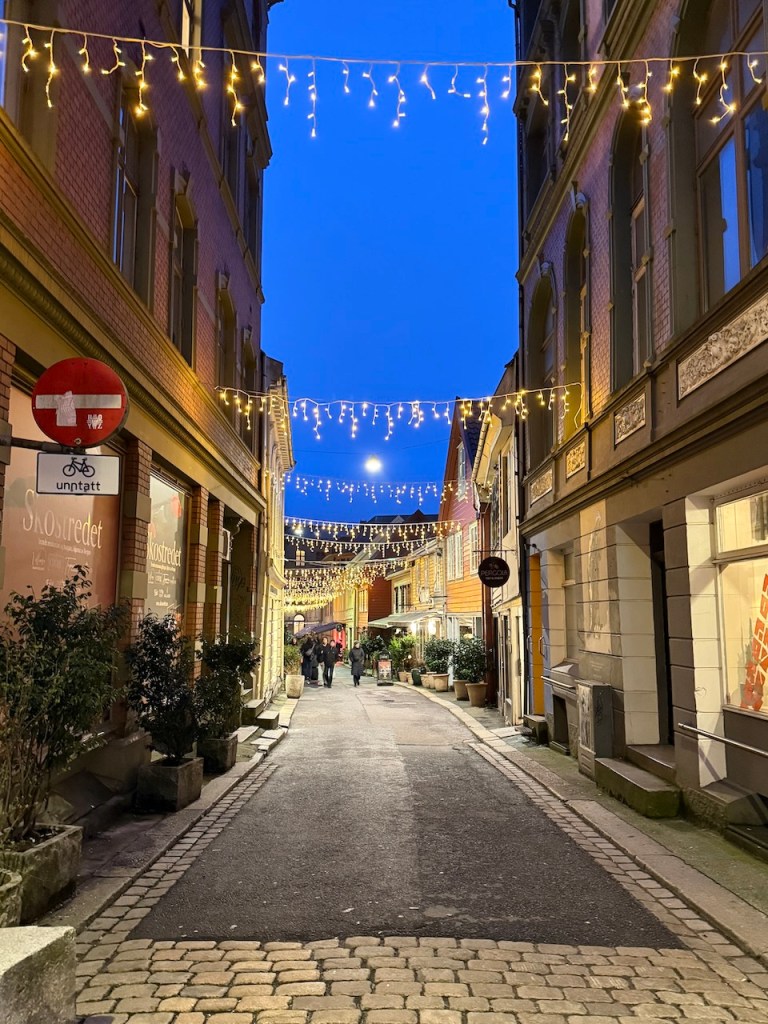
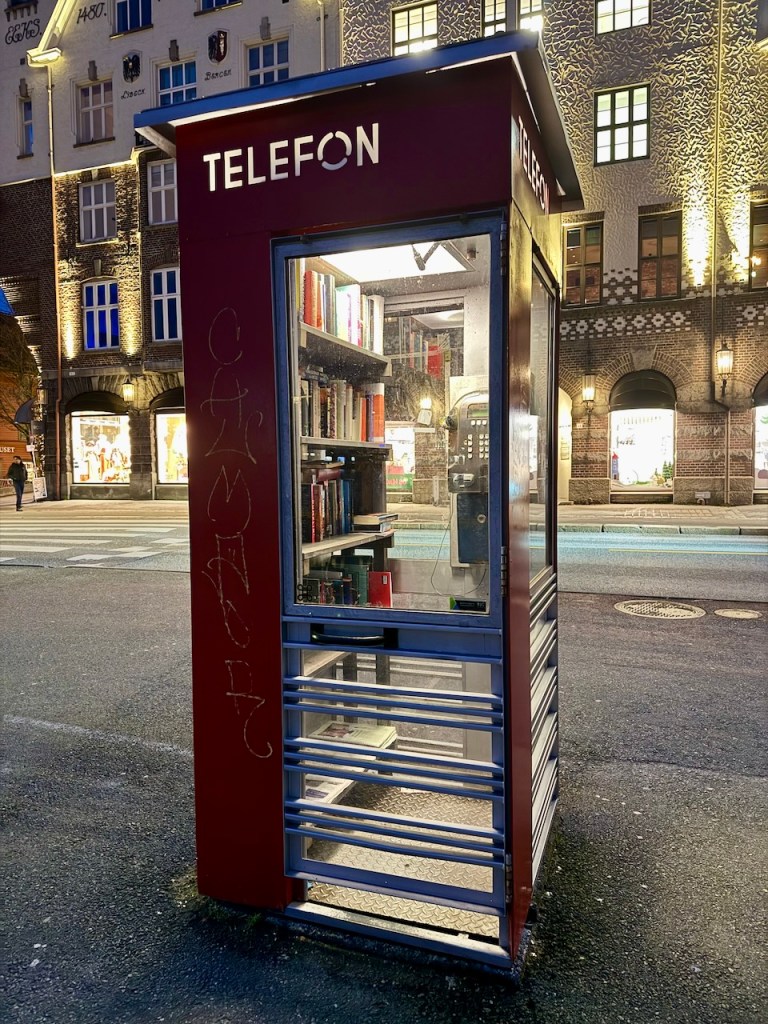
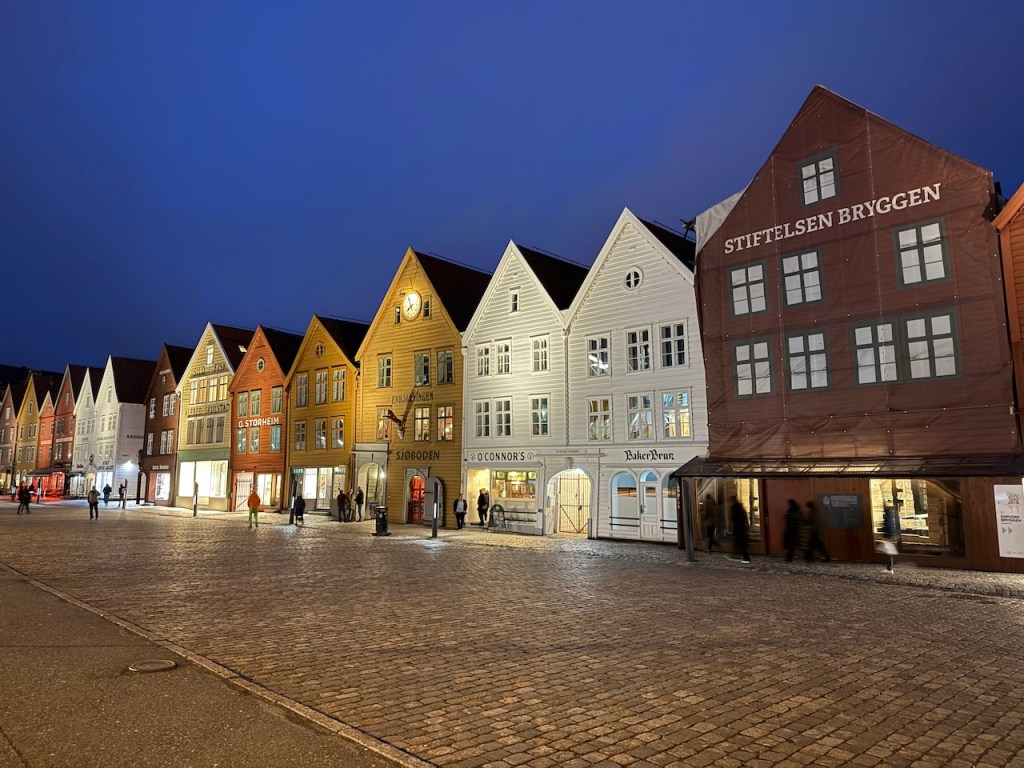
Then the bus and train to Bergen, where I had to time to wander the waterfront and have dinner before getting into my sleeping car for the overnight train-ride to Oslo. Bergen was a really pleasant surprise – super picturesque (it’s surrounded by mountains), easily walkable, lots of good pubs and restaurants and shops and sights to be seen. Trading started there in the 1020’s, and it became a major port for merchants and markets in Central and Northern Europe into the late 18th century. Some of the oldest trade buildings still survive and are beautifully maintained.

Dinner at a local joint and from there it was a small sleeper car for the journey back to Oslo.

Oslo – Days Ten and Eleven

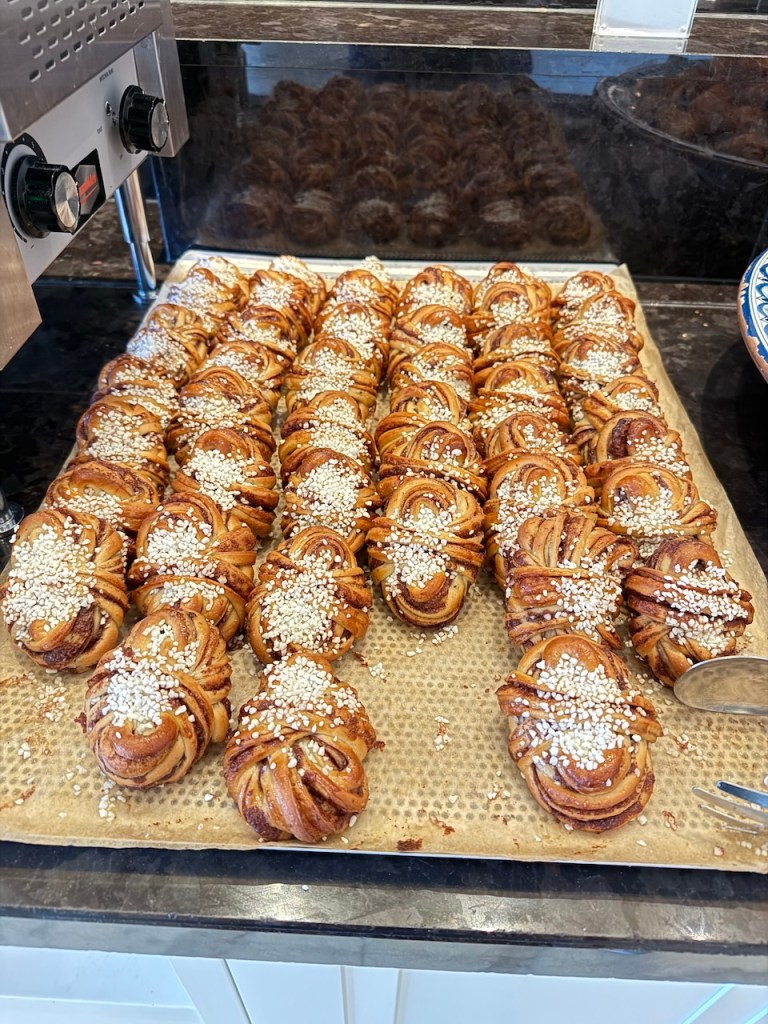
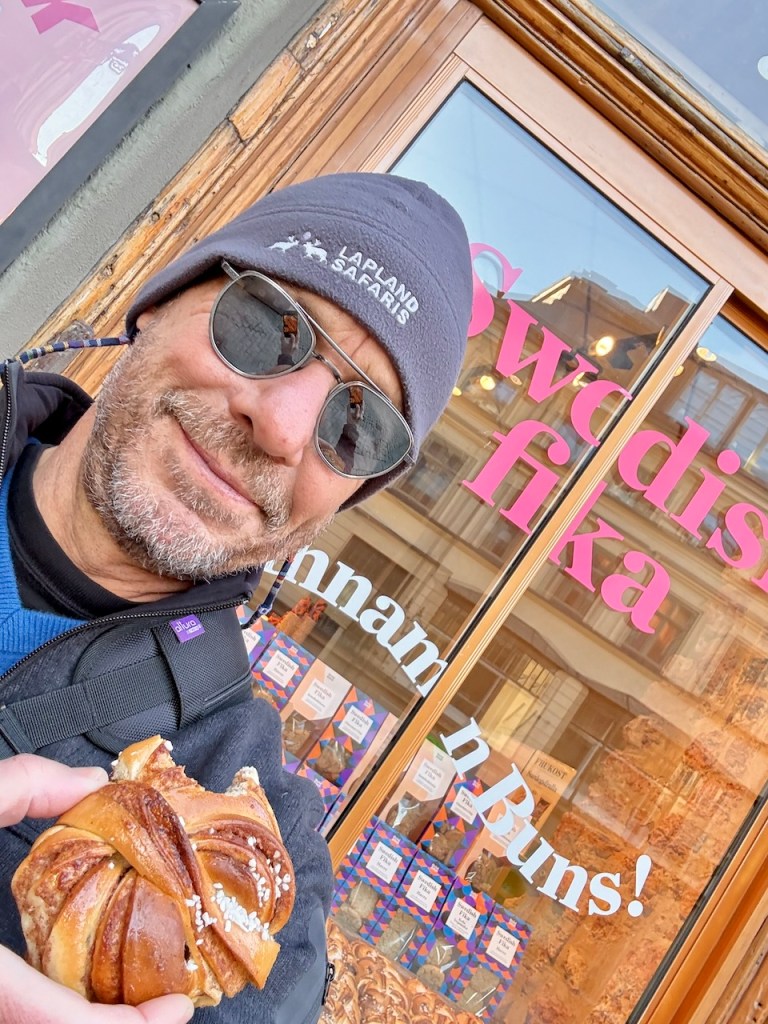
I had to start my last morning in Stockholm with some cinnamon buns (kanelbullar!) but after that, I was off to Oslo.

When I’d booked the trip to Lapland, Helsinki, and Stockholm, I wanted to see if I also could fit in a trip to Norway; looking at the map, it didn’t make sense to do it before Helsinki, given the proximity of Norway to Sweden; once I’d figured that out, it really was just a matter of how to get from Stockholm to Oslo. The train seemed the best way – only about four-and-a-half hours, and across the Scandinavian peninsula, giving me a chance to see the country-side between once capital and the other.

After breakfast it was off to the Central Train Station in Stockholm for what turned out to be an easy and scenic ride. The border between Sweden and Norway is the longest uninterrupted border in Europe, and I’d be traveling east to west across that north/south border.

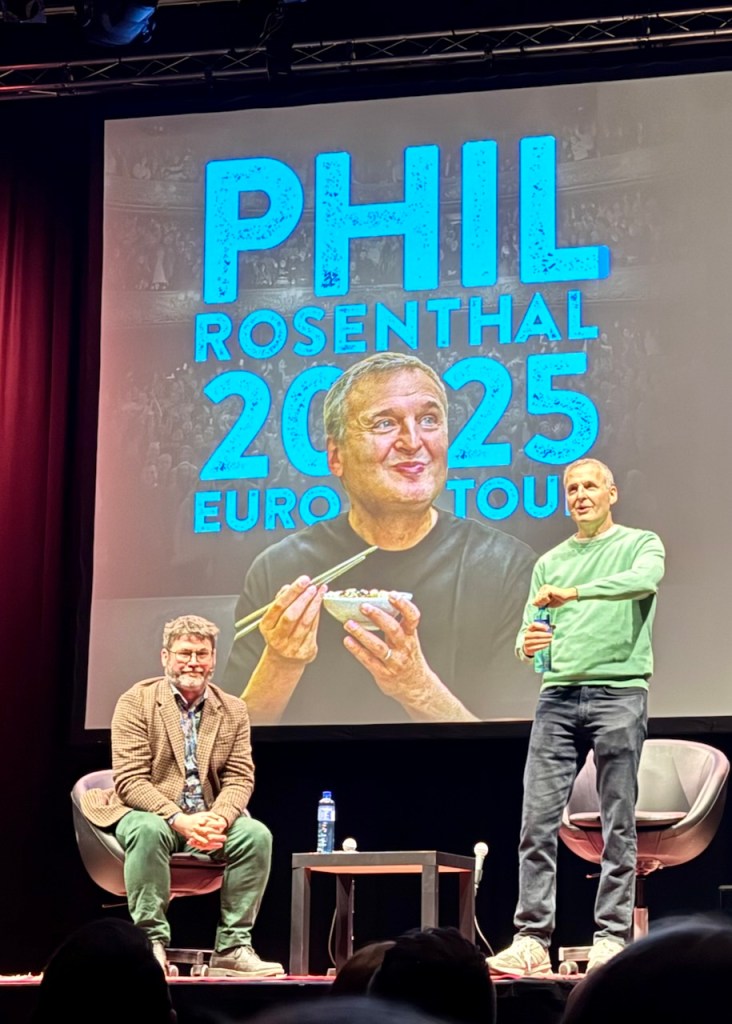
And what did I learn while on the train? Well, Phil Rosenthal, the creator and star of the Netflix series, “Somebody Feed Phil,” which I regularly watched to check out the food culture and places to eat in cities I was visiting, was on his European tour and – waddaya know – he was appearing in Oslo the same evening as my arrival. Serendipity! Ticket purchased for general admission seating, and it was just a matter of arriving in Olso, checking into my hotel, which was literally right next door to the train station, and then walking to the theater where Phil would be performing.
A fun day and an even more fun evening; he was witty and informative, gave me at least one idea of a food place to check out in Oslo, took questions from the audience, and just had to find my own joint for dinner that night. And I couldn’t believe the line outside the venue to see him when I arrived!

Before I move on to tell more of my time in Oslo, there is one story to share about our tour director in Finland and Sweden. While he was born in Chile, his family was from Spain, and he returned there when he was four years old. As an adult, he also has lived in Berlin. He and his wife now live in Warsaw; he is Jewish and his wife is a German Jew, whose mother is still alive (age 96). The mother is an Auschwitz survivor, who left Germany after the Second World War but returned home not long after the War ended.

When Russia first invaded Ukraine in February 2022, the mother implored our tour director to go to the Poland/Ukraine border to see what he could do to help the entering refugees.  On the second day of the invasion, he drove three plus hours to the border; things were terribly disorganized at the point and when he got there he saw streams of people – mostly women and children – with a look of terror in their eyes, not knowing what to do, where to go.  He saw two young adult women clearly traveling together, visibly traumatized at what they were going through.  He grabbed them by the hands, was able to communicate in some combo of Polish and Russian, that he would take them to his home to help them get settled.

With tears in his eyes as he relayed this story, he told me about driving back to Warsaw, the two women only whispering to each other, and he and his wife put them up for two weeks until systems were in place to help them out.  It turns out their father had been killed – he suspects they saw him being killed – and they barely spoke to our guide and his wife the whole time.  They still keep in-touch.

He has made three or four trips to the border since then, but none of them were as brutal as that first one the second day after the invasion. His story of he and his wife’s humanity will stay with me.

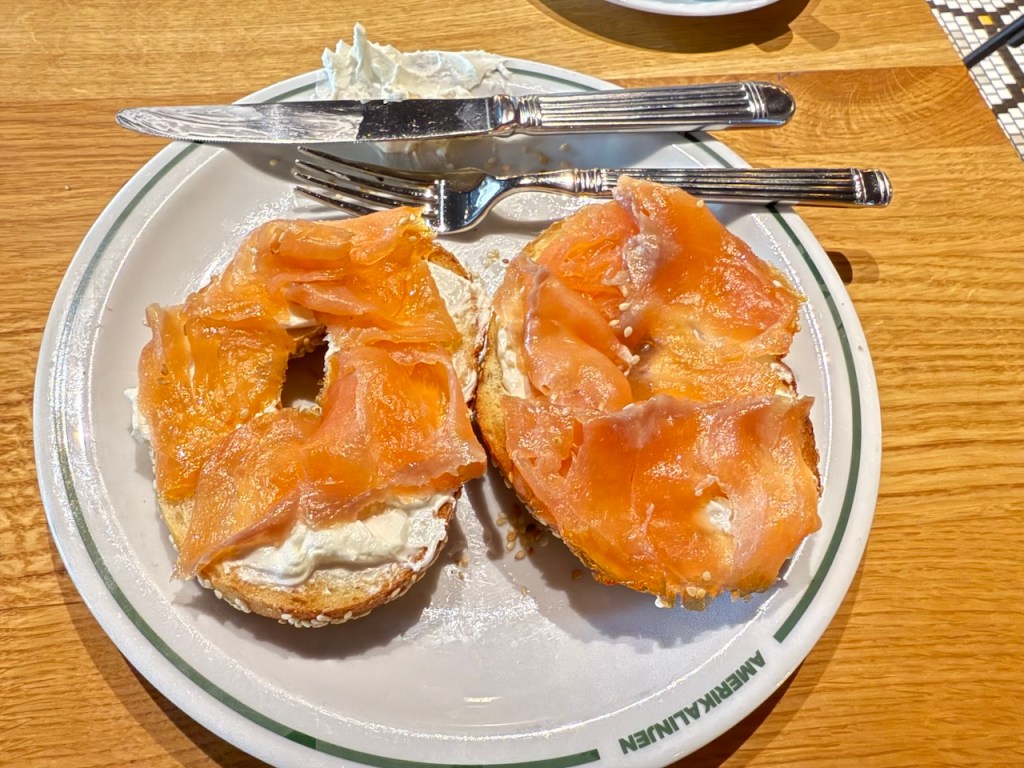
Back to Oslo, a city of 1 million people. While I’d eaten plenty of smoked salmon during my time in Finland and Sweden, the bagels in both those countries left much to be desired. So – finally! – on my first morning in Oslo, I had a decent bagel with smoked salmon.

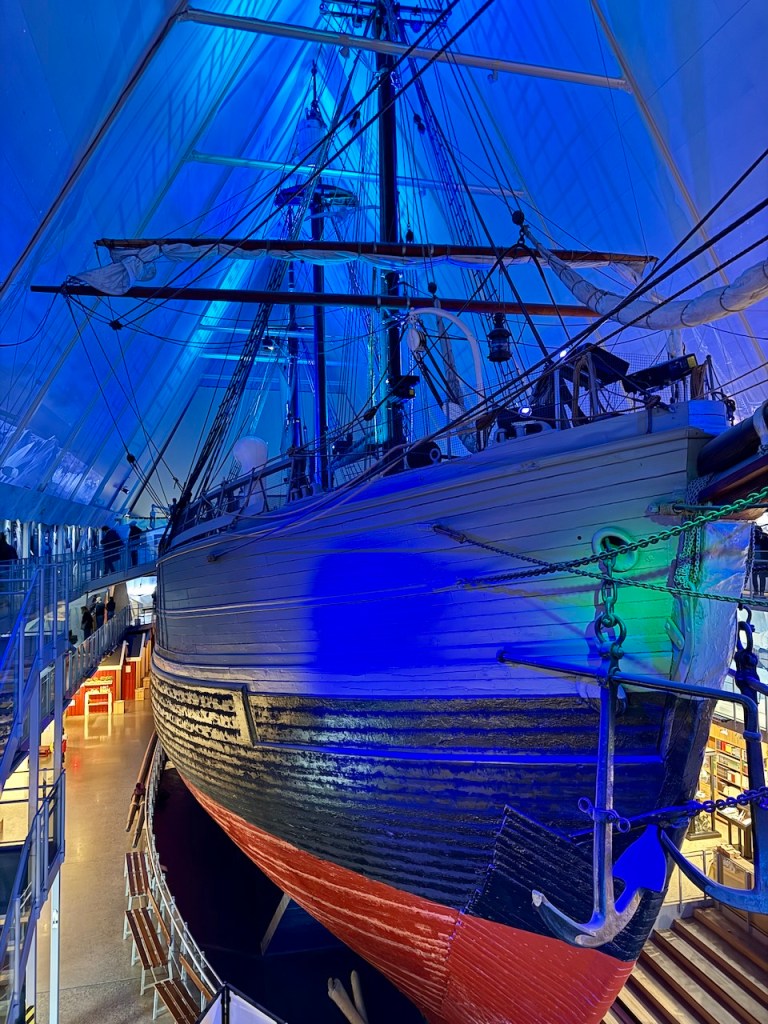
After breakfast, I was by city bus to see two boat museums. The first of these was to see the Fram, a three-masted schooner used by Norwegian explorers to make trips in both the Arctic and Antarctic regions. The Arctic trip alone was remarkable; Fridtjof Nansen wanted to sail further north than anyone prior to him, but he knew two things: 1) the Arctic ice would crush most ships, and 2) that the ice in the Arctic likely moved with the current of the water beneath it. So – he had a ship built to be superbly strong and designed to withstand a five-year journey in which it would be trapped in the ice so that it would be carried from one side of the Arctic to the North Pole and beyond. Unfortunately, though, neither he nor the ship reached the Pole, but the ship survived in the crushing ice for three years from 1893-1896 (he survived too). After that, the Fram made journeys to the Canadian Arctic and, as I mentioned earlier, the Antarctic as well. It may just be the strongest wooden ship ever built.

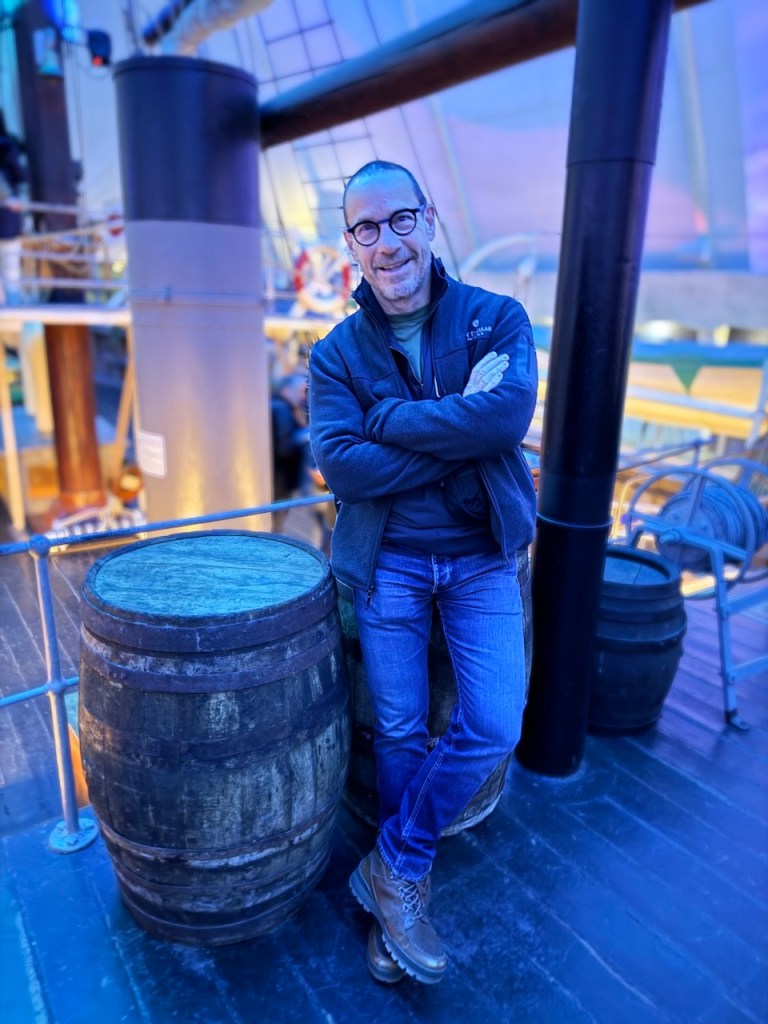
What’s also cool about going to see the Fram is that they let you board it! And they have great special effects in the museum.

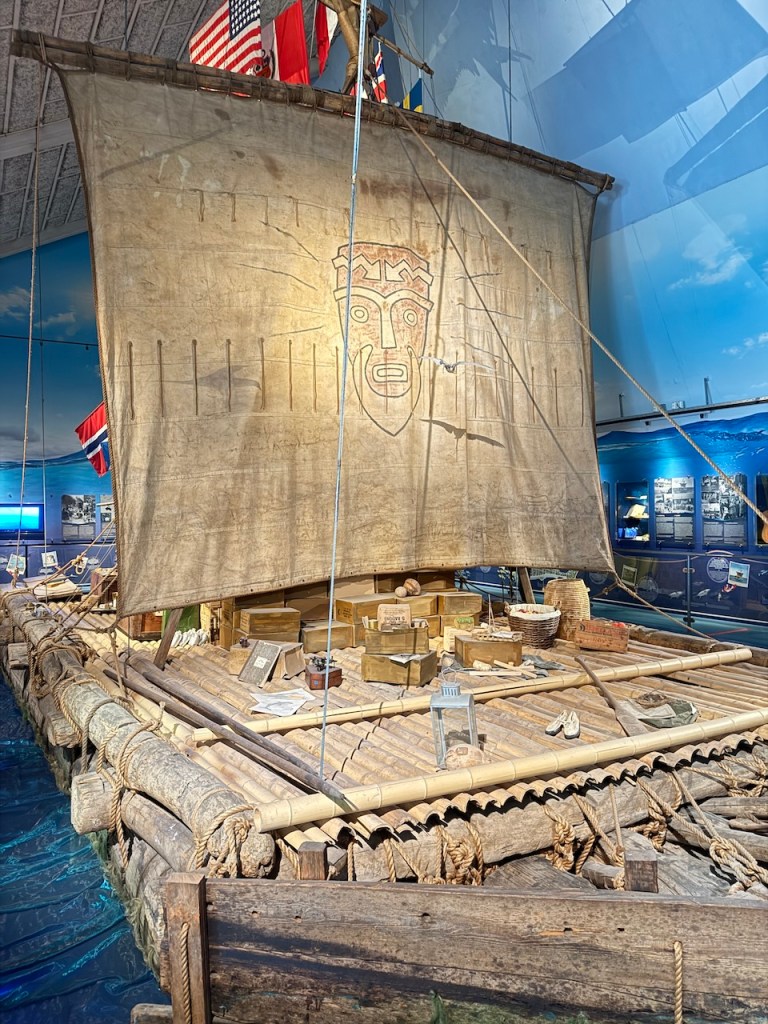
And right across the street from the Fram Museum is the Kon Tiki Museum. Its expedition also is a remarkable story, and the documentary about it won an Academy Award. The Norwegian explorer, Thor Heyerdahl, wanted to prove his theory that peoples from South America could have successfully journeyed, by wind and ocean currents only, to the Polynesian islands in the South Pacific. So, in 1947, he and companions built a raft in Peru using balsa and other native materials; then, with a crew of five others, they survived a trip that lasted 101 days and over 4,300 miles, landing on a reef in French Polynesia (images and film taken on the journey are in the documentary). While you can’t board the Kon Tiki, seeing it and realizing the trip they’d made on it is pretty darn stunning. (Heyerdahl later also became famous for his theories of how the moai – the statues – of Rapa Nui – Easter Island – had been carved and moved elsewhere on the island.)

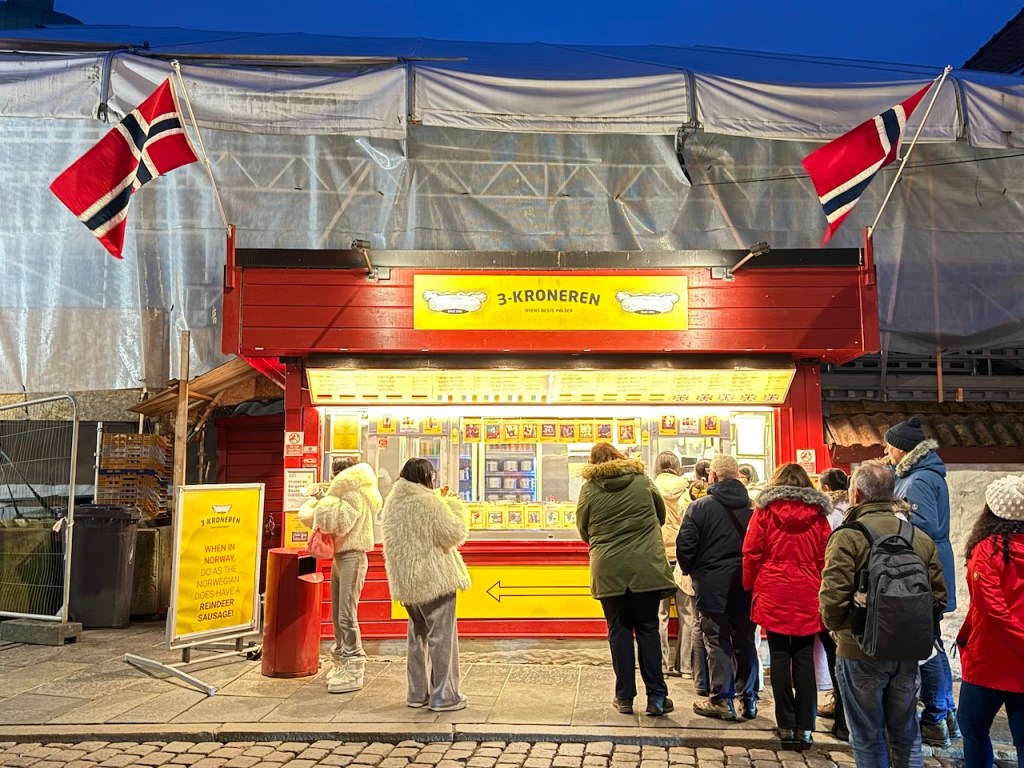
The prior evening, at Phil Rosenthal’s presentation, I’d learned of a hot dog stand in Oslo; the Syverkiosken apparently is the last wooden hot dog stand in Oslo and – beyond that – the hot dogs, traditional Norwegian ones, are supposed to be fantastic. So – off I went to find the stand in time for lunch.

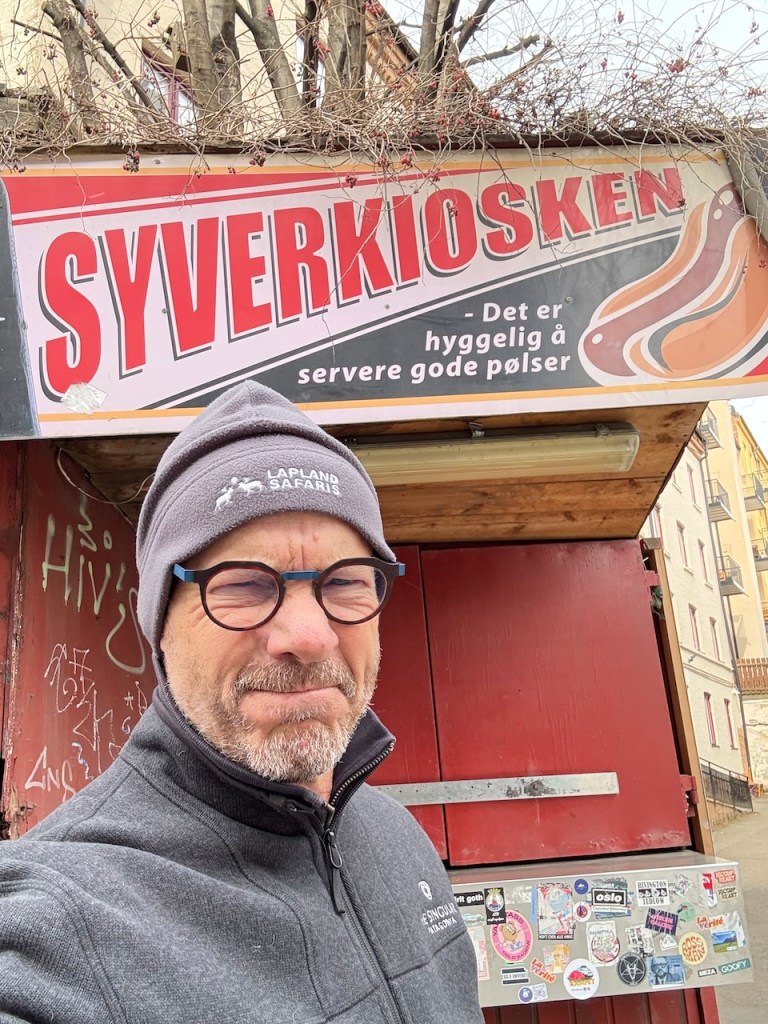
It was closed. Not supposed to be closed. Three other people waiting out front. Great graffiti leading up to it. But closed. I waited about an hour. Still closed. Darn.

A man standing in front of the closed Syverkiosken hot dog stand in Oslo, with a sign featuring the name and description in Norwegian.

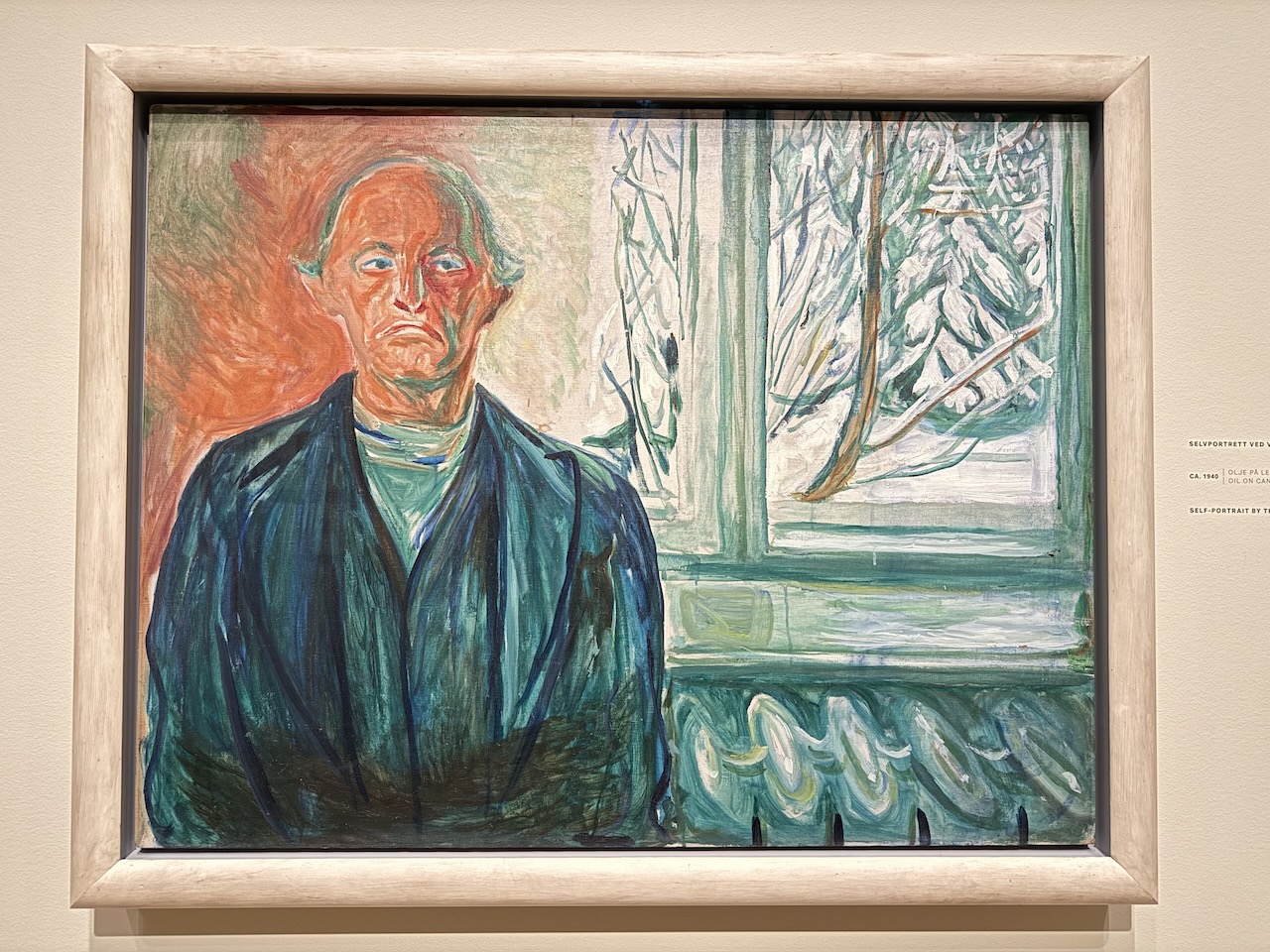
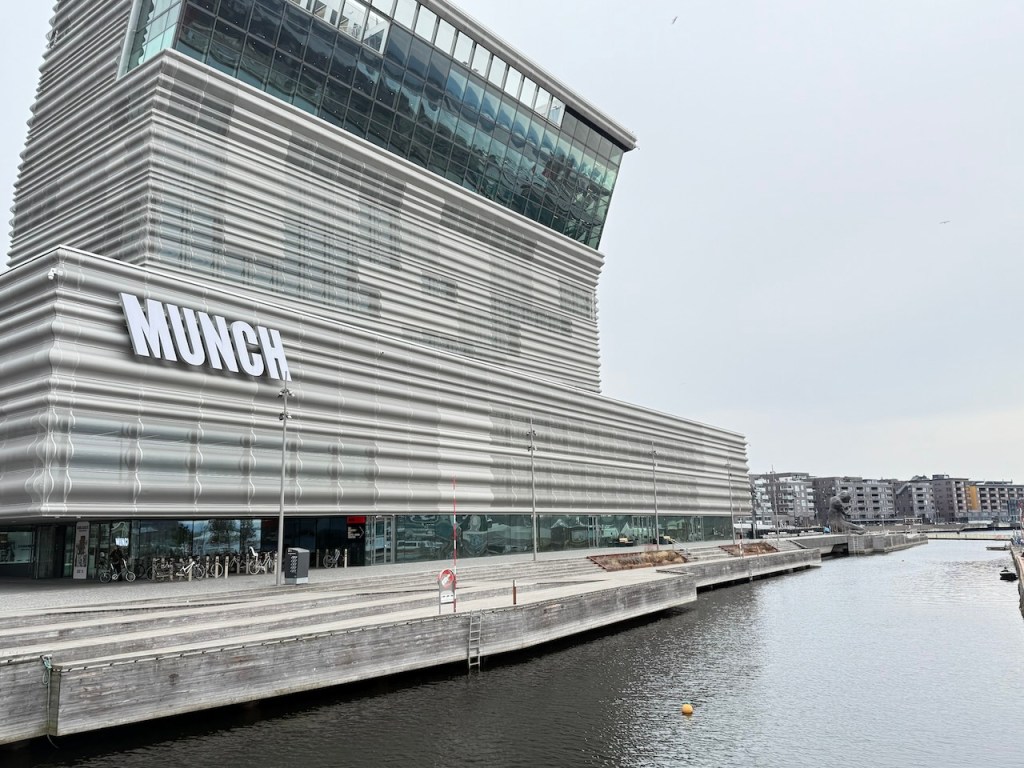
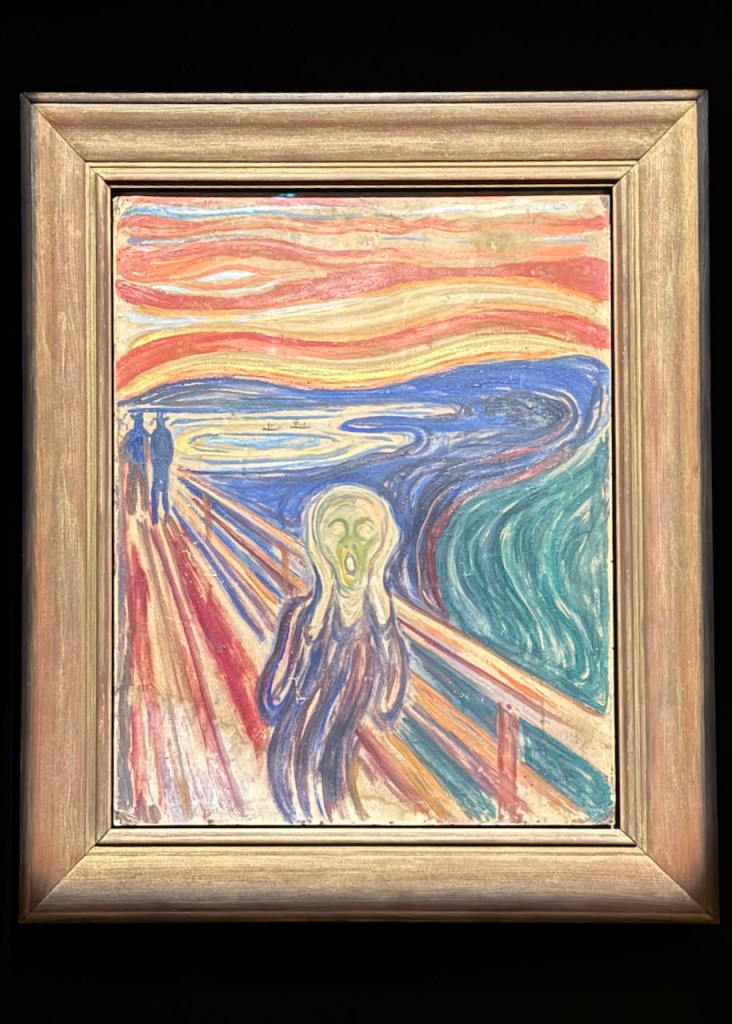
So I grabbed lunch someplace else and than took a long walk through the city to the Munch Museum. Edvard Much, best known for his work, The Scream, had a long and successful career as part of both the Symbolist and Expressionist movements. When he died, he left a huge portion of his artwork to the city of Oslo; the museum contains over half of his entire production of paintings and at least one of each of his prints, amongst other items from him and works by other artists. The Museum itself was built specifically to house the collection; it overlooks the harbor and sits nearby the Oslo Opera House.

And, of course, the Museum has The Scream. In fact, it has three versions of it – a print, a drawing, and a painting, as Munch tended to produce multiple versions of many of his works. Each version of The Scream that the museum has are on display, but only for thirty minutes at a time each, as a way to preserve them. They have their own gallery, and each version is behind a set of automatic doors that open-and-close as necessary every thirty minutes.

The roof of the Opera House is essentially a huge balcony with soaring views of the city and the harbor. At street level of the Opera House, you can walk by large windows that look into where the costumes and hats and hairpieces are made for the opera.

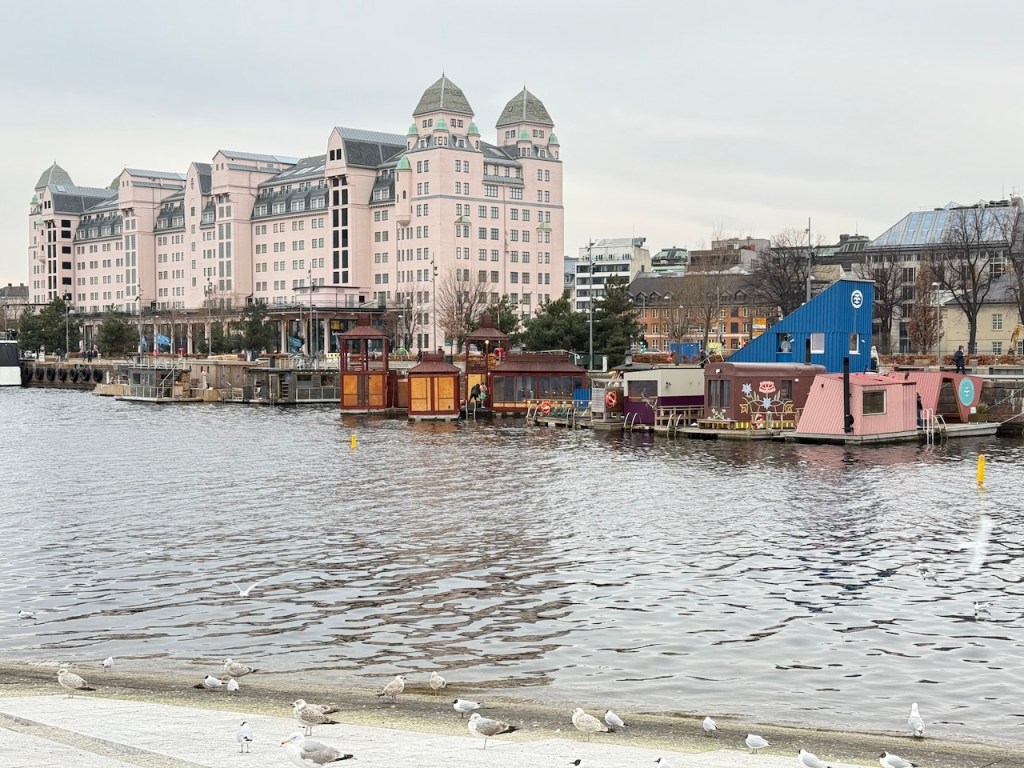
Also along the harbor’s edge, you can spy small floating saunas dock-side, available for rental.

A view of a waterfront area in Oslo featuring colorful floating structures and a pink building in the background, with seagulls along the water's edge.

Stockholm – Days Eight and Nine

If I was ever surprised by a city and how much it had to offer – by its city-scape and architecture and atmosphere and museums and food – it was Stockholm. Who knows what I was expecting – perhaps something that felt old and a bit dusty and cold – but I certainly wasn’t expecting a place as inviting and warm as Stockholm.

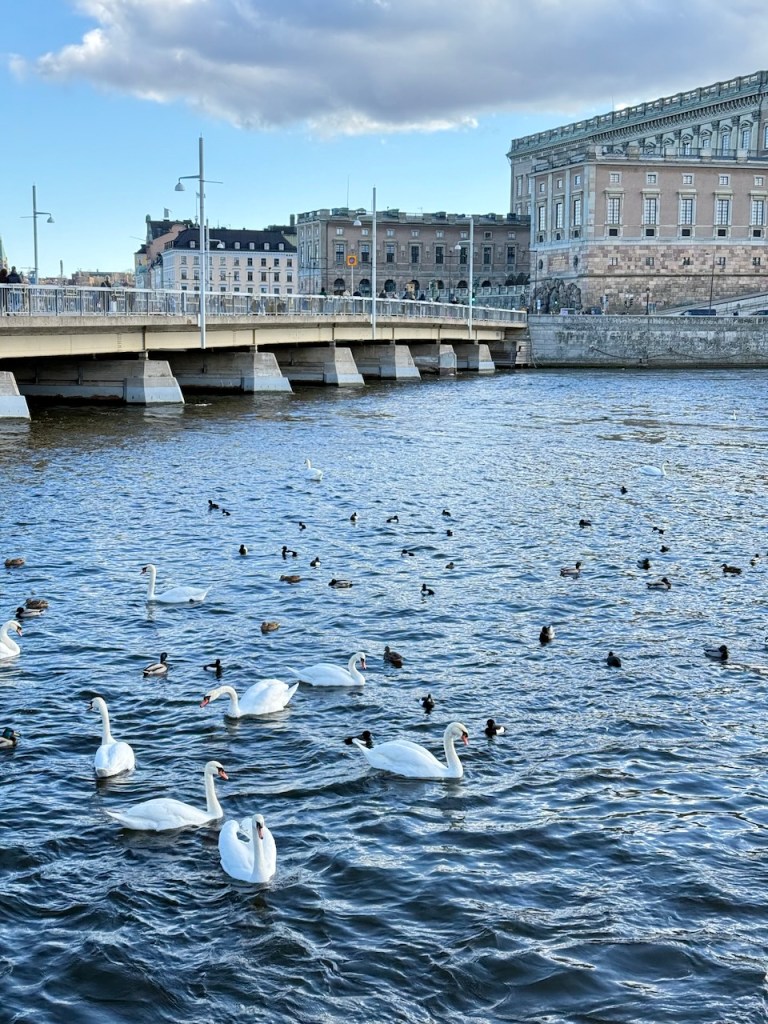
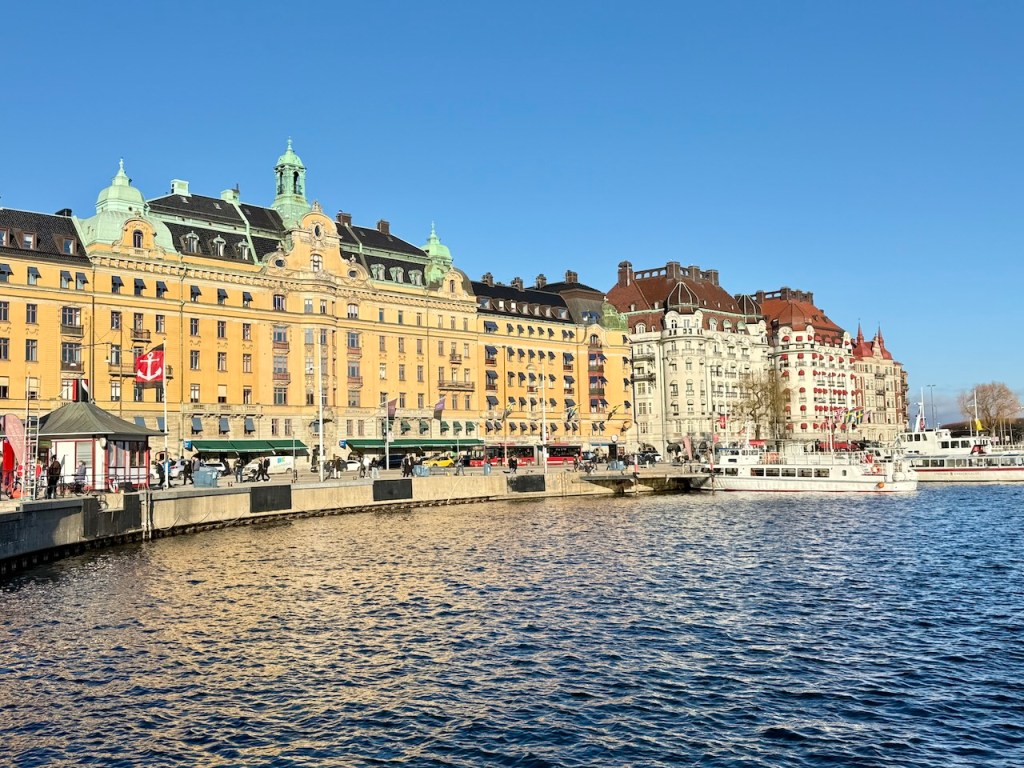
We spent the morning into the early afternoon traveling from Swedish Lapland to Stockholm – long bus ride to the airport, about a 90-minute flight, and then about a 45-minute ride into the city, which has anywhere from 1m to 2.2m people depending upon the geography you’re including.  The city sits on and among fourteen islands within an archipelago of over 30,000 islands that stretches to the Baltic Sea, which gives Stockholm a beautiful waterfront setting and many bridges as the city spreads across those islands (according to Wikipedia, 30% of the city is made up of waterways and another 30% are parks and green space). It’s the capital of the country and is its financial center, it’s where the prime minister and the king have official residences, and it dates back to at least 1252, when it begins to be mentioned in Norse sagas. Overall, it looks and feels like an old European city – lots of grand 19th and 20th century buildings, with modern ones throughout. And it is incredibly safe.

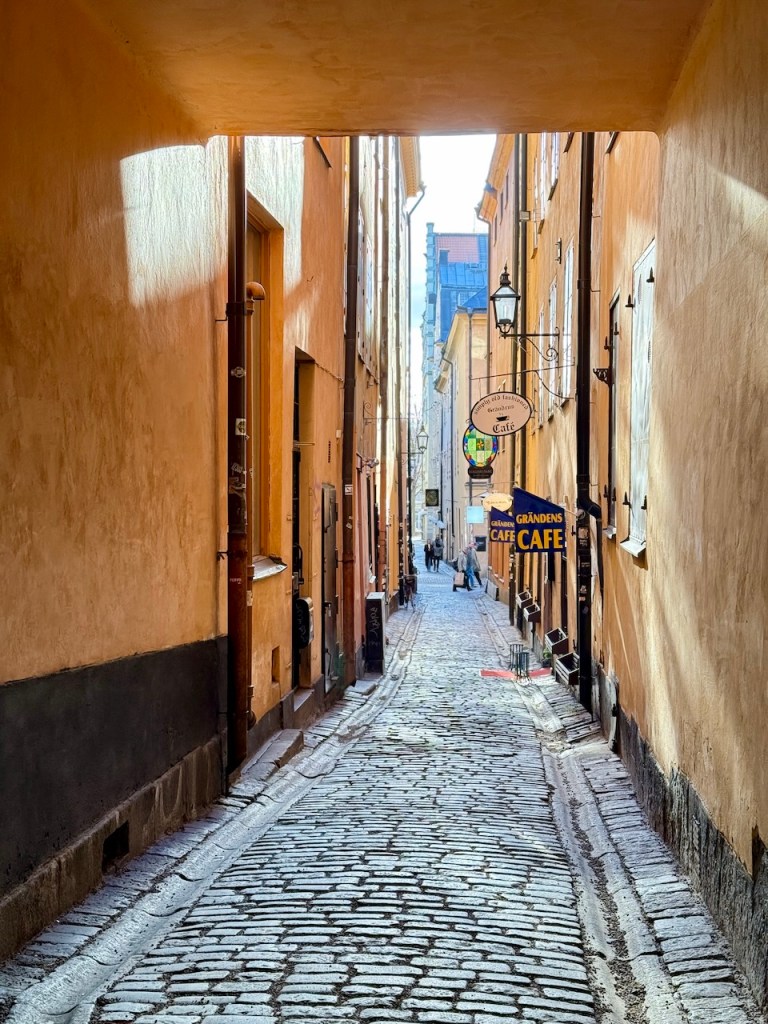
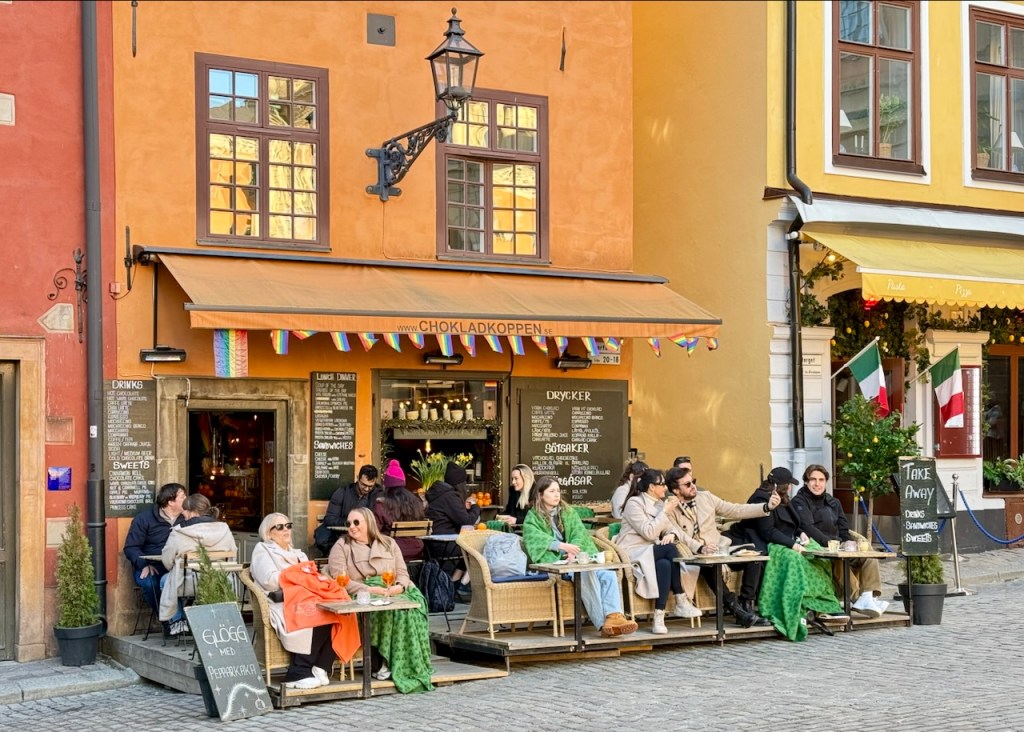
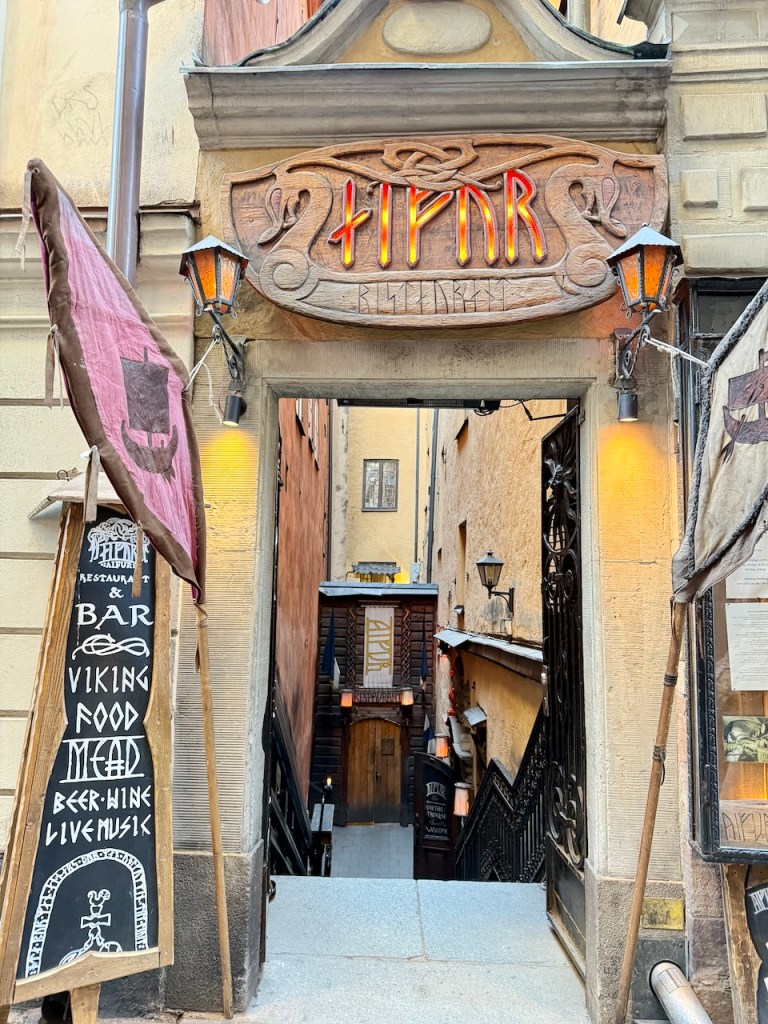
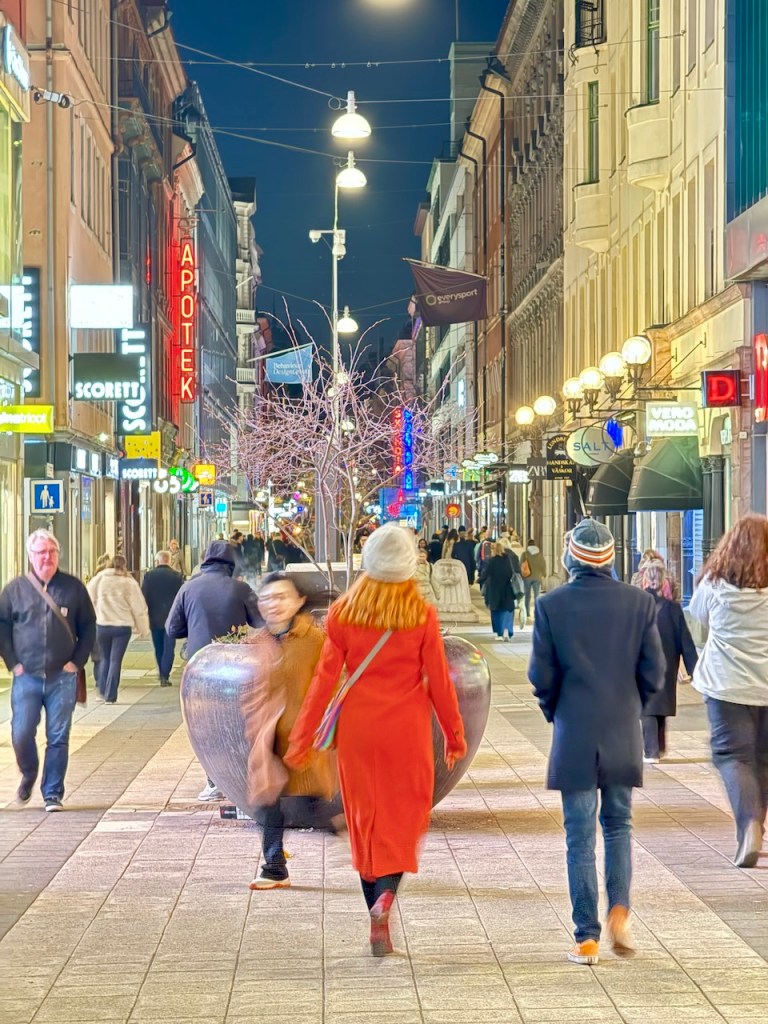
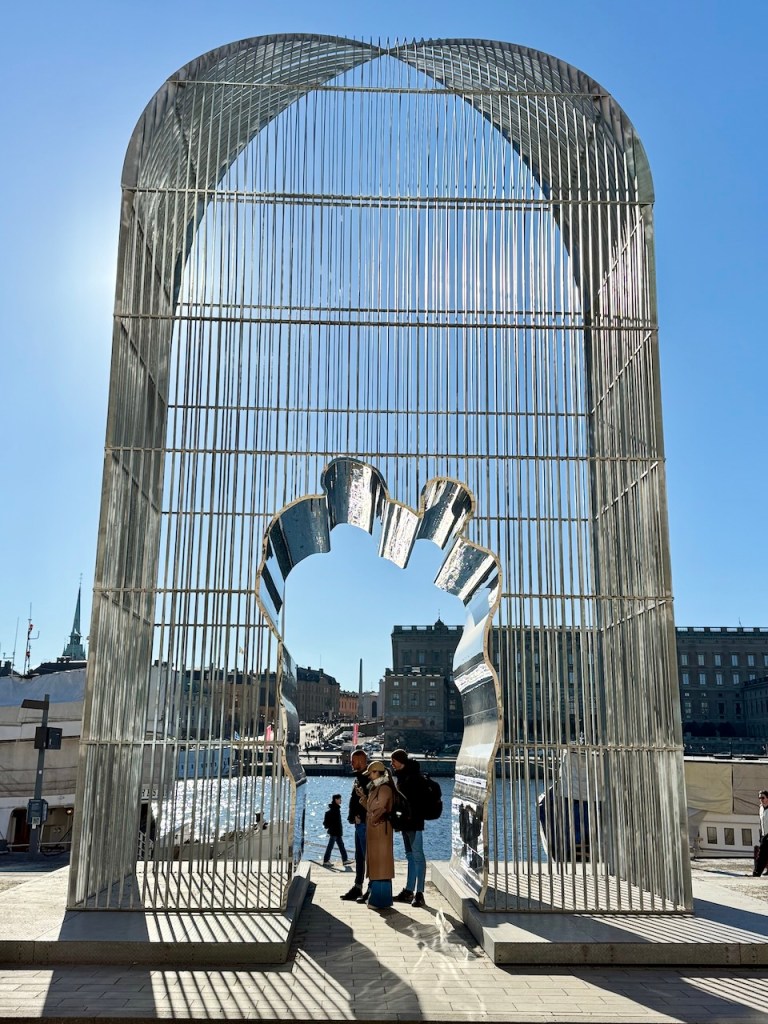
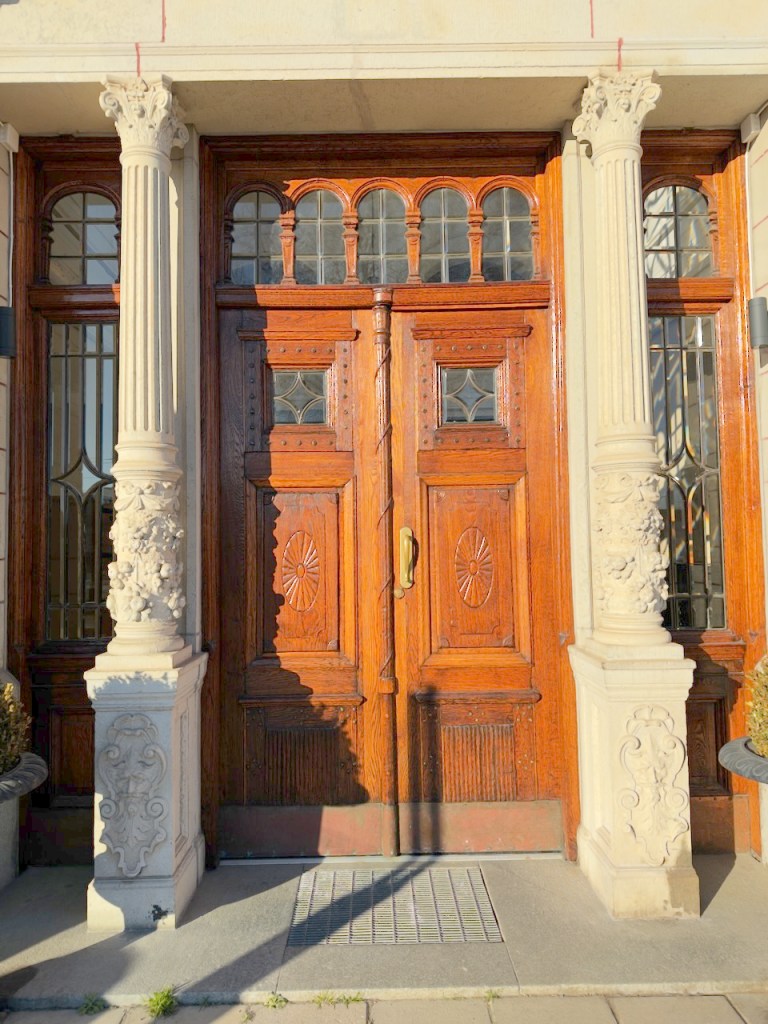
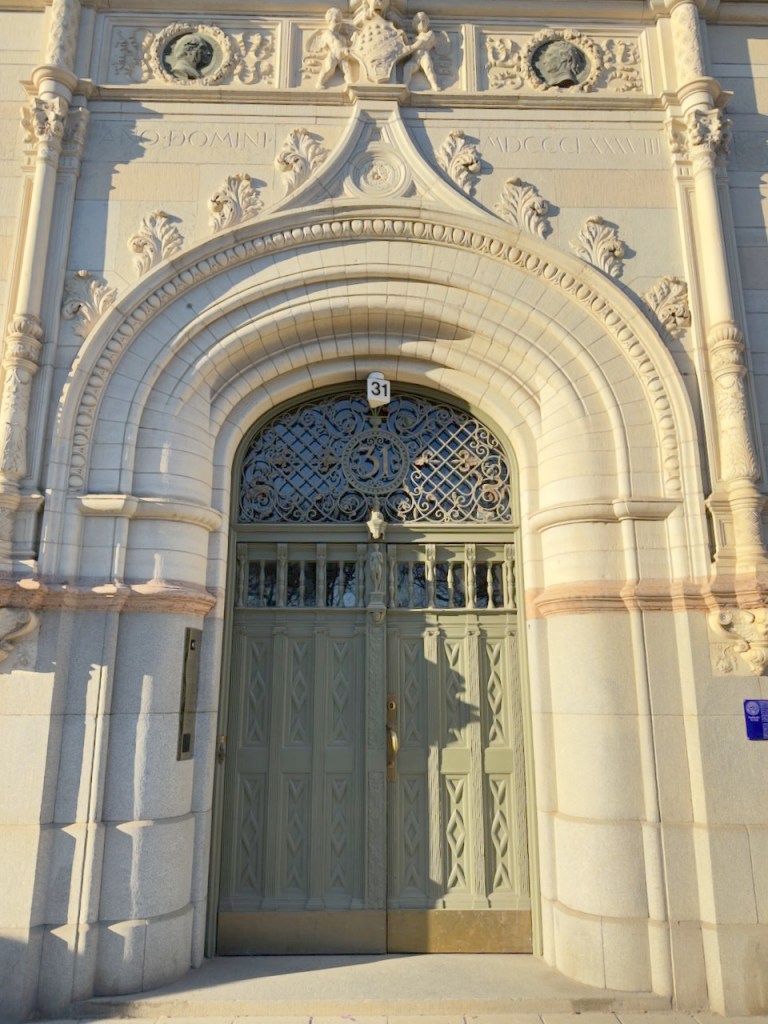
Our time there started with a short walking tour of the oldest part of the city – about 800 years old – the Gamla Stan, which sits on one of the central islands.  This old neighborhood now has lots of small retail shops, restaurants, and bars on the ground floors of the three-, four-, and five-story buildings. Some have good quality clothing, ceramics, jewelry (I bought a bracelet and t-shirt, both with Viking imagery), and the like; some have lots of tourist tchotchke – t-shirts, trinkets, and all the usual stuff (including, maybe, the stuff I got). Narrow streets and alleys, beautiful doorways, sidewalk cafes, old city squares, and tourists. Lots. Of. Tourists.

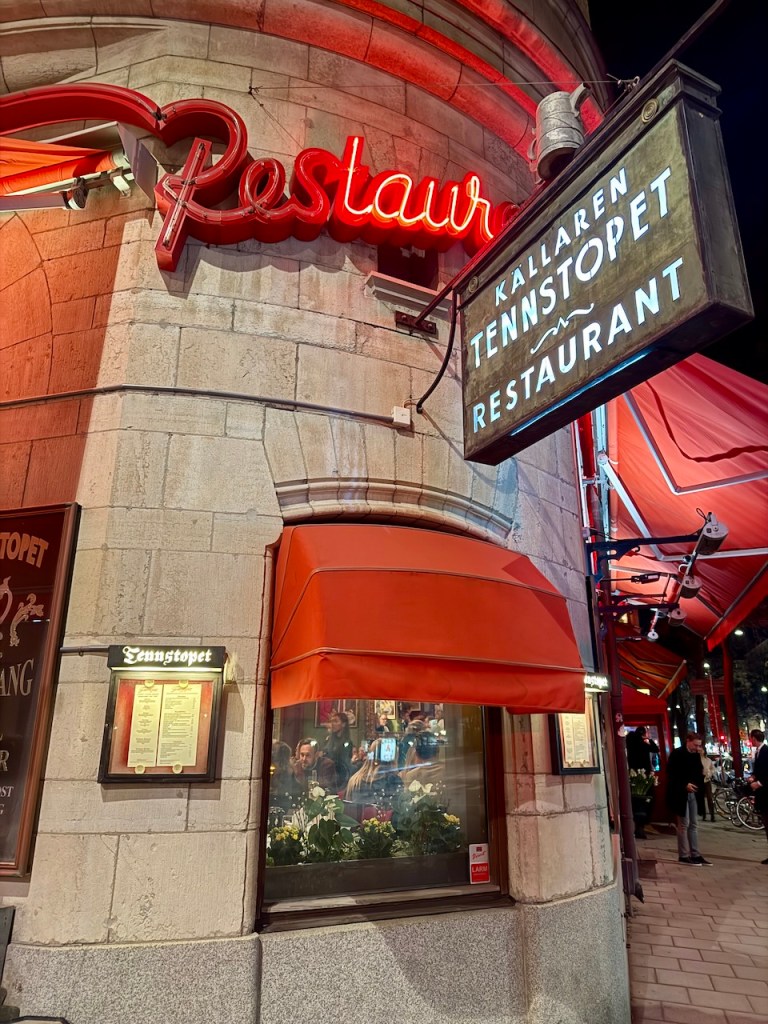
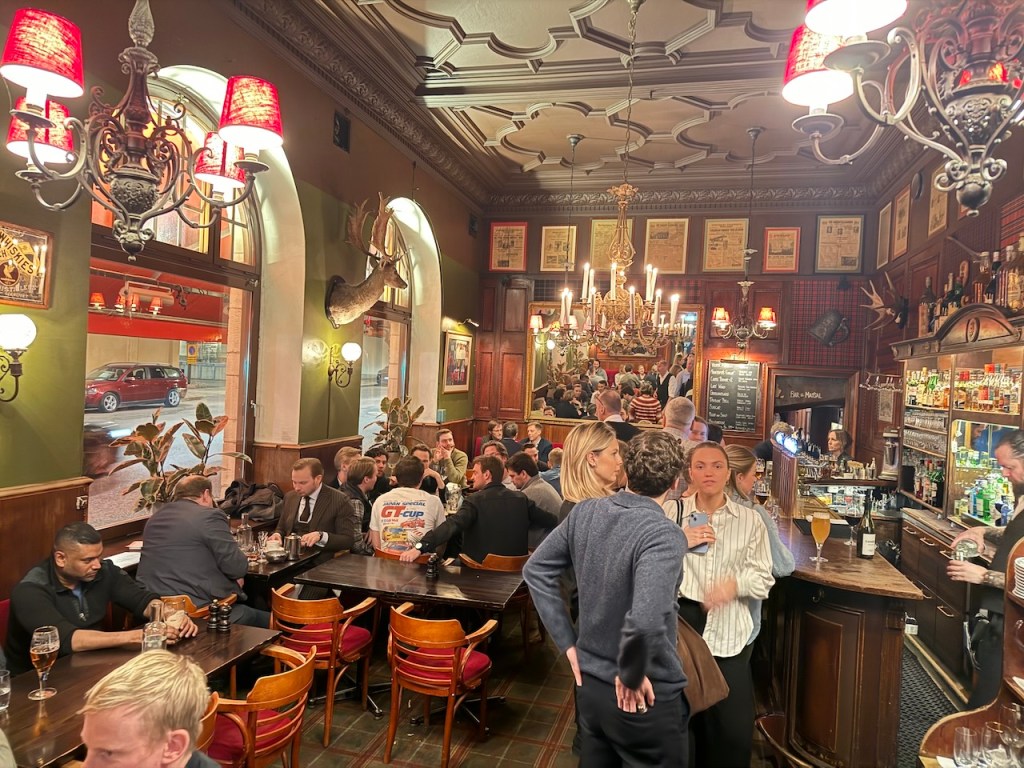
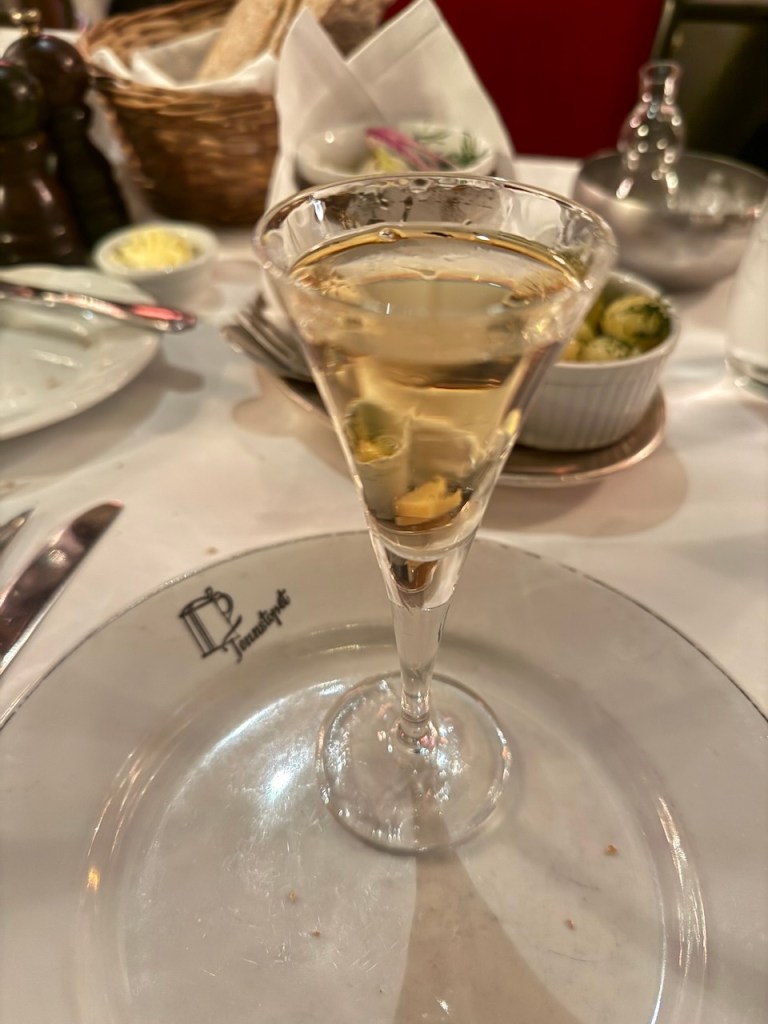
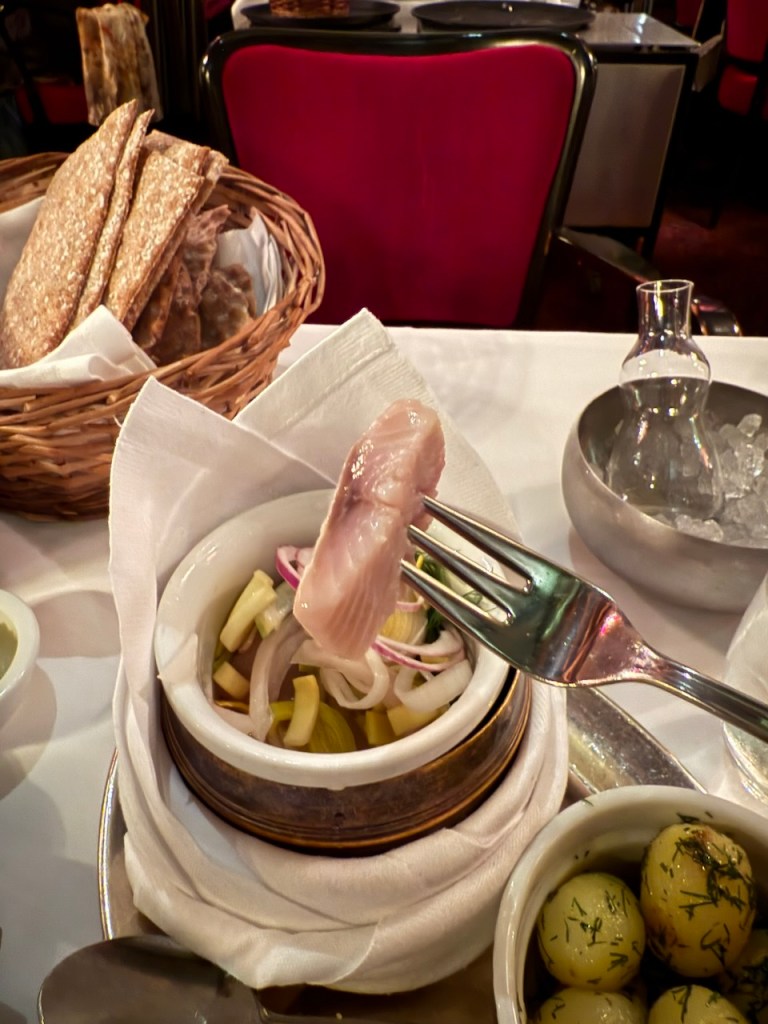
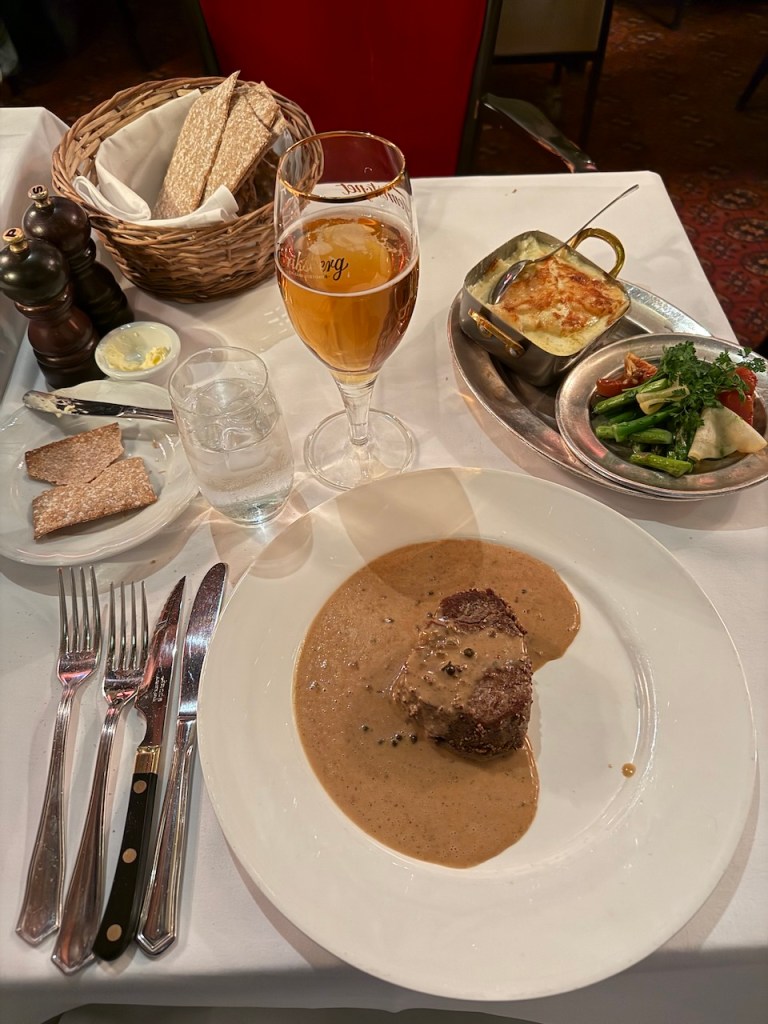
For dinner, I’d learned somehow about an old school restaurant with traditional Swedish food, so decided to take a 40-minute walk through the city to the Tennstopet Restaurant. It was a great joint – super service, and – while a small menu – had a selection of things I really wanted. I started with a vodka at the bar, then was seated in the dining room; I’d read that I just had to have the “S.O.S” as an appetizer – herring, cheese, and butter. When it arrived, I asked the waitress “how do I eat this?”; she explained that I should just take a little of each, but that I MUST have a schnapps with it. So I did! That was followed by the pepper steak flambé, prepared table side. Just a great evening, and I couldn’t recommend this place enough.

On day nine we continued a tour of Stockholm. It’s just a beautiful and beautifully situated city.  There’s also an amazing number of museums and parks (with cherry blossoms, tho we were too early to see them).

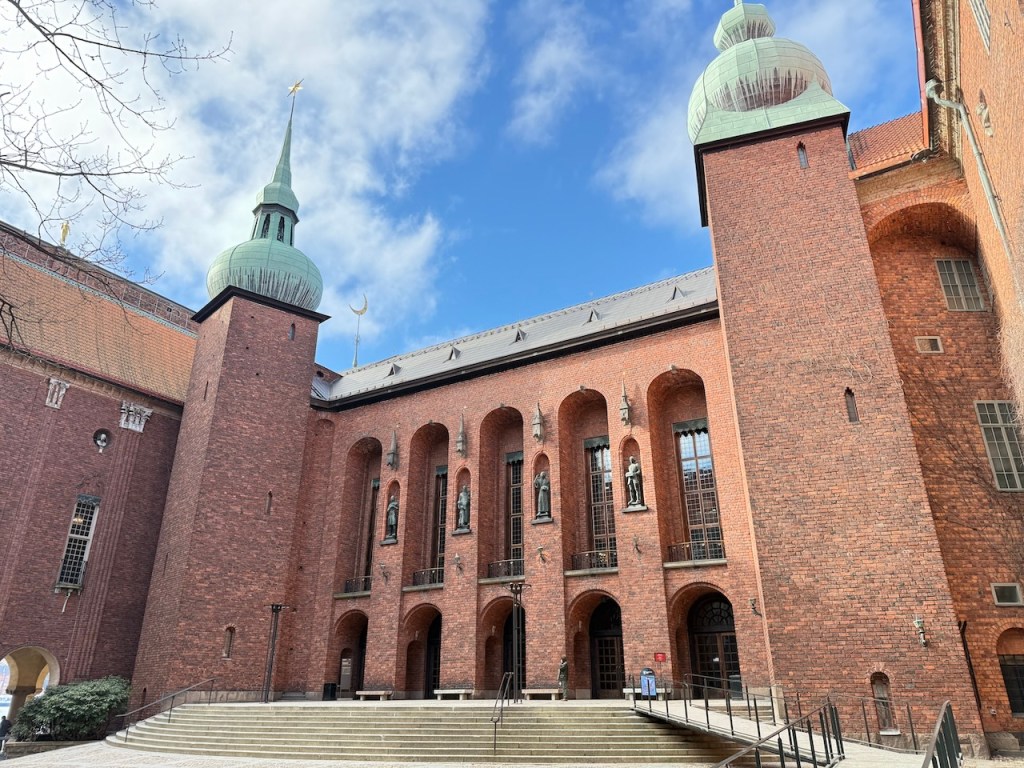
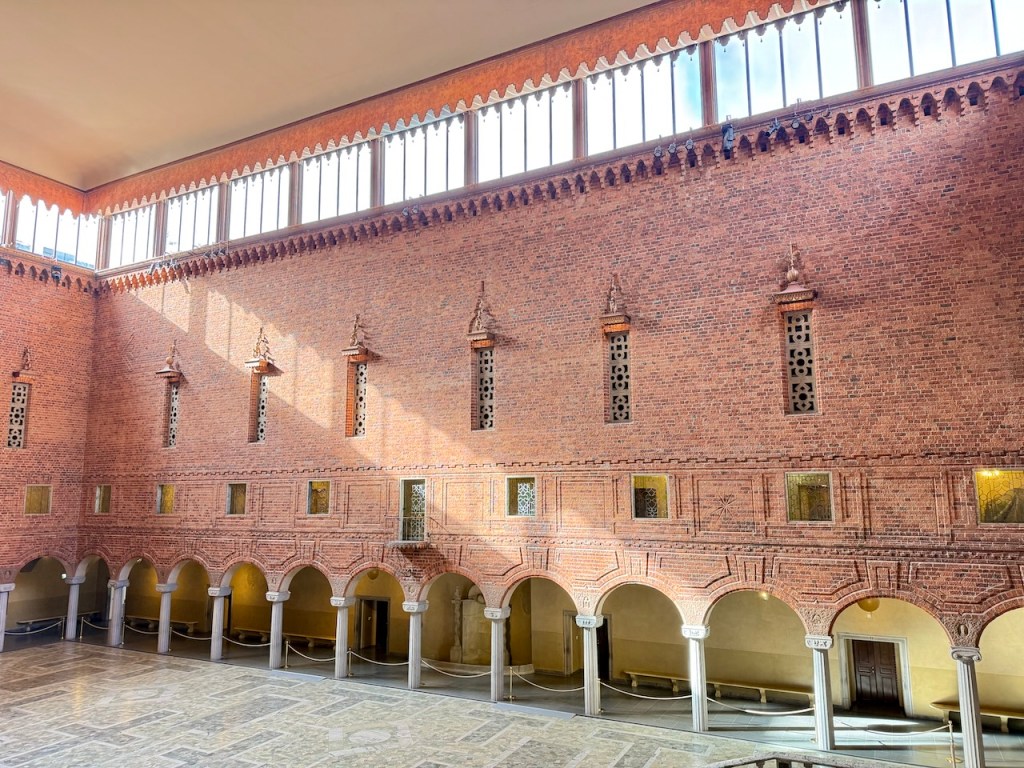
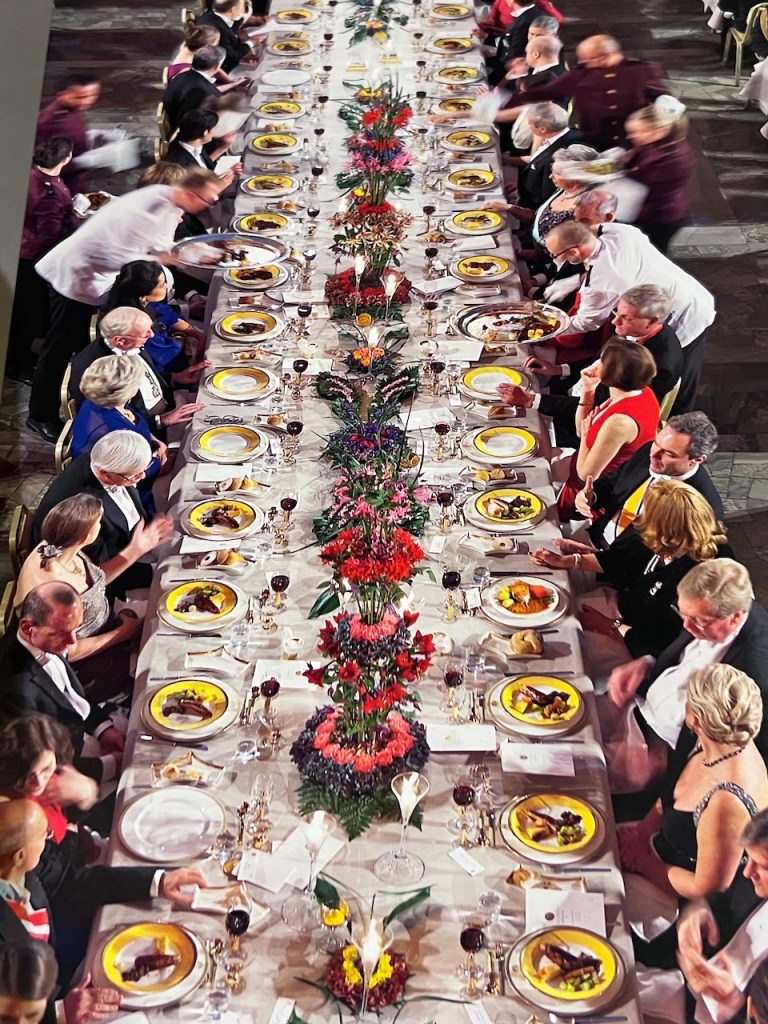
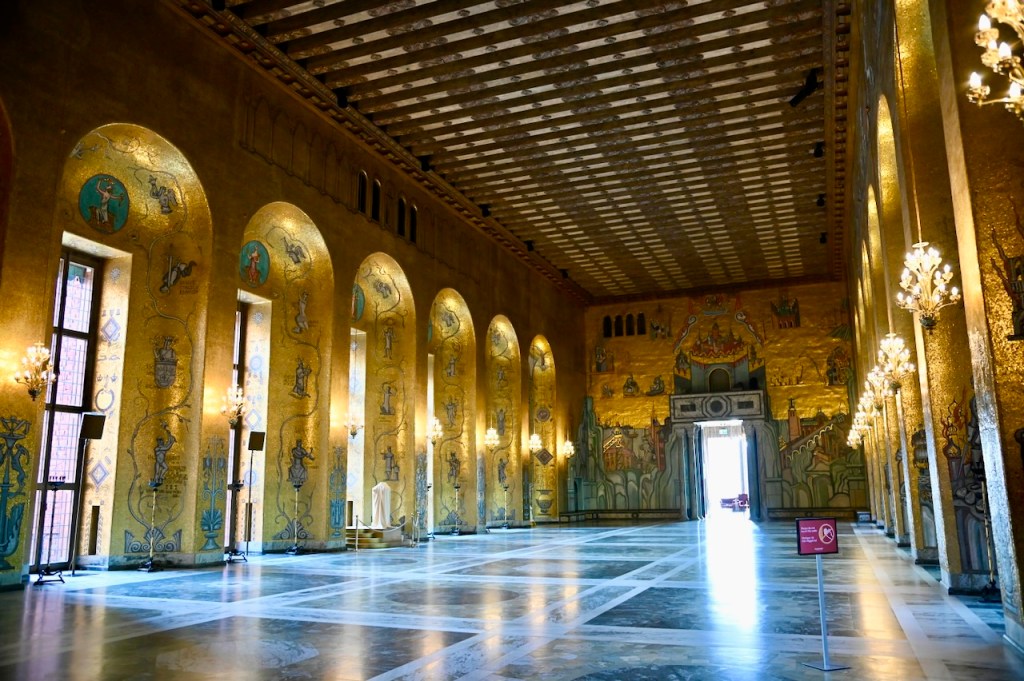
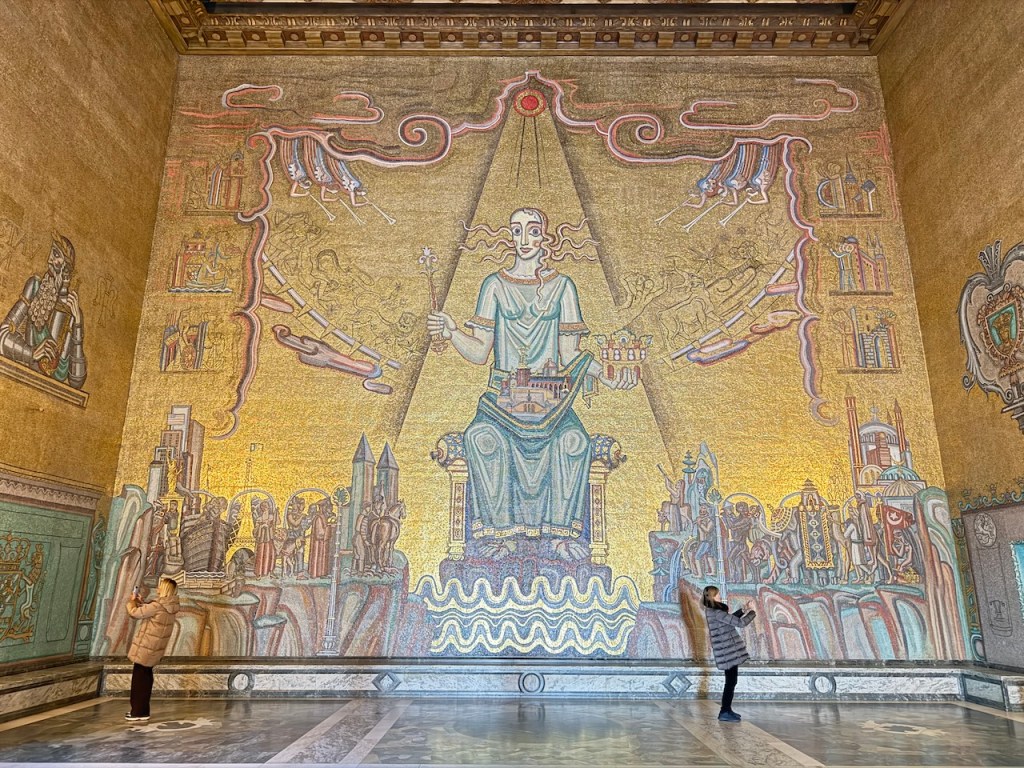
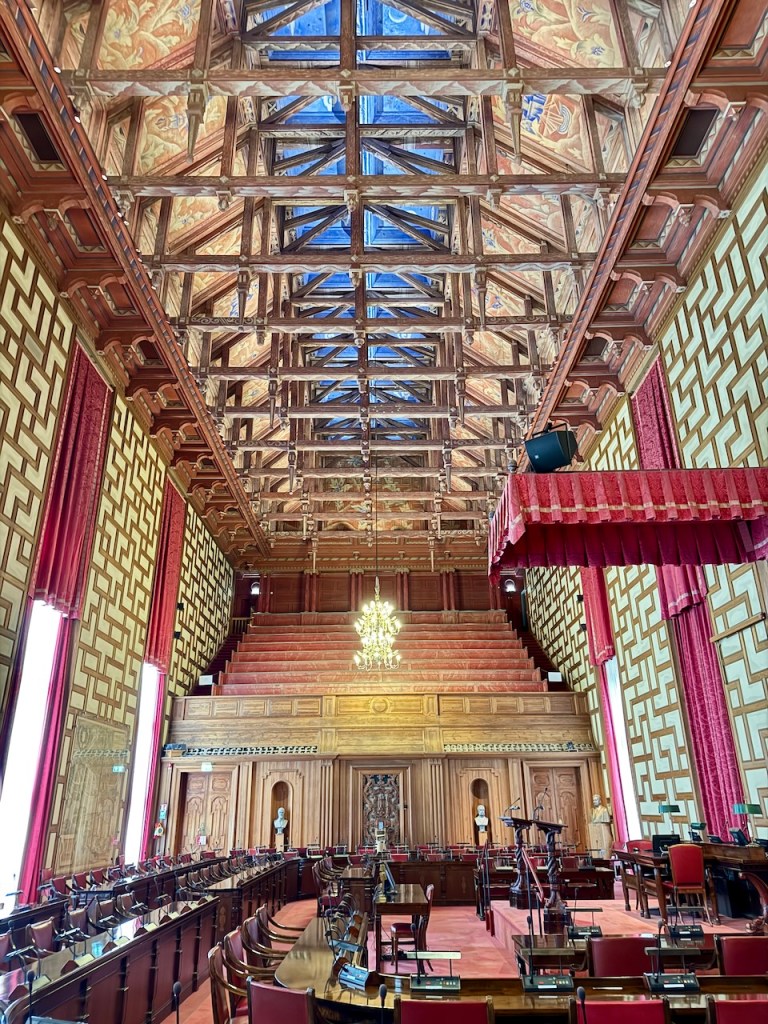
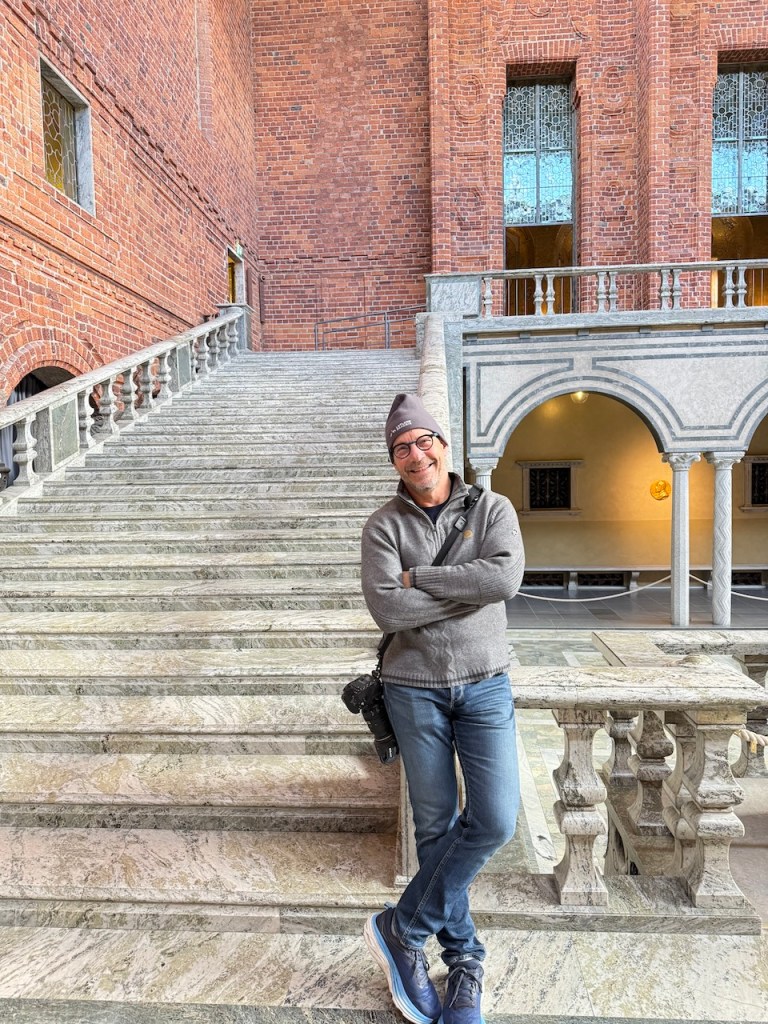
Our tour included three primary things – City Hall, which is where the Nobel dinner and dance are held (most of the Nobel Prices are handed out in Stockholm; only the Peace Prize is handed out in Oslo). It of course sits on one of the islands and, while it was completed in 1923, it is designed to look much older and built of 9 million bricks. The organ in the main hall has more than 10,000 pipes, making it the largest in Scandinavia, and one of the halls has a spectacular set of mosaics – more than 18 million tiles – that depict moments from Swedish history.   (And, for those wondering, City Hall is NOT where Patti Smith performed on behalf of Bob Dylan’s Nobel Prize acceptance – that was at a different location in the city).

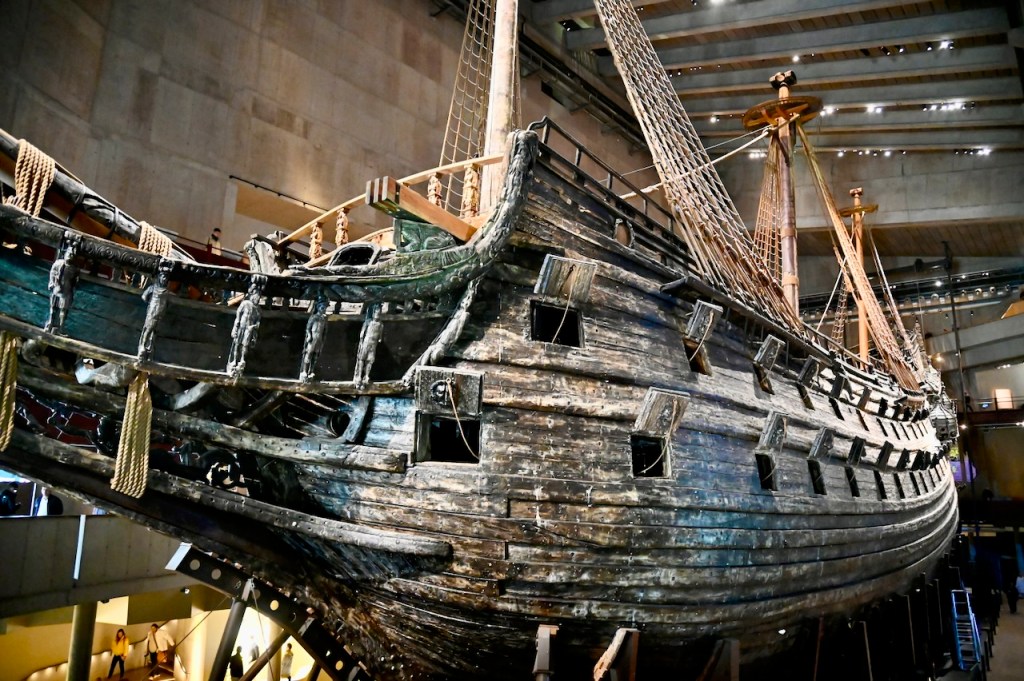
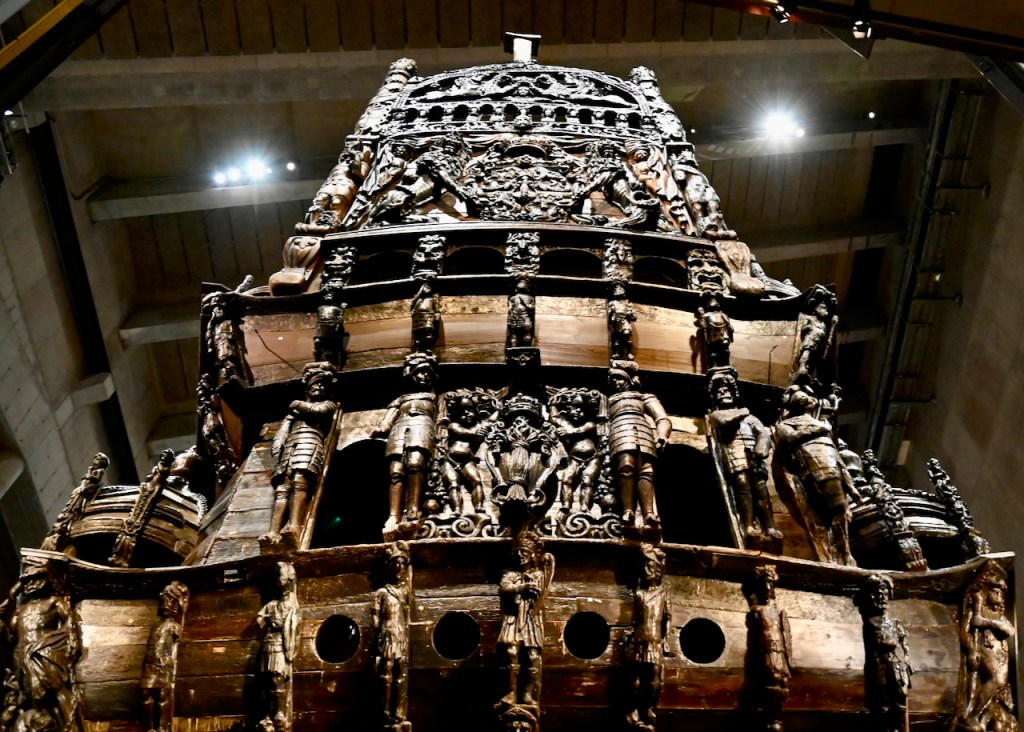
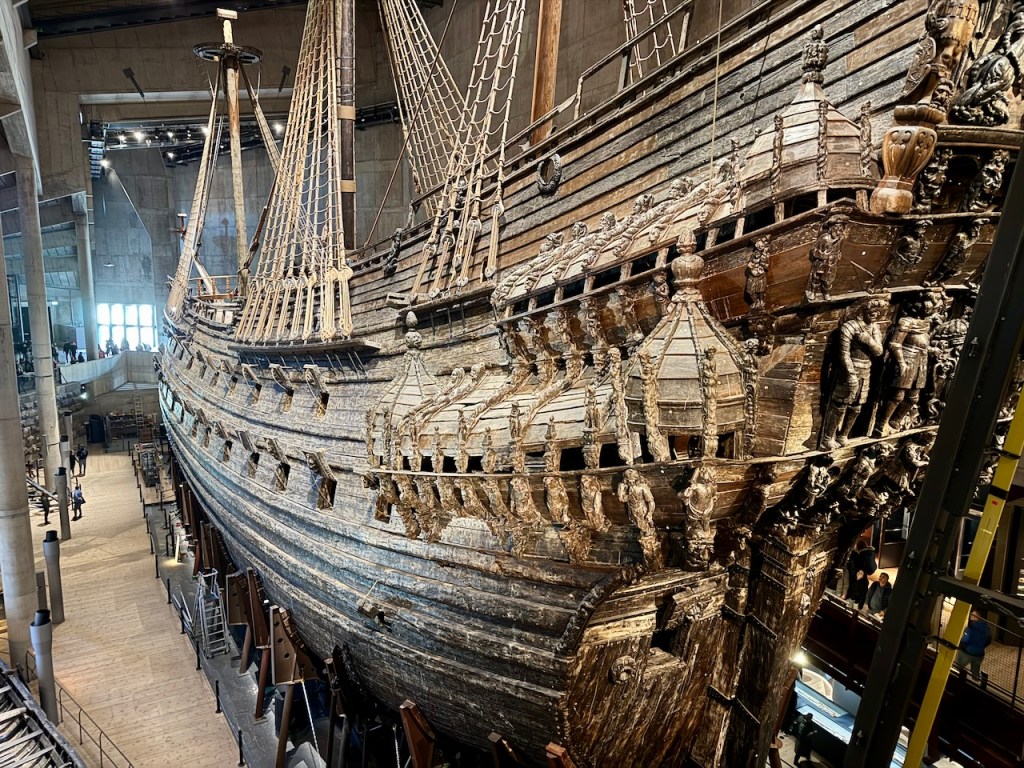
And then we went to see the Vasa, an old Swedish ship. In the late 1620’s, the king of Sweden, Gustav Adolphus, wanted to show-off to the world how wealthy a country Sweden was and how powerful a monarch he was, so he commissioned the building of a warship to be named after Gustav I – Gustav Vasa – a former monarch. To make the ship even more impressive, the king had an extra deck added on the top that included an extra set of cannons; the total cost to build the ship was estimated to be equivalent to about 3%-5% of the country’s GDP at the time. In 1628, on the Vasa’s maiden voyage in Stockholm Harbor, with the king and hundreds if not thousands of spectators in attendance, the ship sank into the mud of the Harbor bottom. Fifteen minutes into the voyage!  Can you imagine the crowd’s reaction? It turns out it was top-heavy and two strong winds blew it over.  At first, its masts could be seen above the harbor’s water-line, but the king – embarrassed by the site – ordered them cut off the ship. The Vasa sat on the Harbor floor for 300 years before the technology existed, in 1961, to bring it to the surface and, now, with 98% of the ship intact, it is an amazing thing to be seen – the best preserved 17th century ship in the world. It is hard to give it due justice in pictures.

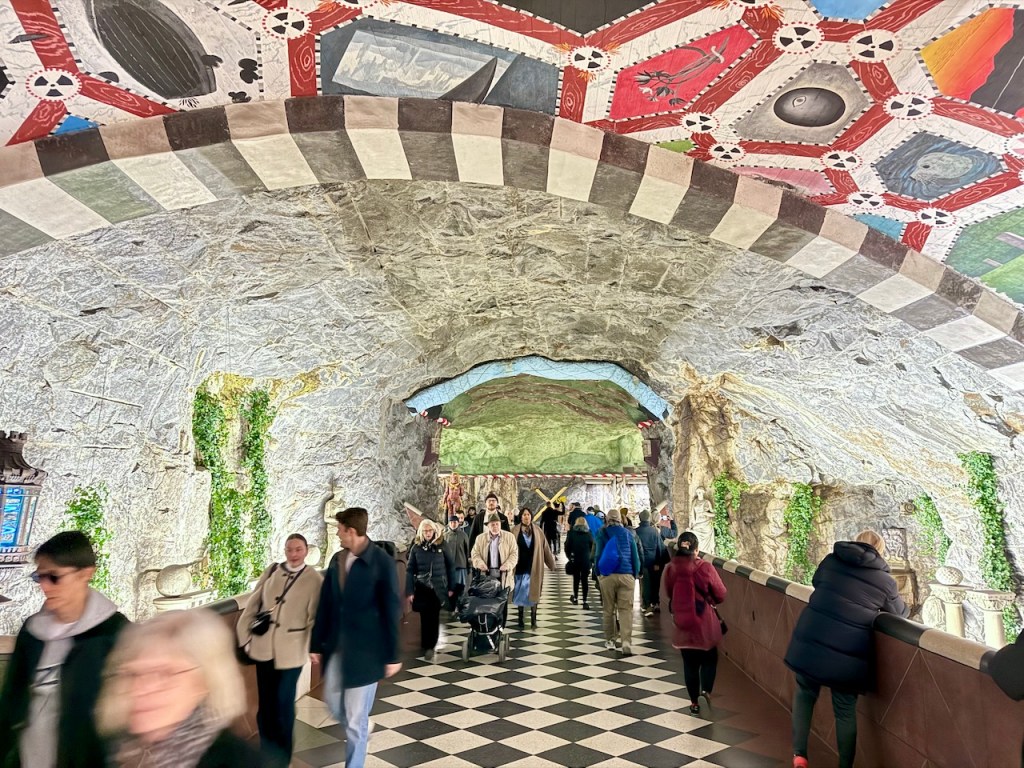
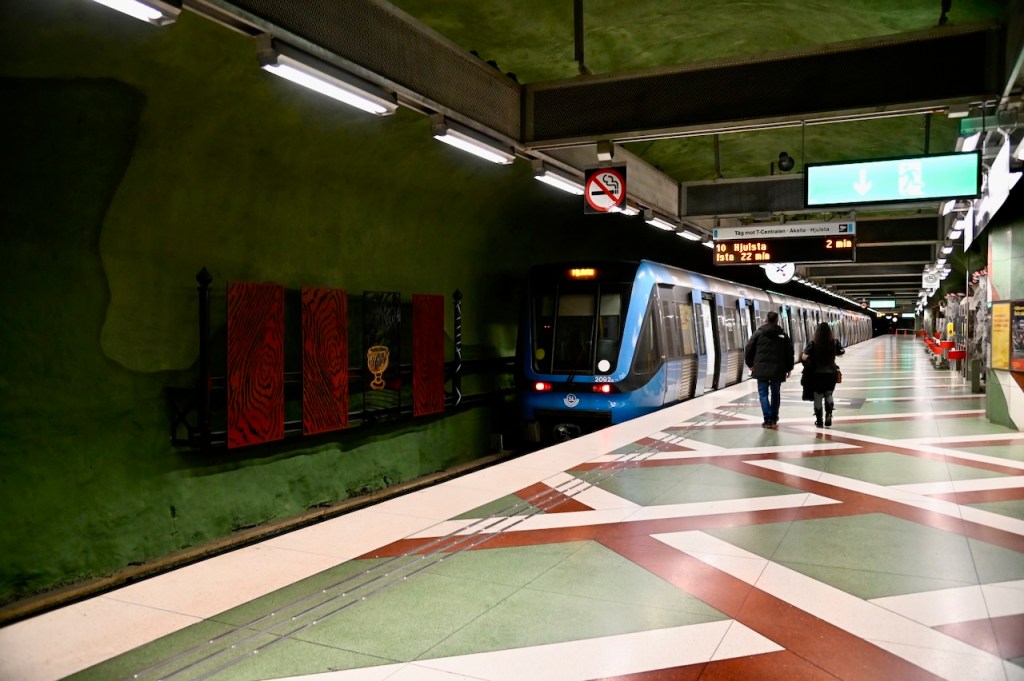
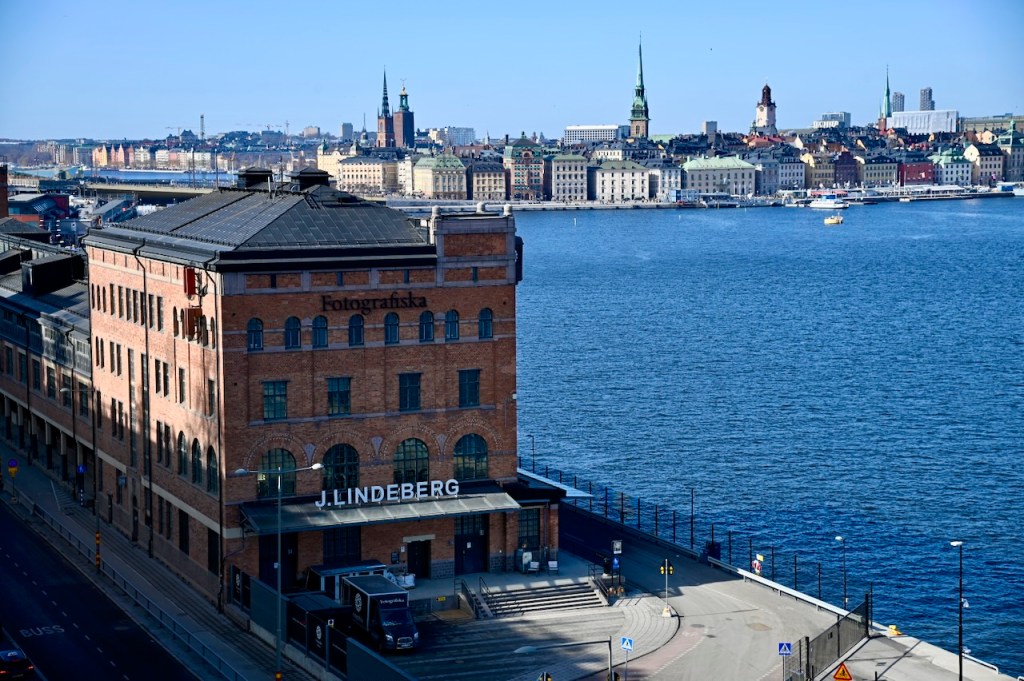
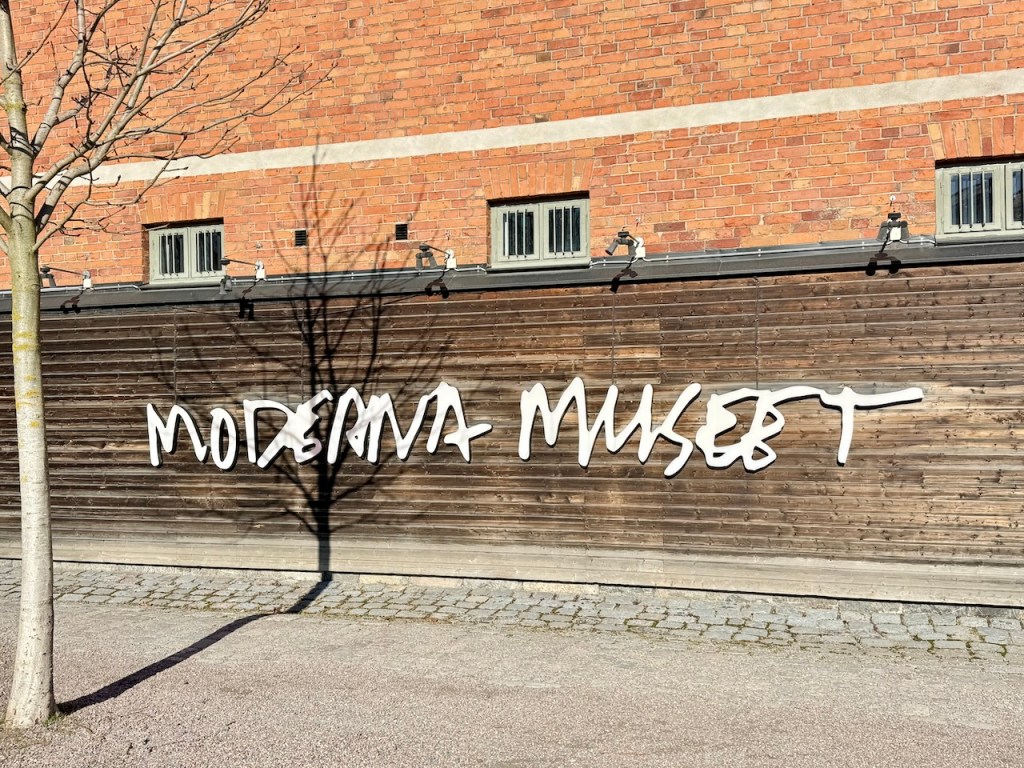
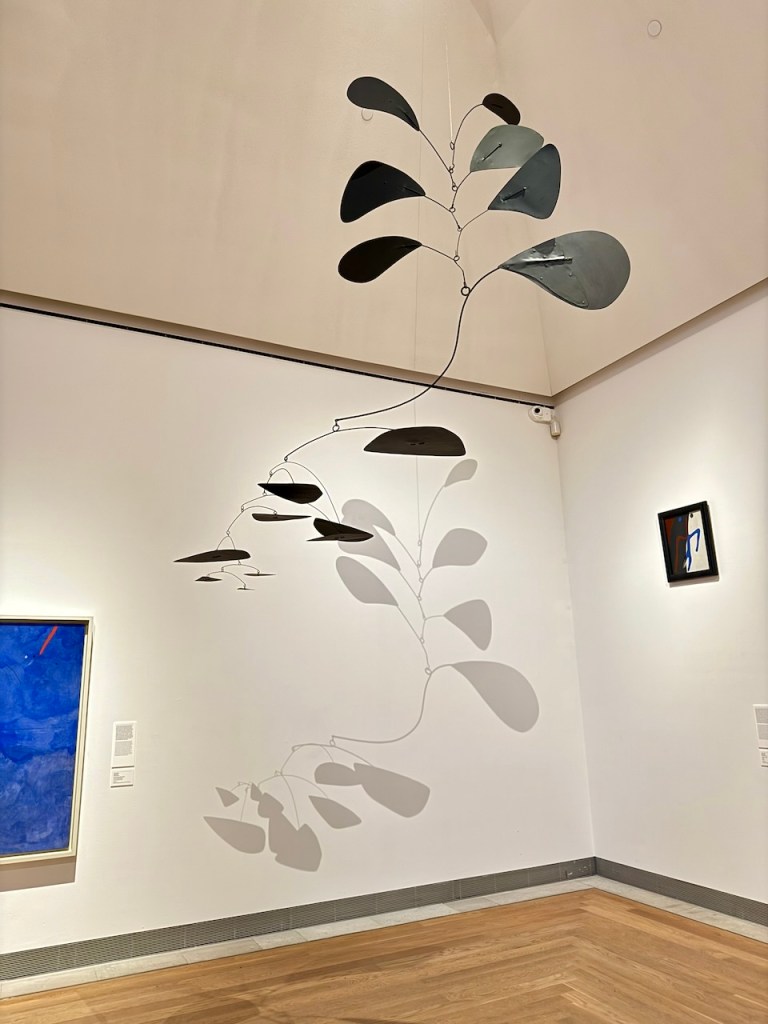
We got a chance to check out one of the metro stops, as Stockholm has decked out its stations, and, with the rest of the afternoon to myself, I walked around a bit and visited the Modern Art Museum (think Picasso, Braques, Calder, Miro), figuring I’d save the Abba Museum for another visit on another day. I also paid a quick visit to the Photography Museum. And I also learned about two fascinating laws in Stockholm; the first says that no dog can be left at home for more than five hours – which means you see a lot of dogs out and about; the second law is a “freedom to roam” – it gives permission for anyone and everyone to be able to enjoy nature, even if its on private land.

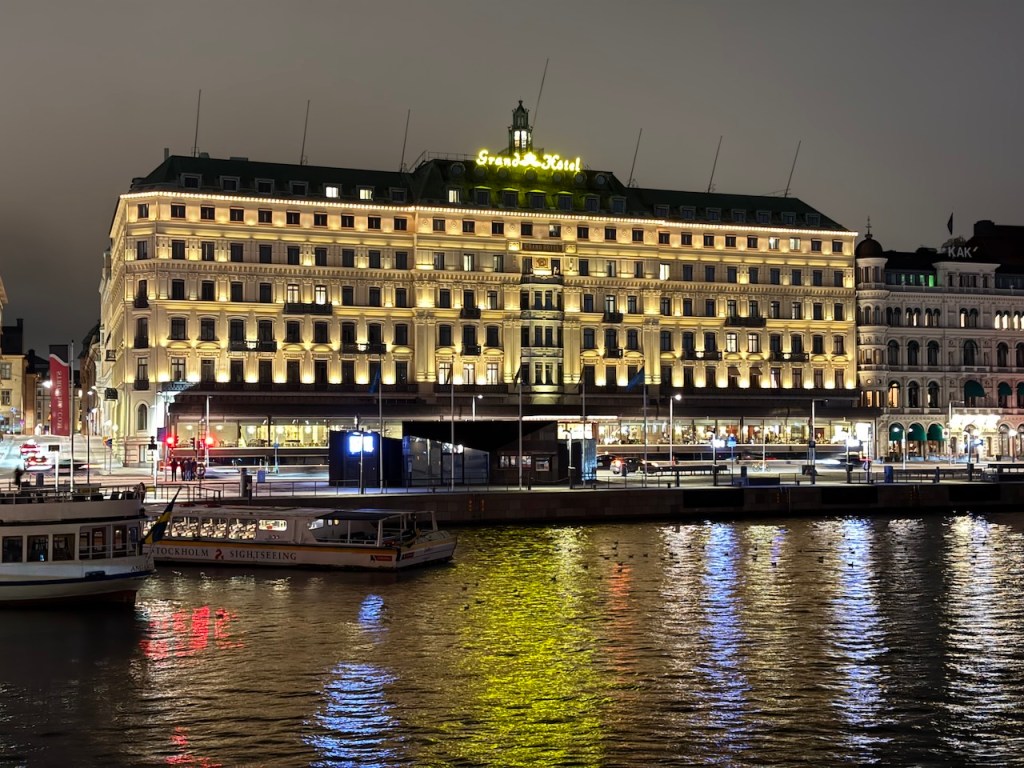
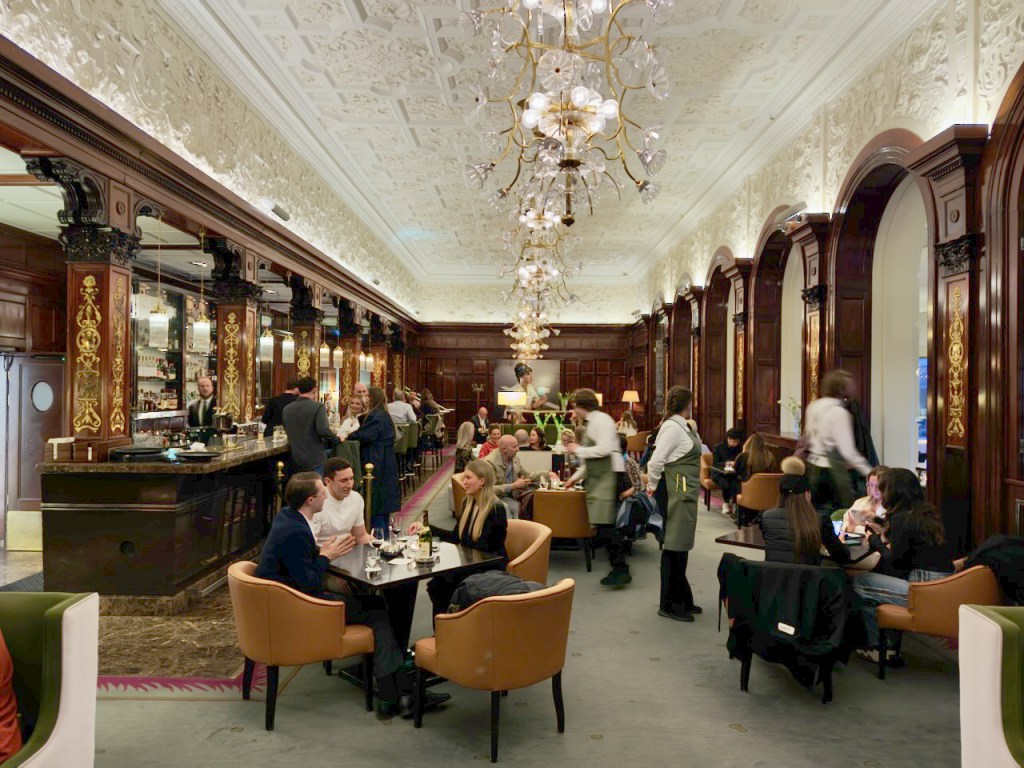
My day finished up at our hotel’s bar, the Grand Hotel’s Cadier Bar, where I enjoyed some of the best martini’s I’d ever had.