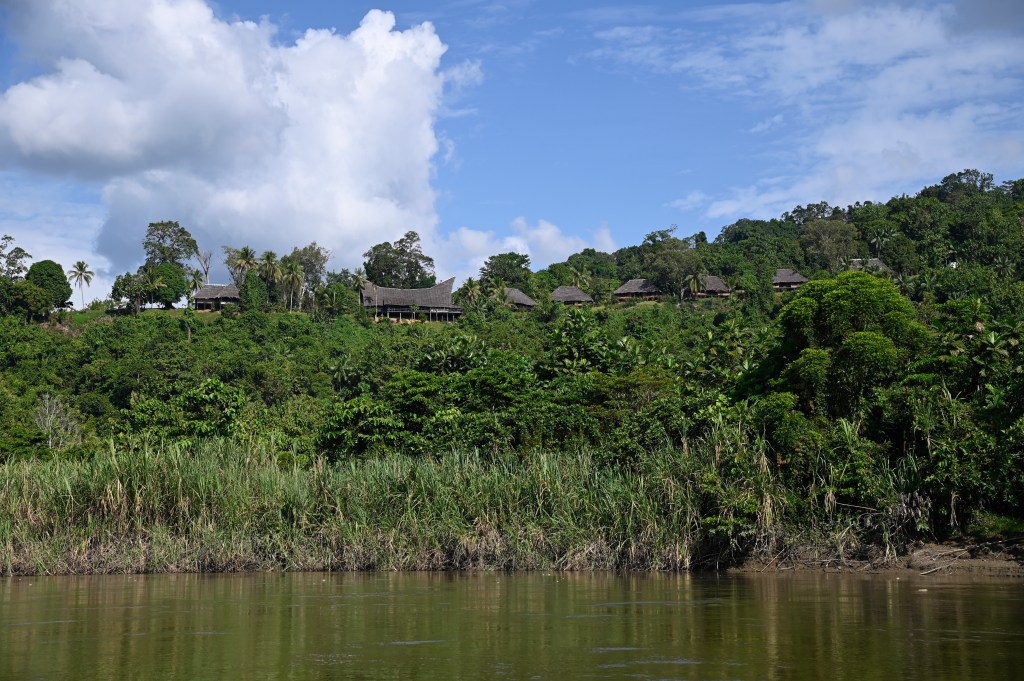
Today we made our move to the Karawari Lodge, located 1,000 ft up a ridge overlooking the Karawari River. This is in East Sepik Province, and the Lodge can’t be reached by road.
We met Sam, our pilot from New Zealand, with whom we had a scheduled 8 a.m. departure, at the charter air-terminal. After waiting a bit more than an hour for low clouds to clear at the Mount Hagen Airport, seven of us (nicknamed “the Roosters” for our early wake-up and scheduled departure) boarded a 10-seat charter for the 45-minute flight (with a maximum altitude of about 10,000 ft) to the grass air-strip along the river’s edge. You could see the landscape change from the air – from the mountains and valleys of the Western Highlands Province to a low, mostly flat plain.
From the airport, located near the town of Amboin, whose terminal was a thatched-roofed wall-less hut where locals – including naked children – watched our arrival, we walked about 100 yards to the river’s edge, where we descended the muddy bank to a waiting 18-seat flat-bottom motorboat. This boat, later launched from more permanent housing, would be our means of exploring the river over the next four+ days. The boat took us on a 10-minute ride on this stretch of the river – about 50 yards wide and 10-20 feet deep, edged by jungle. This was a classic secluded jungle river – the Karawari – a major tributary of the mighty Sepik River, one of the longest in the world and the longest in Papua New Guinea. One of my travel mates was a Vietnam War veteran – a member of the Coast Guard who commanded a boat along the Mekong during the war. He told me our journeys over the next few days gave him many moments of reflection.
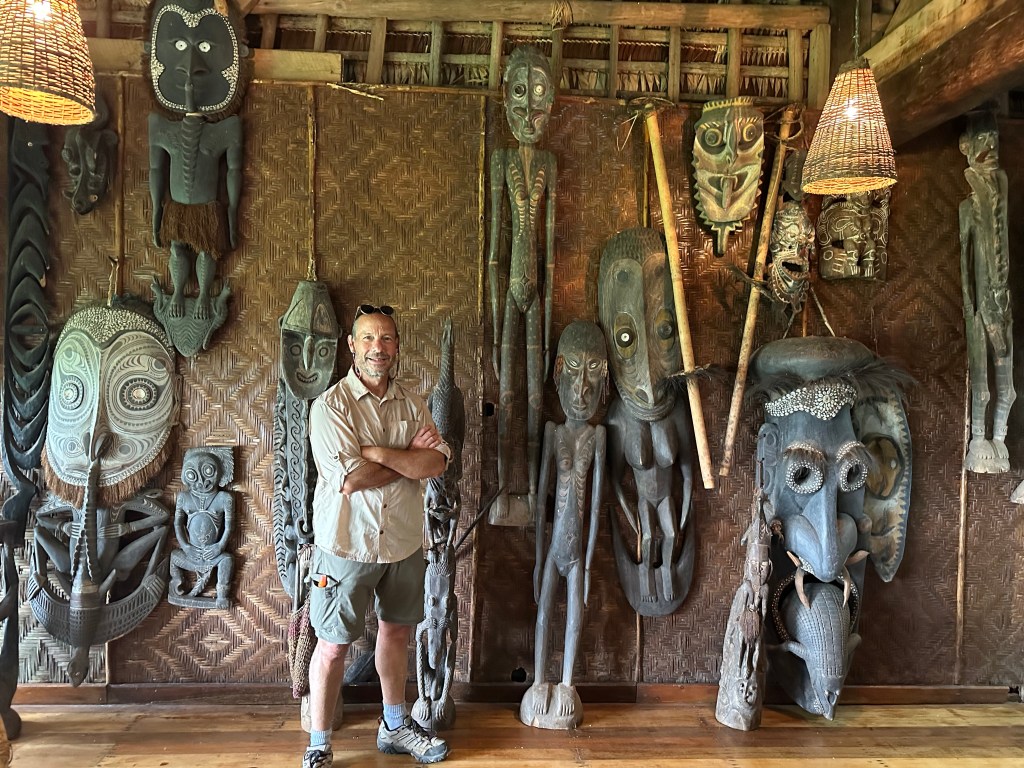
The boat left us at another muddy bank, where a small pick-up truck that had seats installed in its rear bed, picked us up and drove us up the ridge to the entrance to the Lodge. Comprised of a main building that had a lounge area filled with local art, a bar, a balcony overlooking the river, and made completely of wood, the grounds also had several separate buildings, each comprised of two guest rooms.
Here – and for the rest of our stay over the next four nights in the East Sepik Province – we’d have no cell nor internet service and limited hot water.
After hanging out until after lunch – including having my first beer in the Province – we headed out for the afternoon. We rode the pick-up back down the ridge to the river’s edge and re-boarded the boat.
Our guide was Chris, a member of the Yokoim tribe, who formerly practiced cannibalism (Chris told us it ended with his uncle’s generation) and who populate about eight villages along this stretch of the Karawari. Chris believed there were about 3,000 – 4,000 tribal members remaining. There apparently are six different languages in the Karawari area, of the 75 or so different languages spoken in the East Sepik Province. The language they all have in common, though, is Pidgin, with some words and phrases close to their English equivalent. Without this language, the various tribes can’t understand each other; our commercial flight from Port Moresby to Mount Hagen had announcements in English and Pidgin.
The boat cruised variably from 5-25 miles per hour. Brian, our driver, was fantastic in taking us along the river each day we used the boat. He hugged the shore to give himself a shallower draft which helped him pick-up speed, but also slowed down whenever he saw locals on the river or when he saw birds or some other sight along the river’s edge that we’d want to see or photograph.
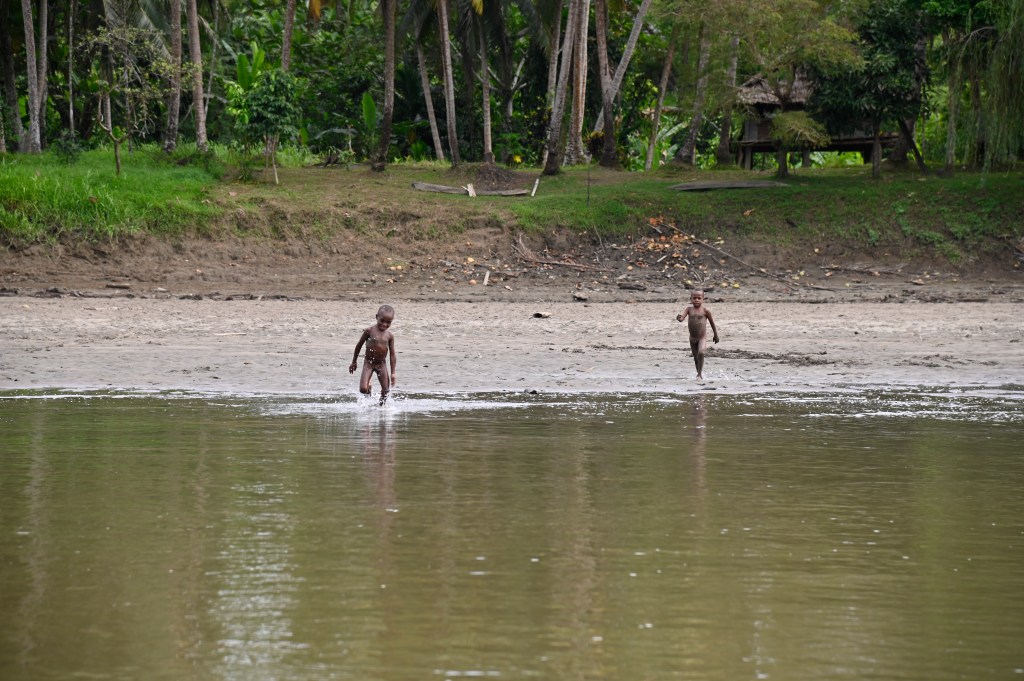
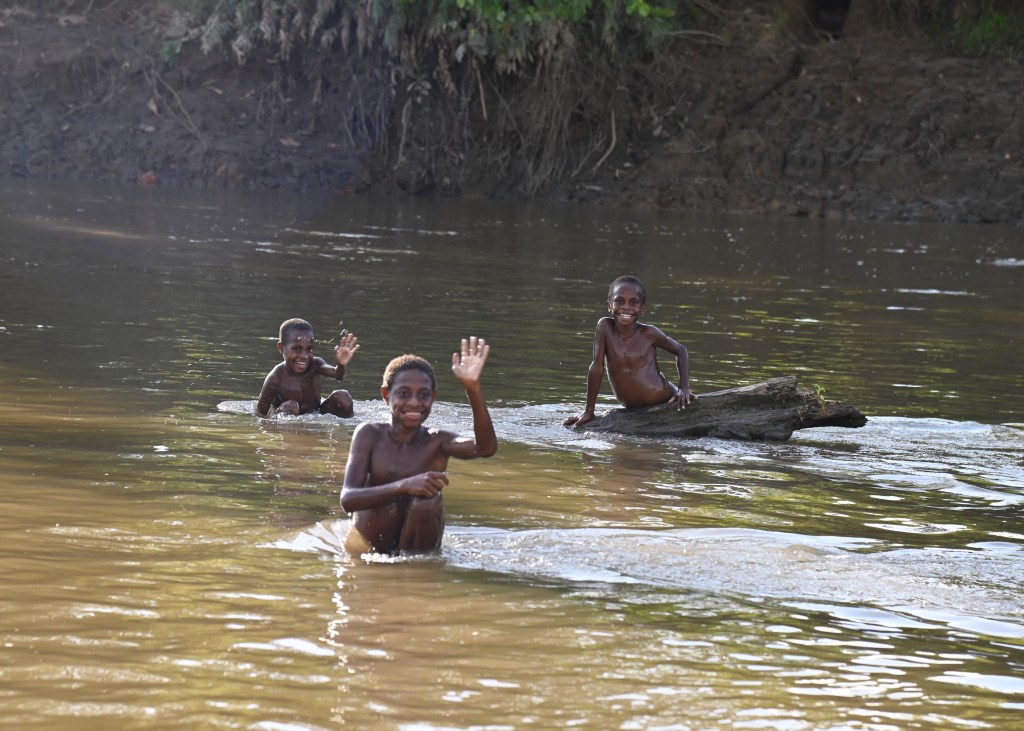
And the views along the river were endlessly fascinating. The people that live here depend upon the river and the surrounding jungle for life and transportation. The river’s edge was mostly tall grass, palms, rain trees, some banana trees, and sago palms, all of which hugged right to the shore. We periodically saw small wooden buildings on stilts and people along the shore, and naked children swimming on the river’s edge. On the river we saw long canoes, sometimes with a single person in them, sometimes with three or four or five or even nine in one circumstance. Sometimes they sat, and sometimes they stood as if they were stand-up paddle-boarding. Clothing was mixed – traditional in some cases and western in others. The canoes were mostly paddled, but we did see a few with outboard motors, and they were used for fishing, for transportation from village-to-village, for commerce, and to begin journeys to elsewhere on the river system.
For the next few days our pattern would be to cruise the river system mostly in our flat-bottomed boat, watching the world go by and looking for birds, until we stopped at one of the local villages, where we would be given a presentation or a demonstration of some traditional aspect of tribal life. Each of these stops invariably included locals displaying and selling traditional art – jewelry, masks, woven baskets, and more. And each stop ended with our making a donation to the village.
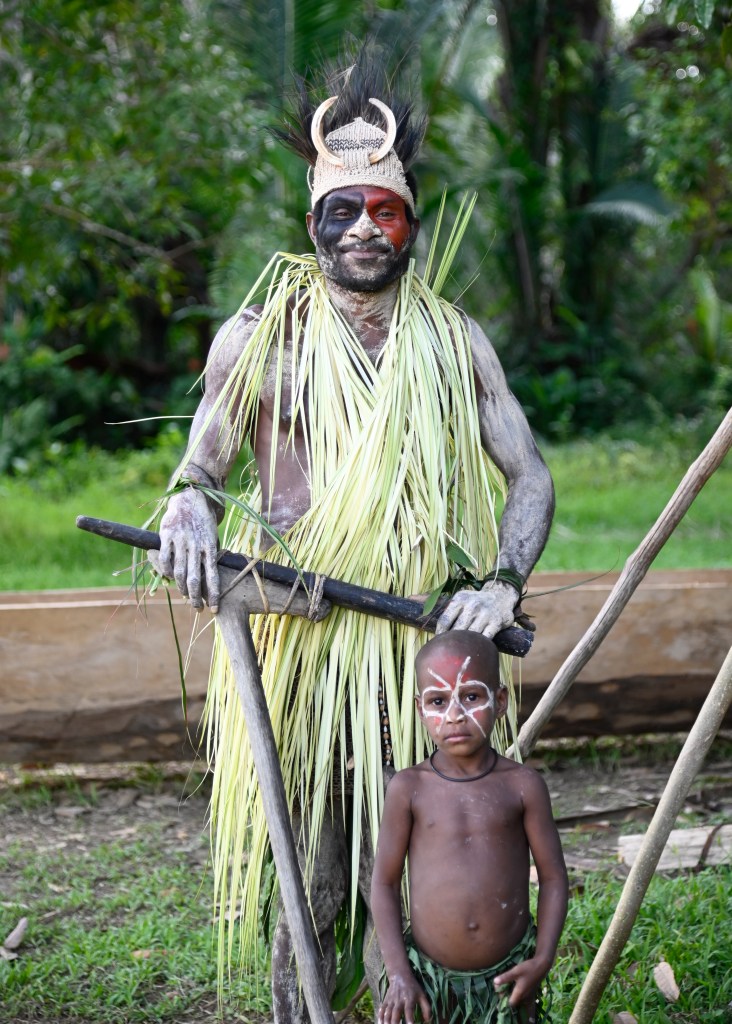
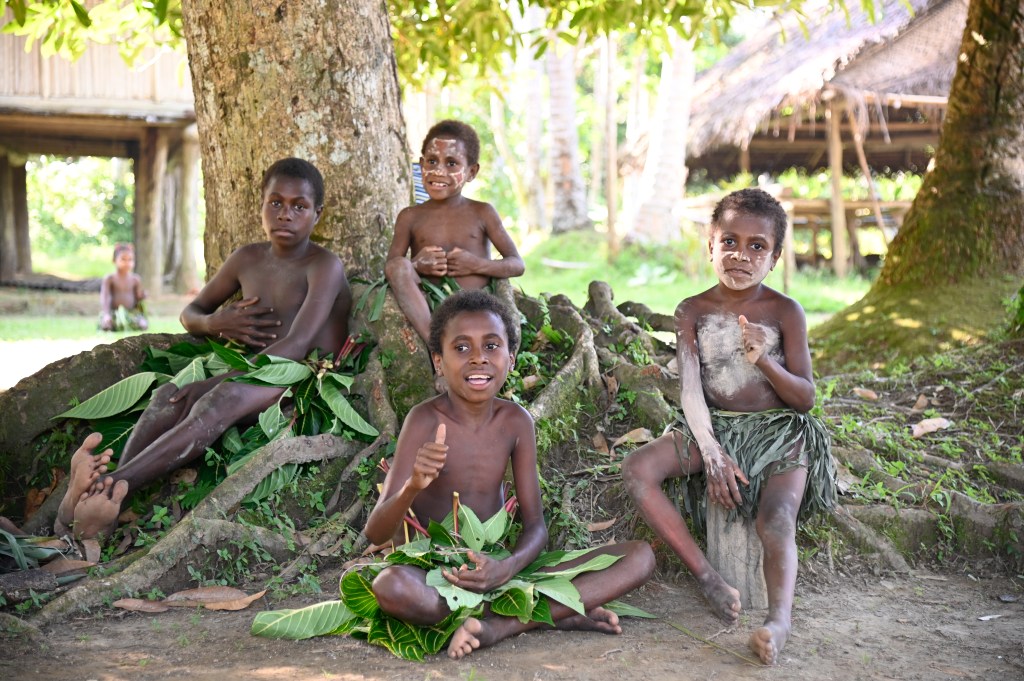
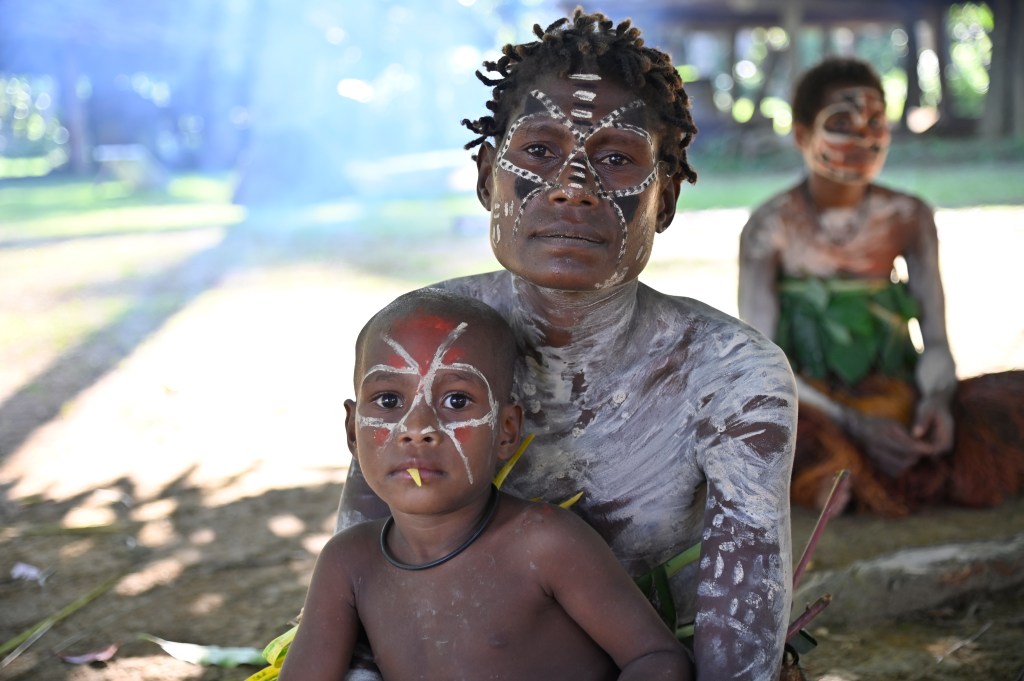
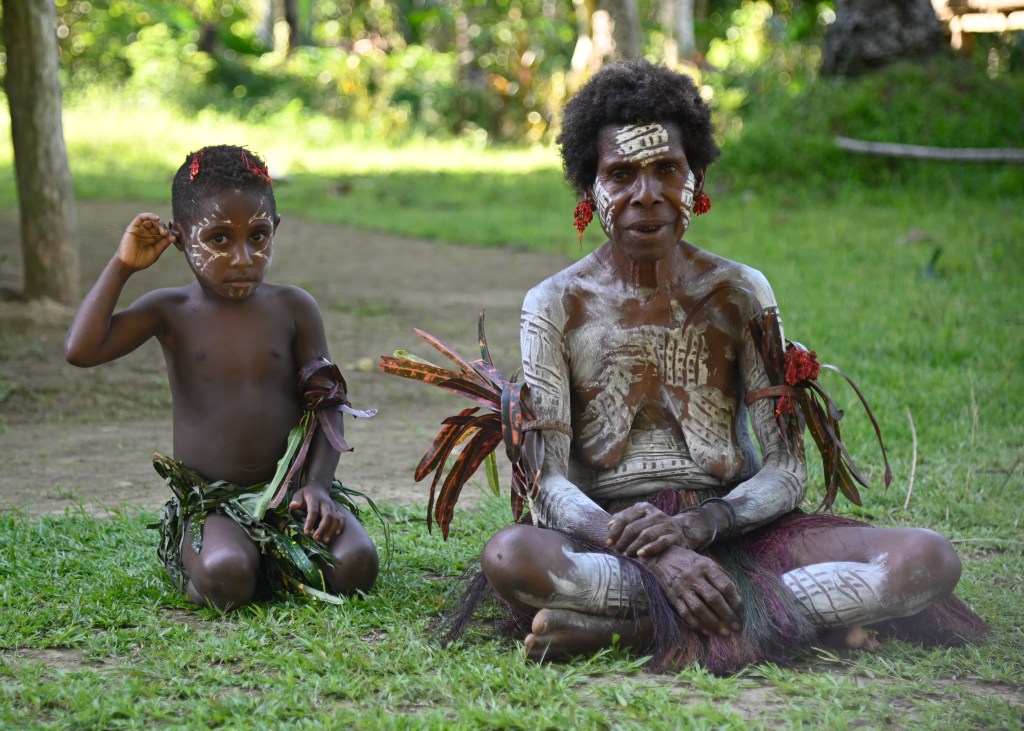
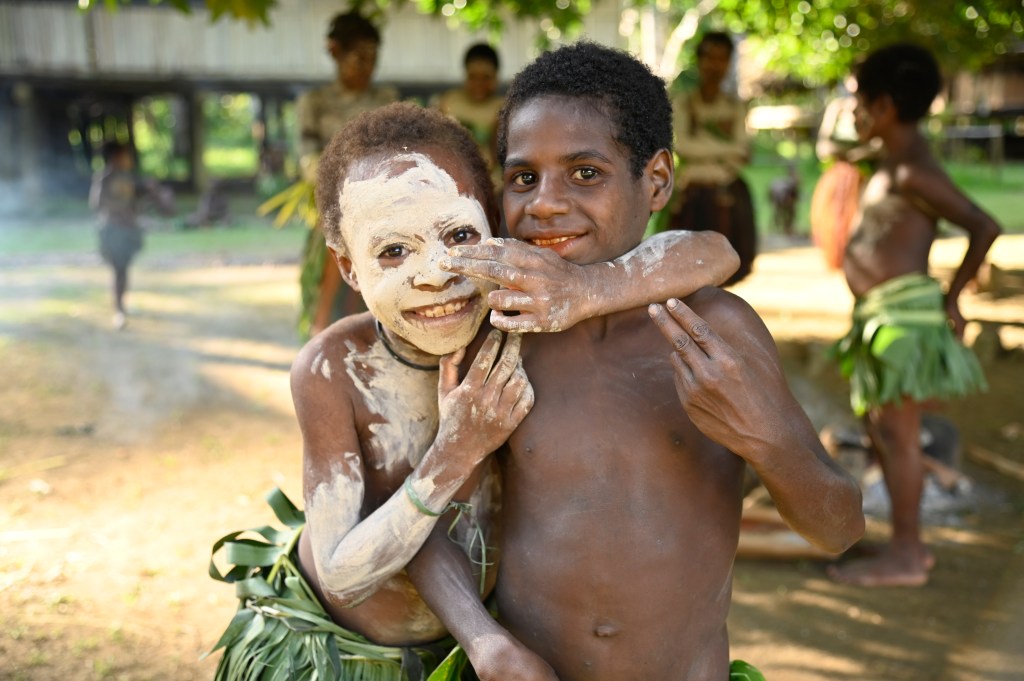
Our stop this afternoon was at a village known as Kundiman II. Here, men, women, and children showed us how important the sago palm – the “tree of life” – is to their existence. With all of the villagers dressed in mostly traditional clothing, head-ware, and face-painting, the men showed us how a palm is cut and broken up to get to the pulp; the women – some bare-breasted (which we would see continuously from Mount Hagen through this part of the journey) – showed us how the pulp was then softened into flour and then cooked into flat pancakes. Local vegetables were mixed with what they called “vegetarian piranha,” a type of fish – the pacu – that had been grilled or smoked.
This was a quiet relaxing amazing afternoon, and a mood-setter for the next four+ days.
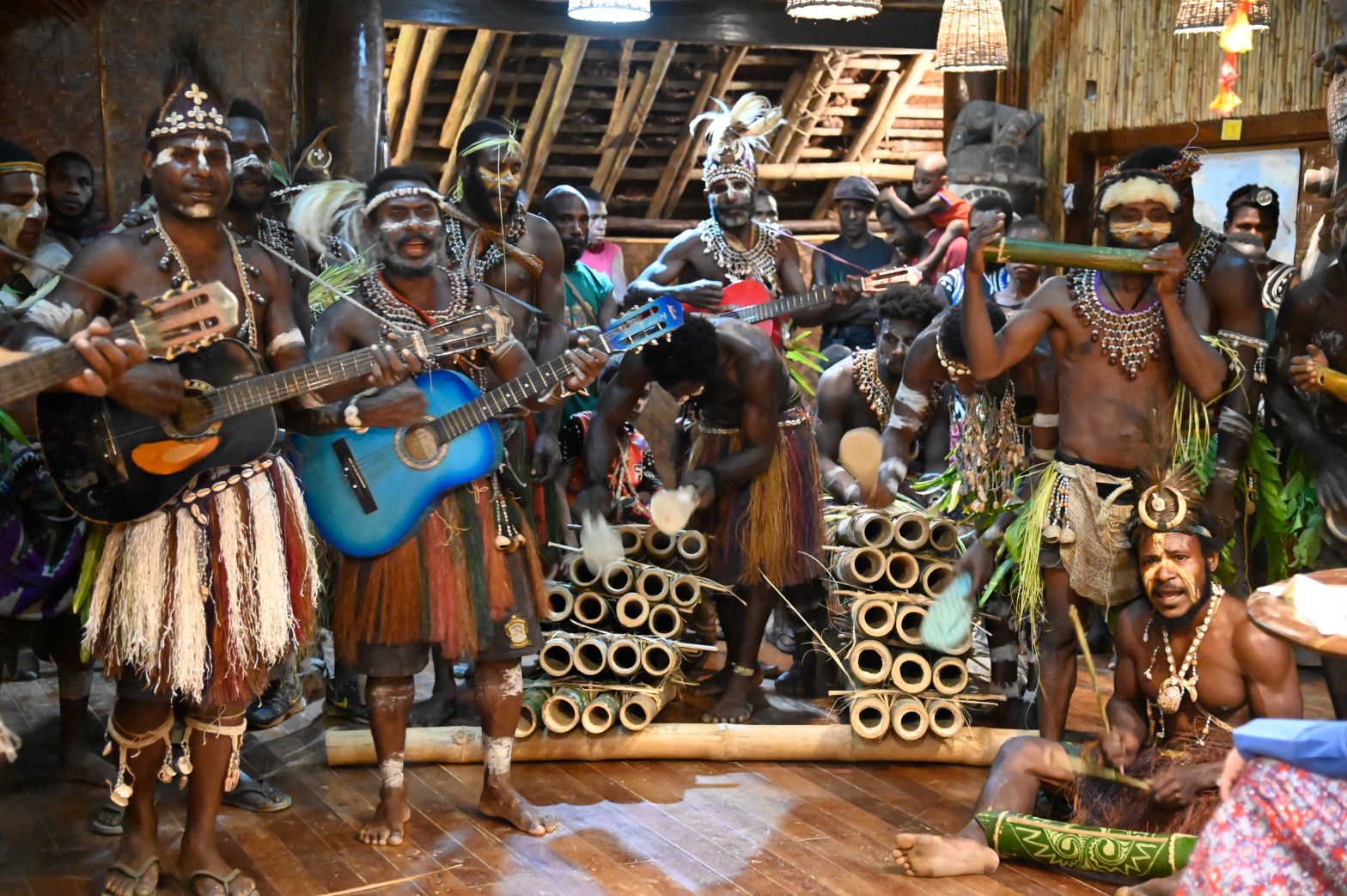
We returned to the Lodge for a short lecture in the main building before dinner. Afterwards, a group of about 30 locals from the Karim tribe – men, women, children – entertained us with traditional songs. The musicians, playing guitars, drums, big flutes, a pan pipe, were dressed in traditional clothing. There were local children dancing, a woman breast-feeding, others from the village watching. It was a remarkably immersive experience.
Electricity would be shut off to all the rooms at around 10 p.m. So – it was back to my lodge at about 9:30, where I proceeded to have a 5-minute fight with a 5” long moth I found in my bathroom (it seemed like a scene out of a movie). My mosquito net covered bed kept the bugs out during the night, and the sounds of the jungle were amazing throughout (if your sound is on, you’ll hear these sounds; if they don’t play automatically, the link is below the photos).
(Clicking on an image below will enlarge it in a new window).



 Fred's Travel Blog