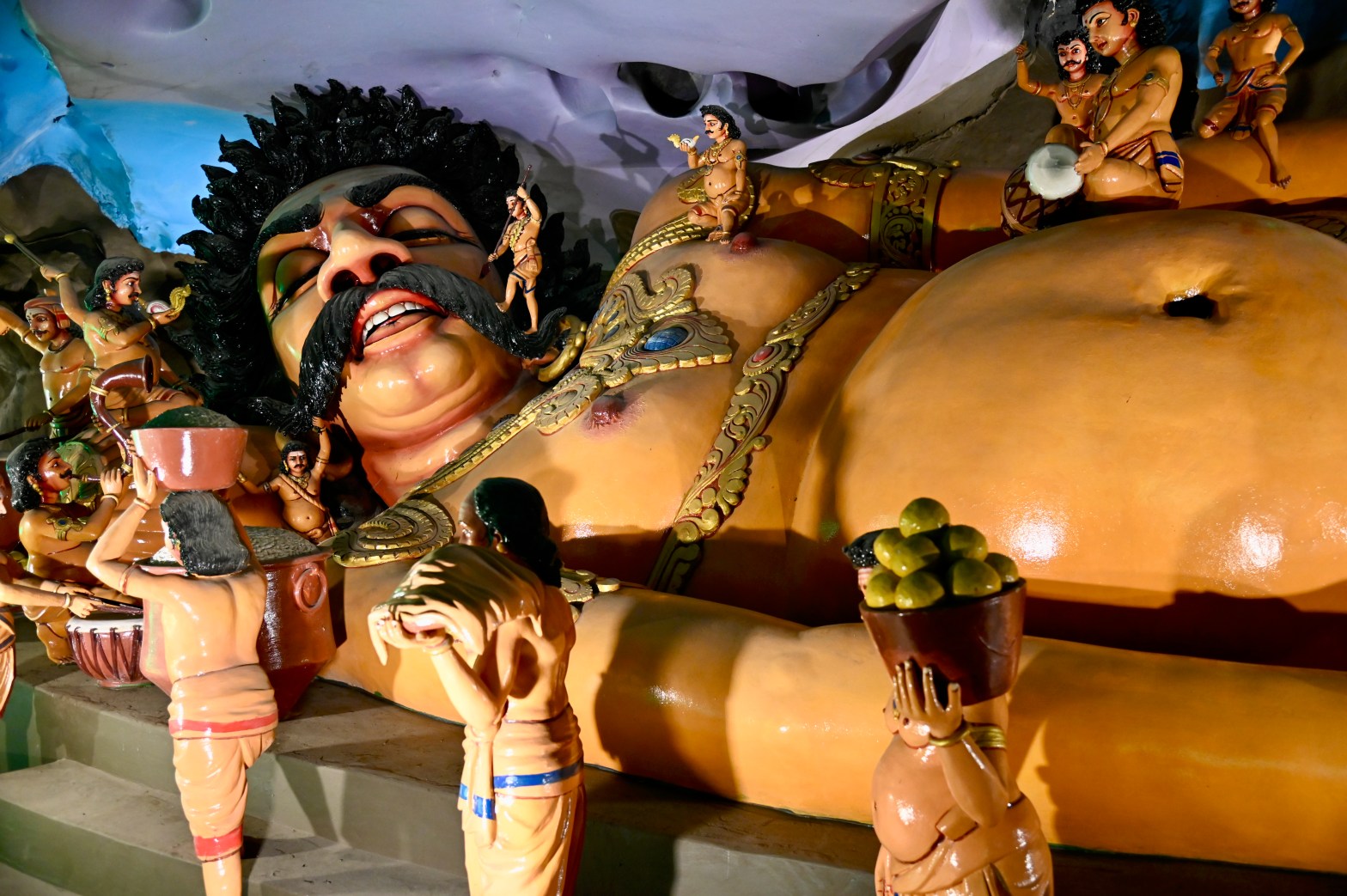
If my first day in KL was about galavanting around the city, getting some exercise in, and breathing some city air, day two was about trying to get outside the city for the day and seeing what I’d be able to visit without having to drive too far away. My ChatGPT queries identified the Batu Caves, the nearby Ramayana Cave, and the not-too-far-from-them Kanching Waterfalls. I found a pretty inexpensive ($38) “GetYourGuide” day-trip that covered all three sites, with a short morning walk to the pick-up site, where I stepped into a small van driven by Vijay with five other people, all of whom seemed to be Americans (though no one actually talked with anyone else).
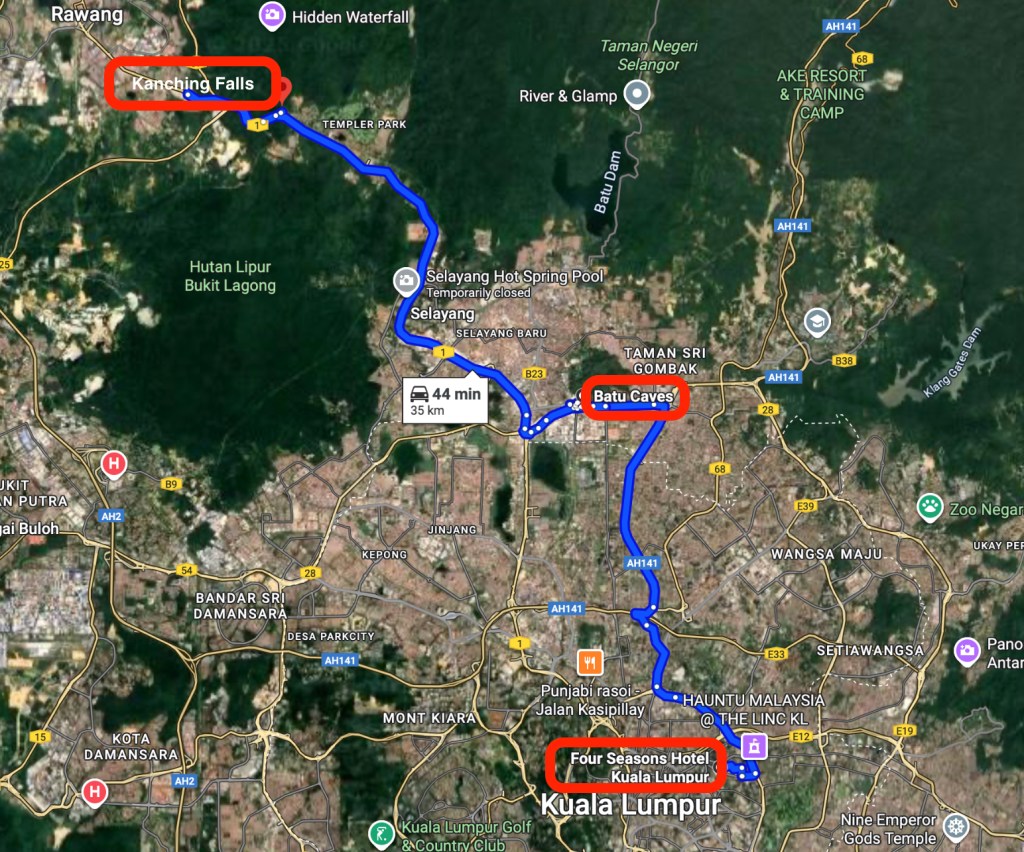
It was a Saturday, so lots of people were out on the road in the morning, leaving the city for the day. After about forty minutes we hit gridlocked traffic heading into the massive (like, football field-sized) parking lot for both Batu and Ramayana. Scattered around the exterior of the lot were tons of food stalls, souvenir stands, and places where you could buy flowers to make offerings in one or both of the caves. Our driver had forewarned us about the macaque monkeys that would be around, looking to steal food and shiny stuff from anyone who wasn’t keeping an eye on their things.
I decided to hit Ramayana first, as clearly Batu was the attraction, and I wanted to save that. The entrance to the cave was on at ground level, but once inside the cave was long and deep and had a series of carved stone and wrought-iron steps to take you up and back to the a deep part of the cave, which is lined with LED lights along the ground and walls. It wasn’t crowded – despite the number of people and cars in the parking lot – a clear indication that Batu was really the attraction here. The cave is dedicated to the story of Ramayana, apparently a popular Hindu tale. The cave is lined with murals and statues representing different characters from the story – and the colors and lighting almost make it psychedelic. The picture at the top of this post is a giant inside Ramayana.
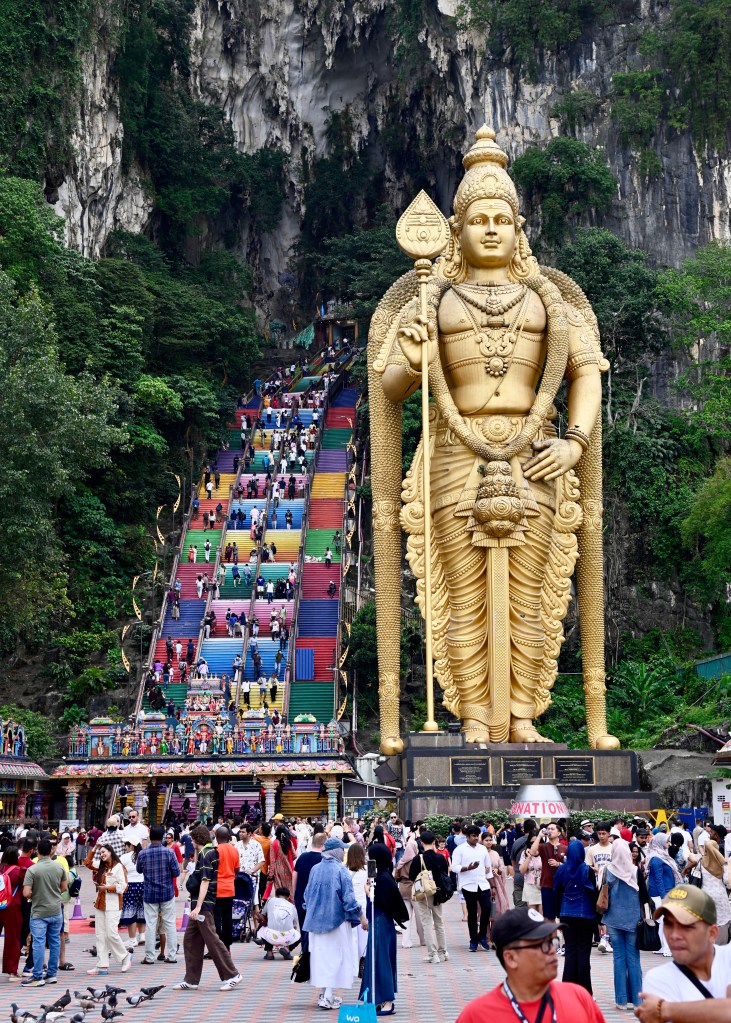
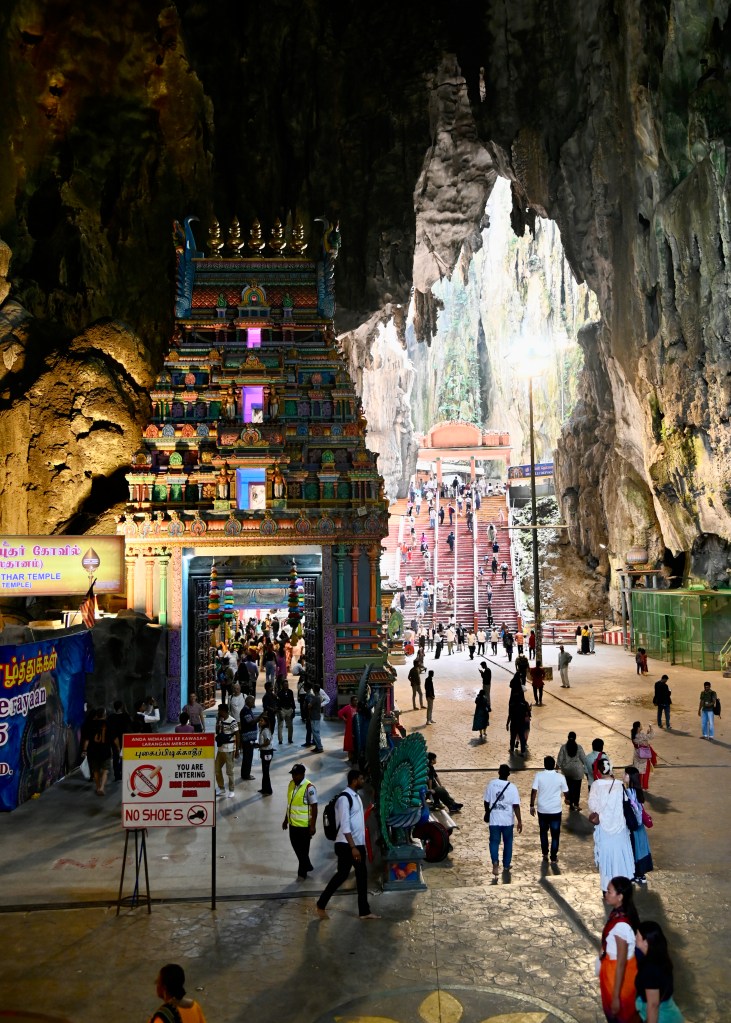
Once I exited the cave (at the same point I entered), I walked about thirty yards down the sidewalk along one edge of the parking lot to the plaza in front of the stairs leading to the Batu Caves. These are inside a limestone mountain and are believed to be over 400 million years old. Inside the caves are temples that date to 1890, and it is the largest indoor temple complex in Malaysian.
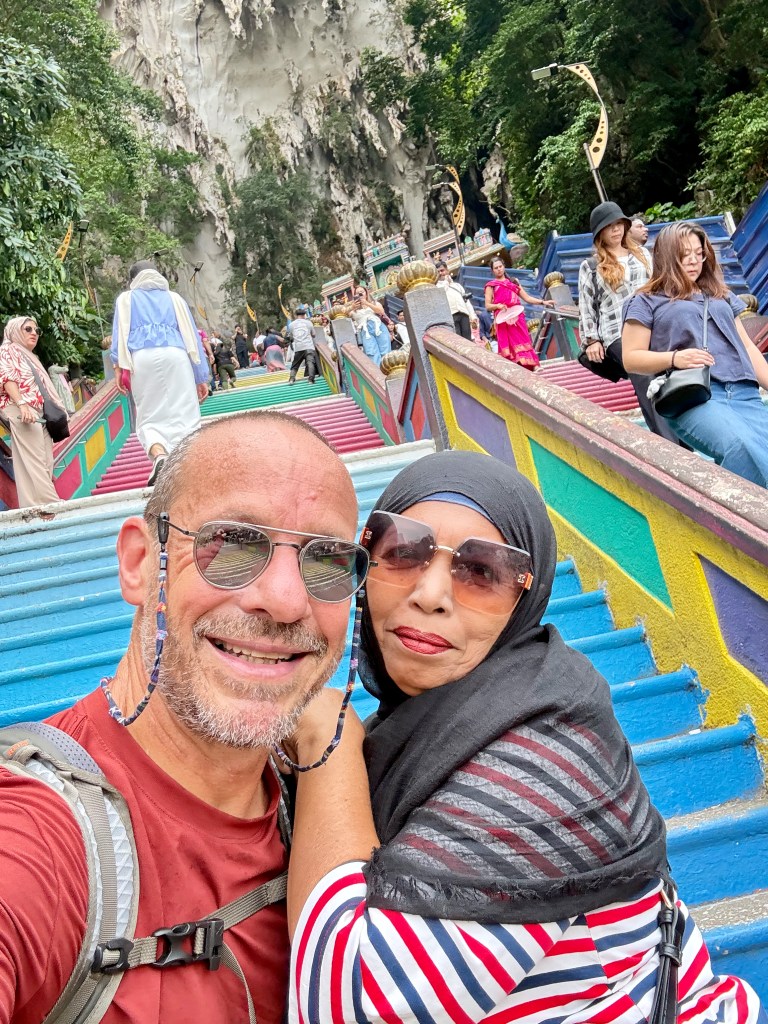
And to get there from the plaza: a climb up 272 steep concrete steps – brightly painted and a photographer’s dream, guarded by a statue of the Hindu god Murugan that is 140 ft tall, weights 360 tons, and made of concrete and steel. It is the tallest statue in Malaysia, and the second tallest Murugan statue in the world.
The plaza out front had tons of people – lots of locals – some making the journey to pray and make offerings, others just for the interest. A colorful, vibrant, invigorating scene with the statue overlooking it all. People stopping for pictures in the plaza, and on the steps and in the caves, asking friends and family and strangers to take pictures and waiting for a clear view. Once you get inside the main portion of the cave – incredibly high with holes in the limestone at the very top, letting in light (and water if it were raining) – there are several shrines, places to buy water and trinkets, and even more steps leading to the farthest reaches of the complex.
Walking around the plaza, walking up the steps, strolling in the caves – just total eye-candy and worth the heat-and-humidity (and sweat). And, of course, once you’re done in the cave you have to walk down the 272 steps – your “whoa muscles” hard at work. And -btw – there are no shortcuts that I saw – in fact, I saw some workers carrying boxes up the steps to the kiosks inside the cave.




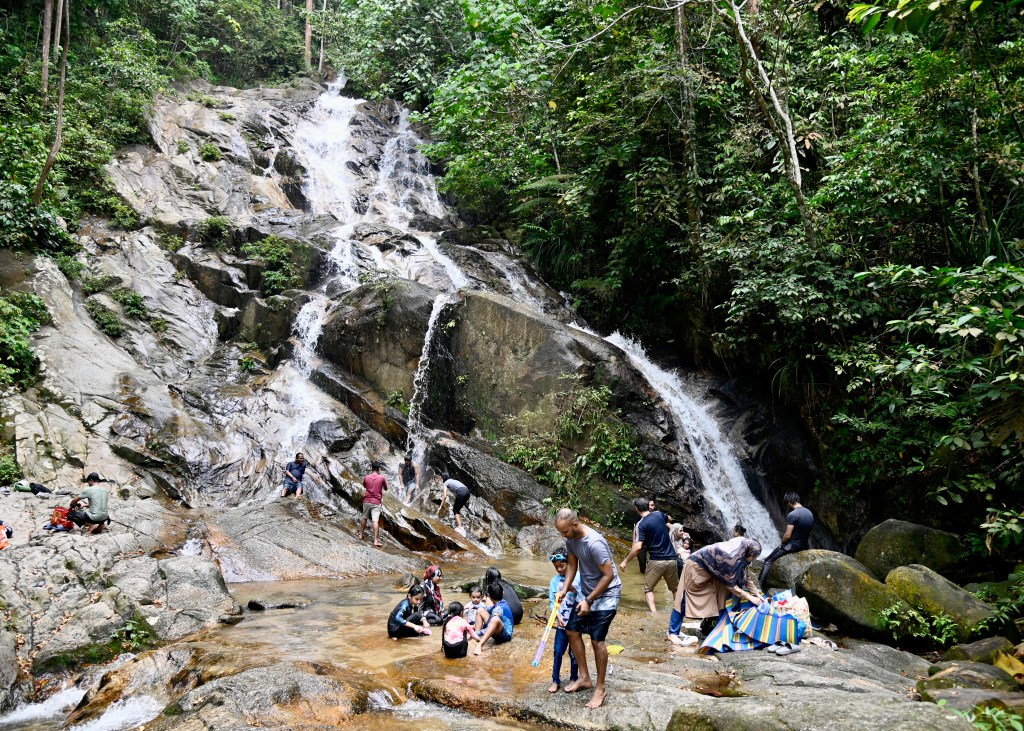
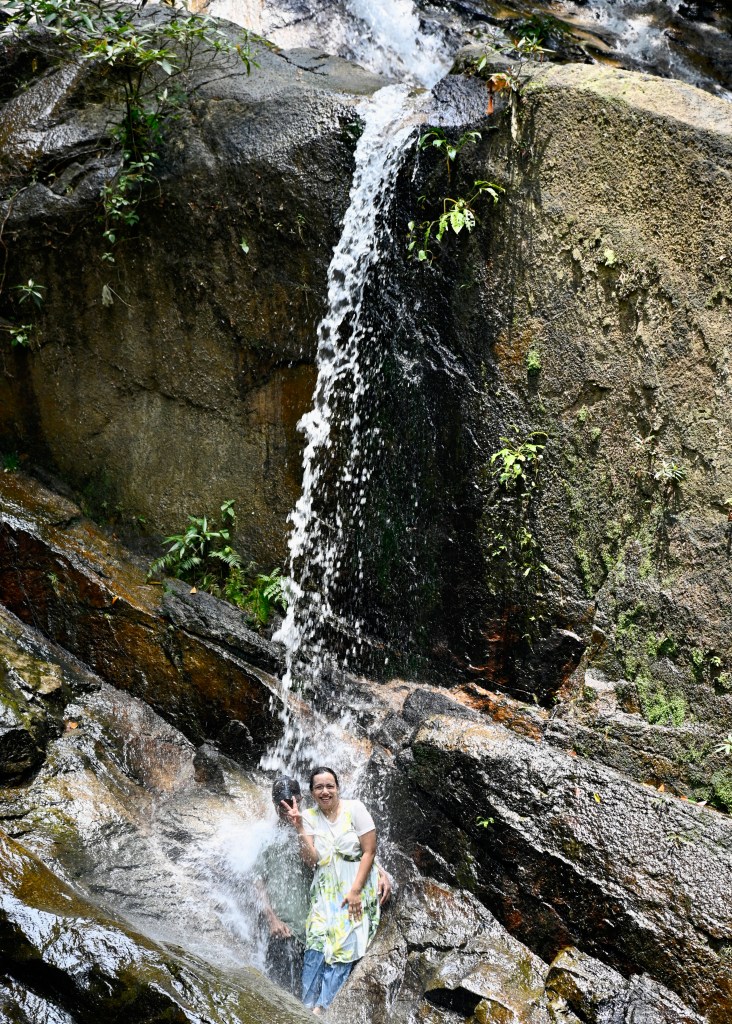
The next stop – about 20 minutes away by van – was the Kanching Waterfalls, a series of seven levels of waterfalls, gradually up the side of a small mountain, with a marked trail from the parking lot initially concrete, then dirt. Vijay, our driver – who walked with us – told us we would go to level three only ( the fourth level, he said was “at your own risk”, but I was thinking – wasn’t the whole thing “at our own risk?”). At the bottom of each falls were natural pools with no rocks at the bottom, making them great spots for swimming (which I didn’t do).
We walked past levels one and two, then stopped at level three. Given that it was a Saturday, there were lot of locals there – several small families and teen-age boys and couples – swimming, picnicking, just relaxing and enjoying themselves. And – hundreds of wild monkeys looking for food, grooming themselves and each other, sipping from the water pools. Our driver Vijay asked me if I want to go to level four and pointed the way – up more steps, then a jog to the right where there were taller and more robust falls. More small families, boys, and couples, and monkeys. Clearly a nice way to spend a Saturday afternoon.
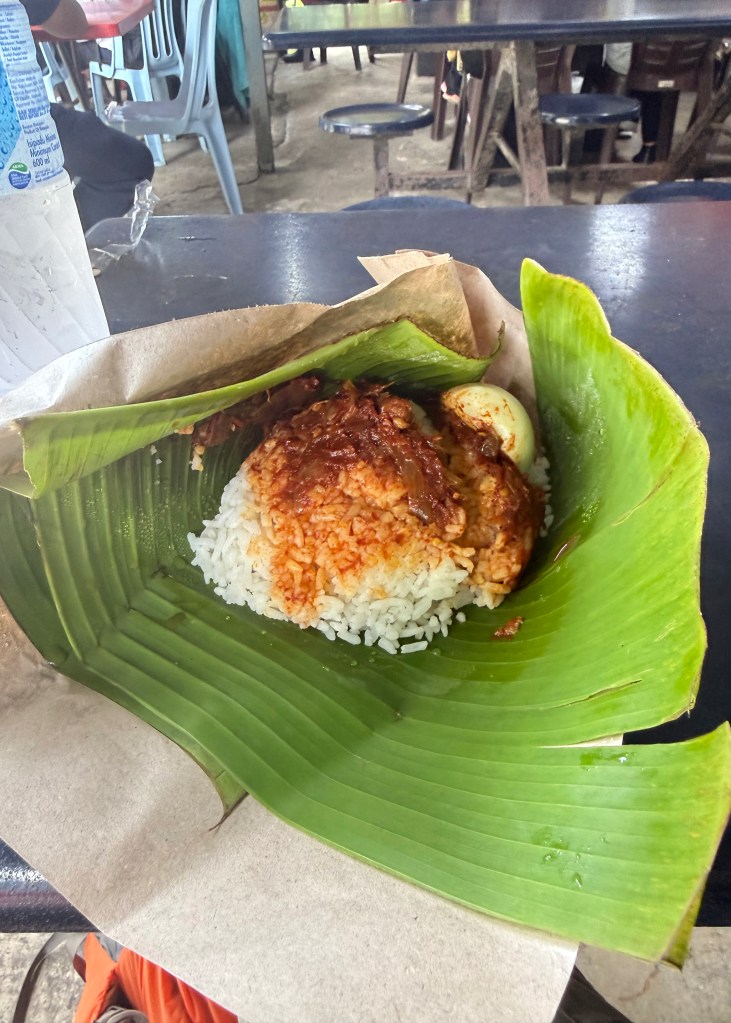
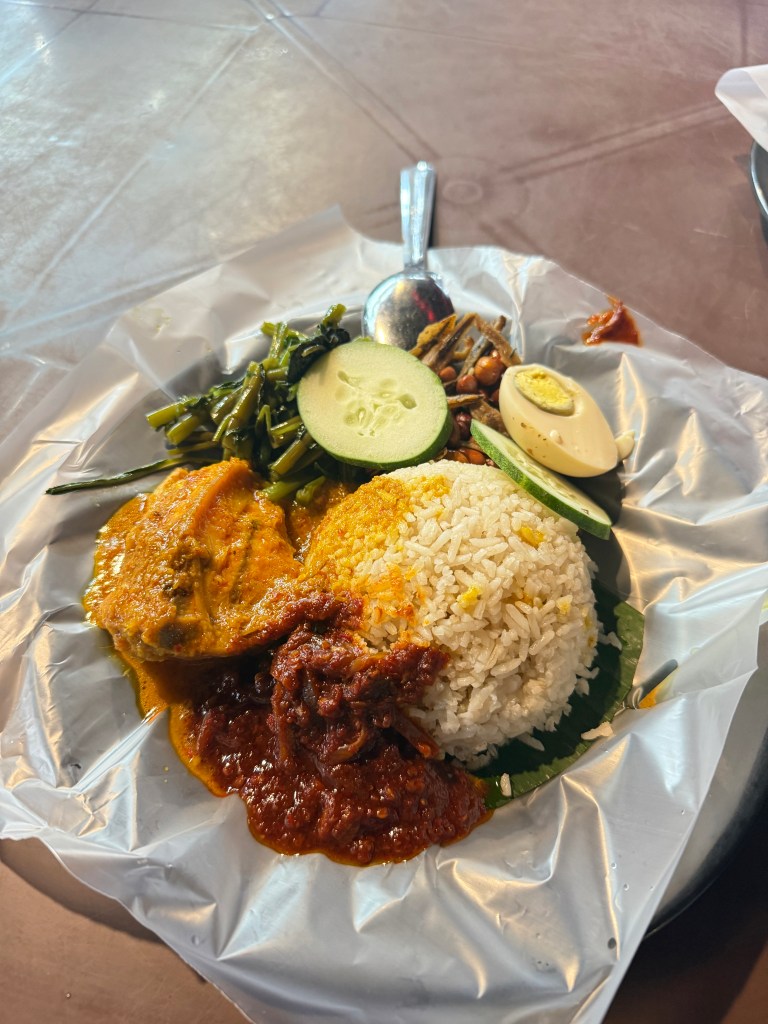
By that time, I was getting hungry, so headed back down the path toward the parking lot, where there was a small stand with a variety of food for sale – chips, candy, sodas, water – but I was indecisive until the proprietor offered me a banana leaf-wrapped package of rice with spices and an egg (I didn’t eat the egg!). I had no idea what it was (until later that night), but it spelled my appetite.
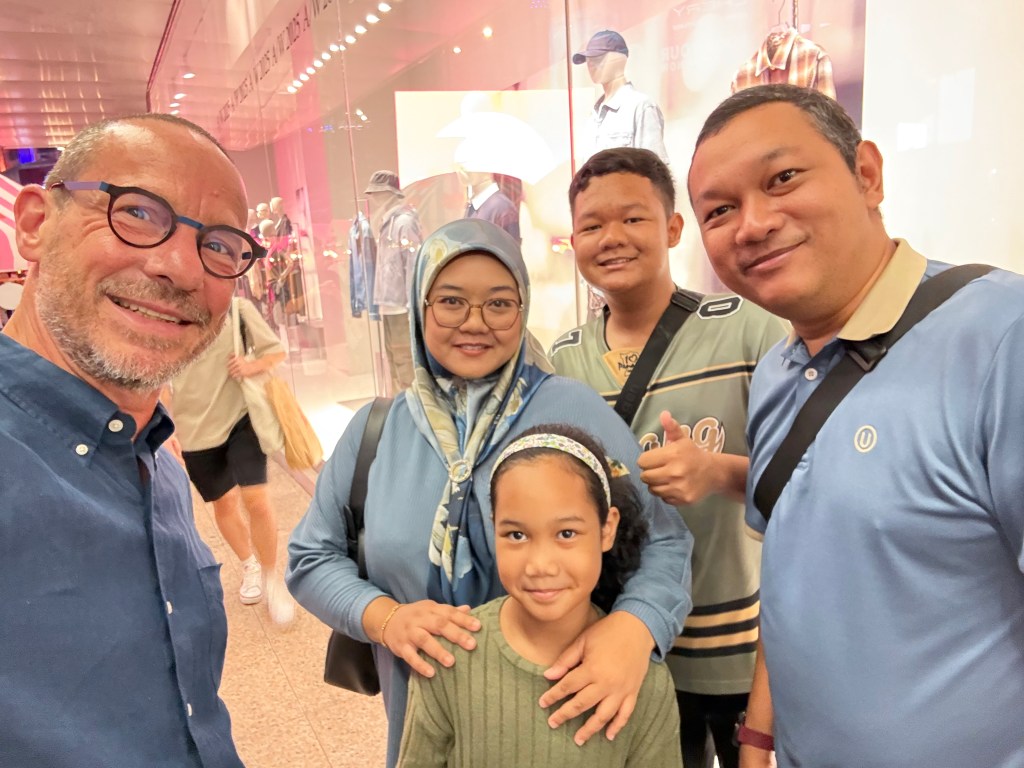
After a little nap at my hotel back in KL, it was time for a Saturday night in Kuala Lumpur. If the prior evening was about a 14-course meal in a Michelin-starred restaurant, this night would be about street food. I found another GetYourGuide offering – this time a night-time food tour at the Jalon Alor markets. It turns out that I was the only one on the tour and that the guide was a professional chef named Faris, raised locally, who had come into the city for the day with his wife, daughter, and 13-year old son, the latter of whom would join us on the tour.
He asked me about food allergies and what kind of food I liked; no allergies, and “I’ll eat anything, just don’t take me to eat ‘tourist food’ – I don’t need to have a cricket on a stick.” He liked my answers, and we were off.
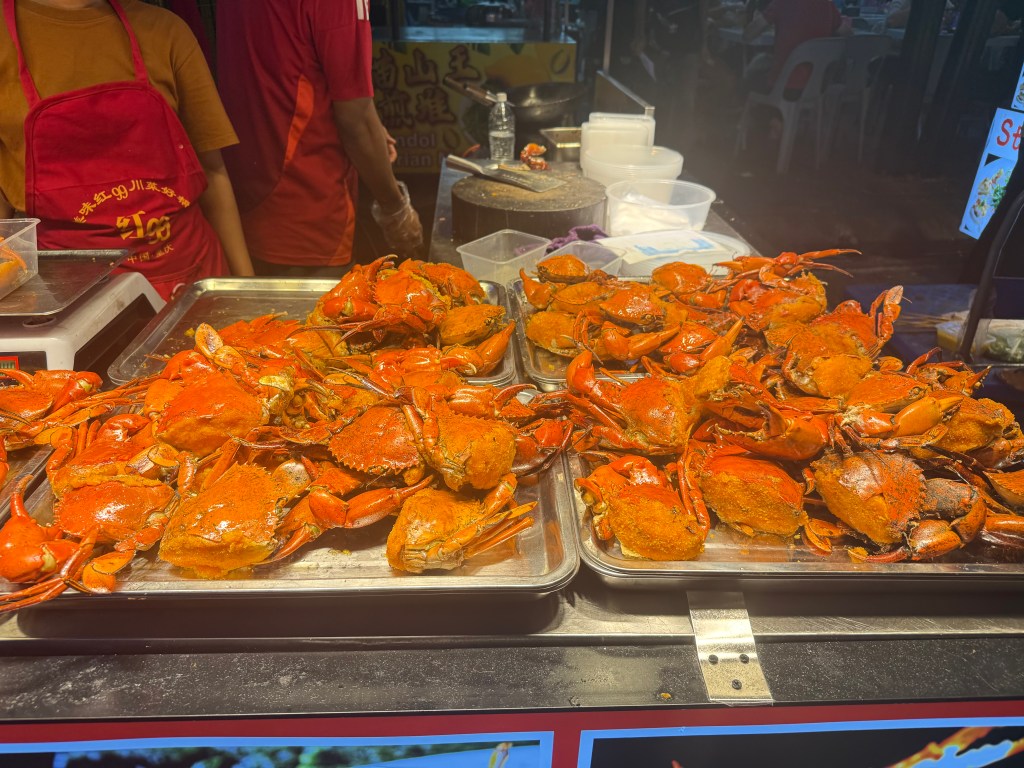
The food market was crazy busy – probably 4-5 blocks long, with stand after stand and restaurant after restaurant and just a hugely crowded scene. Faris said that 99% of the people there were tourists – including the vendors – and that it was this busy all the time. He explained that he doesn’t cook professionally anymore, but that he does cook at home (though his son said that his mom was the better chef!), and he does do these food tours, so he knew where to go and what we would eat.
Over the course of the next 2 1/2 hours, we made five stops to eat six things:
- Char siew pow – a pork bun – with the bun being more flaky and baked then steamed and soft; these were in a display case, so the proprietor just pulled ones out for us.
- Putu piring – steamed rice flour with palm sugar and coconut; typically a dessert, but he wanted me to taste it earlier in the night. We watched two guys make batch after batch of these at their small stand.
- Nasi lemak with chicken rendang – a traditional dish: rice with chicken, a spicy sauce, fried anchovies and peanuts, cucumber, braised greens, and half an egg. It turns out that this is what I’d eaten that afternoon at the Kanching Falls (though I only had the rice, sauce, and egg). Tonight’s was at a busy, busy stand, with small tables set-up in front of it, and we ate it along with a type of tea served in a plastic bag that you could tie around your wrist to walk around with. Nasi lemak was Faris’ son favorite food; he had his with fried chicken.
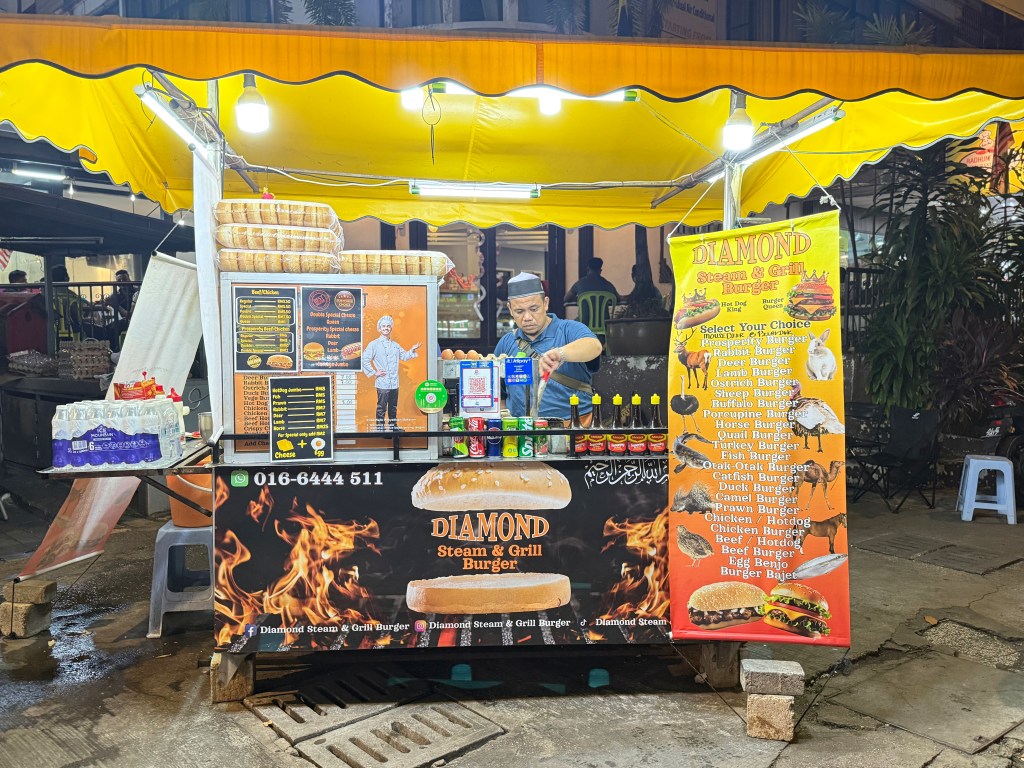
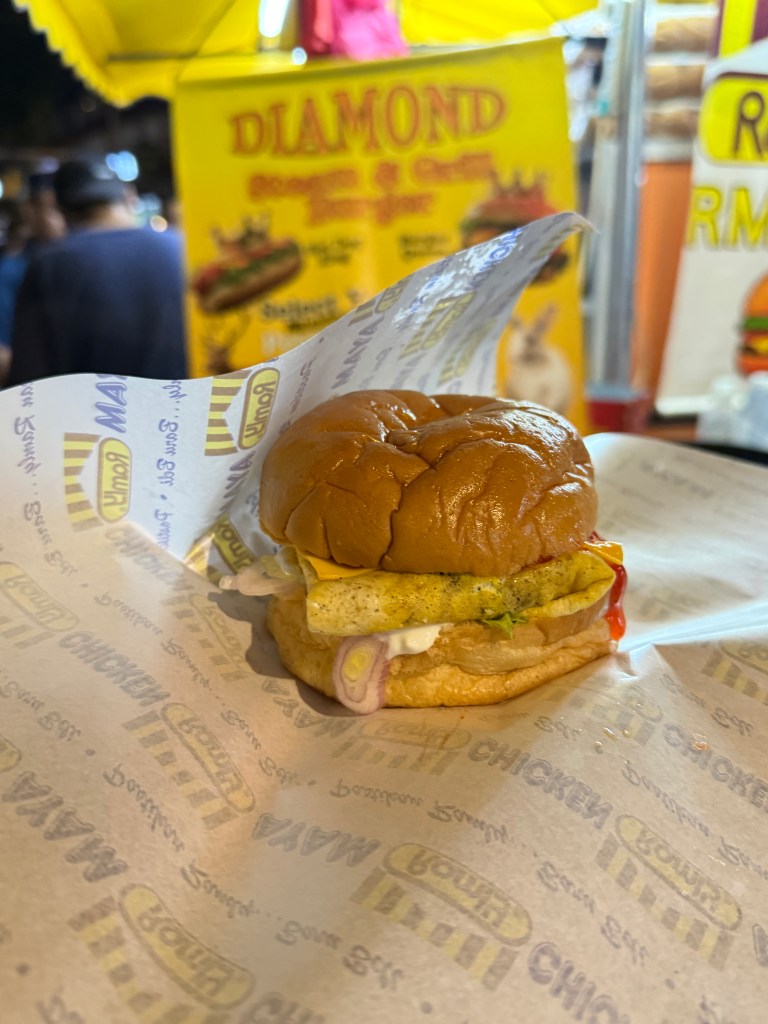
- Ramly beef burger special – a smashed burger patty, wrapped in an egg, with a special sauce, mayo, lettuce, and tomato on a steamed bun – this is cheap, cheap late night food and unbelievably good. This was a small cart – like a hot-dog cart – and we watched the owner cook the burger and put the whole thing together. I was already full before we got to this, but I just had to try it and gobbled it down.
- And – at our last stop – roti canai – a traditional type of Indian flat bread – the “best bread in the world” – served with lentils and/or condensed milk (we tried both), along with teh tarik – a traditional Malaysian hot tea. These we ate at an open-sided restaurant, nearby one of the main thoroughfares in the neighborhood.
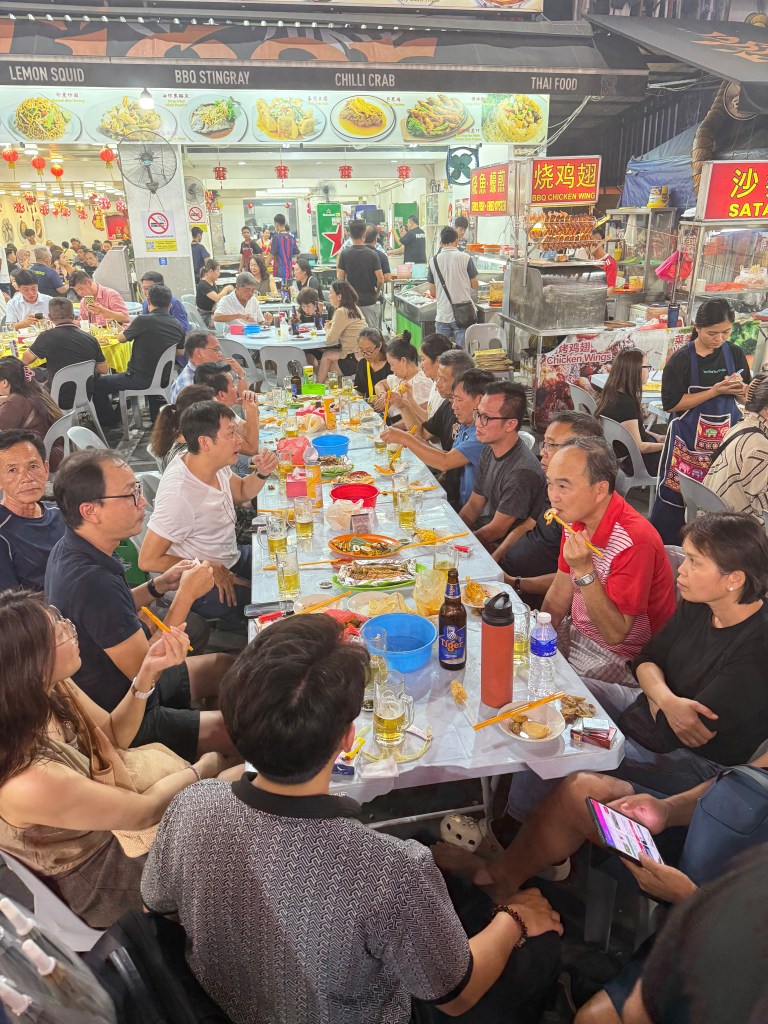
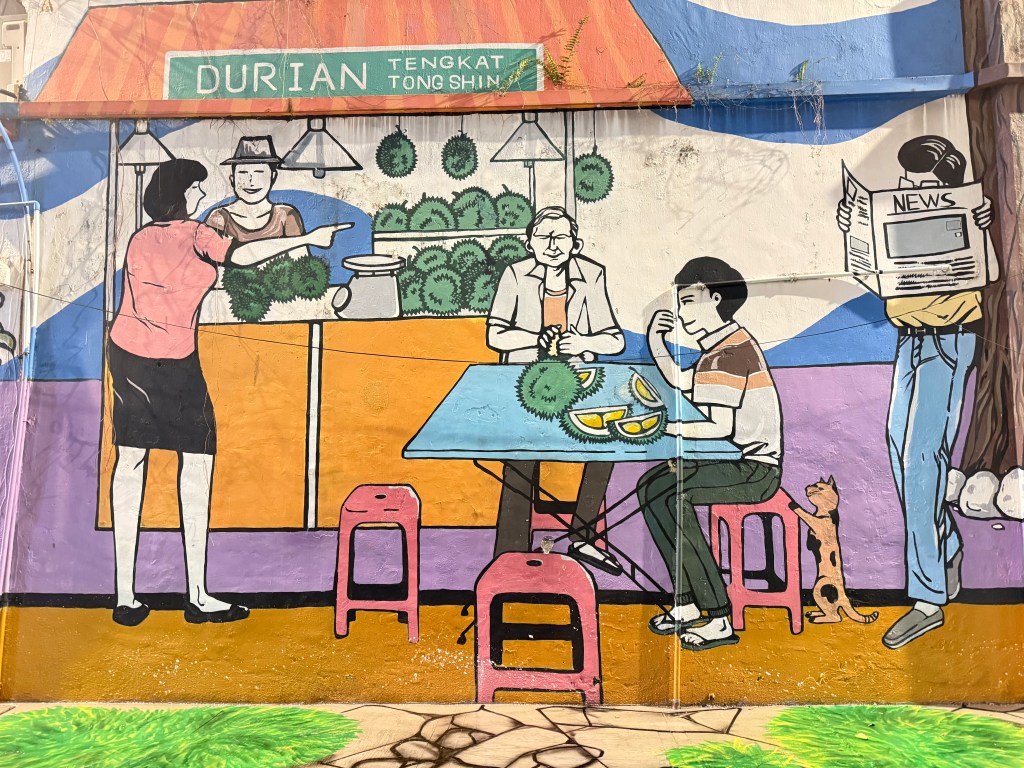
What a night of eating and eye-candy. I was stuffed . . . and Faris pointed me in the direction of what he called “heaven” for tourists and late-night denizens: a busy bar zone with lots of outdoor seating, live music, traffic, pushy waiters, and people from all walks of life.
I walked through heaven, then back to my hotel, where I ended my night with a drink at the (much quieter) hotel bar.
 Fred's Travel Blog