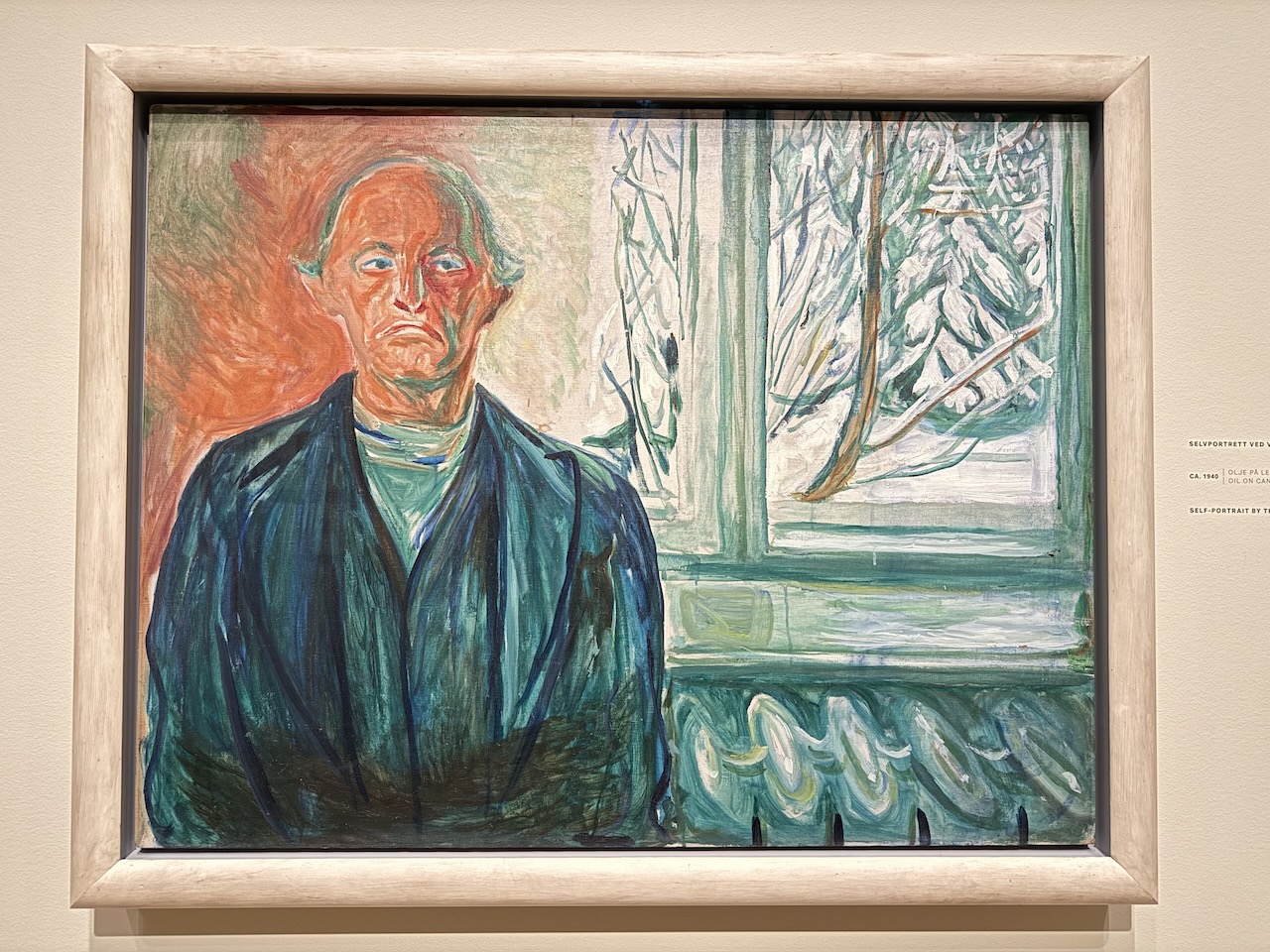
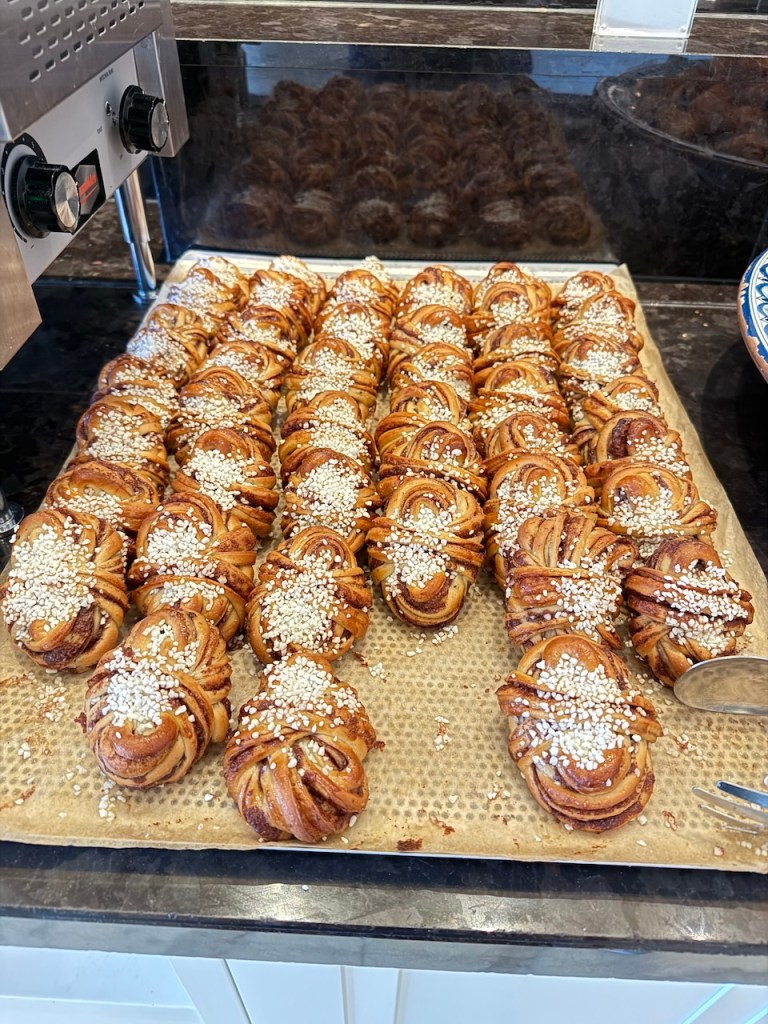
I had to start my last morning in Stockholm with some cinnamon buns (kanelbullar!) but after that, I was off to Oslo.
When I’d booked the trip to Lapland, Helsinki, and Stockholm, I wanted to see if I also could fit in a trip to Norway; looking at the map, it didn’t make sense to do it before Helsinki, given the proximity of Norway to Sweden; once I’d figured that out, it really was just a matter of how to get from Stockholm to Oslo. The train seemed the best way – only about four-and-a-half hours, and across the Scandinavian peninsula, giving me a chance to see the country-side between once capital and the other.
After breakfast it was off to the Central Train Station in Stockholm for what turned out to be an easy and scenic ride. The border between Sweden and Norway is the longest uninterrupted border in Europe, and I’d be traveling east to west across that north/south border.
And what did I learn while on the train? Well, Phil Rosenthal, the creator and star of the Netflix series, “Somebody Feed Phil,” which I regularly watched to check out the food culture and places to eat in cities I was visiting, was on his European tour and – waddaya know – he was appearing in Oslo the same evening as my arrival. Serendipity! Ticket purchased for general admission seating, and it was just a matter of arriving in Olso, checking into my hotel, which was literally right next door to the train station, and then walking to the theater where Phil would be performing.
A fun day and an even more fun evening; he was witty and informative, gave me at least one idea of a food place to check out in Oslo, took questions from the audience, and just had to find my own joint for dinner that night. And I couldn’t believe the line outside the venue to see him when I arrived!

Before I move on to tell more of my time in Oslo, there is one story to share about our tour director in Finland and Sweden. While he was born in Chile, his family was from Spain, and he returned there when he was four years old. As an adult, he also has lived in Berlin. He and his wife now live in Warsaw; he is Jewish and his wife is a German Jew, whose mother is still alive (age 96). The mother is an Auschwitz survivor, who left Germany after the Second World War but returned home not long after the War ended.
When Russia first invaded Ukraine in February 2022, the mother implored our tour director to go to the Poland/Ukraine border to see what he could do to help the entering refugees. On the second day of the invasion, he drove three plus hours to the border; things were terribly disorganized at the point and when he got there he saw streams of people – mostly women and children – with a look of terror in their eyes, not knowing what to do, where to go. He saw two young adult women clearly traveling together, visibly traumatized at what they were going through. He grabbed them by the hands, was able to communicate in some combo of Polish and Russian, that he would take them to his home to help them get settled.
With tears in his eyes as he relayed this story, he told me about driving back to Warsaw, the two women only whispering to each other, and he and his wife put them up for two weeks until systems were in place to help them out. It turns out their father had been killed – he suspects they saw him being killed – and they barely spoke to our guide and his wife the whole time. They still keep in-touch.
He has made three or four trips to the border since then, but none of them were as brutal as that first one the second day after the invasion. His story of he and his wife’s humanity will stay with me.
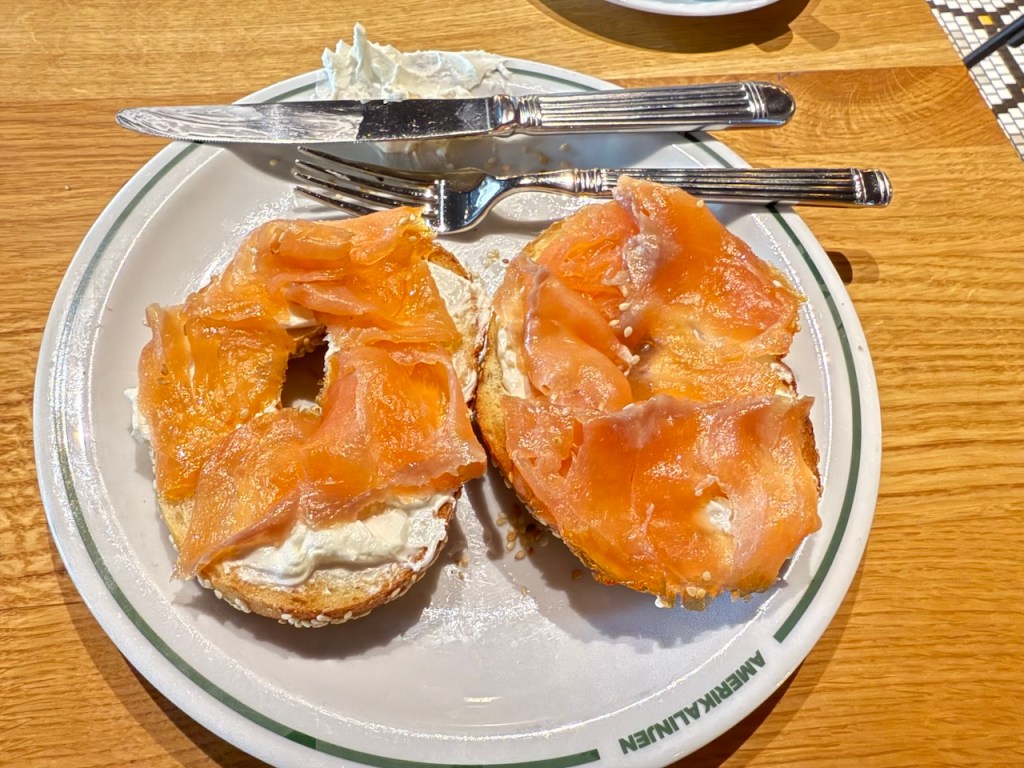
Back to Oslo, a city of 1 million people. While I’d eaten plenty of smoked salmon during my time in Finland and Sweden, the bagels in both those countries left much to be desired. So – finally! – on my first morning in Oslo, I had a decent bagel with smoked salmon.
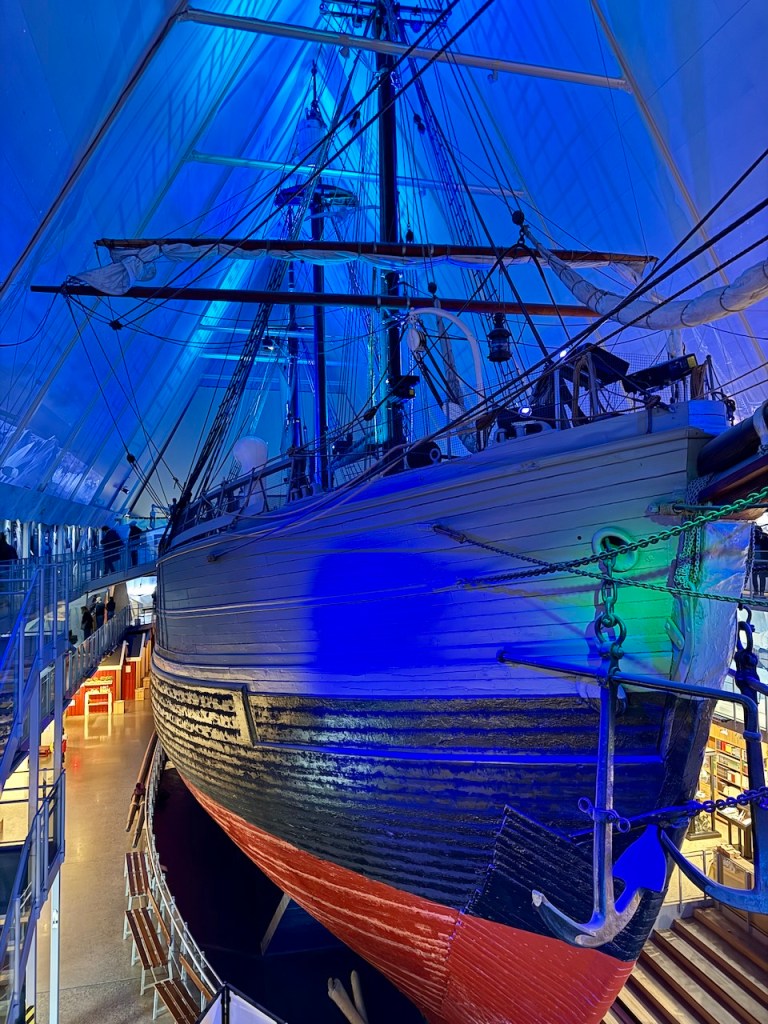
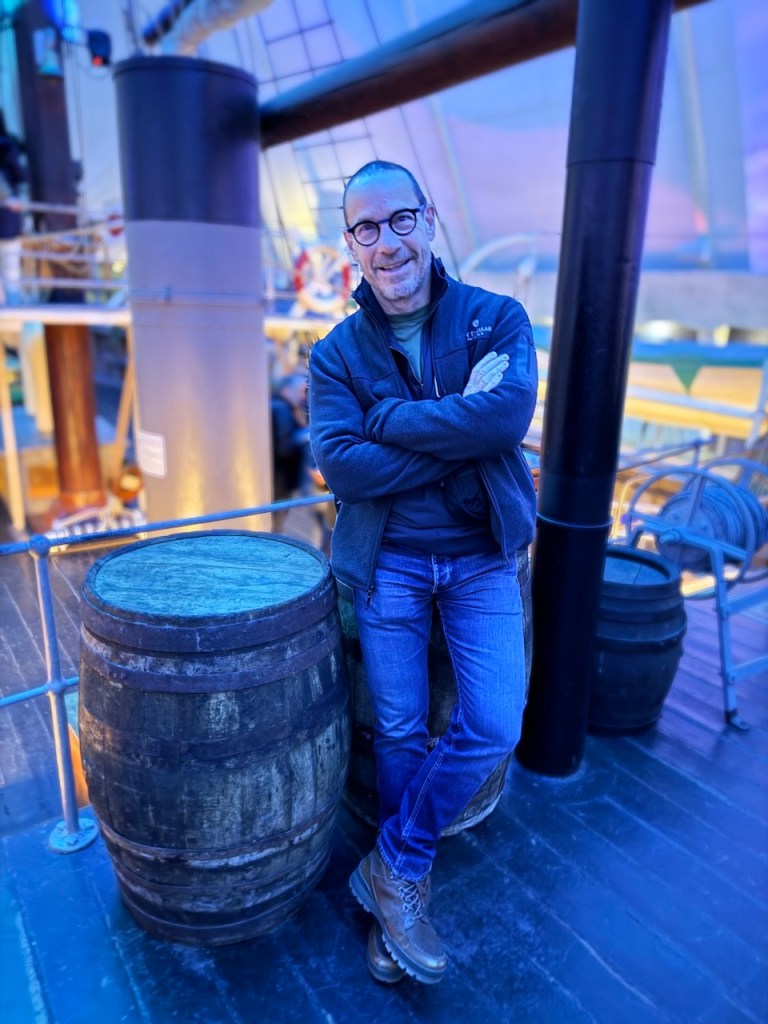
After breakfast, I was by city bus to see two boat museums. The first of these was to see the Fram, a three-masted schooner used by Norwegian explorers to make trips in both the Arctic and Antarctic regions. The Arctic trip alone was remarkable; Fridtjof Nansen wanted to sail further north than anyone prior to him, but he knew two things: 1) the Arctic ice would crush most ships, and 2) that the ice in the Arctic likely moved with the current of the water beneath it. So – he had a ship built to be superbly strong and designed to withstand a five-year journey in which it would be trapped in the ice so that it would be carried from one side of the Arctic to the North Pole and beyond. Unfortunately, though, neither he nor the ship reached the Pole, but the ship survived in the crushing ice for three years from 1893-1896 (he survived too). After that, the Fram made journeys to the Canadian Arctic and, as I mentioned earlier, the Antarctic as well. It may just be the strongest wooden ship ever built.
What’s also cool about going to see the Fram is that they let you board it! And they have great special effects in the museum.
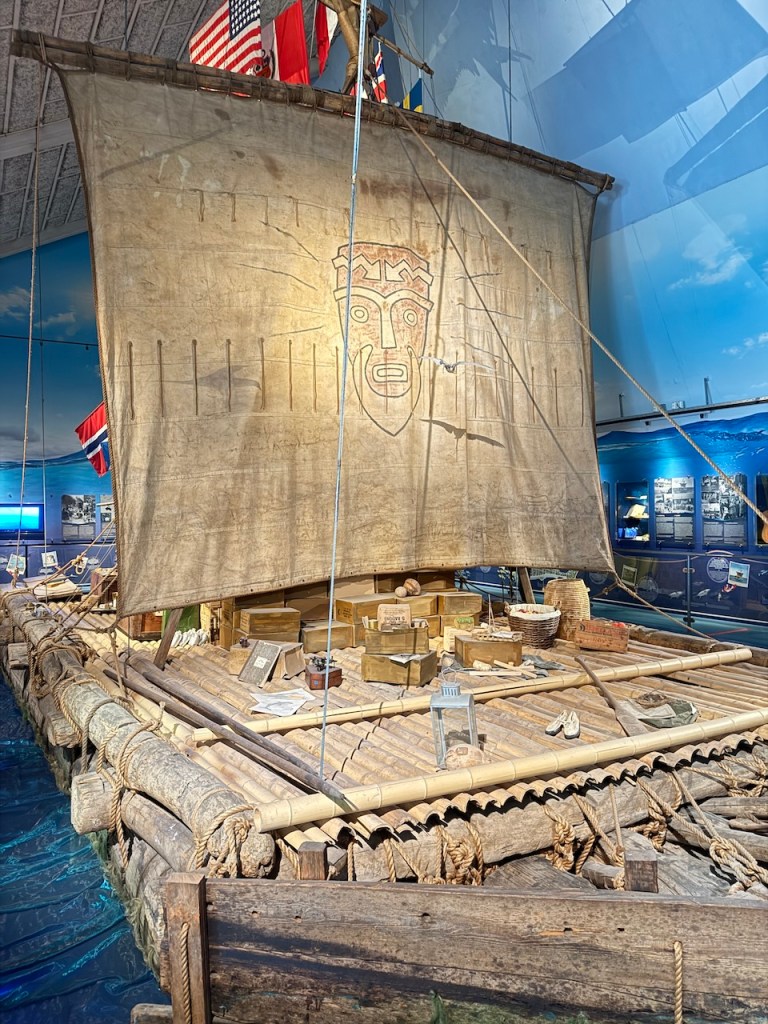
And right across the street from the Fram Museum is the Kon Tiki Museum. Its expedition also is a remarkable story, and the documentary about it won an Academy Award. The Norwegian explorer, Thor Heyerdahl, wanted to prove his theory that peoples from South America could have successfully journeyed, by wind and ocean currents only, to the Polynesian islands in the South Pacific. So, in 1947, he and companions built a raft in Peru using balsa and other native materials; then, with a crew of five others, they survived a trip that lasted 101 days and over 4,300 miles, landing on a reef in French Polynesia (images and film taken on the journey are in the documentary). While you can’t board the Kon Tiki, seeing it and realizing the trip they’d made on it is pretty darn stunning. (Heyerdahl later also became famous for his theories of how the moai – the statues – of Rapa Nui – Easter Island – had been carved and moved elsewhere on the island.)
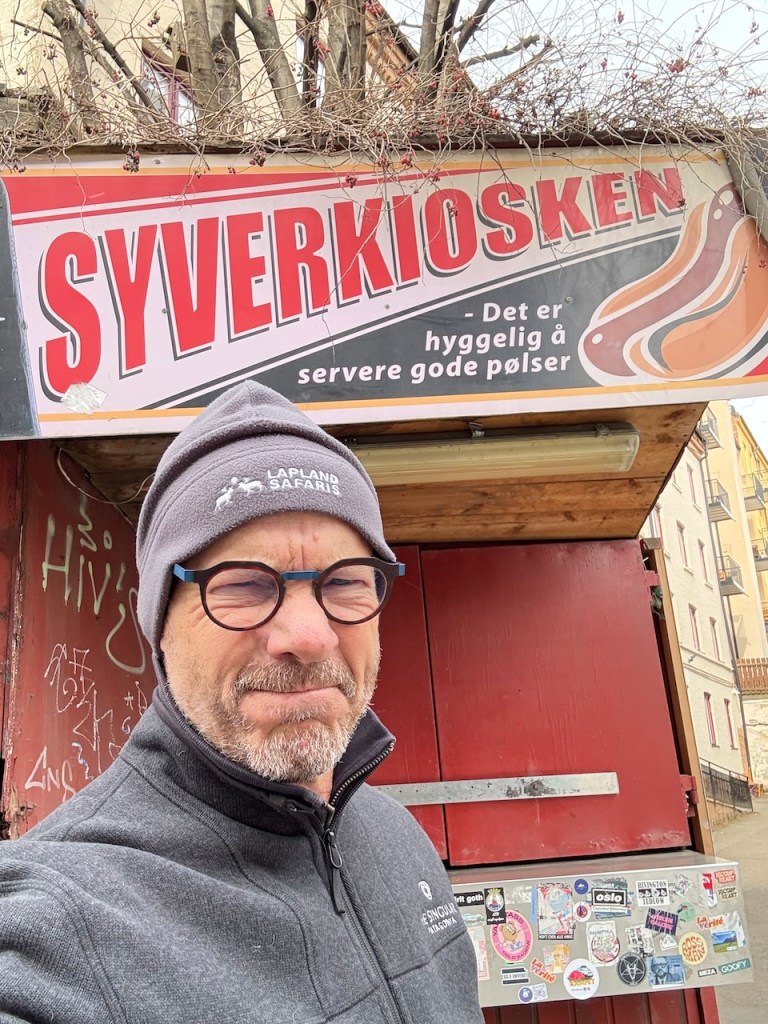
The prior evening, at Phil Rosenthal’s presentation, I’d learned of a hot dog stand in Oslo; the Syverkiosken apparently is the last wooden hot dog stand in Oslo and – beyond that – the hot dogs, traditional Norwegian ones, are supposed to be fantastic. So – off I went to find the stand in time for lunch.
It was closed. Not supposed to be closed. Three other people waiting out front. Great graffiti leading up to it. But closed. I waited about an hour. Still closed. Darn.
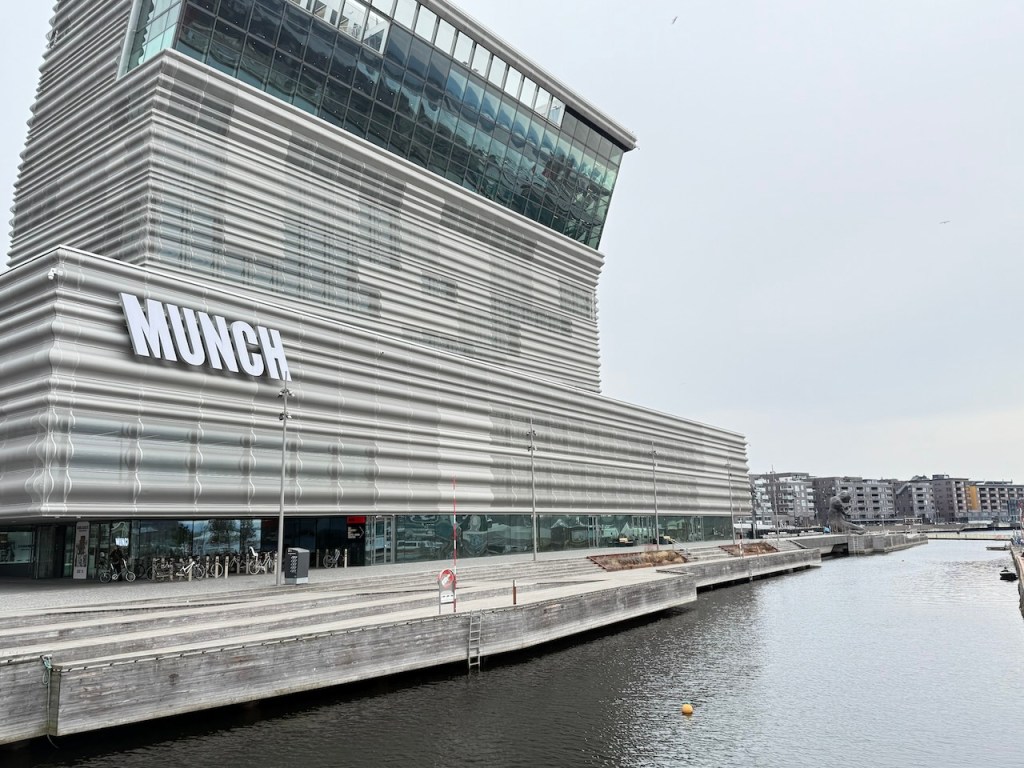
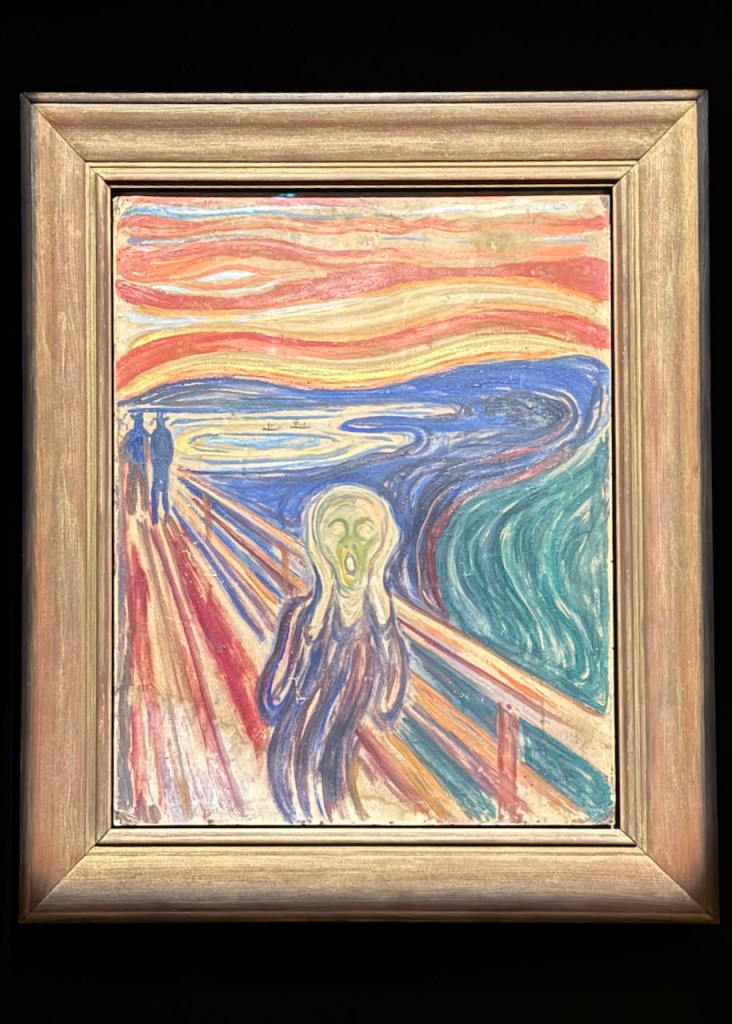
So I grabbed lunch someplace else and than took a long walk through the city to the Munch Museum. Edvard Much, best known for his work, The Scream, had a long and successful career as part of both the Symbolist and Expressionist movements. When he died, he left a huge portion of his artwork to the city of Oslo; the museum contains over half of his entire production of paintings and at least one of each of his prints, amongst other items from him and works by other artists. The Museum itself was built specifically to house the collection; it overlooks the harbor and sits nearby the Oslo Opera House.
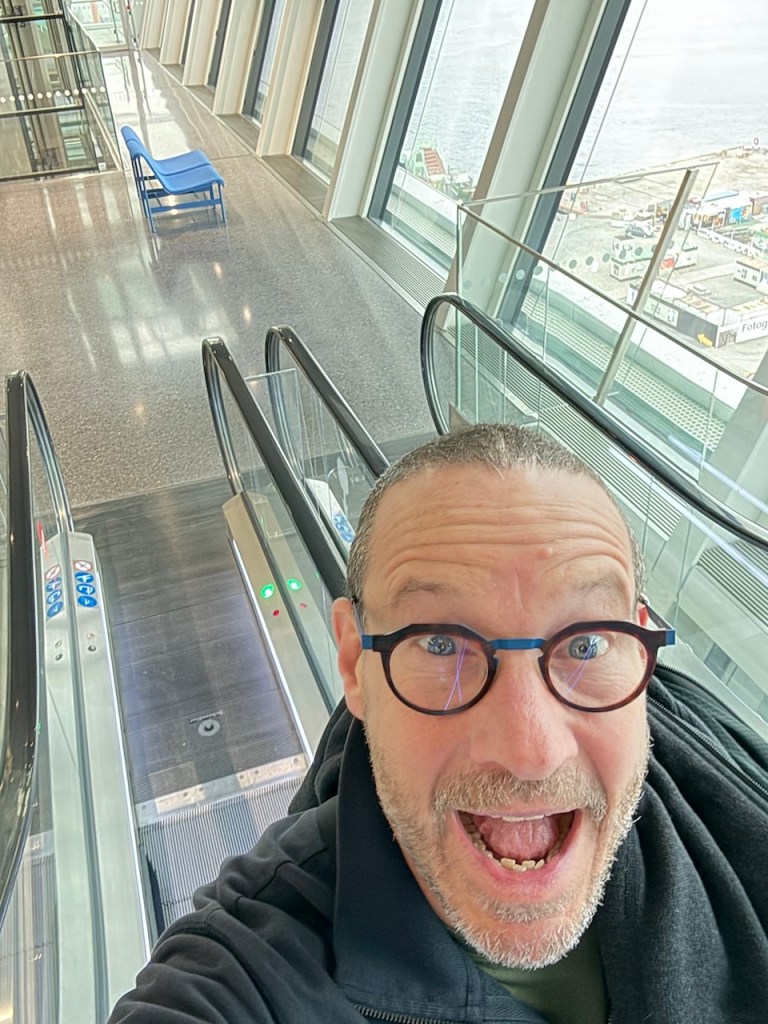
And, of course, the Museum has The Scream. In fact, it has three versions of it – a print, a drawing, and a painting, as Munch tended to produce multiple versions of many of his works. Each version of The Scream that the museum has are on display, but only for thirty minutes at a time each, as a way to preserve them. They have their own gallery, and each version is behind a set of automatic doors that open-and-close as necessary every thirty minutes.
The roof of the Opera House is essentially a huge balcony with soaring views of the city and the harbor. At street level of the Opera House, you can walk by large windows that look into where the costumes and hats and hairpieces are made for the opera.
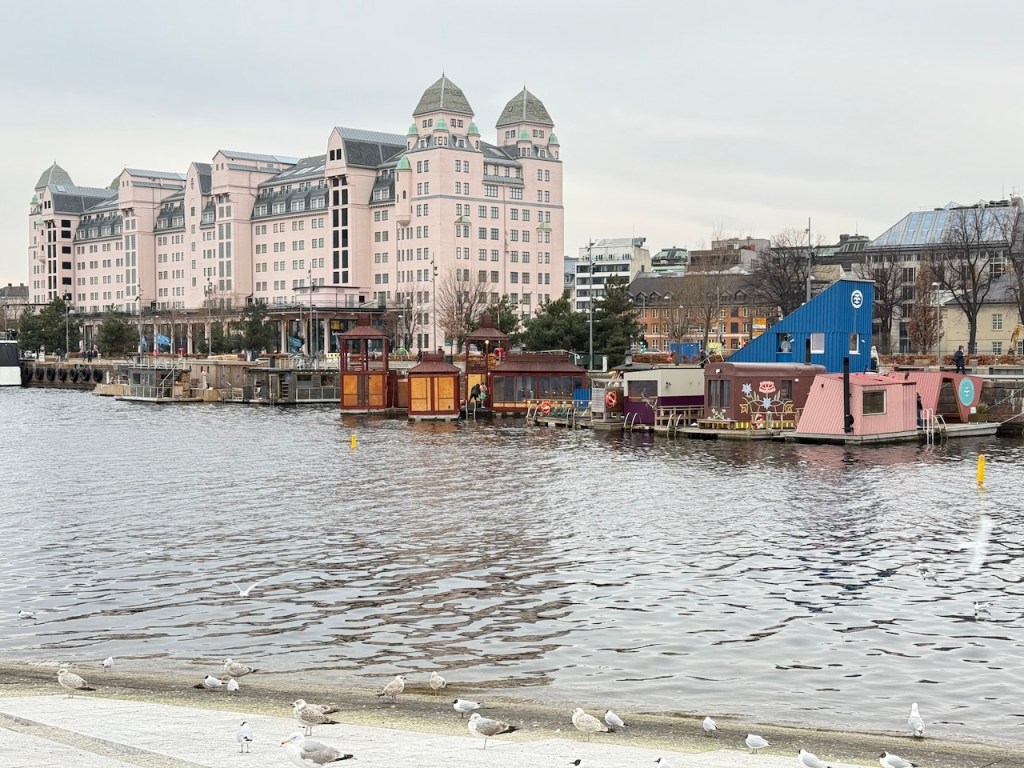
Also along the harbor’s edge, you can spy small floating saunas dock-side, available for rental.
 Fred's Travel Blog